LOVE – THE GREATEST FEELING ON EARTH

Love and Life are two four-lettered words about whom volumes have been written by poets and writers alike. And yet, like writing about Nature, God and Beauty, there is always something more to write.

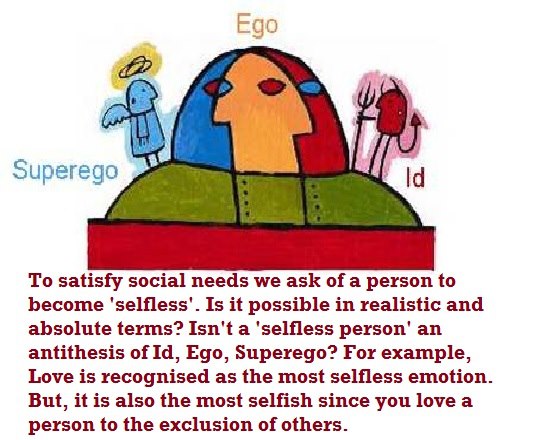
There is a great deal of confusion whether Love is a selfless emotion or the most selfish of the emotions. It is selfless because when you love, in near absolute terms, you come to a point when you are oblivious about yourself, your needs and desires. Amongst the popular lovers of yore, Majnu was so much in love with his Laila that when asked to write God’s name in school, he wrote Laila. He was caned so hard by his teacher (maulvi) that it was feared that his hands would start bleeding. Lo and behold, the hands that started bleeding were those of Laila. Love is so selfless that you can lose your identity in love and assume the identity of your beloved.

Duniya pukarti hai mujhe tere naam se…”

It is also a selfish feeling since you love a person to the exclusion of others and that person is called ‘my love’, ‘my life’ etc. As the holy book of the Sikhs, Sri Guru Granth Sahib brings out, my is roughly tranlated to ‘haume’ and loving someone to the exclusion of others is like claiming something for yourself and hence has an element of selfishness about it.

A mother’s love for her child has both elements in it: the selfishness and selflessness. A few decades back, in an earthquake in USSR a woman was buried with her child under the rubble for three full days and nights. She kept her child alive by feeding it her blood! It is a feeling of supreme selflessness. However, the feeling with her, “The life that I am saving is my child, my creation, my life, my love. If I die it would die. So I have to keep myself too alive”, is indeed a selfish feeling.

Lets put it this way: would you expect Laila to bleed for the entire humanity? No, she bled for her own love. Would you expect the mother in USSR to do such a sacrifice for other children? No, she would do it for her own children.

Selfless or selfish or a mixture of both, Love brings out the best in human beings. Yes, one has to get rid of ‘haume‘, as per the scriptures. However, the highest attainments of Leadership through Love are only possible if there is ‘haume’ (my-ness or ego) involved. Soldiers lay down their lives for the love of their country. Cricketers win matches, snatching victory from the jaws of defeat by having the feeling of my-ness for their team, province, state or country. Getting rid of ‘haume‘ is to be rid of belonging and  attachment. However, if you are rid of it Love dies for everyone except for paramatma (Supreme soul) or God.

Love and Ego

So, don’t think too much whether it is Selfish or Selfless to love. If you are thinking of it, you are aware of ‘Self’! It can’t be the purpose of Life to reach back to God. To love one another may also be the will of God.

I have always challenged the oft-held views. In my ‘An Alternate Philosophy of Life‘, for example, I have challenged our obsession with seeking God for ourselves. I have, on the other hand, suggested that we get out of this obsession and think of the society, the way the Westerns do. In India, most people love God but are not so prone to love one another, cleanliness (despite the renewed stress on Swachchh Bharat (clean India), and values. We would if there was some self-interest or ‘haume’ involved in these.

Here are some of the things that I suggest that we love:

1. Love Life. The greatest gift that God has given us is that of Life. We should love ours and those of others. As Indians, when we drive, pardon my saying so, but, it isn’t apparent whether we love ours’ and those of others. Perhaps we should demonstrate it in more ways than the present one of furiously honking and abusing another person off the road. Each one of has the feeling of self-preservation in some degree or the other. Yes, it is selfish to love one’s own life. However, if you don’t love your own and value it, you cannot be expected to value others’. Last year’s Alejandro Inarritu movie The Revenant (a movie that I didn’t like because of its raw and relentless violence) won him the Best Director’s Award as well as Best Actor award for Leonardo DiCaprio. The movie is all about the quest for survival under extreme harsh conditions for Hugh Glass whilst seeking revenge against John Fitzgerald, a fellow trapper who left him (Hugh Glass played by DiCaprio) as dead after stabbing him. Take the opposite extreme, that of a Jehadi or a Mujahid.  He doesn’t value his own life and those of others in the mistaken belief that by killing himself and others he would, perhaps, serve some purpose of God. Loving Life is the first signs of gratefulness towards God for having created beings, mountains, plains, rivers, seas, etc.

Life Live Love

2. Love Nature. God made the Universe very beautiful indeed. We are part of it and we are beautiful too. However, Nature is more beautiful than all of us individually and collectively. It is our beloved. It is not ashamed to have a bath right in the open and emerge even more beautiful. It doesn’t bore us with the same shape, colour, fragrance and hue all the times. One of the most enchanting things about Nature is that it is forever changing. Just when we feel that we have seen the most alluring part of it, it unashamedly reveals another even more fascinating. Nature reflects the endless attribute of God Himself in case we are used to personifying God.
I thank you O God 2

3. Love Music. It doesn’t matter what kind of music you like or love; be it classical, instrumental, Western, Raaga based, or even punk. However, I would be very suspicious of a person who doesn’t like music and considers all music as jarring noise. Music is the expression of the soul. There must be some expression of your own inner self that finds resonance with some music. My family and I consider life without music to be no life at all.
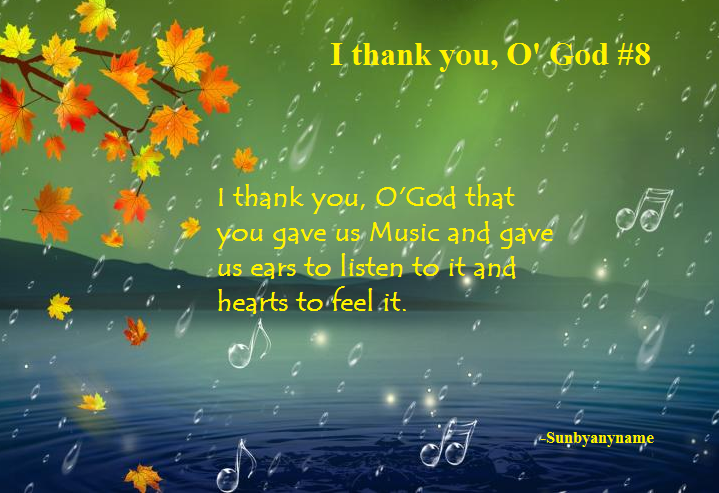
I thank you O God 8

4. Love Children. God gave us innocence at birth and even before it. We had it when we were children. But then, we plunged into worldly knowledge and lost it gradually. That’s the reason that we, with all our knowledge, are farthest from God and little children with their innate innocence are God-like (Please read: ‘How Unbiased Or Innocent Can We Become?’). Therefore, it makes sense to love the child in you as also to love children.
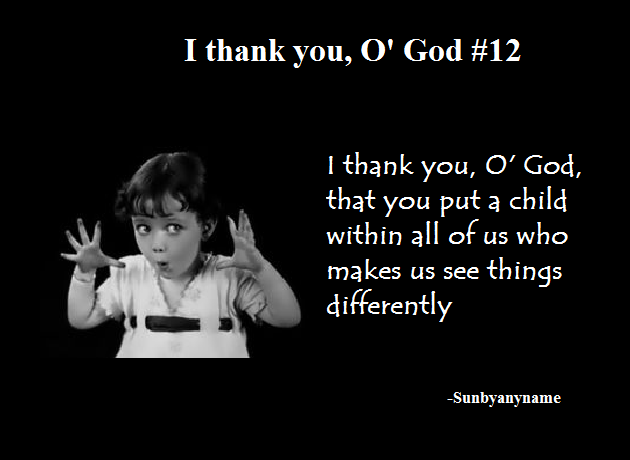
I thank you God 12

5. Love Animals. Many of you must have seen the most successful South African movie ever: the 1980 movie ‘Gods Must Be Crazy’. The movie is about the simple bushmen of Kalahari Desert in Botswana who are happy and content with what God has given them until they are exposed to a Coca Cola bottle (symbolic of the modern world) having been thrown close to them from a plane. And now, the single coca-cola bottle is the source of envy, jealousy, anger, frustration and violence that they had never experienced before. The animal world is like the world of the bushmen as seen in the movie. There is no fear, danger, jealousy, greed and guile. If you can’t be in the wilderness, the next best thing to do is to have a pet and then you suddenly start realising that God made all His beings in His own liking. You can’t help loving them. Indeed, nowadays, scientific and psychological studies have shown that loving a pet relaxes you and enriches your life.
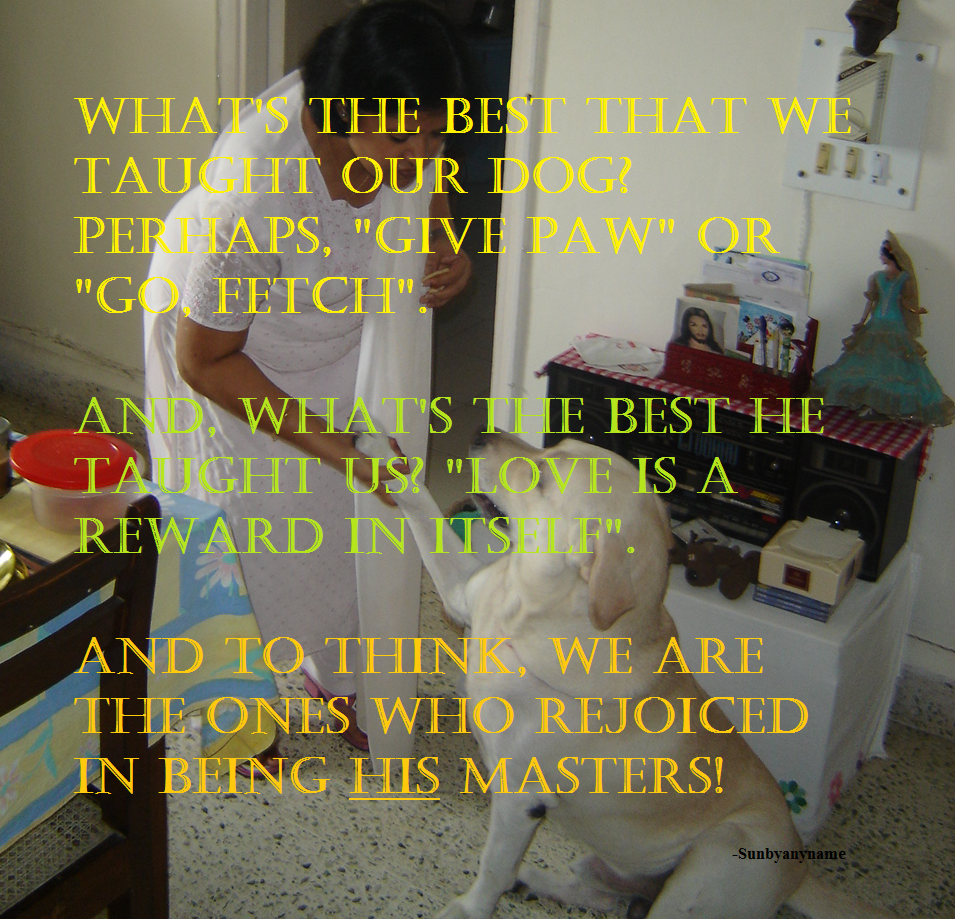
Roger and Us

6. Love Silence and Privacy. We like Sound. Indeed, we like all sensory experiences of hearing, smelling, seeing, touching and tasting. However, there are experiences beyond the senses and these can be found only in silence both outward and inward. You have to make your surroundings and environment around you silent. In modern-day India, for example, we collectively detest silence and are at home with unfettered noise. Considerable part of it is – hold your breath – devotional (Please read: ‘A Quieter Mumbai – Is It A Pipe Dream?’, ‘Noise Is The Newest Form Of Devotion’, ‘Sounds Of Silence’, ‘State Sponsored Noise’, ‘This Patakhawali, This Bombawali Has Nothing In Common With Deepawali’, and ‘Who Are The “People” Whose “Sentiments Need To Be Respected”?’ ) What kind of devotion it must be that uses noise as a medium and doesn’t respect other people’s privacy?
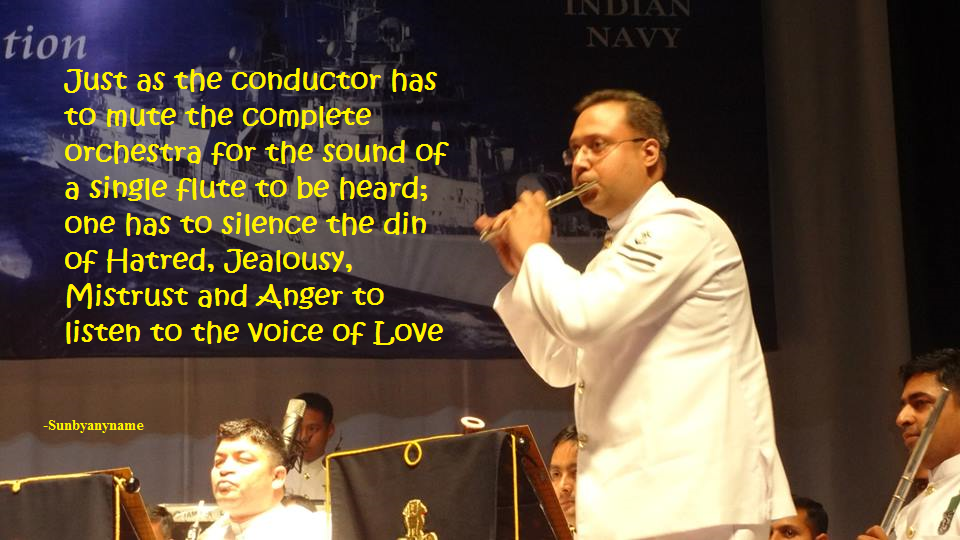
Flute and Orchestra

7. Love the Jawan (Soldier). As long as there is ‘haume’, there is violence. As long as there is violence, someone needs to protect us from being subjugated by violence. That chosen one of God is the Jawan or the Soldier. Whilst others have a profession or vocation, his is a devotion, a sacrifice and way of life. To love a Jawan is to thank him for risking his own life whilst protecting ours. No money, awards, gratitude on earth can ever repay him for what he does 24/7, 365 days in a year.
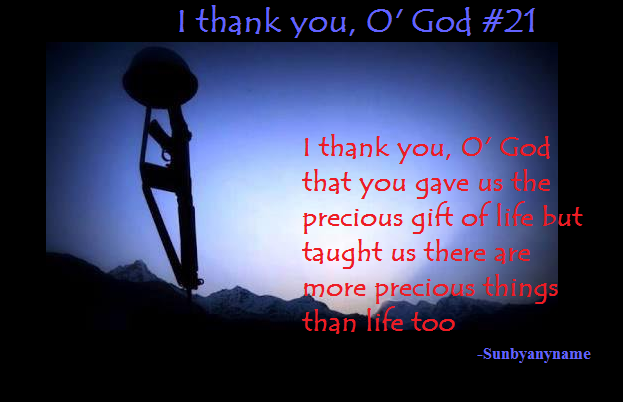
I thank you God 21

8. Love India. We Indians are the most vociferous jingoists in the world. We carry our patriotism on our shirt-sleeves for everyone to see. But, do we really love our country? The answer is a big NO. The person who loves his or her country as his or her own home won’t do any of the following, for example:

  • Dirty it relentlessly and expect someone else to clean up the mess.
  • Indulge in everyday petty corruption and short-cuts knowing that it makes the country weaker.
  • Whiling away time at work knowing that the country’s well-being is dependent upon each one of us working at full efficiency and dedication.
  • Sell the country’s interests both overtly and covertly to the enemies of the country within and without.
  • Have no respect for the law of the land.

There, I have given you my short list of things that we ought to love as our own and cherish that we were given these to love.
I thank you God 27

One of my poems ended like this:

Some live to love,
I love so as to live.

Perhaps you can do it too.
BEST OF ‘MAKE YOUR OWN QUOTES’ – ‘I THANK YOU, O’ GOD’ SERIES

It has been a little more than three  years since I put up in this blog ‘Best Of ‘Make Your Own Quotes’ and fifteen months since I put up here ‘Best Of ‘Make Your Own Quotes’ – Part II’. In these three years or so since the first blog-post and 38 months since I started with the Facebook Page called ‘Make Your Own Quotes’, a lot has happened. One, from a membership of just 30 or so, the Page has a membership of more than 600 now. Two, I started two series: one, about Leadership Lessons and the second about ‘I Thank You, O’ God’. Both are favourite topics with me. I believe that we have to be thankful to God for whatever He/She/It has given us even when we feel that we haven’t got enough. I sincerely feel that gratefulness is the beginning of the journey into happiness,

Why did I start with the page? As I mentioned in the introduction of the first post, “I noticed that on the Facebook and elsewhere, there is a great penchant about putting up Quotes. These range from quotes about Love, Friendship, Politics, Life; indeed about each and every subject. Whilst reading these quotes I was stuck by the realisation that somehow we have this feeling that the sages, saints and wise-people of the past had abundance of sane-advice on all kinds of subjects; but, by a curious quirk of fate, we ourselves and fellow citizens have nothing great to offer in terms of such advice. When I started analysing this, I reached the conclusion that there is nothing simpler than giving sane advice; the answer is really blowing in the wind; it is everywhere. We only have to gather these pearls around us and weave them in a garland”. That’s how I started this Facebook page called ‘Make Your Own Quotes’ with an introduction: “There is nothing simpler than giving sane advice; you don’t have to follow great teachers. Make your own quotes and let others follow you.”

This venture started on the 25th of Feb 2013 and, as I said, I have finished three years of it and it is still going strong. I have received tremendous interest from friends in these Quotes and I am told that around the world these Quotes are being circulated in all kinds of garbs. I have nothing against these since I shall never be making this into a commercial activity.

I like all quotes on Facebook; these provide quick and easy solutions to life’s seemingly complex problems. I believe life is as simple as Facebook; what you get is dependent upon your “settings”.

I started off by giving tips to people on how to make their own quotes, eg,:

Great Quotes Tip #1: Compare Life, Love, Relationships etc to something mundane and infer “great” sounding advice out of it.Here is an (original example): “Friends should be like electricity wires; opposite poles, running parallel and lighting up lives by meeting”. For effect, inscribe this on a totally unrelated picture of, say, a Frog in a Pond. Wanna try your hand at it; go ahead….nothing is simpler! Try comparing Life to Beans!! Go ahead, now that you have joined this site, you will eventually follow your own quotes!!!

Here is therefore the third tranche of Best of ‘Make Your Own Quotes’, but, on a unique topic of finding reasons to thank God.

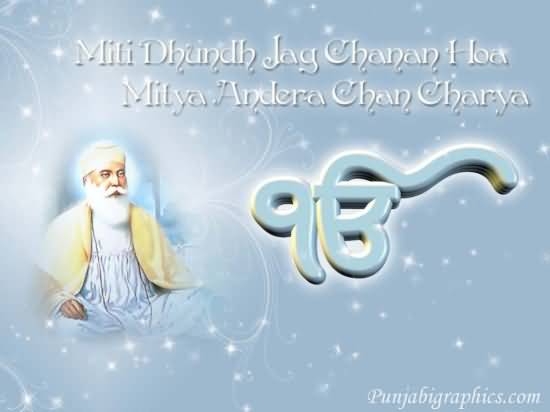
I may not be a traditional believer in God, the one who personifies God and identifies with Him or Her with innumerable idols and pictures. In the ‘Philosophy’ section of my blog there are a number of posts about how the current concepts of God and Religion are causing more harm and even evil than the evil these were conceived to eradicate. Of particular interest to readers would be a blog-post titled: ‘Whose God Is It Anyway?’ that I wrote five and a half years ago. I am into God as a supreme force that should guide us, bind us together, keep us from doing wrong and look after us as children. I am also a believer in the concept of ‘Ik Omkar’, a concept given to us by Sri Guru Nanak Dev ji, and which translated means: ‘God Is One’ and hence there isn’t a separate God for Hindus or Muslims or for that matter Christians or followers of any other religion (Please read: ‘Nanak Shah Fakir – The Movie And Its Message’).

Now that I have explained my concept of God, please go through the following quotes as addressed to that God and not to Ishwar, Allah, Jesus or Buddha.

Lets begin.

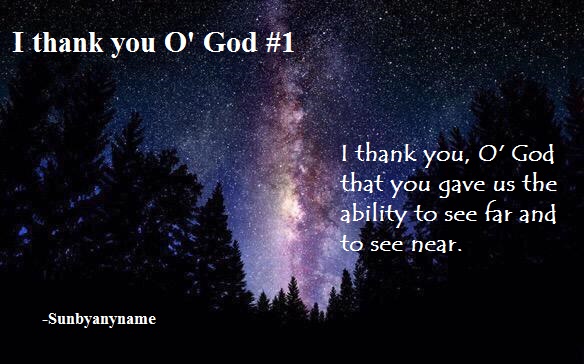
The first one is something that we take for granted: our five senses; particularly the sense of seeing. Here is what a friend Puneet Narula had to write about seeing: “We went to a restaurant in Singapore called “NOX- Dine in the dark”. You are served in pitch dark (No watches and mobile phones allowed) by visually impaired / blind waiters. Amazing experience. You can feel and eat- can’t see a thing. The food tastes better because your entire focus is on taste and not how beautiful it looks. You realize how lucky we are that we can see, hear, feel and smell. Check out http://www.noxdineinthedark.com/”

Far and Near

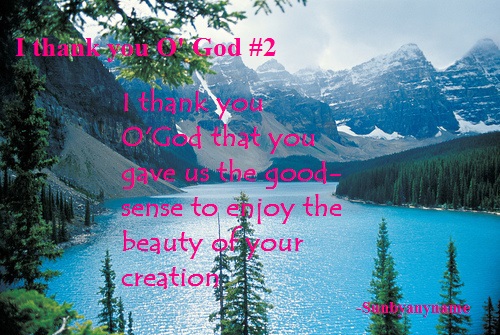
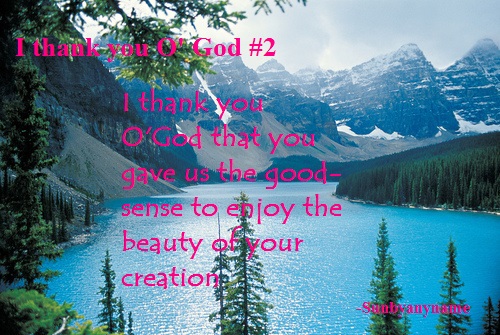
I believe that God has really made this world beautiful. However, all the beauty that God made would have been lost on us if God hadn’t given us the good sense to appreciate this beauty. So here is a quote about it:

I thank you O God 2

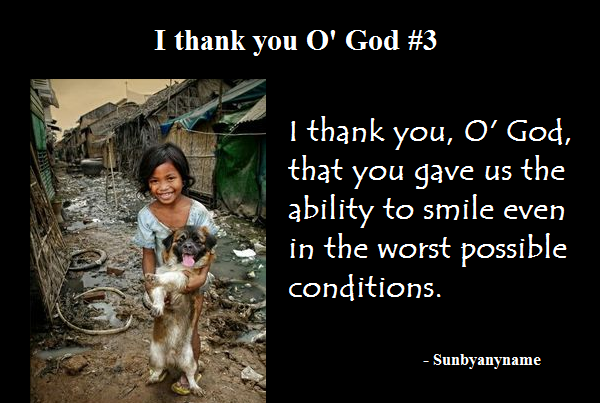
Thank God, we have been given the ability to smile; to make light of our troubles, burdens and situation. If it hadn’t been for this ability, we would have led and lead such hopeless lives:

I thank you O God 3

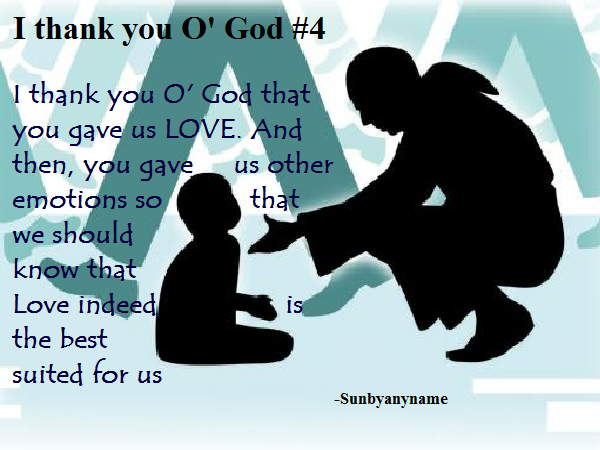
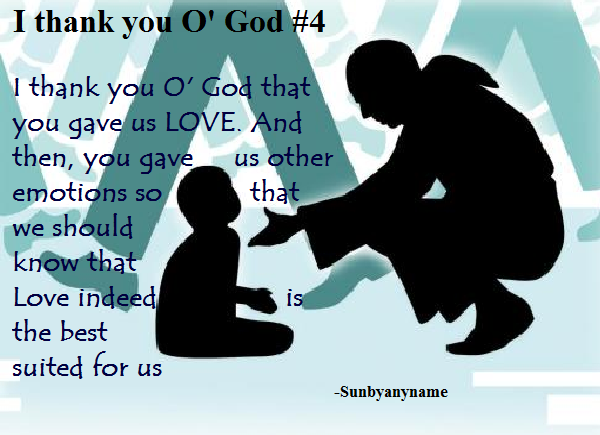
We can never, even if we try our best individually and collectively, to thank God enough for giving us the emotion of Love. God gave us Dark, so that we know the importance of Light. Likewise, God gave us all the other emotions so that we would realise that Love indeed is the best:

I thank you O God 4

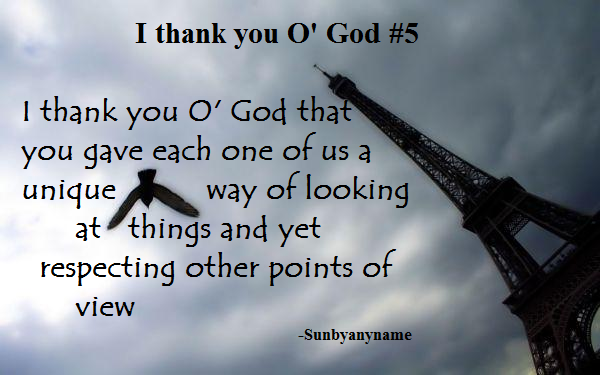
We are often frustrated, especially in arguments, that the other person has a different point of view. But, what if God had given us all the same way of looking at things. It would indeed be such a dull and drab world:

I thank you O God 5

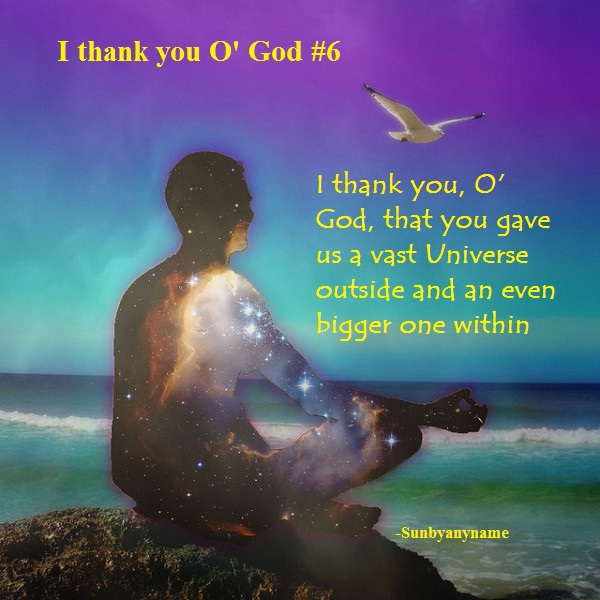
There is no end to God’s Creation. Just at the time when you feel that you have got handle on some part of it, another world opens before your eyes and other senses. It is pointless trying to see the beginning and the end of the universe as if God’s creation is finite. It would be better to adore its infinity and rejoice that there is enough for us for all times to come:

I thank you O God 6

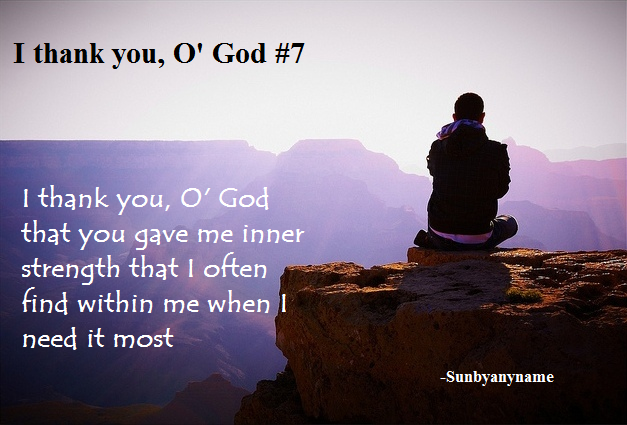
We feel it is intrinsic and innate. However, we refuse to believe that God gave it to us. There is great merit in believing that God gave it to us since, when the chips are down, and darkness engulfs us, we can ask for more. My own experience is that when I have asked for more, God has given it to me:

I thank you O God 7

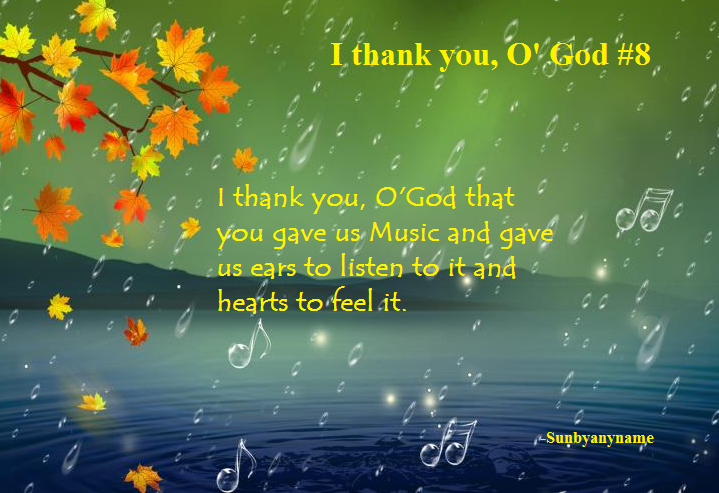
The holy book of the Sikhs have repeated mention of this Music that is beyond ears. Even if we talk only about the aural experience (within the reach of our five known senses), it is still heavenly. Who else, but God would have thought of giving us this wonderful gift:

I thank you O God 8

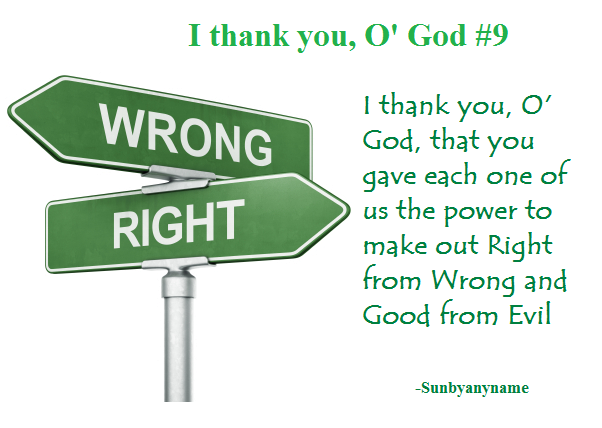
There is considerable debate about what is Right and what is Wrong, about Good and Evil. Since all virtues on earth are relative (Please read ‘Absolute Virtue’), it is quite possible that someone’s Wrong is another man’s Right and vice-versa. However, Reverend Emerson once said, “God, don’t let me prove right with arguments that I know to be wrong.” This quote is about that ability and I sincerely feel that God gave to most of us, if not to all of us:

I thank you O God 9

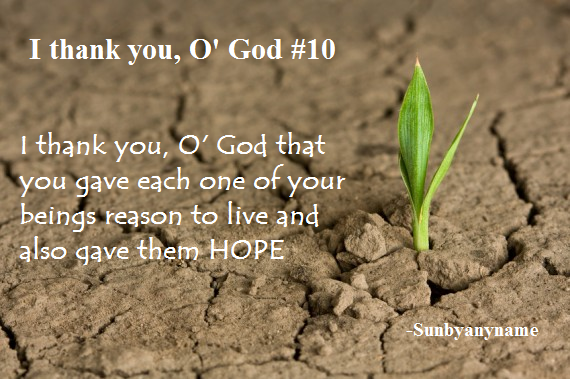
God gave us Life – a four lettered word. He gave us Love – another four lettered word – and most of us love the life that God gave us. For others, God ensured that another four-lettered word was given to them so that even if they won’t love their current life, they would know that the future would be better. God gave us Hope:

I thank you O God 10

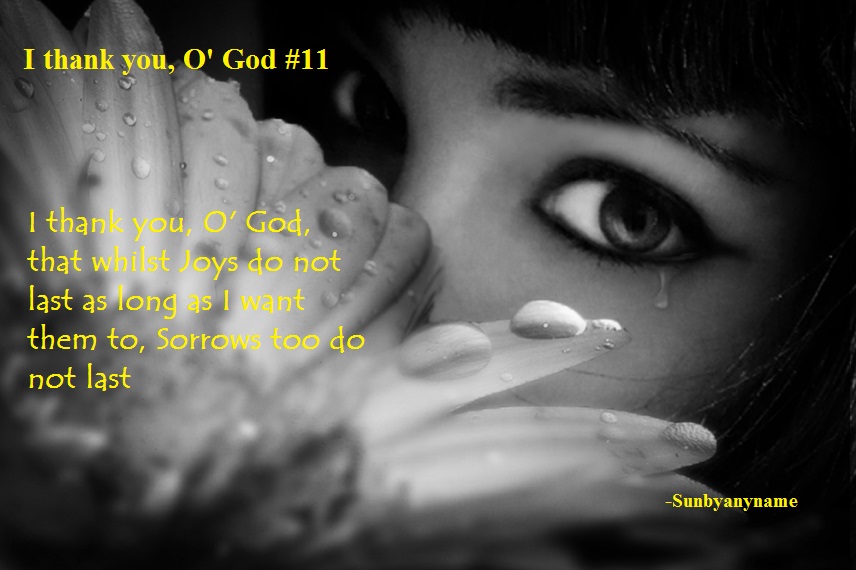
We often bemoan the fact that nothing is permanent in this universe. One form is always evolving into another. In some cases it is so slow that we ain’t conscious of it. However, it surely is changing. Whilst we think of it, many a times, as a bad thing, the fact is that it would have been hopeless if we were to encounter a permanent situation and world:

I thank you O God 11

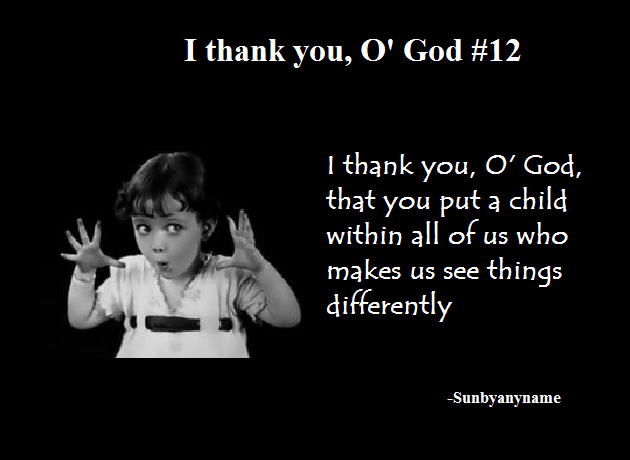
We require worldly knowledge. However, worldly knowledge also confines us and puts limits on our imagination and innovation (I have several posts on this such as ‘How Unbiased Or Innocent Can We Become?’ and ‘Being Non-Sensical May Be Far Sighted’). A child, in this aspect, is better than us. I am fond of giving this example that when a bus tumbles down a hill in an unfortunate accident, often the children and infants are saved. There is, therefore, merit in looking at things afresh as a child; somewhat different from the pejorative expression: ‘Putting one’s foot in one’s mouth’. Have a look:

I thank you God 12

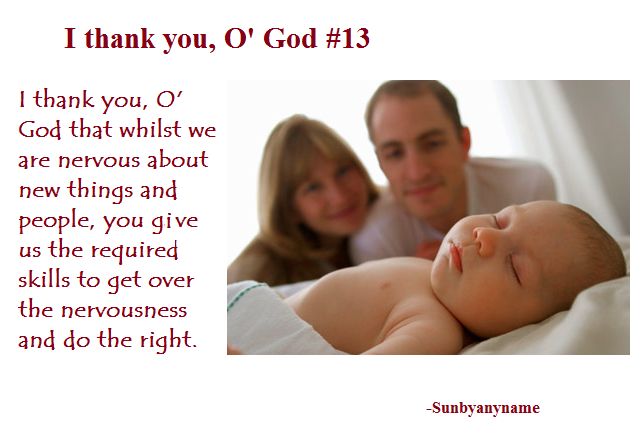
The next one is related to it. We sometime feel that we haven’t been given the requisite skills to live and survive. However, the fact is that God has provided for us to live and survive. Here is from Sri Guru Granth Sahib:

Sail patthar mein jant upaaye,
Taa ka rizk aage kar dharaya,
….Un kavan khilaave, kavan chugaave,
Man mein simran karaya”
(The one who gave birth to creatures in moist rocks,
It provided for their nourishment there too,
…..who makes them feed, who provides for them,
Think about it in your mind)

Here is my quote about it:

I thank you God 13

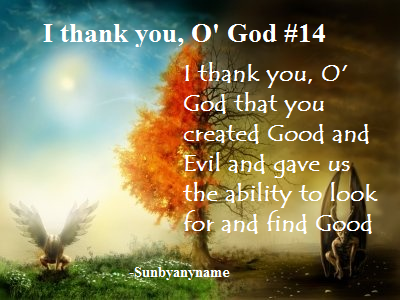
The next one is the simplest of the quotes and should have come much earlier:

I thank you God 14

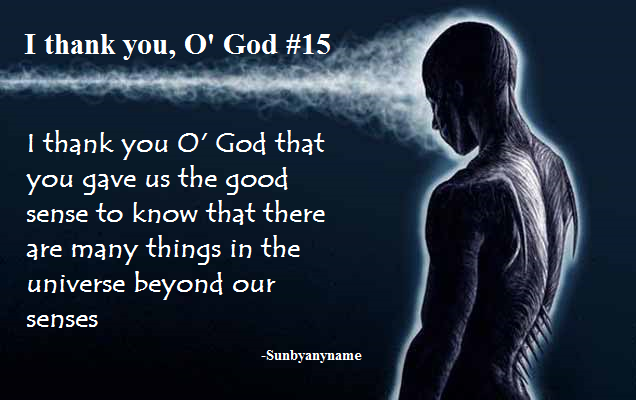
God made no secret of it. God didn’t send us on a wild-goose chase. However, it has made sure that its own abilities (being the Creator) would be far beyond the sum total of all our individual and collective abilities. Here is the quote that was born out of this:

I thank you O God 15

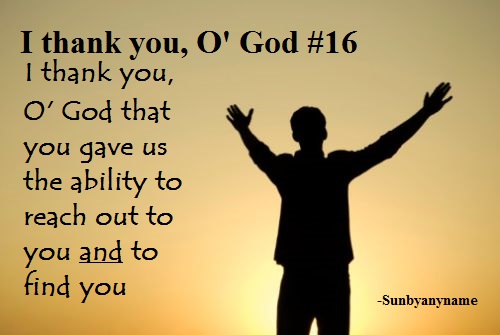
Yes, there is God, if not as a person or a being, but as a Force or Creator. But, of what use these knowledge had been if God had not blessed us with the ability to reach out to it. And since God made everything, it is conceivable that God only gave this ability to us. Hence lets thank God for having given us this ability:

sunset with young man,special toned and color photo f/x, focus point on the man

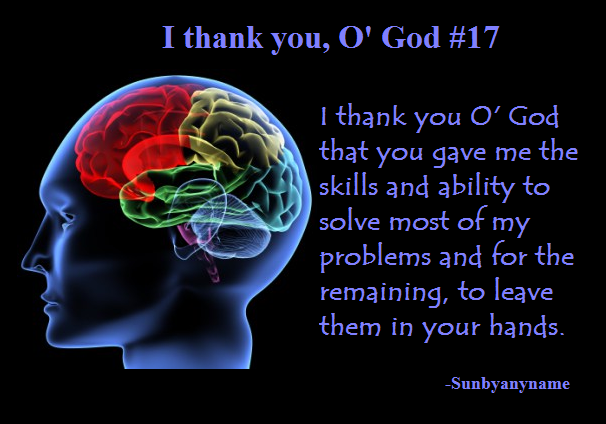
The concept of God as that Force to whom we can pray to solve our problems provides us with tremendous relief. Just imagine that if we hadn’t invented God we would have felt alone and helpless. Here is the quote for that:

I thank you God 17

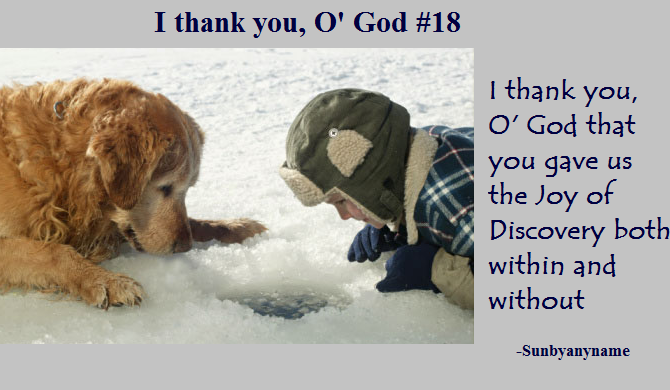
God’s Creation is totally discover-able by us; like they say: Seek and thou shalt find. Here is the quote for thanking God for that:

I thank you God 18

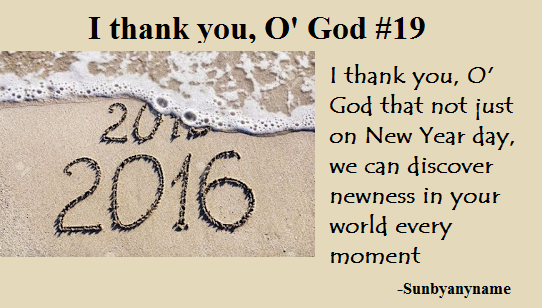
I have discovered – and I am sure each one of you who is reading this would have – that there is newness in God’s Creation everyday, every hour, every moment. It has been medically established that millions of cells in our body are dying everyday and being rejuvenated. Have a look at this, put up by me on the New Year Day of the year 2016:

I thank you God 19

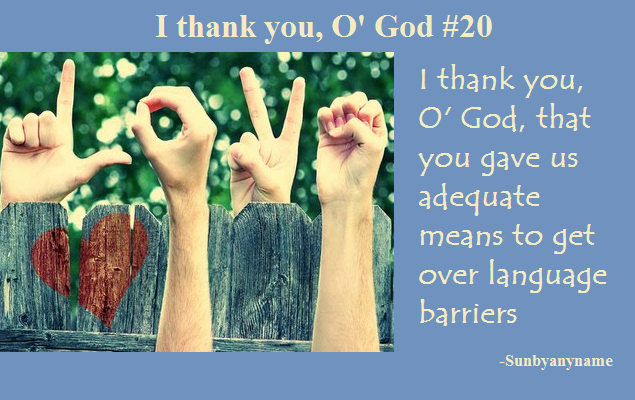
We have thoughts and emotions and ideas and we want to convey to others and listen to theirs. Over centuries, various languages evolved to convey these to others and those who understood these languages had not much difficulty in understanding thoughts, feelings and ideas of others. However, there is a language of humanity that God gave each one of us and it is beyond the languages that we ourselves made. This is a language that is beyond verbal and text means. It is the language beyond all senses too. It is a language between hearts. Here it is:
I thank you God 20

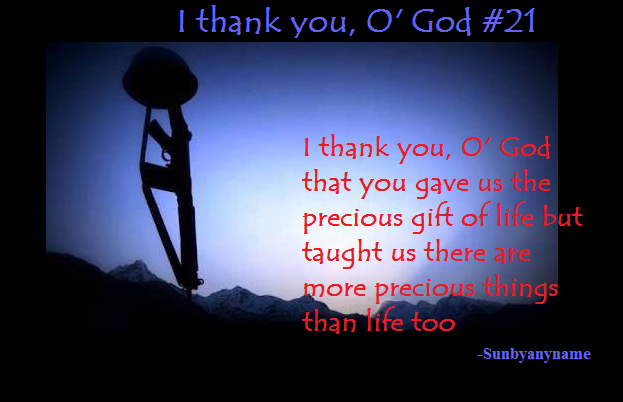
I have maintained that there are more reasons to thank God for than we can think of. We feel that the most precious gift that God has given us is Life. However, each one of us in our lifetime discover that there are many things that God made, for which it is worth giving up life. Taste this:

I thank you God 21

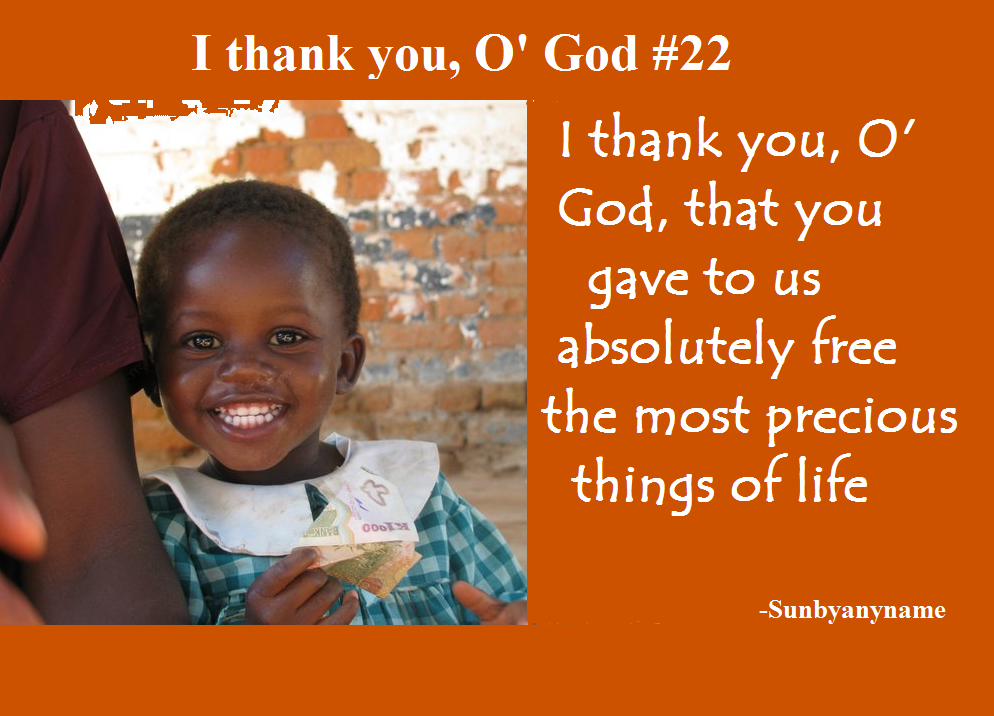
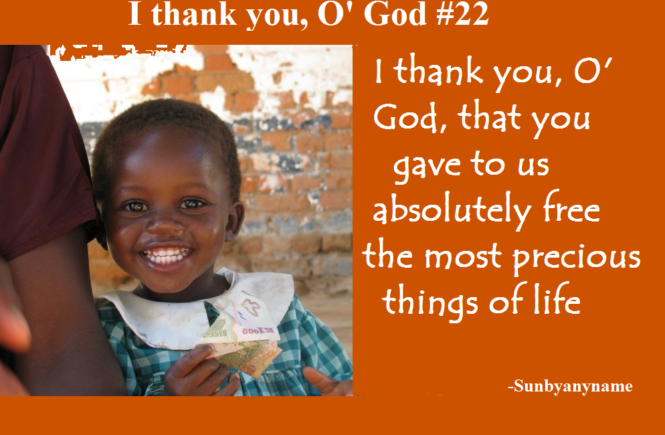
This is something that most of us discover during our lifetime but many of us never think of thanking God for. The fact is that despite our putting a price on many things – the more precious we feel they are, the more is the price – there are quite a few of the most precious things of life that are absolutely free. Have a look at this:

I thank you God 22

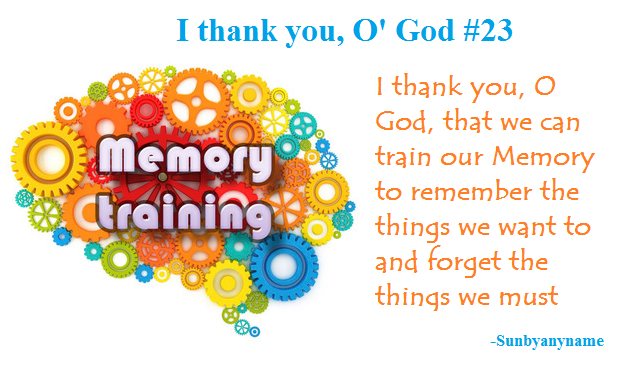
We fall in the habit of cursing our memory and the oft heard crib is: “I don’t seem to remember many a thing”. We reason it out that all that God had to do was to give us elephantine memory so that we would never forget anything. However, think again after seeing the following quote:

I thank you God 23

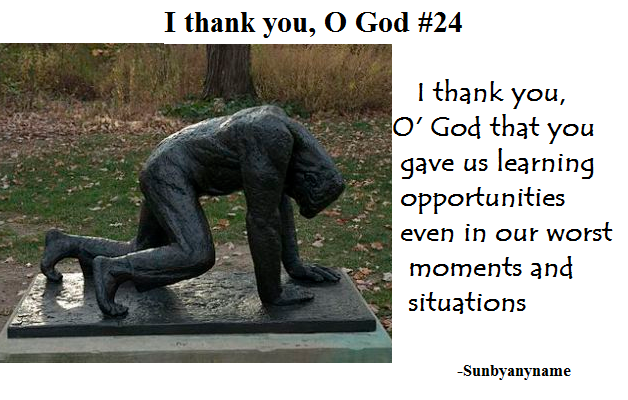
Every once in a while the chips are down for us and we feel that the whole world and even God is lined up against us. I am convinced that God never gives a problem to us without giving us the skills and abilities to solve it. And, it adds to our happiness when we have solved it.

I thank you God 24

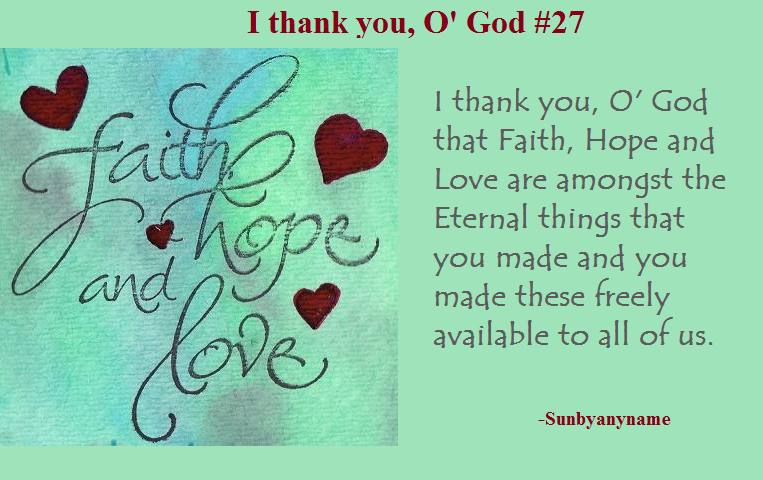
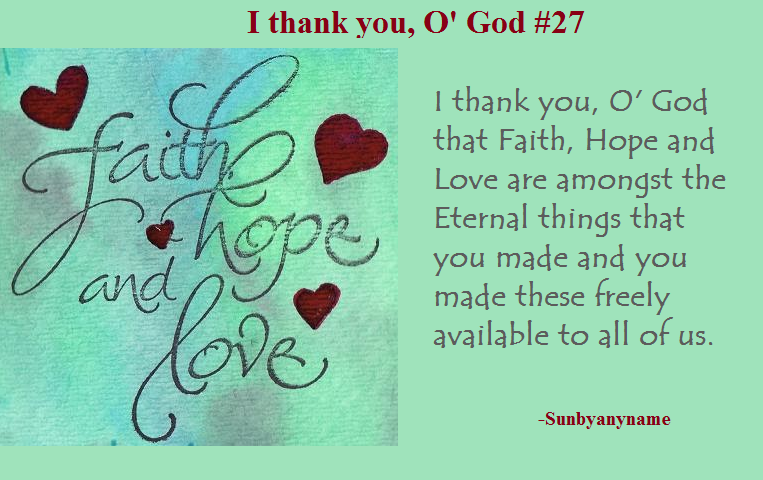
And the last one in this part of the series is about Faith, Hope and Love, the building bricks of the house of our happiness. God is, I am convinced, not like human beings (whatever its shape, size and form be). It isn’t seeking happiness by making us think of it all the while. It is purely in our interest. Hence, if you want to have Faith, Hope and Love without ascribing these to God, there is nothing ungodly about it. That knowledge has also come to you from God that I believe in. I would rather thank it for these since I obtain enormous satisfaction and happiness by thanking it for it:

I thank you God 27

I am sure by now I have convinced you to subscribe to ‘Make Your Own Quotes’. What do you have to pay for the subscription? Nothing; not a cent, pence or paisa. It is totally free. All that you have to do is to like the Page and these Quotes would be delivered to your timeline automatically. You can, on the page, make your own Quotes and share these too with others. Dozens of subscribers have done it already.

FEAR IS THE KEY

I am fond of giving this example in my talks of a frog having fallen into a pit. A rabbit came there and cajoled the frog to come out of the pit by making all out efforts to do so. The frog just sat there at the bottom of the pit helplessly and resignedly. The rabbit motivated him with frequent shouts of “jump”, “yes you can”, “you can’t spend the rest of your life there” and “think of how nice you would feel when you are out of the pit”. But, the frog made no effort to jump and get out since it had already decided that it couldn’t.

Finally, the rabbit asked the frog what help he required to get out. The frog said that perhaps if the rabbit would fetch a ladder, he would climb up the ladder and come out. The rabbit, good Samaritan that he was, went to fetch the ladder and after a few hours managed to get there with his friends carrying the ladder. They noticed that the frog was happily sitting outside the pit. On inquiry the frog replied, “I thought that I could never come out of the pit by jumping. But, after you went to get the ladder, a snake came into the pit and I had no choice but to jump out”.

Fear is the key. It is that all important motivational factor that leaves you with no choice.

I have a senior, a most respected senior, in security industry who feels that deterrence based on fear of being caught and punished is the basic tenet around which security needs to be built. If people get the message that when they do something wrong (petty theft to huge frauds), they would be caught and punished, “97 percent won’t”. The reverse is also true, in that, 97 percent would probably fall into the temptation of doing something wrong if they felt that there were near 100 percent chances of getting away with it.

We used to have a school-time joke of kids attending a Christmas party. Many eatables were laid out on the tables. One of the kids noticed a sign near the cake plate: Take only one slice, God is watching. He went, next, to the chocolate plate and told his friends: “Take as many as you want; God is watching the cake”.

Of course, as societies evolve, respect for law becomes ingrained even when big brother is not watching. In my former service, Indian Navy, when Captain K Pestonji returned from his deputation to West Germany, he told about motorists waiting at the red lights in the middle of the night even when there was no one to see and theirs were the only cars. Similarly, during the 2004 Tsunami, in Japan, a case was reported of a motorist waiting at the red traffic light even when Tsunami was approaching from behind. An Indian, on the other hand would – nine times out of ten – jump the red lights if he knew there wasn’t a cop or a camera guarding those lights.

Two years back, a friend and I visited Vienna, a city ranked amongst the first ten in the world for tourism. Knowing what to expect there, I told my friend that in a day’s time, he should count the number of cops on the roads. By the end of the day, he was not able to spot a single one. And yet, all traffic and people moved with discipline. But, it takes centuries before one can get to that level of self-regulation. I remember having seen pictures of 1971 New York Power Outage and how people, who were not thieves till that time, helped themselves to all kinds of goodies from the malls since all the cameras were switched off due to the outage.

Whenever we talk about Indians rigorously following all traffic rules in Singapore but blithely ignoring them in India, it comes out that the penalties are universally applied in Singapore and cannot be circumvented by paying the cops chai-paani money. In Indian Chalta-Hai manner, the lack of deterrence promotes taking short-cuts and then that becomes the new law.

And it is not that we don’t have it in our culture or religion to use fear as the key. In Hindu religion, the fear of Death and the Punishment that we would get in Hell for our misdeeds often kept us from doing wrong. Indeed, this is the basic tenet, which keeps us on the right and the correct path. Two years back, I had visited this temple in Gujarat and one of the priests was advising a middle-aged man and his wife on the schemes available for charity in the temple. He said that the basic scheme was for Rupees 1100 but added for effect that the scheme worked only for those who hadn’t done any wrong deed. For those who sometimes indulged in wrong, benefit would be gained by donating Rupees 2100. The man was about to take out the sum and offer when the priest added that he should add Rupees 1100 for the welfare and long life of each child. And then, he came up with the clincher: Rupees 5100 would even look after his soul after death. By the time we left the wife was cajoling the man to dish out Rupees 5100 to ensure safety of children and his soul. The priest would have known that fear is, indeed, the key.

Some of the most well circulated posts on Whatsapp are the ones that tell you that good luck would come your way in case you forwarded it to twenty. However, you would rot in the fires of the hell in case you omitted forwarding. And then these give examples of people and what happened to them when inadvertently they didn’t forward the message to twenty. Of course, you don’t believe in this gibberish. But, you reason it out that there is no harm in passing it to your friends. Fear is the key.

Despite our religious practices and what is contained in our scriptures, we Indians are idealistic enough to believe that people and nations would behave nicely with us if we continue to give them homilies about peaceful co-existence and other such virtues. We are fond of giving the example of Porus, the King of Pauravas who fought Alexander the Great in the Battle of the Hydaspes (Jhelum) in 326 BC and was defeated. Having been captured alive, Alexander asked Porus as to how should Alexander treat him (Porus). Porus seemed to have replied, “As one king treats another”. It is said that Alexander was so impressed by his adversary that not only he reinstated him as a satrap of his own kingdom but also granted him dominion over lands to the north extending until the Hyphasis (Beas).

This idealistic and largely non-realistic philosophy – somewhat similar to telling a lion to convert to vegetarianism because of its mutual benefits – has been practised by us as a Grand Strategy. For decades we are trying to convert our neighbour Pakistan to vegetarianism by such promises as good relations, most favoured nation, and peaceful co-existence. And Pakistan terror groups, very routinely, get away with terror killings of our countrymen. We threaten them with – hold your breath – discontinuation of talks. Fear and deterrence are conspicuous by their total absence. Indeed, the only fear that the cross-border terrorists think of is that since killing Indians in terror attacks is such a cake-walk, they (the terrorists) may not get the 72 virgins (houri) in paradise that they would have got if there was some degree of difficulty involved in such jehadi act.

Of course you cannot fight Terror with Terror as was tried out, quite unsuccessfully in Punjab; Gulzar’s 1996 movie Maachis portrayed the ill effects of state-terrorism let loose on innocent people converting them to terrorism. But, fighting Terrorism with Deterrence brought out by Fear of Consequences is another thing altogether.

Fear can be the key if it is supported by Love and not Terror. You cannot, for example, make loyal personnel in a company, by always confronting them with the fear of losing their jobs; some of the companies, for example, revel in their hire-and-fire policies. The employees, of course, pay back such companies in kind. And suddenly, you find, that they are not afraid to lose their jobs but you are afraid to lose them.

Fear is, of course, the key and is a pragmatic security philosophy. However, in the end, I leave you with two thoughts that shall be covered in the follow-up article:

  1. In some regions of Maharashtra, farmers commit suicide unable to pay back crop loans due to failure of monsoons and other factors. What fear of consequences would work against such people; more so, if they were to be wrongly motivated to perform wrong and even terror acts?
  2. What exactly is the difference between Fear and Terror? At what stage the distinction between Deterrence and Terror would appear to blur.

Let me hear your views in the comments below.

On the lighter side, here is an imaginary (I hope) conversation, on the phone,  between a kidnapper and a man whose wife has been kidnapped.

Kidnapper (nastily): We have your wife. We shall not set her free if you don’t give us Five Lakh Rupees.

Man (Matter of fact): And I shall kill you if you set her free!

There is, as you can see, a quick transfer of Fear.


PHILOSOPHIES THAT MAY HELP YOU

At the end of the last year I wrote an article titled: ‘Debatable Philosophies of Life’. I gave you five of them that have become obsolete and don’t make sense anymore.

You may be tempted to ask as to which are the philosophies that would help you. In this article, I have listed some that have helped me.

Philosophy #1 Have a World of Your Own

This follows naturally from the first debatable philosophy: We should be selfless.

It is not possible to be selfless. Hence, make space for yourself where you are by yourself, comfortable, and without having to explain to others the why and how.

Two anecdotes shall make it clearer. One is about our cat Minnie. Out of all the toys that we have for her, she likes an empty cardboard box the first. Every once in a while she goes and sits in her box and imagines that no one can touch her there.

IMG-20160107-WA0053

The second one was related to me by an ex army officer during the recent Pathankot terror attack. He told me about the time when he was in a unit in J&K engaged in anti-terrorist operations. One evening, after they returned from an encounter in which two terrorists were killed, he looked down from his room to the river bank where some children were playing in the sand. He watched them for sometime and noticed they were totally oblivious of terrorists or other distasteful things of life. It won’t have mattered to them where they were: in India or Pakistan; their play was much more important to them. It was a world of their own.

(Pic courtesy: theguardian.com)

Now, I am not suggesting that you become a recluse or isolate yourself from everyone. All I am saying is that you should have a world that you can retreat into when you want.

My world, for example, has music (old Hindi songs) and writing. When I am in this world, for the duration of time that I spend here, the other world ceases to exist even with all its seemingly urgent chores, problems and tribulations.

Try it; it is not escapism. Everyone requires a world of one’s own.

Philosophy #2 Train Yourself Not To Have Regrets

I have proved it in my earlier article about Debatable Philosophies Of Life that the philosophy ‘We shouldn’t live in the past or we should forget the past’ is ludicrous, not pragmatic and is against the progress of civilization through knowledge since all knowledge is essentially past knowledge.

I have also discussed in an article called Absolute Virtue that all virtues in this universe are relative; the only absolute is God. It is the same for evils too. The realisation that neither your virtues and evils nor of any other person or persons on earth are absolute (and can only be better than some and at the same time worse than others) should automatically lead us to the pragmatism of the philosophy that I am suggesting.
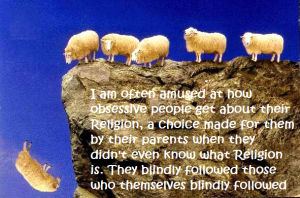
Indeed, it is not just a question of more or less; sometimes, it is difficult to make out the difference between good and bad, virtue and evil. As the English say: one man’s meat is another’s poison.

Hence, whilst remembering your past (that you cannot get rid of), you don’t have to have either regrets or false pride; you can be worse off than some and better off than others.

It should also fill you with relatively guiltless existence or life. If you have consciously done what you were convinced was right and good and it actually resulted in a catastrophe for people you know or do not know, you don’t have to constantly or relentlessly curse yourself.

In one of my essays, I have brought out that when Christ on Cross said, “God, forgive them for they know not what they do”, He certainly didn’t mean it spitefully or superciliously. He was conscious that human beings will never have absolute knowledge of the cause and effect of their actions; it would be Godlike if they did.

One can, therefore, keep one’s conscience clear.

In case you haven’t trained yourself, it won’t come to you simply because I suggest. Gradually you will learn to be free of regrets and guilt-feelings. It is a great liberating feeling.

Philosophy #3 Have Least Expectations From People Close To You

You are a good man or woman and you have a world of your own and have not many regrets. However, it gnaws you a lot to know that people are both unreasonable and ungrateful. No matter what you do for them, they do not appear to have any gratefulness at all towards you.

A close friend of mine in the last one year, to his utter shock and horror, found out that the person whose career he had nurtured with his own hands for the last two decades suddenly chose to tell everyone that he had become what he had become due to his own hard-work, professionalism and vision. Now my friend is not the one who is prone to say ‘Et tu Brute’ to all those who ditched him. He is a great leader and a great realist. But, it proved to me that none of us are beyond expectations. The least that we expect is for the recipient of our goodwill to acknowledge and say, “Thank you”.

However, the realisation that being selfish is hardwired into man for his survival over centuries and that to expect a person to see things from your point of view is totally unrealistic should help us to gradually calibrate or moderate our expectations until we bring them to near zero.

Good leaders, for example, do not motivate people by just telling them what they (the leaders and the organisation) would get out of following the leaders’ schemes or plans; but, they do tell them what they (the people) would gain from them.

Your expectations of people become more realistic and viable if you are able to align them with their expectations.

Philosophy #4 Train Yourself To Be Filled With Hope

It is a four-lettered word like Life, Love and Time. Many a times when it sounds most unrealistic (a myth), start believing in it, build stories around it, relentlessly think of it and you will see it works. The fact is that the whole world is a myth too. You are what you believe you are; you see what you believe you see (Please read: ‘The Virtual World’). There is a saying that if you think of a virtue repeatedly; it would soon become yours. Hence, it is possible to be trained to become Hopeful.
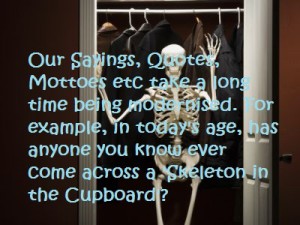
Now, you are bound to argue with me that two of the failed philosophies, viz, All men are born equal, and ‘As you sow, so shall you reap’ actually do not leave much room for Hope. People who are meant to get better of you will get better of you, you will argue. Very true; however, Philosophy #2 above: ‘Train Yourself Not To Have Regrets’ should, if followed correctly, should fill you with Hope. We never have complete knowledge of causes and effects concerning us. How can we have this about others? Hope is simply about the wellness of the outcome concerning you. It is not lessened by their doing well too. The more you dream it is all working out well for you, the more it fills you with Hope.


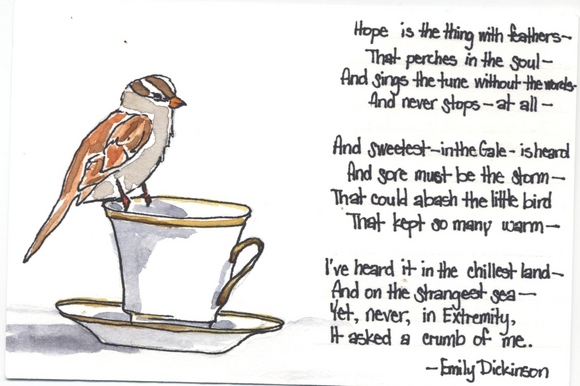
A Bird Called Hope by Emily Dickinson

Philosophy #5 Do Not Chase Friends, Love And Happiness

All these three are a natural fallout of social existence of man. How can Happiness be a fallout of social existence, you may ask. Agree; but, chasing Happiness is. Amongst all the virtues that are relative, the one where we do most comparison is Happiness. Many a times people feel happy and content but are saddened by comparison with those that they think have more.

My close friend whom I have mentioned above in the article is fond of telling about officers feeling happy about being given Excellent grading in their annual performance review. However, such happiness is short-lived when they discover that some others whom they regarded as good-for-nothing have also obtained Excellent grading.

Chasing Happiness is like chasing a rainbow; anytime you feel it is close and you can almost touch it, it appears far away. I have come across many people who would have been happy but the chase after Happiness has left them fatigued and sad. I must have Happiness at all costs even if that makes me miserable they seem to say like the Manna De song in the 1974 movie Aavishkaar: Hansane ki chaah ne itana mujhe rulaaya hai (the longing for laughter made me cry a lot).

Chasing Friends is a hobby that one indulges in similar to collecting stamps and trophies; the more one has, the happier he or she would be. Various philosophies are thrown in such as Life without Friends is meaningless and No one understands you better than your friends.

Yes, indeed, Friends are important in one’s life. However, making Happiness dependent upon having them as friends is not called for. At the back of one’s mind should always be the thought that another person on earth is as unique as you are. No one can really be selfless; it is not in the nature of the man. People would naturally be your friends of their interests and needs coincide with yours. Chasing them won’t get you anywhere. The opposite may actually be the result.

Finally, even though Love is the best emotion on earth, chasing Love is unrealistic. It is a bird that would sit at your window when you don’t go hunting for it.

I read a poignant piece by a middle-aged lady who awaits her children visiting her in the same fashion as she used to visit and spend time with her parents. She bemoaned how the very definition of love between parents and children have changed; the latter don’t appear to have time for the former. Love demands a lot of time thinking about the loved ones and spending with them. This lady should have realised that the nature of people is always selfish; only the degree of selfishness changes with people and time. If this lady had somehow read this article and paid heed to my usable Philosophy #1 about building a world of her own whilst concentrating on building one for the children, it would have never come to this pass. Chasing Love, now, or any time isn’t going to help.

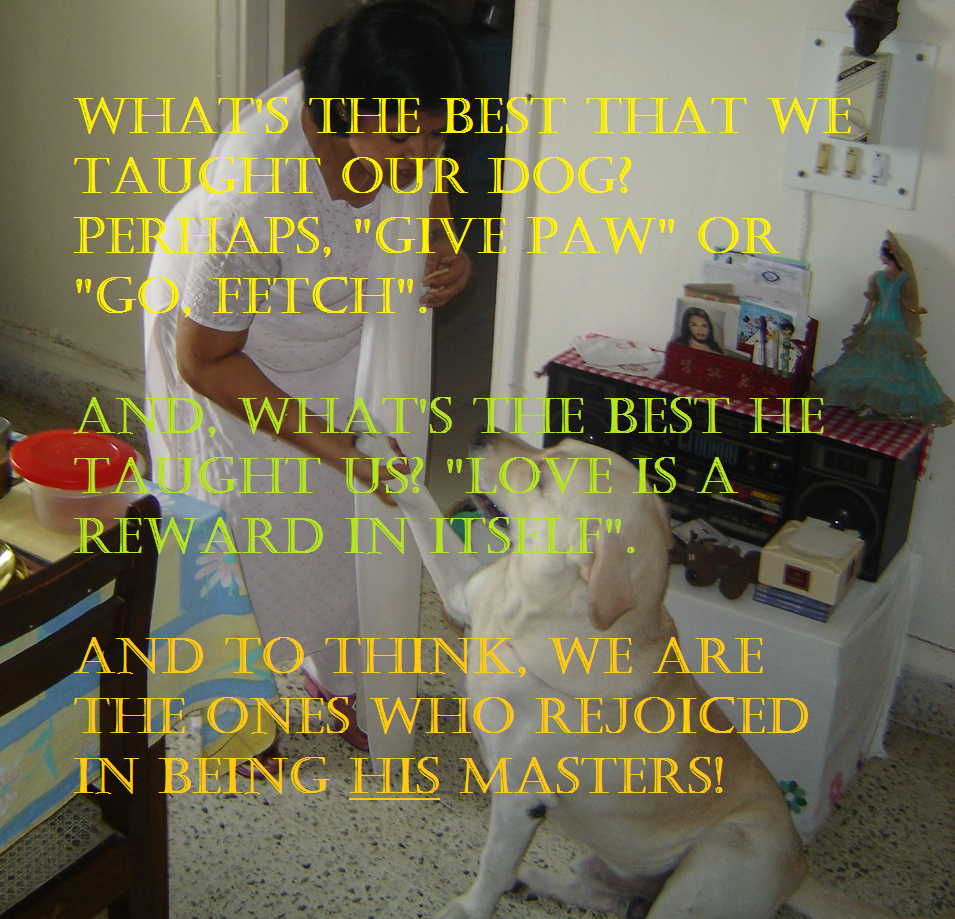
There, I have given you my short list of usable philosophies. When you do a thing over and over again, it becomes a habit. God has intended the world to be like this wherein like the earth rotating on its axis and revolving around the sun, each one of us is required to achieve perfection by repetitions. So, first time in case the practice of these philosophies do not come easily to you, do them again and again and your mind, like a trained dog, would follow your command of Go fetch it.

Best of luck.

DEBATABLE PHILOSOPHIES OF LIFE

One of the biggest truths about God’s Creation is that He/She/It made all virtues and evils Relative. The only Absolute is God Himself. Thanks to Albert Einstein, the Relativity of Time in the Universe is now somewhat well known to us. For others, please read my Absolute Virtue if you entertain any doubts.

What an essay, at the end of the year, you may remark. The fact of the matter is that end-of-the-year itself is not universal or absolute reality. It exists on Earth simply because of rotation of Earth around its axis and its revolution around the Sun. It doesn’t universally exist. It is a convenient method adopted by us to anchor our lives to a dimension called Time, which too is purely our own creation. You may argue with me that Time does exist; after all, we do get older, trains and aircraft are scheduled by hours and minutes (and sometimes seconds), we get our salaries because of it and if there was no Time, our world would collapse. Fair enough; but do remember that our invention of Time is actually an effort, on our part, to give a beginning and end to things, events and people on Earth only and has relevance only to our minuscule part of the Universe, ie, very micro part of God’s endless Creation as a whole.

One of the fundamental laws of the universe that we have discovered (not invented) is the Law of Conservation of Energy. The law of conservation of energy is a law of science that states that energy cannot be created or destroyed, but only changed from one form into another or transferred from one object to another. This law of science is actually a pointer towards the ludicrousness of considering our self-invented dimension of Time so as to define beginning and end to things and people.

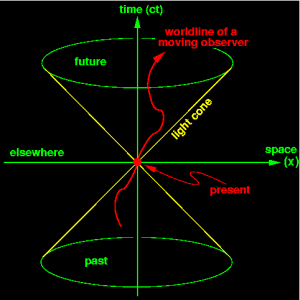
Einstein's Spacetime Cone (All of physical reality is contained within this cone; the region outside ("elsewhere") is inaccessible because one would have to travel faster than light to reach it. (Pic courtesy: einstein.stanford.edu)
Einstein’s Spacetime Cone (All of physical reality is contained within this cone; the region outside (“elsewhere”) is inaccessible because one would have to travel faster than light to reach it. (Pic courtesy: einstein.stanford.edu)

That leaves Events, Ideas, Thoughts, and Emotions. Lets take Events first. All Events actually result in Energy and Mass to be changed from one form to the other and hence it is covered in Law of Conservation of Energy. As far as Ideas, Thoughts and Emotions are concerned, we often claim to be the first person to have come up with a thought or idea; whereas, all these already exist in one form or the other. We only re-discover them. Mercifully, as far as emotions are concerned, we never claim to be the first persons to become angry, happy, fall in love with, hate etc. We have no idea how these evolved and who was the first person to get angry, love-stricken, hated or happy.

From my Facebook Page 'Make Your Own Quotes
From my Facebook Page ‘Make Your Own Quotes

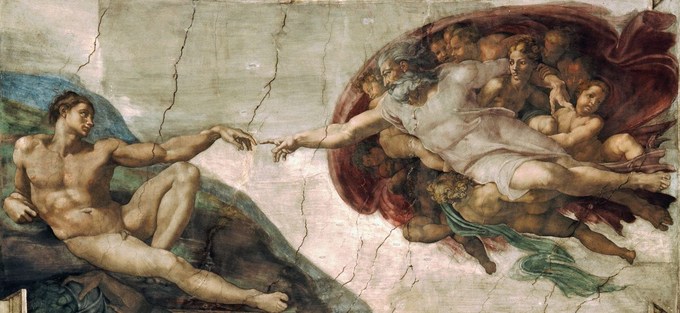
The second last thing to consider before we take up the main discussion is whether there are any universal truths, beliefs or perceptions that have withstood the test of time. There ain’t many; not even the most sacred ones. Consider that Adam and Eve were sent on the earth and they produced a  boy and a girl. For the world to progress, this boy and girl, brother and sister, that is, must have procreated amongst themselves. Likewise, hundreds of beliefs and tenets have changed over centuries. Hence, whilst there are no Absolute Truths in Space, there are none in Time too except one.

The last thing that I want to take up is the distinction between Natural and Artificial that we have made. Natural is defined as existing in or derived from nature; not made or caused by humankind. Artificial is the exact opposite of it; made or produced by human beings rather than occurring naturally, especially as a copy of something natural. On the easier side is the difference between natural flowers with their texture, hues and fragrance and artificial look-alike flowers. On the complex side is the natural way (fire, flood, solar-action, wind-force etc) to convert one form of energy into another and artificial way of doing it say in lighting a bulb. It becomes even more complex when we think of the fact that human beings are part of Nature and there is nothing that they can do that has Free Will (Please read: ‘How Unbiased Or Innocent Can We Become?’). Hence, if Natural is God’s Creation, accepting as something Artificial is like accepting that someone other than God can create. Let alone faith, it is against the science of law of conservation of energy. So much for the distinction between Natural and Artificial. God makes the temperature drop as we move away from the centre of the Earth (increase altitude) and away from the Sun (in earth’s elliptical orbit around the Sun); that is natural. But, we, as human beings made air-conditioning (God had no role to play in it!) and made temperature fall wherever we are even when we are closest to the Sun in the orbit of the Earth. Now, that is Artificial.

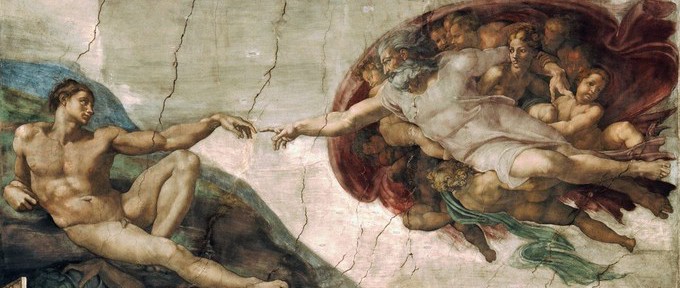
(Michaelangelo's The Procreation)
(Michaelangelo’s The Procreation)

With this background, lets look at some of the debatable philosophies of life; I call all our philosophies as philosophies of convenience to serve specific purposes or objectives. Lets examine if these are anachronisms.

Philosophy #1 We Should Be Selfless

An ideal man, it is said, is the one who is selfless. To start with, if you read ‘How Unbiased Or Innocent We Can Become?’, you would know that to be completely selfless (without ‘haume’ as Guru Granth Sahib calls it) is to find and merge with param atma. Therefore, we can only be partially selfless.

Now, lets examine how being selfless is against the grain of human nature (what a word, you may say, when seen in the light of the discussion on Natural and Artificial.

Every instinct and every reflex action of a human being, over generations and centuries, is honed towards self-preservation and survival. Indeed, Men have come up with Herculean efforts, brave and courageous acts that we have admired in furtherance of their survival instincts.

You take away self from Man and he merges with Param Atma. That means that it is not possible to be absolutely selfless for a man. Would that really be the purpose of Life that God sent us on this earth and we should always be doing everything to merge back with Him? We can only be partially selfless. However, in the bigger definition of selflessness, to do something for the betterment of one’s soul, family, nation and world still has the element of haume’ about it; one does it because it is one’s own. There is still me and mine involved in it. A mother, for example, does everything for her child; it would be somewhat more selfless if she did for other than her own child. It would be somewhat more selfless if she did it without thinking of gains for her own soul.

Philosophy #2 We Should Not Live In The Past or We Should Forget The Past

All our knowledge is in the past. The world is made safer, securer and better place to live in because of past knowledge. And yet, many of those who have the best interests of our society in mind routinely tell us to forget the past.

In our survival instincts, we are hard wired to remember the past and learn from it. We don’t have to, for example, die ourselves to learn the horrors of dying. We have knowledge of people dying and we consciously avoid all those things that can kill us; say, for example, jumping from high-rise buildings.

Think of how dangerous the world would become if all of us we were to forget the past and start discovering everything afresh. Think of how lost we would be if we were to start with a clean slate everyday or every hour. In this case, Ignorance will not be bliss.

There are people and countries such as Taliban in Afghanistan who tried to bury the past. But, these generally have disastrous results.

Another connected advice or philosophy is to live in the present. It is like living in a house made of just one straw. That’s exactly what Present is; a fleeting moment that becomes past like a bubble in a pond. Trying to capture the Present is like holding this bubble in the palm of one’s hand.

Lastly, the Past also enables us to provide an anchor to excel. So, if you are trying to break the world record in high jump, and you have been jumping, say, 6 feet, you are able to make out the gap that you must fill. Other people’s similar feats also enable us to emulate and excel.

Philosophy #3 All Men Are Born Equal

Of all the hogwash that is dished by those who are adept at making feel-good philosophies, this takes the cake.

Millions of years ago when Life started on earth, it is possible that God may have made all men equal. However, over all these years, generational and genetic memory ensured that each became unique and different. It is for this reason that even though the DNA of even twins at birth is the same, it undergoes changes as they grow up and their children do not have the same DNA.

This philosophy of convenience actually fills us with hope that we have the same chances of succeeding as, say, Bill Gates or Narendra Modi.

Every once in a while we have success stories from those who were not born with silver spoons in their mouths but did well through sheer grit and commitment. The fact is that if similar grit and commitment were displayed by the ones born with silver spoons, it would be a totally different story.

Now, I am not suggesting that it should fill each of us with defeatism that we were not born of the same mould as Ambanis or Birlas. All I am saying here is that it is okay to make peace with one’s circumstances dictated by generations of data-memory and move on to do one’s best to achieve the best under the circumstances.

Philosophy #4 As You Sow, So Shall You Reap

There is absolutely no proof of this philosophy except in folklore. It appears to be a plaintive cry for divine justice by the meek and the downtrodden and fills him with hope when he sees that the thugs, ruffians, and cheaters in the world seem to be doing well in comparison to the good guys. The latter imagine the former burning in the fires of the hell and paying for their sins.

In South India there is a respectable chain of restaurants. At the entrance of these restaurants is a picture of the founder with huge sandalwood garland around it. You are filled with great respect for the man whose vision, sagacity and generosity enabled him to set up mass eating joints at affordable prices. Decades later many had forgotten that he had spent time in jail for making counterfeit money and that he was enjoying the fruits of his earlier labour after his jail term.

These days, the rich and the influential don’t even have to go to jail before enjoying the fruits of their deceit and swindles.

In a recent article titled ‘Is Truth Worth Fighting For?’ I had concluded that all that the conscientious and the saintly do get is the hope that, in the end, they would die happily. So the reward for them to have spent their lives in constant toil and misery is the promise of happiness when the body and soul part. Some compensation that.

Most people are nowadays already aware of it and leave the count of those that live wretchedly but are promised happy deaths.

When the evil don’t appear to be getting just punishments, we cover it up by saying that someone somewhere in one of their previous lives has done something good or that they would suffer in their next lives.

The charade goes on.

It is absolutely debatable whether your deeds, good or bad, will repay you in kind.

It is time we found a new philosophy.

Philosophy #5 Religions Started Centuries Back Should Be Preserved Till The End of the World

Lastly, all present major religions in the world are based on the premise that God or Son of God arrived in this world only during a certain period of time in history, started the religion for all times to come and all those who are loyal adherents of these religions are pious and righteous. The rest are as good or bad as pagans. God will one day punish the non-believers.

The followers of all major religions also believe in and practice the philosophy that even violence and war, in the name of God and Religion are just and justified. Hence, Religion and God are worth laying down lives for – one’s own and those of one’s enemies.

Lastly, the followers of all major religions in the world believe that since the founders of the religions were God or descendants, these have been writ in stone and nothing in these should ever change.

From my Facebook Page: Make Your Own Quotes

In my ‘Whose God Is It Anyway?’ I had brought out that when, for example, Mohammad told his followers that men should marry many women, he had in mind the war widows of the 7th century AD in Arabia who were young and required shelters, which could be provided to them if men married them. He won’t have made this as a law for all times to come.

There, I have given you at least five philosophies and beliefs that are debatable and suffer from obsolescence. Let me hear your views, if you so desire, in the comments below.

Beliefs, perceptions and philosophies take a long time changing. Why, even expressions do. We still use the expression, for example, skeletons in the cupboard though the last person to see them must have been a hundred years ago.

From my Facebook Page: Make Your Own Quotes

It is high time we change them in keeping with the modern times. Please remember that when religions were founded they changed the existing beliefs and philosophies of those times. It can’t, therefore, be sacrilegious to do so.

Happy new year 2016 to all my readers and friends.


TIME AND RAINBOW

It suddenly appeared across the hill, across the river and the rocks. Before it appeared in its seven visible vibgyor colours, there was a wedding of giddad-giddadi (he and she jackal); as was the folklore to describe rain and sun appearing together.

It appeared so near and yet so far. As a young boy I ran after it, to catch it in my little soiled hands, to bathe in its vivid hues, even to climb up and look down on the world through its prism. At that time it appeared far; it was near when I didn’t want to own it, when I wasn’t very conscious of its existence; it was far when it crept over my consciousness, when I wanted to hold it and possess it.

I have had the same experience with Time.

Before I lost myself in the rapid whirlpool of later-life Time, it flowed like a gentle stream. Indeed, at times it stood still and placid like a pond, like a lake. I didn’t know how much of it I had but it appeared vast, endless, infinite.

I played lukan-chhipi (hide n seek) with my friends and graduated to marbles, gilli-danda, football and cricket. I was small but Time was big. It was everywhere and totally free. I bought kaafal (a type of berry sold near my school, Vijay High School, Mandi), ice on stick, and an anna a booklet of film-songs lyrics. But, I never had to buy Time.

Perhaps because it was freely available, I didn’t place too much of value on it. As a young boy, I read Herman Wouk’s Caine Mutiny and as was normal for me during those days, finished it in a night’s time. How much I still remember; I am surprised. “Wasted hours” it said somewhere in the book, “Are just as painful in the beginning as in the end; only, in the end, it becomes more apparent”.

And now, looking back in time, that halcyon period of my life, when I had all the Time in the world, passed so quickly. I never tried to catch it but it appeared and disappeared like a rainbow; it was here a moment ago: red, orange, yellow and so on and now it is gone; not even the fading colours beyond violet and below red are there now.

Last to last night I saw the Hindi movie Maya that I wanted to see with its beautiful Salil da numbers based on Western classical music beats: Tasveer teri dil mein, jis din se banaayi hai and Jaa re jaa re udd jaa re panchhi. It turned out to be a trash movie and I rued the two and a half hours’ time that I wasted watching it. Two and half hours; in my boyhood days, I used to spend many times that time just day dreaming, writing worthless poetry or catching butterflies.

It is the same sand, passing through the same small opening in the hour-glass; why does it appear to be draining out much faster now? There appears to be lots to do and very little Time to do it. How do I slow it down? Should I catch it now before it gets still faster and makes me akin to a twig being pushed through the flow against my wish? Did I ever have the power to slow it, to stop it; if not to reverse it? Could I have ever caught the rainbow?

Hour Glass

I don’t even think about how it would have been if I had thought, planned and done things differently. I am not even filled with ‘If Only’ regrets. But, it still gnaws me to think about whether I ever had the power to do things independently in my own way or whether I have been in a puppet in the hands of Time, trying to catch rainbows and doing things what have been writ for me including writing this article?

ज़िन्दगी में
ज़िन्दगी की तलाश में
ज़िन्दगी को पाने के लिए
कहाँ कहाँ नहीं गया?
क्या क्या ना किया?
पल पल, छिन छिन,
ज़िन्दगी मोम की तरह
पिघलती रही
ना जाने क्या थी?
ना जाने क्या है?
चंद लम्हे और मिल जाते
लौ कुछ और देर जलती
फिर क्या होता?
वक़्त का सितम
ठहर जाता क्या?
यादों के मरहले
खड़े होके क्या ना बिखरते?
कौस-ओ-क़ज़ाह
हाथ में आ जाता क्या?
ख्वाब की
ख़याल की
सराब की
असलियत समझ आ जाती क्या?
किस को मिली है आज़ादी
वक़्त की ज़ंजीरों से?
कौन समझा  है?

Sand castle

Zindagi mein
Zindagi ki talaash mein
Zindagi ko paane ke liye
Kahaan kahaan nahin gaya?
Kyaa kyaa na kiyaa?
Pal pal, chhin chhin,
Zindagi mome ki tarah
Pighalti rahi.
Naa jaane kyaa thi?
Naa jaane kyaa hai?
Chand lamhe aur mil jaate
Lau kuchh aur der jalati
Phir kyaa hota?
Waqt ka sitam
Thehar jaata kyaa?
Yaadon ke marhale
Khade hoke kyaa na bikharte?
Qous-o-qazah
Haath mein aa jaata kyaa?
Khwaab ki
Khayaal ki
Saraab ki
Asleeyat samajh aa jaati kyaa?
Kis ko mili hai azaadi
Waqt ki zanjeeron se?
Kaun samajha hai?

POLITICISATION OF RELIGION AND IDOL-WORSHIP IN INDIA


After US President Barrack Obama’s last visit to India in Jan 2015, when he was the chief guest at our Republic day parade, I wrote an article titled ‘Is Communal Disharmony A Challenge To India’s March To Greatness?’ Talking to Delhi University students, he brought out that “No society is immune from the darkest impulses of men,” said Obama. “India will succeed so long as it is not splintered along the lines of religious faith.” I had traced the history of exploitation of religion and religious disharmony in India and had concluded that five diverse reasons existed for latent religious disharmony in India manifesting into large-scale unrest and violence that would undermine India taking its rightful place as an emerging economic and political power.

It has been eight months since I wrote the article. Lets take stock of how far have we reached in the politicisation of religion and secularism. Lets start in the news item of 22 Sep 15, in Hindustan Times:

‘The Rashtriya Swayamsevak Sangh (RSS) believes the concept of being secular was “irrelevant” in the Indian context and the “artificial injection of secularism” was not needed in a social order as hospitable and assimilative as Hindu society.

Sangh publicity chief Manmohan Vaidya said at an event in Chennai that Bharatiya or Indian tradition has from time immemorial regarded all faiths and sects as one.

“Secularism evolved along the themes of separation of the church and state in Europe and since India doesn’t have a history of theocratic states, the concept of secularism is irrelevant in the Indian context,” he said addressing more than 80 columnists from the southern states at an RSS-organised seminar last weekend.

Vaidya’s remarks closely follow RSS chief Mohan Bhagwat’s suggestion to set up a committee to review reservation system. This remark has already evoked sharp political reactions.

“Perversion of the concept of secularism in India has resulted in the terming of nationalists as communal and people with communal thinking being hailed as secular,” Vaidya said in the presence of RSS general secretary Suresh Bhaiyaji Joshi, the second-most powerful man in the outfit which is the BJP’s ideological mentor.’

One would like to believe these proclamations at face value; more so if one belongs to what once was the most benign, inclusive and reasonable religion in the world: Hinduism. However, in the past few decades of Congress rule, and in the more recent BJP rule, the divisive forces are being constantly fanned over what should be non-issues. The result is that over the electronic media, the minorities have openly started saying that they feel uncomfortable and insecure.

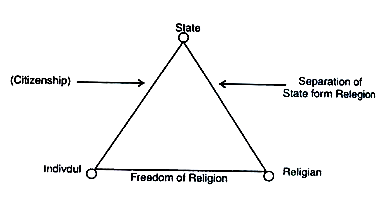
Take a look at the following illustrative diagram:

Secularism explained (Pic courtesy: yourarticlelibrary.com)

Despite the obvious spelling mistakes in the diagram, I found it illustrative of how the state must keep clear of religion and individual choices. Yes, as Manmohan Vaidya said, we don’t have a history of theocratic states. But, the state’s interference  in matters of religion and individual choices has been on the increase. All political parties in India exploit religions as possible vote-banks. That’s precisely the reason why pooja-pandals have smaller pictures of the gods for whose collective worship the pandals have been made but much larger pictures of the political leaders sponsoring the pandals. One would want to hear from Manmohan Vaidya why wouldn’t the political parties in India leave religion to the people? Why would a BJP MLA make open and publicized remarks against the High Court’s curbs on noise during religious festivals by saying that the courts should respect people’s freedom of religious practices? Why does a political leader feel compelled to be a spokesperson for a particular religion if, as Vaidya said, we do not have, like the Europeans, the merging of the church and the state? Talking about the church, a government functionary in south India preaching the teachings of Christ in his official duties is as bad as the state getting involved in what is euphemistically called respecting the religious sentiments of the people (Please also read ‘State Sponsored Noise’ and ‘Who Are The People Whose Sentiments Need To Be Respected?‘)

I have read any number of articles on the net and otherwise extolling the virtues of idol-worship in India. The virtues range from child like innocence and purity of approach when a person stands reverently in front of an idol in total submission to how the idols help us to concentrate and stay focused. All very well and I would have been for it. However, when the same idol-worship, that should have been a private and personal affair becomes politically exploited communal affair, there are great challenges and dangers. Some of these are:

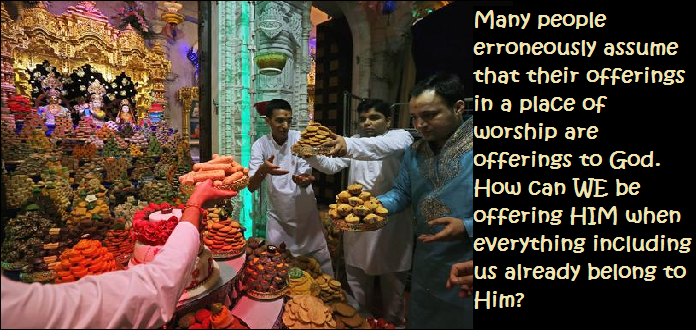
1. Keeping People From Scholarly Pursuits. Hinduism, the religion that I respect most, is all about scholarly pursuits. I wrote in my ‘A Quieter Mumbai – Is It A Pipedream?‘ that the name of the country Bharat is a combination of two Sanskrit words Bha (Knowledge) and Rat (Absorbed in); and that Bharat literally means a country whose people are absorbed in knowledge. People collectively always seek the easy way out and hence most rituals in religion abound in which people can be easily swayed to join. For example, our priests openly exhort us to offer to an idol thinking of the idol as the real God. Scholars are supposed to reason out things; our religion is perhaps the only religion that has encouraged reasoning (Arjuna did it with our Lord Krishna even in the battlefield). So, if you reason out such offerings to the idols, you would conclude, as I did on my page ‘Make Your Own Quotes’:

Offering

When the Chinese pilgrims Fa-Hein and Huien-Tsang visited India in the 5th and 7th centuries AD (during the Gupta dynasty), they were impressed by the scholarly pursuits of our people and Brahmins. Indeed, Baidyanath Saraswati has brought out in ‘Swaraj in Education’ how Kashi (now Varanasi or Benaras) grew into a great seat of learning surpassing other civilisational centres of the world including Rome and Mecca. Except for Bihar, they didn’t find a single place in the entire route of their pilgrimage in India where idol worship was being performed. Whenever, people deviated from the scholarly religious pursuits our religious leaders tried to bring us back such as Swami Vivekananda and Guru Nanak.

Take the latter, Guru Nanak, for example. The incident at Jagannath Puri, just before the annual rath yatra has Guru Nanak being invited for the Aarti at the temple has been recorded in our history.

The Guru visited the temple not to offer Aarti to Lord Krishna but to teach the people that the worship of God is superior to the worship of the deity. It was the evening time and the priests brought a salver full of many lighted lamps, flowers, incense and pearls and then all stood to offer the salver to their enshrined idol-god. The ceremony was called ‘Aarti’, a song of dedication. The high-priest invited the Guru to join in the god’s worship. The Guru did not join their service which enraged the priests. On being asked the reason the Guru explained that a wonderful serenade was being sung by nature before the invisible altar of God. The sun and the moon were the lamps, placed in the salver of the firmament and the fragrance wafted from the Malayan mountains was serving as incense. The Guru, therefore, instead of accepting the invitation of the high-priest to adore the idol, raised his eyes to the heaven and exhorted people to worship God directly rather than through the idol of God.

The sad part is that a small percentage of Hindus chose to become Sikh (learned or taught) and chose the easy way out to form a separate religion rather than to seek religious reforms from within.

2. Environmental and Other Damages. There is a great deal of debate, for example, on the environmental degradation due to visarjan of the huge idols, for example, particularly of our water bodies. In congested cities and towns (and we have only that variety), traffic problems get multiplied during such public idol-worship due to both: the pandals coming up on the roads and the almost everyday processions. Noise that affects us all aurally and adding to hygiene and medical problems is now too large to be ignored. Many of our people are now becoming gradually deaf.

3. Dangerous Trend of Intolerance. Most right-minded and sane minded people feel that such public show of idol worship is as far from religion as we can get and is only with vested commercial and political interests. However, such is the demonstrated intolerance of the mobs that are exploited for these that most of these people have to now cower in fear of violence. Imagine religion leading to violence! However, when mobs do such things that should be individual and personal and private choices, reason is often the victim. Such competitive intolerance amongst communities does no good to people but is the bread and butter of politicians and those who have to gain by dividing people along religious lines.

4. Keeping Us From Our Obligation towards Humanitarian Issues and Causes. Yes, idol-worship does provide focus to us. However, now a stage has reached when we can do without such focus. Recently, we have found out through the audits of the four largest temples in India that the offerings in these temples are enough to feed our country for the next 200 years. And yet, we have the largest number of poor in the world in India. In Human Growth Indices our country ranks a lowly 140 or so. The conclusion to be drawn is that our people would do anything to save their own souls by offering to the idols in the temples rather than giving directly to people in need. That’s utterly selfish use of idol-worship, diametrically opposite of the virtues that are extolled in all the articles that I have read.

5. Not in Keeping with the Times. There are other religions which opposed reforms and tried to become as medieval as possible. A flagrant example of these is Jihad in the name of God. We, on the other hand, were much better off with assimilation of modernity in our thoughts whilst doing away with anti-social traditions such as Sati, Untouchability, and Child-marriage. The open idol-worship (as opposed to personal and private) is taking us backwards to medieval times. As I wrote in my ‘Whose God Is It Anyway?’:

‘God is within us and all around us. We neither have to go to mountains, nor churches, mosques and temples to worship Him or Her. Collective worshipping of God or gods helps no one except to divide communities (who are also the same God’s creations and hence related to us) and only helps the politicians or so called custodians of faith who thrive from such polarization.’

If you read the full article, you will agree with me that the reasons to have collective worship of God or gods no longer exist. Religion and such devotion should increasingly become private and personal, if at all.

The need of the hour is for us individually and collectively engage ourselves in poverty-alleviation programmes, education of the deprived and infrastructure building rather than dissipating time, energy and effort in telling God to save us and our should or our community or our nation.

Goodness is another name for God and is the most relevant in the modern times.


NANAK SHAH FAKIR – THE MOVIE AND ITS MESSAGE

India is a nation of debates, discussions and controversies. Our news channels generate enough in a week to last us a few lifetimes. If you listen to a news hour debate anchored by Arnab Goswami, for example, you would conclude that he, by himself, can account for a major part of global-warming.

Religious controversies, however, are not just an Indian phenomenon; all over the world, religious fervour and fanaticism can result into tempers running high, killings and violence in the name of God and Religion. The more anyone would want to liberate the world from ritualistic adherence to religion, the more anyone would desire a world free from fundamentalist hydra-heads, the more these mushroom everywhere. Historically, when Mankind drifted away from God and Godliness, many right-minded saints, gurus and incarnations of God Himself descended on earth to show the right path to the people. However, it appears that the Devil is perhaps as strong and more wily than God that people easily become the followers of the former and require reminders, again and again, to align themselves with God.

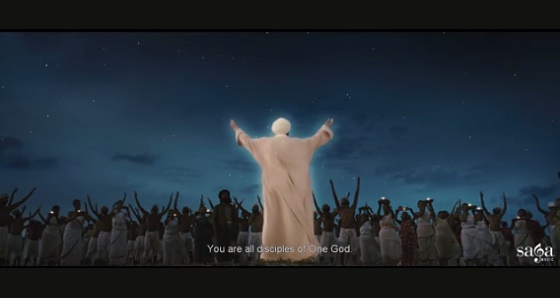
The above were my first reactions on seeing the premiere of Harinder Sikka’s Nanak Shah Fakir on 16th April 2015 in PVR, Juhu, Mumbai; and the ban on the movie in Punjab engineered by SGPC (Shiromani Gurudwara Prabhandak Committee) and a few other organisations ostensibly representing the best interests of Sikhs. Whilst discussing the ills of Kalyug over Satyug, Guru Nanak brought out that there is a great positive in Kakyug; which is that whilst in Satyug you required someone to pray for you, in Kalyug you are one to one with God. Nothing stands between you and God.

(Poster courtesy: www.nanakshahfakir.co.in)

SGPC and other organisations haven’t seen the writing on the wall if they feel that they are intermediaries between us and God. They are as much out of sync as various Hindu organisations including militant ones who tell you what is acceptable to Hindus. They don’t keep you intact because of common culture and love but because of threat of violence in case you don’t listen to them. Incidentally, Guru Nanak and the movie shunned violence but the modern protectors of our religion think nothing of keeping their flock together through threat of violence.

And, as I write this, Harinder Sikka after receiving directions from Akal Takht Jathedar Giani Gurbachan Singh has decided to withdraw the movie for the time being even though he had earlier decided to go ahead with the release of the movie on 17th April with the above poster despite opposition from SGPC, DSGMC and Akal Takht mainly because portrayal of Sikh Gurus on the celluloid is not permitted. The movie has also been banned in UK bowing to the sentiments of the Sikh community.

I feel that Harinder Sikka and his team (Cast of Arif Zakaria (playing Mardana), Puneet Sikka (Harry’s daughter playing Guru Nanak’s elder sister Nanaki, Shraddha Kaul, Anurag Arora, Adil Hussain (playing landlord Rai Bular), Narendra Jha and Tom Alter; Music of Uttam Singh; Sound of Rosul Pookutty; and Cinematographer AK Bir) deserve to be congratulated for an outstanding movie on several counts.

Firstly, the idea behind the movie and its focus. I am convinced that Harry Sikka must have been chosen by God to take up such a project. Sri Guru Granth Sahib has a mention of such blessings showered by God on the chosen ones. The focus throughout the movie is on Guru Nanak and his teachings. There is no other side story; there is no attempt at direct teaching by the chronicler of the movie Mardana, for example or by the movie makers.

One of the examples of stunningly beautiful cinematography of the movie (Pic courtesy ibnlive.in.com)

Secondly, I like the anecdotes that have been selected from the life of Guru Nanak. These have been selected with an eye on their current relevance. Once again, rather than forcefully and imposingly preaching, these have been as gently brought out as we imagine Guru Nanak to be. There are, for example:

Guru Nanak as a young boy refusing to wear the holy thread Janeyu that every Hindu male is required to wear by religion. This was Guru Nanak’s first opposition to ritualistic adherence to religion rather than binding oneself with God.

Nanak selecting a friend and consort who was always booed as Marjana (Cursed to die) and calling him Mardana. Mardana, the rebab player, a Muslim, accompanies Guru Nanak wherever he goes and gives musical accompaniment to his raagas.

Nanak being sent by his father Mehta Kalu (Full name Kalyan Chand Das Bedi) with 20 rupees “to do business”. Nanak buys food with the money and distributes amongst saints and poor. When questioned by his father, he responds that he has done Sachcha Sauda or “True Business”. It would be sometime before his father would understand. The movie indeed brings out how Rai Bular, the local landlord and Nanak’s elder sister Bebe Nanaki were the first to have recognise divine qualities in him even when he was a boy.

Nanak selling baajra at Sultanpur Mandi and whilst emptying the bowls in buyers’ bags, getting stuck at the count of terah (13), since terah also means ‘yours’ (in this case God’s). A complaint is made against him to Daulat Khan Lodhi, employer of Nanaki’s husband, through whom the job was given to Nanak. But, when the gunny-bags of grains are counted, there is no discrepancy!

Nanak’s wedding with Sulakhani and the mature understanding relationship that he had with her. At the end of the movie, Guru Nanak, back from an Udaasi (travel) to spread the word of God, is seen leaning on the shoulders of their two sons, Sri Chand and Lakshmi Chand and telling them the simple essence of his teachings:

Vand Chhako: Share with others in need.
Kirat karo: Earn or make a living honestly without fraud or exploitation.
Naam Japna: Meditate on God’s name.

Nanak was thirty years old, in the year 1499 when he went to meditate and bathe beside the river Kali Bein (Black River), accompanied by Mardana. Mardana later discovered Nanak’s clothes on the bank but Nanak was missing. A search was mounted for him including divers sent by Daulat Khan but there was no success. Everyone, except Babe Nanaki, assumed that he had drowned. Three days later, Nanak emerged from the river alive. He had achieved Enlightenment and the locals started calling him Guru. The very first words that he uttered after his Enlightenment were: “Na koi Hindu; na koi Mussalman” (There is no Hindu; there is no Muslim). This led to his prime teaching: Ek Omkar, there is One God.

Soon after his Enlightenment, Guru Nanak, accompanied by Mardana, went on his first Udasi (travel) to Bengal, Assam and Manipur (Between the year 1500 to 1524, Guru Nanak undertook five Udaasis, covering a distance of more than 28000 kms, in all four directions, as far as Tibet, Ceylon, Kashmir, Baghdad, Mecca and Medina.

The movie brings out some remarkable anecdotes during the Udaasis. The incident of his having accepted the invitation of a low-caste artisan, Bhai Lallo and rejected that of the rich landlord Malik Bhago was well covered. When Malik Bhago was enraged, Guru Nanak asked for the two meals: one from Lallo’s house and one from Bhago’s. He produced milk from the former and blood from the latter. Thus, in his simple but clear way of teaching, he brought home the difference between honest work and exploitation in order to obtain riches.

The second anecdote very well covered was at Hasan Abdal, near Rawalpindi. Guru Nanak, Bhai Mardana and a congregation gathered at the foot if the hill, atop which a Muslim priest Bawa Wali Qandhari had established his dera next to the only source of water there. Since Guru Nanak’s congregation was thirsty, Guru Nanak sent Bhai Mardana to request Wali Qandhari to release water for them. The latter angrily turned down the plea. Mardana was asked by Guru Nanak to go up again and request for water. Reluctantly he did and Wali Qandhari derisively asked Mardana to tell Guru Nanak to directly appeal to his God for water. Guru Nanak then lifted a stone over sand, dug with his hands and produced water. Meanwhile Wali Qandhari’s pond began to dry. Enraged he launched a huge rock down the hill in order to crush Guru Nanak and his followers. When the hurling rock came charging towards Guru Nanak, he merely touched it with his hand and the rock stopped. Wali Qandhari witnessed this and suddenly realised that Guru Nanak was a messenger of God and he then fell at Guru’s feet. We all know that the spot of this miracle is marked by Gurudwara Panja Sahib.

My favourite incident of Guru Nanak’s Udaasis, accompanied by my favourite hymn, has been depicted so well in the movie that it left me stunned. The incident at Jagannath Puri, just before the annual rath yatra has Guru Nanak being invited for the Aarti at the temple.

The Guru visited the temple not to offer Aarti to Lord Krishna but to teach the people that the worship of God is superior to the worship of the deity. It was the evening time and the priests brought a salver full of many lighted lamps, flowers, incense and pearls and then all stood to offer the salver to their enshrined idol-god. The ceremony was called ‘Aarti’, a song of dedication. The high-priest invited the Guru to join in the god’s worship. The Guru did not join their service which enraged the priests. On being asked the reason the Guru explained that a wonderful serenade was being sung by nature before the invisible altar of God. The sun and the moon were the lamps, placed in the salver of the firmament and the fragrance wafted from the Malayan mountains was serving as incense. The Guru, therefore, instead of accepting the invitation of the high-priest to adore the idol, raised his eyes to the heaven and uttered the following Shabad as Aarti (Punjabi: Kaisi aarti hoy…)

“The sun and moon, O Lord, are thy lamps; the firmament
Thy salver; the orbs of the stars, the pearls enchased in it.
The perfume of the sandal is Thine incense; the wind is
Thy fan; all the forests are Thy flowers, O Lord of light.
What worship is this, O Waheguru (God)?

This hymn and the scene in the movie at the sea-shore are a powerful message against ritualistic observance of religion, meaningless and fruitless practices and institutions. Instead, one should directly be with God as a supplicant.

My favourite scene of the movie (Pic courtesy: www.sikhsiyasat.net)

If I have to sum up the movie in one word, I would call it outstanding. And yet, the movie has controversies about it. The media talks about “objectionable scenes in the movie” but no one has specifically brought out as to what is objectionable. So, we are left to wonder whether the so-called guardians of religion have their egos hurt that such a fine movie has been made not because of them, but, in spite of them. Guru Nanak cautioned us all against giving in to haume (I am); five centuries later, is it that the guardians of religion themselves are ruled by haume?

Secondly, doesn’t Guru Nanak belong to all of us surpassing the boundaries of religion? In which case, does our personal observance of his teachings have to be coloured by some intermediaries?

Whilst on this issue, and it is a very touchy issue, the very first utterance of Guru Nanak, after Enlightenment is that there is no Hindu and there is no Mussalman. Five centuries later, we are propagating that even Hindus and Sikhs are different! If that is indeed the case then who exactly is going to reform the religious practices of Hindus and Muslims that Guru Nanak had set out to do? Why is it that idol worshipping is as prevalent today as it was many centuries back? Why are even elections in our so-called democratic society fought on basis of castes that Guru Nanak sought to eradicate? I have visited many gurdwaras and the ritualistic practice of sukh-aasan of the Sri Guru Granth Sahib (Resting of SGGS for the night) would compete with the ritualistic aarti of Jagannath Puri that Guru Nanak was opposed to. If Guru Nanak was to be born again, he would surely tell that when his tenth successor Gobind Singh ordained, “Guru Granth ko maaniyo, pargat Guran ki deh” (“Consider the Granth as your Guru now onwards; wherever the Granth is present, the Guru is bodily present”), he meant the observance of the teachings contained in SGGS and not ritualistically following it as the flesh and body of the Gurus. Guru Nanak wrote about one fifth of the Shlokas in the SGGS and many of these bring out how to be a true Muslim or Hindu sans the rituals. Even in the movie, when Daulat Khan asks him to do the Namaaz with them, he joins. But, when he is told that although he sat with them, he hardly said the Namaaz; Guru Nanak brought out that even they didn’t do so since whilst their lips moved, their minds were elsewhere! Why do we forget all his teachings and observe religion in rituals only?

The other day someone asked me as to why the Sikhs (the word Sikh, to me, has much greater meaning than the narrow confines of religion that were, in any case, opposed by Guru Nanak himself. The word means “the taught” or learned or one who has gained consciousness through his true intellectual growth) have prospered and survived many centuries after the Gurus? My instant response was that the Sikh gurus lived with their people through adversity and kept the flock together through personal sacrifices and examples. A Sikh, therefore, finds his way out of any adversity, trials and tribulations. His faith in oneness of God makes him so brave that he can battle against totally hopeless situations and emerge a winner (the Battle of Saragarhi, for example, on 12 Sep 1897, had 21 Sikhs of 4th Battalion of Sikh Regiment under the British fighting against 10000 Afghans; read ‘Battle of Saragarhi‘ on Wikipedia recorded by the UN as the bravest battle in the world ). Who were the leaders after our Gurus who were fired by the same spirit of sacrifice and selflessness? The factionalism both in our religion and politics, in the current world, is to be seen to be believed. Most of it is based on haume.

One of the arguments against the movie, surprisingly, is that “sentiments of the Sikhs have been hurt”. I have brought out in a series of articles (For example, read: ‘Who Are The “People” Whose “Sentiments Need To Be Respected”‘ and ‘Whose God Is It Anyway?’) that people or mobs do not always have the best sense. If they did in history, for example, we didn’t require the likes of Guru Nanak to bring them to the right path. Lets not follow the edict blindly that Sikh Gurus cannot be depicted on-screen. First of all, as the makers have clarified no human being is represented as the Guru; he being depicted only through a computer graphic. Secondly, if hundreds and thousands of pictures and write-ups are available on the net, in the books, movies, and on the television, why only in the movie that these are not permitted? And, most importantly, the movie makers have taken no license to distort history; the events have been, to the best of my knowledge, brought out as historically recorded.

Guru Nanak was one voice against the social ills of his times. He was eminently successful but now we are back to square one. Now is the time when a movie such as Nanak Shah Fakir should be most welcome and seen by all classes and conditions of men and women everywhere. The region of Punjab that Guru Nanak was born in and lived in has the menace of drug-addiction amongst the youth. His teachings would be most relevant to such misguided elements. Religious fundamentalism has shown its ugly ahead in the world again and there is violence and killings in various parts of the world; just as it was Babar’s forces that unleashed unheard of violence in India that was depicted at the end of the movie. We need the teachings of Guru Nanak all over again. Greater part of India is once again in the grip of idol worshipping, corruption, intolerance and the like. We need a messenger of God like Guru Nanak to do away with the dhund (mist) of ignorance and bless the people with chaanan (Light).

mitti-dhund-jagg-chanan-hoya

So, rather than banning, opposing or protesting against Harry Sikka’s movie, we should ensure that as many people as possible should see it and profit from Guru Nanak’s messages of one God and oneness with God, no haume, no religious and caste divides, Vand Chhako, Kirat Karo and Naam Japna. As the makers of the movie have proclaimed, all proceeds from the sale of tickets would be used to further the teachings of Guru Nanak.

IS COMMUNAL DISHARMONY A CHALLENGE TO INDIA’S MARCH TO GREATNESS?

Historically, and I am talking about many hundred years ago or so, the Indian record of racial and communal indiscrimination had been better than the world’s average. At one time in our history, we didn’t require the kind of advice that the US President Barack Obama gave to Indians through his talk to the Delhi students recently when he visited us as the Chief Guest for the Republic Day Parade. Obama reminded predominantly Hindu India about the rights of minorities and the challenges the developing nation faced about religious pluralism.

“No society is immune from the darkest impulses of men,” said Obama. “India will succeed so long as it is not splintered along the lines of religious faith.”

For many painful years the Europeans and Americans suffered the adverse and in case of Europe horrible effects of racial discrimination. The German concept of Master Race (die Hessenrasse) was adopted as a Nazi ideology. The German ubermensch (overman or superman) was a concept in the philosophy of Friedrich Nietzche and finally adopted by Adolf Hitler as one of the significant thoughts behind his desire to purge the world of other than pure white Nordic race. The end result was the Holocaust in which approximately six million Jews were exterminated by the Nazis. The “Final Solution” was a Nazi term used to refer to their plan to abrogate the Jewish race during World War II. The race extermination of the Jews was the summit of the Nazis anti-Semitic hatred. The massacre of the Jews was invoked in stages. Here is one of the many horrible pictures of the pogroms carried out by the Nazis:

(Pic courtesy: www.kalleiceberg.blogspot.com)

Barack Obama’s own country, the USA, had the concept of Master Race in the context of Master – Slave relations and even provided a pseudo-scientific justification for slavery based on superior race’s relations with an inferior race. During the colonising period, anti-Catholicism was at its peak. In 1915 the Ku Klux Klan re-emerged on a national level, preaching anti-Semitism and anti-Catholicism; it amassed more than 4 million members. In American history, it was as late as in October 1964 that Martin Luther King received the Nobel Peace Prize for fighting the racial inequality prevalent in the American society. Nevertheless, the immediate after-effect of 9/11 was that anyone of Asian origin and supporting a beard was targeted simply because the 9th September 2001 attacks in New York and Washington DC that killed nearly 3000 people were coordinated by an organisation called Al-Qaeda that had roots in Afghanistan and whose leader Osama bin Laden and many others in the organisation supported free-flowing beards. It is only later that it occurred to America not to alienate an entire community in reprisal for attacks by a handful.

Ku Klux Klan (Pic courtesy: www.time.com)

The European record of Wars based on religion is quite pathetic and indeed violent. From the 7th to 8th centuries of Muslim Conquests to Christian Crusades and finally Wars of Religion of 16th to 17th centuries killed millions of people. The Christians even fought a Hundred Years War between themselves, euphemistically called Wars of Reformation.

India, on the other hand, had a great tradition of religious and racial tolerance. For the first time in our history, we were exposed to large scale religious intolerance by the Muslim kings that ruled over us. It started sometime in the 11th century. These rulers, unlike others from Central Asia retained their religious identity and created legal and administrative systems that superseded the systems in India based on religious and racial tolerance. They, for the first time in the history of India, also indulged in the hated and much bandied about word: Conversions; that is, forcing, inducing, facilitating and motivating people of indigenous religions to convert to Islam. The cruel and violent exploits of the Afghan warlord Mahmud of Ghazni (early 11th century), Muhammad Ghori (from Ghor in Afghanistan), Mamluk, Khalji, Tughlaq, Timur, Babur, Aurangzeb and Nadir Shah are only too well known for their cruelty and atrocities. Even at that, some of the rulers such as Akbar the Great (11 Feb 1556 to 27 Oct 1605) found a way of merging their religion with the religion in India. He was as orthodox a Muslim as any of his predecessors. However, so impressed was he with the Sufi practice in India and the good in various religions that he integrated them all into a common belief called Din-e-Ilahi.

The Ibādat Khāna (House of Worship) was a meeting house built in 1575 CE by the Mughal Emperor Akbar (r. 1556–1605) at Fatehpur Sikri to gather spiritual leaders of different religious grounds so as to conduct a discussion on the teachings of the respective religious leaders. (Pic courtesy: en.wikipedia.org)

Therefore, if we really trace the seeds of modern-day religious Intolerance in India, these were laid during the century and a half leading to India’s independence on 15th August 1947. As is easy to visualise these were politically exploited for vested interests. The British openly propagated a policy of Divide and Rule, which served their political and military aims quite well. We were puppets in their hands. However, just as we learnt the system of dowry from the Europeans and then left them far behind in its practice; similarly, as soon as the politicians of the sub-continent realised the political advantages to be gained from dividing people along religious lines, they left their original exponents the British far behind. Mohammad Ali Jinnah, the founding father of Pakistan excelled in it before independence and the Indian politicians learned to stay in power through this after independence.

For several decades after independence the only ruling party in the country, the Congress, learnt to exploit the minorities and dubbed this appeasement of minorities as Secularism. It was so successful in this game of exploiting minorities that any voice even remotely critical of this pseudo-secular approach was promptly dubbed as anti-secular. It very often rallied all so-called ‘secular’ parties behind its plank in order to keep at bay any opposition to its rule.

Lets, for example, take the infamous Shah Bano Case of April 1985 in the regime of Rajiv Gandhi. Shah Bano Begum, mother of five children and an old woman (62 years old) was divorced by her husband in 1978 as per the Islamic practice prevalent in the country. She filed and won a criminal case in the Supreme Court of India. The court ruled that she was entitled to alimony from her husband as per the law of the land. However, since Muslims were an assured vote-bank for the Congress, the Indian Parliament reversed the judgment of its highest court buckling under pressure from Muslim orthodoxy. Since the Congress enjoyed absolute majority in the parliament, it caused to pass the Muslim Women (Protection of Rights on Divorce) Act, 1986 and diluted the intent of the Supreme Court in yet another act of appeasement of minority, in this case Muslims.

The infamous Shah Bano case (Pic courtesy: www.youtube.com)

The main opposition to Congress came from a splinter party formed in 1951 by Shyama Prasad Mookerjee and called Jana Sangh that was in response to Congress’s pseudo-secularism. The leaders of the party in succession after the death of SP Mookerjee were Deen Dayal Sharma, Atal Behari Vajpayee and then LK Advani. The party was widely regarded as the political arm of Hindu nationalist organisation called the RSS or the Rashtriya Swaymsevak Sangh. After Indira Gandhi imposed Emergency in the country in June 1975 when her election was set aside by Allahabad High Court on the ground of misuse of official machinery in her election campaign, in 1977, Jayaprakash Narayan led a successful campaign and a collision of parties under the banner of Janata Party came to power in 1977. This experiment didn’t last long and the Janata government collapsed in 1979. Bharatiya Janata Party emerged in 1980 from the break-up of Janata Party.

The formation of BJP was followed by a longish period of communal violence and it was widely perceived by the party under LK Advani that its Hindu revanchist strategy directly led to its forming the government at centre under Atal Behari Vajpayee. LK Advani, of course, was the mastermind of Ram Janambhoomi movement that eventually led to the Babri Masjid demolition in Ayodhaya on 6th Dec 1992. Waves of violence emerged in the country following this and over 2000 people were killed, at least half of them in Bombay riots of early 1993 that became, amongst others, the subject of Mani Ratnam’s famous 1995 movie Bombay starring Arvind Swamy and Moinisha Koirala.

Babri Masjid just before its demolition by Kar Sevaks (Pic courtesy: indiatoday.intoday.in)

Before that, the so called secular party Congress masterminded anti-Sikh riots in the capital New Delhi itself for four days after the assassination of Prime Minister Indira Gandhi in her residence at the hands of her own Sikh bodyguards Beant Singh and Satwant Singh. By an independent estimate approximately 10000 Sikhs including women and children were mercilessly massacred by frenzied mobs incited by Congress leaders. The worst was that her son Rajiv Gandhi was anointed as the Prime Minister and he tried to justify the massacre by his now infamous utterance, “When a big tree falls, the earth shakes”. Thirty years later the victims of this pogrom are still to find justice.

A scene of 1984 massacre of Sikhs in the capital of India (pic courtesy: www.en.wikipedia.org)

And then, of course, the Feb 2002 Godhara Riots took place. The initial cause was reported to be the burning of a train on 27 Feb 2002 in Godhara, Gujarat that caused the death of 58 pilgrims returning from Ayodhaya. The resultant riots in reprisal resulted in the massacre of approximately 1000 people, mostly Muslims. The case has been widely used as the cause of Muslim terrorism both indigenous and from across the border. In a game of pot calling the kettle black, the Congress took the government of the then Chief Minister Narendra Modi (now Prime Minister) to task for allowing the rioters free hand over the next 72 hours or so to settle scores.

Godhara Riots (Pic courtesy: inewsindia.com)

The fact of the matter is that political parties of all hues and leanings have found it expedient to play the communal card or the so called secular card in direct or indirect attempts to garner assured votes. Therefore, after coming to power, even though the Prime Minister Narendra Modi has assiduously steered clear from the manifestation of religious ideology of his party BJP or its ideological parent organisation RSS, the Hindu revanchists have started the process of Ghar Wapasi (Reverse Conversions of those Hindus who had earlier converted to Islam or Christianity) and many other controversial movements that have actually called to question our secular leanings. Recently, Prakash Javedkar, a BJP MP from Rajya Sabha and BJP official spokesman mooted the idea of dropping the two words ‘Secular’ and ‘Socialist’ from the Preamble to the Indian Constitution. These words were incorporated in the Preamble in the year 1976.

It is in this background that Barack Obama said: “The peace we seek in the world begins in human hearts; it finds its glorious expression when we look beyond any differences in religion or tribe and rejoice in the beauty of every soul,” said the president, who namechecked prominent Indian Muslims, Sikhs and sportswomen. “It’s when all Indians, whatever your faith, go to the movies and applaud actors like Shah Rukh Khan. When you celebrate athletes like Milkha Singh, or Mary Kom,” he said.

The present Prime Minister Narender Modi came to power as the 15th PM of the country in May 2014 with BJP winning 282 of National democratic Alliance (NDA)’s 336 seats of the Lok Sabha’s 543 seats. This means that not just the NDA, but even the BJP has absolute majority (272 seats required) in the Lok Sabha. During Obama’s recent visit, the media (both India and American) went ballistic about the growing personal relationship between the two leaders. However, Modi is the same leader who was previously denied a US visa following accusations that he tacitly facilitated the Godhara anti-Muslim riots in his state Gujarat in 2002  wherein he was the Chief Minister.

A series of attempts by rightwing Hindu groups to hold mass conversion ceremonies and somewhat mysterious fires at churches have sparked controversy in recent months. Last week the hardline Vishnu Hindu Parishad group claimed to have “re-converted” more than 20 Christians in the southern state of Kerala. The organisations come from the same broad political family as Modi’s Bharatiya Janata Party.

In this background, lets ask the question again: Is there real danger of the latent communal disharmony blowing over into large scale unrests and violence that would undermine India taking its rightful place as an emerging economic and political power? The answer to this is sadly in the affirmative due to several counts.

The first is the tacit policy being adopted by Pakistan’s terrorist organisations supported both covertly and overtly by those in power to bleed India by a thousand cuts either by themselves or in collusion with home-grown terrorists and supporters to their cause. It is in their interest to cause as many communal unrests as possible and weaken India. Just like the 2002 Godhara Riots, every communal violence in India helps their cause.

The second is the success rate of using the religion and caste cards by political parties. They have tasted the blood of vote bank politics by exploiting the communal passions and are unlikely to see reason in a hurry.

The third is the revanchist attitudes by communities to undo the historic wrongs done to them. In this we would do well to keep in mind what Obama said: “No society is immune from the darkest impulses of men”. It won’t do any good to revert to a selected point in history when the others were on the wrong foot. Take the track record of both the major parties. The Congress, for example, has been calling BJP communal on the basis of such acts as Babri Masjid demolition and Godhara Riots. The BJP has been equally strident in pointing out the track record of communal riots in Congress ruled states including the national shame of Sikh Riots in the capital of India post the assassination of Smt. Indira Gandhi. Similarly, any attempts to alienate the Muslim community on the basis of historic wrongs done by Muslim rulers of erstwhile India are intrinsically wrong. Just as USA quickly realised post 9/11 that alienating and isolating indigenous Muslim community was not in the interest of America; similarly, sane thoughts should prevail in India.

The fourth is the emotional nature of religion as is practised in India. Every religion believes in one God but it has to be their God only and no other God. Surprisingly, even though our religion is decided for us by our parents at an age when we don’t even understand what religion is, when we grow up we are prepared to (somewhat blindly) give up our lives for it. A quote from my Facebook page ‘Make Your Own Quotes’ brings this out succinctly:

Religious Sheep

The fifth is the current situation. From all accounts, after nine months of being in government, Narendra Modi and to some extent his party have earned people’s appreciation for doing everything within their means to restore governance and India’s image abroad. In this scenario, Congress, that had been so far in India’s independent history triumphantly proclaiming that there is no alternative (TINA) to Congress, seems to be realising that it is headed for oblivion. There is only one hope and that is if BJP falls prey to communal machinations, riots and violence. This actually increases the probability of such engineered communal disharmony.

In the light of this, rather than brushing aside what Obama said, we should take it rather seriously and see to it that nothing comes in the way of India’s march towards progress. Neither political parties, nor ideological and militant organisations, nor even forces from across the border can do much harm without the help of people at large. If we as people resist being manipulated, we can yet make India into a great country, as visualised by Nobel Laureate Rabindra Nath Tagore as early as in the year 1910:

Where the mind is without fear and the head is held high
Where knowledge is free
Where the world has not been broken up into fragments
By narrow domestic walls
Where words come out from the depth of truth
Where tireless striving stretches its arms towards perfection
Where the clear stream of reason has not lost its way
Into the dreary desert sand of dead habit
Where the mind is led forward by thee
Into ever-widening thought and action
Into that heaven of freedom, my Father, let my country awake.

BEST OF ‘MAKE YOUR OWN QUOTES’ – PART II

It has been less than two years since I put up in this blog ‘Best Of ‘Make Your Own Quotes’ ‘. In these 21 months since the post and 23 months since I started with the Facebook Page called ‘Make Your Own Quotes’, a lot has happened. One, from a membership of just 30 or so, the Page has a membership of nearly 500 now. Two, a number of (nearly 300) new Quotes have been started.

Why did I start with the page? As I mentioned in the introduction of the first post, “I noticed that on the Facebook and elsewhere, there is a great penchant about putting up Quotes. These range from quotes about Love, Friendship, Politics, Life; indeed about each and every subject. Whilst reading these quotes I was stuck by the realisation that somehow we have this feeling that the sages, saints and wise-people of the past had abundance of sane-advice on all kinds of subjects; but, by a curious quirk of fate, we ourselves and fellow citizens have nothing great to offer in terms of such advice. When I started analysing this, I reached the conclusion that there is nothing simpler than giving sane advice; the answer is really blowing in the wind; it is everywhere. We only have to gather these pearls around us and weave them in a garland”. That’s how I started this Facebook page called ‘Make Your Own Quotes’ with an introduction: “There is nothing simpler than giving sane advice; you don’t have to follow great teachers. Make your own quotes and let others follow you.”

This venture started on the 25th of Feb 2013 and very soon it would be two years old. I have received tremendous interest from friends in these Quotes and I am told that around the world these Quotes are being circulated in all kinds of garbs. I have nothing against these since I shall never be making this into a commercial activity.

I like all quotes on Facebook; these provide quick and easy solutions to life’s seemingly complex problems. I believe life is as simple as Facebook; what you get is dependant upon your “settings”.

I started off by giving tips to people on how to make their own quotes, eg,:

Great Quotes Tip #1: Compare Life, Love, Relationships etc to something mundane and infer “great” sounding advice out of it.Here is an (original example): “Friends should be like electricity wires; opposite poles, running parallel and lighting up lives by meeting”. For effect, inscribe this on a totally unrelated picture of, say, a Frog in a Pond. Wanna try your hand at it; go ahead….nothing is simpler! Try comparing Life to Beans!! Go ahead, now that you have joined this site, you will eventually follow your own quotes!!!

Here is therefore the second tranche of Best of ‘Make Your Own Quotes’.

Going into historical background of things has been a favourite subject with me. We have documented some of our history whereas most of the important one is in the form of gospel, ie, passed down from one to other without being written. However, one important aspect of the history is the history of not just the events but history of our emotions. This is important since it has been asserted that God is beyond emotions. So, how then did the first man or woman get these emotions?

First Man

Now this is totally tongue in cheek and about my life in the armed forces which are largely hierarchal and authoritarian:

Shit upwards

The subjects of God and Religion are close to my heart; both being the inventions of Man to keep sanity. I have written a number of articles about this in this blog. The most comprehensive is the one that tracks the origin of God and Religion, viz, Whose God Is It Anyway? I have argued that whilst we do need God, but Religion has to move away from being community activity to something personal. Here is a Quote about God:

God is what we thinkI continue to indulge in Alternate Definitions of words, as in the previous edition. Here is one on Secretariat:

Secretariat

Rains always bring out the romantic spirit in me. Here is one about the rains:

Walking in the rain

Here is another:

couple in rain

As we move into a world where we are in crowds and yet alone and lonely, I have frequently given quotes on this subject. Here is the first one:

OLYMPUS DIGITAL CAMERA

Here is another:

Loneliness in crowd

And yet another (though all these appeared at different times):

Loneliness Quote

And a penultimate one on the same subject:

Lonely and Sad

Finally, if we have ever examined sadness, we would have probably reached the same conclusion as me:

Sadness

I frequently bring out the comparisons between Faith and Science; and, my way of looking at it is that both are the same except that the differences are more entrenched in our minds than similarities. Taste the following:

Science and Faith

Whilst on this subject, I am often amused at the prevalent distinction between God-made and Man-made; it is as if the latter really have equal powers to make things as God!

Man Made

I also frequently indulge in the witty, humorous and the light-hearted. For that, I have a running series called ‘My Moments Of Madness’. Here is one such post:

If at first you dont succeed

Here is another:

Speed

And another:

Accident

Here is one in which I have even expressed ‘Hope’ after Life!:

Unpaid bills

Here is another funny one, addressed to God:

Battle of the Bulge

Another running series is Alternate Definitions. Some of these are merely punning on words; but, these would make you feel. Taste the first one about my specialisation or field of interest: Maritime (I spent 37 years in the Indian Navy and am retired now):

Marry Time

Every one of us have heard the word Anglicised. Here is my definition of it:

Anglicized

Lets take a few about the attributes of the Indians. First of all, we are really very filthy people and litter everywhere with abandon. Here is a take on that:

Contribution

Our traffic conditions are amongst the most chaotic in the world. Indeed, we kill more people on the roads than during wars. Here is a take on that:

Miscellaneous

And the third is the Indian Politics. But then, when I put it up, foreigners told me that it is the same in their country too:Politics

As I told you, I spent nearly 37 years in the Navy and hence sea is in my veins. There are several Quotes on this theme; the most popular of these was:

Sailor and Romance

Here is another one about the same romance of the seas:

Ship Sea and The Moon

Here is one about the sea itself and how it changed my life:

Sea

The four lettered word Life is a favourite topic with me. I give you a few quotes about this subject. Here is the first one:

Deceiving Life

Here is another:

Life in Things

And another since Life is such a vast subject:

Life is a Play

And yet another:

Life Live Love

This one about Life should make you think:

Live to love

And a last one about Life:

Living and Dreaming

Let me now give you three at random before finishing with this edition of Best of Make Your Own Quotes. There are, of course, many more and you can await the next edition. This one is about the limitation of Reason and Reasoning:

Reason

This one is being happy about what the sages and saints say; that is, Life is a Myth:

Myth

And to end this edition, here is a quote about my ability to make you look at God’s world differently:

Roses and Thorns

I am sure by now I have convinced you to subscribe to ‘Make Your Own Quotes’. What do you have to pay for the subscription? Nothing; not a cent, pence or paisa. It is totally free. All that you have to do is to like the Page and these Quotes would be delivered to your timeline automatically. You can, on the page, make your own Quotes and share these too with others too. Dozens of subscribers have done it already.

CAN GOD BE REBORN AMONGST US?

In the history of mankind, a period of about a thousand years is required to visualise a civilizational historical trend. In the case of God being born amongst us; whether it was Mohammad or Jesus or Krishna or Ram or Buddha; the unanswered question that often lurks at the back of my mind is why did God favour particular periods in history of mankind to come to us as man; all within a thousand years or so? Could it be that since mankind was taking its first steps to be civilized, our idolatry for those who gave us direction as a civilized society raised human beings to the level of God? (Read: ‘Whose God Is It Anyway?‘) After that, when such idolatry continued in history, it fortified the concept of God and those who didn’t agree with these visible manifestations of God, were regarded as heretics? How is it that God didn’t appear in His human manifestations again? Those who keep God as someone they have rightful claim on, explain that God chooses particular periods in history when human tyranny and immorality become so overwhelming that God then is born as a human being to eradicate such evil and holocaust. If that is the case, how is it that God wasn’t born amongst us even during the World Wars? Could it be that with civilization came rationalisation and now we look at all such manifestations such as Guru Nanak and Swamy Vivekananda as great but human only? Even though the Catholic church, for example, still wants proof of miracles performed by a man or woman before being ordained as a saint; the fact is that it is now becoming increasingly more difficult to convince people that miracles do occur.

Jesus Miracle
Jesus’ first public ministry, where at the request of his mother, He turned water into wine at the wedding feast of Cana (Pic courtesy: www.hudsonfla.com)

Now, why should I write an article like this? Am I a heretic or an atheist? No, I believe in God and I believe in goodness. God has been with me always and I do believe that God will never forsake me. But, I do believe that time is now ripe when we should move away from human or iconic manifestation of God and see God in a different manner. What do we have to lose? Conversely, what are we losing in iconic representation of God. Well, this is what this article is all about.

First of all, lets acknowledge the fact that God gifted us Logic and Reasoning and the Power or Ability to Rationalise. He hasn’t gifted these powers to others in His Creation. It should have been inconceivable, therefore, that God would have placed himself/herself/itself beyond reasoning and logic. Therefore, unlike what guardians of God and Religion tell us, let us use reasoning and logic to understand God.

Logic and Reasoning tell us that human manifestation of God was required and was helpful in a certain period of history. Indeed, logically, one proof of the concept of God being dynamic is that when God was born as a human being in the shape of Jesus, Mohammad, Krishna, Ram or Buddha, He shattered the popularly held beliefs of those times. This, amongst other miracles He performed, proved that majority held prevalent view of that era might not have been right even though, later, majority might have started believing in the new belief that the human manifestation of God gave us.

We are now in a different period of history of mankind. We are no longer at the advent of civilized society; but, an era whence civilized society are not an exception. People may not follow these completely, but, there are no widespread differences of opinion about Good and Evil. Indeed, we have moved to a stage when learned people openly say like Reverend Emerson, “God, don’t let me try to prove by logic and reasoning that I know to be wrong.”

What are we losing in iconic representation of God? Lets take the example of the greatest religion on earth: Hinduism. More than three years back, I wrote an article titled ‘A Quieter Mumbai – Is It A Pipe-Dream?‘ I had brought out that when the Chinese pilgrims Fa-Hein and Huien-Tsang visited India in the 5th and 7th centuries AD (during the Gupta dynasty), they extensively visited India and found that idol worship was not prevalent in any part of the country except in Buddhist regions. I had also brought out that Shashi Tharoor, writing about Amartya Sen’s book ‘The Argumentative Indian’ in Newsweek of 24 Oct 05, brought out an interesting observation. “Sen”, he wrote, “is particularly critical of the Western overemphasis on India’s religiosity at the expense of any recognition of the country’s equally impressive rationalist, scientific, mathematical and secular heritage. According to Sen, “That scientific spirit of inquiry can also be seen in ancient India.” His book cites 3,500-year-old verses from the Vedas that speculate sceptically about creation, and details India’s contribution to the world of science, rationality and plural discourse – fields generally treated by Orientalists as ‘western spheres of success’.

Sri Bhagwad Gita, for example, is the world’s finest document on religious intellectualism. However, gradually, Hindus moved away from intellectualism and the Brahmins sought power for themselves by idol worshipping. Take the case of large-scale idol worshipping of Lord Ganesha in Maharashtra. Here is an excerpt from Wikipedia:

“In 1893, Lokmanya Tilak transformed the annual domestic festival into a large, well-organized public event.[ Tilak recognized the wide appeal of the deity Ganesha as “the god for everybody”, and popularized Ganesh Chaturthi as a national festival in order “to bridge the gap between Brahmins and ‘non-Brahmins’ and find a context in which to build a new grassroots unity between them”, and generate nationalistic fervour among people in Maharashtra against the British colonial rule. Tilak was the first to install large public images of Ganesh in pavilions, and also established the practice of submerging in rivers, sea, or other pools of water all public images of the deity on the tenth day after Ganesh Chaturthi.”

“Under Tilak’s encouragement, the festival facilitated community participation and involvement in the form of intellectual discourses, poetry recitals, performances of plays, musical concerts, and folk dances. It served as a meeting ground for people of all castes and communities in times when, in order to exercise control over the population, the British discouraged social and political gatherings.”

What have we done to this idea 120 years later? A programme (spoof called ‘The Week That Wasn’t) by Cyrus Broacha on CNN IBN, just before Ganesh Chaturthi this year, brought out that it is merely a means of commercialism these days. It has enormous scope for inconveniencing and even hassling people through traffic snarls due to processions and pandals on roads, cacophonic noise (Read ‘State Sponsored Noise’ and ‘Who Are The People Whose Sentiments Need To Be Respected?’) and even extracting money from people by coercion.

A time has reached in our religion, now when our belief in iconic or human manifestation of God is actually keeping us away from goodness, godliness, humanity and other desirable virtues. We are using God as an excuse to do what we want to do. Our modern-day politicians, unlike Bal Gangadhar Tilak, use God and religion to divide people. We, therefore, need to have a more private and personal concept of God rather than moving Him/Her/It to the streets and even to political arena. If we don’t learn this, in another few years (say a few centuries later) it would be forced on us. God is in everything and every being. It no longer has to demonstrate its presence by being born as human being. We learnt that lesson centuries ago and now we must move on to an idea being God rather than a human being; eg: God is goodness.

If idolatry of God comes in the way of Goodness,  we should be prepared to shun it. Lets not make or elevate Asarams into Gods. Don’t let past be our only guide. I believe that God gave us reasoning and rationality to make use of. If we go beyond the idolatry of God, we would then realise that God cannot be limited to mandir, masjid or gurudwara. This would also help us to stop fighting in the “name” of God. What happens when God becomes an excuse to do wrong and evil things? For example, the exponents of Jehad feel that killing people in the name of God is alright.

(Pic courtesy: theveritasnetwork.org)

As we move away from the human manifestation of God; or God as an idol or icon, we not only get over the prevalent myths and evils that are now concomitant with this, but, move towards the following individual and societal benefits:

  1. God and religion would be in ideals and virtues not in iconic or idolatry history.
  2. God and religion cannot be used to exploit, manipulate or divide people.
  3. God and religion cannot become excuses to do evil things including to kill in the name of God or religion.
  4. The amount of effort and money that we put in idol worshipping and in ensuring that our numbers grow can be used for poverty alleviation and towards ensuring that humanity prospers.

As Abba Eban (the late Foreign Affairs and Deputy PM of Israel) once said, “Men and nations behave wisely only after they have exhausted all other options.”

I think we have exhausted most other options in our Concept of God and Religion. Perhaps, it is time to start behaving wisely.

BEST OF ‘MAKE YOUR OWN QUOTES’

I noticed that on the Facebook and elsewhere, there is a great penchant about putting up Quotes. These range from quotes about Love, Friendship, Politics, Life; indeed about each and every subject. Whilst reading these quotes I was stuck by the realisation that somehow we have this feeling that the sages, saints and wise-people of the past had abundance of sane-advice on all kinds of subjects; but, by a curious quirk of fate, we ourselves and fellow citizens have nothing great to offer in terms of such advice. When I started analysing this, I reached the conclusion that there is nothing simpler than giving sane advice; the answer is really blowing in the wind; it is everywhere. We only have to gather these pearls around us and weave them in a garland. That’s how I started this Facebook page called ‘Make Your Own Quotes’ with an introduction: “There is nothing simpler than giving sane advice; you don’t have to follow great teachers. Make your own quotes and let others follow you.”

This venture started on the 25th of Feb 2013 and on the coming 25th of April, it would be all of two months old. I have received tremendous interest from friends in these Quotes that have not only advice, but, at times are humorous and even naughty. I give you here the best of ‘Make Your Own Quotes’ from my Facebook page for the last two months, with the promise that the best is yet to come as long as you subscribe to it by Liking the Page.

I like all quotes on Facebook; these provide quick and easy solutions to life’s seemingly complex problems. I believe life is as simple as Facebook; what you get is dependant upon your “settings”.
I started off by giving tips to people on how to make their own quotes, eg,
Great Quotes Tip #1: Compare Life, Love, Relationships etc to something mundane and infer “great” sounding advice out of it.Here is an (original example): “Friends should be like electricity wires; opposite poles, running parallel and lighting up lives by meeting”. For effect, inscribe this on a totally unrelated picture of, say, a Frog in a Pond. Wanna try your hand at it; go ahead….nothing is simpler! Try comparing Life to Beans!! Go ahead, now that you have joined this site, you will eventually follow your own quotes!!!
I followed this up with:
Great Quotes Tip #2
Take a famous Quote and make it stand on its head by a juxtaposition of words. They will really marvel at the quotes “great” and “pragmatic” message.
For example:
Where there is a way, there is a will!
WillGreat Quotes Tip #3Simplify to the point of being ridiculous and you have a great Quote….especially if it is on a colourful picture.
Kites
Great Quotes Tip #4: Quotes about something called ‘LOVE’ will always be very popular; the best are those that don’t make any sense at all; for then they have this enigmatic quality about them, which is similar to the subject of the Quotes!
Love Quote
At a fairly early stage, I could make fun of my own quotes. Here is one:
Quote about Quotes
Here is one of my early quotes about the reality of Poverty Alleviation Programmes:
Poverty Alleviation ProgrammesMany times, My Quotes are regarding prevalent fads. Here is one of them:
LikeI have made many that are simply ‘tongue in cheek’. This one was well liked. Indeed, a friend commented that in future she would think of this every time in a discussion:
Making up Mind
I then started with Alternate Definitions of words. This one is my very first effort:
Dogmatic
I have always been interested in Psychology and Philosophy. In this blog itself there is a section on Philosophy. Naturally, therefore, many of my quotes are on this subject. Here is one:
Ego etc
Some of my quotes are based on my observations and lessons that I have learnt in life. Here is one based on my observations:
Sympathy
I simply adored our dog Roger. I have made a number of quotes about Dog as the Master of Man. This is a simple one:
Roger and Us
Half way through, I reminded everyone not to be rooted to the ideas of the sages and saints of the past by believing that somehow they are the only ones who could say wise things. Taste this:
Saints and Sages
Subject of God has also been favourite with me. This became my most popular Quote:
God's Miracle
My love of dogs in general and Roger in particular is a recurring theme with me. Taste this:
Gruesome
I delve a lot into finding answers to Philosophical and Meta-Physical questions; questions about space, universe, God, Religion etc. I have a section called ‘Philosophy’ on my blog, wherein I give vent to these. Here is one of the quotes regarding this:
Sun and Earth
Love and Hate are subjects of Quotes for me too. Here is a genuine doubt reflected in a quote:
Love and Hate
Whilst being on the subject of Love and Hate, here is one about Love and War and the uselessness of loving war:
Love and War
All of us need some comforting thought or the other. For me, my most grateful thought has been that somehow God has not made me as miserable as He has made others. Thank God for that:
Miserable
Here is a real tongue-in-cheek on the abundance of Free Advice available on the net these days, including my own!
Free Advice1
Mahatma Gandhi believed in Simplicity. I have tried to reason out that most of Life’s lessons are simple indeed. Take a look:
Simple Lessons
Talking about Simplicity leading to Greatness, I genuinely feel that Being Poor at Heart is a great virtue indeed. The Quote below was as a result of this:
Poor at Heart
Here is my Quote on the Indian festival of Colour called Holi. This is totally tongue-in-cheek:
Happy Holi
Love and Hate continued to fascinate me. One result was:
Love and Hate (2)
I considered that no subject is a taboo for me. The following is on the subject of Sex and it generated a fair deal of healthy discussion:
Sex Fantasy
I also make Quotes on my observations. Here is one about great communication skills being mistaken for great knowledge:
http://www.dreamstime.com/-image21746016
Here is a bit of advice about giving and rendering service for others who can do nothing for you except to give you the gift of advice; but, it is the greatest gift.
Smile
Here is a humorous take on ‘forgetful husbands’. Is there another kind?
Forgetful man
Here is another one on Free Advice:
Free Advice
I asked a genuine doubt if Heart has a Mind of its own. I received a number of smart answers:
Heart and Mind
And here is one about the place of Ego in Love:
Love and Ego
Here is a real good one about the oft touted ‘Out-of-the-box’ thinking. Does it bring a smile on your face?
Out of Box
Here is one about taking on a popular saying and making the logic of it stand on its head. It was very well received:
Tree with Crows
Here is a dig on the ubiquitous and all powerful auditors: a necessary evil!
Auditors
Ever heard of a word called Dililady? No? Well read the meaning:
Dililady
Finally, let me end with one about the Mightier doing horrible things to those whom they find Meek and different; which is half the humanity or more! I cannot forget growing up as a boy belonging to a minority community in a majority state and being subjected to relentless taunts, abuses, innuendo and violence.
Oh to be a Woman I am sure by now I have convinced you to subscribe to ‘Make Your Own Quotes’. What do you have to pay for the subscription? Nothing; not a paisa. It is totally free. All that you have to do is to Like the Page and it would be delivered to you on Facebook. You can make your own quotes and share these too with others.

AN ALTERNATE PHILOSOPHY OF LIFE

There is no stronger and more wide-spread philosophy than the Philosophy of Convenience. Indeed, I have proved it in another article: ‘How Innocent Or Unbiased We Can Get?’ that there is only one way to get pure innocence or pure un-bias and that is the Concept of Free Will, which can be achieved only outside this universe. We have self or as Sri Guru Granth sahib calls ‘haume’ writ large on the footprints of our lives.  None of us can hope to get out of this loop of seeking something for ourselves, our interests, our family interests, our community, village, town, nation; indeed anything that is ours.

The Philosophy of Our Convenience was born the day Self, Ego, ‘haume’ ‘my or mine’ were born; ie, the day the universe was created. Lets take the Concept of Happiness for example and lets say you are one of those self-sacrificing saints who does ‘everything’ for others’ happiness. In the end, you still have to reckon with this claim: “It gives me happiness to make others happy.” There is no way you can take ‘me’ out of even seemingly ‘selfless’ deeds.

One fallout of this ‘Philosophy of Convenience’ is that most – if not all – of us wish to be regarded as virtuous, no matter what we are doing. The reason is that most – if not all – of us feel that people when they look at our deeds they don’t really understand what goes through our minds when we do what we do. At other times, we detest the tendency in people to misread the thoughts of our minds and give them a different colour than the one we had intended. And the best part is that our intention is also dynamic that keeps pace with our current and ever-changing philosophy of how to be virtuous and seen as virtuous.


Our collective and generational philosophy of convenience made us invent the following (Read: ‘Whose God Is It Anyway?’, ‘The Virtual World’ and ‘Absolute Virtue’):

  • God.
  • Religion.
  • Good, Bad, Virtuous and Evil.
  • Time.

Each one of these were and is necessary for community or societal living. The first three are easy to understand as the products of our desire to make rules about our lives in a society or community. The last one is also not difficult to comprehend: we invented Time only for our part of the Universe, ie, one rotation of the Earth around the Sun would be 24 hours and during the revolution of the Earth in an orbit around the Sun seasons would be there depending upon if the Earth is closer to the Sun (Summer) in its elliptical orbit, or away (Winter). Living in a society on Earth, Time and Seasons help us to convert a Relative Phenomenon (Time is dependent upon the velocity of light) into an Absolute one; so much so that we tick off people who are late for work by a few minutes; or, call it a New Year at the stroke of midnight, wherever we are.

The Philosophy of Hindu Religion is that God is beyond all emotions, biases and Time; and that if we are to be one with God, we have to detach ourselves from all worldly feelings, possessions, time and even thoughts. Finding Paramatama, therefore, calls for rising above – what we call as – worldly feelings and thoughts, needs and desires. In Sri Guru Granth Sahib this condition is called ‘Jeevatya marna’ (to kill (all worldly thoughts whilst living one’s life). Total abnegation of all worldly things and total surrender to the will of God is the biggest philosophy of convenience that we have derived for ourselves. Let us examine the lines in Sri Guru Granth Sahib:

[lineate]जो नर दुख में दुख नहिं मानै। [/lineate][lineate]सुख सनेह अरु भय नहिं जाके, कंचन माटी जानै।। [/lineate][lineate]नहिं निंदा नहिं अस्तुति जाके, लोभ-मोह अभिमाना। [/lineate][lineate]हरष शोक तें रहै नियारो, नाहिं मान-अपमाना।। [/lineate][lineate]आसा मनसा सकल त्यागि के, जग तें रहै निरासा। [/lineate][lineate]काम, क्रोध जेहि परसे नाहीं, तेहि घट ब्रह्म निवासा।। [/lineate][lineate]गुरु किरपा जेहि नर पै कीन्हीं, तिन्ह यह जुगुति पिछानी। [/lineate][lineate]नानक लीन भयो गोबिंद सों, ज्यों पानी सों पानी।। [/lineate]

It says, in simple words, with the blessing of the Guru, the person who realises and keeps himself away from worldly feelings and things, understands the Creation, and becomes one with his/her Creator just as Water merges with Water.

Buddhism or the Philosophy of Moksha or Nirvana

When we examine the Truth of this advice we realise that being beyond lust, anger, greed, belongingness, sorrow, grief, shame and pride brings us closer to our inner self and hence to God. Lets say because of one’s lust a son is born and one feels a sense of fulfillment and pride in having an intelligent son; one gets angry or ashamed when he does something wrong and one is full of greed for him to do well in life. However, he is killed in an accident and one is full of intense and indescribable grief and helplessness and even frustration with God for being unnatural in recalling the son before the father. That’s the time when the wise and the saintly, through collective and generational philosophy of convenience tell you the following:

  • He was never yours (Only God owns everything and everybody) so why are you sorrowful?
  • God’s creation never dies and hence your son is reborn as someone else’s son now.
  • Grief and sorrow, just like happiness and pride are worldly feelings and God keeps giving us periodic hints to rise above these.
  • Look at the entire srishti (Creation or Universe) as your own and you will realise that you neither gained anything when you had him nor lost anything when he went away.
  • God loves us all and will never do anything to sadden us; it is just that understanding of His ways is beyond us all.

Various rituals were and are born out of this philosophy of convenience. In my village in Punjab, women from neighbouring houses and families used to congregate at the house of a family whereat someone had died and they would beat their chests and do maatam (mourning) so as to help the bereaved to take out intense feelings of grief at their loss. Death is not seen as the final “end”, but is seen as a turning point in the seemingly endless journey of the indestructible “atman” or soul through innumerable bodies of animals and people. Hence, Hinduism prohibits excessive mourning or lamentation upon death, as this can hinder the passage of the departed soul towards its journey ahead: “As mourners will not help the dead in this world, therefore (the relatives) should not weep, but perform the obsequies to the best of their power.” The period of mourning, therefore, last until 13 days and has various stages such as Uthala (Rising), and Chautha (fourth day).

Now what if we have all got it wrong? What if God had given us various feelings and thoughts to face them and not to run away from them? A strangely rebellious thought? No, on the other hand, it is realisation of the fact that nothing can be created by anyone other than by God, if there is one. If He is the all-powerful and the only Creator than He alone made all worldly things, feelings and thoughts. Lets say, over a period of Time (our own invention; else, it doesn’t exist), since the beginning of the Earth, we, human beings, intensified these feelings a hundred times and brought newer thoughts and biases to these. However, nothing can be created out of nothingness; sometime or the other, however weak, these feelings originated and would have been given to us by God. We worship Earth, Sky, Water, Fire etc because these are God’s creations. However, why does our philosophy of convenience goads us to run away from emotions, feelings, thoughts etc in order to discover Him? Did God create these as obstacles so that we’d cross these and then find Him; a sort of cosmic Hide and Seek?

And who are we trying to please by abnegating these God’s creations? Our God, and for the good of our soul. I think the dichotomy lies in the fact that the world has evolved as a society or community whereas such abnegation makes us do something only for one person or one soul that is our own. Where do you want to stay; as an ascetic in the hills and caves or as a social being in the world?

Don’t seek God, therefore, for yourself and for the peace of your soul. It is a downright selfish and un-godly feeling. Seek kindness, and goodness for another person, another soul and leave the rest to God to give your just reward or punishment.

Let alone run away from feelings, thoughts and emotions; I am suggesting that you own someone’s loss, feel his or her grief, face his anger, pride and greed and be kind to him or her rather than at all times being worried about obtaining Paramatama for yourself.

Three years back, Mr. NR Narayana Murthy, the founder chairman of Infosys gave a speech at the Lal Bahadur Shastri Institute of Management, on 09 Oc 2009. The speech was titled ‘Learning From The West’. It is worth reading this speech and I have given you the link. See what a shift of philosophy from the individual to the society can do for us Hindus. It is the need of the hour; we need it more than at any time in our history.

BORN FREE? SATYAMEV JAYATE? LETS WORK TOWARDS IT

In my last article in Philosophy section of the blog, I wrote about ‘How Unbiased Or Innocent Can We Become?  The article had this quote from Swami Vivekanand near the end: “Therefore we see at once that there cannot be any such thing as free-will; the very words are a contradiction, because will is what we know, and everything that we know is within our universe, and everything within our universe is moulded by conditions of time, space and causality. … To acquire freedom we have to get beyond the limitations of this universe; it cannot be found here.” I concluded, therefore, that with the influences acting on our consciousness or sub-consciousness from ages and during our lives, we can never be absolutely unbiased or innocent. At best, we can be more or less unbiased or innocent than others.

Lets now descend from the stratosphere to ground reality. The fact is that perhaps never before in Indian society we were less free than we are at present; both physically and in our thinking. Satyamev Jayate, the serialised programme by Aamir Khan, is all about individual and collective freedoms and desirable restrictions thereon; for example, in the last episode, it was brought out that the unrestricted littering and pollution of water sources in India need to be checked. However, it is my firm belief that changes in societies and individuals come from within, as a response to the perceived environment. Individuals think of these changes; but, finally, they require people’s support to bring about the changes. Sometimes only they are forced upon us; such as cleanliness drive after plague in Surat or need for coastal security after 26/11 attack in Mumbai. However, such changes have limited sustainability; as soon as the threat posed by the incident recedes, we go back to our routine way of doing things.

So, what this article seeks to do is to make us aware of some of the significant issues and suggest ways out. In each one of his episodes, Aamir Khan invariably brings out about individuals and organisations that are doing a yeoman service to get over the problems. This article is a small contribution to increase awareness.

Freedom or Right to be Born and Live. We have a very high Infant Mortality Rate in India. The infant mortality rate (IMR) is the number of deaths of infants under one year old per 1,000 live births. This rate is often used as an indicator of the level of health in a country. The infant mortality rate of the world is 49.4 according to the United Nations and 42.09 according to the CIA World Factbook. As per the list of countries by infant mortality rate from the 2011 revision of the United Nations World Population Prospects report, by five years averages, India ranks at 150 in 194 countries with an IMR of 60.82. Our ranking is tucked in between that of Bangladesh and Ghana on top of us and Eritrea and Zimbabwe below us. Singapore has the lowest IMR with just 2.60 deaths per thousand. Since our death rate is 6.4 deaths per 1000, our IMR is about ten times. This means that in India ten times more children die before attaining the age of one than the number of deaths in other ages.

It would still have been alright to be complacent about these statistics. However, when the incidence of Female Infanticide is added to these, it should make us sit up and take notice. Some activists, including as brought out in an Aamir Khan’s Satyamev Jayate episode, believe that India’s 2011 census shows a serious decline in the number of girls under the age of seven – activists fear eight million female foetuses may have been aborted between 2001 and 2011.  I brought out the plight of being an Indian Woman in an early article ‘Is There Reason To Celebrate Women’s Day in India?’ and how female foetuses were discovered in a well in Patiala. Wikipedia, however, holds that these claims are controversial and that the 2011 census birth sex ratio in India, of 917 girls to 1000 boys, is similar to 870-930 girls to 1000 boys birth sex ratios observed in Japanese, Chinese, Cuban, Filipino and Hawaiian ethnic groups in the United States between 1940 to 2005. They are also similar to birth sex ratios below 900 girls to 1000 boys observed in mothers of different age groups and gestation periods in the United States. I don’t agree. I feel that Female Infanticide is prevalent in India in significant numbers and even if a girl-child exercises the Right to be Born, she soon starts praying that she would be dead.

Look at the picture below. It is from the television serial on Colors channel. The series were titled ‘Na Aana Is Des Laado‘ (Don’t Come to this World Girl). It premiered on 9th March 2009, much before Aamir Khan brought it out on SJ. The story deals with the social evil of Female infanticide, and concentrates on the problems faced by women in a male-dominant world.

A scene from Colors serial ‘Na Aana Is Des Laado’

Solution. Being born is a gift of God; to live depends upon our conditions. As a society we have to realise that life starts much before the actual birth and that female infanticide is murder. A child should be allowed to be born irrespective of its sex. After having been born, it should get adequate nourishment and health-care so as to live. We keep talking of an emerging great power called India. It is total hogwash if 6 percent of Indian children die within a year of being born and millions of female foetuses are discarded because our society has little use for women. We cannot change the entire country; but, we can certainly change the way we look at things in our own families and immediate neighbourhood. Others will have as much value for Indian lives – both male and female – as we have for our own lives. Six percent IMR doesn’t suggest we value Indian lives too much.

Freedom to Choose Religion. This is a very touchy subject with us. Just like during the elections when we see that there are people whose votes have been already cast, we have our religion already chosen for us even before birth. After that, even in the kindergarten admission form ‘Religion’ has to be specified. This continues during our lives for all admission forms and other applications. Whose religion is it? It is that of our parents and their parents? We cannot dare to go outside the ambit of the religion chosen for us by our parents. We have no idea whether other religions are good or bad (actually ‘bad’ is not even an option; we are talking about religion and not potatoes or appliances); but, we are somehow told that absolute and blind loyalty to our religion is the stuff that separates us from pagans or beasts. It is therefore an acceptable thing to break the legs of or burn the house of a person who is perceived to be desecrating our religious symbols or monuments. Our religion itself might just be teaching us to look at all human beings with kindness; but, to hell with that. It is the religious practice or rituals that are more important to us. Hence, we are prepared to do irreligious things, even to kill, in order to defend our religion that our parents chose for us and about whose virtues we simply have had no idea. Some loyalty this.

Courtesy: wallpaper.diq.ru
Solution. Organised religion became the need when human beings started living in communities to be better prepared to protect themselves from animals, disease and vagaries of nature. Now that people live in cities, towns and villages, better equipped to defend themselves than many centuries ago, orgaised religions have started dividing people and are easy prey to machinations of hordes of godmen and politicians. We should, therefore, consider making religion more private than public and vulgar display of blind loyalty. Also, if all religions believe that we are God’s children, it cannot be that God as a father would look kindly on his Muslim or Christian or Hindu children and send others to rot in hell. God loves us all. (Read ‘Whose God Is It Anyway?‘)

Freedom to Live Anywhere in the Country. Now this sounds rather easy and doesn’t look like an issue at all; especially since Aamir Khan has not (yet) talked about it being an issue. Let me, therefore, give you a few facts. Two years back, in response to a PIL (Public Interest Litigation), the Supreme Court of India ruled that an Indian has an inherent right to settle down anywhere in the country. Now, why would you require a Supreme Court ruling on it? A few years back, in an election rally, I heard the Chief Minister of my home-state make an unlawful and unconstitutional statement saying, “Himachal is for Himachalis only.” Similarly, the goons of MNS want us to believe that only ‘sons-of-soil’ have the right to settle down in Maharshatra. A RAND study, a few years back, concluded that within the next two decades India would be divided into at least 50 states. Why are we becoming so parochial? Who is profiting from dividing us? This time it is not really a “foreign-hand” that is manipulating us. This time, just like pre-independence days when British ruled over us by following a ‘Divide and Rule’ policy, our own politicians too have learnt how to manipulate people by dividing them along religious, geographical, linguist and casteist lines. So, whilst earlier we lost our independence to the British, now we have lost it to the politicians. The states are now becoming more and more isolated from the concept of a united India. Within the states and cities we already have colonies of Muslims, Sikhs, Biharis, Bengalis etc. Three years back a Muslim was refused permission to buy a flat in a predominantly Hindu building in Pune. Many a times any opposition to these parochial ideas are met with threats of or actual killings.

Solution. Parochialism of this nature is anti-Indian. We have to publicly and individually shun it. We have to focus on the concept of one India rather than being divided into various regions. If we don’t do so, very soon we shall have anti-social and anti-national elements ruling over us. As an example, Maoists writ now runs large in about one third of the districts of our country. For any movement to succeed, people have to stand up to the nonsense dished out by politicians who take up the patronage of colonies and regions based on parochial interests. We, as people of free India, must stand against these. Lets ask of our candidates in the next elections that we would vote for them only if they undertake not to divide us further. As a small step, all vehicle registration plates, by law, are to be based on “modern Hindu-Arabic numerals and Roman alphabets”. Lets shun those that are in local script; these are illegal.

Courtesy: team-bhp.com

Freedom to Choose Government. “Aha, here we got you” you are bound to say, “India is the largest democracy in the world and we choose governments on the average of every five years.” Think again. Do you really exercise a choice? Is it really functional democracy? One and a half years back, on the occasion of our 62nd Republic Day I brought out in an article ‘How Proud Should We Be Of Indian Republic at 62?‘ that an elected representative in our country represents, on an average, about 9 percent of the electorate (people of voting age who are registered voters). This means that a good 90 percent of the electorate haven’t elected him/her. However, when he/she enters the parliament he starts using such arrogant words as ‘supremacy of the parliament’ (mind you not ‘supremacy of the people’ but that of his seat of “power“). And these 9 percent voters; how did they elect him/her? The only issues that he brought out to them during his/her messy election campaign were those of caste, religion, and vituperation of the other candidates and parties. Think again; what choice did you exercise whilst electing him/her? Did you exercise your choice of ‘none of the above’? Or, most likely, you only chose what appeared to be the least harmful of a band of rogues? If you did you are amongst the lucky few who actually went to vote and after going there found that your name is actually on the voters’ list (a tall order in case you happen to vote conscientiously and not enmass as people in the politically patronaged colonies do) and your vote has not already been cast after you have reached the voting booth.

Courtesy: rediff.com

Solution. We require a truly representative government in India; one where we actually exercise a choice. It wouldn’t come about unless the thinking middle-class wakes up and hold the representatives accountable. Please remember after the 26/11 Mumbai attacks, when the middle class took out candle light marches for the victims and stridently took the elected representatives to task for complete absence of security, Colaba, the constituency where the attacks took place, recorded the lowest voter turn out of just 37 percent. Most middle class voters enjoy the three-four days holidays that they get for voting. Simple solutions then: One, ensure your name is on the voters’ list; two, ensure that you vote; three, lets have a strong enough movement to get ‘none-of-the-above’ choices included in the voters pad; four, vote conscientiously and not as an ad hoc choice at the spur of the moment.

Freedom to Choose Life Partner. India is a country where until recently we had the prevalence of Sati. A widow was expected to jump into the funeral pyre of her dead husband since it was considered that after the husband was dead, the wife had no right to continue living. And who was her husband? Did she choose him? No, for heaven’s sake, what are you talking about? Many of the Indian girls are still married when they are children (see pic below). The parents decide who she should get married to; of what religion and caste are the governing factors. It is the same with boys; he dare not marry anyone outside the ambit laid by the parents and the community. In many cases, should the boy and the girl decide to exercise choice, the future that awaits them is that of complete ostracising and also of death. With the increased expectancy of life, the couple is expected to spend the next five decades or more together but both of them do not exercise choice for fear of parents, relatives and khap-panchayats. In majority of the cases, the boy’s family either demands dowry directly or makes it clear that the girl will be happier if her parents provide something for her; eg, “Humein kuchh nahin chahiye, jo kuchh hai aap apni ladki ko de sakte hain.” (We don’t need anything; you are free to give anything to your daughter though)

Prevalence of child marriage (Pic courtesy: asianews.it)
Solution. Life is unique and life is precious. The happiness of our children lies in providing them the freedom to choose life partners. Dowry and other considerations of caste and community should be shunned. The only way to change the society is if we do it with our children and start with ourselves and our families.

Freedom of Expression. This is a very sensitive subject with us. From ostracism of MF Hussain to Mamta Bannerji getting after people with vengeance who were making cartoons of her, we are certainly losing patience and becoming more rigid in our approach. It is not just James Laine’s ‘Hindu King in Islamic India’ but, nowadays, increasingly large number of movies and books are found objectionable by communities and vested interests; many of these without either seeing the movie or reading the book. It is true that freedom of expression should be responsibly used; however, I am talking about more and more people in our society being pseudo loyalists and jingoists. We are gradually becoming a society where fear prevails and true expressions remain suppressed for ages.

Laine burning (Courtesy: patwardhan.com)

Solution. We should be proud of the pluralism of India. Even when foreign kings came to India and ruled over us, we didn’t require armies and senas to protect our beliefs and ideas. In the end, ideas conquer because of the strength of the ideas and not because of the authorities or senas protecting these. What we need is a society more tolerant of others’ ideas. As Winston Churchill said, “I do not agree with you but I shall defend to the hilt your right to say your thing.”

Right to Privacy. Lets face it: we are too many of us. There is no way we can let people by themselves; everything is public, everything is everywhere. In this, the role of the present day Indian media is to be abhorred. Imagine sending a microphone down to Prince having fallen into a 40 metres hole and asking him, “Kaisa lag raha hai tumhen?” (How do you feel being down there?). Similarly, telling us live what is happening every minute to the innards of Pramod Mahajan after having been shot by his brother, I would think it is invasion of privacy. Listening to people’s calls, e-mails, messages in the name of tightening security is also invasion of privacy. There is nowhere to go these days. Young boys and girls in love are frequently hassled by the police. All your sensitive information is public knowledge. India has emerged the capital of the world for white collar crimes such as stealth of banking data of people and credit card details. Similarly, the police feels that they can stop anyone anywhere and start harassing ordinary citizens in order to show their “supreme power”. Any number of promoters ring you up and sms you any number of times to advertise their products. You won’t find directions on the road as to how to reach the airport, hospital or railway station but you will find large hoardings telling you how far and where the next MacDonald is. Whether or not you want to participate in a religious festival, since these are largely celebrated on roads and public places you end up participating in these against your choice. You cannot dare to speak against the noise levels. We have simply lost privacy.

Loss of Privacy (courtesy: wearethebest.wordpress.com)

Solution. This will take a long time to come in India beset as we are with the problems of terrorism both from across the border and home grown. The law enforcing agencies feel that they have a right to pry into people’s private lives and people on their own feel helpless. Some of them even ask what’s the big deal about it? Possibly, we can start asserting individual’s right to privacy in awareness campaigns. The more people talk about it, the more will be the compulsion to do away with privacy. As far intrusions into privacy of individuals by communities are concerned, includind intruding by unwanted and illegal noise, we can start with ourselves, our children and our families and perhaps the movement will grow.

Freedoms We Can Do Without. Having given vent to some of the desirable freedoms that we should have as Indians and the ones that we are still far from having, let me now make a short list of freedoms that we have ascribed to ourselves but which encroach upon others’ rights and freedoms. We should restrict these so called ‘freedoms’:

The first one of these is the freedom to have sex with everyone and everywhere without consideration of age and circumstances. The instance of incest in our country is as high as 49 percent. Many very young lives have been scarred for life with our people’s inability to control sexual urges. Rapes are on the increase and Delhi has now earned the dubious distinction of being the ‘Rape Capital of the World’.

The second is freedom to use the roads every which way. The other day a foreigner asked me to describe traffic in India. I have written a lot on the subject in this very blog. But, in order to cut a long story short, here was my reply: In India you would do well to understand that on our roads we have all types of vehicles and non-vehicles at all times in all directions at all times. Can’t we individually and collectively bring some order into it?

The third is our uncontrollable urge to litter; the freedom that we feel our forefathers have won for us. The result is that our houses, colonies, roads, public places, anywhere and everywhere, look shabby, full of paan stains, with mounds or heaps of filth. Diseases and epidemics result from this unchecked pollution especially of all our water bodies. However, we don’t want to bring in even an iota of discipline in our civic lives.

Lastly, we can do away completely with the freedom to consider public moneys and properties as our own. From netas to common man, everyone is now part of the great Indian corruption scene; it is all to do with shortcuts to get ahead in life somehow. We Indians have really lost our soul. (Read ‘Indians – Bartering Character For Prosperity‘)

Fortunately for us having touched rock bottom there is no way to go but up. Lets work towards it.

Satyamev Jayate.

HOW UNBIASED OR INNOCENT CAN WE BECOME?

Is the world an obstacle course to cross and reach God? Is the purpose of our life or existence only to be with God or finally reach Him? Why is it that God can be obtained by the abnegation or denial of all human feelings, desires and wants? In our scriptures and even in ordinary conversation our baser feelings are described as being “animalistic“. But, who made those animals? Who made us? We tend to feel that whenever we do or think something ‘good’, God is controlling us. Then who is controlling us when we do or think ‘evil’ things? Who decides what is ‘good’ or ‘evil’? Who gives us any knowledge or consciousness? Is it God or does knowledge and consciousness exist in the world like internet; a huge highway?

Lets first examine the concept of consciousness. Consciousness is not an absolute term. Indeed, I have already established that there is no Absolute Virtue in this world (Read ‘Absolute Virtue’) and all virtues, qualities, good or bad, and hence beliefs and knowledge are in relation to others. Consciousness too is defined as ‘the relationship between our mind and the rest of the world with which we interact’. Thus, even though consciousness is awareness, it is subjective. And how do we know about consciousness? It is, we are at pains to say, something intrinsic, something intuitive. Something like our perception of God; an idea that emerged from nowhere but we intuitively know it is the right idea.

Consciousness: a relationship between us and the world (pic courtesy: zazenlife.com)

This then brings us to ‘Intuition‘. Intuition is known as the opposite of reason. And what is reason? It is the ability that we have ascribed to ourselves to think logically or to make sense of the facts presented to us. In other words, being reasonable is the same as being rational. Intuition on the other hand is the ability to have or use knowledge without reasoning. The origin of the word is Latin ‘intueri’ which means ‘to look inside’. Lets say you weigh factors in your mind and then decide on a course of action, your selection is dependent upon reason. However, if without weighing the facts in mind you, some inner voice or gut feeling tells you what you should do, you do so intuitively. Many people have won great fortunes or warriors won great battles by following their intuitions rather than reasoning. Intuition is also called Guardian Angel. It is not clear at whose behest your inner voice or Guardian Angel speaks to you.

Intuition: seeing it with the inner eye (pic courtesy: mindpowermasters.blogspot.com)

Lets subject Intuition to scrutiny, reasoning or logic. Is it really the opposite of rational and hence irrational or unreasonable or illogical? Then, how is it that even consciousness is what is intuitively known to us? What about post-event analysis or reasoning? For example, if an intuition can save you from an accident, what is irrational or illogical about it? Is it that if with your current sensory and extra-sensory knowledge leads you to disaster, then only it is fruit of a rational thought. Else, it is to be explained with the phrase ‘nothing succeeds like success’ or with the derisive ‘the b____r is just lucky’. About a century ago, in 1921, Carl Jung defined intuition as ‘perception by the unconscious’. Jung said that a person in whom intuition was dominant, an ‘intuitive type’, acted not on the basis of rational judgment but on sheer intensity of perception.

Last year, I wrote an article ‘Being Nonsensical May Be Far Sighted’. In this I had argued that since we compare our knowledge with what has been in the past, we limit our future knowledge. Therefore, the world’s knowledge grows only incrementally. Anybody who takes a leap of knowledge far beyond our current or past thinking is called non-sensical since we are limited by our senses. I also wrote that we live in ‘The Virtual World’ since even seeing is not believing and also, things do exist in the cosmos that are beyond our senses and hence, simply because we can’t see, touch, hear, taste and smell them are no grounds for their non-existence.

Okay, lets see what I have established so far in this article; it is that all consciousness, awareness, knowledge, rational, reasoning and logical approach is after all an attempt to compare the current knowledge with other current or previous knowledge so as to make sense of the facts presented to us. However, when we ‘intuitively‘ arrive at a conclusion, even if it turns out to be more right for us than reasoning, it is still the product of an irrational thinking or simply a ‘perception born out of unconscious’.

Intuition, therefore, may be defined as understanding or knowing without conscious recourse to thought, observation or reason. There is a great deal of mysticism or supernaturalism associated with it since we appear to be responding to cues, hints or suggestions given to us by our gut-feeling or without any previous knowledge. However, what if knowledge or awareness or consciousness about this previous knowledge is beyond the ambit of our senses? It would still then be historical data stored in the depths of our mind or hanging in the air, which comes to surface only when we are faced with a particular situation.

Sounds incredible? Well, it is not really so. We already have something called reflex action that makes a child instinctively take its hand away from fire or sharp object without having experienced it before during its short life of say three months. It is because generations of knowledge are imprinted in its nervous system through its parents, grandparents etc. Similarly, could this be that an intuition is nothing but generational knowledge imprinted in our system somewhere and it is designed to surface when it does? In that case, it is still comparing current knowledge with previous knowledge or simply experience. Have we experienced such a thing before? If yes, then how does the current experience compare with the previous one?

Therefore, experience is considered the very essence of consciousness; it is a subjective feeling, something intrinsic with each one of us. We are therefore conscious that there cannot be someone or something devoid of consciousness and still be called human.

Lets return to the original question: ‘who, therefore, gives us the consciousness, knowledge, awareness, and even intuition and reflex action, gut feeling or inner voice?’ Is there something beyond consciousness that drives us? Whenever we subject anything to our senses, we invariably compare it with a template we have in our mind of an earlier experience or history either directly through our memory or through intuition. Hence, we can never be innocent or unbiased since consciousness, knowledge, awareness, intuition etc all are relative and subjective. There is no absolute objectivity.

At this stage, let’s have a look at what exactly is Bias? How many times have you come across the expression, “Saala shakal se hi badmaash lagta hai” (He simply looks like a rogue). Lets give it a thought as to what exactly is contained in this statement? It is a template in our mind about what we think a rogue should look like. Have we got enough personal experience of rogues to form this template; or is it some one’s historic data, or description that has got us swayed?

Bias is, therefore, the tendency to have a one-sided perspective in comparison to other equally valid choices. It is a selfish point of view; something similar to a lover’s devotion towards his beloved. It is more emotional than reasoning. The fact is (this is my bias speaking) that every one of us has a philosophy of convenience and we invariably look for reasons to prove this theory or philosophy right.

A very good way to explain Bias by nirmukta.com

A bias can be cognitive if you take decisions based on cognitive skills rather than through evidence. We take shortcuts to arrive at decisions based on emotional and social factors rather than by seeking the proof of a particular statement, event or person.The term cognition comes from the Latin verb congnosco (con ‘with’ + gnōscō ‘know’), which itself is derived from the Ancient Greek verb gnόsko “γνώσκω” meaning ‘learning’. Hence cognition means: ‘to conceptualize’ or ‘to recognize’. If our mind, through emotional or social process of cognition has decided, even before hearing the evidence, that a certain person is bad influence; we cut out all reasoning and arguments against our decision. That’s Bias without our even stopping to think and analyse. Many a times we are not even aware that our mind does this to us; since, believe it or not, it is auto-programmed to do it without any inputs or help from us.

Take a mother’s love for her child; she gets immune to hearing anything that spoils her impression that she has the most beautiful child on earth.

With the kind of pre-knowledge that we are programmed to have, even before we are born, it is not possible for us to be ever unbiased or innocent. Every thought with us, whether conscious or intuitive, is based on historical knowledge (it may be immediate history or of thousands of years back) and hence, when we tell someone to clear his or her mind of all ideas and then make a decision, we are as far from the truth as we can get. Bias, with each one of us, is present in some manner or the other, in some degree or the other. All thinking is Bias in its larger sense. None of us can ever be totally innocent since all knowledge actually corrupts the mind and keeps the mind from reacting to a new situation or idea based on its own merit and not on historic data in our mind or elsewhere. Also, one can never be completely innovative; for, if one did, it would simply be non-sensical or beyond the scope of senses.

How then can we ever regain innocence? Indeed, this sentence unknowingly suggests that we had innocence at one time and lost it by our own actions, thoughts or inactions. Actually that itself is a myth. Anyway, lets at least examine the chances of our ever becoming unbiased or innocent.

The holy book that I look for guidance is the Sri Guru Granth Sahib. Guruji has described something called haume (Self or Ego) that gets into every thinking of ours and we are never free from it. According to Sri Guru Granth Sahib, if we can be rid of haume, we would be close to param aatma (Supreme Soul) or God.

Sounds very simple, is it? Get rid of haume and we are next to God. To help us examine it, we have to decide whether we have the Free Will to think or do things independently or some force somewhere guides us all the time?

Historically, there has been considerable debate with scholars and spiritual leaders about whether we have Free Will or not. It is a somewhat divided house. Is a person, of sane mind (whatever that means), to be morally responsible for his/her thoughts or actions or is what one does or doesn’t do already determined by a higher force; something that the Sri Guru Granth Sahib calls Kirt (writ already for you for a particular life or determined in advance)? Already, in most courts, a person’s guilt is held to be minimised or even held as zero if he or she was not sane or in a position to decide by himself or herself; for example, a small child suffocating her father through sheer ignorance will be held in the courts as innocent because a child is not expected to know what he/she is doing; and certainly not have mens rea (a guilty mind or an intention to commit wrong). However, if we carry forward this argument further, and come to the collective conclusion that no man or woman can ever be totally free to take a decision or commit a deed, what does it make of our collective reasoning to punish such a man? “For heavens sake, a forty-year old can’t be as innocent as a child”?

Lets study the concept of  Free Will a little more. Free Will is our ability to make choices free from all constraints. What stands in the way of Free Will is metaphysical determinism and what favours is the concept of metaphysical libertarianism.

Determinism broadly means that some form of determinism or pre-set conduct or behaviour is true, and hence there is nothing like Free Will. This takes four major forms: Casual, Logical, Theological and Biological. Lets just take one of these to understand what it is. Logical determinism is the notion that all propositions, whether about the past, present or future, are either true or false. The problem of free will, in this context, is the problem of how choices can be free, given that what one does in the future is already determined as true or false in the present.

In Hinduism, the various schools of thought do not agree with one another on whether we have Free Will or not. Here is Swami Vivekananda about it; one of Hinduism’s thinking and modern saints: “Therefore we see at once that there cannot be any such thing as free-will; the very words are a contradiction, because will is what we know, and everything that we know is within our universe, and everything within our universe is moulded by conditions of time, space and causality. … To acquire freedom we have to get beyond the limitations of this universe; it cannot be found here.”

I found this in Wikipedia: However, the preceding quote has often been misinterpreted as Vivekananda implying that everything is predetermined. What Vivekananda actually meant by lack of free will was that the will was not “free” because it was heavily influenced by the law of cause and effect—”The will is not free, it is a phenomenon bound by cause and effect, but there is something behind the will which is free.” Vivekananda never said things were absolutely determined and placed emphasis on the power of conscious choice to alter one’s past karma: “It is the coward and the fool who says this is his fate. But it is the strong man who stands up and says I will make my own fate.”

So, finally, we have come to the end of this long discourse; which is that we can never be unbiased or innocent. However, there is a Consciousness far beyond the western or common notion of consciousness as given above. If, in some way, we are able to arouse this consciousness, we can get over what is pre-determined for us.

Until then, we can be more unbiased or innocent than someone; and at the same time be less unbiased or innocent than someone else. Also, we cannot be absolutely unbiased or innocent. As Eugene O’ Neill wrote, “No man’s guilt is not yours; nor is any man’s innocence a thing apart.”

Sri Guru Granth Sahib, which I believe, in large parts, is based on the Vedas (the holiest of Hindu scriptures), has this to say about it: “Man jeete jag jeet(Conquer the mind to conquer the universe).

Easier said than done, since, you can’t free the Mind of Bias (borne out of haume) even for a second.

Follow

Get every new post delivered to your Inbox

Join other followers:

error

Enjoy this blog? Please spread the word :)

RSS
Follow by Email
YouTube
YouTube
Set Youtube Channel ID
LinkedIn
Share
WhatsApp
Copy link
URL has been copied successfully!