THE BEST SONGS OF SHAILENDRA, THE LYRICIST BEYOND COMPARE – PART I

I am a lyrical man; words of the songs are often the most important part of the songs for me. Indeed, on the Facebook I have a page titled ‘Lyrical’ to honour and pay tribute to various lyricists. I have several (almost a dozen) posts on  my blog on my favourite lyricist and poet Shakeel Badayuni. The following posts about Shailendra have been reconstructed from the same page.

Song #1
Kuchh aur zamaana kehta hai…

When I was giving you Shakeel Badayuni’s songs during the Countdown to his Birth Centenary on 03 Aug, I started giving you, one song a day from his contemporary lyricists starting with Shailendra.

I am, as you already know, a ‘Lyrical’ man in the same sense (though lacking in equivalent excellence) as my friend Anand Desai is an Instrumental man.

In the era in which I was brought up, good lyrics simply ruled the scene. We may not remember the story-line of a movie after so many decades, but we do remember the lyrics. I can give you several examples, such as Rajinder Krishan‘s:

“Ghar se chale the ham to khushi ki talaash mein,
Gham raah mein khade the wahin saath ho liye,
Khud dil se dil ki baat kahi aur ro liye.”

If you have seen the movie Adaalat, you would know how aptly the lyrics fit with the story-line and the emotions of Nargis.

Shailendra Kesarilal was one such lyricist. He was born on 30th Aug 1921 in Rawalpindi (now in Pakistan). He and Hasrat Jaipuri associated with Shankar Jaikishan to create some of the best known songs in the Hindi movies.

His son Dinesh Shankar Shailendra brought out to us during the Shankar Jaikishan Music Foundation’s Mumbai Meet that we had on the 18th June 16 that amongst all of them, Shailendra was the only one who knew English and hence all contracts for the S-J and Hasrat were perused by him for correctness before asking them to sign!

If Raj Kapoor hadn’t noticed his poetry in a mushaira in Bombay in the year 1947, Shailendra would have probably continued working in the railways! And then first Aag (1948) and then Barsaat (1949) took place. Shailendra thereafter took us on a better journey than he would have in the Indian Railways.

Shailendra at work (Pic courtesy: JungleKey.in)

There are hundreds of his lyrics to appreciate. I am particularly fond of Patita’s Mitti se khelte ho baar baar kis liye and this from the 1965 movie Chhoti Chhoti Baatein that starred Nadira and Motilal.

The movie was written, produced and directed by Motilal. As some of you would know, Motilal died before the movie was released.

You would also appreciate the setting of this great song (and I urge you to see it please) in a boat.

Whilst giving you the description of Raag Sarang on Lyrical, I had mentioned the various names by which Sarang is known, the most popular being Brindavani Sarang. This is, however, composed in Gaur Sarang by Anil Biswas and the tal is Dadra.

Singing for Nadira is Meena Kapoor. She became famous for her 1957 movie Pardesi song: Rasiya re man basiya re. She was, of course married to Anil Biswas. Many people used to comment upon the likeness of her voice to Geeta Dutt with whom she was a friend.

But, this song has to be appreciated most for its exquisite lyrics by Shailendra! I get floored by them every time I listen to them.

Please enjoy: Kuchh aur zamaana kehta hai…..

kuchh aur zamaanaa kahataa hai, kuchh aur hai zidd mere dil kii
mai.n baat zamaane kii maanuu.N, yaa baat sunuu.N apane dil kii
kuchh aur zamaanaa kahataa hai …

duniyaa ne hame.n berahamii se
Thukaraa jo diyaa, achchhaa hii kiyaa
naadaan ham samajhe baiThe the
nibhatii hai yahaa.N dil se dil kii
kuchh aur zamaanaa kahataa hai …

inasaaf, muhabbat, sachchaa_ii
vo raham-o-qaram ke dikhalaave
kuchh kahate zubaa.N sharamaatii hai
puuchho na jalan mere dil kii
kuchh aur zamaanaa kahataa hai …

go bastii hai insaano.n kii
insaan magar Dhuu.NDhe na milaa
patthar ke buto.n se kyaa kiije
fariyaad bhalaa TuuTe dil kii
kuchh aur zamaanaa kahataa hai …

Song #2
Mitti se khelte ho baar baar kisliye…

Whilst my favourite Shakeel Badayuni and so many others such as Sahir Ludhainvi, Kavi Pradeep, Pt. Narendra Sharma and even Majrooh Sultanpuri, were poets and lyricists, Shailendra used all his literary genius in writing lyrics for songs. As a find of Raj Kapoor, he wrote most of his songs for Shankar Jaikishan, though in later years, he associated with other composers and music directors too.

Pic courtesy: Bablou (Dinesh) Shailendra

Let me recall this one from his 1953 movie Patita starring Dev Anand and Usha Kiran. A song from this movie has a mukhada that is the title of a Facegroup group of mine: Yaad Kiya Dil Ne; though penned by Hasrat Jaipuri. Indeed, when it came to S-J’s songs, we always keep going, like a metronome, between Shailendra and Hasrat.

Patita has two other songs penned by Shailendra: Kisi ne apna bana ke mujhako muskarana sikha diya, and Hai sabase madhur woh geet jise ham dard ke sur mein gaate hain.

However, my favourite in Lyrical excellence is Mitti se khelate ho baar baar kis liye.

The second stanza is particularly powerful.

Please enjoy: Mitti se khelate ho baar baar kis liye….

MiTTii se khelate ho baar-baar kis liye
TuuTe hu_e khilauno.n se pyaar kis liye

banaake zi.ndagaaniyaa.N bigaa.Dane se kyaa milaa
merii ummiid kaa jahaa.N ujaa.Dane se kyaa milaa
aa_ii thii do dino.n kii ye bahaar kis liye

zaraa sii dhuul ko hazaar ruup naam de di_e
zaraa sii jaan sar pe saat aasamaan de di_e
barabaad zi.ndagii kaa ye si.ngaar kis li_e

zamiin Gair ho ga_ii ye aasamaa.N badal gayaa
hawaa ke ruK badal ga_e har ek phuul jal gayaa
bajate hai.n ab ye saa.Nso.n ke taar kis li_e

Song #3
O sajana barkha bahaar aayi…

Last night I finally saw the 1960 movie Parakh!

If there is a song from a movie that I like, especially if it is an old one, I avoid seeing the movie lest I should be disappointed with the movie, its setting and the picturisation of the song.

My most favourite rain song ever is O sajana barkha bahaar aayi. It haunts me during the rains and it fascinates me otherwise. When I hear the notes of it and the lyrics, my heart goes aflutter. I build up my own scene around the songs and do not like the realm of my own imagination to be broken.

Shailendra certainly has the quality that tickles my imagination.

Even though the movie is a Bimal Roy movie, I avoided having a conflict between my own imagination and that of the movie’s.

However, yesterday I saw the movie with its story (a light-hearted satire/comedy, which no one can believe Bimal Roy would have directed!) written by Salil Chowdhury.

220px-parakh

When I listen to the song, I imagine it as the picturisation of rain and the longing of a woman in rain for her lover without any necessity of a video! However, when I saw the movie and the song, I realised that the director and the music director too have done outstandingly well and the lyrics come out alive and throbbing with their handling.

Salil da, of course, composed the song in Raag Khammaj, Tal Kaherava. He thought about it with the swishing of his Ambassador car’s wipers in the rain. It is a late evening Raaga and that’s precisely the time in the movie too.

Shailendra was able to say it in a few words that would take volumes otherwise. Lata singing for Sadhana brought out the longing even more.

Please enjoy: O sajana barkha bahar aayi…..

(o sajanaa, barakhaa bahaara aaI
rasa kii phuhaara laaI, a.Nkhiyo.n me pyaar laaI ) – 2
o sajanaa

tumako pukaare mere mana kaa papiharaa – 2
miiThii miiThii aganii me.n, jale moraa jiyaraa
o sajanaa …

(aisI rimajhima me.n o saajan, pyaase pyaase mere nayana
tere hii, khvaaba me.n, kho gae ) – 2
saa.nvalii salonii ghaTaa, jaba jaba chhaaI – 2
a.Nkhiyo.n me.n rainaa gaI, nindiyaa na aaI
o sajanaa …

Song #4
Yeh mera deewanapan hai…

Just like Shakeel, Shailendra won the Filmfare Best Lyricist Award thrice:

1958: “Yeh Mera Deewanapan Hai” (Yahudi)
1959: “Sab Kuch Seekha Hamne” (Anari)
1968: “Main Gaoon Tum So Jao” (Brahmchari)

These awards were instituted in 1958. This means that Shailendra had won the first two awards after their institution, before Shakeel won the next one for the 1960 film Chaudhvin Ka Chand. And then of course, Shakeel did a hat-trick.

Day before yesterday I saw a Bimal Roy movie Parakh. Yahudi was another Bimal Roy movie. Dilip Kumar, Meena Kumari, Sohrab Modi, Nazir Hussain, and Nigar Sultana starred in the movie. It was based on a play Yahudi Ki Ladki by Agha Hashar Kashmiri, a classic in Parsi-Urdu theatre, about persecution of Jews in the Roman Empire. Hindi cinema, at that time was opening out to situations around the world.

yahudi

1958 was only the 6th Filmfare Awards and already Best Lyricist award was introduced. Mukesh sang this song on the composition by Shankar Jaikishan.

Please enjoy: Yeh mera deewanapan hai yaa mohabbat ka saroor….

dil se tujhako bedilii hai, mujhako hai dil kaa guruur
tuu ye maane ke na maane, log maane.nge zuruur

ye meraa diivaanaapan hai, yaa muhabbat kaa suruur
tuu na pahachaane to hai ye, terii nazaro.n kaa qusuur
ye meraa diivaanaapan hai …

dil ko terii hii tamannaa, dil ko hai tujhase hii pyaar
chaahe tuu aae na aae, ham kare.nge i.ntazaar
ye meraa diivaanaapan hai …

aise viiraane me.n ik din, ghuT ke mar jaae.nge ham
jitanaa jii chaahe pukaaro, phir nahii.n aae.nge ham
ye meraa diivaanaapan hai …

Song #5
Chhoti si ye duniya pehchaane raaste..

Lyricists during those days didn’t have independent existence. They were either attached to music directors or to film studios. Shailendra was part of Shankar Jaikishan set up.

Shailendra (extreme right) with Hasrat Jaipuri and Shankar-Jaikishan (Pic courtesy: Cinema Sangeet)

Once, S-J promised Shailendra that they would recommend him to other music directors; but, later totally forgot about it. I have already told you that writing lyrics was the only life Shailendra had. So, he sent them a note after reasonable time had elapsed. The note said: “Chhoti si ye duniya, pehchaane raaste hain; kahin to miloge to poochhenge haal“.

Shankar-Jaikishan straightway understood that Shailendra was conveying to them about failed promise. However, the lines that Shailendra wrote were so good, loaded and with light ruefulness that they used it in a song.

The movie was the 1962 movie Rungoli that starred (exactly like the 1956 movie New Delhi that I saw last night): Kishore Kumar and Vyjayanthimala.

The film had the following songs:

1. Chhoti Si Ye Duniya, Pahachaane Raasate Hain – Kishore Kumar
2. Choti Si Ye Duniya Pehchane Raaste Hai – Lata Mangeshkar
3. Hum Tum Ye Khoyi Khoyi Rahe, Chanchal Isharon Se – Lata Mangeshkar , Mukesh
4. Ek Nazar Kisi Ne Dekha Aur Dil Hua Deewana – Kishore Kumar, Lata Mangeshkar
5. Jaao-jaao Nand Ke Lala Tum Jhoote – Lata Mangeshkar
6. Rangoli Sajaao Re, Teri Paayal Mere Git – Kishore Kumar
7. Sagar Pe Aaj Maujon Ka Raaj, Bechain Hai Nazaara – Lata Mangeshkar
8. Hum Bechare Pyar Ke Maare, Aur Tum To Tum Ho – Kishore Kumar
9. Chaau Chaau Bombiyana, Ishq Hai Maraz Purana – Manna Dey

Credits for the lyrics of the songs were shared between Shailendra and Hasrat Jaipuri.

Please enjoy: Chhoti si ye duniya pehchaane raaste hain….

chhoTii sii ye duniyaa, pahachaane raste.n hai.n
tum kabhI to miloge, kahii.n to miloge to puuchhe.nge haal
chhoTii sI …

ham to ye samajhe.nge hamane ek patthar ko puujaa
lekin tumako apane jaisA nahii.n milege duujaa, nahii.n milegaa duujaa
chhoTii sii ye duniyaa …

siikhaa nahii.n hamaare dil ne pyaar me.n dhiiraj khonaa
aag me.n jal ke bhI jo nikhaare, hai vohii sachchaa sonaa, hai vohI sachchaa sonaa
chhoTii sii ye duniyaa …

dil kI daulat mat Thukaraao, dekho pachhatAoge
aaj chale jaate ho jaise, lauT ke bhI aaoge, lauT ke bhI aaoge
chhoTii sii ye duniyaa …

Song #6
Awaara hoon…

I call Shakeel Badayuni as the Best Poet and Lyricist. Similarly, Gulzar calls Shailendra as the Best Lyricist the Hindi movies ever saw.

The most popular song (internationally) that was ever written by a Hindi films lyricist was actually written by Shailendra and at a very early stage in his career. I am talking about the title song of the 1951 Raj Kapoor movie Awaara. I need not repeat it that the song was a hit song across lands and oceans: China, Middle East, Europe and even Americas.

awaara-1951

Recently, a WhatsApp video is going around with Turkish President singing the song at a public function. Of course, in Turkey Awaara was remade as Avare (1964) starring the Turkish actor Sadri Alışık, along with actress Ajda Pekkan.

In 2012, Time Magazine included Awaara and Anari amongst the 100 Best Movies Of All Times.

Shankar Jaikishan, of course, composed the song in their favourite Raaga: Raag Bhairavi, Tal Kaherava.

Please enjoy: Awaara hoon…..

(aavaaraa huu.N, aavaaraa huu.N
yaa gardish me.n huu.N aasamaan kaa taaraa huu.N ) – 2
aavaaraa huu.N, aavaaraa huu.N

gharabaar nahii.n, sa.nsaar nahii.n
mujhase kisIko pyaar nahii.n – 2
usapaar kisiise milane kaa iqaraar nahii.n
mujhase kisIko pyaar nahii.n – 2
sunasaan nagar anjaan Dagar kaa pyaaraa huu.N
aavaaraa huu.N, aavaaraa huu.N

aabaad nahii.n barabaad sahii
gaataa huu.N khushiike gIt magar – 2
zakhmo.n se bharaa siinaa hai meraa
ha.nsatii hai magar ye mast nazar
duniyaa .a.a.a
duniyaa me.n tere tiir kaa yaa takadiir kaa maaraa huu.N
aavaaraa huu.N, aavaaraa huu.N
yaa gardish me.n huu.N aasamaan kaa taaraa huu.N
aavaaraa huu.N, aavaaraa huu.N

Song #7
Kaise din beete kaise beetin ratiyan…

I saw the 1960 Anuradha again last year in the month of July. I had seen it once when I was a boy more than 50 years ago. And the reason for seeing the movie was badically for its memorable songs. And what songs they are:

1. “Jaane Kaise Sapno Main” – Lata Mangeshkar
2. “Sanware Sanware Kahe Mose” – Lata Mangeshkar
3. “Kaise Din Beete, Kaise Beeti Ratiyan” – Lata Mangeshkar
4. “Bahut Din Huye” – Mahendra Kapoor
5. “Hai Re Woh Din Kyon Na Aaye” – Lata Mangeshkar

Each one of them has that pull that tugs at the chords of one’s heart. The film stars Balraj Sahni and Leela Naidu in lead roles. Leela Naidu was Miss India before joining films and this was her debut movie. The movie is all about the idealist village doctor Balraj Sahni ignoring the desires and aspirations of his city bred wife Anuradha (Leela Naidu) who, before she married him, had interest in music and singing (she was a singer on the All India Radio).

This sensitive theme was handled by Hrishikesh Mukherjee very well indeed. And, to help him build up the theme were Shailendra’s lyrics in the above songs and Sitar Maestro Ravi Shankar’s compositions (one of the rare movies with him as Music Director).

(Pic courtesy: Roadandmusic.com)

I am particularly fond of this one penned by Shailendra and composed by Pandit Ravi Shankar in Manj Khammaj, Tal Dadra.

Please enjoy: Kaise din beete kaise beeti ratiyan, piya jaane na….

ha~~ay~
kaise din biite kaise biitii ratiyaa
piyaa jaane na
haay

nehaa lagaa ke mai.n pachhataa_ii
saarii saarii rainaa nindiyaa na aa_ii
jaan ke dekho mere jii kii batiyaa
piyaa jaane na
haay
kaise din biite kaise biitii ratiyaa
piyaa jaane na

rut matavaalii aa ke chalii jaaye
man me.n hii mere man kii rahii jaaye
khilane ko tarase nanhii nanhii kaliyaa.N
piyaa jaane na
haay
kaise din biite kaise biitii ratiyaa
piyaa jaane na

kajaraa na sohe gajaraa na sohe
barakhaa na bhaaye badaraa na sohe
kyaa kahuu.N jo puuchhe mose morii sakhiyaa.N
piyaa jaane na
haay
kaise din biite kaise biitii ratiyaa
piya jaane na

Song #8
Ab ke baras bhej bhaiyya ko babul….

Tonight we have taken upon ourselves to give songs of Shailendra without Shankar-Jaikishan.

We just finished listening to 1960 Hrishikesh Mukherjee movie Anuradha’s number full of pathos of a woman ignoring her own desires and aspirations for her idealist husband Balraj Sahni who is devoted to his patiens in a village where there is no amusement for her at all. The song is: Kaise din beete kaise beeti ratiyan piya jaane na.

Let me take you now to the 1963 Bimal Roy movie Bandini with Nutan in the title role and Ashok Kumar and Dharmendra in leading roles.

bandini

The movie had a debut song by Sampooran Singh Kalra who took over the nom de plume of Gulzar: Mora gora ang layi le. The rest of the songs were penned by Shailendra:

1. Mora Gora Ang Laile Lata Mangeshkar
2. Jogi Jabse Tu Aaya Lata Mangeshkar
3. O Janewale Ho Sake To Laut Ke Aana Mukesh
4. O Panchhi Pyare Sanjh Sakare Asha Bhosle,
5. Ab Ke Baras Bhejo Asha Bhosle
6. O Mere Majhi Mere Sajan Hai S.D. Burman
7. Mat Ro Mata Lal Tere Manna Dey

All songs are masterpieces both in the excellence of their lyrics as well as the beautiful compositions by Sachin Dev Burman. I think the most poignant song is Ab ke baras. Sachin da composed it in Raag Pilu, the same raag in which OP Nayyar composed many of his songs including the 1958 movie Phagun song picturised on Madhubala: Piya, piya na laage mora jiya. The only difference is that whilst Phagun song is in Tal Kaherava, the Bandini song is in Tal Dipchandi (Moghali).

Please enjoy a masterpiece by Shailendra: Ab ke baras bhej bhaiya ko babul……

ab ke baras bhej bhaiyaa ko baabul
saavan ne liijo bulaay re
lauTe.ngii jab mere bachapan kii sakhiiyaa.N
dejo sa.ndeshaa bhiyaay re
ab ke baras bhej bhiiyako baabul …

ambuvaa tale phir se jhuule pa.De.nge
rimajhim pa.De.ngii phuhaare.n
lauTe.ngii phir tere aa.Ngan me.n baabul
saavan kii Tha.nDii bahaare.n
chhalake nayan moraa kasake re jiyaraa
bachapan kii jab yaad aae re
ab ke baras bhej bhiiyako baabul …

bairan javaanii ne chiine khilaune
aur merii gu.Diyaa churaaii
baabul kii mai.n tere naazo.n kii paalii
phir kyo.n huii mai.n paraaii
biite re jag koii chiThiyaa na paatii
na koii naihar se aaye, re
ab ke baras bhej bhiiyako baabul …

Song #9
Aaja re pardesi….

What about Shailendra‘s songs for the 1958 Bimal Roy movie: Madhumati starring Vyjayanthimala in the title role? She had Dilip Kumar, Pran and Johnny Walker, amongst others to support her.

madhumati2

The songs of this movie are fondly remembered even more than 50 years of their first appearance in the movie. Bimal Roy wanted SD Burman to compose the songs but Sachin da suggested to him that for what Bimal Roy had in mind, Salil Chowdhury would be better.

These are certainly amongst the best of Salil da:

1. “Aaja Re Pardesi” Lata Mangeshkar 04:26
2. “Chadh Gayo Papi Bichhua” Lata Mangeshkar, Manna Dey 05:23
3. “Dil Tadap Tadap Ke” Mukesh, Lata Mangeshkar 03:27
4. “Ghadi Ghadi Mora Dil Dhadke” Lata Mangeshkar 03:11
5. “Hai Bichhua Hai Re Hai” Lata Mangeshkar 01:55
6. “Ham Haal-e-Dil Sunaenge” Mubarak Begum 03:26
7. “Jungle Mein Mor Naacha” Mohammad Rafi 03:07
8. “Kancha Le Kanchi Lai Lajo” Asha Bhonsle, Sabita Chowdhury & Ghulam Mohammad 03:24
9. “Suhana Safar Aur Yeh Mausam” Mukesh 03:44
10. “Tan Jale Man Jalta Rahe” Dwijen Mukherjee 03:22
11. “Toote Huye Khwabon Ne” Mohammad Rafi 03:42
12. “Zulmi Sang Aankh Ladi” Lata Mangeshkar 04:05

Hats off to Shailendra to have written the lyrics of all these songs. And the only reason that he didn’t receive the Best Lyricist award for any of these was because he was getting the award for the title song of Awara, the very first Best Lyricist Award.

Aja re pardesi became the most memorable song of the movie and certainly amongst the best of Lata Mangeshkar too (as acknowledged by the Nightingale of India herself). Salil da composed it in Raag Bageshri and Tal Kaherava (the fast version of it).

Please enjoy: Aja re pardesi, main to kab se khadi is paar….

aa jaa re .a.a.a paradesii
mai.n to kab se kha.Dii is paar
ye a.Nkhiyaa.N, thak ga_ii pa.nth nihaar
aa jaa re, paradesii

(tum sa.ng janam janam ke phere
bhuul gaye kyuu.N saajan mere ) – 2
ta.Dapat huu.N mai.n saa.njh savere, o …
aa jaa re, mai.n to kab se kha.Dii is paar …

(mai.n nadiyaa phir bhii mai.n pyaasii
bhed ye gaharaa baat zaraa sii ) – 2
bin tere har raat udaasii, o …
aa jaa re, mai.n to kab se kha.Dii is paar …

mai.n diye kii aisii baatii
jal na sakii jo bujh bhii na paatii
aa mil mere jiivan saathii, o …
aa jaa re, mai.n to kab se kha.Dii is paar …

Song #10
Barsaat mein hum se mile tum sajan tum se mile hum…..

Ladies and gentlemen, sorry for my absence yesterday; I had gone to see the premiere of the movie Rustom that a brother was kind enough to invite me for.

I am sure the more I write about Shailendra, the more you must be convinced that my having chosen him immediately after Shakeel Badayuni is not merely by fluke. By the way, this happens to be his birth-month too, having been born on 30th Aug in the year 1921 in Rawalpindi in then India, now Pakistan.

Tonight I am going to give you songs that he penned for his first movie: the 1949 Barsaat that happens to be also the debut movie of Shankar Jaikishan. It was also the debut movie of Nimmi and the first movie in which credit for playback singing was given to Lata Mangeshkar.

barsaat_1949_film_poster

Here are all those debut artistes together in the title song of the movie. S-J composed it in a Raaga that turned out to be their favourite – Raag Bahiravi, that is. Tal Kaherava.

Please enjoy the very first song of Shailendra, S-J, Nimmi and Lata Mangeshkar (for which she was given credit on the screen): Barsaat mein hum se mile tum sajan tum se mile hum…..

ko : tak dhinaa dhin
dhinaa dhin
tak dhinaa dhin
barasaat me.n
ko : tak dhinaa dhin
barasaat me.n hamase mile tum sajan tumase mile ham
barasaat me.n
ko : tak dhinaa dhin
barasaat me.n hamase mile tum sajan tumase mile ham
barasaat me.n
ko : tak dhinaa dhin

priit ne si.ngaar kiyaa
mai.n banii dulhan -2
sapano.n kii rimajhim me.n
naach uThaa man
meraa naach uThaa man
aaj mai.n tumhaarii hu_ii tum mere sanam
tum mere sanam
barasaat me.n
ko : tak dhinaa dhin
barasaat me.n hamase mile tum sajan tumase mile ham
barasaat me.n
ko : tak dhinaa dhin

naino.n se jhaa.nkii jo
merii mast jawaanii
duniyaa se kahatii phire
dil kii kahaanii
mere dil kii kahaanii
unakii jo huu.N mai.n
unase kaisii sharam

ye samaa.N hai jaa rahe ho
kaise manaa_uu.N -2
mai.n tumhaarii raah me.n ye
nain bichhaa_uu.N -2
tum naa jaa_o tumako merii
jaan kii qasam -2

der naa karanaa kahii.n ye
aas chhuuT jaaye
saa.Ns TuuT jaaye
tum naa aa_o dil kii lagii
mujhako hii jalaaye
Kaaq me.n milaaye
aaG kii lapaTo.n me.n pukaare ye meraa man
mil naa sake haay mil naa sake ham -2

Song #11
Patli qamar hai tirchhi nazar hai…

The 1949 movie Barsaat had the following songs:

1. “Chhod Gaye Balam” Hasrat Jaipuri Mukesh, Lata Mangeshkar 4:28
2. “Jiya Beqarar Hai” Hasrat Jaipuri Lata Mangeshkar 3:10
3. “Barsaat Mein Humse Mile” Shailendra Lata Mangeshkar 5:00
4. “Hawa Mein Udta Jaye” Ramesh Shastri Lata Mangeshkar 2:30
5. “Zindagi Mein Hardam Rota Hi Raha” Hasrat Jaipuri Mohammed Rafi 2:51
6. “Patli Kamar Hai” Shailendra, Akhilesh Mukesh, Lata Mangeshkar 5:17
7. “Bichhde Hue Pardesi” Hasrat Jaipuri Lata Mangeshkar 3:28
8. “Mujhe Kisi Se Pyaar Ho Gayaa” Jalal Malihabadi Lata Mangeshkar 2:46
9. “Meri Aankhon Mein Bas Gaya Koi Re” Hasrat Jaipuri Lata Mangeshkar 2:47
10. “Ab Mera Kaun Sahara” Hasrat Jaipuri Lata Mangeshkar 3:15
11. “Jiya Beqarar Hai” Instrumental 2:29

If you have had a look at the list, you would know that the only other song that Shailendra wrote in his debut movie was Patli kamar hai, tirchhi nazar hai.

It has been sung by Mukesh for a licentious Prem Nath who is at pains to drive into Raj Kapoor, his best friend, that life is to be enjoyed with various women, clubs, drinks and all that and that love or true love is for the nincompoops.

Shailendra with his mastery over lyrics was able to contrast the licentious conduct of Prem Nath with the true love of Nimmi who loved him that way whilst he merely flirted with her as he did with others.

Of course, Lata sang for Nimmi.

Please enjoy: Patli kamar hai tirchhi nazar hai….

patalii kamar hai tirachhii nazar hai
khile phuul sii terii javaanii
koii bataaye kahaa.N qasar hai
o~ aajaa mere man chaahe baalam
aajaa teraa aa.Nkho.n me.n ghar hai

mai.n cha.nchal mad_mast pavan huu.N
jhuum jhuum har kalii ko chumuu.N
bichha.D gayii mai.n ghaayal hiraNii
tumako Dhuu.NDhuu.N ban ban ghuumuu.N
merii zi.ndagii mast safar hai
patalii kamar hai …

tum bin naino.n kii barasaate.n
rok na paa_uu.N laakh manaa_uu.N
mai.n bahate dariyaa kaa paanii
khel kinaaro.n se ba.Dh jaa_uu.N
ba.Ndh na paa_uu.N
nayaa nagar nit nayii Dagar hai
patalii kamar hai …

Song #12
Din dhal jaaye haay raat na jaaye…

I am going to end tonight with a song of his for the 1965 Dev Anand, Waheeda Rehman classic movie: Guide based on story by RK Narayan.

guide_1965_film_poster

In this movie, as with Bimal Roy’s Bandini, Shailendra paired with SD Burman and created some exceedingly great songs:

1. “Aaj Phir Jeene Ki Tamanna” Lata Mangeshkar Dev Anand & Waheeda Rehman
2. “Din Dhal Jaaye” Mohammed Rafi Dev Anand & Waheeda Rehman
3. “Gaata Rahe Mera Dil” Kishore Kumar & Lata Mangeshkar Dev Anand & Waheeda Rehman
4. “Kya Se Kya Ho Gaya” Mohammed Rafi Dev Anand & Waheeda Rehman
5. “Piya Tose Naina Laage Re” Lata Mangeshkar Waheeda Rehman
6. “Saiyaan Beimaan” Lata Mangeshkar Dev Anand & Waheeda Rehman
7. “Tere Mere Sapne” Mohammed Rafi Dev Anand & Waheeda Rehman
8. “Wahan Kaun Hai Tera” Sachin Dev Burman Dev Anand
9. “He Ram Hamare Ramchandra” Manna Dey & Chorus Dev Anand
10. “Allah Megh De Paani De” Sachin Dev Burman Dev Anand

Each one of the songs is as much a classic as the movie and yet, after winning the first two Filmfare Best Lyricist awards in 1958 and 1959, it wasn’t until the 1968 movie Brahamachari (Main gaayun tum so jaao) that another Filmfare award was given to him!

In that year when Guide was released, the Best Lyricist award went to Majrooh Sultanpuri for his Chahunga main tujhe saanjh savere for Dosti. Shailendra was not nominated for any of the songs of Guide but for Sangam’s Dost dost na raha.

Award or no award, this happens to be my favourite song from Guide for its lyrics, music and picturisation.

Please enjoy: Din dhal jaaye haay raat na jaay…..

din Dhal jaaye haay, raat naa jaay
tuu to na aae terii, yaad sataaye, din Dhal jaaye

pyaar me.n jinake, sab jag chho.Daa, aur hue badanaam
unake hii haatho.n, haal huaa ye, baiThe hai.n dil ko thaam
apane kabhii the, ab hai.n paraaye
din Dhal jaaye haay …

aisii hii rim-jhim, aisii fuvAre.n, aisii hii thii barasaat
khud se judaa aur, jag se paraaye, ham dono.n the saath
phir se vo saavan, ab kyuu.N na aaye
din Dhal jaaye haay …

dil ke mere tum, paas ho kitanii, phir bhii ho kitanii duur
tum mujh se mai.n, dil se pareshaa.N, dono.n hai.n majabuur
aise me.n kisako, kaun manaaye
din Dhal jaaye haaye …

Song #13
Mera joota hai Japani…

Even though today is the 5th day and it is the 13th song of this great lyricist: Shailendra, frankly, it appears like as if we have just begun with him.

Shailendra wrote nearly a hundred songs more than Shakeel Badayuni; 859 to Shakeel’s 761. And hence, it is but natural that we take up quite a few of his songs.

In his case, I have decided not to go chronologically or by any plan or scheme but to give you the songs as they come to me. Suffice it to say that I am a ‘Lyrical’ man and good lyrics hold attraction for me.

The other day I gave you two songs from his debut film: the 1949 movie Barsaat.

He and Hasrat Jaipuri were the lyricists with music director Shankar Jaikishan to make songs for Raj Kapoor movies.

I saw the movie Shree 420 exactly a year back, in Aug 2015. In this movie, Shailendra and Hasrat didn’t divide the songs equally between themselves. Shailendra penned 5 to Hasrat’s 3:

1 “Dil Ka Haal Sune Dilwaala” Manna Dey Shailendra 5:36
2 “Ichak Dana Beechak Dana” Mukesh, Lata Mangeshkar Hasrat Jaipuri 5:08
3 “Mera Juta Hai Japani” Mukesh Shailendra 4:33
4 “Mudh Mudh Ke Na Dekh” Asha Bhosle, Manna Dey Shailendra 6:34
5 “O Janewale” Lata Mangeshkar Hasrat Jaipuri 2:20
6 “Pyar Hua Iqrar Hua” Lata Mangeshkar, Manna Dey Shailendra 4:22
7 “Ramaiya Vastavaiya” Mohammed Rafi, Lata Mangeshkar, Mukesh Shailendra 6:10
8 “Sham Gayi Raat Aayi” Lata Mangeshkar Hasrat Jaipuri 4:00

shree420

Just like the title song of Awara that became an international hit, one song of this movie became a global hit. My ship INS Himgiri made a port call at Odessa (in USSR then and now in Ukraine) in Aug 1975 and many Russians on the street would be humming this song.

The singing voice of Raj Kapoor: Mukesh, sang it. Shankar Jaikishan composed it in Raag Bhairavi (their favourite, as I have already told you several times) and in Tal Kaherava.

Please enjoy a song that is meaningful for our Independence Day 28 hours away: Mera joota hai Japani….phir bhi dil hai Hindustani…

Meraa juutaa hai jaapaanii, ye pataluun i.ngalistaanii
sar pe laal Topii ruusii, phir bhii dil hai hi.ndustaanii
meraa juutaa…

nikal pa.De hai.n khulii sa.Dak par
apanaa siinaa taane – (2)
ma.nzil kahaa.N kahaa.N rukanaa hai
uupar vaalaa jaane – (2)
ba.Dhate jaaye.n ham sailaanii, jaise ek dariyaa tuufaanii
sar pe laal…

uupar niiche niiche uupar
lahar chale jiivan kii – (2)
naadaa.N hai.n jo baiTh kinaare
puuchhe.n raah vatan kii – (2)
chalanaa jiivan kii kahaanii, rukanaa maut kii nishaanii
sar pe laal…

ho.nge raaje raajaku.Nvar ham
biga.De dil shahazaade – (2)
ham si.nhaasan par jaa baiThe
jab jab kare.n iraade – (2)
suurat hai jaanii pahachaanii, duniyaa vaalo.n ko hairaanii
sar pe laal…

Song #14
Ramaiyya Vastavaiyya…

The simplistic lyrics of the last song: Mera joota hai Japani had deep meaning; which is that as a newly independent country we might have things imported from various parts of the world but we were proud to be totally Indian at heart and proud of it.

A movie was titled on the last part of the mukhada of the song; ie, Phir Bhi Dil Hai Hindustani.

Another very popular song from the movie was a song about the homecoming of Raj Kapoor amidst his people (the poor people on the streets of Bombay) from whom he had departed to taste the life of the high and the mighty by being as deceitful as them; and that’s why the title: Shree 420, a man who indulges in deceit and fraud.

Hats off to Shailendra for the title of the song: Ramaiyya Vastavaiyya that he took from Telugu. The literal translation is: Ram, I knew you’d come (return).

This song has been sung in three parts: Mohammad Rafi for one of the street cronies of Raj Kapoor, Lata Mangeshkar for Nargis and in the end Mukesh for Raj Kapoor.

As with the first song Mera joota hai Japani, this too was composed by S-J in Raag Bhairavi but the Tal is Dadra/Hinch.

Please enjoy: Ramaiyya vastavaiyya….

ramayyaa vastaavayyaa, ramayyaa vastaavayyaa – 2
maine dil tujhako diyaa – 2
haa.N ramayyaa vastaavayyaa, ramayyaa vastaavayyaa

naino.n me.n thii pyaar kii roshanii
terii aa.Nkho.n me.n ye duniyaadaarii na thii
tuu aur thaa teraa dil aur thaa
tere man me.n ye miiThii kaTaarii na thii
mai.n jo dukh paauu.N to kyaa, aaj pachhataauu.N to kyaa
maine dil tujhako diyaa – 2
haa.N ramayyaa vastaavayyaa, ramayyaa vastaavayyaa …

us desh me.n tere parades me.n
sone chaa.ndii ke badale me.n bikate hai.n dil
is gaa.Nv me.n dard kii chhaa.nv me.n
pyaar ke naam par hii ta.Dapate hai.n dil
chaa.Nd taaro.n ke tale, raat ye gaatii chale
maine dil tujhako diyaa – 2
haa.N ramayyaa vastaavayyaa, ramayyaa vastaavayyaa …

aa …
yaad aatii rahii dil dukhaatii rahii
apane man ko manaanaa na aayaa hame.n
tuu na aae to kyaa bhuul jaae to kyaa
pyaar karake bhulaanaa na aayaa hame.n
vahii.n se duur se hii, tuu bhii ye kah de kabhii
maine dil tujhako diyaa – 2
haa.N ramayyaa vastaavayyaa, ramayyaa vastaavayyaa …

rastaa vahii aur musaafir vahii
ek taaraa na jaane kahaa.N chhup gayaa
duniyaa vahii duniyaavaale vahii
koii kyaa jaane kisakaa jahaa.N luT gayaa
merii aa.Nkho.n me.n rahe, kaun jo tujhase kahe
maine dil tujhako diyaa – 2
haa.N ramayyaa vastaavayyaa, ramayyaa vastaavayyaa …

Song #15
Pyaar hua iqraar hua..

The 1955 movie Shree 420 was produced and directed by Raj Kapoor on a story by Khwaja Ahmad Abbas. Its songs are still as popular today as 61 years ago.

Here is an iconic duet from the movie sung by Mukesh for Raj Kapoor and Lata Mangeshkar for Nargis.

This is the thrid song from the same movie that S-J composed in Raag Bhairavi, Tal Kaherava. Once again, enjoy the beauty of the lyrics of Shailendra.

The image of Nargis and Raj Kapoor under an umbrella in rain has withstood the vagaries of time and has prevailed as the image of a loving couple in a their first romantic moments. It has been copied in many movies and stage performances.

pyaar-hua-ikraar-hua

Please enjoy: Pyaar hua iqraar hua….

pyaar huaa iqaraar huaa hai
pyaar se phir kyo.n Darataa hai dil
(kahataa hai dil, rastaa mushkil
maaluum nahii.n hai kahaa.N ma.nzil ) – 2
pyaar huaa iqaraar huaa …

dil kahe is maa.ng ko, mai.n taaro.n se sa.nvaar duu.N
tumase nayaa sa.nsaar luu.N, tumako nayaa sa.nsaar duu.N
chaa.Nd aur suuraj, diip gagan ke
is dharatii pe utaar duu.N
aahaa haa aahaa haa, aa …
pyaar huaa iqaraar huaa …

raato.n daso.n dishaao.n se, kahe.ngii apanii kahaaniyaa.N
priit hamaare pyaar kii, doharaae.ngii javaaniyaa.N
mai.n na rahuu.Ngii, tum na rahoge
phir bhii rahe.ngii nishaaniyaa.N
aahaa haa aahaa haa, aa …
pyaar huaa iqaraar huaa …

Song #16
Jaayun kahan bata ai dil…….

We have just started with our new series: ‘Remembering Great Lyricists’ and we started with the first: Shailendra born in Rawalpindi as Shankardas Kesarilal on 30th Aug 1921. Unlike other lyricists on his era who were poets too, all the talent of Shailendra was spent on writing lyrics for songs in Hindi movies. Gulzar called him the Best Lyricist ever in Hindi films.

In the last five days we have taken up 15 of his songs.

Tonight I start with a favourite of mine, penned by him for the 1959 movie Chhoti Behan starring Balraj Sahni and Nanda. As with most of his songs, it has been composed by Shankar Jaikishan and sung by Mukesh. The song has been picturised on Rehman and the best ever on him.

chhoti-behan

Now, why is this a favourite of mine? Simply because it was composed by S-J in Raag Jhinjhoti, the same raaga in which Naushad composed the best of Shakeel: Mere mehboob tujhe. I was able to observe and then convey to you that many of the songs composed in Jhinjhoti have the element of self-pity in them; eg, Ghungroo ki tarah bajata hi raha hoon main; Koi hamdam na raha, koi sahaara na raha; Mose chhhal kiye jaaye; Tum mujhe youn bhula na paayoge. So is this song. The Tal is Kaherava.

Please enjoy: Jaayun kahan bata ai dil…….

jaa_uu.N kahaa.N bataa ai dil
duniyaa ba.Dii hai sa.ngadil
chaa.Ndanii aa_ii ghar jalaane
sujhe na ko_ii ma.nzil
jaa_uu.N kahaa.N bataa …

banake TuuTe yahaa.N aarazuu ke mahal
ye zamii.n aasamaa.N bhii gaye hai.n badal
kahatii hai zi.ndagii is jahaa.N se nikal
jaa_uu.N kahaa.N bataa …

haay is paar to aa.Nsu_o.n kii Dagar
jaane us paar kyaa vo kise hai khabar
Thoka.re.n khaa rahii har kadam par nazar
jaa_uu.N kahaa.N bataa …

Song #17
Raat ne kyaa kyaa khwab dikhaye…..

It is not as if Shailendra didn’t write for Music Directors other than for Shankar Jaikishan. We have just covered only 16 songs of his and already I have given you his song of Anuradha (Kaise din beete) with Pandit Ravi Shankar, of Madhumati (Aaja re pardesi) with Salil Chowdhury and of Guide (Din dhal jaaye haay) with SD Burman.

If the last song that I gave you was called a ‘favourite’ by me, I don’t really know what I should call this? It often tugs at the strings of my emotions and makes me repeatedly conscious of its great lyrics, sadness of notes and awesome singing.

It is from the 1957 movie Ek Gaon Ki Kahani in which Talat Mehmood sang and acted opposite Mala Sinha. It has been composed by the same composer who worked with Shailendra one year later in Madhumati: Salil Chowdhury.

ek-gaon-ki-kahani

Please close your eyes and listen to: Raat ne kyaa kyaa khwab dikhaye…..

raat ne kyA kyA khvAb dikhaaye
ra.ng bhare sau jaal bichhAye
A.Nkhe.n khulI to sapane TUTe
rah gaye Gam ke kaale sAye
raat ne …

o … (ham ne to chaahA bhUl bhI jAye.n
vo afasAnA kyo.n dohorAye.n ) – 2
dil rah rah ke yaad dilAye
raat ne kyA kyA …

(dil me.n dil kA dad.r chhupAye
chalo jahA.n qismat le jAye ) – 2
duniyA parAyI log parAye
raat ne kyA kyA …

Song #18
Teri yaad dil se bhulane chala hoon…..

Some of you would have observed that I put up just three songs in a day and consciously or unconsciously I try to get the matching mood in all three. Tonight, we first listened to Jaayun kahan bata ai dil and then followed it up with Raat ne kyaa kyaa khwab dikhaye.

To end tonight, I give you a matching song from the 1962 movie Haryali Aur Rasta. The movie starred two actors whose style of acting was the same: in-your-face acting: Manoj Kumar and Mala Sinha. I who have always admired subtlety and sensitivity of acting just couldn’t stand them.

hariyali_aur_rasta_1962_hindi_film

However, just look at their luck; the best of the songs in this movie (and several others) have been on them:

“Teri Yaad Dil Se Bhulaane Chala Hoon” (Shailendra) Mukesh
“Allah Jaane Kya Hoga Aage” (Hasrat Jaipuri) Lata Mangeshkar, Mukesh
“Yeh Hariyali Aur Yeh Rasta” Lata Mangeshkar
“Parwano Ki Raah Mein” Asha Bhosle
“Kho Gaya Hai Mera Pyar” (Hasrat Jaipuri) Mahendra Kapoor
“Ek Tha Raja Ek Thi Rani” (Shailendra) Lata Mangeshkar
“Dil Mera Chup Chap Jala” Lata Mangeshkar, Mukesh
“Bol Meri Taqdeer Mein Kya Hai- I” (Shailendra) Lata Mangeshkar
“Bol Meri Taqdeer Mein Kya Hai – II” (Shailendra) Lata Mangeshkar, Mukesh

Manoj and Mala apart, nothing takes away the excellence of the songs penned by Shailendra in the movie. Teri yaad dil se bhulane chala hoon was composed by Shankar Jaikishan in Raag Tilak Kamod, Tal Kaherava.

Please enjoy: Teri yaad dil se bhulane chala hoon…..

terii yaad dil se, bhulaane chalaa huu.N
ke khud apanii hastii, miTaane chalaa huu.N – 2
terii yaad …

ghaTaao.n tumhe.n saath denaa pa.Degaa – 2
mai.n phir aaj aa.Nsuu bahaane chalaa huu.N
bahaane chalaa huu.N
terii yaad …

kabhii is jagah khvaab dekhe the maine – 2
vahii KAk apanii u.Daane chalaa huu.N
u.Daane chalaa huu.N
terii yaad …

Song #19
Aaja ri aa nindiya tu aa….

Eighteeen songs of this great lyricist and it appears as if we have just started.

Having finished seeing 1953 movie Patita on my computer last night, I completed seeing 74 movies on my com in about a year and a half, Of course, Shaielndra’s three songs in the movie were great. The one that I gave you: Mitti se khelte ho baar baar kis liye must rank amongst his finest. The other two: Hai sabase madhur woh geet jise hum dard ke sur mein gaate hain; and Kisi ne apana bana ke mukhako muskarana sikha diya also tell of his mastery.

But, today, I start with another Bimal Roy movie (two of his movies Bandini and Madhumati had Shailendra’s lyrics in the songs except Mora gora rang layi le penned by Gulzar). This is the 1953 classic Do Bigha Zameen starring Balraj Sahni and Nirupa Roy. I saw the movie on 08/09 May this year when I was in my home-station Kandaghat.

do-bigha-zameen

Surprisingly, being a 1953 movie, when it was a done thing to have a dozen songs in the movie, Do Bigha Zameen had only four songs; it rode on the acting skills of Balraj Sahni and Bimal Roy’s superb direction. Just like Bimal Roy’s Parakh, it had a story written by Salil Chowdhury and all songs and background music was also composed by Salil da.

Have a look at the songs:

1. “Aaja ri aa nindiya tu aa” – Performed by Lata Mangeshkar
2. “Ajab tori duniya ho mere raaja” – Performed by Mohammed Rafi
3. “Dharti kahe pukaar ke” – Performed by Manna Dey, Lata Mangeshkar & chorus
4. “Hariyaala saawan dhol bajaata aaya” – Performed by Manna Dey, Lata Mangeshkar & chorus

We shall take up Aaja ri aa nindiya tu aa. Bimal Roy, very cleverly and poignantly brings out the contrast in this song between the poor Nirupa Roy working as a maid in the house of Meena Kumari; the latter singing a lullaby to put her child to sleep whilst Nirupa Roy’s lad (in earlier scenes) sleeps hungry. Shailendra came up with superb lyrics as follows:

aa jaa re aa ni.ndiyaa tuu aa
jhilamil sitaaro.n se utar aa.Nkho.n me.n aa sapane sajaa

soI kalI soyaa chaman pIpal tale soI havaa
sab ra.ngaa ik ra.ng me.n tuune ye kyaa jaaduu kiyaa
aa jaa …

sa.nsaar kii raanI hai tuu raa jaa hai meraa laaDalaa
duniyaa hai merii god me.n soyaa huaa sapanaa meraa,
aa jaa …

Song #20
Aha rimjhim ke yeh pyaare pyaare geet liye….

In the last song from Do Bigha Zameen, you would agree that one has to be full of immense sensitivity to write something like that. Shailendra was indeed a very sensitive lyricist.

Whereas Raj Kapoor used Shailendra for romantic songs (some of the best romantic songs of Raj Kapoor movies have been penned by him), Salil da made use of his sensitivity to come up with such numbers as the Do Bigha Zameen lullaby that I gave you or Parakh‘s: O sajana barkha bahaar aayi.

It is not as if Salil da was beyond romantic duets. Indeed, some of the romantic duets that he made with Shailendra are amongst the most enchanting in Hindi films.

Here is one of them. It is from the 1960 movie Usne Kaha Tha starring Sunil Dutt and Nanda. Talat Mahmood and Lata Mangeshkar have sung for them.

Recording a song for Usne Kaha Tha. Pic shows Salil da, Mohammad Rafi, Bimal Roy and Shailendra

Please enjoy: Aha rimjhim ke yeh pyaare pyaare geet liye….

t: aahaa rimajhim ke ye pyaare pyaare giit lie
aaI raat suhaanii dekho priit lie
miit mere suno zaraa havaa kahe kyaa, aa …
suno to zaraa, jhii.ngar bole chiikiimiikii chiikiimiikii
rimajhim ke ye pyaare pyaare giit lie
## Then Lata repeats it##

t: (khoii sii bhiigii bhiigii raat jhuume
aa.Nkho.n me.n sapano kii baaraat jhuume ) – 2
dil kii ye duniyaa aaj baadalo.n ke saath jhuume
aahaa rimajhim ke ye …

l: (aa jaao dil me.n basaa luu.N tumhe.n
naino.n kaa kajaraa banaa luu.N tumhe.n ) – 2
jaalim zamaane kii nigaaho.n se chhupaa luu.N tumhe.n
aahaa rimajhim ke ye …

t: (haath.on me.n tere meraa haath rahe
dil se jo nikalii hai vo baat rahe ) – 2
meraa tumhaaraa saarii zindagii kaa saath rahe
aahaa rimajhim ke ye …

Song #21
Kahe jhoom jhoom raat ye suhaani….

This is as metronomical as Salil da‘s last number from Usne Kha Tha. Surprisingly, this was not composed by him but by Shankar Jaikishan (it will still remind you of Salil da!).

This is from the 1959 movie Love Marriage starring Dev Anand and Mala Sinha and would remind you of the two Salil da’s number in Dev Anand-Mala Sinha starrer (though with Majrooh’s lyrics) Maya: Jaa re jaa re udhja re panchhi and Tasveer teri dil mein jis din se utaari hai.

love-marriage

Shankar Jaikishan composed it in Raag Kirwani, Tal Khareva. It has been sung by Lata Mangeshkar for Mala Sinha and of course Shailendra‘s lyrics are simply bewitching.

Please enjoy: Kahe jhoom jhoom raat ye suhaani….

kahe jhuum-jhuum raat ye suhaanii
piyaa haule se chhe.Do dubaaraa
vahii kal kii rasiilii kahaanii
kahe jhuum-jhuum raat …

sun ke jise dil meraa dha.Dakaa
laaj ke sar se aa.Nchal sarakaa
raat ne aisaa jaaduu pheraa
aur hii nikalaa ra.ng sahar kaa
kahe jhuum-jhuum raat …

mastii bharii ye Kaamoshii
chup huu.N kha.Dii dekho mai.n kho_ii sii
dekh rahii huu.N mai.n ek sapanaa
kuchh jaagii sii kuchh so_ii sii
kahe jhuum-jhuum raat …

tan bhii tumhaaraa man bhii tumhaaraa
tumase hii baalam jag ujiyaaraa
rom-rom meraa aaj manaa_e
chhuuTe kabhii na saath tumhaaraa
kahe jhuum-jhuum raat …

Song #22
Dil ki nazar se…..

In 1947, Shailendra started as an apprentice in Railways in Matunga (Bombay). He had started taking part in mushairas with his poems that he used to write in spare time. These days the movie Udhta Punjab is famous and controversial. Raj Kapoor noticed him with his poem Jalta hai Punjab and that changed everything for him.

Between him and Hasrat Jaipuri, they have written almost all songs in Raj Kapoor movies, which were then composed by Shankar Jaikishan.

I have already given you a few songs from Barsaat and Awaara. Lets turn to his 1959 movie Anadi for which he received his second Filmfare award for Best Lyricist. Since this award was introduced only the previous year, Shailendra had got the award for the first two years of its inception before being undseated by Shakeel Badayuni for the next three years.

anadi

The movie had the following songs. If you have a look at them you would realise two things: One, each one of them is a super-hit even today and two, Hasrat Jaipuri penned just one of the seven songs.

The first songs: Dil ki nazar se is so dear to me that I named a Song Group on Facebook ‘Dil Ki Nazar Se‘ until circumstances forced me to quit (It is going to be similar story for my other group ‘Yaad Kiya Dil Ne’, the song having been penned by Hasrat Jaipuri whilst for the same movie Patita from where the song has been taken, Shailendra penned two greeat numbers: Mitti se khelte ho baar baar kis liye, and Hai sabase madhur woh geet jinhe hum dard ke sur mein gaate hain).

1 “Dil Ki Nazar Se” Mukesh, Lata Mangeshkar Shailendra 04:38
2 “Nineteen Fifty Six ” Manna Dey, Lata Mangeshkar Shailendra 04:59
3 “Woh Chand Khila Woh Tare” Mukesh, Lata Mangeshkar Shailendra 04:13
4 “Sab Kuchh Seekha Ham Ne” Mukesh Shailendra 03:40
5 “Ban Ke Panchhi Gaaye Pyar Ka Tarana” Lata Mangeshkar Hasrat Jaipuri 03:35
6 “Kisi Ki Muskurahaton Pe” Mukesh Shailendra 04:31
7 “Tera Jana” Lata Mangeshkar Shailendra 03:41

As romantic duets go, Dil ki nazar se is one of the most enchanting compositions, if not the most enchanting, of Shankar Jaikishan. Together with its ethereal lyrics, it transports you to another world; the world of pure love. If you then come to the conclusion that there cannot be a more heart-warming romantic duet than this in Hindi movies, you are not too much off the mark.

It has been sung so beautifully by Mukesh and Lata Mangehskar; so much so that when they come to the words: ‘Hum kho gaye, chand hai ya koi jaadugar hai?‘, you are already in your own dream world.

Lyricist is the starting point of the singing emotions of the actors. So, first of all, full marks to Shailendra to have penned this.

Please enjoy: Dil ki nazar se…..

dil kii nazar se, nazaro.n kii dil se
ye baat kyaa hai, ye raaz kyaa hai
koI hame.n bataa de

dhiire se uThakar, hoTho.n pe aayaa
ye giitaa kaisaa, ye raaza kyaa hai
koI hame.n bataa de, dil kii nazar se …

(kyo.n bekhabar, yU.N khi.nchiisii chalii jaa rahI mai.n
ye kaunase bandhano.n me.n ba.ndhii jaa rahii mai.n ) – 2
kuchh kho rahaa hai, kuchh mil rahaa hai
ye baat kyA hai, ye raaz kyA hai
koI hame.n bataa de, dil kii nazar se …

(ham kho chale, chaa.Nd hai yA koI jaaduugar hai
yaa, madabharii, ye tumhaarii nazar kaa asar hai ) – 2
sab kuchh hamArA, ab hai tumhaaraa
ye baat kyA hai, ye raaz kyA hai
koI hame.n bataa de, dil kii nazar se …

(aakaasha me.n, ho rahe.n hai.n ye kaise ishaare
kyaa, dekhakar, aaj hai.n itane khush chaa.Nd-taare ) – 2
kyo.n tum paraaye, dil me.n samaaye
ye baat kyaa hai, ye raaza kyaa hai
koI hame.n bataa de, dil kii nazar se …

Song #23
Kisi ki muskrahaton pe ho nisaar….

I was going to go sequentially in giving you these songs penned by Shailendra but Sanjiv S Desai, the most ardent fan of Lyrical, intervened and hence, in his honour, I am putting up this song.

The lyrics of this song are a suggestion about how to live life. Coincidentally, today itself, my sister Surekha Saini, put up a quote: “If you develop a habit of praying to God for others, you will never need to pray for yourself”. The song amplifies this further to say that living for others is actual life.

Once again, it is Mukesh singing the lyrics of Shailendra, on S-J‘s composition.

Please enjoy: Kisi ki muskrahaton pe ho nisaar….

kisii kii muskuraahaTo.n pe ho nisaar
kisiikaa dard mil sake to le udhaar
kisiike vaaste ho tere dil me.n pyaar
jiinaa isii kaa naam hai
kisii kii …

(maanaa apanii jeb se fakiir hai.n
phir bhii yaaro.n dil ke ham amiir hai.n ) – (2)
miTe jo pyaar ke liye vo zindagii
jale bahaar ke liye vo zindagii
kisii ko ho na ho hame.n to aitabaar
jiinaa isii kaa naam hai

(rishtaa dil se dil ke aitabaar kaa
zindaa hai hamii.n se naam pyaar kaa ) – (2)
ke mar ke bhii kisii ko yaad aaye.nge
kisii ke aa.Nsuo.n me.n muskuraaye.nge
kahegaa phuul har kalii se baar baar
jiinaa isii kaa naam hai

Song #24
Sab kuchh seekha hamane, na seekhi hoshiyari….

And now for the song for which Shailendra got his second Filmfare Best Lyricist Award (the first one being for 1958 movie Yahudi’s ‘Ye mera deewanapan hai’; the first ever Filmfare award for Best Lyricist).

On Facebook, I have chosen this as my own profile song since I strongly feel that it is better not to be too clever, cunning or worldly-wise.

As expected, Shankar Jaikishan have composed it in their favourite Raag Bhairavi, Tal Kaherava.

As also expected Mukesh has sung this. Here is a picture of Shailendra with Jaikishan, Shankar and Mukesh with their awards:

shailendra-jaikishan-shankar-mukesh

Please enjoy: Sab kuchh seekha hamane, na seekhi hoshiyari….

Sab kuchh siikhaa hamane naa siikhii hoshiyaarii
Sach hai duniyaavaalo.n ki ham hai.n anaa.Dii

Duniyaa ne kitanaa samajhaayaa
Kaun hai apanaa kaun paraayaa
phir bhii dil kii choT chhupaa kar
hamane aapakaa dil bahalaayaa
khud pe mar miTane kii ye zid thii hamaarii (2)
sach hai duniyaavaalo.n ki ham hai.n anaa.Dii

Asalii nakalii chehare dekhe
Dil pe sau sau pahare dekhe
mere dukhate dil se puuchho
kyaa kyaa khvaab sunahare dekhe
TuuTaa jis taare pe nazar thii hamaarii (2)
sach hai duniyaavaalo.n ki ham hai.n anaa.Dii

Dil kaa chaman uja.Date dekhaa
Pyaara kaa ra.nga utarate dekhaa
hamane har jiine vaale ko
dhan daulat pe marate dekhaa
dil pe marane vaale mare.nge bhikhaarii (2)
sach hai duniyaavaalo.n ki ham hai.n anaa.Dii

Song #25
Tera jaana dil ke armaano ka lut jaana….

And now I come to a favourite of mine from the 1959 movie Anadi starring Raj Kapoor and Nutan. The movie had only one song out of seven penned by Hasrat. From the remaining six, Shailendra’s Sab kuchh seekha hamane fetched him his second Filmfare Award for Best Lyricist; the second year in succession after the award was instituted in 1958.

The song Tera jaana has been sung by Lata Mangeshkar. Once again, Shankar Jaikishan have composed it in their favourite Raaga Bhairavi, Tal Kaherava. It is a sad song since Nutan and Raj Kapoor have parted never to meet again. However, the beat is fast and both the interludes are different and beautiful.

Please enjoy: Tera jaana dil ke armaano ka lut jaana….

( tera jaanaa
dil ke aramaano.n kaa luT jaanaa ) -2
ko_ii dekhe -2
ban ke taqadiiro.n kaa miT jaanaa
teraa jaana

teraa Gam terii Kushii
meraa Gam merii Kushii
tujhase hii thii zindagii
ha.Ns kar hamane thaa kahaa
jiiwan bhar kaa saath hai
ye kal hii kii baat hai
aa

teraa jaanaa
dil ke aramaano.n kaa luT jaanaa
ko_ii dekhe -2
ban ke taqadiiro.n kaa miT jaanaa
teraa jaana

jab-jab chandaa aayegaa
terii yaad dilaayegaa
saarii raat jagaayegaa
mai.n ro kar rah jaa_uu.Ngii
dil jab zid par aayegaa
dil ko kaun manaayegaa
aa
teraa jaanaa
dil ke aramaano.n kaa luT jaanaa
ko_ii dekhe -2
ban ke taqadiiro.n kaa miT jaanaa
teraa jaana

I hope you liked my choice of 25 of his best songs. Please await another 25 in Part II.
MERA, APNA, HAMARA SONGS FEST ON YKDN – MY SONGS

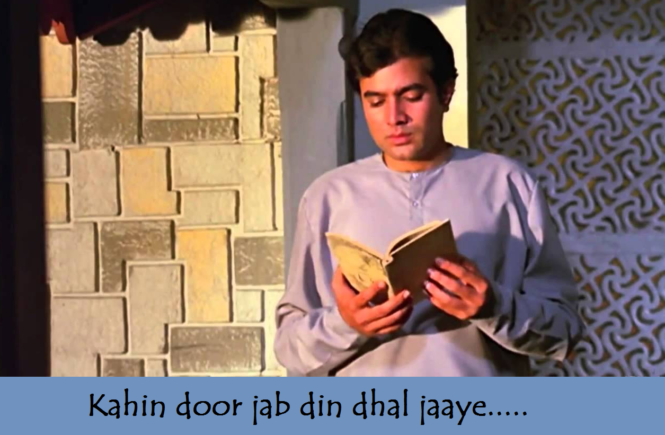
Last night we concluded the Mera, Apna, Hamara Songs Fest on my Facebook group ‘Yaad Kiya Dil Ne’ at about 11 P.M. This Fest had large number of theme songs; I myself had a list of some 620 songs. It is, therefore, not possible for me to give all songs here. I am generally the organiser of the fests on YKDN. In addition, I participate like an ordinary participant with two exceptions: one, I put up my songs after everyone has put up theirs; and two, generally, the song of the cover picture of the Fest is reserved for me. This time the reserved song was Kahin door jab din dhal jaaye.

The rules of the fests remain the same fest after fest and these were:

1. Starts at 0600 hrs on Sat, 15th Oct 16.
2. Concludes at 2300 hrs on Sun, 16th Oct 16.
3. The songs are to have the word Mera or Apna or Hamara or any other synonyms/variations of these, either in the mukhada or the antara of your songs. Words such as Main and Hum are not permitted. However, Mora, Hamra etc are permitted.
4. Every participant is permitted to put up five songs per day and a total of ten songs in two days. You can’t put up ten songs in one day. If you have repeated someone’s song, you can’t replace it with another.
5. You must put up the mukhada (first few words) of the song as a comment in the pinned post (the post right on top; it is generally that month’s Calendar post.) to avoid repetitions. Also, read the previous comments put up by others to find what others have put up.
6. Don’t write full story in the comment as at Pt. #5 above. Just the first few words. Put up just one song per comment. I shall be copying and pasting these comments for preparing the Results and don’t want to copy the link: “See More”.
7. The description of your song (in your post and not in the pinned post) must have the title ‘MERA, APNA, HAMARA SONGS FEST” and the Day number and song number; eg, “MERA, APNA, HAMARA SONGS FEST, Day#1, Song #1 and so on). Immediately below this, copy pasre the mukhada that you put in the pinned post so that your song can be related to the mukhada. Immediately below this write the line in which the Theme-word/Keyword of the Fest occurs.
8. You neither write the lyrics of the song, nor sing it, nor make its music, not even make its video. Your total contribution is how well you present the song that you are putting up. Markings for presentation will be independent of Likes as that would be a separate category.
9. Negative marks (upto 5) for those who repeat songs that others have put up. Positive marks (upto 10) for those who put up rare songs.
10. All are requested not to put up, like or comment upon other than Fest theme songs for the duration of the Fest. These can be put up before 0600 hrs on Day #1 and after 2300 hrs on Day #2.
11. Songs are to be put up in YKDN group and not on the event page.
12. The second day starts at midnight after the first day.
13. In order to help me find your songs please title your songs “MERA, APNA, HAMARA SONGS FEST Day #1, Song #1′ and so on only. Don’t use your own synonyms or spellings. Negative marks will be awarded to those who default since members not following these make me spend extra time searching for your posts whilst preparing results.
14. Please put up one mukhada followed by a song and then the next one. Do not reserve songs by putting up nember of mukhadas together.
15. Please discourage copy-paste ‘artistes’ who put up just the url of the song (without any effort), by totally ignoring their posts. I intend awarding negative marks to those who mechanically ‘Like’ such posts.

Alright, with this introduction lets plunge into the ten songs on the theme put up by me. In this Fest, I tried telling a story through these songs and I am sure you will enjoy the story whilst listening to the songs.

Day #1 Song #1

Mera mujh mein kichh nahin…
Keyword: First word of mukhada

And now that we are nine hours into the Fest, it is finally my turn to put up my posts. As I said, I have made a list of over 600 theme songs but, if I can help it, I don’t want to put at random. I want to make it into a story.

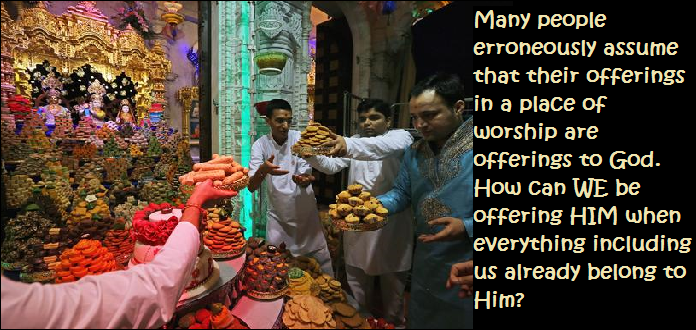
Of this story, this song is the introduction. What is the essence of the song? Only this that the word MERA or any of its synonyms is a myth. Nothing actually belongs to any of us. On my Facebook page: ‘Make Your Own Quotes’ I had put up a quote about the futility and ridiculousness of offering sweets etc to God in temples. We accept the fact that everything – even every thought of our minds – is owned by Him. Hence, to then take out a small portion of that everything and offer it back to him is totally incongruous. It is like going to a jeweller and offering him free a beautiful necklace from his own shop. When you offer His own things back to God, it reeks of your desire to show ownership over those gifts. How ludicrous it sounds.

offering

I was conscious of this recently when I did and asked you too to help Anindya Chatterjee in distress. Money is the least of the things that belong to us. Love and gratefulness may actually last longer. For example, any time (100 percent) I chat with and talk to Raj Dutta, he wins! That’s the least I can do for all the love that he showers upon me without holding back anything.

I was conscious of this thought when I planned the Fest. How arrogant MERA, APNA, HAMARA sounds! You already know my last song: Kahin Door Jab Din Dhal Jaaye and hence some of you can guess the intervening story that I shall be knitting for you.

A word about the hymn: Mera mujh mein kichh nahin, jo kichh hai oh tera (I don’t have (O’ God) anything of my own. Whatever is there is yours). This Shabad is composed by Bhagat Kabeer Ji, Guru Arjan Dev Ji and Guru Nanak Dev ji. It is on Page 1375 of Sri Guru Granth Sahib Ji:

1. Kabeer, mayraa mujh meh kichh nahee
Jo kichh hai so tayraa
tayraa tujh ka-o-sa-upatay
ki-aa laagai mayraa

2. Mai naahee parabh sabh kichh tayraa.
eeghai nirgun ooghai sargun kayi karat
bich su-aamee mayraa.

3. Tu jeevan too paraan adhaaraa.
tujh hee paykh paykh man saadhaaraa.
too saajan too pareetam mayraa.
chiteh na bisrahi kahoo bayraa.
ha-o kichh, naahee sabh kichh tayraa.
ot pot naanak sang basayraa.

4. Kabeer, mayraa mujh meh kichh nahee
Jo kichh hai so tayraa

Translation:

1. (Kabeer) Nothing within myself is mine. Whatever there is, is Yours.
If I surrender to You what is already Yours, what does it cost me?

2. I am nothing, God; everything is Yours.
In this world, You are the absolute, formless Lord; in the world hereafter, You are the related Lord of form. You play it both ways, O my Lord and Master.

3. You are my Life, the very Support of my breath of life.
Gazing upon You, beholding You, my mind is soothed and comforted.
You are my Friend, You are my Beloved.
I shall never forget You.

4. (Kabeer) Nothing within myself is mine. Whatever there is, is Yours.

The shabad or the hymn teaches us to ‘Let Go’! A story of Guru Nanak comes to my mind. I was fortunate to see the movie ‘Nanak Shah Fakir’ with my brother Raj Dutta. In his youth, Guru Nanak was working as a storekeeper. One day, he was counting provisions verbally whilst dispensing them to the buyers, ‘One, two, three, …, eleven, twelve, thirteen’. When he reached thirteen, he started saying that number repeatedly. In Punjabi, the number thirteen is ‘Tera’, which also means ‘Yours’. This was called ‘Sachcha Sauda‘ (True Trade or Business) in Guru Nanak’s life as well as in the movie.

There are many different uses of this hymn to bring us inner peace. However, now that we are grief-stricken because of Anindya Chatterjee and Priti Chavan, let me recall the use of the hymn in grief:

Grief is an inevitable part of human experience. For example, the discovery that your child is autistic triggers grief. The discovery that the person you love so dearly does not reciprocate your feelings triggers grief. The discovery that you no longer have your job triggers grief. The discovery that you can never bear a child triggers grief. The list is endless.

In modern psychology, the KÃbler-Ross Model for the grieving process is quite popular. It was developed in 1969 by a Swiss psychiatrist KÃbler-Ross who spent many decades working with the terminally ill. The model has five stages: denial, anger, bargaining, depression and acceptance. The first four stages reflect non-acceptance. Note the words used for describing non-acceptance: ‘denial’, ‘anger’, ‘bargaining’ and ‘depression’.

How does one reach ‘acceptance’ when faced with grief? Many techniques and ideas are found in psychology and spiritual books. There is no single technique or algorithm that works for everybody. For those with a devotional bent of mind, hymns like ‘Mera Mujh Mein‘ are helpful. They shorten the time period that we would otherwise have spent in denial, anger and depression. They also lessen the impact of these negative states of mind, quickly bringing us back on track, with smiles adorning our faces.

And now, you would know why, when I put up pics of Arun Chavan’s daughter Priti Chavan with her husband and the twins who were born to die (all of us are; but in their case it was much much shortened due to SMA Type #1 or Spinal Muscular Atrophy; a rare ailment), I used the words in the cover picture itself: ‘God is always kind’. Tera tujhko saunpte, kyaa laagat hai mera?

Even at the risk of this post becoming long, here is a story that we used to hear and read when I was small:

Once, There was a fakeer (Typical name for a Muslim saint who perpetually worships ‘Allah‘). He used to always recite God’s name. If he got something to eat, then only he’d have his meal, else not. He wasent in need of any of the worldly wants: home, clothes, etc.

But one day, while meditating, a thought came into his mind, ‘O Allah, I pray to you a lot with full heart, but what have you given to me ? I don’t have any home/shelter, there is no second pair of clothes for me, I don’t even know from where am I going to get my next meal. What have you given me?’

So, he went to dargah (Muslim place to worship) and started ‘razoi‘ (We have akhand paath (Prayers without a break) in Sikhism, Muslims have ‘razoi‘). In the end, he put forth the same question to allah.

A voice came: What do you want dear fakeer ?

Fakeer: Hey Allah, you know very well why have I came here. Look at me, the condition of the person who praises you. My clothes are torn apart, I have rashes all over my body, I don’t even have even shoes. At some door, I get some food to eat, else I am left alone with hunger. Put something in my lap. Give me something.

Same voice (of Allah): Ok, here you go.

(‘1′ was placed in his lap/jhooli. (Now don’t ask what is ‘1’. Later you all will know, what is it).

Fakeer: Huh? Just ‘1’? What am I going to do with that ‘1’? You have just ‘1’ for me from your treasure house? You give loads of riches to others and just ‘1’ to me?

Same voice: Go dear, this ‘1’ is very valuable.

Fakeer: As you say Allah.

So he went …

After some time, a ‘0’ (zero) was added after that ‘1’. (Means he progressed 10 times). Then after some more time, one more ‘0’ was added making it ‘100’. Now as the time passed by, the 0’s (zeros) kept on adding.

A worthy thing to notice here is that the ‘0’s’ (zeros) are getting added after that ‘1’ which Allah gave to him. If that ‘1’ was not there, then no matter how many ‘0’s’ you have, the sum will always be equal to 0.

After some time, he became the richest man in the country. Now he had so much wealth, that it was difficult for him to take care of the same. He was very happy being so rich.

One day, he was sitting and reciting … Allah … Allah … and then suddenly he thought that he had so much wealth, now what’s the use of that ‘1’ given to him by his Allah? That ‘1’, he mused, was the only thing He gave me, rest all the wealth was accumulated up by me only. (Sri Guru Granth Sahib calls it: ‘Hau-main’, that is, the feeling of ‘I’ came). Why not I return the ‘1’ to Him back so that it won’t be said that I took Allah’s favour?

So he went back to that dargah and again called upon his Allah.

Allah: Fakeer what do you want now?

Fakeer: Nothing Allah. Now I haven’t came to ask for something, I came here to give you something. (See, a mortal human – Fakeer, acting as a daata/giver in front of the greatest and only true giver of the universe).

(Just think about this for a moment, are we in a position to give anything to our God?)

Allah: First you came to me being a bhikhari (beggar) and now you are in front of me in the form of daata (Great giver)? What is it that you are giving to me?

Fakeer: I came to you last time and you gave me just ‘1’, after that, it was me who gathered all the wealth myself. So I am here to return you that ‘1’.

Allah: (Laughing at his stupidity) Are you sure?

Fakeer: Absolutely. I made up my mind and then came with strong will to return to you your ‘1’.

Allah: Ok. As you wish. (And took back that ‘1’)

Now, in the absence of that ‘1’, it didnt took any time for that so called fakeer turned richest man to be turned back to the same old begger fakeer which  he was in the beginning.

Then he again went back to that dargah.

Fakeer: Mere allah, please return me that ‘1’.

Allah: Fakeer, go, you won’t starve because you have recited my name, but I cannot give you back that ‘1’ because it has been taken by some other true lover.

Ladies and gentlemen, Mera mujh mein kichh nahin, jo kichh hai o tera is indeed the beginning of true knowledge and happiness.

My sister Surekha Saini would have told you (If she was participating, she would have certainly put this up) that various singers have sung this hymn over a period of time but the best was the original, sung in 1972, by Bhai Gopal Singh Ragi.

Please enjoy: Mera mujh mein kichh nahin….

Day #1 Song #2

Ai bhai zara dekh ke chalo…
Keyword: Last line: Viraan chidhiya ka basera hai, na tera hai, na mera hai.

The story so far: After announcing the Fest on this theme, I have been hit with emotions of regret. The word ‘Mera‘ (Mine) is a myth. Nothing is ever mine or yours. Everything belongs to God.

I read a lot of philosophy and have written a fair bit on my blog Sunbyanyname.com. A lot of debate and dicussion is there on the concept of Free-Will. However, if you have followed me so far, you would know that if nothing belongs to you, how can a mere mortal have ‘Free-Will’. One of the foremost modern thinkers on this subject was Swami Vivekananda. According to him you cannot find Free-Will in the universe. For obtaining Free-Will, as per Swami ji, one has to get out of the confines of the universe. And guess what, by invoking Consciousness, from the Vedic period, our sages have been actually traveling beyond the confines of the universe.

Generally, songs for Raj Kapoor movies have been penned by either Shailendra or Hasrat Jaipuri. However, this one from the 1970 movie Mera Naam Joker has been penned by Neeraj.

Mera Naam Joker is a comic theme about a circus joker who makes his audiences laugh, hiding his own sorrows and sadnesses. This song and the other: Jeena yahan marna yahan, is ke siwa jaana kahan, are actually, at the higher level, representative of the thoughts I have penned above. Things have been already writ for you (What the Guru Granth Sahib calls ‘Kirt‘. By the way, as an aside I must mention that my return to Sri Guru Granth Sahib, every now and then, is not to proclaim that it is the best amongst treatises of various religions. However, only give a thought that SGGS is already amalgamation of various religious thoughts in our country between 15th to 18th century and should not actually be the proprietary document of any particular religion).

Pay attention to every line penned by Neeraj and you would know that it is straight from the scriptures. Lets start with the first two: Tu jahan aaya hai, woh tera ghar nahin, gaanv nahin, gali nahin, kuuchcha nahin, rasta nahin, basti nahin…..duniya hai. And what happens in this duniya, since nothing belongs to us:

“Veeraan chidhiya ka basera hai, na tera hai, na mera hai“.

Many years before, Shakeel Badayuni, brought out similar thoughts in his famous Mela (closeness to ‘Circus’ of Mera Naam Joker) song:

“Duniya hai mauj-e-dariya,
Katre ki zindagi kyaa”

A person who says Mera Mera (Mine, Mine) is like this:

“Jab tak tha dum mein dum,
na jhuke aasma se hum,
jab maut aagai,
tab zameen ne daba liya”

(When there was life in this body,
The sky was the limit for me,
When I died
I was burried inside the earth)

Ladies and gentlemen, at this stage, remember what Bahadur Shah Zafar wrote (he was an emperor!):

“Kitana hai badnaseeb Zafar dafan ke liye,
Do ghaz zameen bhi na mili kuye yar mein“.

We might have differences about the best lyricist: my sisters Manik Lakhkar Chava and Evani Leela would insist it is Sahir and I proclaim it is Shakeel. However, we have no differences about the music duo ever in Hindi films (I did a 45 days tribute to them on Lyrical). This too has been composed by them; Shankar Jaikishan. Manna Dey is the singer.

Please enjoy – and now that some of you at least are reading my story – pay attention to Neeraj’s lyrics: Ai bhai zara dekh ke chalo…. For example, see how each line has a meaning at a higher level. Let me give an example: “Ooper hi nahin, neeche bhi“. This is not just entertainment; as I said, it is straight out of the scriptures!

(Ai bhaaii, zaraa dekhake chalo, aage hii nahii.n piichhe bhii
daaye.n hii nahii.n baaye.n bhii, uupar hii nahii.n niiche bhii) – 2
Ai bhaaii

Tuu jahaa.N aayaa hai vo teraa – ghar nahii.n, gaa.Nv nahii.n
Galii nahii.n, kuuchaa nahii.n, rastaa nahii.n, bastii nahii.n

Duniyaa hai, aur pyaare, duniyaa yah ek sarakas hai
Aur is circus me.n – ba.De ko bhii, choTe ko bhii
Khare ko bhii, khoTe ko bhii, moTe ko bhii, patale ko bhii
Niiche se uupar ko, uupar se niiche ko
Baraabar aanaa-jaanaa pa.Dataa hai

(Aur ri.ng maasTar ke ko.De par – ko.Daa jo bhuukh hai
Tho.Daa jo paisaa hai, ko.Daa jo qismat hai
Tarah-tarah naach kar dikhaanaa yahaa.N pa.Dataa hai
Baar-baar ronaa aur gaanaa yahaa.N pa.Dataa hai
Hero se jokar ban jaanaa pa.Dataa hai) – 2

Girane se Darataa hai kyo.n, marane se Darataa hai kyo.n
Thokar tuu jab na khaaegaa, paas kisii Gam ko na jab tak bulaaegaa
Zi.ndagii hai chiiz kyaa nahii.n jaan paayegaa
Rotaa huaa aayaa hai chalaa jaaegaa
Kaisaa hai karishmaa, kaisaa khilavaa.D hai
Jaanavar aadamii se zyaadaa vafaadaar hai
Khaataa hai ko.Daa bhii rahataa hai bhuukhaa bhii
Phir bhii vo maalik par karataa nahii.n vaar hai

Aur insaaN yah – maal jis kaa khaataa hai
Pyaar jis se paataa hai, giit jis ke gaataa hai
Usii ke hii siine me.n bhokataa kaTaar hai

Circus?

Haa.N baabuu, yah circus hai sho tiin gha.nTe kaa
Pahalaa gha.nTaa bachapan hai, duusaraa javaanii hai
Tiisaraa bu.Dhaapaa hai

Aur usake baad – maa.N nahii.n, baap nahii.n
BeTaa nahii.n, beTii nahii.n, tuu nahii.n,
Mai.n nahii.n, kuchh bhii nahii.n rahataa hai
Rahataa hai jo kuchh vo – Kaalii-Kaalii kursiyaa.N hai.n
Kaalii-Kaalii taambuu hai, Kaalii-Kaalii gheraa hai
Veeran chi.Diyaa kaa baseraa hai, na teraa hai, na meraa hai

https://www.youtube.com/watch?v=2nRzs4BHzxY

Day #1 Song #3

What have I got of my own?
Keyword (s): In the mukhada (two out of the seven words)

Just before I went for my evening walk, followed by calisthenics, I got a live demo (arranged by God) of the fact that nothing belongs to me. I spent about 45 mins preparing this post and I was about to press ‘Post’, when Vipan Kohli commented on my Song #1. It popped up and instead of pressing ‘Post’, his pop-up notification got pressed. Lo and behold, my post vanished. This was God’s way to tell me that even the posts are not my posts! Ha!

THE STORY SO FAR: Nothing belongs to us; Everything belongs to God and to understand this simple fact is the beginning of true knowledge and real happiness. We do not have Free-Will. To obtain Free-Will one has to go beyond the confines of the universe. In the absence of Free-Will, we are like puppets in a Mela or Circus (Aur ring-master ke kodhe pe). And, we have an Invisible Force that controls our everything.

By the mukhada of this song, if you feel that mine is a one track mind and I am continuing relentlessly with this sub-theme, you are mistaken. With this song, I introduce the highest feeling on earth called Love. That invisible force, who gave us everything, every emotion, every thought in this world (duniya) gives us Love to exercise partial control. It is because Love controls everything. Love is God Himself.

It brings us sadnesses and grief, but, ultimately Love is Happiness.

As I was typing this, last time, I had Raj Dutta commenting on my post with a poem by Baba Farid where he compares human beings to maati ke putle. Here is for you, Raj Dutta, by a most respected lyricist Shailendra in a song from a movie produced by him (This song is not my post but introduction to my post):

(दुनिया बनाने वाले, क्या तेरे मन में समाई
काहेको दुनिया बनाई, तूने काहेको दुनिया बनाई ) – २

काहे बनाए तूने माटी के पुतले,
धरती ये प्यारी प्यारी मुखड़े ये उजले
काहे बनाया तूने दुनिया का खेला – २
जिसमें लगाया जवानी का मेला
गुप-चुप तमाशा देखे, वाह रे तेरी खुदाई
काहेको दुनिया बनाई, तूने काहेको दुनिया बनाई …

तू भी तो तड़पा होगा मन को बनाकर,
तूफ़ां ये प्यार का मन में छुपाकर
कोई छवि तो होगी आँखों में तेरी – २
आँसू भी छलके होंगे पलकों से तेरी
बोल क्या सूझी तुझको, काहेको प्रीत जगाई
काहेको दुनिया बनाई, तूने काहेको दुनिया बनाई …

प्रीत बनाके तूने जीना सिखाया, हंसना सिखाया,
रोना सिखाया
जीवन के पथ पर मीत मिलाए – २
मीत मिलाके तूने सपने जगाए
सपने जगाके तूने, काहे को दे दी जुदाई
काहेको दुनिया बनाई, तूने काहेको दुनिया बनाई …

Dear Raj Dutta, if you listen to the last stanza, you will now know what my story is leading to and perhaps now you will be able to guess why I kept Kahin door jab din dhal jaaye as the last song.

Trini Lopez’s What Have I Got Of My Own? was a song that I listened to when I was a boy and this song has found repeated mention in my blog. His songs like Lemon Tree, La Bamba, If I had a Hammer, and Love Me Tonight were popular during our times.

In the first three stanzas, he rues not having anything of his own; but, in the last stanza, he says if he’d have true love, he won’t want anything else on earth!

In short: ‘When you have love, you have everything‘. It lasts a lifetime being with you (Hindus believe it last saat janam) and, for God’s sake, that’s owning it much much longer than anything else!

I am not going to repeat my complete earlier post. What has gone is gone!

But, please enjoy: What have I got of my own?

What have I got of my own, my own?
What have I got of my own?

The castles I build when I lie in the sand,
Belong to a king in a fairy tale land.
The treasures I find, when I dream in my sleep,
Are gone in the dawn. Not a thjng I can keep.
What have I got of my own, my o~own?
What have I got of my own?

The stars all belong high in heaven above.
My heart belongs to the one that I love.
The rivers that flow all belong to the sea.
What have I got that belongs to me?
What have I got of my own, my o~own?
What have I got of my own?

I hope someday before too long
My heart will sing a happy song.
I’m tired of being lonely, unhappy and sad.
I wanna have the things that other men have.
What have I got of my own, my o~own?
What have I got of my own?

Solo interlude

If I could choose one thing forever to hold,
I know I would never choose diamonds or gold.
Just give me one true love to be mine alone,
Then I’ll have all the things of my own, my own.
What have I got of my own?

My own.

What have I got of my own?

Day #1 Song #4

Saare jahan se achcha Hindostan hamara
Keyword: In the mukhada.

THE STORY SO FAR: Nothing belongs to us. Everything belongs to God. Hence, we should never rue the loss of anything; it was God’s and He took it back. We have no Free-Will. We are like people in a play or circus who are given their parts to play and we do so to the best of our ability (Please recall the sermon given to Arjuna before the Battle of Mahabharta by our Lord Krishna) However, amongst everything that goes gives and takes back, Love is an emotion that gives us some sort of control after we fall in love (one has no control over Love and hence the expression “falling” in love and not “stepping” into it!)

Love is, hence, not a reasoned emotion! It is an attachment at one end and at the highest end, it is the greatest feeling on earth.

IT GIVES US OWNERSHIP!

Lets see, if all of us were to become saints and sages, what will happen to the world? No one would ever “fall” in love and people would be ‘selfishly‘ in pursuit of God. Now, it can’t be that God sent us on this earth to get back to Him; then, why to send us at all?

Let me take the Love between a Man and a Woman first, the commonest form of Love. Guru Nanak thinks of it as the purest form of Love since he in Sri Guru Granth Sahib (SGGS) regards himself as a woman seeking her Lover, God. He goes about advising all of us to be in that relationship with God as a ‘suhaagan‘ is with her ‘suhaag‘.

The other day, whilst commenting on one of the Sufi songs of Surekha Saini, I brought out this commonality between SGGS and Sufism.

What does this ownership born out of LOVE do to you? Well, it inspires you to be loyal to your love so that you are in true and perfect relationship and not just infatuated. This Love then is the beginning of all other relationships on earth: Brothers, Sisters, Uncles, Aunts etc. Without this Love relationship, the world won’t have progressed and hence when Shailendra bemoaned in Teesri Kasam as to why God made Love, he already had the answer.

The ownership (for as long as you love, you have it) born out of Love is the aspect that makes highest attainments in human beings possible.

Recently, we had the Surgical Strikes across LOC. What was the controlling feeling? Naturally, it is Love for one’s country and countrymen and women. That’s why we have defence forces and not offence forces. We are protectors of that Love for our country.

Let me give you one of the poems as introduction to the National Song to which I am leading you now. This poem was written by Ram Prasad Bismil. He was born on 11th June 1897 in Shahjahanpur. He was hanged by the British at the age of 30 years for what? For his love for the country. Look at the junoon this love manifests into:

सरफ़रोशी की तमन्ना अब हमारे दिल में है
देखना है ज़ोर कितना बाज़ू-ए-क़ातिल में है

(ऐ वतन,) करता नहीं क्यूँ दूसरा कुछ बातचीत,
देखता हूँ मैं जिसे वो चुप तेरी महफ़िल में है
ऐ शहीद-ए-मुल्क-ओ-मिल्लत, मैं तेरे ऊपर निसार,
अब तेरी हिम्मत का चरचः ग़ैर की महफ़िल में है
सरफ़रोशी की तमन्ना अब हमारे दिल में है

वक़्त आने पर बता देंगे तुझे, ए आसमान,
हम अभी से क्या बताएँ क्या हमारे दिल में है
खेँच कर लाई है सब को क़त्ल होने की उमीद,
आशिक़ोँ का आज जमघट कूचः-ए-क़ातिल में है
सरफ़रोशी की तमन्ना अब हमारे दिल में है

है लिए हथियार दुशमन ताक में बैठा उधर,
और हम तय्यार हैं सीना लिये अपना इधर.
ख़ून से खेलेंगे होली गर वतन मुश्किल में है,
सरफ़रोशी की तमन्ना अब हमारे दिल में है

हाथ, जिन में हो जुनून, कटते नही तलवार से,
सर जो उठ जाते हैं वो झुकते नहीं ललकार से.
और भड़केगा जो शोलः सा हमारे दिल में है,
सरफ़रोशी की तमन्ना अब हमारे दिल में है

हम तो घर से ही थे निकले बाँधकर सर पर कफ़न,
जाँ हथेली पर लिये लो बढ चले हैं ये कदम.
जिन्दगी तो अपनी मॆहमाँ मौत की महफ़िल में है,
सरफ़रोशी की तमन्ना अब हमारे दिल में है

यूँ खड़ा मक़्तल में क़ातिल कह रहा है बार-बार,
क्या तमन्ना-ए-शहादत भी किसी के दिल में है?
दिल में तूफ़ानों की टोली और नसों में इन्क़िलाब,
होश दुश्मन के उड़ा देंगे हमें रोको न आज.
दूर रह पाए जो हमसे दम कहाँ मंज़िल में है,

जिस्म भी क्या जिस्म है जिसमें न हो ख़ून-ए-जुनून
क्या लढ़े तूफ़ान से जो कश्ती-ए-साहिल में है
सरफ़रोशी की तमन्ना अब हमारे दिल में है
देखना है ज़ोर कितना बाज़ू-ए-क़ातिल में है

This poem inspired many. One of them was Shahid Bhagat Singh. He sang (another theme song): Mera rang de basanti chola and when he was to be hanged for his own Love for India and his mother came to see him in the prison, he had this to say to her:

तू ना रोना, के तू है भगत सिंह की माँ
मर के भी लाल तेरा मरेगा नहीं
डोली चढ़के तो लाते है दुल्हन सभी
हँसके हर कोई फाँसी चढ़ेगा नहीं !

That is what Love can do for you. Mile sur tera hamaara. Just as a man in love thinks of his beloved as dulhan, the one who is in true love with his nation, thinks of his country as the Motherland. Just as a man thinks of his beloved as the most beautiful on earth, a man in love with his country thinks of his country (motherland) as the most beautiful.

And that brings us squarely to our national song:

It is known as Taranah-e-Hind or Anthem of the People of Hindustan. Forty three years before independence, it was written by the poet Muhammad Iqbal and published in the Ittehad, a weekly journal.

The next year, it was read by him in Government College Lahore (then in India) and it soon became the manifestation of our opposition to the British rule. He was, of course, a lecturer in the same college.

There is no Indian, whose chest doesn’t swell with pride at the recitation of this poem/song.

In parades all over the country, men and women march to the tune of this song.

I am giving you the poem in all three languages: Urdu, Hindi and English and its meaning in English:

Urdu

سارے جہاں سے اچھا ہندوستاں ہمارا
ہم بلبلیں ہیں اس کی، یہ گلستاں ہمارا

غربت میں ہوں اگر ہم، رہتا ہے دل وطن میں
سمجھو وہیں ہمیں بھی دل ہو جہاں ہمارا

پربت وہ سب سے اونچا، ہمسایہ آسماں کا
وہ سنتری ہمارا، وہ پاسباں ہمارا

گودی میں کھیلتی ہیں اس کی ہزاروں ندیاں
گلشن ہے جن کے دم سے رشکِ جناں ہمارا

اے آبِ رودِ گنگا! وہ دن ہیں یاد تجھ کو؟
اترا ترے کنارے جب کارواں ہمارا

مذہب نہیں سکھاتا آپس میں بیر رکھنا
ہندی ہیں ہم، وطن ہے ہندوستاں ہمارا

یونان و مصر و روما سب مٹ گئے جہاں سے
اب تک مگر ہے باقی نام و نشاں ہمارا

کچھ بات ہے کہ ہستی مٹتی نہیں ہماری
صدیوں رہا ہے دشمن دورِ زماں ہمارا

اقبال! کوئی محرم اپنا نہيں جہاں میں
معلوم کیا کسی کو دردِ نہاں ہمارا!

Hindi

सारे जहाँ से अच्छा हिन्दोसिताँ हमारा
हम बुलबुलें हैं इसकी यह गुलसिताँ हमारा

ग़ुर्बत में हों अगर हम, रहता है दिल वतन में
समझो वहीं हमें भी दिल हो जहाँ हमारा

परबत वह सबसे ऊँचा, हम्साया आसमाँ का
वह संतरी हमारा, वह पासबाँ हमारा

गोदी में खेलती हैं इसकी हज़ारों नदियाँ
गुल्शन है जिनके दम से रश्क-ए-जनाँ हमारा

ऐ आब-ए-रूद-ए-गंगा! वह दिन हैं याद तुझको?
उतरा तिरे किनारे जब कारवाँ हमारा

मज़्हब नहीं सिखाता आपस में बैर रखना
हिन्दी हैं हम, वतन है हिन्दोसिताँ हमारा

यूनान-व-मिस्र-व-रूमा सब मिट गए जहाँ से
अब तक मगर है बाक़ी नाम-व-निशाँ हमारा

कुछ बात है कि हस्ती मिटती नहीं हमारी
सदियों रहा है दुश्मन दौर-ए-ज़माँ हमारा

इक़्बाल! कोई महरम अपना नहीं जहाँ में
मालूम क्या किसी को दर्द-ए-निहाँ हमारा!

English

Sāre jahāṉ se acchā, Hindositāṉ hamārā
Ham bulbuleṉ haiṉ is kī, yih gulsitāṉ hamārā

G̱ẖurbat meṉ hoṉ agar ham, rahtā hai dil wat̤an meṉ
Samjho wuhīṉ hameṉ bhī dil ho jahāṉ hamārā

Parbat wuh sab se ūṉcā, hamsāyah āsmāṉ kā
Wuh santarī hamārā, wuh pāsbāṉ hamārā

Godī meṉ kheltī haiṉ is kī hazāroṉ nadiyāṉ
Guls̱ẖan hai jin ke dam se ras̱ẖk-i janāṉ hamārā

Ai āb-i rūd-i Gangā! wuh din haiṉ yād tujh ko?
Utrā tire kināre jab kārwāṉ hamārā

Maẕhab nahīṉ sikhātā āpas meṉ bair rakhnā
Hindī haiṉ ham, wat̤an hai Hindositāṉ hamārā

Yūnān o-Miṣr o-Rūmā, sab miṭ ga’e jahāṉ se
Ab tak magar hai bāqī, nām o-nis̱ẖaṉ hamārā

Kuch bāt hai kih hastī, miṭtī nahīṉ hamārī
Ṣadiyoṉ rahā hai dus̱ẖman daur-i zamāṉ hamārā

Iqbāl! ko’ī maḥram apnā nahīṉ jahāṉ meṉ
Maʿlūm kyā kisī ko dard-i nihāṉ hamārā!

English Translation

Better than the entire world, is our Hindustan,
We are its nightingales, and it (is) our garden abode

If we are in an alien place, the heart remains in the homeland,
Know us to be only there where our heart is.

That tallest mountain, that shade-sharer of the sky,
It (is) our sentry, it (is) our watchman

In its lap frolic where thousands of ponds,
Whose vitality makes our garden the envy of Paradise.

O the flowing waters of the Ganges, do you remember that day
When our caravan first disembarked on your waterfront?

Religion does not teach us to bear ill-will among ourselves
We are of Hind, our homeland is Hindustan.

In a world in which ancient Greece, Egypt, and Rome have all vanished without trace
Our own attributes (name and sign) live on today.

Such is our existence that it cannot be erased
Even though, for centuries, the cycle of time has been our enemy.

Iqbal! We have no confidante in this world
What does any one know of our hidden pain?

At this stage, I can hear my friend Jaswant Singh Lagwal ask me, “Sirjee, is baar Raagas ka kyaa huaa?“. Dear Jaswant Singh Lagwal, yes this is in Raag Pahadi (the raaga of your and my place in the hills). I could have given you Sarfroshi ki tamanna itself in Raag Darbari.

Day #1 Song #5

Tere bachpan ko jawani ki duaa deti hoon
Keyword in first line of first stanza: Mere munne mere gulazaar ke nanhe paudhe

THE STORY SO FAR: Nothing belongs to us, everything belongs to God. This realisation is indeed true knowledge and happiness (Song #1: Mera mujh mein kichh nahin, jo kichh hai o tera). We do not have free-will and we do everything as directed to us by an invisible force (Song #2: Ai bhai zara dekh ke chalo). However, if at all we must own anything, we must own Love, the highest feeling on earh (Song #3: What have I got of my own?) This love has many different forms such as between Man and Woman. Love always inspires us to do everything to protect our loved one. This can be and has been used to lead people into sacrificing their lives in love for their country (Song #4: Saare jahan se achha Hindostan hamara).

Lets proceed further:

One of the oft talked about Love (ownership) is by a mother for her child. If love can inspire people to highest attainments in everything, a love of a mother always reaches such pinnacles. I am fond of giving this example of a mother and her infant stuck under the rubble for three full days in an earthquake in Russia. As the rubble was moved away after three days, without having anything to eat or drink, the couple (mother and child) were found alive! It came out that the mother fed the child her own blood in order to keep it alive and willed herself to remain alive because if she would die the infant was certain to die (without any nourishment). That’s the love (ownership: mere bachche) of a mother for you.

I have been giving a song as introduction to my song (there are plenty of songs on the theme, that is why) Here is an introductory song from the movie Amar Prem. She is not even the blood-mother of the child (Vipan Kohli in his hymn of Anup Jalota would know that Yashoda wasn’t the blood mother of Krishna) and yet look at the words used by her:

बड़ा नटखट है रे कृष्ण-कन्हैया
का करे यशोदा मैय्या, हाँ … बड़ा नटखट है रे

(ढूँढे री अंखियाँ उसे चारों ओर
जाने कहाँ छुप गया नंदकिशोर ) – २
उड़ गया ऐसे जैसे पुरवय्या
का करे यशोदा मैय्या, हाँ … बड़ा नटखट है रे

(आ तोहे मै गले से लगा लूँ
लागे ना किसी की नज़र मन मे छुपा लूँ ) – २
धूप जगत है रे ममता है छैंया
का करे यशोदा मैय्या, हाँ … बड़ा नटखट है रे

(मेरे जीवन का तू एक ही सपना
जो कोई देखे तोहे समझे वो अपना ) – २
सब का है प्यारा, हो सब का है प्यारा बंसी-बजय्या
का करे यशोदा मैय्या, हाँ … बड़ा नटखट है रे

She wants her child to be as beloved to the people as Kanhaiyya is to all of us.

If this can be the feelings of the not-blood-mother, imagine the sense of ownership of the blood-mother wishing her child the best.

I copy the lyrics of the songs from Smriti.com. Normally, there is no introduction to the songs, just the lyrics. However, this song’s lyrics have an introduction and this is it:

“This song is sung by a mother (Waheeda) to her child as a “lori“. The father (Sunil Dutt) is a “daaku” and is on the run from the law. Hence the entire family is constantly in hiding, moving from place to place hoping to remain undetected. This song is basically an expression of how the sins of the parents visit the children. The “dard” and softness in Lata’s voice as she sings this song makes it
one of the most moving songs I have heard.”

Manik Lakhkar Chava and Evani Leela, I have to give it to you: the lyrics by Sahir Ludhianvi (your favourite poet and lyricist) are simply out of this world. As it is, in this world, after a new child is born, the mother thinks of how the child would face the cruel, selfish, and hostile world. However, if he/she is a dacoit’s son, one worries extra for the society treating the child with added animosity.

The fact of the matter is that a child carries with it, on its tiny shoulders, some of (if not most of) the virtues and sins, fruits of good deeds and bad deeds of its parents. In that sense, this song’s lyrics are truly a reflection of how one generation (sense of ownership) is carried forward to the next.

Mujhe Jeene Do. Chalo, mujhe to jeene na diya; ab isse to jeene do!

Please enjoy: Tere bachpan ko jawani ki dua deti hoon….

Tere bachapan ko javaanii kii duaa detii huu.N
Aur duaa deke pareshaan sii ho jaatii huu.N

Mere munne mere gulazaar ke nanhe paudhe
Tujhako haalat kii aa.ndhii se bachaane ke liye
Aaj mai.n pyaar ke aa.nchal me.n chhupaa letii huu.N
Kal ye kamazor sahaaraa bhii na haasil hogaa
Kal tujhe kaa.nTo.n bharii raaho.n pe chalanaa hogaa
Zi.ndagaanii kii ka.Dii dhuup me.n jalanaa hogaa
Tere bachapan ko javaanii …

Tere maathe pe sharaafat kii koI mohar nahii.n
Cha.nd hote hai.n muhabbat ke sukuun hii kyaa hai.n
Jaise maao.n kii muhabbat kaa koI mol nahii.n
Mere maasuum farishte tuu abhii kyaa jaane
Tujhako kis-kisakii gunaaho.n kii sazaa milanii hai
Diin aur dharm ke maare hue i.nsaano.n kii
Jo nazar milanii hai tujhako vo khafaa milanii hai
Tere bachapan ko javaanii …

Be.Diyaa.N leke lapakataa huaa kaanuun kaa haath
Tere maa.N-baap se jab tujhako milii ye saugaat
Kaun laaegaa tere vaaste khushiyo.n kii baaraat
Mere bachche tere a.njaam se jii Darataa hai
Terii dushman hii na saabit ho javaanii terii
Khaak jaatii hai jise sochake mamataa merii
Usii a.njaam ko pahu.nche na kahaanii terii
Tere bachapan ko javaanii …

https://www.youtube.com/watch?v=P2D-Z7XM7aU

Day #2 Song #1

Kisi raah mein kisi mod par
Keyword: In the last two words of the mukhada: Mere hamsafar.

THE STORY SO FAR: Nothing belongs to us, everything belongs to God. This realisation is indeed true knowledge and happiness (Song #1: Mera mujh mein kichh nahin, jo kichh hai o tera). We do not have free-will and we do everything as directed to us by an invisible force (Song #2: Ai bhai zara dekh ke chalo). However, if at all we must own anything, we must own Love, the highest feeling on earh (Song #3: What have I got of my own?) This love has many different forms such as between Man and Woman. Love always inspires us to do everything to protect our loved one. This can be and has been used to lead people into sacrificing their lives in love for their country (Song #4: Saare jahan se achha Hindostan hamara). One of the forms of pure Love is between a mother (acting in the likeness of a Creator) and her child and she does everything to protect her child (Song #5: Tere bachpan ko jawani ki dua deti hoon)

Lets proceed further, today, the second and the last day of the Fest:

It has been nearly 16 hours since everybody else started putting up songs for the second day and hence it is safe for me to start putting up now without anyone telling me that I put up his/her song. I had to re-jig my story a little bit because of some of you putting up the songs I had planned to do.

In any case, if you would have noticed I am trying to tell my story through the medium of very ordinary songs rather than trying to impress you with my choices. I maintain that anybody could have chosen the songs through which I am telling my story.

Love between a husband and wife is regarded in our scriptures as the purest form of love, so much so that Guru Nanak used the simile of husband and wife to talk about the Love that must exist between a man (or woman) and God. Isn’t it surprising that Guru Nanak didn’t choose the Love simile of a mother or father for her/his child?

How does this Love (not infatuation but real Love) take place? Our (culture and religion) theory is that this Love and the ensuing wedding is made in heaven. Please don’t forget what I told you about “Duniya bananewaale ne preet banayi”.

After undertaking the journey of life singly, the lovers are now planning to undertake this journey together, enjoying it together and surpassing all obstacles together: Tere mere sapane ab ek rang hain and so on.

Hamsafar is the right word to use for them in undertaking this journey. The girl has a doubt (in our culture, she is the one who leaves her family and moves with and into the boy’s family; or at least that used to happen during the period of the songs we are talking about); if not several doubts and she requires reassurance whether she has made the right choice in taking him as a hamsafar.

Sometimes even the boy has doubts, especially if he is poorer. There are several songs to this effect. One of the best that I can give you (as an introduction) is from the 1959 movie Kali Topi Laal Rumaal (as ordinary a movie as any of my songs). Majrooh, Chitragupta, Rafi and Lata have put this together:

ल : लागी छूटे ना अब तो सनम
चाहे जाए जिया तेरी क़सम
लागी छूटे ना …

र : तुझको पुकारे बन के दीवाना ना माने रे जिया -२
ल : ओ जी हो
प्यार किया तो करके निभाना सुनो जी रसिया
र : ओ प्यार किया तो प्यार किया तेरी क़सम
लागी छूटे ना …

ल : दूर हूँ फिर भी दिल के क़रीब निशाना है तेरा -२
र : सोच ले फिर से एक गरीब दीवाना है तेरा -२
ल : सोच लिया जी सोच लिया तेरी क़सम
र : लागी छूटे ना …

ल : जब से लड़ी है तुझसे निग़ाहें तड़प रहा दिल -२
र : देख के चलना प्यार की राह बड़ी है मुश्किल
ल : देख लिया जी देख लिया तेरी क़सम
लागी छूटे ना …

Please pay particular attention to the words: Soch liya ji soch liya, teri kasam!

Even in Ajnabee (and for that matter in several hundred movies) she still continues to have these doubts. Do you remember the train scene when he asks (in the song, that is): Kyaa soch rahi ho? And she answers:

“Aisa na ho tu kabhi chhod de mera saath”

And he immediately answers: “Phir na kabhi karna dil todane waali baat”

Reassured, she quips, “Maine to ki thi dillagi“!

You can call this Dillagi to ask this most important question sooner than later but the fact is you don’t want to be alone, high and dry when he leaves (Don’t forget that the Man by his very nature, from Stone Age onwards is actually polygamous) and then sing (Acknowledging his polygamous nature): Tum mujhe bhool bhi jaao to yeh haq hai tumako, meri baat aur hai maine to mohabbat ki hai (another theme song that is).

A similar thing happened with Sharmila Tagore in the 1970 movie Mere Hamsafar when she is running away with her love Jeetendra. Last night I was responding to Suman Saxena and I brought out this curious coincidence that Sharmila, in various movies, was the most easily impregnated woman and most often than not she landed up being an unwed mother from Aradhana to Daag to Aa Gale Lag Ja. Even in Amar Prem she took fancy to a boy who was not her son. Hence, for her to be asking this question is really important!

The beauty of this song penned by Anand Bakshi is that he reassures her with the sweetest sounding words: Teraa sa.ng saayaa bahaar kaa teraa ruup aa_iinaa pyaar kaa; tujhe aa nazar me.n chhupaa luu.N mai.n tujhe lag na jaa_e kahii.n nazar. Which is another way of saying what Suchitra Sen and Pradeep Kumar said to each other in Mamta: Chhupa lo youn dil mein pyaar mera ke jaise mandir mein lau diye ki. And yet, in that movie, he couldn’t be hers!

This song was composed by Kalyanji Anandji (KgAg for Jaswant Singh Lagwal) in Raag Charukesi, Tal Rupaktal (Rare combination that makes this ordinary song get the veneer of being extraordinary).

Suman Saxena brought out that Laxmikant Pyarelal were well versed with the use of Flute in their songs. Of course, I agreed with her and even gave her Milan song: sawan ka mahina pawan kare sor, as an example. But, the fact is that many composers of that era used Flute extensively. You should hear OP Nayyar in Phagun (Piya O piya na laage mora jiya, another theme song) or Naushad in Baiju Bawra or Kalyanji Anandji in this song or in the songs of Jab Jab Phool Khile (eg, Pardesiyon se na akhiyan milana).

The duet that I have selected for you has been sung by Lata Mangeshkar and Mukesh, the pair that put together some of the most enchantingly romantic songs in Hindi movies: eg, Dil ki nazar se.

Please enjoy: Kisi raah mein kisi mod par, kahin chal na dena tu chhod kar….

La : Kisii raah me.n kisii mo.D par kahii.n chal na denaa tuu chho.D kar
mere hamasafar -4
Mu : Kisii haal me.n kisii baat par kahii.n chal na denaa tuu chho.D kar
mere hamasafar -4

La : meraa dil kahe kahii.n ye na ho ( nahii.n ye na ho ) -2
kisii roz tujhase bichha.D ke mai.n tujhe Dhuu.NDhatii phiruu.N dar-ba-dar
mere hamasafar -4

Mu : teraa sa.ng saayaa bahaar kaa teraa ruup aa_iinaa pyaar kaa
tujhe aa nazar me.n chhupaa luu.N mai.n tujhe lag na jaa_e kahii.n nazar
mere hamasafar -4

La : Teraa saath hai to hai zindagii
Mu : Teraa pyaar hai to hai roshanii
La : Kahii.n din ye Dhal jaa_e kyaa pataa
Mu : Kahaa.N raat ho jaa_e kyaa Kabar
Do : Mere hamasafar -4

La : kahii.n chal na denaa …

Day #2 Song #2

Baabul moraa naihar chhootoo hi jaae
Keyword: Second word of the mukhada: moraa.

THE STORY SO FAR: Nothing belongs to us, everything belongs to God. This realisation is indeed true knowledge and happiness (Song #1: Mera mujh mein kichh nahin, jo kichh hai o tera). We do not have free-will and we do everything as directed to us by an invisible force (Song #2: Ai bhai zara dekh ke chalo). However, if at all we must own anything, we must own Love, the highest feeling on earh (Song #3: What have I got of my own?) This love has many different forms such as between Man and Woman. Love always inspires us to do everything to protect our loved one. This can be and has been used to lead people into sacrificing their lives in love for their country (Song #4: Saare jahan se achha Hindostan hamara). One of the forms of pure Love is between a mother (acting in the likeness of a Creator) and her child and she does everything to protect her child (Song #5: Tere bachpan ko jawani ki dua deti hoon).

And today, in the very first song we started with the Love between Man and Woman that would eventually lead to wedlock but she (and sometimes he) has doubts whether he would walk with her all throughout the journey of life or leave her midway (Song #6: Kisi raah mein kisi mod par kahin chal na dena tu chhod kar).

Lets proceed further:

He is in love with her and she wants to tell the whole world (Aaj mere man mein sakhi baansuri bajae!). She hopes for the best (Tera mera sath rahe). They sing together: Tere mere sapane ab ek rang hain and Hum tuhaare liye, tum hamare liye phir zamaane ka kya ho? or Tere mere beech mein kaisa hai yeh bandhan or Kisi ne apna bana ke mujhako muskarana sikha diya or even Kora kaagaz that ye man mera, likh diya naam uspe tera. She is grateful to God and him: Aap ki nazaron ne samajha pyaar ke kaabil mujhe.

And finally, it is: Mehandi lagi mere haath re!

And then, she has to leave her parents’ to join him and his family. Hundreds and even thousands of songs to describe this feeling such as: Chal ri sajani ab kyaa soche, Mujhe baabul ke ghar jaana hai, Baabul ki duaayen leti jaa and finally, after she reaches ther: Main to bhool chali baabul ka des, piya ka ghar pyaara lage.

However, the best in this category is the one that addresses this at two different planes: the material world plane of a woman leaving her home to join her new home, that of her husband. And the spiritual plane of finishing the journey of this world and going to the other world (jahan se koi nahin waapis aaya!).

By the way, there is a third plane at which the song is addressed:

The song was written by Nawab Wajid Ali Shah, the 19th-century Nawab of Awadh as a lament when he was exiled from his beloved Lucknow by the British Raj before the failed Rebellion of 1857, where he uses the metaphor of bidaai (bride’s farewell) of a bride from her father’s (babul) home, and his own banishment from his beloved Lucknow, to far away Calcutta, where he spent the rest of his years.

This song has, therefore, illustrious lineage about it. As I said earlier, it was written by Wajid Ali Shah, the last Nawab of Awadh. He was a poet, playwright, dancer and great patron of the arts. He is widely credited with the revival of Kathak as a major form of classical Indian dance. If you see Satyajit Ray’s movie Shatranj Ke Khiladi based on a story by Munshi Premchand, you would know how his kingdom was annexed by the British in a bloodless coup whilst he, the Nawab, busied himself in his artistic pursuits.

It was composed by RC Boral or Rai Chand Boral, widely considered as the father of Hindi films music. Naturally, he was the recipient of the highest in performing arts: the Babasaheb Phalke Award conferred by the government of India.

It was sung by the first super-star of the Hindi or even Indian movies: Kundan Lal Saigal. He often sang for himself playing the title and lead roles in the movies; before the playback era, he is credited with a song that he sang live whilst performing!

This thumri of the days of Wajid Ali Shah was composed by RC Boral in Raag Bhairavi, Tal Kaherava. The name of this 1938 movie was: Street Singer.

Please enjoy a song that addresses itself at three different planes (I am providing the translation): Baabul mora naihar chhooto hi jaay….

Baabul moraa, naihar chhuuTo hii jaae

Chaar kahaar mil, morii Doliyaa sajaave.n – 4
Moraa apanaa begaanaa chhuTo jaae
Baabul moraa …

Aa.Nganaa to parbat bhayo aur deharii bhayii bidesh
Je baabul ghar aapanaa mai.n piiyaa ke desh
Baabul moraa …

Baabul moraa, naihar chhuuTo hii jaae

बाबुल मोरा, नैहर छूटो ही जाए
चार कहार मिल, मोरी डोलिया सजावें (उठायें)
मोरा अपना बेगाना छूटो जाए | बाबुल मोरा …

आँगना तो पर्बत भयो और देहरी भयी बिदेश
जाए बाबुल घर आपनो मैं चली पीया के देश | बाबुल मोरा …

O My father! I’m leaving home.
The four (coffin) bearers lift my palanquin.
I’m leaving those who were my own.

Your courtyard is now like a mountain, and the threshold, a foreign country.
I leave your house, father, I am going to my beloved’s country.

Day #2 Song #3

Tere mere sapne ab ek rang hain
Keyword: Second word of the mukhada: mere.

THE STORY SO FAR: Nothing belongs to us, everything belongs to God. This realisation is indeed true knowledge and happiness (Song #1: Mera mujh mein kichh nahin, jo kichh hai o tera). We do not have free-will and we do everything as directed to us by an invisible force (Song #2: Ai bhai zara dekh ke chalo). However, if at all we must own anything, we must own Love, the highest feeling on earh (Song #3: What have I got of my own?) This love has many different forms such as between Man and Woman. Love always inspires us to do everything to protect our loved one. This can be and has been used to lead people into sacrificing their lives in love for their country (Song #4: Saare jahan se achha Hindostan hamara). One of the forms of pure Love is between a mother (acting in the likeness of a Creator) and her child and she does everything to protect her child (Song #5: Tere bachpan ko jawani ki dua deti hoon).

And today, in the very first song we started with the Love between Man and Woman that would eventually lead to wedlock but she (and sometimes he) has doubts whether he would walk with her all throughout the journey of life or leave her midway (Song #6: Kisi raah mein kisi mod par kahin chal na dena tu chhod kar).

In the next song (Song#7: Baabul mora naihar chhooto hi jaay) she leaves her baabul’s place and joins him. This song was, some of you must have guessed it, a most important link to the journey that we started with abnegating Mera to start with and then having Mera pyaar, mera pati, meri patni.

Lets proceed further:

At this stage, I had dozens of songs to carry forward the story and none of them had been put up so far; for example:

1. Agar mujhse mohabbat hai mujhe sab apne gham de do (in which she tells him to share his sorrows just as he is sharing life with her; viz, Shareek-e-zindagi ko kyun shareek-e-gham nahin karte, dukhon ko baant kar in dukhon ko kam nahin karte). (Raag Darbari Kanada)

2. Aap ki nazaron ne samajha pyaar ke kaabil mujhe (Ji hamen manzuur hai aapka yeh faisla; and padh gayin dil pe mere aap ki parchhayian (and to think the Song#1 above is from the movie called Aap Ki Parchhayiyan! Coincidence? Hardly, since both have been penned by Raja Mehdi Ali Khan. (Raag Adana).

3. Naino mein badra chhaye bijali si chamake haay (Picchale janam se teri prem kahani hoon main; aa is janam mein bhi tu apna bana le (Raag Bhimpalasi)

I can go on and on but the song (a most ordinary one at that) that suits my story is Tere mere sapne. The fact, if you have followed the story so far, is that nothing is absolute, nothing is permanent; indeed, nothing is even real! It is merely a dream. However, it a dream worth having. It is a thought worth entertaining. Tere mere milan ki ye raina, naya koi gul khilayegi…..chanchal naina finally result in ….. nanha sa gul khilega angana, sooni bainyan sajegi sajana……and then it starts all over again.

You have to give it to Shailendra for having come up with these fine lyrics. All lyricists of that era were seeped in spiritualism and religion and Shailendra has very often taken us to a different plane with his songs. Here too he talks about the bond between them as the one that cannot be broken by “duniya“. And, he talks about “Jahan bhi le jaayen raahen (the journey of life) ham sang hain“.

However, he acknowledges it in his Teesri Kasam songs that the bond and its breaking are actually beyond us. These are in the hands of that invisible force that made you revel in Mera and Tera to start with. Guru Nanak went one step further and said that even the sense required for thinking of God or the Invisible Force is given to us by God; you cannot ask for it.

SD Burman who was responsible for having composed most of the songs for Dev Anand composed it in Raag Gara, Tal Dadra. Look at the beauty of this Raag. Two widely opposite songs, viz: Jeevan mein piya tera saath rahe and Hamsafar saath apna chhod chale have both been composed in this Raag. On my Facebook Page Lyrical, I had given you the ten basic thaats in which most, if not all raagas fall. Gara is from Khammaj thaat (O sajana barkha bahaar aayi being in Raag Khammaj).

Mohammad Rafi sang it for Dev Anand.

Please enjoy: Tere mere sapne ab ek rang hain…….

Tere mere sapane ab ek ra.ng hai.n
Ho jahaa.N bhii le jaae.n raahe.n, ham sa.ng hai.n

Tere mere dil kaa, tay thaa ik din milanaa
Jaise bahaar aane par, tay hai phuul kaa khilanaa
O mere jiivan saathii…

Tere dukh ab mere, mere sukh ab tere
Tere ye do nainaa, chaa.nd aur suuraj mere
O mere jiivan saathii…

Laakh manaa le duniyaa, saath na ye chhuuTegaa
Aa ke mere haatho.n me.n, haath na ye chhuuTegaa
O mere jiivan saathii…

https://www.youtube.com/watch?v=ORFczJpiwfI

Day #2 Song #4

Kahin door jab din dhal jaaye
Keyword: Fourth line of the mukhada: Mere khayalon ke aangan mein koi sapano ke deep jalaaye.

THE STORY SO FAR: Nothing belongs to us, everything belongs to God. This realisation is indeed true knowledge and happiness (Song #1: Mera mujh mein kichh nahin, jo kichh hai o tera). We do not have free-will and we do everything as directed to us by an invisible force (Song #2: Ai bhai zara dekh ke chalo). However, if at all we must own anything, we must own Love, the highest feeling on earh (Song #3: What have I got of my own?) This love has many different forms such as between Man and Woman. Love always inspires us to do everything to protect our loved one. This can be and has been used to lead people into sacrificing their lives in love for their country (Song #4: Saare jahan se achha Hindostan hamara). One of the forms of pure Love is between a mother (acting in the likeness of a Creator) and her child and she does everything to protect her child (Song #5: Tere bachpan ko jawani ki dua deti hoon)

And today, in the very first song we started with the Love between Man and Woman that would eventually lead to wedlock but she (and sometimes he) has doubts whether he would walk with her all throughout the journey of life or leave her midway (Song #6: Kisi raah mein kisi mod par kahin chal na dena tu chhod kar).

In the next song (Song#7: Baabul mora naihar chhooto hi jaay) she leaves her baabul’s place and joins him. This song was, some of you must have guessed it, a most important link to the journey that we started with abnegating Mera to start with and then having Mera pyaar, mera pati, meri patni.

In the song before this (Song #8: Tere mere sapne ab ek rang hain) I told you why I selected this song from dozens; primarily because of the pledge by the Man and Woman to Dream together, even forgetting the dream-maker!

Why am I ending the story with one song still to go, you will ask me. Wait, ladies and gents, guys and gals, it would become clear to you with the last song after the story! Now, I have a gut feeling that no one would put it up.

Why this song? Well isn’t it clear? I prepared you for Love and the relationship between Man and Life and everything else in the universe as just a dream (Sapna): Zindagi khwaab hai aur khwaab mein jhoot hai kya, sach hai kyaa!

In case of Raja Mehdi Ali Khan, Geeta Dutt sang one of his songs when he was just 17 years old:

मेरा सुन्दर सपन बीत गया
मैं प्रेम में सब कुछ हार गयी
बेददर् ज़माना जीत गया
मेरा सुन्दर सपना बीत गया

क्यों काली बदरिया चायी है
क्यों कली कली मुस्कायी है
मेरी प्रेम कहानी खत्म हुई
मेरा जीवन का संगीत गया
मेरा सुन्दर सपना बीत गया

ओ चोड़ के जाने वाले आ
दिल तोड़ के जाने वाले आ
आँखें असुवन में डूब गयीं
हँसने का ज़माना बीत गया
मेरा सुन्दर सपना बीत गया

हर रात मेरी दिवाली थी
मैं पिया की होने वाली थी
इस जीवन को अब आग लगे, आग लगे
इस जीवन को अब आग लगे
मुझे चोड़के जीवन मीत गया
मेरा सुन्दर सपना बीत गया

The time taken by this dream to get over varies. However, in all of us, without exception, the dream (sapna) gets over sometime or the other. In some cases, it lasts a lifetime.

In case it is still not clear, here it goes; it is from the same movie Anand, the 1970 movie, from where I have taken the last or the final song for this Fest. Here is the famous dialogue from the movie. A dear friend of mine Anindya Chatterjee informed me thus: ‘By the way, this dialogue of Anand was straightaway lifted from — The Seven Seasons — by Shakespeare —- You can find the poem in class 9th English CBSE Book’:

मौत तू एक कविता है,
मुझसे एक कविता का वादा है मिलेगी मुझको

डूबती नब्ज़ों में जब दर्द को नींद आने लगे
ज़र्द सा चेहरा लिये जब चांद उफक तक पहुचे
दिन अभी पानी में हो, रात किनारे के करीब
ना अंधेरा ना उजाला हो, ना अभी रात ना दिन

जिस्म जब ख़त्म हो और रूह को जब साँस आऐ
मुझसे एक कविता का वादा है मिलेगी मुझको

The above was spoken on the microphone by Dr Bhaskar (Amitabh Bachchan) to Anand (Rajesh Khanna) holding the mike and recording a memory. And then Anand role-plays the following dialogue:

‘Babumoshai, zindagi aur maut uparwale ke haath hai jahanpanah. Usse na toh aap badal sakte hain na main. Hum sab toh rangmanch ki kathputhliyan hain jinki dor uparwale ki ungliyon main bandhi hain. Kab, kaun, kaise uthega yeh koi nahi bata sakta hai. Ha, ha, ha.’

Still require clarification, ladies and gents? Well, this recorded tape plays on when Anand is no more and the spounds of Ha, ha, ha are the last sounds on the tape….. the tape of life.

Here is further introduction to this song by a song from the same movie:

Zi.ndagii …
kaisii hai pahelii, haae
kabhii to ha.nsaaye
kabhii ye rulaaye
zi.ndagii …

Kabhii dekho man nahii.n jaage
piichhe piichhe sapano.n ke bhaage
ek din sapano.n kaa raahii
chalaa jaae sapano.n ke aage kahaa.N
zi.ndagii …

Jinhone sajaae yahaa.N mele
sukh-dukh sa.ng-sa.ng jhele
vahii chunakar Kaamoshii
yuu.N chalii jaae akele kahaa.N
zi.ndagii …

So, the Man and the Woman having vowed to share sorrows and happinesses together, if you follow the above introduction, are only role playing; it is just a dream sequence! But, it is the best dream sequence that we ever go through!

So finally:
Kahin door jab din dhal jaaye (The meaning on another plane would be clearer to you if you have followed my story, that is, Somewhere in the twilight years of your life!)
Saa.Njh kii dulhan badan churaae (Even the twilight fades)
Chupake se aae (It flits in silently)
Mere Kayaalo.n ke aa.Ngan me.n (In the threshold of my thoughts)
Koii sapano.n ke diip jalaae, diip jalaae (Someone lights the lamps of dreams) (I am sure you are following me now and you are wondering why you never thought of the song with its meaning at this plane!)
Kahii.n duur …

Kabhii yuu.Nhii.n, jab huii.n, bojhal saa.Nse.n (Sometimes, like this only, when breathing became a burden)
Bhar aa_ii baiThe baiThe, jab yuu.N hii aa.Nkhe.n (And simply whilst sitting, the eyes got moist)
Tabhii machal ke, pyaar se chal ke (Then in a light-hearted manner, moving on the steps of love)
Chhue koii mujhe par nazar na aae, nazar na aae (Someone touches me but I cannot see) (Ok, you got the point; I am not attempting any more translation)
kahii.n duur …

Kahii.n to ye, dil kabhii, mil nahii.n paate
Kahii.n se nikal aae, janamo.n ke naate
Ghanii thii ulajhan, bairii apanaa man
Apanaa hii hoke sahe dard paraaye, dard paraaye
Kahii.n duur …

Dil jaane, mere saare, bhed ye gahare
Kho gae kaise mere, sapane sunahare
Ye mere sapane, yahii to hai.n apane
Mujhase judaa na ho.nge inake ye saaye, inake ye saaye
Kahii.n duur …

That’s the reward for Love, for having gone through this Sapna (Dream): You have memories that you can finally call your own! Yeh mere sapane, yehi to hain apne. MERA, APNA, HAMARA is this only! Nothing more, nothing less!

The last line is the most important part of the story, ladies and gentlemen: Mujhase judaa na honge inake ye saaye (Their shadows (of those dreams and memories) will never be separated from me.

Even when you are re-born and some of those memories are still there with you. By the way, even scientific studies are holding that we carry forward all these.

Hats off to Yogesh the lyricist for helping me complete my story. It is better to have loved and lost than not to have loved at all. You have memories and dreams that no one can take from you….not even that Invisible Force. Mujhase judaa na honge (and he (Anand) knew he was going to die) inake ye saaye! What can be a better ending?

Hasts off to Salil Chowdhury for the heart-touching tune (copied from the original sung in Bengali by Hemant Kumar). And hats off to Mukesh for its meaningful and superb rendition.

Babumoshai, zindagi aur maut ooper waale ke haath mein hai Jahanpanah!

Hahahahahahaha
HAHAHAHAHAHA

https://www.youtube.com/watch?v=BmYT79bYIQw

Day #2 Song #5

Ashqon mein jo paya hai….
Keyword: First word of the last line: Apne liye le de ke bas ik daaG mila hai!

Finally the story has ended: Meri apni kahani; my own story! Even the tape has screeched to a halt after the maddening Hahahahaha. Then why this?

Well, I have acted in a number of plays and directed quite a few. This is the curtain call!

Yeh zindagi jise ham meri, hamari, apna kehte hain, yeh sirf ek rangmanch hai aur ham ismein kaam karne waale kathputliyan. All of us.

It is my karma to plan and organise the fests. It is your karma to participate in these; we are all role playing. And the best part is that I too participate. Each one of us deserves a curtain call, that 15 seconds of applause for having gone through two days of sharing songs that are close to our hearts, for liking, for commenting, for sharing emotions, for burning the midnight oil in first researching and then in putting up posts. All that we want in the end, as Manik Lakhkar Chava would tell you, is someone liking and commenting on our posts, to show empathy for all the hard-work that has gone into our participation in the Fest.

And the last thing that I want or anyone of us wants is ‘Zamaane ko gila hai‘ (The world has a complaint or grudge).

Yes, dreams are ours! But apne liye le de ke daaG to na do, please. How much time does it take to read, to view, to like and encourage with comments?

Hum (all of us here) phool hain auron ke liye laaye hain khushboo!

Go through the lyrics, ladies and gentlemen and see how appropriate the words are. Take two lines, for example:

“Jo taar pe nikali hai woh dhun sab ne suni hai,
Jo saaz pe guzri hai woh kis ko pata hai”

Yeh zindagi ek rangmanch hai! No one knows what all has gone into, for example, each song that we have shared with others and then we have these copy-paste artistes who like to tell us by simply sharing a url or the lyrics that they have excellent taste! To them I have this to say (all my introductions of songs have been other songs):

दिल आज शायर है, ग़म आज नग़मा है
शब ये ग़ज़ल है सनम
गैरों के शेरों को ओ सुनने वाले
हो इस तरफ़ भी करम

(आके ज़रा देख तो तेरी खातिर
हम किस तरह से जिये) – २
आँसू के धागे से सीते रहे हम
जो ज़ख्म तूने दिये
चाहत की महफ़िल में ग़म तेरा लेकर
क़िस्मत से खेला जुआ
दुनिया से जीते पर तुझसे हारे
यूँ खेल अपना हुआ …

(ये प्यार हमने किया जिस तरह से
उसका न कोई जवाब) – २
ज़र्रा थे लेकिन तेरी लौ में जलकर
हम बन गए आफ़ताब
हमसे है ज़िंदा वफ़ा और हम ही से
है तेरी महफ़िल जवाँ
जब हम न होंगे तो रो रोके दुनिया
ढूँढेगी मेरे निशां …

(ये प्यार कोई खिलौना नहीं है
हर कोई ले जो खरीद) – २
मेरी तरह ज़िंदगी भर तड़प लो
फिर आना इसके करीब
हम तो मुसाफ़िर हैं कोई सफ़र हो
हम तो गुज़र जाएंगे ही
लेकिन लगाया है जो दांव हमने
वो जीत कर आएंगे ही …

That was a song penned by the poet Neeraj for Dev Anand starrer Gambler. This has been penned by our man from Ludhiana: Sahir. It has been composed by N Dutta and Talat Mehmood has sung this. Each word is a gem.

Please enjoy: Asqon mein jo paaya hai woh geeton mein diya hai,
Is par bhi suna hai ki zamaane ko gila hai….

Ashko.n ne jo paayaa hai vo giito.n me.n diyaa hai
is par bhii sunaa hai ki zamaane ko gilaa hai

Jo taar se nikalii hai vo dhun sab ne sunii hai
jo saaz pe guzarii hai vo kis dil ko pataa hai
ashko.n ne jo paayaa hai …

Ham phuul hai.n auro.n ke liye laaye hai.n khushabuu
apane liye le de ke bas ik daaG milaa hai
ashko.n ne jo paayaa hai …

अश्कों ने जो पाया है वो गीतों में दिया है
इस पर भी सुना है कि ज़माने को गिला है

जो तार से निकली है वो धुन सब ने सुनी है
जो साज़ पे गुज़री है वो किस दिल को पता है
अश्कों ने जो पाया है …

हम फूल हैं औरों के लिये लाये हैं खुशबू
अपने लिये ले दे के बस इक दाग़ मिला है
अश्कों ने जो पाया है …

I hope you enjoyed my selection of ten Mera, Apna, Hamara songs in the Fest. I shall put up a selection from others’ posts later.

See you in the next Fest on ‘Yaad Kiya Dil Ne’.

“INDIA RETALIATES” – THE AFTERMATH AND THE CONSEQUENCES

Exactly a week back, on the day (29th Sep 16, Thursday) when our DGMO declared to a euphoric nation the fact of the Indian Army conducting what he called as “tactical surgical strikes to neutralise terrorists who were ready to sneak into our country and attack us”, I penned a piece titled: ‘Cross-LOC Surgical Counter-Terrorism Strikes, A New Indian Psyche And Resolve?’ .

The news headlines were all about ‘India STRIKES’ and ‘India Retaliates’ and so on. We felt proud of our army and the government for having given a befitting response to Pakistan for relentlessly waging a proxy-war against India.

I myself went on record saying that perhaps we have learnt a lesson 825 years after Prithviraj Chauhan refused to learn it in 1191 after winning the First Battle of Tarain against Mohammad Ghori. Little did I and like-minded people know that we Indians are adept at snatching defeat from the jaws of victory.

I am painfully aware of how we are used to putting our foot in our mouth viz-a-viz our neighbour (Please read: ‘Indians Poor In Record-Keeping; Armed Forces No Exception’). However, what made me call it a seminal change in Indian psyche was the fact that unlike the neighbouring rajahs of Prithviraj Chauhan in 1192, the opposition in the immediate aftermath of the declaration of surgical strikes stood resolutely behind the army and the government.

Presently (just a week later), if you google ‘Surgical Strikes by India’, you are likely to run into headlines such as ‘India fails to sell surgical strikes’ and ‘Surgical farce blows up in India’s face’.

Lets look at the events as the aftermath of our spectacular declaration on 29th Sep and see what went wrong.

  1. The Uri attack takes place on 18th Sep 16 (19 soldiers die) and the opposition (they take the moniker very seriously and feel duty-bound to oppose everything that the government does) takes the government to the mat for “inaction”. The opposition reminds the PM, Shri Narendra Modi that whilst in opposition he roared like a lion and immediately after the Uri attack, he is silent about any retaliatory strikes.
  2. So the government, after ten days of Uri attack, allows a tactical military response and the military declares it in so many words; nothing more, nothing less. The opposition, sensing the mood of the country supports it “whole-heartedly”.
  3. Both parties go to sleep and wake up the next day with changed feelings (or unchanged feelings of ‘back to politics; thank you military for that small distraction‘).
  4. The government supporters see in this tactical military response an opportunity to lionise the PM for an unprecedented slap in the face of Pakistan (indeed a large number of cartoons with PM’s hand imprinted on the face of Pakistan do the rounds on the social media. The government supporters’ response is largely understood for taking credit for a purely tactical military response. After-all the government is the one that permitted this response and allowed it to be announced. Purely military analysts have brought out that the government permitting the strike to go through and announcing it to the world were even more damaging to our friends across the border than the strikes themselves. However, the opposition’s response is ludicrous to say the least:
    a. “We supported it ‘whole-heartedly’ without ever seeing the proof”. Ha!Ha! What was the compulsion to support it?
    b. “We ourselves conducted many cross-LOC surgical strikes but never pom-pomed these as great achievements”!
    c. “And now that we see the damage being done to our chances in UP elections, we demand to see the proof of these strikes”.
  5. I am really not amazed by the level of debate and discussion of the ‘uninformed‘. I am really amazed at the levels to which the so called ‘informed‘ have gone, such as:
    a. “A purely military ‘strategy’ to sort out India-Pak problem is bound to fail” (Ha! Ha! Who told them that ‘surgical strikes’ are a ‘strategy’? But, I guess they have their pet argument and lose no opportunity to air it even if it is not an appropriate one, given the circumstances. The circumstances are that the DGMO not just declared these as tactical response but reiterated that we have no intent to convert this into a strategy. He insisted, on the other hand that we don’t have plans to continue these strikes in future.
    b. “An eye for an eye makes the whole world blind. We should be prepared for retaliation”. This is another pet response, which takes for granted that after conducting the strikes we were likely to rejoice until struck by them.
  6. The fact of the matter is that:
    a. We have the fifth largest army in the world and it has an openly declared ‘military strategy‘ of avoiding war by deterrence.
    b. Continued incidents like Pathankot and Uri bring out that this deterrence is not being taken seriously and circumvented by proxy war.
    c. We conduct a ‘tactical‘ strike to reassert this deterrence.
    d. Political signaling either adds or subtracts from such strategic deterrence. The kind of signaling that we have let out in the aftermath of the strikes has, I am afraid, further weakened the deterrence; how can you take a nation seriously whose leaders convert everything into electoral issue and are not above playing with the pride of the nation for electoral gains? You can imagine the damage caused by this signaling by taking into account that one of the opposition (Kejriwal) is now a national hero in Pakistan!
    e. If you then conclude that we are ‘self-sufficient nation‘ and have our own ‘indigenous enemy‘ rather than depending upon the enemy across the border to roger us, we are not too far off the mark.
    f. And to think that we are a nuclear nation. Most (if not all) of nuclear deterrence actually revolves around ‘signaling’.

So when the opposition and the ‘informed‘ think-tanks and so called strategists make a mockery of Indian Army’s well-conceived and well-executed surgical strikes, it is not a victory for them; it is our collective defeat as a nation. Lets get back to expecting more proxy-war attacks from them, more killings of innocents, and bemoan as a nation and ask the US or Nawaz Sharif to rein in Pak Army, and gather signatures to declare Pak a terror-sponsor (as if our experience teaches us – and please permit me to use strong words for once – that the moment we call a whore a whore, she immediately stops whoring!)

As if political wrangling over the surgical strikes is not enough, we have any number of these peaceniks who recommend the Gandhian philosophy of offering the other cheek too if someone slaps us on one. These are the worthies who openly declare that soldiers are meant to die since they are paid to do so and that they (the soldiers) wilfully chose the profession of arms (no one forced them).

It must be very lonely being a soldier in our country. He fights his own battles and wars.

peaceniks-in-india

Jai Hind!
Jai Hind Ki Sena

HIMACHAL THE BEAUTIFUL STATE, PART III – RAJU BHARTI GUEST HOUSE, GUSHAINI (KULU-MANALI), TIRTHAN VALLEY

When my wife and I planned to visit Kulu-Manali, a friend who runs a travel agency in Shimla recommended that we should spend at least two days at Raju Bharti Guest House. I put it away in my mind at that time. Later, when I checked about the Guest House on the net I came across dozens of excellent reviews and pictures about it; most of them calling it amongst the best guest-houses in the world. My curiosity was aroused. Even though we had requested my friend months before to do the reservations, just a few days before our visit, he dropped the bombshell that no accommodation was available. I spoke to Varun Bharti, the owner’s son, on the phone and obtained accommodation.

Now that we have had one of the most pleasant experiences of our lives, I have decided to pen down a detailed review of the place so as to help others too.

How to Book?

You can get in touch with Raju ji or Varun or Karan or Vicky on the following phone numbers:

  • +91-9459833124 (Varun), +91-8894488122 (Varun), +91-9459227375 (Rajuji), +91-9418149808 (Raju ji), +91-9805918124 (Vicky or Bharat Bhushan) and +91-9625211848 (Karan).
  • The Facebook Profile where you can get connected with them: Raju’s Cottage – Goshaini | Tirthan Valley
  • Email: goshaini@yahoo.com

How much will it cost?

It will cost you between Rupees 1500 to 1700 per day per person that includes all your meals, tea, coffee, juices etc. Please remember it is a guest house and there is no a la carte menu. Drinks of all varieties are however available on cost. We were there for two days and we can assure you that they give you more to eat and drink than you can take in. And the dining room is really your home there in addition to the cabins:

img_20160908_155617 img_20160909_075157 img_20160909_075519

How to Reach

Even if you go to Kulu by air (Bhuntar Airport), you have to reach the Guest House by road. We traveled by car all the way from Kandaghat. To our pleasant surprise we found that it is very well-marked on Google Maps and Earth. From Mandi, it is a distance of 82 Kms. The Google recommended time is 2 hrs and 25 mins but you are likely to take more as you will be stopping every now and then to take pictures (the valley is that beautiful). You travel along the highway (NH3) from Mandi towards Kulu. Just before entering the Aut tunnel (53.6 Kms from Masndi) that would cut across the hill to Kulu, you continue straight to NH 305 and follow directions to Banjar (fairly easy; from the Aut tunnel you have to go only 28 kms to the Guest House, and Banjar is 19 kms away). At Banjar, after you cross the bridge over Tirthan River, you should be on the look-out for sharp left turn towards the hill (chances are that you cannot negotiate this in one go; perhaps it would be better to go further (10 to 20 metres), take a U-turn and then go towards Gushaini (10 kms away and the Guest House is 1 Km short of Gushaini). For most of the passage from Banjar, you have the Tirthan River to the left. When you cross the river and it comes to your right, you should be on the lookout for the Guest House. It is opposite the milestone on Banjar-Gushaini road that says Gushaini 1 Km.

Your first view of the parking place for your vehicle, the ropeway to cross the river and the Guest House would be like these. You can see the Gushaini 1 Km clearly in the first pic:

img_20160909_100829img_20160908_154607img_20160908_154419

Who Should and Shouldn’t Go There?

If you are one of those who are accustomed to ticking off places of tourist interest (monuments, temples, museums et al) that you have seen, this place is not for you. This place is meant for those who want to put their hair down for two or three days and just let the beauty of the Tirthan Valley soak into their skin. Please remember that there is no staff in the Guest House. Raju Bharti the owner, his wife Lata, sons Varun and Karan and their cousin Vicky would personally look after you including helping you with your baggage, serving you in your rooms and dining rooms etc. Raju runs an 80 Bigha apple and other fruits orchard. The labour helps in the upkeep of the Guest House.

Raju's son Karan (right) and nephew Vicky helping out in the kitchen. Lata (Raju's wife) is never to be seen. She prepares all the meals.
Raju’s son Karan (right) and nephew Vicky helping out in the kitchen. Lata (Raju’s wife) is never to be seen. She prepares all the meals.

Raju Bharti, the man with the dark grey cap in pics below is the owner of a huge apple orchard and by all standards, a very rich-man. However, it appears that he and his family take the tenet Atithi Devo Bhava (Guest is Like God) very seriously. Hence, they don’t mind subjecting you to their personal hospitality, making you feel totally at home and even helping you with your baggage. In personal conversation with me, Raju ji told me that the idea occurred to him in the year 1999 and in the last 17 years they have had guests from all corners of the world.

img_20160909_085300 img_20160909_090059

What Can You Expect in the Guest House?

Raju ji and family have maintained this as an eco-friendly guest house. From the top building of the guest house (suitable for large families and groups) the next morning, we could see the labourers clearing the waste in an incinerator. All cabins and most of the fittings are wooden and it would come as a pleasant surprise to you that everything works: the faucets, the WC, the hot water geyser, and the lights. The cabins are very tastefully done and in the lower guest house (we preferred to stay there even though the view from the upper guest house is breathtaking), since it is right next to the gurgling Tirthan river, you get the vibrations all the while.

The upper guest house, suitable for larger families/groups

img_19700707_064332 img_19700707_072057 img_20160708_174001 img_20160708_174824 img_20160708_174841 img_20160708_174900 img_20160708_175147 img_20160708_175329 img_20160708_180325

Dogs and cats keep you company. You can’t forget the names of the dogs: Bhalu, Bulbul, Yeti, Ghoju and Spiky and they follow you wherever you go in the orchard. We went at the time when the apples had been harvested. However, there were still some apples left (for birds to eat), persimmons, pomegranates and walnuts.

img_20160708_175659 img_20160708_175839

img_20160909_130842 img_20160909_131406 img_20160909_173939 img_20160909_174218

What can you do there?

First of all being there is a great thing; I mean to say how many of us have joyous river flowing next to your bedroom and being in the  midst of a thriving apple orchard? As you can see in the above pics, going for walks in the vast premises, sitting in the gazebos, or around the fire at nights, and going to the river and fishing (we had trout fish for dinner that Vicky and Karan caught from the river) are great pastimes there. And then in case you are interested, you can go for a trek to the Great Himalayan Park or just laze around in Gushaini with a hanging wooden bridge that shakes when you move over it.

img_20160708_180255 img_20160708_184101 img_20160909_103634 img_20160909_104946 img_20160909_105730 img_20160909_121627 img_20160909_154621

Raju ji and family have provided you with a sitting room too and everywhere there are periodicals and books and a few indoor games to play too. You can even spend time in reading all the messages left by the previous guests. I left one of my own too:

img_20160709_073716 img_20160909_075210 img_20160909_075224 img_20160909_075232 img_20160909_075312 img_20160909_075348 raju-guest-house

What is your take-away?

Two days spent here add two years to your life. In those parts, hills are not apologetically standing there but do so majestically. The river Tirthan flows blithely and refreshingly. The verdure of the orchard, the freshness of the clean air, the birds, the dogs and cats and above all the hospitality of Raju Bharti and family provide life long memories.

img_20160909_103913 img_20160909_121502 img_20160909_123804 img_20160909_130451 img_20160909_131218

This was our first stop in Kulu-Manali hills. All throughout we also noticed the efforts made by the authorities in keeping the places clean, eco-friendly and litter-free.

Stay tuned for more travelogues.

HIMACHAL THE BEAUTIFUL STATE, PART II – MANDI

This is the place wherein I spent seven years of my childhood and early boyhood. I studied in the then Vijay High School Mandi from 2nd to 8th standards, from the years 1959 to 1966. During our recent trip to that side of Himachal, my wife and I just skirted Mandi on our way to Manali from my present hometown in Kandaghat, Shimla Hills. My first reaction was that it has now grown into a crowded (concrete jungle), dusty and warm place (in early September, that is; Mandi is a little less than 3500 ft in altitude), unlike a hill station:

img_20160908_125010

But, on our way back, we stopped at Mandi and re-discovered its native charm.

First of all, since it is indeed nostalgic for me, I start with a visit to my school: Vijay High School, named after the 16th rajah of Mandi: Bijai or Vijay Sen. If you think that his surname sounds Bengali, you are indeed right! Mandi as a princely state was founded by Bahu Sen, a descendant of the Sen dynasty of Rajputs from Bengal. Initially, his title was that of a Chief (Rana). However, his descendants became the rajahs of Mandi, which came up as a city only in 1526 in the reign of Ajbar Sen.

When we asked for directions to Vijay High School, the locals just blinked their eyes. Later, during my calling on the principal, I came to know that when the school became a senior secondary school, the name Vijay was dropped. However, the name board behind the principal’s (Sh. Paras Singh Saini) seat in his office still had the name Vijay on it.

img_20160914_121026

The present office building of the school houses the science laboratory and I compared it with the slate-roofed building in which I sat as a student of the 6th class, on a mat on the floor:

vijay-high-school-mandiimg_20160914_122622

The erstwhile new L block, next to the assembly ground is still there. This is where I did my 7th and 8th standards from:

img_20160914_115941 img_20160914_122613

But, more than anything, I was interested in the old school building which was to be declared a UN heritage building. The principal saddened me by informing that it had not yet been accepted as a UN heritage building since there was some controversy about the year of its construction. I could see massive renovation work in progress to restore it to its old glory:

vijay-high-school-mandi-old-building img_20160914_122645 img_20160914_122803 img_20160914_122823 img_20160914_122829 img_20160914_122852

The block behind the old building also used to have slate roof and this is where I studied in my primary classes:

img_20160914_122714

I also located the erstwhile main gate of the school (now kept closed):

img_20160914_123311
The first view of the school, as one descended the steps from the school gate used to be this:

img_20160914_122826
One’s school is important to oneself only and hence you must have been eagerly waiting for me to take you around the rest of Mandi. Alright, here we go:

First of all, Mandi is not a big town. In the 2011 census, Mandi’s population was only about 26000, which is less than one-tenth of the population of Kharghar in Navi Mumbai wherein I reside half the year. Mandi is called the Kashi or Benares of Himachal because of innumerable temples there. I take you first to the Tarna temple atop the hill adjoining the Vijay High School. The hill itself is called Tarna Hill and the temple was built by Rajah Shyam Sen in honour of goddess Kali.

img_20160914_112619 img_20160914_112902 img_20160914_113024 img_20160914_113054

When I was small, we could see most of Mandi from here including the Paddal Ground. We asked a street-sweeper next to the temple and he shrugged his shoulders. I walked in the general direction that I remembered of more than 50 years ago and there it was hidden by the houses having been constructed around it. Paddal ground is next to Mandi university. The view of the Beas from the place from where I could see this ground is also awesome. Here are a few pictures:

img_20160914_113646 img_20160914_113741 img_20160914_115124 img_20160914_115146

Bhootnath Temple (a temple devoted to Lord Shiva) was in the route of my walking to school from my home in Jawahar Colony (A colony of the Horticulture and Agriculture department (my dad served in the former) to my school. Mandi owes its existence as a city to Raja Ajber Sen and the way he founded it, it was built with the temple (1527 AD) being the centre of the city:

bhootnath-templebhootnath_10205

How important this temple is to the city of Mandi can be made out from this: Raj Madhav Rao, the ruling deity of Mandi, used to offer prayers here before commencing the festival of Maha Shivratri. However, during my childhood no paint was used over the stone structure of the temple:

bhootnath-temple

Maha Shivratri is the most important festival in Mandi and silver and gold idols of the deities from neighbouring temples (81 of them) are brought to the centre place of Mandi (near the Ghanta Ghar (Watch Tower). During this year, it was held from 7th to 14th of March. It has assumed widespread recognition nowadays and is called International Maha Shivratri festival of Mandi:

(Pic courtesy: incrediblehimachal.info)

However, Himachal as I have already told you, is an abode of gods (Dev Bhoomi) and some festival or the other is always in progress. During our visit on 13th Sep, therefore, we could see one or two of the idols on the roads. In the olden days when I resided in Mandi as a child and boy they used to walk all the way. However, now they walk only the remaining one or two kilometers.

img_20160914_124651


img_20160914_130059

Because of the ever increasing importance of International Maha Shivratri, the Madhav Rai (a name for Lord Krishna holding the flute) is the most famous temple of Mandi now. I told you about Mandi city having been founded by Raja Ajbar Sen. His successor, Raja Suraj Sen built the temple in the 17th century.
BMadhav Rai temple is one of the famous and religious temples of the Mandi district. This temple was built by the Raja Suraj Sen in the 17th century as one of the several temples of Lord Vishnu. He became the ruler of the Mandi after the Raja Ajbar Sen who is the one of the greatest ruler of the Mandi district. This Madhav Rai temple is of Lord Vishnu, in this temple there is an idol of the Lord Vishnu is placed. During his time period he had made so many temples and all of them are of the Lord Vishnu. This was to offset the focus on only Lord Shiva (the Bhootnath Temple) by his predecessor.

We went to the Victoria Bridge, a suspension bridge built during the reign of Raja Bijai or Vijay Sen who also built my school and hospital etc. From there we could see the Madhav Rai temple, next to River Beas.

img_20160914_124249

Victoria Suspension Bridge over Beas was the next focus of our attention. This bridge was made during the reign of Raja Vijay in 1877 and I have many nostalgic memories of this bridge. This was the bridge I crossed twice a day from Jawahar Colony to my school via the Bhootnath temple during my schooling from 2nd to 8th standards. We noticed now that the bridge has steel sheets and sides. During my childhood, these were all wooden planks and I used to walk on the side planks. Whenever a vehicle would cross over the bridge, the entire structure used to shake and I used to hold on to the sides for dear life. I remember during the 1965 war when a military convoy passed over the bridge my raincoat flew out and I nearly followed the raincoat into the river. The river used to be full of pine and cedar wood logs being transported through the river. Divers with inflated leather bags would swim along the banks guiding the logs to midstream. All these memories came back to me as negotiated the bridge and took pictures:

img_20160914_123805 img_20160914_124115 img_20160914_124514 img_20160914_124552

The next thing (the most nostalgic, of course) for me to do was to find our ealier house in the Jawahar Colony. First, some pictures of my childhood/boyhood days in that house:

mandi-house1 mandi-house2 mandi-house3

And this is how we found the house now:

img_20160914_125256

Finding our old house after fifty years did bring a lump in my throat. From here, we used to walk to the Gurudwara on the other end of the city on Sundays (on Manali Road). The Gurudwara is named after Guru Gobind Singh, the tenth Guru of the Sikhs who came to these parts (Also read: ‘Himachal The Beautiful State, Part I – Rewalsar’) gathering support in war against the Mughal King Aurangzeb. The Gurudwara is also called Gurudwara Palang Sahib since it adorns the original palang (cot) on which the Guru Sahib used to sleep:

img_20160908_124423

If you have read ‘Himachal The Beautiful State, Part I – Rewalsar’, you would have read a mention of Padmasambhava (Guru Rinpoche) having been burnt alive by the raja of Mandi for teaching tantric vidya to the princess Mandarava. If you recall I had told you that his pyre burnt for a week until he appeared in the midst of lake (Tso Pema) as a young lad sitting on a lotus. The raja of Mandi then repented his deeds and married Mandarava to Pdmasambhava. Mata Kuan Rani temple in Mandi has the idol of the deity Mandarava:

mandarava

The last place that we visited in Mandi is equally nostalgic for me: the Ghanta Ghar (Watch Tower), the centre-place of the city of Mandi that is equi-distant (within walking distance) from both, my erstwhile school Vijay High School and the Bhootnath temple. It is here that I used to go during the lunch-break from the school with my tiffin. On the stage here I acted in a school-play during the Maha Shivratri festival. Overlooking this is the Rajah’s palace. During my childhood days, all the deities from the temples used to gather here for the Shivratri. Nowadays because of larger crowds, these gather at the Paddal Ground. We also saw that the stage has now got a thriving farm-produce market and we ourselves bought some walnuts from there. Enjoy the pics:

img_20160914_131015 img_20160914_131017 img_20160914_131043 img_20160914_131811 img_20160914_131842 img_20160914_131857

As we bid good-bye to the historic city of Mandi, the name that derived from the market-place that you saw in the heart of the city and also because of the sage Mandav who prayed in this area, I had re-lived, even for half a day, my childhood and early boyhood spent there. Mandi, to me, shall always remain a city next to the beautifully flowing Beas river and the temples and Gurudwara situated right next to it.

img_20160914_124206

Please await my next travelogue about my state, the most beautiful state of Himachal.

HIMACHAL THE BEAUTIFUL STATE, PART I – REWALSAR (TIBETAN SHRINES)

In my earlier article: ‘Himachal The Beautiful State, Part I – Rewalsar’, I had brought out the journey to this beautiful lake town, 24 kms from Mandi. I had also brought out that Rewalsar is a confluence of three religions: the Hindu, the Sikh and the Buddhist.

I had covered the Guru Gobind Singh Gurudwara of the Sikhs and the three main temples of the Hindus: the temple of the Lomush sage, the Shiv temple and the Krishna temple.

I had then just embarked on the Buddhist shrines when I ended the article to be covered in this part.

The local name for Rewalsar (called Tso Pema by the Tibetans) is Trisangam (confluence of three). Right now, the most prominent and most impressive structures are the ones put up by the Tibetans. We went to three of them.

The first one is the shrine and the statue of Padmasambhava on the hill opposite to the Gurudwara Hill. Here is a picture of these taken by me from the Gurudwara:

img_20160914_141922

And then a closer picture from the lake. Unfortunately the sun was against me even though I tried various angles.

img_20160914_150719

Why is this place so important to the Tibetans that they would go about erecting an 123 feet high statue of Padmasambhava at this sight that was inaugurated by the Dalai Lama on 01 Apr 2012 and also go about making an impressive and ornate shrine for him? Padmasambhava was an Indian ‘Tantric’ who left from here for Tibet to spread Buddhism. He was and is known as Rinpoche (the Precious one). It is, thanks to him, that Buddhism spread to Tibet.

There is a local belief that the islands of reed found in the lake are the ones in which his soul resides. This belief has its origin in the legend that the king of Mandi had Padmasambhava burnt alive after rumours that he had tried ‘Tantras’ with his daughter. Padmasambhava or Guru Rinpoche’s pyre burnt for a full week with billows of smoke. After this period, a lake (Tso Pema) appeared at the spot and the Guru appeared as a young boy, sitting on a lotus in the middle of the lake. The king, in repentance, married his daughter to the Guru.

img_20160914_150650
Islands of reeds in the lake with the holy Tibetan buntings

After climbing the small hill, one has to undertake these steps (62 of them) to reach the first stage of the shrine:

img_20160914_154719

As you reach the top, on the right side of the shrine, somewhere near the steps is the commemoration stone of the shrine.

img_20160914_155143

Rinpoche is the recognised avatar of Buddha. One of the locals from whom I asked for the way to the shrine told me that the local population has gone crazy by going to the court and getting a stay-order for opening anything but the ground floor to the public since permission was taken for a shrine of Buddha but the shrine is a tribute to Padmasambava!

The first thing that you notice about the shrine is how immaculate it is. The second is the imposing statue of Padmasambhava and the third is the beautiful entrance:

img_20160914_154909 img_20160914_155206 img_20160914_155633 img_20160914_160034 img_20160914_160550

As we entered the shrine, we observed the chanting by the monks to the beat of a drum and the maginificent statues of Buddha, and the beautiful paintings on the walls and the ceiling.

img_20160914_155429img_20160914_155617 img_20160914_155640

We left the shrine saddened that we could not proceed to the first and second floors because of the court-order. Before we go any further, here is what you can expect in Rewalsar as far as Buddhist shrines are concerned:

img_20160914_161524

Next we went to the Zigar Drupka Kargyud Institute, within walking distance (five minutes walk). We couldn’t go around the entire institute but we could see the shrine and once again took in the exquisite and splendid beauty of the shrine:

img_20160914_162456 img_20160914_162505 img_20160914_162537 img_20160914_162627 img_20160914_162639 img_20160914_162700 img_20160914_162714 img_20160914_162946 img_20160914_163013

By now, you must be wondering if anything can be as beautiful as the interior of this shrine or monastery. Well, you haven’t seen enough yet.

We went back to the Gurudwara hill (by our car) to have a look at this most beautiful monastery of the three in Rewalsar. Here is our first look as soon as we stopped the car:

img_20160914_164424

Here is how the Gurudwara appears from there:

img_20160914_164452

By the way, I made a number of videos about our visit to Rewalsar and I shall put them on You Tube under the same name: Sunbyanyname. Our first visit in the monastery was to the wax-lamps room and there is only a video about it which I shall put on later. Have a look at the imposing entrance and pay attention to the most enchanting mudras of dancing-girls at the bottom of the shrine walls:

img_20160914_164613 img_20160914_164938 img_20160914_165024 img_20160914_165108 img_20160914_165118 img_20160914_165133

In one of the pics above you would have seen a small Gompa on one end of the monastery. Here is a large prayer wheel on the other end:

img_20160914_170637

Now that we have seen the exterior, lets see the interior on the ground floor:

img_20160914_165256 img_20160914_165913

Here are the stairs we climbed to go to the first floor:

img_20160914_170103

And here is what we say (You must remember that most of what we saw is available on the videos and would be put up on the You Tube. This is only an introduction):

img_20160914_170357

img_20160914_170505

The spiral stairs leading to the second floor are simply awesome and a bit scary too:

img_20160914_170124 img_20160914_170532

You are breathless when you reach the top and not only because of all the physical work you put in to reach there:

img_20160914_170617 img_20160914_170632

As you come down, you can’t keep your eyes off the beautiful exterior of the shrine (in addition to the most beautiful interior) and you  have one last look at the giant prayer wheel:

img_20160914_165202 img_20160914_165708 img_20160914_170827 img_20160914_171557

As you leave with all that beauty in your eyes, heart, mind and of course the camera, you wonder if you can get a cup of hot tea or coffee and you discover that they have provided that too free of cost:

img_20160914_171041

As we drove away from Rewalsar, there were many thoughts in our mind; the foremost being of course that Himachal is a beautiful state indeed. The second was about the beauty of the Buddhist shrines in this part (in the first part I described the Sikh and Hindu shrines). And the third, naturally was that Emperor Ashoka (a Maurya king) and his successors did a lot about the spread of Buddhism in India and abroad and it prospered in India for twelve centuries before Mahmud of Ghazni and his successors arrived in Indian sub-continent and used violence to do away with this religion from most parts of the sub-continent. Padmasambhava took the religion to Tibet and from there it returned to India and it is alive in Rewalsar. On the birth anniversary of Padmasambhava in 2004, for example, the Tsechu fair was held and attended by 50, 000 Buddhists from all over the world.

I am sure I must have convinced you to visit this extraordinarily beautiful town of Rewalsar just 24 kms from Mandi.

Please await my next edition of beautiful Himachal.

CROSS-LOC SURGICAL COUNTER-TERRORISM STRIKES, A NEW INDIAN PSYCHE AND RESOLVE?

Mu’izz ad-Din Muhammad Ghori, also known as Muhammad of Ghor, was a Sultan of the Ghurid Empire (The Ghurids were a Persian dynasty from Ghor region that is presently in Afghanistan). The dynasty was originally Buddhist but they converted to Sunni Islam after the conquest of Ghor by Mahmud of Ghazni in 1011 (Kashmir, Doab, Rajasthan and Gujarat were never conquered by Mahmud of Ghazni and remained Hindu dynasties). Mahmud of Ghazni specialised in extreme cruelty, treachery, looting and plunder and extended his empire in the north-western part of Indian sub-continent. He was particularly devoted to the spread of Islam and the tales of his demolitions of Hindu temples can still be seen in many dilapidated structures.

Despite all the cruelties and plunders done in the region by Mahmud of Ghazni, Pak military named its short-range ballistic missile as Ghazanvi missile to honour (!) Mahmud of Ghazni.

The foundation of Muslim rule in India was however laid by Muhammad Ghori. He extended the Ghurid Empire to Delhi and then all the way to Bengal (present day Bangladesh) and greater part of Indian peninsula.

During his conquest of Hindustan, in 1191, Muhammad Ghori captured Bhatinda and planned to take over the neighbouring kingdom of Prithviraj Chauhan. In the First Battle of Tarain (now near Thanesar in Haryana), he was roundly defeated by Prithviraj and was seriously wounded. The Rajput king declined to conduct a hot-pursuit of the retreating Muhammad Ghori’s army as it was considered against the accepted norms of battle that Rajputs believed in.

Mu’izz ad-Din Muhammad Ghori and his army, however, didn’t suffer from any of these armed conflict ethics. So, in the Second Battle of Tarain, in 1192, they defeated Prithviraj’s army through guile and deceit (Prithviraj’s army was used to battle between sunrise and sunset whereas Muhammad Ghori’s army carried out successful surprise attacks pre-dawn). Also, since Prithviraj had fought against all his neighbouring Hindu kingdoms, none of them came to his rescue even though he called for help. Prithviraj was defeated, captured and finally executed.

Pak military named three of its medium-range ballistic missile Ghauri-I, Ghauri-II and Ghauri-III, in the memory of Mu’izz ad-Din Muhammad Ghori.

The conquest of India by an Islamic Sultan led to, in the ensuing centuries, large-scale forced conversions of Indians. It also coincided with the defeatist attitude by Indians so much so that many Indians fondly recall the greatness and splendour of the Islamic rulers including the Taj Mahal and the Lal Qila.

The last of the Mughals: Bahadur Shah Zafar surrendered to British forces led by Maj William Hodson on 20th Sep 1857 and thus ended the Mughal Empire in India.

The British too not just enslaved us but ensured that in our mindset we would remain enslaved forever. Even after acquiring independence, we had the defeatist attitude that many things such as railways and post & telegraph were done better by the British and that we have to bow to the superior workmanship, doctrine and principled ways of doing things of our erstwhile rulers.

With this national psyche our resolve to do things decisively, on our own, went down gradually until it was literally in our shoes.

The Indian armed forces, on the other hand, refused to have this defeatist attitude and gloriously proved themselves in all wars except in the 1962 war with China wherein Pandit Jawahar Lal Nehru considered his becoming a statesman more important than the national strategic interests and succumbed to this honed defeatist attitude and thus ensured our defeat even before the war.

Many historians believe that in 1191, after decisively defeating Mohammad Ghori, had Prithviraj Chauhan carried out a hot-pursuit of the retreating defeated army, perhaps the events that followed later could have been avoided.

Last night, ladies and gentlemen, after 825 years of this tactical mistake by Prithviraj Chauhan (By the way, we named our own SRBM Prithvi. Though it means Earth, but, the fact is that we still adhered to the disciplined and principled way of fighting adopted by Prithviraj Chauhan), our gallant armed forces crossed the LOC and did what Prithviraj should have done to Mohammad Ghori after the First Battle of Tarain.

Terrorists don’t follow rules taking a cue from the tactics of Muhammad Ghori. But, we had a national psyche of restraint despite repeated attacks by the Pak supported terrorists. Our countrymen often wondered what would be the limit of our self-imposed restraint. The Americans, on the other hand, exercised what they termed as Right of Self-Defence thousands of miles away by carrying out relentless drone strikes against terrorist hide-outs in Waziristan.

Last night’s surgical strike, I feel, is a seminal change in Indian psyche and perhaps the beginning of the end to our slavish and defeatist attitude of centuries. As I listen to the news I find all opposition parties (coming out of the mould of the neighbouring Hindu kings of Prithviraj Chauhan) supporting Narendra Modi’s government and saluting the Indian army for a precision, successful and effective cross-LOC surgical strike that should have been first conducted years back.

Jai Hind!
Jai Hind Ki Sena!


MY FAVOURITE FIVE SONGS OF LATA MANGESHKAR

She was born on this day (28th Sep) in 1929. She is 87 years old today.

Childhood photo of Lata Mangeshkar (Pic courtesy: wn.wikipedia.org)

What do you say or write about a legend? You just bow your head in respect and of course thank God that you have lived through most of the era when she sang.

Lata Mangeshkar is to us what breathing is to all beings in the universe: she keeps us alive and kicking.

To many of us she is of our mother’s age. To the younger generation, she is of grand-mother’s and even great-grand-mother’s age.

One can write pages and pages about the number of awards that she has won starting with the highest in India: the Bharat Ratna, as well as the highest in Indian cinema: the Dadasaheb Phalke Award. One can even write about the number of awards that she has graciously declined so as to give the other singers a chance.

Everytime you write about her, you discover something new and yet, she is not just a phenomenon but an era, there is no way that you can ever do justice to a write-up on her. No one can.

All one can say is to play and listen to one’s favourite songs. My list of her top ten favourites has been ready for ages. How are one’s favourites different from hers and anyone else’s? I have explained it several times but here it is again: Your favourite may not have anything to do with the real or acknowledged worth of a singer’s singing prowess. Your favourite evokes the kind of emotions within you that others can’t.

Song #1
Rasik balma dil kyun lagaaya tose dil kyun lagaaya…

She was the favourite of Shankar Jaikishan (and vice-versa) and indeed, the first time that she was credited as a playback singer on screen was in their 1949 movie Barsaat, in a song penned by the great Shailendra.

Shankar-Jaikishan with Lata Mangeshkar (Pic courtesy: www.songsofyore.com)

It is therefore no surprise that my Choice #1 of her songs for decades now has been a song composed by S-J in Raag Shuddha Kalyan, Tal Kaherava. I happily lived the memories of this song without ever seeing the movie: the 1956 Raj Kapoor movie Chori Chori. I saw the movie last year on my computer but if you really ask me I don’t remember the scene in the movie when Nargis lip-syncs this song; so strong is my own imagined scene of the song!

This one was not penned by Shailendra but by Hasrat Jaipuri.

Lata with Jaikishan (on her left) and Hasrat Jaipuri on her right (Pic courtesy: www.sjmusic.org)

What feelings the songs evoke in me? Well, Lata Mangeshkar’s singing represented the feelings of all the women of that era who were left to pine for their lovers; and she did it so well. When the pardesi or the balma went away (even if in misunderstanding), they had nothing left with them except yaad. Lata sang her best songs in that era whence, sadly, women were not considered the equivalent of men and indeed all the heroines for whom she sang were paid much less than their male counterparts. It is another thing that in the movie, she (Nargis) is the daughter of a millionaire and Raj Kapoor the hero is the poor journalist.

Please enjoy my #1 favourite (consistently) amongst tens of thousands of Lata Mangeshkar’s songs (Some of you who do Cost-Benefit analysis of your time spent on the net in general and on my Facebook group Yaad Kiya Dil Ne in particular would say (secretly though): “In this much of description, I would have put all the five, if not ten!” But then, you are you and I am I and I have never been hard pressed for time!) (I remember the time when by hook and crook a driver overtook me in Mumbai traffic and we stopped parallel to each other on the next traffic light. I lowered my window and asked him, “Bhai sahib, ye jo aap ne peechhe kiya, us se aap ek do minute pehle pahunch jaayenge. Par us ek do minute mein aap kyaa zabardast cheez karne waale hain?” He laughed and laughed and when the lights turned green he saluted me and drove off!): Rasik balma, dil kyun lagaaya tose dil kyun lagaaya; jaise rog lagaaya……

rasik balamaa, haay, dil kyo.n lagaayaa
tose dil kyo.n lagaayaa, jaise rog lagaayaa

jab yaad aaye tihaarii
suurat vo pyaarii pyaarii
nehaa lagaa ke haarii
aa~
nehaa lagaa ke haarii
ta.Dapuu.N mai.n Gam kii maarii
rasik balamaa …

Dhuu.Ndhe hai.n paagal nainaa
paaye na ik pal chainaa
Dasatii hai ujda.Dii rainaa
aa~
Dasatii hai ujda.Dii rainaa
kaase kahuu.N mai.n bainaa
rasik balamaa …

Song #2
Jaa jaa re jaa baalmava…

Lata ji is as rooted in Raagas as were Shankar Jaikishan. After the Shankar Jaikishan Music Federation Mumbai Meet in Jul this year, my friend Anand Desai gifted us each a CD with 500 of S-J’s Raaga based songs. Quite a few of these have been sung by Lata Mangeshkar.

Not surprisingly then, that the second most favourite Lata song has also been composed by S-J. They chose the same raaga in which my most favourite song ever of any artiste has been composed: Raag Jhinjhoti (and the song everyone in my Facebook group Yaad Kiya Dil Ne knows is Mere mehboob tujhe meri mohabbat ki kasam). Jhinjhoti is a raaga named after an apsara and Hindi films songs based on it (my own observation) often bring in feelings of self-pity such as in “Tum mujhe youn bhula na paaoge” and “Mere mehboob tujhe” and of course the Mamta song picturised on Suchitra Sen: “Rehte the kabhi jinake dil mein hum jaan se bhi pyaron ki tarah“.

The song is from the 1956 movie Basant Bahaar and its lyrics are a marvel produced by the great Shailendra. Its tal is Tintal.

Why would a song picturised on a courtesan evoke such strong feelings in me? Well, courtesans were essentially a part of our culture. One of them (Anarkali) nearly married a would be emperor. In Shashi Kapoor’s movie Utsav, he brought out how important a courtesan (Rekha as Vasantsena) was in our society. In the movie Amrapali (based on a true story), the king Ajatashatru wages a war to get her (Vyjayanthimala in the title role) and she finally takes to Buddhism! By the way, Amrapali had some of her best songs including the iconic Tumhen yaad karte karte jaayegi rayn saari (also created for her by the team of Shailendra and Shanakar Jaikishan).

Vyjayanthimala lip-synching Lata's Tumhe yaad karte karte in the 1966 movie Amrapali based on true story.
Vyjayanthimala lip-synching Lata’s Tumhe yaad karte karte in the 1966 movie Amrapali based on true story.

Hindi films directors of yore, often used the courtesans to express the feelings of the heroines (eg in Chhote Nawab song, the first song of RD Burman with Lata ji (composed in Raag Malgunji): Ghar aaja ghir aaye badraa saanwariya.

I can go on and on but the song is dear to me. Kumkum as Radhika does a very becoming dance on the song.

Please enjoy: Jaa jaa re jaa baalmwa…….

jaa jaa re jaa, baalamavaa
sautan ke sa.ng raat bitaa_ii
kaahe karat ab jhuuTii batiyaa.N
jaa jaa re jaa, baalamavaa

Gair ke ghar karii raat jagaa_ii
mose kahe tere binaa nii.nd na aayii
kaiso harajaa_ii daiyyaa
jaa jaa re, jaa baalamavaa …

kaa.Ndhe lagaa laayii bindiyaa kisiikii
jaanuu.N mai.n churaayii tuune nindiyaa kisiikii
laaj na aayii tohe
jaa re jaa, jaa re jaa, jaa re jaa, baalamavaa …

Song #3
Unako ye shikayat hai ke hum kuchh nahin kehate…

What is the common thread that you have noticed in the first two songs that I put up? Naturally, the first thing is Raaga based. Then that the lyrics are very beautiful. So that’s it; my choice of songs is always based on lyrics since I am indeed a Lyrical man.

Talking about good lyrics, some of the best songs of Lata ji have been penned by Rajendra Krishan and Raja Mehdi Ali Khan and in the next two songs I shall give you both.

Rajendra or Rajinder Krishan (Pic courtesy: travel.sulekha.com)

Rajendra or Rajinder Krishan’s 1958 movie Adalat was a major success for him and he cemented his pairing with Madan Mohan to create some of the best Lata Mangeshkar songs. As I never grow tired of saying it, the Top 10 Lata songs have Rajinder Krishan and Madan Mohan in large measure.

Lata ji with her "Madan bhaiyya"
Lata ji with her “Madan bhaiyya”

Adalat starred Pradeep Kumar, Nargis and Pran and the story of her having been forced to become a courtesan is the same as Suchitra Sen’s Mamta or dozens of other pics that Hindi films dished out.

The songs of the movie were not as commonplace as the story and are amongst the best of Lata. Have a look:

1. “Zameen Se Hamen Aasmaan Par” Asha Bhosle, Mohammad Rafi 03:44
2. “Yun Hasraton Ke Daag Mohabbat Mein” Lata Mangeshkar 04:00
3. “Dupatta Mera Malmal Ka” Asha Bhosle, Geeta Dutt 02:49
4. “Jaana Tha Humse Door Bahaane Bana Liye” Lata Mangeshkar 03:20
5. “Unko Yeh Shiqaayat Hai Ki Hum Kuchh Nahin Kehte” Lata Mangeshkar 04:31
6. “Ja Ja Re Ja Saajna (slow)” Lata Mangeshkar
7. “Ja Ja Re Ja Saajna (fast)” Asha Bhosle 05:50
8. “Jab Din Haseen Dil Ho Jawaan” Asha Bhosle, Mohammad Rafi 04:07

Lets start with the lyrics of top most: Youn hasraton ke daag mohabbat mein dho liye. Marvel at the outstanding beauty of the lyrics:

Ghar se chale the ham to khushi ki talaash mein,
Gham raah mein padhe the wahin saath ho liye

And then take up the 4th one: Jaana tha humse door bahaane bana liye and look at these outstanding lyrics:

dil ko mile jo daaG jigar ko mile jo dard
un daulato.n se hamane khazaane banaa liye

But the song with the most powerful lyrics is the 5th one: Unako yeh shikayat hai ke hum kuchh nahin kehate.

This was composed by Madan Mohan in Raag Malgunji, Tal Dadra, the same raag in which RD Burman composed his first Lata song: Ghar aaja ghir aaye badra saanwariya in Chhote Nawab.

Please enjoy: Unako ye shikaayat hai ke ham kuchh nahin kehate….

un ko ye shikAyat hai ke ham, (kuchh nahI.n kahate – 2)
apanI to ye aadat hai ke ham, (kuchh nahI.n kahate – 2)

majabUr bahaut karatA hai ye, (dil to zubaa.n ko – 2)
kuchh aisI hI haalat hai ke ham, (kuchh nahI.n kahate – 2)
apanI to ye aadat …

kahane ko bahaut kuchh thA agar, (kahanepe aate – 2)
duniyA kI inaayat hai ke ham, (kuchh nahI.n kahate – 2)
apanI to ye aadat …

kuchh kahanepe tUfAn (uThA letI hai duniyA – 2)
ab isape qayAmat hai ke ham, (kuchh nahI.n kahate – 2)
apanI to ye aadat …

Song #4
Aap ki nazaron ne samajha pyaar ke kaabil mujhe…

The fourth, as I have already let you know has been penned by Raja Mehdi Ali Khan who started giving us good songs when he was just about 17 years old, viz the 1947 movie Do Bhai (the same year when Shakeel penned his first song Afsaana likh rahi hoon) song sung by Geeta Dutt and composed by SD Burman: Mera sundar sapana beeta gaya, main prem mein sab kuchh haar gayi, bedard zamaana beet gaya.

Why do I like this song from the 1962 movie Anpadh (Illiterate) even though the movie, as seen by me, was just an average movie and the heroine was Mala Sinha who is as far from being my favourite heroine as you can get?

The reason are three. One, the lyrics by Raja are just superb. Look at this expression:

Padh gayi dil pe mere aap ki parchhayiyan,
Har taraf bajane lagi sainkadon shahnaayiyan.

Second is the composition by the maestro Madan Mohan whom Lata ji used to call “Madan bhaiyya”. Some of her best songs have been composed by him including Lag jaa gale se phir ye haseen raat ho na ho (I never get tired of telling you that it is is in Raag Pahadi), Naino mein badra chhaye (Raag Bhimpalasi) and Bairan neend na aaye mohe (Raag Kafi).

Raja Mehdi Ali Khan with Madan Mohan

And lastly, the singing by her in her young voice has made this song not only my favourite but that of millions. Madan Mohan composed it in Raag Adana, a raag of late night (the raag being a blend of Raag Darbari Kanada and Malhar) and in Tal Rupaktal.

Please enjoy: Aap ki nazaron ne samajha pyaar ke kaabil mujhe….

aap kii nazaro.n ne samajhaa, pyaar ke kaabil mujhe
dil kii ai dha.Dakan Thahar jaa, mil ga_ii ma.nzil mujhe
aap kii nazaro.n ne samajhaa

jii hame.n ma.nzuur hai, aapakaa ye faisalaa – 2
kah rahii hai har nazar, ba.ndaa-paravar shukariyaa
do jahaa.N kii aaj khushiyaa.N ho ga_ii.n haasil mujhe
aap kii nazaro.n ne samajhaa …

aap kii ma.nzil huu.N mai.n merii ma.nzil aap hai.n – 2
kyuu.N mai.n tuufaan se Daruu.N mere saahil aap hai.n
koii tuufaano.n se kah de, mil gayaa saahil mujhe
aap kii nazaro.n ne samajhaa …

pa.D ga_ii dil par merii, aap kii parchhaa_iyaa.N – 2
har taraf bajane lagii.n saika.Do.n shahanaa_iyaa.N
ha.Nsake apanii zi.ndagii me.n, kar liyaa shaamil mujhe
aap kii nazaro.n ne samajhaa …

HIMACHAL THE BEAUTIFUL STATE, PART I – REWALSAR

I stay in Kandaghat, Shimla Hills, Himachal Pradesh (Please read: ‘Home Is Where The Heart Is – Kandaghat In Shimla Hills’). Earlier because of my job (I served as an officer in the Indian Navy and retired as a Commodore and then took up job as a Senior VP in RIL) I was able to spend only my leave holidays in Kandaghat. But, now that recently I am fully retired from all jobs, I have started rediscovering the state wherein I have lived all my life. It is possible that through my own visits, you may too discover/rediscover this state that introduces you to beauty that you may not have seen elsewhere. I was recently in Manali and met an erstwhile Austrian Martin (now Indian; he runs a watering hole and eatery by his name) who married a pahadi woman just so that he would continue enjoying the enchantment of Manali hills.

My wife’s and my visit took us this time from Kandaghat to our first halt at Raju Bharti Guest House in Gushaini (near Banjar in Manali Hills) next to Tirthan River and next to The Great Himalayan National Park, Manali Hills.

img_20160708_174818

A write up about this guest house would follow later. Next we went to Manikaran to see the historical Sikh Gurudwara and Hindu Mandir co-located in the same complex there. Then we went to Manali via Out, Bhuntar, Nagger and stayed with the Army there in their Palchan Transit Camp. We visited Rohtang Pass, Solang Valley, Nagger Castle, Roerich Art Gallery, Museum, Memorial and House, the ancient Hidimba Temple, Vashisht Temples and Hot Springs. Thereafter we visited Mandi whereat I had spent seven years of my childhood from 1959 to 1966. The write-ups about all these places would follow.

Why am I starting with Rewalsar? Well, for one thing, Himachal is known as the Dev Bhoomi (The land of gods) and Rewalsar is one place wherein there is a confluence of three major religions: the Hindu, the Sikh and the Buddhist.

We took the direct 25 Kms route from Mandi, close to the school wherein I studied: Vijay High School (now Vijay Senior Secondary School). In this way we avoided the Ner Chowk way where the road is bad due to four-laning work in progress. Also, this isolated stretch of road is very picturesque:

img_20160914_134257 img_20160914_135101 img_20160914_135910

The middle picture shows you a roadside pooja (prayer) place, in the wilderness, which is the speciality of Himachal (you can pray anywhere anytime).

And soon we were there in Rewalsar (the last three letters indicating a lake). The Tibetans call it Tso Pema (though in the vidoes that I shot I mispronounced it as Tsang Po). Here is our first view of this serene, beautiful and remarkably clean lake:

img_20160914_142430

Our first stop was at the Gurudwara (Sikh Temple). This Gurudwara was erected by Raja Joginder Sen of Mandi in the year 1930 to honour the tenth Guru of the Sikhs, Guru Gobind Singh, who visited Rewalsar and stayed here for a month seeking support from the Hill Rajas in fight against the atrocities leashed on Hindus by the Mughal Emperor Aurangzeb (the cruelest of them all).

img_20160914_142555 img_20160914_143015 img_20160914_143044 img_20160914_143403 img_20160914_144508 img_20160914_144751

Naturally, as you would have seen in one of the pics above, we partook of the Langar (24 hours free community kitchen as per Sikh traditions).

From the height of the Gurudwara, we descended to the lake and admired its beauty:

img_20160914_150628 img_20160914_150650 img_20160914_151040 img_20160914_152210 img_20160914_152303

Of course, next to the lake is the Hindu Havan Kund (for performing the fire-ritual) and the Temple for the Rishi Lomush (Sage Lomush) who meditated in these hills (there are other seven lakes on the heights; but, we didn’t go there):

img_20160914_150613 img_20160914_151433 img_20160914_151454 img_20160914_151624

The meditation done by Rishi Lomush enabled him to be favoured by Shiva and Parvati to reveal the secrets of gods and heavens. Next to this temple are thus located the temples of Shiva and Krishna:

img_20160914_151816 img_20160914_151823 img_20160914_151849

Having visited the Sikh and Hindu holy shrines, our next visits were to Buddhist or Tibetan shrines, However, before that, we climbed up to the Lake View Hotel to have a breathtaking view of the lake:

img_20160914_153123 img_20160914_155853

You can see various Buddhist shrines along the lake. The most prominent of this is not seen here since we were at that end. It is a huge (123 feet high) statue of Padmasmabhava (Rinpoche) that was inaugurated by the Dalai Lama on 01 Apr 2012.

img_20160914_154909 img_20160914_155206 img_20160914_161053 img_20160914_161149 img_20160914_161427

Rumour has it that the king of Mandi had Padmasambhava burnt alive on the suspicion that he had tried to convert his daughter to Buddhist ways. Even after burning for days, the Padmasambhava appeared as  a boy from within a lotus in the middle of the lake.

I shall stop here now and cover the other most ornate and beautiful Buddhist shrines in the next part.

I hope I have aroused your curiosity enough to visit the place called Rewalsar and Tso Pema as the Tibetans call it.

Rest in the next part: ‘Himachal The Beautiful State, Part I – Rewalsar (Tibetan)’.

SHE WILL GET ME SOME TIME, I KNOW – A CONFESSION

What a long-lasting affair?
What a long wait for her?
She has been chasing me
Ever since I was a boy
Perhaps she liked my daring even then
Dangling from rocks
Diving into a raging river naked
To flirt with her
Even when I didn’t know swimming.

During my youth
She knew she had got me
On many an occasion
When I was careless, reckless
But, only nearly
I flirted, she came closer
I never wanted to capitulate totally
But, now that I am confessing
I might as well tell all.

The fact is, being a woman
She too flirted with me
Knowing I was going to marry
Another woman; she didn’t care
On that night, when next morning
My wife was going to join me
I was drunk and I drove my bike
And she sat as pillion
Clutching and feeling me everywhere.

As some sense came into me
And more because I was married
I started keeping distance
Barely acknowledging her presence
Even when I could see her from a distance
And anyone could have seen me
In her bewitching eyes
Waiting to get me
Waiting to hold me in her arms.

I became more careful
More artful about hiding our affair
She was forever in my heart
In my conscious mind
When I retired, she again came closer
I will get you, she whispered publicly
She was as young as when
I was a little boy
And I was the one who had become old.

Secret Love

How long can I resist her?
Her love has grown, but, mine
Mine has nearly died
I don’t flirt with her anymore
I want to run away from her
To a quiet, secluded place
Where she can’t find me
I admire her patience, though
A lifelong wait to have me.

A number of times she’s beckoned me
I too am adamant not to give in
She has everything ready
The flowers, the music, the feast
But can’t she sense, though she’s young
She is not even half as adorable
As when I flirted with her in my youth?
Can’t she sense I don’t
Want to be hers anymore?

Doesn’t she know
I don’t want her anymore?
I love my wife, my kids
My family, my friends
And she doesn’t even fit in
All daring has left me now
I even cross the road
When the walk light is green
I don’t want her anymore.

Shouldn’t she too abandon
The plans to wed me?
Knowing I have become a good guy
Brushing my teeth, twice a day
Taking my pills regularly
Shunning all excitement and evil stuff
For the good of my heart.
Look for someone else, my love
I actually want to live.

misty mort 3

VETERANS’ OBSESSION WITH MEDICAL ISSUES AND ECHS

Now that I have joined the Veterans’ community six years ago (We wear a badge to that effect in all our gatherings; we in the armed forces have always taken badges so seriously that many of us gave up our lives to earn two inches of ribbon and a badge (medal)), I find that not only that ailments are a constant companion with most of us, talking about our ailments is an irresistible hobby.

Here is how two Veterans meet:

Veteran 1 (heartily): Nice to see you, buddy (it is almost an exclamation at finding him still alive).
Veteran 2 (equally heartily): Nice to see you too, ole chap (“I am also stunned that you can still be seen”).
Veteran 1 (coming straight to the important issue): So how is your gall-bladder these days? (This in the tone of one inquiring about a close family member).
Veteran 2 (wistfully, as if missing the loss): I had it removed. How is your Psoriasis?
Veteran 1 (as if talking about a pet dog): Behaving. I have to keep visiting Asvini. But, it is great fun meeting all the old friends there.

Veterans are at, what the author James Michener used to call as, the age of metal; that is, silver in their hair, gold in their teeth, and lead in their walk (though James used a more disparaging term).

Hence, whatever be the original topic of discussion between them, it is dexterously steered to the most significant issue of ailments and solutions. I am reporting an actual conversation (the names ain’t actual):

Veteran A: I heard the good news about your daughter Nalini getting married last month.
Veteran B: Yeah, she and Vikas are quite happily settled in the USA.
Veteran A: USA is the place to be. What does Vikas do?
Veteran B: He is a doctor.
Veteran A: A doctor, is it? Somehow the best of our doctors have all gone abroad. The other day I went to Asvini to see a urologist; this b—-r didn’t know his ass from his elbow and I had gone all the way from Kandivli to see him.
Veteran B: You are telling me? I had gone to get medicines for my cardiac condition and this chap was simply clueless. On top of that, at the ECHS clinic they didn’t have the requisite medicines after making me – a cardiac patient – wait in the queue for over an hour.
Veteran A: Ahh ECHS. They never have the medicines and the guys there talk so rude too. I keep telling them, “Wait till you retire beta; then you will know“.

ECHS or Ex-Servicemen Contributory Health Scheme is the second most favourite topic with us. Gone are the days when we used to be fitness freaks and talk at length about climbing this hill or that or trekking or going for cross-country runs. Earlier, our contribution towards our post-retirement health was to pay in advance for the treatment. Now, it is to go from pillar to post fetching medicines.

In the Annual General-body Meetings (AGMs) of the Navy Foundation, just about the only agenda items are those related to ECHS. It appears that happiness is spelt with a capital E; the moment we have sorted out all our ECHS problems, this bird called Happiness would sit on our window-sill and tweet our favourite tunes. Have a look at one of the AGMs in progress with this singular agenda point in various garbs:

In AGM after AGM we listen intently to how "in the near future" our ECHS problems would be sorted out.
In AGM after AGM we listen intently to how “in the near future” our ECHS problems would be sorted out.

With all our focus on medical and ECHS issues, one would feel that most veterans would look frail and ailing and as the saying goes one foot in the grave and other on a banana peel. Surprisingly, the number of octogenarians honoured every year during the AGMs is rather large:

(Octogenarians of 2015 AGM with the Navy Foundation (Mumbai) office-bearers.

Perhaps all the running around to get ECHS and medical issues sorted out and to obtain the treatment and medicines actually keeps them fit! They fully deserve the memento that’s given to them:

Memento given to honour the octogenarians.

This year the AGM was held in Lonavala. At the end of energetically discussing all the ECHS problems, our dedicated and forever witty Secretary informed the members that there is indeed good news: the Command Headquarters have informed the Navy Foundation that they would send a wreath (free of cost) for any veteran kicking the bucket and in case he is a gallantry award winner, then a bugle would be sent to play at his funeral. Needless to say this brought unrestricted smile to the faces of all veterans. Wow, a wreath and (in the case of lucky ones) a bugle!

If you see in the picture ladies smiling more than the men, it is because they would actually hear the bugle!
If you see in the picture ladies smiling more than the men, it is because they would actually get to hear the bugle!

Life in the armed forces, for the veterans, was full of challenges and joys. Life after the armed forces is still full of challenges and joys. However, the most welcome and joyous part of the armed forces, as laid out for us, is death ushered in with flowers and bugles.

THE MOST IMPORTANT RELATIONS AND RELATIONSHIP(S)

Origins of Emotions and Relations

I find Human Evolution as a very fascinating subject. Humans or homo sapiens, as we see them around now, at some point of history of primates, separated themselves from the apes (hominids). Genetic studies bring out that the history of primates is older than 85 million years ago. There have been many theories (in the absence of recorded history we have either theories or gospel (word of mouth)) regarding the Evolution of Man, the foremost or the most accepted being the Darwinian theory. All these theories explore only the anatomical aspects; for example, the origin of man standing and walking on two feet and legs (bipedalism). Nothing has yet brought out the evolution of emotions and relationships, except in gospel. And that is the aspect that fascinates me most. For example, who was the first man or woman to fall in love? Or was it at the great ape stage or even earlier? When, how and why did the first man get angry and who triggered those emotions in him?

First Man

From emotions, relations and relationships are just the next logical steps, provided there has been some logic in evolution of these things. It is quite reasonable to assume that relations as we see them today have undergone dynamic changes in the thousands of years of evolution. Even if we believe gospel, for example, and assume that Adam and Eve were the only homo sapiens that were sent on Earth, their procreation, in terms of today’s relations would have produced only brothers and sisters. It would have stopped any further evolution of human-kind if they had considered procreation between brothers and sisters as sinful.

Family and Genes

It would be easy to consider that family and genes (both related to heredity) wouldn’t be exclusively human concepts. As humans, we are told (by sages and spiritual/religious leaders) that a feeling of I, My, Mine is the biggest obstacle that keeps us from true happiness and God (Sri Guru Granth Sahib refers to it as haume’) (Please read ‘Debatable Philosophies Of Life’). I had argued it out in the essay (that I have quoted above) that a feeling of myness is the most natural feeling in primates. No one needs to teach it even to apes and animals; they are naturally rejoicing in and protective of their progeny. So strong is this myness that it is imprinted on our genetic cells over generations; for example, we belong to a larger family having similarity of genes (heredity).

Even at that all-encompassing relationship of myness, it would be interesting to imagine the origin of specific familial relations, say, between father and son, husband and wife, uncles, aunts, brothers and sisters.

When did the concept of familial relations originate? (Pic courtesy: io9.gizmodo.com)

Blood Relations

Just as we have seen in the story of Adam and Eve, the concept of familial relations too has gone innumerable changes and modifications to arrive at the present accepted concept. The fact is that the present accepted concept is just a majority concept and is certainly not universal. In certain races or religions, for example, marriages are to take place within the family of blood relations only.

I have covered the concept of Religion and God in my essay ‘Whose God Is It Anyway?’ Lets, therefore, only ponder the concept of blood relations. It has become an important concept in legal circles and various tests are defined to prove blood relations. It would be easy to understand that the concept draws heavily from sexual reproduction (a physical phenomenon) and has nothing to do with one’s beliefs, biases and proclivities. Most often than not you don’t have to prove that you are brother and sister, mother and son, father and daughter. However, if inheritance, as seen by the law is at stake, you may have to prove that. It is another thing that at one time all of us may have belonged to one family. But, then, historically, as families became larger and larger, the concept of blood relations became narrower.

Human Relations Beyond Blood Relations

The fact is that increasingly human relations and relationships have become significantly more important than blood relations. One of the first ones to help propagate this concept was Lord Krishna. Even those who feel these tales are merely mythological (and have little historical basis), we are here talking about a concept that originated in India, which for the first time, more than 3000 years before Christ, made sacred a relationship beyond blood relation, even if forced by events or imagined events of that era. I am talking about the relationship between mother and child. Krishna was born to Devaki, the wife of Vasudeva. During the wedding of Krishna’s parents there was a prophecy that the eighth son of Devaki would kill the cruel Kansa. Since this prophecy was announced in the presence of Kansa (Devaki’s brother), he killed six sons that were born to Devaki. The seventh one Balarama escaped death by being transferred to the womb of Vasudeva’s other wife Rohini. Krishna escaped death by Vasudeva, his father, carrying him across Yamuna to his foster mother Yashoda (a wife of Nanda). In Hindu scriptures, Yashoda, the foster mother (not a blood relation) is far more important and revered than Devaki. In tales of Krishna-Leela, his childhood spent with Yashoda, is the most important period of episodic enchantment. Yes, this is not recorded history but gospel. However, this is the first time (even in folklore) that anyone called a relationship far more important than blood relation; the relationship of pure love that is.

Yashoda, the foster mother of Krishna playing with him (Pic courtesy: www.iskconbangalore.org)

Two important things to note here are (whether or not it is historical) is that the concretisation of the concept of blood relations in later-day India and the legal wranglings to prove blood relations (for inheritance) have radically moved away from this concept. This is all the more ironical since the Law itself has been an evolution over centuries and not something writ in stone. And the other follows from the first one itself, which is that even those who believe in Krishna, move the courts to prove blood relations. Hence, religion is not a way of life all the way but merely a philosophy of convenience; we believe in some parts and ignore others that stand in the way of pragmatism.

Husband – Wife Relationship

In Hinduism there is no relationship more sacred than the one between Krishna and Radha; so much so that Radha Krishna is considered as one name rather than a combination of two. And yet, though the concept of marriage was prevalent in that period (such as Devaki marrying Vasudeva; Krishna’s parents, that is), Krishna and Radha never married.

Some four thousand years (or more) after Krishna was believed to have been born to Devaki and Vasudeva, the Sanskrit poet Jayadeva (recorded history) wrote a famous poem Gita Govinda in the 12th century AD, and then the spiritual love between Radha and Krishna became the subject of intense folklore. Hence whilst Krishna is shown not as deity but God Himself, Radha, His devotee, is shown as the embodiment of love by a devotee towards God. The Hindus raised this Love by Radhe as even more important than God Himself (Krishna). And that’s why it is always Radha Krishna or Radhe Krishna and never Krishna Radha.

Radhe Krishna

Human and God Relationship

The Adi Granth, the predecessor of present day Guru Granth Sahib, was compiled by the fifth Guru of the Sikhs – Guru Arjan Dev – in the sixteenth century. Thereafter, every Guru added something to it. The tenth and the last Guru, Guru Gobind Singh (whose name was one of the names of Krishna) didn’t add anything of his own but added all 115 hymns of his father Guru Teg Bahadur. In the year 1708, he decreed that after him there won’t be a human Guru but the Sikhs are to consider Guru Granth Sahib as their Guru.

The relationship between a devotee and God has been described in the Guru Granth Sahib by the first Guru – Guru Nanak – and curiously, it has drawn from the Radhe Krishna relationship: of between a wife and her husband. Guru Nanak portrayed the love of a suhagan (wife) for her husband as the purest form of devotion. He, of course, stressed upon the adornments for the suhagan being not material things like gold jewellery and diamonds but purity of heart and thoughts.

Take the case of Meerabai (born 1498). Meera Bai was born into a Rathore (Rajput) royal family of Kudki district of Pali, Rajasthan. Although born a princess, she renounced everything and became a devotee of Lord Krishna and considered herself married to Him. Since she flouted social and familial norms, she was persecuted by the society and especially by her in-laws. However, she didn’t desist from her chosen path. The Hindu scriptures, considering Devotee-God relationship as the one between wife and husband (Radhe Krishna), have widespread mention of the bhakti of Meera for Krishna as her husband, more than four thousand years after Krishna lived on earth.

More than four thousand years after Krishna, Meera again embodied the relationship between Devotee and God as being between wife and husband (Pic courtesy: lovekanha.blogspot.com)

Evolution of Modern Thought Process on Relations

Various rituals have been evolved over centuries to cement husband-wife relationship, the origin of all other familial relations.

The Saptapadi (Sanskrit for seven steps/feet), is the most important ritual of Vedic Hindu weddings, and represents the legal part of Hindu marriage. Sometimes called Saat Phere (seven rounds), couple conduct seven circuits of the Holy Fire (Agni), which is considered a witness to the vows they make to each other.

The Sikhs have Anand Karaj (blissful union introduced by Guru Amar Das (the third Guru) and involves four circuits around the Guru Granth Sahib (four lavan). Here God’s embodiment in the form of Guru Granth Sahib is considered witness to the holy marriage.

There are rituals in various other religions and castes most of them having some embodiment of God (such as agni, Guru Granth Sahib, Bible and other holy documents) as witness to the sacred marriage.

Guru Nanak, in his famous ‘Gagan mein thaal….’ arti in Jagannath Puri exhorted people to directly worship God (contained in His naam) rather than through any embodiment of God or deity (he refused to offer arti to Lord Krishna being only a deity when God Himself could be approached directly. Please read: ‘Nanak Shah Fakir – The Movie And Its Message‘). Curiously, this is one common element of all religions: they all know and feel that there is One God but the only real God is what they worship and all others are merely deities.

So the point is that the process of marriage is merely a ritual. Even if you want to make your marriage as sacred (marriages are, as is talked about in most religions and beliefs, made in heaven and then you are together for several lives (janam janam ka saath), merely chanting the name of God whilst accepting a person as your partner should be adequate for all purposes except for inheritance for which you have to legally prove your marriage.

Talking about dynamism or forever evolving concept of relationships, on the lighter side, in Mumbai (they must be elsewhere too) I have come across many couples whose male partners started off being Rakhi-Brothers (not blood brothers) (especially to widows) and who finally married their Rakhi Sisters.

Continuing with the lighthearted approach towards relations, I remember this anecdote of a divorced husband having to pay the bringing-up charges for his son (as part of alimony) until adulthood. On the first of every month, the son used to come calling at his blood father’s house, collect the alimony and go. On the first of a month just before the son’s 18th birthday, the father derisively told him, “Well, go back and tell your mother I am not your father anymore.” At this the son responded, “Mom wanted me to tell you that you never were”. Light-hearted alright, but that opens our eyes to the so called blood relations.

More and more people are now moving away from the religious rituals of weddings and for the purpose of legality of marriages for inheritance and other purposes getting married in courts (My son Arjun and daughter-in-law Samira did. Please read ‘Loveapalooza Arjun And Samira’s Lifetime Music Fest‘). Love is the strongest thread that need to be tied in order to complete the nuptials. Please recall that Guru Nanak, being a Hindu at that time, refused to wear the holy thread Janeyu as he said that no material symbols could replace oneness with God in thoughts.

Have the Hindi Movies Got it Right?

I am a fan and you would have seen it extensively in my blog posts. Whether or not the Hindi movies have got it right in other aspects of the movies, as far as evolution of relationships is concerned they seem to have kept pace and in many cases, several paces ahead.

Let me just give you three cases.

The first one is that of 1972 Shakti Samanta movie Amar Prem (Immortal Love) starring Rajesh Khanna and Sharmila Tagore. The film portrays the decline of human values and relationships (in blood relations, that is; Sharmila Tagore’s uncle sells her off as a courtesan) and contrasts it by presenting an outstanding example of a boy’s innocent love (Rajesh Khanna legally married to a wife who doesn’t care for him at all) for the same courtesan. A song about the decline of these relationships and double standards of people is a favourite of mine. It was penned by Anand Bakshi and composed by RD Burman in Raag Khammaj, Tal Kaherava. You must go through the lyrics in order to get the full meaning of these in the wake of discussions on relationships so far:

(kuchh to loga kahe.nge, logo.n kaa kaama hai kahanaa
chho.Do bekaara kii baato.n me.n kahii.n biita naa jaae rainaa ) – 2
kuchha to loga kahe.nge, logo.n kaa kaama hai kahanaa

kuchha riita jagata kii aisii hai, hara eka subaha kii shaama huii – 2
tU kauna hai, teraa naama hai kyaa, siitaa bhii yahaa.N badanaama huii
phira kyuu.N sa.nsaara kii baato.n se, bhiiga gaye tere nayanaa
kuchha to loga kahe.nge, logo.n kaa kaama hai kahanaa
chho.Do bekaara kii baato.n me.n kahii.n biita naa jaae rainaa
kuchha to loga kahe.nge …

hamako jo taane dete hai.n, hama khoe hai.n ina ra.ngaraliyo.n me.n – 2
hamane unako bhii chhupa chhupake, aate dekhaa ina galiyo.n me.n
ye sacha hai jhuuThii baata nahii.n, tuma bolo ye sacha hai naa
kuchha to loga kahe.nge, logo.n kaa kaama hai kahanaa
chho.Do bekaara kii baato.n me.n kahii.n biita naa jaae rainaa
kuchha to loga kahe.nge 

The second one is this 1969 Asit Sen movie Khamoshi (Silence) starring Rajesh Khanna and Waheeda Rehman. She is a nurse in the hospital where he is admitted with mental disorder caused by having been deceived in love by his beloved he wanted to marry. This song penned by Gulzar and composed by Hemant Kumar says it all as far as relationships are concerned; it suggests that the only true relationships are those of love:

Hamane dekhii hai un aa.Nkho.n kii mahakatii Kushabuu
haath se chhuu ke ise rishto.n kaa ilzaam na do
sirf ehasaas hai ye ruuh se mahasuus karo
pyaar ko pyaar hii rahane do koii naam na do
hamane dekhii hai un aa.Nkho.n kii mahakatii Kushabuu
haath se chhuu ke ise rishto.n kaa ilzaam na do
hamane dekhii hai

Pyaar koii bol nahii.n, pyaar aavaaz nahii.n
ek Kaamoshii hai sunatii hai kahaa karatii hai
na ye bujhatii hai na rukatii hai na Thaharii hai kahii.n
nuur kii buu.Nd hai sadiyo.n se bahaa karatii hai

sirf ehasaas hai ye ruuh se mahasuus karo
pyaar ko pyaar hii rahane do koii naam na do
hamane dekhii hai un aa.Nkho.n kii mahakatii Kushabuu
haath se chhuu ke ise rishto.n kaa ilzaam na do
hamane dekhii hai

muskuraahaT sii khilii rahatii hai aa.Nkho.n me.n kahii.n
aur palako.n pe ujaale se jhuke rahate hai.n
ho.nTh kuchh kahate nahii.n, kaa.Npate ho.nTho.n pe magar
kitane Kaamosh se afasaane ruke rahate hai.n

sirf ehasaas hai ye ruuh se mahasuus karo
pyaar ko pyaar hii rahane do koii naam na do
hamane dekhii hai un aa.Nkho.n kii mahakatii Kushabuu
haath se chhuu ke ise rishto.n kaa ilzaam na do
hamane dekhii hai

Surprisingly, the third one that I am giving is also from a Rajesh Khanna movie: the 1971 Hrishikesh Mukherjee movie Anand (Bliss). The song in which the truth about relationships occurs was also sung by Hemant da in Bengali. Here, it was penned by Yogesh and composed by Salil Chowdhury. Here are very meaningful lines about relationships:

Kahii.n to ye, dil kabhii, mil nahii.n paate
Kahii.n se nikal aae, janamo.n ke naate

Love is the Greatest Relationship

Three months back I wrote an essay titled ‘Love – The Greatest Feeling On Earth‘. The relationship of Love is indeed the greatest relationship. And, it need not be between a husband and wife. Look at the relationship that a soldier has for the motherland (a son’s dedication for Bharat Mata). He is prepared to give his life for her and often does. There is a relationship of love between us and animals. Take this about our dog Roger and us:

Roger and Us1


The most important relation or relationship is not by virtue of rituals and ceremonies but what a person actually means to you. Rituals and ceremonies are for societal and legal purposes, for example for inheritance. And why should inheritance be the consideration in relationships since after you are gone, you don’t own anything anymore? As Shakeel Badayuni wrote:

Yeh zindagi ke mele,
Duniya mein kam na honge,
Afsos ham na honge.

You can go narrower and narrower in relations and relationships. The fact is that every man is a variation of yourself and you are indeed related to every person on earth by the colour of his or her blood. If you want to seek more refinement in this God made relationship, you can seek a relationship of Love.

Today happens to be the canonisation of Mother Teresa. She is now onwards Saint Teresa of Calcutta. Here is the relationship that made that possible:

Relationship of Love


AS IF WE OTHERWISE RESPECT MEDAL WINNERS

One oft-repeated comment that I received on my ‘Olympics Are Biased Against Indians’ has been that I should write a fresh one for the just concluded Olympics. The article, people wrote, is hilarious; but, they want a fresh one too. So here it is, not during but after the Olympics. It is not hilarious but in my own straight-bat manner, I have tried to hit the nail on the head.

Whenever we as Indians discuss and debate any issue, just like in Arnab Goswami’s telly debates, we divide ourselves into we versus they; we are the good people with best interests of the country with us and they are the evil, inefficient, and corrupt lot who are hell-bent to take the country backwards. Shobha De, for example is us and the politicians and ministers who didn’t let Sakshi (a Bronze Medal winner in wrestling in Rio Olympics) speak in her own felicitation function (because they wanted to grab the limelight themselves) are they. And, these we and they keep changing places depending upon the flavour of the day; for, if there is one word that describes Indians, it is opportunists. We ain’t good competitors; but we are good opportunists. All of us.

‘One reason for evil to last is for good men to do nothing about it’. This should lead us to realise that not just they but we too are responsible for the situation we are in.

Nearly a year back I wrote an article in this blog titled: ‘Indians – Poor In Record – Keeping; Armed Forces No Exception’. In this, amongst other things, I had brought out that after the 1999 Kargil War, the citation for Grenadier Yogendra Singh Yadav, who received the highest military gallantry award that the country had to offer – the Param Vir Chakra, that is, read that he was being awarded this medal posthumously. The poor Grenadier went on record saying that he didn’t want a medal that killed him even when he was still alive. This is how much we cared about the medal given for the highest in gallantry. Reacting to this article, some of my army friends emotionally brought out that this happens in fog of war. For heavens sake we are talking about the highest gallantry award and the army didn’t know whether the recipient was dead or alive.

We Are Like That Only. There are no we versus they. All of us including me are to be blamed. I remember the time when the Anna Hazare movement was at its peak. Everyone expected that once we would sort out the corrupt politicians and bureaucrats through such instruments as Lokpal Bill, India would suddenly emerge as a corruption free nation. We conveniently forgot our own involvement in making the babus and netas corrupt and our penchant to seek short-cuts to success through greasing palms of these worthies.

We are indeed like that only.

Thus, before and during the Olympics, it is made to appear that medal-winners are worthy of our respect and emulation, except that we don’t seem to be having many.

First, lets take a quick count of medals won by us in all the Olympics so far. The modern version of Summer Olympics started in 1896 and India sent just one athlete Norman Gilbert Pritchard (later as Hollywood actor Norman Trevor) to the second of those in the year 1900. He won two Silver medals. But, he was of British parentage, born in Calcutta and in 1905 went to settle in Britain.

We didn’t send a team until the sixth Olympics in 1920 when a team of six men (four athletes and two wrestlers) and two managers participated. We drew a blank. We drew a blank again in 1924 when we sent a team of 14 (seven athletes and seven tennis players) with one manager.

Our first Olympic Gold came in the year 1928, in the eighth Olympics, when we sent a team of 21 (seven athletes and 14 hockey players with the manager GD Sondhi. We won the hockey finals. We won the hockey gold for the next five Olympics in succession. Hockey also helped us get our first Olympic Gold as an independent nation in the 1948 London Olympics.

The first Indian (and not of British parentage who just happened to be born in India when India was under the British) to win an individual medal was in the the twelfth Olympics, the 1952 Summer Olympics in Helsinki. Khashaba Dadasaheb Jadhav won a wrestling bronze in the Bantam Weight category. Despite his sterling performances in national events he nearly missed a berth for the Helsinki Olympics due to nepotism, the bane of Indian sports. He didn’t bow down to corruption in Indian sports but appealed to Maharaja of Patiala, himself a sports enthusiast. The Maharaja felicitated his entry in Olympic trials where Jhadav defeated his opponent who was otherwise billed to go to Olympics!

Jadhav in the centre in Helsinki Olympics 1952 (Pic courtesy: www.karad.mazegav.com)

What was the honour bestowed on him being the first Indian individual medal winner in Olympics? None, since he had earned the ire of the officials. Three years after the Helsinki Olympics, he joined as a sub-inspector in police. He continued winning domestic competitions. He was also a wrestling coach. He served in the police for 27 years and retired as Assistant Police Commissioner and since he had learnt to fight in wrestling, they made him fight for his pension. He was a pariah of the sports federations and thus neither a Padma Shri nor any riches were bestowed on him. He died of a tragic accident in 1984. In the last few years of his life and until his death, he was a poor man. That is India’s first individual medal winner. Do you think any industry in India, any organisation, any philanthropist supported him? The answer is none.

The last Olympics before India became independent were held in 1936 in Berlin and our team size was 27 competitors (four athletes, three wrestlers, one Burmese weight-lifter, and a hockey team of 19) and three officials including manager G D Sondhi. As soon as we became independent, our team size bulged to 79 and from 3 sports and we suddenly started taking part in ten sports. In 1952 Helsinki Olympics, for the first time we sent 3 women. Thus, after their inception in 1896, it is only in the twelfth Olympics that we sent women (there were no Olympics held in 1916 due to World War I and 1940 and 1944 due to World War II).

In Hockey, we have won a total of 11 medals including 8 Golds, 2 Silver and 1 Bronze. In individual medals, thanks to the deplorable treatment meted out to Khashaba Dadasaheb Jadhav, our next individual medal came only in 1996 (23rd Olympics) when Leander Paes won a Bronze in Tennis (men’s Singles). Leander Paes competed in consecutive Olympics from 1992 to 2016 making him the only tennis player in the world to have participated in seven Olympics.

He has been bestowed with many awards. He has received the Rajiv Gandhi Khel Ratna award, India’s highest sporting honour, in 1996–97; the Arjuna Award in 1990; the Padma Shri award in 2001 and its 3rd Highest Civilian Award the Padma Bhushan in January 2014 for his outstanding contribution to tennis in India.

At this juncture let me bring out that there is money in tennis and cricket. Yuvraj, for example, instantly won a crore rupees for hitting six sixes in an over. The reason is that both these sports are well suited for advertisements in between the overs and the games and there are huge advertisement budgets and sponsorships involved in both the games.

Compare these with an event that both our men and women have been winning since its inception in 2004, the Kabaddi World Cup, that is. So far, there have been seven world cups for men and three for women (since 2012). We have won all the seven golds for men and all the three golds for women. But, have a look at the women waiting for and finally getting into an auto-rickshaw after winning the World Cup:


(Pic courtesy: www.sportskeeda.com)

If you go on the net or check the newspapers, you would get to see our former sports persons who brought glory to the nation languishing in poverty. Here are a few of those pics:

I am not going to fill this entire blog with numerous stories of neglect of sports persons even after they made the country proud.

Lets take one of the most famous: Shankar Lakshman who was the goalkeeper of the Indian team in the 1956, 1960 and 1964 Olympics, that won two gold medals and one silver medal. He was the first goalkeeper to become Captain of an international hockey team and was awarded the Arjuna award and the Padma Shri by the Indian government. He was Captain of the Indian team which won the gold in the 1966 Asian Games. After missing the selection for the 1968 Olympics, Lakshman quit hockey. He remained with the Army, retiring in 1979 as a Captain of the Maratha Light Infantry. He lived the final years of his life in poverty, and died in 2006 after suffering gangrene in one leg, in Mhow.

Shankar Laxman, the Indian hockey goalkeeper, with whom we won two Golds and one Silver died in poverty
Shankar Lakshaman, the Indian hockey goalkeeper, with whom we won two Golds and one Silver died in poverty

Lets take just one more case, that of Sita Sahu. This intrepid 15-year-old at the time of 2011 Special Olympics at Athens won for the country two Bronze medals: in 200 m relay race and in 1600 m race. What does she do now? She still lives in abject poverty and sells golgappas and paapdi chaats.

Sita Sahu, winner of two Bronze medals at Special Olympics in Athens in 2011, selling golgappas and chaats to survive

In our characteristic style we blame the netas and the babus and the self-serving officials of sports federations in India, very sure in our minds that we ourselves have no role to play in this rot. And then we blame the money spinning games of cricket and tennis for the neglect of other sports.

Who goes to see the cricket and tennis matches? We do. Who goes and spends hours and days watching tamasha (spectacle) at the IPL? We do. Indian sports persons have won a total of only 28 medals in all the Olympics so far that include two of Norman Pritchard and 11 of Hockey; a miserable 15 medals in 28 Olympics. Six of these were won in London Olympics and two in Rio. This means that we just had seven individual medals to our credit in 26 Olympics.

Five years ago, I wrote an article titled ‘Indians Bartering Character For Prosperity’. I concluded the article with the following words:

“At the present juncture, I am sorry to say, we are doomed to be what we bemoaned at one time: ‘a rich country inhabited by the poor’; except that now, poor is defined as ‘poor in character‘.

Everyone of us has to bring in (and do so proudly) discipline in our individual and collective lives.”

Lets face it; we love tamasha (spectacle) whether in sports or in religion or in anything we do. Everything has to be seen in money terms. IPL interests us because it is a media-made tamasha, that makes us feel great just like three hours spent watching a Hindi movie takes us away from the reality of the squalor and misery that we still live in.

And if we feel that the political leaders are responsible for this mess, think again. Who elects them? We do.

During the height of Anna Hazare movement, I wrote several articles as to why the movement would fail unless we are involved in clearing the mess and not leave it to them to do so. My only poem in Punjabi (my mother tongue) was ‘Anne Na Raho (Don’t Remain Blind)’ bringing out our own responsibility in electing the right people and not just toss a coin and vote or not to wait at all.

And, mind you, we are talking about medals won in sports. As a nation we don’t have respect for those who won gallantry medals at the risk of their lives or often sacrificing their lives for the country.

Here is a spectacle of veterans returning their medals in protest against the non-implementation of One Rank One Pension. Who cares? We don’t.

Veterans returning their hard-earned medals during an OROP Rally (Pic courtesy: timesofindia.indiatimes.com)

Next time, following the advice of our former and most respected President: Dr. APJ Abdul Kalam, rather than pointing finger at the political bosses and some other officials, lets point a finger at ourselves and begin with ourselves to set things right. Lets take a pledge, for example, that we shall desist from such tamasha as IPL and encourage our athletes and other sportsmen, even if the current entertainment value of watching them is little.

Lets all win together and not make it look like that they are us if they win and they are they if they lose.


A HUNDRED GHAZALS IN HINDI MOVIES – PART VI

As I brought out in the introduction of ‘A Hundred Ghazals In Hindi Movies – Part I’, ‘A Hundred Ghazals In Hindi Movies – Part II’, ‘A Hundred Ghazals in Hindi Movies – Part III’, ‘A Hundred Ghazals In Hindi Movies – Part IV’, and ‘A Hundred Ghazals In Hindi Movies – Part V’, the ghazal is a poetic form consisting of rhyming couplets and a refrain, with each line sharing the same meter. A ghazal may be understood as a poetic expression of both the pain of loss or separation and the beauty of love in spite of that pain. The form is ancient, originating in ancient Arabic poem in Arabia long before the birth of Islam. The term Ghazal is of North African and Middle Eastern origin. Its root term in Arabic is “gh-zl” and is derived from the Arabian panegyric qasida.

The ghazal spread into South Asia in the 12th century due to the influence of Sufi mystics and the courts of the new Islamic Sultanate. Although the ghazal is most prominently a form of Dari poetry and Urdu poetry, today it is found in the poetry of many languages of the Indian sub-continent.

I gave you 18 Ghazals in Part I starting with Shakeel Badayuni‘s Na milata gham to barbaadi ke afsaane kahan jaate, to Rajinder Krishan‘s Jahan Ara ghazal sung by Talat Mahmood: Phir wohi shaam wohi gham wohi tanhaayi hai. In between I packed ghazals by Kaifi Azmi, Sahir Ludhianvi, Bahadur Shah Zafar, Muztar Khairabadi, Hasrat Mohani, Hasrat Jaipuri, Jaan Nisar Akhtar, Majrooh Sultanpuri, and Farooq Qaiser.

I followed it up with another 18 Ghazals in Part II starting with Mohammad Rafi singing Sahir Ludhianvi‘s ghazal Tum ek baar mohabbat ka imtehaan to do for the 1960 movie Babur, to Lata Mangeshkar singing Jaan Nisar Akhtar‘s Aap youn faaslon se guzarte rahe for the 1977 movie Shankar Hussain. In between I gave you ghazals sung by Mubarak Begum, and ghazals of Mirza Ghalib, Raja Mehdi Ali Khan, Majrooh Sultanpuri, Rajinder Krishan, Gulzar, Bashar Nawaz and Mir Taqi Mir.

I followed the second part with another 16 Ghazals in Part III, starting with Talat Mehmood singing Sardar Jafri’s Shaam-e-gham ki kasam, aaj gamgeen hain ham, Aa bhi jaa, aa bhi jaa, aaj mere sanam…. modified by Majrooh Sultanpuri for the 1953 movie Footpath and ending with Lata Mangeshkar singing Sahir Ludhianvi’s Jurm-e-ulfat pe hamen log saza dete hain, Kaise nadaan hain sholon ko hawa dete hain… for the 1963 movie Taj Mahal. In between I gave you three more ghazals by Talat Mehmood, one sung together by Mohammad Rafi and Mahendra Kapoor, a ghazal of Hassan Kamal, a few of Majrooh sultanpuri, one of Anand Bakshi and a few for which the great music director Roshan composed music.

In Part IV, I gave you 17 Ghazals, starting with Mahendra Kapoor singing Qamar Jalalabadi’s most famous ghazal: Rafta rafta woh hamare dil ke armaan ho gaye for the 1966 movie ‘Hum Kahan Jaa Rahe Hain’ to Shahryar‘s 1981 movie Umrao Jaan‘s ghazal sung by Asha Bhosle: Ye kyaa jagah hai dosto, ye kaun sa dyaar hai. In between, I gave you ghazals by SH Bihari, Shakeel Badayuni, Hasrat Jaipuri, Naqsh Lyallpuri, and Shahryar‘s other ghazals.

In the part immediately before this, Part V that is, I gave you 14 ghazals, starting with Noor Jahan sung ghazal penned by Faiz Ahmed Faiz, for the 1940 movie Qaidi (Mujhase pehle si mohabbat mere mehboob na maang) to Mahendra Kapoor sung ghazal of Hasan Kamaal for the 1982 movie Nikaah (Beete huye lamahon ki kasak saath to hogi). In between I gave you some more ghazals by Noor Jahan, Gulzar, Qamar Jalalabadi, three of them either sung or composed by Hemant Kumar before ending with Mahendra Kapoor.

Lets resume our journey into the fascinating world of Ghazals for the final part containing 16 ghazals.

Ghazal #85

Jagjit Singh

Now that we are getting close to the 100 mark, my anxiety is increasing; there are quite a few excellent ones still not having been put up.

This includes most of the ghazals of the Ghazal King Jagjit Singh who left us on 10th Oct 2011, having been born on 8th Feb 1941 in Sri Ganganagar earlier in Bikaner state and now part of Rajasthan.

Singh was still struggling to make a living in 1967 when he met the Bengali-born Chitra Dutta. She divorced her husband and married Singh in December 1969. Following the birth of their son, Vivek, the couple performed as a singing duo but it was not until the 1976 release of the album The Unforgettable that they found significant, and surprising, success. In the interval, the primary difficulty for them had been that the ghazal music genre was dominated by Muslim artists and especially those from Pakistan.

(Pic courtesy: jagjitchitra.wordpress.com)

Anyway, to cut a long story short, he finally emerged as the finest and most unique singer of ghazals in the sub-continent.

I have already given you a famous ghazal of his, penned by Kaifi Azmi, on the music of Kuldeep Singh for the 1982 movie Arth: Jhuki jhuki si nazar beqraar hai ki nahin (Ghazal #2 in the present series)

Here is another of his ghazals from the same movie. This too has been penned by Kaifi Azmi. Here Jagjit Singh has sung on his own music.

Please enjoy: Tum itana jo muskara rahe ho….

tum itanaa jo muskuraa rahe ho
kyaa Gam hai jisako chhupaa rahe ho
tum itanaa…

aa.Nkho.n me.n namii ha.Nsii labo.n par
kyaa haal hai kyaa dikhaa rahe ho
kyaa Gam hai…

ban jaaye.nge zahar piite piite – (2)
ye ashq jo piite jaa rahe ho
kyaa Gam hai…

rekhaao.n kaa khel hai muqaddar – (2)
rekhaao.n se maat khaa rahe ho
kyaa Gam hai…

Ghazal #86

Jagjit Singh

Another famous ghazal of Jagjit Singh. This was penned by Javed Akhtar for the 1982 movie Saath Saath starring Farooq Sheikh and Deepti Naval. Jagjit Singh sang it on Kuldeep Singh’s music.

saathsaath1

Please enjoy: Tum ko dekha to ye khayal aaya….

tum ko dekhaa to ye Kayaal aayaa
zi.ndagii dhuup tum ghanaa saayaa
tum ko…

aaj phir dilane ek tamannaa kii – (2)
aaj phir dilako hamane samajhaayaa
zi.ndagii dhuup tum ghanaa saayaa…

tum chale jaaoge to soche.nge – (2)
hamane kyaa khoyaa, hamane kyaa paayaa
zi.ndagii dhuup tum ghanaa saayaa…

ham jise gunagunaa nahii.n sakate – (2)
vaqt ne aisaa giit kyuu.N gaayaa
zi.ndagii dhuup tum ghanaa saayaa…

https://www.youtube.com/watch?v=-GRqHkV9Bls

Ghazal #87

Jagjit Singh

The unique style of Jagjit Singh’s ghazal singing at its best in the 2002 movie Leela. It is a Gulzar’s ghazal sung by Jagjit Singh on his own music.

Leela

Please enjoy: Khummar-e-gham hai, mahekti fiza mein jeete hain….

Khumaar-e-gham hai, mahekti fiza mein jeete hain -2
Tere khayaal ki aab-o-hawa mein jeete hain
Khumaar-e-gham hai, mahekti fiza mein jeete hain

Bade itafaak se milte hain milne waale mujhe -2
Woh mere dost hai, teri wafa mein jeete hain
Tere khayaal ki aab-o-hawa mein jeete hain
Khumaar-e-gham hai, mahekti fiza mein jeete hain

Firaaq-e-yaar mein saanson ko rok ke rakhte hain -2
Harek lamha guzarti qaza mein jeete hain
Tere khayaal ki aab-o-hawa mein jeete hain
Khumaar-e-gham hai, mahekti fiza mein jeete hain

Na baat poori huwi thi, ke raat toot gayi -2
Adhure khwaab ki aadhi saza mein jeete hain
Tere khayaal ki aab-o-hawa mein jeete hain
Khumaar-e-gham hai, mahekti fiza mein jeete hain

Tumhaari baaton mein koyi masiha basta hai -2
Haseen labon se barasti shabha mein jeete hain
Tere khayaal ki aab-o-hawa mein jeete hain
Khumaar-e-gham hai, mahekti fiza mein jeete hain
Tere khayaal ki aab-o-hawa mein jeete hain

Ghazal #88

Kishore Kumar

Impossible, you are bound to tell me; Ravi old chap, you found three ghazals of Hemant Kumar…but you can’t find a single one of Kishore da. Kishore da was as far from ghazals as chalk is from cheese.

Well, don’t be too sure. Here is one from the 1985 movie Alag Alag starring Rajesh Khanna and Tina Munim. It has RD Burman‘s music and Anand Bakshi‘s lyrics.

(Pic courtesy: hindilyrics.tv)

Please enjoy: Kabhi bekasi ne maara….

haai ho, oh ho ho, oh oh ho ho ho
ye gazal hai na geet hai koi
ye mere dard ki kahani hai
mere seene me sirf, ho
mere seene me sirf shole hai
meri aankho me sirf pani hai
kabhi bekasi ne mara, kabhi bekasi ne mara
oh, kabhi bebasi ne mara, kabhi bekasi ne mara
oh, kabhi bebasi ne mara
gila maut se nahi hai, gila maut se nahi hai
mujhe zindagi ne mara
kabhi bekasi ne mara oh, kabhi bebasi ne mara

muqaddar pe kuch jor chalta nahi
wo mausam hai ye jo badalta nahi
muqaddar pe kuch jor chalta nahi
wo mausam hai ye jo badalta nahi
kahi thi ye badnaseebi oh, kahi thi meri garibi
oh, kahi thi meri garibi
kis kis ka naam lu mai oh, kis kis ka naam lu mai
mujhe har kisi ne maara
gila maut se nahi hai, gila maut se nahi hai
mujhe zindagi ne mara
kabhi bekasi ne mara oh, kabhi bebasi ne maara

bemurawwat bewafa duniya hai ye
hai ye duniya to kya duniya hai ye
bemurawwat bewafa duniya hai ye
hai ye duniya to kya duniya hai ye
na kami thi dosto ki, na kami thi dushmano ki
oh, na kami thi dushmano ki
kahi dushmani ne luta, kahi dushmani ne luta
kahi dosti ne mara
gila maut se nahi hai, gila maut se nahi hai
mujhe zindagi ne mara
kabhi bekasi ne mara, kabhi bebasi ne mara

ujalo se veshat mujhe ho gayi hai
andhero ki aadat mujhe ho gayi hai
ujalo se veshat mujhe ho gayi hai
andhero ki aadat mujhe ho gayi hai
raha jab talak andhera oh, kata khub waqt mera
oh, kata khub waqt mera
mujhe chaandni ne luta oh, mujhe chaandni ne luta
mujhe roshni ne mara
gila maut se nahi hai, gila maut se nahi hai
mujhe zindagi ne mara
kabhi bekasi ne mara, kabhi bebasi ne mara
kabhi bekasi ne mara oh, kabhi bebasi ne mara

https://www.youtube.com/watch?v=RfxGw3F4Ecg

Ghazal #89

Kishore Kumar

Can a truck driver have such finer feelings as to think of a ghazal whilst driving? Well, only Kishore Kumar can make it possible!

This too is on the music of RD Burman but it has Gulzar‘s lyrics.

The name of this 1982 movie is Namkeen and the truck-driver is Sanjeev Kumar.

Namkeen

Two Kumars, one Dev and one Singh (Sampooran Singh, alias, Gulzar) making a Ghazal!

Please enjoy: Raah pe rehate hain, yaadon pe basar karate hain…

raah pe rahate hai.n yAdo.n pe basar karate hai.n
khush raho ahale vatan ho ham to saphar karate hai.n

jal gaye jo dhUp me.n to sAyA ho gaye – 2
AsamA.N kA koI konA le tho.DA so gaye
jo guzar jAtI hai bas usape guzar karate hai.n
ho raah pe rahate hai.n yAdo.n pe basar karate hai.n
khush raho ahale vatan ho ham to saphar karate hai.n

u.Date pairo.n ke tale jab bahatI hai.n zamIn – 2
mu.Dake hamane koI ma.nzil dekhI hI nahI.n
raat din rAho.n pe ham shAmo sahar karate hai.n
ho raah pe rahate hai.n yAdo.n pe basar karate hai.n
khush raho ahale vatan ho ham to saphar karate hai.n

aise ujA.De AshiyA.N me.n tinake u.D gaye
ho aise ujA.De AshiyA.N me.n tinake u.D gaye
bastiyo.n tak aate aate rAste mu.D gaye
ham Thahar jAye.n jahA.N usako shahar kahate hai.n
ho raah pe rahate hai.n yAdo.n pe basar karate hai.n
khush raho ahale vatan ho ham to saphar karate hai.n

Ghazal #90

Chitra Singh

Day before yesterday I gave you a popular ghazal of Jagjit Singh for the 1982 movie Saath Saath starring Farooq Sheikh and Deepti Naval: Tumako dekha to yeh khayal aaya.

Now I give you one by Chitra Singh for the same movie. This too has Javed Akhtar’s lyrics and Kuldeep Singh’s music. Chitra, of course, never sang in a concert on her own. She was so much in love with her second husband Jagjit Singh that after his death on 10th Oct 2011, she lost all interest in singing and became a recluse. Of course, the couple only sang sad, tragic numbers after they lost their son Vivek in a road accident at the age of 20.

Anyway, enjoy one of her most popular ghazals: Kyon zindagi ki raah mein majboor ho gaye….

kyo.n zindagii kii raah me.n majabuur ho gae
itane hue kariib ki ham duur ho gae

aisaa nahii.n ki hamako koii bhii khushii nahii.n
lekin ye zindagii to koI zindagii nahii.n
kyo.n isake faisale hame.n ma.nzuur ho gae,
itane hue …

paayaa tumhe.n to hamako lagaa tumako kho diyaa
ham dil pe roe aur ye dil ham pe ro diyaa
palako.n se Kvaab kyo.n gire kyo.n chuur ho gae,
itane hue …

https://www.youtube.com/watch?v=JyXSPgFaioM

Ghazal #91

Suresh Wadkar

Talking about the gentleman actor Farooq Sheikh, takes me to another contemporary singer Suresh Wadkar who too has sung some fine ghazals in addition to scores of songs from his debut in Krodhi in 1981. His ghazal in concert with Bhupinder shall be put up by me later (picturised on Sayyeed Jafri and Naseeruddin Shah).

(Pic courtesy: chiloka.com)

At the present juncture I want to give you this ghazal penned by someone who wrote all of Umrao Jaan’s ghazals: Shahryar. It has Jaidev’s music. The name of this 1978 movie is Gaman.

Please enjoy: Seene mein jalan, aankhon mein toofaan sa kyun hai….

siine me.n jalan aa.Nkho.n me.n tuufaan saa kyo.n hai
is shahar me.n har shaKs pareshaan saa kyo.n hai

dil hai to dha.Dakane kaa bahaanaa koI Dhuu.NDhe
patthar kii tarah behis-o-bejaan saa kyo.n hai

tanahaaI kii ye kaun sii ma.nzil hai rafiiqo
taa-hadd-e-nazar ek bayaabaan saa kyo.n hai

kyaa koI naI baat nazar aatii hai ham me.n
aaInaa hame.n dekh ke hairaan saa kyo.n hai

Ghazal #92

Jagjit Singh and Chitra Singh

Keeping the last nine ghazals (from the Top 100 Ghazals in Hindi Movies) for the three days leading to the death anniversary of the greatest poet and lyricist of all times: Shakeel Badayuni. And then, on 20th April, after we finish with the current theme, we shall have a full day of tribute to Shakeel.

I have already introduced Jagjit and Chitra Singh to you. Let me introduce Sudarshan Faakir, the lyricist to you. He was born in Ferozepur in Punjab in 1934.

(Pic courtesy: alchetron.com)

NCC cadets and officers know him very well since the NCC song (the best song of all the uniformed services!) Ham sab bhartiya hain was penned by him.

Beghum Akhtar and Jagjit and Chitra sang some of his ghazals.

Here is the most famous one for the 1987 movie Aaj; the one immortalised by the couple. It not just fills all of us with nostalgia about childhood but also wets the eyes of most of us.

(Pic courtesy: musicmylifelyrics.blogspot.com)

Please enjoy: Ye daulat bhi le lo, ye shohrat bhi le lo…

ye daulat bhii le lo, ye shoharat bhii le lo
bhale chhiin lo mujhase merii javaanii
magar mujhako lautaa do bachapan kaa saavan
vo kaagaz kii kashtii, vo baarish kaa paanii

–Jagjit–
muhalle kii sabase nishaanii puraanii
vo budhiyaa jise bachche kahate the naanii
vo naanii kii baaton mein pariyon kaa deraa
vo chahare kii jhuriryon mein sadiyon kaa pheraa
bhulaae nahiin bhuul sakataa hai koi
vo chhotii sii raaten vo lambii kahaanii

–Chitra–
kadii dhuup mein apane ghar se nikalanaa
vo chidiyaa vo bulabul vo titalii pakadanaa
vo gudiyaa kii shaadii mein ladanaa jhagadanaa
vo jhuulon se giranaa vo gir ke sambhalanaa
vo piital ke chhallon ke pyaare se tohafe
vo tuutii hui chuudiyon kii nishaanii

–Jagjit–
kabhii ret ke unche tiilon pe jaanaa
gharaunde banaanaa banaake mitaanaa
vo maasuum chahat kii tasviir apanii
vo kvaabon khilaunon kii jaagiir apanii
na duniyaa kaa gam thaa na rishton ke bandhan
badii khuubasuurat thii vo zindagaanii

Ghazal #94

Bhupinder and Asha Bhosle

Bhupinder and Asha Bhosle again (as earlier in Aitbaar: Kisi nazar ko tera intezzar aaj bhi hai). This time on a ghazal by Nida Fazli.

Nida Fazli is an Urdu poet who was born in Delhi to a Kashmiri family on 12th Oct 1938. During the partition, his parents decided to go to Pakistan but he stayed in India. Besides being awarded the Sahitya Akademi award in 1998, the government of India honoured him by conferring the award of Padma Shri on him.

(Pic courtesy: radioandmusic.com)

This is from the 1981 movie Ahista Ahista. Such poetry when it would have Khaiyyam’s music, comes alive gently.

Please enjoy: Kabhi kisi ko mukammal jahan nahin milata….

kabhii kisii ko mukammal jahaa.N nahii.n milataa
kahii.n zamiin to kahii.n aasamaan nahii.n milataa

jise bhii dekhiye vo apane aap me.n gum hai
zubaa.N milii hai magar hamazubaa.N nahii.n milataa
kabhii …

% (sung to a somewhat different tune)
bujhaa sakaa hai bhalaa kaun vaqt ke shole
ye aisii aag hai jisame dhuaa.N nahii.n milataa
kabhii …

% (saving the best one for the end)
tere jahaa.N me.n aisaa nahii.n ki pyaar na ho
jahaa.N ummiid ho isakii vahaa.N nahii.n milataa
kabhii …

https://www.youtube.com/watch?v=k82SZZaWgtU

Ghazal #95

Mohammad Rafi

God of Songs, Greatest Singer in Indian Cinema, Greatest Ghazal, Bhajan, Sad Songs Singer; well, these are some of the epithets that come to your mind when you think of Mohammad Rafi.

His mellifluous voice was so well suited for Ghazals that even the songs that he sang came out as Ghazals.

In any case, those were the days of great lyricists and they all excelled in Ghazals and Mohammad Rafi sang them with excellence.

Let me begin with Hasrat Jaipuri‘s since it was his birth anniversary three days back. Predictably, the music was by Shankar Jaikishen and the name of this 1965 movie was Aarzoo.

Some of the best Ghazals of Mohammad Rafi in the Hindi movies are picturised on Rajendra Kumar and so is this except that he is disguised as an old man. I cannot give the best picturised on him and the best of Mohammad Rafi: Mere mehboob tujhe…

A scene from the 1965 movie Arzoo starring the Mere Mehboob pair Rajendra Kumar and Sadhana

Please enjoy: Chhalake teri aankhon se sharaab aur ziyaadah….

chhalake terii aa.Nkho.n se sharaab aur ziyaadaa – 3
khilate rahe.n ho.nTho.n ke gulaab aur ziyaadaa – 2

kyaa baat hai jaane terii mahafil me.n sitamagar – 3
dha.Dake hai dil-e-khaanaa-kharaab aur ziyaadaa – 2

is dil me.n abhii aur bhii zaKmo.n kii jagah hai – 3
abaruu kii kaTaarii ko do aab aur ziyaadaa

tuu ishq ke tUfaan ko baa.Nho.n me.n jaka.D le – 2
allaah kare zor-e-shabaab aur ziyaadaa
khilate rahe hoTho.n ke gulaab aur ziyaadaa

https://www.youtube.com/watch?v=M2Ihu_yoixs

Ghazal #96

Mohammad Rafi

If you were a woman and Mohammad Rafi was to sing this to you on a full moon night, what would you do, even if you were invalid and in bed? Well, you would want to see him even on a wheel chair!

Mohammad Rafi3

That’s exactly what Nanda did for Sunil Dutt in the 1963 movie Aaj Aur Kal.

It is a beautiful ghazal penned by Sahir Ludhianvi with equally enchanting music by Ravi.

Caution: Do not watch the last part of the video!

Please enjoy: Itani haseen itani jawan rat kyaa kare….

itanii hasiin itanii javaa.N raat kyaa kare.n – 2
jaage hai.n kuchh ajiib se jazabaat kyaa kare.n
itanI hasiin itanI javaa.n raat kyaa kare.n

saa.nso.n me.n ghul rahii hai kisii saa.ns kii mahak – 2
daaman ko chhuu rahaa hai koI haath kyaa kare.n – 2
itanI hasiin itanI javaa.n raat kyaa kare.n

shaayad tumhaare aane se ye bhed khul sake – 2
hairaan hai.n ki aaj naI baat kyA kar.n – 2
itanI hasiin itanI javaa.n raat kyaa kare.n

Ghazal #97

Shakeel Badayuni Mohammad Rafi

To talk about Mohammad Rafi without talking about Shakeel Badayuni is as impossible as to talk about Chandini without thinking of Chand.

Rafi-Shakeel-Lata-Naushad

That means, with just two days to go for the death anniversary of the greatest poet and lyricist in the Hindi movies: Shakeel Badayuni, it is slowly getting to be time to restart talking about him!

This is not an ordinary ghazal; it is the best ghazal to describe the beauty of a woman on a full moon night. As Shakeel himself said (and no one can say things better than him!):

Yaa zindagi ke saaz pe chhedi hui ghazal!

Only Shakeel could do it!

The same Mohammad Rafi and Ravi who created magic in Sahir’s ghazal: Itani haseen itani jawan raat, crossed all boundaries of excellence in this because the lyricist was Shakeel!

As I mentioned several times (countless times), Shakeel means ‘Handsome’, ‘Good Looking’……as if you had any dount!!

Please enjoy the title ghazal song of Guru Dutt’s 1960 movie Chaudhvinh ka chaand ho…..

chaudahavii.n kaa chaa.Nd ho, yaa aafataab ho
jo bhii ho tum khudaa ki qasam, laajavaab ho

zulfe.n hai.n jaise kaa.Ndhe pe baadal jhuke hue
aa.Nkhe.n hai.n jaise may ke payaale bhare hue
mastii hai jisame pyaar kii tum, vo sharaab ho
chaudahavii.n kaa …

cheharaa hai jaise jhiil me khilataa huaa ka.nval
yaa zi.ndagii ke saaj pe chhe.Dii huii gazal
jaane bahaar tum kisii shaayar kaa Kvaab ho
chaudahavii.n kaa …

ho.nTho.n pe khelatii hai.n tabassum kii bijaliyaa.N
sajade tumhaarii raah me.n karatii hai.n kaikashaa.N
duniyaa-e-husn-o-ishq kaa tum hii shabaab ho
chaudahavii.n kaa …

Ghazal #98

Shakeel Badayuni and Mohammad Rafi

Two of the brightest stars in the sky! Decades after they are gone, the world of songs, ghazals, geet and poetry is as alive as when they were there. Yes, Beghum Akhtar was Shakeel’s voice in non-Hindi films ghazals; but, when it came to movies, the voices of Mohammad Rafi and Lata Mangeshkar sang his finest ghazals.

Rafi and Shakeel

I have given quite a few of them to you. In the end there is only Yaad! I would have given Mili Khaak mein mohabbat; but that was put up by Evani Leela yesterday.

Here is one on Ravi’s music from the 1964 movie Door Ki Awaz starring Joy Mukherjee and Saira Bano.

Please enjoy: Kyaa younhi rooth ke jaane ko mohabbat ki thi….

banaa ke meraa muqaddar bigaa.Dane vaale
javaab de o meraa ghar ujaa.Dane vaale

kyaa yuu.N hii ruuTh ke jaane ko mohabbat kii thii -2
zindagii merii miTaane ko mohabbat kii thii
kyaa yuu.N hii …

aa.Nkh me.n aa.Nsuu lab pe kahaanii terii
mujhako ta.Dapaatii hai din-raat nishaanii terii
kyaa mujhe tuune rulaane ko mohabbat kii thii
kyaa yuu.N hii …

o mujhe bhuulane vaale tuu kahaa.N hai aajaa
kyaa hu_ii mujhase Kataa ye to zaraa batalaa jaa
yaa ye kah de ke dikhaane ko mohabbat kii thii
kyaa yuu.N hii …

Ghazal #99

Shakeel Badayuni, Naushad, Lata, Dilip Kumar and Madhubala

Shakeel Badayuni formed a quartet with Naushad, Mohammad Rafi and Dilip Kumar to create the finest songs in Hindi movies. However, as I have mentioned several times earlier, Lata Mangeshkar came equal to the task and sang some of his very good ghazals.

Lata Mangeshkar with Mohammad Rafi and Shakeel Badayuni (Pic courtesy: rckapoor.wordpress.com)

This one was deleted from the colour version of Mughal-e-Azam but I have selected it here because the lyrics of this have real life between Madhubala and Dilip Kumar mirror the reel life!

Without much ado, please enjoy: Hamen kaash tumase mohabbat naa hoti……

hame.n kaash tum se muhabbat na hotii
kahaanii hamaarii haqiikat na hotii

na dil tum ko dete na majabuur hote
na duniyaa na duniyaa ke dastuur hote
qayaamat se pahale qayaamat na hotii

hamii.n ba.Dh gaye ishq me.n had se aage
zamaane ne Thokar lagaayii to jaage
agar mar bhii jaate to hairat na hotii

tumhii.n phuu.Nk dete nasheman hamaaraa
muhabbat pe ahasaan hotaa tumhaaraa
zamaane se koi shikaayat na hotii

https://www.youtube.com/watch?v=BvNKAZtGyas

Ghazal #100

Shakeel Badayuni, Naushad Ali, Mohammad Rafi and Dilip Kumar

Shakeel Badayuni, Naushad, Rafi, and Dilip Kumar….the last time they were together….their 1968 movies Sunghursh and Aadmi were the last time the quartet was together. Aadmi had a famous ghazal that I have already given you: Kaisi haseen aaj baharon ki raat hai. So, I end four weeks of Ghazals in Hindi movies with this one from Sughursh.

Relive the magic!

It is picturised on Dilip Kumar and Vyjayanthimala.

Please enjoy: Ishq deewana husn bhi ghayal dono taraf ik dard-e-jigar hai….

ishq diivaanaa husn bhii ghaayal dono.n taraf ik dard-e-jigar hai
dil kii ta.Dap kaa haal na puuchho jitanii idhar hai utanii udhar hai
ishq diivaanaa husn bhii …

apane fasaane dil ke taraane yaa tum samajho yaa ham jaane.n
tumako hamaare dil kaa pataa hai hamako tumhaare dil kii Kabar hai
ishq diivaanaa husn bhii …

bikharii zulfe.n aa.Nchal Dhalakaa lab pe tabassum halkaa-halkaa
pyaar me.n ham to kho_e hai.n lekin aaj tumhe.n bhii hosh kidhar hai
dil kii ta.Dap kaa …

chaa.Nd-sitaare shoK nazaare sab hai.n tumhaare husn ke ghaayal
husn ko rakhanaa apane bachaa ke dekho tumhii.n par sabakii nazar hai
ishq diivaanaa husn bhii …

There then, in six parts, I have given you my selection of 100 ghazals in Hindi movies. I started with my favourite Shakeel Badayuni and ended with him.

It is quite possible that you would have a list of your own favourites. You may mention to me in the comments below if I have missed out on anything. But, only remember this: these are not the best ghazals of all fora; these are the best in Hindi movies only.

Let me say good-bye to you at this stage: Alvida, Shabba Khair, Khuda Hafez.


A HUNDRED GHAZALS IN HINDI MOVIES – PART V

As I brought out in the introduction of ‘A Hundred Ghazals In Hindi Movies – Part I’, ‘A Hundred Ghazals In Hindi Movies – Part II’, ‘A Hundred Ghazals in Hindi Movies – Part III’, and ‘A Hundred Ghazals In Hindi Movies – Part IV’, the ghazal is a poetic form consisting of rhyming couplets and a refrain, with each line sharing the same meter. A ghazal may be understood as a poetic expression of both the pain of loss or separation and the beauty of love in spite of that pain. The form is ancient, originating in ancient Arabic poem in Arabia long before the birth of Islam. The term Ghazal is of North African and Middle Eastern origin. Its root term in Arabic is “gh-zl” and is derived from the Arabian panegyric qasida.

The ghazal spread into South Asia in the 12th century due to the influence of Sufi mystics and the courts of the new Islamic Sultanate. Although the ghazal is most prominently a form of Dari poetry and Urdu poetry, today it is found in the poetry of many languages of the Indian sub-continent.

I gave you 18 Ghazals in Part I starting with Shakeel Badayuni‘s Na milata gham to barbaadi ke afsaane kahan jaate, to Rajinder Krishan‘s Jahan Ara ghazal sung by Talat Mahmood: Phir wohi shaam wohi gham wohi tanhaayi hai. In between I packed ghazals by Kaifi Azmi, Sahir Ludhianvi, Bahadur Shah Zafar, Muztar Khairabadi, Hasrat Mohani, Hasrat Jaipuri, Jaan Nisar Akhtar, Majrooh Sultanpuri, and Farooq Qaiser.

I followed it up with another 18 Ghazals in Part II starting with Mohammad Rafi singing Sahir Ludhianvi‘s ghazal Tum ek baar mohabbat ka imtehaan to do for the 1960 movie Babur, to Lata Mangeshkar singing Jaan Nisar Akhtar‘s Aap youn faaslon se guzarte rahe for the 1977 movie Shankar Hussain. In between I gave you ghazals sung by Mubarak Begum, and ghazals of Mirza Ghalib, Raja Mehdi Ali Khan, Majrooh Sultanpuri, Rajinder Krishan, Gulzar, Bashar Nawaz and Mir Taqi Mir.

I followed the second part with another 16 Ghazals in Part III, starting with Talat Mehmood singing Sardar Jafri’s Shaam-e-gham ki kasam, aaj gamgeen hain ham, Aa bhi jaa, aa bhi jaa, aaj mere sanam…. modified by Majrooh Sultanpuri for the 1953 movie Footpath and ending with Lata Mangeshkar singing Sahir Ludhianvi’s Jurm-e-ulfat pe hamen log saza dete hain, Kaise nadaan hain sholon ko hawa dete hain… for the 1963 movie Taj Mahal. In between I gave you three more ghazals by Talat Mehmood, one sung together by Mohammad Rafi and Mahendra Kapoor, a ghazal of Hassan Kamal, a few of Majrooh sultanpuri, one of Anand Bakshi and a few for which the great music director Roshan composed music.

In Part IV, I gave you 17 Ghazals, starting with Mahendra Kapoor singing Qamar Jalalabadi’s most famous ghazal: Rafta rafta woh hamare dil ke armaan ho gaye for the 1966 movie ‘Hum Kahan Jaa Rahe Hain’ to Shahryar‘s 1981 movie Umrao Jaan‘s ghazal sung by Asha Bhosle: Ye kyaa jagah hai dosto, ye kaun sa dyaar hai. In between, I gave you ghazals by SH Bihari, Shakeel Badayuni, Hasrat Jaipuri, Naqsh Lyallpuri, and Shahryar‘s other ghazals.

Lets resume our journey into the fascinating world of Ghazals.

Ghazal # 71

Noor Jehan

She was born as Allah Wasai on 21 Sep 1926 in Kasur, Punjab

now in Pakistan). She was one of the gretatest and most influential singers of her times and earned the honorific title of Mallika-e-Tarunnam (Queen of Melody). Even though Lata Mangeshakr later emerged as a very versatile singer, Lata would have given anything to have the range of singing that Noor Jehan naturally possessed. She learnt singing under Ustad Bade Ghulam Ali Khan, himself a genius.

Malika-e-Tarannum Noor Jahan (Pic courtesy: pics.urduwire.com)

Lets start with her rendition of Faiz Ahmed Faiz’s famous ghazal that is still regarded as the best rendition ever by Noor Jehan (next only to Awaaz de kahan hai). Her singing style was unmatched.

The ghazal appeared in the 1940 movie Qaidi. Music was composed by Rashid Atre.

Please enjoy: Mujhase pehli si mohabbat mere mehboob naa maang….

mujh se pahalii sii mohabbat, mere mahabuub, na maa.Ng – 4
mai.nne samajhaa thaa ke tuu hai to daraKshaa.n hai hayaat
teraa Gam hai to Gam-e-dahar kaa jhaga.Daa kyaa hai
terii suurat se hai aalam me.n bahaaro.n ko sabaat
terii aa.Nkho.n ke sivaa duniyaa me.n rakhaa kyaa hai – 2
tuu jo mil jaae to taqadiir nigo.n ho jaae
yuu.N na thaa, mai.nne faqat chaahaa thaa yuu.N ho jaae
% aur bhii dukh hai.n zamaane me.n mohabbat ke sivaa
% raahate.n aur bhii hai.n vasl kii raahat ke sivaa
mujh se pahalii sii mohabbat, mere mahabuub, na maa.Ng

anaginat sadiyo.n ke taariik bahimaanaa talism
resh-o-aThalas-o-kamaKaab-o-baazaar me.n jism
Kaak me.n lita.De hue Kuun me.n nahalaae hue
% jism nikale hue amaraaz ke tanavvuro.n se
% piip bahatii huii galate hue naasuuro.n se
lauT jaatii hai idhar ko bhii nazar kyaa kiije
ab bhii dilakash hai teraa husn, maGar kyaa kiije – 2
aur bhii dukh hai.n zamaane me.n mohabbat ke sivaa
raahate.n aur bhii hai.n vasl kii raahat ke sivaa

mujh se pahalii sii mohabbat, mere mahabuub, na maa.Ng

https://www.youtube.com/watch?v=Tpd6C_9uFRY

Ghazal # 72

Noor Jehan

Since in 1947, she decided to join Pakistan, in order that her ghazals should qualify for Hindi Movies (the current theme of Lyrical), I have to put up her ghazals before partition (though it is a fact that her ghazals sung in Pakistan are also gems).

Here is her most famous one from the 1946 movie Anmol Ghadi in which she acted together with Suraiya and Surendra. It has Naushad’s music. Surendra joins in the second stanza.

(Poster courtesy: en.wikipedia.org)

The gahazal is considered by many as the ultimate standard in ghazal singing.

Please enjoy: Awaaz de kahan hai, duniya meri jawan hai…

aavaaz de kahaa.N hai duniyaa merI javaa.N hai
aabaad mere dil me.n ummiid kaa jahaa.N hai
duniyaa merI javaa.N hai …

aa raat jaa rahI hai
yuu.n jaise chaa.Ndanii kI
baaraat jaa rahI hai
chalane ko ab falak se
taaro.n kaa kaaravaa.N hai
aise me.n tU kahaa.N hai
duniyaa merI javaa.N hai …

kismat pe chhaa rahI hai
kyo.n raat kii siyaahii
vIrA.N hai merI nii.nde.n
taaro.n se le gavaahii
barabaad mai.n yahaa.N huu.N
aabaad tU kahaa.N hai
bedard aasamaa.N hai …

aavaaz de kahaa.N hai …

Ghazal # 73

Suraiya

It was only later that the honorific title of Mallika-e-Tarunnam was given to Noor Jehan. The original Melody Queen was Suraiya or Suraiya Jamaal Sheikh born on 15th June 1929 in Gujaranwala in Punjab (now in Pakistan).

She continued to stay in India and her love affair with Dev Anand almost ended in their marriage.

Dev Anand and Suraiya in happy times (Pic courtesy: www.pinkvilla.com)

She has acted in many movies that she has sung songs for.

Her most famous ghazal has been penned by Kaifi Azmi and has Ghulam Mohammad’s music (he gave music for Pakeezah). It has been sung for the 1961 movie Shama.

Shama

Please enjoy: Dhadakte dil ki tamanna ho mera pyaar ho tum….

dha.Dakate dil kii tamannaa ho meraa pyaar ho tum
(mujhe qaraar nahii.n) – 2
(jab se beqaraar ho tum) – 2
dha.Dakate dil kii tamannaa ho meraa pyaar ho tum

(khilaao phuul kisii ke kisii chaman men raho) – 2
jo dil kii raah se (guzarii hai vo bahaar ho tum) – 2

(zah-e-nasiib ataa kii jo dard kii sauGaat) – 2
vo Gam hasiin hai jis (Gam ke zimmedaar ho tum) -2
dha.Dakate dil kii tamannaa ho meraa pyaar ho tum

cha.Daauu.N phuul yaa aa.Nsuu tumhaare qadamo.n me.n
merii vafaao.n ke (ulfat kii yaadagaar ho tum) – 2
dha.Dakate dil kii tamannaa ho meraa pyaar ho tum

https://www.youtube.com/watch?v=M64silP33xY

Ghazal # 74

Gulzar

Sampooran Singh Kalra was born on 18th Aug 1934 in Jhelum district (now in Pakistan). He started his career as a lyricist at the age of 29 and is the most versatile personality in Hindi movies having tried his hand at direction, story and dialogue writing. He assumed the pen name Gulzar (Rose Garden) and is known widely by that name.

Gulzar (Pic courtesy: www.indiatvnews.com)

He has written some very fine ghazals in the Hindi movies.

Lets start with his ghazal duet sung by Kishore Kumar and Lata Mangeshkar for the 1978 movie Ghar starring Vinod Mehra and Rekha (it is nice to observe the chemistry between them). Music has been composed by RD Burman.

Please enjoy: Aapki aankhon mein kuchh mehake huye se raaz hain….

kishor: aap kii aa.Nkho.n me.n kuchh mahake hue se raaz hai
aapase bhii khuubasuurat aapake a.ndaaz hai.n
aap kii aa.Nkho.n me.n kuchh mahake hue se raaz hai

lab hile to mogare ke phuul khilate hai.n kahii.n – 2
aap kii aa.Nkho.n me.n kyaa saahil bhii milate hai.n kahii.n
aap kii khaamoshiyaa.N bhii aap kii aavaaz hai.n

lataa: aap kii aa.Nkho.n me.n kuchh mahake hue se raaz hai
aap se bhii khuubasuurat aapake a.ndaaz hai.n
aap kii aa.Nkho.n me.n kuchh mahake hue se raaz hai

aap kii baato.n me.n phir koI sharaarat to nahii.n – 2
bevajah taarif karanaa aap kii aadat to nahii.n
aap kii badamaashiyo.n ke ye naye a.ndaaz hai.n
kishor: aap kii aa.Nkho.n me.n kuchh mahake hue se raaz hai
lataa: aap se bhii khuubasuurat aapake a.ndaaz hai.n
aap kii aa.Nkho.n me.n kuchh mahake hue se raaz hai

https://www.youtube.com/watch?v=NbqCWwlNKrA

Ghazal # 75

Gulzar

Here is another of Gulzar’s ghazals composed by RD Burman. This is for the 1987 movie Ijaazat starring Naseeruddin Shah, Anuradha Payel and Rekha. The singer is Asha Bhosle.

Naseeruddin Shah and Rekha in the 1988 movie Ijaazat. The scene is of the railway waiting room wherein the separated couple accidentally meet and discover the truth of their lives without each other. The story was based on a Bengali story Jatugriha by Subodh Ghosh

Please enjoy: Mera kuchh samaan tumhaare paas padha hai….

meraa kuchh saamaan tumhaare paas pa.Daa hai – 2
o o o ! saavan ke kuchh bhiige bhiige din rakhe hai.n
aur mere ek khat me.n lipaTii raat pa.Dii hai
vo raat bhulaa do, meraa vo saamaan lauTaa do – 2
meraa kuchh saamaan tumhaare paas pa.Daa hai – 2

patajha.D hai kuchh … hai naa ?
o ! patajha.D me.n kuchh patto.n ke girane kii aahaT
kaano.n me.n ek baar pahan ke lauT aaI thii
patajha.D kii vo shaakh abhii tak kaa.np rahii hai
vo shaakh giraa do, meraa vo saamaan lauTaa do – 2

ek akelii chhatarii me.n jab aadhe aadhe bhiig rahe the – 2
aadhe suukhe aadhe giile, sukhaa to mai.n le aayii thii
giilaa man shaayad bistar ke paas pa.Daa ho !
vo bhijavaa do, meraa vo saamaan lauTaa do

ek sau solaa chaa.nd ki raate.n ek tumhaare kaa.ndhe kaa til – 2
giilii me.nhadii ki khushabuu, jhuTh-muuTh ke shikave kuchh
jhuuTh-muuTh ke vaade sab yaad karaa duu.N
sab bhijavaa do, meraa vo saamaan lauTaa do – 2

ek ijaazat de do bas, jab isako dafanaauu.Ngii
mai.n bhii vahii.n so jaauu.ngii

Ghazal #76

Qamar Jalalabadi

Sorry for the three days break necessiated by my being very busy. I return to tell you about another great poet and lyricist Qamar Jalalabadi. You know him best as the lyricist of the songs of the 1958 movie Howrah Bridge starring Ashok Kumar and Madhubala that included the iconic song ‘Aaiye mehrabaan‘ and the best Hindi song with whistling: ‘Dekh kar teri nazar‘.

He was born in Jalalabad near Amritsar in 1919 as Om Prakash Bhandari. He started writing Urdu poetry at the age of seven. In the year 1940 he cane to Poona to try his hand at being lyricist in Hindi movies. His songs in 1942 movie Zamindar were well received especially the one sung by Shamshad Beghum: Duniya mein ghareebon ko aaraam nahin milata.

Qamar Jalalabadi1

He shot to fame in 1958 with Howrah Bridge. In addition to the two songs that I have given you above, Mera naam chin chin choo became super hit.

His song for the 1954 movie Pehali Tarikh: Aaj pehali tarikh hai was played by Radio Ceylon on the first of every month for decades.

He wrote some fine ghazals. His most famous ghazal: Ghazab kiya tere waade pe aitbaar kiya was sung as a non-filmy ghazal by Mohammad Rafi and hence I cannot give you here.

However, the same ghazal was sung by Rajkumari for the 1954 movie Waris starring Talat Mehmood and Suraiyya on Anil Biswas’ s music.

(Pic courtesy: www.indianetzone.com)

Please enjoy: Ghazab kiya tere waade pe aitbaar kiya…..

Gazab kiyaa tere waade pe aitabaar kiyaa
tamaam raat qayaamat kaa i.ntazaar kiyaa

sautan ghar na jaa o more saiyaa.N -2
sautan ghar na jaa bairan ghar na jaa o more saiyaa.N
sautan ghar na jaa o more saiyaa.N

Kabar na thii ke hame.n ashqabaar kar doge
hamaarii Kushiyaa.N kisii par nisaar kar doge
to.D ke meraa pyaar kaa sapanaa -2
na jaa pa.Duu.N mai.n tore pa_iyaa.N o more saiyaa.N -2
sautan ghar na jaa bairan ghar na jaa o more saiyaa.N

https://www.youtube.com/watch?v=6HP0yR9GmXk

Ghazal #77

Qamar Jalalabadi

In the first post of today I gave you a write-up about this great poet and lyricist who very actively participated in mushairas as a shayar.

Amongst the popular sings he wrote are: Chhaliya mera naam, Ik pardesi mera dil le gaya, Phir tumhaari yaad aayi hai sanam, and Main soya akhiyan meeche.

I have already given you his best ghazal: Ghazab kiya tere waade pe aitbaar kiya.

Here is his ghazal for the 1967 Manoj Kumar movie Upkaar. Even though I am not a fan of Manoj Kumar but Mukesh sung it so well on Kalyanji Ananji’s music.

Deewano se ye mat poochho

Please enjoy: Deewaano se ye mat poochho deewaano pe kya guzri hai…

diivaano.n se ye mat puuchho diivaano.n pe kyaa guzarii hai
haa.N unake dilo.n se ye puuchho, aramaano.n pe kyaa guzarii hai
diivaano.n se ye mat puuchho …

auro.n ko pilaate rahate hai.n
aur Kud pyaase rah jaate hai.n
ye piine vaale kyaa jaane
paimaano.n pe kyaa guzarii hai
diivaano.n se ye mat puuchho …

maalik ne banaayaa inasaa.N ko
inasaan muhabbat kar baiThaa
vo uupar baiThaa kyaa jaane
inasaano.n pe kyaa guzarii hai
diivaano.n se ye mat puuchho …

Ghazal #78

Qamar Jalalabadi

This must rank amongst his best ghazals not only because of the beauty of its lyrics but also because Mohamnad Rafi has sung this so well. I am reminded of it because I just gave you a ghazal composed by Kalyanji Anandji. This is another one composed by him.

It is from the 1966 movie Preet Na Jaane Reet starring Shammi Kapoor with B Saroja Devi.

Preet Na Jaane Reet

Please enjoy: Main bewafa nahin hoon tere pyaar ki kasam….

mai.n bevafaa nahii.n huu.N tere pyaar kii qasam
ikaraar jo kiyaa hai usii ikaraar kii qasam
mai.n bevafaa nahii.n …

maanaa hamaare pyaar kaa aalam badal gayaa
apane hii dil kii aag se kaashaanaa jal gayaa
dil phir bhii hai vo hii tere diidaar kii qasam
mai.n bevafaa nahii.n …

ulfat ke phuul gir ga_e qismat kii dhuul me.n
Kushbuu hai tere saa.Ns kii har ek phuul me.n
is pyaar ke luTe hu_e gulazaar kii qasam
mai.n bevafaa nahii.n …

https://www.youtube.com/watch?v=9dzzdeeCsLQ

Ghazal #79

Hemant Kumar

“This is too much” you are bound to tell me, “How can Hemant Kumar, an exponent of Rabindra Sangeet, be associated with Ghazals? He would be as far away from Ghazals as Ludhiana is from London”.

I would then point out that when he as a Music Director would pair with the ace poet and lyricist Shakeel Badayuni whose death-anniversary falls in 20th April, even Hemant da would have no choice but to compose the songs as ghazals.

To the best of my knowledge Hemant da has sung only one ghazal though he composed music for three. At the end of it, I would ask a cognoscenti like you to tell me if I am correct.

The ghazal is from 1963 movie Bin Baadal Barsaat (one of three movies in which Shakeel paired with Hemant da) starring Biswajit and Asha Parekh.

Bin Baadal Barsaat

Hemant da has sung the ghazal on his own music.

Please enjoy: Zindagi kitani khoobsurat hai…

zi.ndagI kitanI khUbasUrat hai, Aiye ApakI zarUrat hai
zi.ndagI kitanI …

ArazUo.n ke diye, Aj raushan kIjiye
Ae hai.n milane ko ham, zi.ndagI ke parade liye (?)
kyA hasI.n rAt kyA muhUrat hai, zi.ndagI kitanI …

yU.N na ab sharamAiye, yU.N na ab ghabarAiye
phUl ke ghU.NghaT se ab, chA.NdanI barasAiye
chA.NdanI rAt kyA zarUrat hai, zi.ndagI kitanI …

https://www.youtube.com/watch?v=QeT3KJp5AxI

Ghazal #80

Hemant Kumar

Now that the surprise at Hemant da singing a ghazal is over, let me give you another composed by him.

This too is penned by the great Shakeel Badayuni whose death anniversary falls on 20th April. It has been sung by Lata Mangeshkar. Hemant da has given the kind of music that can be only expexted from Madan Mohan.

This is from the 1962 movie Bees Saal Baad starring Waheeda Rehman and Biswajit.

bees_saal_baad_1324636867

Please enjoy: Aye mohabbat meri duniya mein tera kaam na tha…

ai mohabbat merii duniyaa me.n teraa kaam na thaa
tuu naa aa_ii thii to Gam kaa bhii kahii.n naam na thaa
ai mohabbat merii duniyaa …

jaane kyuu.N aaj hai shikavaa mujhe duniyaa bhar se
isase pahale to kisii par ko_ii ilzaam na thaa
ai mohabbat merii duniyaa …

merii qismat ki mujhe ashq hii piine ko mile
mere hisse me.n mohabbat kaa ko_ii jaam na thaa
ai mohabbat merii duniyaa …

dene vaale mujhe kyo.n tuune mohabbat de dii
kyaa mujhe ishq se pahale ko_ii aaraam na thaa
ai mohabbat merii duniyaa …

https://www.youtube.com/watch?v=jPf9T1O8aEI

Ghazal #80

Hemant Kumar

The third surprise ghazal composed by Hemant Kumar was penned by Kaifi Azmi. It appears that when lyricists like Shakeel and Kaifi Azmi wrote, the music directors didn’t have any choice but to compose them into ghazals!

This is from the 1965 movie Faraar and is picturised on Shabnam and Anil Chatterjee. Lata has sung this.

(Poster courtesy: www.lyricsbogie.com)

Please enjoy: Dil-e-nadaan ko sambhalun to chale jaayiyega….

dil-e-naadaa.N ko sa.Nbhaaluu.N to chale jaaiyegaa
ek zaraa hosh me.n aa luu.N to chale jaaiyegaa

abhii raaho.n me.n a.ndheraa hii a.ndheraa hogaa
aur a.ndhere me.n chhupaa ko_ii luTeraa hogaa
har taraf diip jalaa luu.N to chale jaaiyegaa
ek zaraa hosh me.n aa luu.N to …

jaan pahachaan mulaaqaat hu_ii Kuub hu_aa
merii duniyaa me.n na_ii baat hu_ii Kuub hu_aa
baat se baat banaa luu.N to chale jaaiyegaa
ek zaraa hosh me.n aa luu.N to …

rok luu.N aap ko dil me.n nahii.n aramaa.N aise
meri duniyaa me.n kahaa.N aate hai.n mehamaa.N aise
apanii duniyaa ko sajaa luu.N to chale jaaiyegaa
ek zaraa hosh me.n aa luu.N to …

https://www.youtube.com/watch?v=kbYhqSGAoF4

Ghazal #82

Mahendra Kapoor

He was born on 9th Jan 1934 in Amritsar. His hero was Mohammad Rafi. He worshipped him whilst he learnt classical music under classical singers like Pt. Hussanlal, Pt. Jagannath Bua, Ustad Niaz Ahmed Khan, Ustad Abdul Rehman Khan and Pt.Tulsidaas Sharma. He debuted in V Shantaram’s 1958 movie Navrang. From then onwards, until his death in Mumbai on 27th Sep 2008, he sang some 25000 songs in various languages.

His silky smooth voice was very well suited for ghazals and he sang quite a few of them.

I have already given you a famous ghazal of his enacted by Shashi Kapoor for the 1961 movie Dharmaputra: Bhool sakta hai bhala kaun woh pyaari aankhen.

Many of his ghazals have been penned by Sahir Ludhianvi. This one too is penned by Sahir. It has Ravi’s music and it is from the 1965 movie Kaajal.

(Poster courtesy: ravepad.com)

Please enjoy: Aap ke paas jo aayega pighal jaayega….

aap ke bhiige hue jisam se aa.Nch aatii hai
dil ko garmaatii hai, jazbaat ko bha.Dakaatii hai

aap ke paas jo aaegaa, pighal jaaegaa
is haraarat se jo ulajhegaa, vo jal jaaegaa

aap kaa husn vo shabanam hai jo sholo.n me.n pale
garm khushbuo.n me.n tapate hue ra.Ngo.n me.n Dhale
kisakaa dil hai jo sambhaale se sambhal jaaegaa

ho.nTh hai.n yaa kisii shaayar kii du_aao.n kaa javaab
zulf hai.n yaa kisii saavan ke talabagaar kaa Kvaab
aise jalavo.n ko jo dekhegaa machal jaaegaa

is kadar husn zamaane me.n na dekhaa na sunaa
usakaa kyaa kahanaa jise aapane hamaraaz chunaa
usakii taqadiir kaa iinaam badal jaaegaa

https://www.youtube.com/watch?v=9ZFKIVimkNk

Ghazal #83

Mahendra Kapoor

Did he sing any of Shakeel Badayuni? Yes, of course he did. This one is from the 1965 movie Zindagi Aur Maut and it has C Ramchandra’s music.

Zindagi Aur Maut

It also happens to be one of his best.

Please enjoy: Dil laga kar ham yeh samajhe zindagi kyaa cheez hai…

dil lagaakar ham ye samajhe, zi.ndagii kyaa chiiz hai
ishq kahate.n hai.n kise aur, aashiqii kyaa chiiz hai

haay ye ruKasaar ke shole, ye baahe.n marmarii
aapase milakar ye do baate.n, samajh me.n aa ga_ii.n
dhuup kisakaa naam hai aur chaa.Ndanii kyaa chiiz hai

aapakii shoKii ne kyaa-kyaa, ruup dikhalaa_e hame.n
aapakii aa.Nkho.n ne kyaa-kyaa, jaam pilavaa_e hame.n
hosh kho baiThe to jaanaa, beKudii kyaa chiiz hai

aapakii raaho.n me.n jabase hamane rakhaa hai qadam -2
hamako ye mahasuus hotaa hai ki hai.n ma.nzil pe ham
koii kyaa jaane mohabbat kii khushii kyaa chiiz hai

Ghazal #84

Mahendra Kapoor

I end with a ghazal of his for the 1982 movie Nikaah for which I have already given you a ghazal each by Ghulam Ali and Slama Agha.

Nikaah

This too has been penned by Hasan Kamaal and this has Ravi’s music.

Please enjoy: Beete huye lamhon ki kasak saath to hogi…

abhii alavidaa mat kaho dosto.n
na jaane phir kahaa.N mulaaqaat ho, kyo.nki

biite hue lamho.n kii kasak saath to hogii
Kvaabo.n me.n hii ho chaahe mulaaqaat to hogii

ye pyaar ye Duubii huii ra.Ngiin fizaae.n
ye chahare ye nazaare ye javaa.N rut ye havaae.n
ham jaae.n kahii.n inakii mahak saath to hogii
biite hue lamho.n kii …

phuulo.n kii tarah dil me.n basaae hue rakhanaa
yaado.n ke chiraaGo.n ko jalaae hue rakhanaa
lambaa hai safar is me.n kahii.n raat to hogii
biite hue lamho.n kii …

ye saath guzaare hue lamhaat kii daulat
jazbaat kii daulat ye Kayaalaat kii daulat
kuchh paas na ho paas ye saugaat to hogii
biite hue lamho.n kii …

That brings us to the end of Part V of A Hundred Ghazals in Hindi Movies. We have had a total of 84 ghazals so far and in the Part VI, the last part, we are left with only 16 ghazals.

Please let me know in the comments below if some ghazal of yours should appear in the Top 100. I shall try to accommodate in the last part. Only, please remember that these are not the best ghazals in all fora; these are only considered the best that appeared in Hindi movies.

Follow

Get every new post delivered to your Inbox

Join other followers:

error

Enjoy this blog? Please spread the word :)

RSS
Follow by Email
YouTube
YouTube
Set Youtube Channel ID
LinkedIn
Share
WhatsApp
Copy link
URL has been copied successfully!