A FLEETING VISIT TO SILVASSA AND DAMAN

We (my wife and I) recently went to Silvassa, the capital of Union Territory of Dadra and Nagar Haveli, the erstwhile Portuguese colonies, which joined the Indian state in 1961. My company has a Polyester Texturising Plant there. Lyn, my wife, went around in Silvassa looking at the parks, dams and lakes whilst I busied myself in my job. Silvassa, derives its name from the Portuguese word “silva”, which means wood. Silvassa is just 180 kms from the concrete jungle called Mumbai and after this 3 hours drive on a very good six lanes NH8 you are transported to a rare sylvan beauty: 

Madhuban dam built across river Daman Ganga

A view of the Ban Ganga Lake

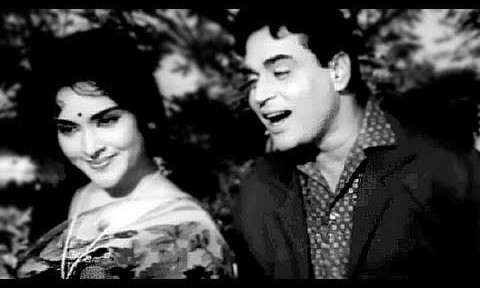
The Madhuban Dam amd Ban Ganga Lake are great tourist attractions at Silvassa. Ban Ganga Lake is a paradise for nature lovers and its scenic beauty, serenity and lush verdure around it have inspired many scenes, especially song sequences in Hindi movies. The following pictures may trigger memories of those scenes:

Ban Ganga Lake – the scene of many songs from Hindi movies

Lake, trees, and a boat….and that too sun coloured. What more do you want? Chand?

Scene around Ban Ganga Lake – makes you break into a song


180 kms from Mumbai and you are one with Nature all by yourself

And, if there is flora, fauna can’t be far, is it?
Around Ban Ganga lake in Silvassa, you can go on a wild-goose chase and enjoy it

You’d love being ashore……..
—–and love looking into water

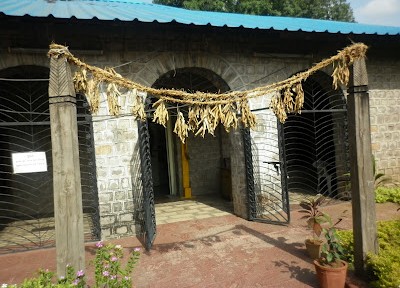
Adding to the scenic beauty is the Silvassa Museum or the Tribal Museum. It has some imaginative displays that give one glimpses into the tribal culture through a collection of masks, musical instruments, traditional jewelry and hunting tools. You can also see Warli paintings and traditional crafts and even buy this stuff. Have a look in the following pictures:

Entrance to the Silvassa Museum

Some of the displays in the museum:


Alright, I must have already convinced you to visit Silvassa. There are Lion and Deer safaris to be had. The tourism brochure gives you a number of choices in eco-tourism, agri-tourism, tribal culture, wildlife, water sports etc. And all this is just 180 kms from Mumbai.

Thirty kms from Silvassa, on the other side of National Highway Number 8 between Mumbai and Ahmedabad is the Union Territory of Daman. Just like the UT of Dadra and Nagar Haveli, Daman too has an impressive entrance:


Entrance to the Union Territory of Daman

Just as at the entrance of Dadra and Nagar Haveli, the tribal or indigenous people have been show-cased. This statue of a fisherman greets you at the entrance:

Memorial to the common man – a fisherman at the entrance to Daman

A Portuguese Diogo de Melo arrived at Daman, by chance in 1523, when heading towards Ormuz but caught in a violent storm and having his boat blown towards the coast of Daman. Soon the other Portuguese arrived and made it into a Portuguese colony. It remained so till its merger into Indian state as a Union Territory in 1961 when a pitched battle took place between the Indians and the Portuguese that left four Indian and ten Portuguese dead and more than a dozen wounded. Just a km from the entrance is a monument of the multi-masted ships that the Portuguese used that gave them more speed and maneuverability than the Indian or Arab craft with a single mast. Hence, they were able to overpower the indigenous Indians or the Moghuls that ruled over great parts of India. The neglect of the sea-power in India led to our subjugation. However, until recently this simple fact escaped our collective attention. Portugal didn’t recognise the merger or annexation of Daman with India until 1974, one year after I had joined the Indian Navy.

Multi masted ship, a symbol of Portuguese sea power

Daman is divided by the Daman Ganga River into two parts namely Nani Daman (Nani means “small”) and Moti Daman (Moti means “big”). We entered through the Moti Daman and in our fleeting visit, as given in the title, we didn’t go across the bridge to Nani Daman. We were also told that despite its name, Nani Daman is the bigger of the two [parts of Daman and has shopping complexes, residences and other public utilities. Moti Daman, on the other hand turned out to be quiet, sleepy, devoid-of-activity town.

The bridge between the two Damans – Nani (small) and Moti (large)

Earlier there were two bridges; one for light vehicles and other for four-wheelers and above. The light bridge collapsed in Aug 2004 killing 8 school children. It was re-built but hat two collapsed. In addition to the sole bridge now, there are small boat ferries between the two Damans.

The ferry points on either side are visible
The river side memorial
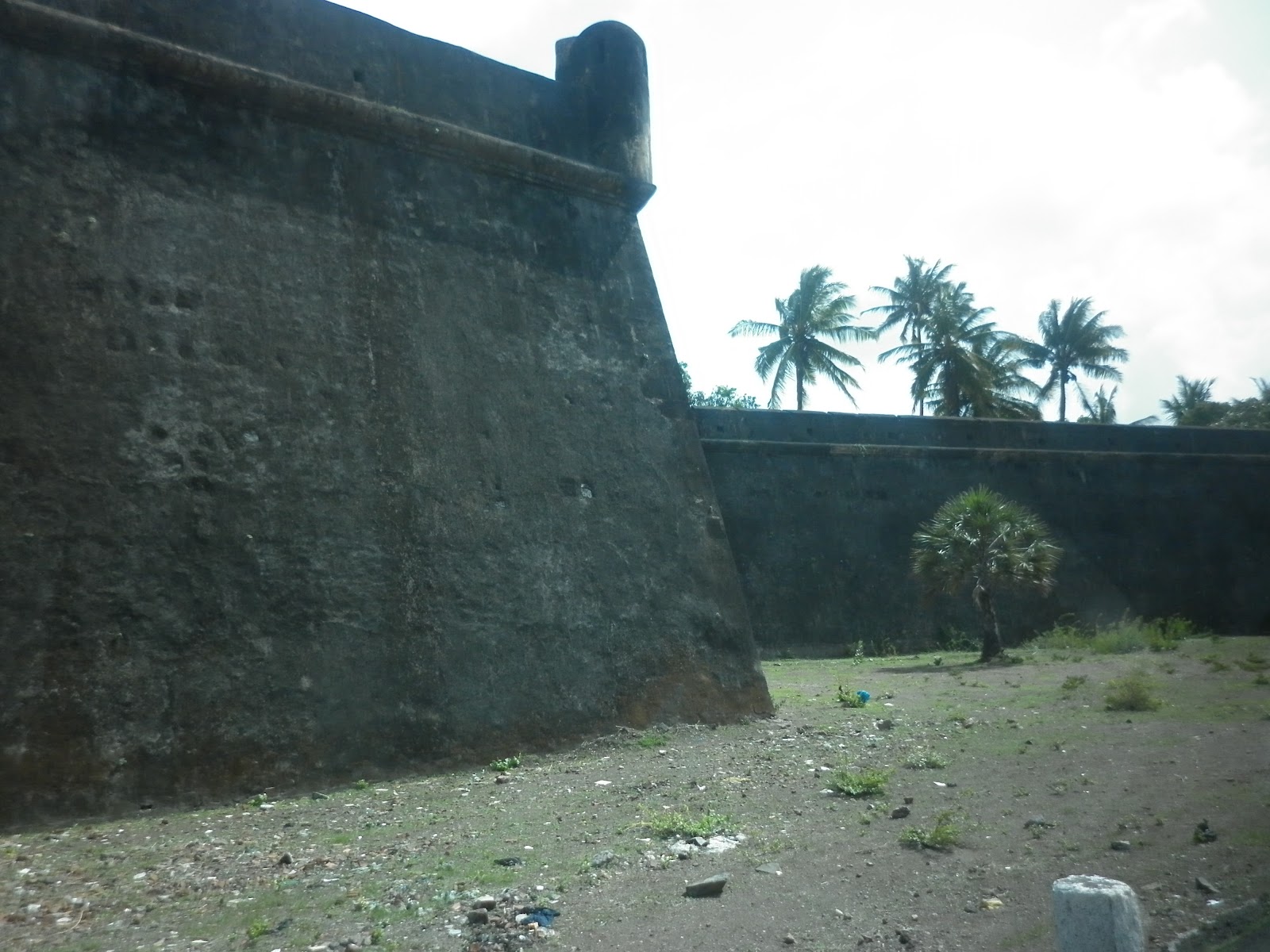
Soon after the Portuguese arrived, they built a fort in Moti Daman to guard against the Mughals who were in the area before the Portuguese. You can see from the pictures below that the fort still stands after four centuries. It is lit at night.

Photo taken at the river side resort and showing the entrance to the Fort
As we started going around the fort from the North side, we say the black and white painted Lighthouse through he fishing boats. The Lighthouse has a radar above it.
We started our journey along the outer wall of the fort towards Westwards.

And very soon we reached the lighthouse:

The Daman lighthouse with radar antenna atop it

The old lighthouse inside the fort

Travelling south from the new lighthouse with is entrance
Going along the south side of the fort
The villagers next to the fort – predominantly Hindu


Another view of the fort

Back to the other entrance – ie, the South entrance

The total population of Daman is still less than a lakh. Its literacy rate is 76 percent, which is better than the rest of India. Most of the population in Daman consists of skilled and educated migrant workers (from all over India) who reside in Daman for a period of around 4 to 5 years. The local population consists of mostly fishermen called Tandels in Gujarati. The major part of the population is a mixture of Hindus, Muslims and Christians, with Hindus being dominant in number. There has never been any communal violence reported in this area. Unlike Goa, you don’t find ubiquitous crosses, niches with Mother Mary and Jesus statues and chapels everywhere. On the other hand there are temples, the most popular being Satya Narayan’s.

There are many temples in Daman

The Portuguese history of Daman, which has given it the present unique lifestyle, still revolves around Roman Catholicism. Surprisingly, two out of the three famous churches that we visited are still in use. First we visited the Church of Bom Jesus. Here is from Wikipedia, “This early 17th Century church dedicated to Bom Jesus is one of the most impressive holy places in Daman. It was completed in its present form in 1603 AD and is a living tribute to the excellence achieved by Portuguese architects and artisans in ornate and intricate Church buildings. The richly carved doorway and the highly, decorated interiors together with the lofty ceiling are aesthetic and pleasing. There are six finely made statues in the best traditions of Roman Church art and architecture. In early days of the Portuguese rule, Bom Jesus was a parish church. The Church now attracts both tourists and pilgrims in large numbers”.  You can also read some history from this signage:

Whilst structures that are made of stone are still in good condition elsewhere in the country (especially of ancient Hindu temples), it was nice to see a brick and mortar structure still standing with its old glory:

The facade of the 1603 church of Bom Jesus in Moti Daman
Some more description of the church
Ornate interior of the church. Services are held even today
A view of the pulpit and the original side door
A view of the altar, apse and the tabernacle in the church
As you come out of the church, on the eastern side you see the main street of Moti Daman and it is lined with exquisite green lamp posts:


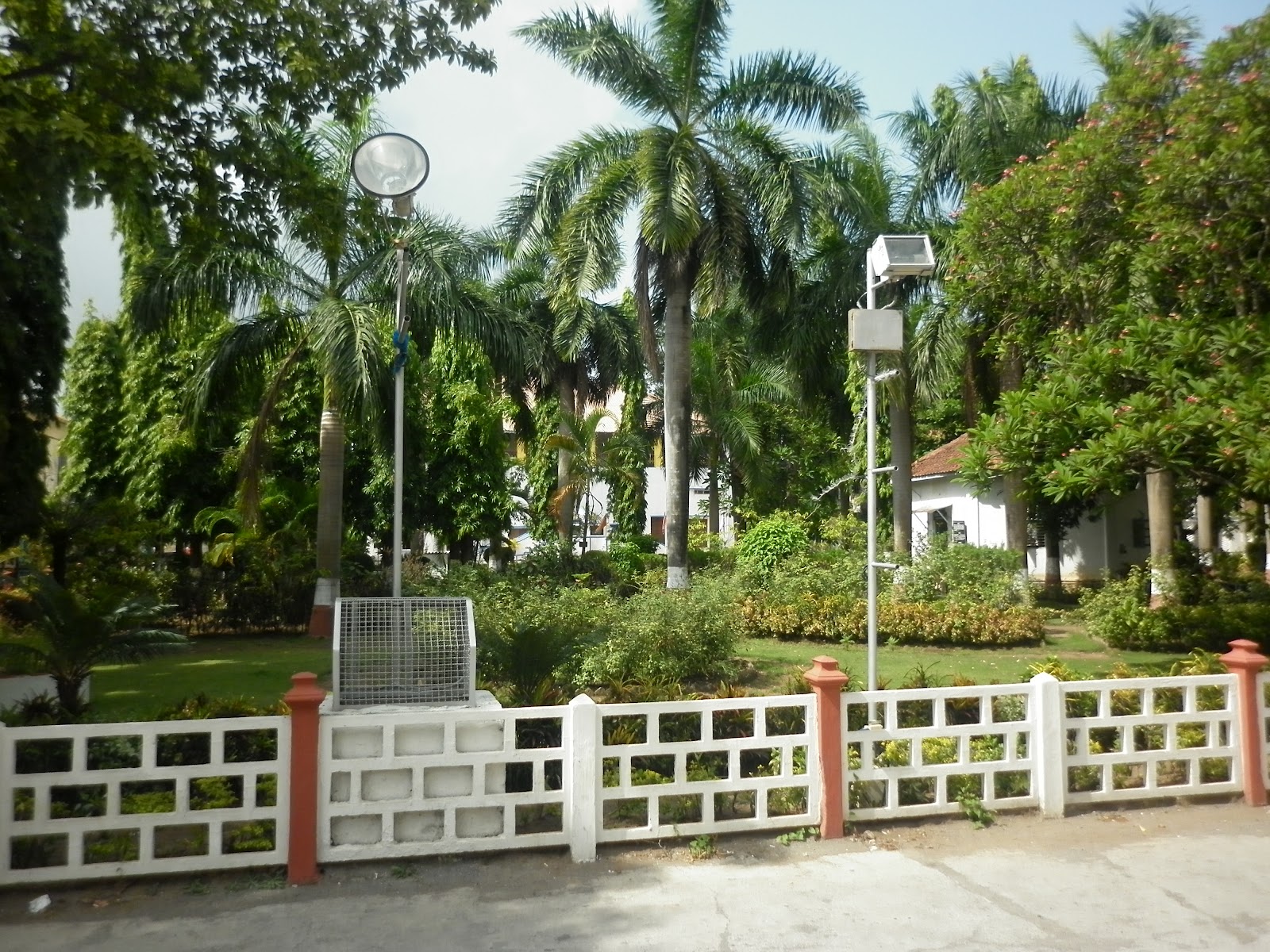
Garden between the church and the old Collectorate

Another old Portuguese building – now a government office

Because of this being a hurried visit, we missed seeing the Chapel of Our Lady of Rosary, also built during the beginning of the 17th century. However, what we saw was  the Church of The Lady of Remedies. Its beauty left us gasping for breath. It is partly Gothic and partly Byzantine and has beautiful interior and original frescoes. Please look at the following pictures; the church is currently in service:

Description of the church both in Hindi and English
Facade of the Church of The Lady of Remedies


The church building: typically Iberian


The ornate interior of the church
Painting dating back four centuries
Exquisitely carved pulpit
A fresco dating back to 1607

The stone at the altar dating back to 1816
Altar
Towards left of the altar
And to the right

One of the doors of the church
Another door
Church bell
Right exterior of the church

Left wall of the church and the only addition to the church after Portuguese left
that is, the memorial hall on left
Inscription on the memorial hall

The other places that we visited are:

The new Secretariat building inaugurated by Sh PM Sayeed, Union Minister of State for Home in 1993


The new Collectorate
A memorial at the park close to the Secretariat

What we didn’t see was the vibrant life at the beaches of Daman during the weekends, the night clubs, casinos, spas etc. Easy availability of cheap liquor has made Daman as the quick get-away for people especially Gujaratis who are otherwise denied liquor due to prohibition. Daman attracts frequent tourists from Vapi, Bhilad, Valsad, Surat and even Vadodara. The two well known beaches of Daman are Devka beach in Nani Daman and Jampore beach at the entrance of Moti Daman. One passing thought: if ACP Dhoble has his way, very soon we may have even Mumbaiites travelling all of 200 kms to be at Daman to a watering-hole.

THE BASTARD

All characters in this story are imaginary and bear no resemblance to anyone dead or alive. All incidents except historic incidents are fictitious. Names of places and some historic events are actual but are only incidental to the story and not purported to convey specificity of places, events, organisations etc.

1

It wasn’t easy being a bastard child. In the school he came up with – what he thought as – clinching excuse that his father died saving a wounded soldier during the last war. However, gradually he knew that he knew as much about his father as other children knew about God; no body had seen Him but they believed that He existed.

The war connection – his mother once told him – was indeed correct. She, however told him that he didn’t save a wounded soldier; he was the wounded soldier, or, to be exact, the wounded airman. She saved him whilst her husband was away fighting at the border against his father’s country.

It was the darkest of the dark nights, made more dark because of the black-out against attacks from the air by the Pakistan Air Force. They had to maintain total black-out out not only because of their personal safety but also because the closeness of her village Rangarh to Indo-Pak border at Attari. Whilst lights on either side of the border would help the pilots, total darkness would disorient them in some way. She had gone to sleep early since, she told him, she was scared to remain awake. It was cold and she felt safe pulling the quilt over her head, which not only provided warmth but muffled the piercing sounds of the fighters and bombers at night. Two nights before, she was informed by the other villagers, one of the PAF pilots baled out of his burning plane and landed on the kotha (house top) of Jagtar Singh’s house. Jagtar was an octogenarian but patriotism, intensified by the war, had bestowed a certain degree of sprightliness and presence of mind in him. So, before the hapless pilot could extricate himself from the parachute and the stunning landing, Jagtar had inverted a bucket over his head and screamed for help. The vigilante group of young men of the village had then taken charge of the pilot and handed him over to the police. Jagtar and the young boys had emerged heroes. However, Kunti, his mother, had wondered, with some justification, what on earth was Jagtar doing on the kotha on a dark winter night (In their village, and in other villages of Punjab, it was customary to sleep on the clay roof top only during summers).

Anyway, since then, Kunti carefully latched up the door to the staircase leading up to the kotha of her own house as well as the front door. On that night, it was the front door of the house on which she heard urgent knocking. When she heard it, for quite some time, her reaction was that it couldn’t be. Surya, her husband had left just a month back, his leave having been cut short with war clouds gathering between India and Pakistan. He couldn’t have been sent again on leave so early. She tried to go back to sleep thinking that the breeze was playing tricks. But, anon, there was urgent metallic knocking and not the careless work of the incessant breeze. She slipped out of the quilt, put on her chappals and donned her dupatta over her salwar-kameez and rushed to the wooden front door.

“Kaun hai?” (Who’s there?) she challenged the intruder.
“Pehle kunda tanh khol kudiye, pher dasdanh haan” (First open the door, lass, and then I shall tell you)

This was not to her liking at all. Calling her a lass was understandable; she was married less than six months back at the age of sixteen, the age at which most of her friends and relatives got married. So, indeed, her voice had given herself away that she was still a girl in her teens. However, that she would open the door for a stranger, in the middle of night, in the midst of war, would be a wrong assumption on any one’s part, even if he knew Punjabi, her mother tongue. She picked up fresh courage thinking of her husband Surya in the Indian Army and said in no nonsense, yet girlish voice:

“Main nahiyon kholna kunda” (I will not open the door)
“Tera biyaah ho gaya hai, kudiye?” (Are you married?) The voice across the door asked her.

Before she could deny, and since all through her childhood, she had been brought up to always tell the truth, she accepted it straightway by saying, “Ji; aur oh border te ladan waaste gaye ne” (Yes, and he has gone to the border to fight)

“Kudiye, mere pichhe bande paye ne. Main Pakistan Air Force wich haan. Zara soch, je tera ghar waala Pakistan wich qaid hone waala hoye tanh tu nahin chawehngi koi usnoo bacha lave?” (Lass, men are chasing me. I am in Pakistan Air Force. Just think, if your husband was running not to get himself imprisoned in Pakistan, won’t you wish someone would save him?”

She involuntarily shuddered when he mentioned Pakistan Air Force. But then, she instantly thought of Surya too, imagining him heavily wounded and bleeding, knocking at the door of some Pakistani woman. Only she could save him from sure death. Her mind was immediately made up and she lowered the chain latch from the door. One side then opened with his incessant pushing. He nearly fell inside the veranda but steadied himself and sat on the manji (a cot made from hemp rope and bamboo frame).

“Chheti buhaa band kar lai. Ate je koi puchhe tanh keh dayin tu kalli hain.” (Quickly latch up the door and if anyone should ask, tell them you are all alone) He instructed her.

He was fast becoming unconscious. So first thing after latching the door she took him inside and made him lie down on her palang (bed), covered him with her rajaai (quilt) and offered him some water in a copper glass. He drank and asked her to look at him briefly with his pen torch. He was boyish, less than twenty-five she decided; probably about twenty two or so (“why did he call me a lass then when he was himself a boy?”) She hadn’t looked at men’s faces closely other than of her own husband and her brother. However, she instantly knew that even though he was bruised and pale he was handsome. He was in his flying suit and boots and then she noticed the area around his midriff where a lot of blood had oozed out and congealed there with the thick fabric of the flying suit. By this time, exhaustion had got him totally and he was knocked out on the bed with his booted feet resting on the floor.

She went close to his face and heard his breathing and reassured herself that he was still alive. She was just taking out his flying boots when there was incessant knocking on the door and some voices. She had the presence of mind to respond after a gap of nearly a minute. From the veranda she shouted, “Kaun hai?” (who is there?)

One of the vigilante boys shouted back that they were looking for a PAF pilot who baled out of his burning plane and whose parachute was discovered in the bushes near the pond. He asked if she had heard or seen him. Kunti shouted back that she was sleeping and that she was alone and she had both her doors latched and there was no question of anyone coming inside.

The boys left with an instruction to her to be vigilant.

She returned to the bed and holding the pen torch between her teeth she removed his shoes with some effort and then the socks. She found the zipper of the flying suit from his neck to his legs but it was difficult to see the wound because the congealed blood had made it stick to the skin. She took the thermos flask next to her bed wherein she had kept warm water for her for the night and dipped the end of towel in it and nursed the wound. It was deep and the bleeding recommenced after her nursing. She went to the cupboard and took out a bottle of Dettol, drenched the towel in it and applied it to the wound. He got up wincing with the pain and instructed her how to nurse his gash. Since the towel was already spoiled she tied it around his wound and then let him sleep. She had to sleep on the floor sandwiched between two quilts she got from the other room. In the night he winced with the pain several times but didn’t get up.

2

The dawn presented its own problems. As she got up she saw the mess around. Anyone coming in would know what had happened; many times the neighbourhood women came to pass the time; then there was the jamadarni (sweeper woman) who would come to take the night soil from the latrine. Kunti mopped up all the blood and swept the clay floors, bathed, said her morning prayers, switched on the small Bush transistor Surya had got from the army canteen and listened to bhajans (hymns) being broadcast in Vividh Bharti’s morning programme, got the chulha (village stove) going with gobber (compost) pies burning in it. She made a glass of tea and took it to him holding the hot steel glass in her dupatta. He was still in pain and could not get up on his own. She helped him up and perched him against the bed rest with a tasseled and embroidered pillow stuck between his back and the bed rest. He confirmed that it pained a lot as he sipped the tea.

She hurried him with the morning ablutions even though he could hardly move telling him that once the jamadaarni came, he should be in the other room. All went well except the jamadaarni pointed out whilst carrying out the night soil, “Tid tanh thuada theek hai ke nahin?” (Do you have a tummy upset?). Anyway, she was paying her all of ten rupees a month and it wasn’t for her to point out the bigness or smallness of the job involved. She could have been with her husband.

Later, the PAF pilot told her that his name was Haneef Mohammad and he was flying a F-78 Sabre jet when it was shot down and he had baled out. He had taken off from the air base of Sargodha in Pakistan. She asked him innocently and he agreed that if he had not been shot down he would have bombed their village and wiped out many innocent lives probably including hers. She was only sixteen but having been told Mahabharata and Ramayana stories by her nani (maternal grandmother), when she was small, she knew that fighting was a person’s calling just as being a housewife was hers.

Haneef instructed her what to get from the village chemist to nurse his wound properly. The only problem was that in that small village, the hakeem (chemist) would be too suspicious to supply her with those items. So, they decided against it. She, therefore, took a little bit of his half dried blood, soaked a make-shift bandage in it, tied to her finger and went to the hakeem to buy dettol, and some pain killers and cotton. She boiled some water and cleaned up the wound as best as she could with Dettol. She fed him some breakfast of roti and achaar and milk and gave him a pain-killer. So, when the neighbourhood women came to chat with her, he was fast asleep in the room on her palang (a cot with nawaar or taped coarse cloth) whilst they sat on the manji in the veranda. The talk was all about the plane having been shot down by the ack-ack guns in the night and how it had totally burnt after it hit the ground. They had thought the pilot had got burnt with the plane but later they had found his parachute. He could be anywhere, the women said. All other news was how good the Indian forces were doing on all fronts and had “nearly reached Lahore“.

Later, she asked Haneef about his plans. He said it would take him at least a week to recuperate and literally begged her to keep him there.

Having given him shelter, she had no choice. ‘Atithi devo bhava‘ (Guest is like god) is what her nani had taught her.

His needs were very little. He told her many stories of the war and about Pakistan. But, however hard she tried, he didn’t open up about himself and his family. He carried a picture of himself in his wallet and when she asked for it, he gave to her to keep. He was a devout Muslim and said his prayers five times a day.

She had no difficulty about keeping him there. After the first day, everyone had lost interest in his whereabouts especially since a bloated dead body was discovered in a flying suit in the nehar (canal) in the next village and everyone assumed it was that of the one who had baled out near their village.

The night before Haneef left, until late in the night Kunti and Haneef lay in their separate beds. She was, she knew, sad to let him go. When Surya was away, she had someone to talk to, someone to help in the house, someone to share her loneliness with; a lass of sixteen who had been with a man – Surya – only too briefly before he was called for fighting at the border. If only he were not an enemy, she would have been quite fond of him, she thought.

She turned in her sandwich of quilts. She heard a whisper from the palang, “Neend nahin aa rahi?” (You ain’t able to sleep?) She decided that if she answered immediately it would give her away. So she took her time and answered, “Nahin aisa tanh nahin hai.” (No, it isn’t like that). “Ute aa ke kyun nahin let jaaundi?” (Why can’t you come up and sleep?), he asked her. She replied immediately, “Nahin, eh galat hai” (No, it is wrong). “Marna bhi galat hai, ladaai bhi galat hai; theek ki hai?” (Death is wrong, war is wrong; what then is right?) he philosophised.

She had much more resistance than that. He’d known this in the last six days of being there with her that her nani had given her immense character. However, after many hours when he whispered from the bed, “Mainu pyaar ho gaya tere naal. Mera jaanh wich dil nahin hai” (I have fallen in love with you and I don’t want to leave). She whispered back, “Eh galat hai” (This is wrong).

But, she lacked conviction and he got down from the bed, lifted the quilt from her and carried her in his arms to the bed.

3
Her parents came to stay with her during the pregnancy. The war had ended a few months back. There was no news from Surya, no post card, no inland letter. She prayed for him everyday even when she carried Haneef’s child in her womb. She was prepared to tell him that her pregnancy was the result of their conjugal relations on the night before he was called to the border. She prayed that the child would have resemblance to her more than to Haneef.

One day, she received an official looking registered letter. With trembling fingers she opened it; at the same time praying to all the gods that Surya should be alive. Gods heard her prayer; but, the news was as bad as the news she had feared: Surya had been declared missing in war. At the end of 1971 Indo-Pak War hundreds of armed forces men, from both sides, were declared ‘missing’. This meant that the fact of their being dead or alive couldn’t be ascertained beyond reasonable doubt. Many years later, for example with Rajjab Ali of 8 Rajputana Rifles’ Charlie Company, many were found in the prisons of the other side even when they had been declared ‘martyred‘.

She was inconsolable with the news. She had become a half-widow at the age of seventeen. Her first reaction was that the reason why Surya was missing was because of Haneef’s country waging a war against India. And yet, not only had she helped Haneef, an enemy pilot of the same country recover from his war injury but had also helped him escape. She had taken him in the evening to the village temple in her husband’s clothes. He carried his flying suit and ID papers in a bag with him. This didn’t invite any suspicion since many people would gather at the temple on occasions and pray together for war to end and for their and their relatives’ and friends’ safety. After the kirtan (singing of hymns), Haneef had just slipped into the temple vaatika (garden) and that’s the last she ever saw of him. Since, there was no news later of his discovery or being killed, she knew he must have crossed over the no man’s land between the two countries that was reputed to be heavily mined.

It was in September 1972 that she gave birth to a bonnie boy. Her parents were ecstatic and so was she. Her penury condition had become better at that time because the army after having waited for six months after the war had declared her husband dead so that she would be entitled to pensionary benefits (of a person killed in war) and other claims. Also, she had inherited some money after her nani‘s death who had willed her everything being her favourite grandchild.

When it came to naming the child, there was consensus amongst the family and neighbours that he, being the son of Kunti and Surya – as in Mahabharata – should be named Karan. Only she knew that he could very well have been named Kareem.

Unfortunately, Kunti’s prayers regarding the likeness of Karan to her hadn’t come correct. Surya and Kunti both were dark complexioned but Karan was fair like Haneef, and ruggedly handsome. Indeed, when he was of the age when he could play with other boys, they all teased him that he couldn’t have been born to Kunti and Surya or anyone from their village Rangarh and that most likely he was haraami (bastard).

By the time Karan was in his seventh standard, two things were prominent about him: one, he was very bright student; and two, he was totally fed up of the abuses hurled at him about being a bastard child. When boys visited his house, he’d proudly show them Surya’s garlanded picture in a soldier’s uniform. But, the abuses continued.

On the day, Karan stood first in the whole of Punjab, in his matriculation state board examination, he received the usual jealous and distasteful remarks from his class mates, “Haraami chahe badmash di aulad hai per laik kaafi hai” (The bastard may be a devil’s son but he is very intelligent).

On many occasions, he had asked his mother about his father and she kept saying that he was Surya’s son. However, on the day when  his matriculation exam results were announced, he had been emboldened to not just ask her but also reason out with her. He started by saying that he had no resemblance with Surya. She said it happens sometimes. He asked how was it that he hadn’t heard much about him. She said that was due to the fact that he was killed before he could see him, his child. He said that he didn’t even resemble her. She said that too happened sometimes.

Finally, he weighed it in his mind; it was one thing to be suspicious and it was yet another thing to be confronting her, his own mother, the mother who had sacrificed everything for his happiness and provided him good education and facilities (with the money she had got from the army, his mother had opened a sewing center in their residence whereat three girls worked for her from 9 AM to 5 PM and stitched the clothes that his mother cut and designed. These were then sent for sale to Amritsar).

Nevertheless, curiosity got the better of him and he told her, “Per maan tussi ik chhoti photo her waqt dekhde ho jadon thuanu lagda hai ke main nahin dekh rahiya.” (But, mother, I have seen you looking at a small picture when you think I am not looking).

Kunti finally succumbed, burst out crying and told him all about Haneef. She told him that he was a very nice man, very handsome, thorough gentleman; but, had now crossed over to his home-country Pakistan. She showed him the dog eared picture of Haneef.

As Karan lay in his bed that night, he kept thinking about the incident of the Sabre jet, the baling out of his dad, the mental condition of his sixteen years old mother, and the atmosphere of the night before his father left for Pakistan. Finally, when he went to sleep in the wee hours of the morning, he forgave his mother. But, he wondered whether Haneef would still be alive and would he recognise his son from across the border…..so that he won’t be haraami any more. His picture was now imprinted indelibly on his mind’s slate.

4

It was the first major anti – terrorist operation for Karan Singh of the National Security Guard in his home district of Amritsar. He was just fourteen when NSG was formed as a special force for counter-terrorism activities post learning of lesson during the 1984 Operation Blue Star to flush out Jarnail Singh Bhindranwaale and other terrorists from the Golden Temple at Amritsar. Karan was deeply religious as brought by his mother’s teachings but the use of the Golden Temple for terrorist activities and subsequent shooting down of the Indian Prime Minister by one of her own security guards, Beant Singh, in retaliation against her having ordered Operation Blue Star had a deep impact on Karan Singh. So, whilst, young men from his area dreamt of joining the army, Karan was focused on joining the army and later to become a NSG commando or a Black Cat. His resolve was strengthened when in end April 1986: 80 officers, 180 JCOs and 1,500 NSG commandos participated in clearing the Golden Temple in Operation Black Thunder I. The temple was cleared and handed over to Punjab Police on 1 May 1986. There were no casualties on either side.

By the time in May 1988, Operation Black Thunder II was conducted that resulted in the killing of 30 terrorists and surrendering of nearly 200, Karan had finished his schooling. One year later, Karan appeared for the Union Public Services Commission (UPSC) examination for National Defence Academy at Khadagvasla near Pune. He topped the merit and was called for interview at Services Selection Board, Meerut. Three days of grueling tests and he was to undergo a detailed medical examination. When he was selected, he knew that joining the Army (Infantry) was for him only a step towards becoming an officer in the NSG.

During the three years training at the NDA and one year at IMA after that, the one person that he missed most was his mother. She was the person always closest to him and he worshipped her. When he was to pass out of NDA, she came to NDA to witness the passing out parade and Karan receiving the President’s Gold Medal that made her very proud of him.

After being commissioned into the army, Karan opted for and got selected in the special forces and was employed in J&K to counter the insurgency there. After a few years of this, as was his desire, he was selected to be part of the National Security Guard. He liked the ring of the title ‘Black Cat’. He felt proud of being part of the elite Special Action Group (SAG).

Karan’s first major operation was in July 1999. Two terrorists had attacked a BSF camp near Srinagar, killed three BSF officers and wife of the fourth one and had taken 12 hostages. The orders given to him and the team that he led was that no harm should come to the hostages. BBC and various Indian news channels showed the stand off nearly live. Later when Karan saw the footage, it appeared to him that the NSG were shown in poor light even though it was a very successful operation. It was all due to the fact that the two terrorists were holed up for nearly thirty hours and the news channels, without even understanding what was involved in the operation, appeared to give a verdict that it was shameful for so many of the Indian security forces to be pitched against just two terrorists for nearly thirty hours. The general feeling was that the Israelis would have done it neatly and much faster. Such perceptions irked Karan and he resolved that in the next operation, he would be more pro-active to seek results quickly. No one dared call him a Bastard now that he was an officer, but, every time Karan read the word or heard it, it hit him hard that he was actually one until he would find his dad. However, any active campaign on his part to find his dad would give him away; as also spoil the reputation of his mother whom he loved immensely. In J&K, he had interrogated many captured terrorists; some who had taken to terrorism after being in the Pakistan armed forces; but, no one had heard of a pilot named Haneef Mohammed and what had happened to him after the 1971 Indo Pak War.

5

Karan would never forget the date of 24 Dec 1999. He wished it had turned out better. The whole nation thought of it as a botched up operation. He, and others in NSG, however, knew that they tried their best. And, if at all anything was lacking it was the decision making at the higher levels; the delayed decision making, that is. In any case, he wasn’t thinking about the anti-hijacking operation launched by he and his team. He was talking about him whose life he could have saved. That morning, he got up early as usual and went through the demanding physical fitness routine he had set for himself. At Manesar, in Haryana, they were to listen to a lecture and witness a demonstration on counter-terrorism techniques by a German team. He looked forward to both. NSG having been modeled on Germany’s GSG 9 (Grenzschutzgruppe 9or “Border Guard Group 9”) was fortunate to receive periodic inputs from it. It was a grueling day since the Germans were really professional. In NSG, as Karan knew, there was never an easy day. However, as the day was ending, he was about to heave a sigh of relief. And then, there was a beep on his secure communication set. They were seeing the last part of the German demonstration on the ground. The next day, Christmas Day, was a holiday. He had planned to take a vacation until the New Year and spend sometime with his mother in their village. Seven more days, he thought, and it would be another millennium. How many people can boast of being there for the ending of a new millennium and beginning of a new one? The beep was an urgent communication on the most secure set. Within an hour Karan and his team were heliborne to land at Raja Sansi airport at Amritsar. The Indian Airlines Flight IC 814, with 178 people on board, had been hijacked immediately after take off from the Tribhuvan International Airport in Kathmandu, Nepal. It was to head for Indira Gandhi International Airport in New Delhi, India. Captain Sharan was in command. Karan was getting regular updates. It was late in the evening, at about 17:30 P.M. that the plane had entered Indian airspace. The hijackers had demanded from Captain Sharan that the aircraft be taken to Lahore. They reached overhead Lahore when it was night and dark and they were low on fuel. However, the authorities in Pakistan had turned off all lights at Lahore airport as Pakistan didn’t want to get involved with the terrorists and the hijackers. Captian Sharan had told the hijackers that the plane was now really low on fuel and had to land at Amritsar. And, that’s why Karan and his team were on their way to Amritsar. The country held its breath. Luck didn’t appear to be on the hijackers side. Now that the Flight IC 814 had landed at Amritsar, there was a chance that Indians would be able to stop the flight taking off further. The Crisis Management Group had had an emergency meeting in Delhi and it was decided to refuse the aircraft’s request for refueling. Decision had been taken to immobilise the plane.

The MI-8 helicopter carrying them to Amritsar was taking much more time than they had planned. This was one occasion when the entire country was waiting for them. Karan thought of giving the country a beautiful Christmas gift: rescuing the hostages without a single casualty and apprehending the hijackers. He was fully alert and so were his men. With a large sketch of the aircraft he was giving instructions to his men about how to storm the aircraft.

He knew that the Punjab Police won’t be able to do anything. He wanted the negotiating team to buy time till the time he and his team landed at a heli pad nearby and then were taken to the airport. The CMG had meanwhile instructed the Punjab Police to have a sharp shooter immobilise the aircraft by shooting at its tyres.

It was becoming extremely difficult at the Amritsar ATC not to heed the request of the hijackers for refueling the aircraft. They were already threatening to shoot one passenger at a time. All that the ATC could do was to tell the hijackers that the fuel was being arranged since there was no earlier requirement and hence provision for night-fueling at Amritsar. Every five minutes of else the hijackers would boom, “Aur kitna time lagega? Hum passengers ko shoot karne waale hain.” (How long more it would take. We are ready to shoot the passengers).

The pilot of the MI 8 was signaling to Karan that they were landing. All the men and their weapons and ammunition were promptly put in a vehicle and they were on their way to Raja Sansi Airport. He was receiving continuous instructions on his walkie-talkie about storming the aircraft through the fuel-tanker that was being sent to refuel the aircraft.

At the ATC, there were overalls waiting for them, the ones usually worn by the air fueling teams. These included red helmets. He squeezed in the seat besides the driver. Two other Black Cats squeezed in the cabin whereas others were hanging on the side, with slings and hooks,  not visible from the aircraft.

As the tanker sped towards the aircraft, Karan thought of the glorious moment. Once the refueling started and he and his team of intrepid commandos hid in the belly of the aircraft, half the rescue work would be over. The other half would be when they’d cut their way upwards from the belly and storm the aircraft at least at two places to take the hijackers off guard. The team at ATC told them that they were able to establish that there were 3 to 5 hijackers on board.

But, why was the tanker driver going so fast? Before Karan could tell the driver to slow down, the ATC on his radio set asked him to slow down. This was quite a sight: at one end of the runway was this Airbus 300 aircraft seemingly ready to take off. From the other end a speeding fuel tanker was approaching it. Karan felt that the tanker was still going too fast. His boys needed time to carry out their plan. Also, speed was not particularly suitable for hanging at the back of the tanker for dear life.

Already, from the voice at the ATC, Karan could make out that a lot of rethinking was going on. He won’t have been surprised if the CMG from Delhi was busy passing instructions by the minute. Why couldn’t they simply trust that the NSG, with its motto ‘Sarvatra Sarvottam Surakhsha’ or ‘Best Protection All Round’ would be able to do its job well? They were highly trained for just these kind of contingencies. A fledgling organisation like the NSG needed such high risk operations to earn and build on its fierce reputation, Karan thought. But,  firstly, they had reached very late and the patience of the hijackers was at its lowest. Secondly, still there were doubts about the success of the venture.

To his utter frustration the ATC asked the tanker to slow down further. It was as if the tanker was now being remotely controlled. Karan thought the driver got panicky and instead of lifting his foot slightly from the accelerator, he screeched to a halt.

Sensing that the Indians were up to some tricks, in the aircraft, a Hijacker who called himself Doctor stabbed a passenger called Rupen Katyal several times. Captain Sharan was given orders to take off despite further protests from the ATC.

Suddenly, Karan and his team saw the aircraft coming towards them and even when they ducked for cover the Flight IC 814 took off. It was so close, it could have hit the tanker and they would have all died.

Finally, Flight IC 814, with hijackers on board, had taken off without refueling but also without the Indian authorities having been able to stop it.

As Karan up-righted himself, he wanted to ask the driver why did he panic and screech to a stop when all that he was being asked was to slow down? This one act had warned the hijackers that there was something amiss about the tanker approaching. It was as if the driver had somehow managed to warn the hijackers about the impending storming of the aircraft by the Black Cats.

He turned towards the driver. One look and even through his beard he recognised him: Haneef Mohammad, his father. He couldn’t control himself and muttered under his breath: “Bastard.” His eyes had extreme hatred in them for seeing his father after years but seeing him as a helper of the terrorists, as an enemy who would always be on the other side.

The driver heard the word ‘bastard’, saw the look of hatred in the eyes of the young commando, opened the door and jumped out of the tanker. Karan jumped out of his seat at his end. Whilst jumping out he had his Browning 9 mm pistol out. Haneef had started running now. He was still trying to figure out as to how did this young man guess about his having warned the hijackers by his suddenly stopping the tanker. Surely, everyone else would have taken it as justifiable confusion on the part of the driver.

Karan shouted, “Stop” but Haneef kept running.
Karan shouted again, “Stop or I’d shoot.”

Still Haneef kept running. Karan now aimed low so as to injure Haneef in the leg and stop him. But, at this juncture Haneef slipped and whilst falling forward the 9 mm bullet hit him in the back.

By the time Karan caught up with him, Haneef was breathing his last and there was blood everywhere. He turned him around to face him. He was still very handsome. He wanted to save him and call him “Papa” or “Dad”; but, it was already too late.

Later, they took him away. The only regret Karan would always have was that his mother saved Haneef and gave him love and now he, Karan, his son, killed him. He had to kill him.

“Why did you have to run away?” he silently asked, thinking of Haneef at night, “Why couldn’t you live with us as a family, in love, in trust, and in peace?”
हर तरफ तेरा जलवा

फिर मुझे पुकारा है…..
तेरी चाहत ने, तेरी आहट ने
तेरी आवाज़ ने, दिल के साज़ ने
तेरी धड़कन ने, तेरी उलझन ने
तेरी साँसों ने, तेरे अश्कों ने
तेरी आँखों ने, तेरे होंठों ने
तेरे हाथों के गरम छूने ने
तेरी याद ने, तेरी हसरत ने
तेरे प्यार ने, तेरी उल्फत ने
तेरे दर्द ने, तेरे ज़ख़्म ने
तेरे हसीन ख्यालों के वहम ने
तेरी हंसी ने, तेरे रोने ने
मेरे ज़हन में तेरे होने ने
तेरी आँखों  की मधुर मुस्कान ने
तेरे दिल में उमढ़ते तूफ़ान ने
तेरी आहों ने, तेरी राहों ने,
मेरे आगोश में उलझी बाहों ने
तेरे लबों से थिरकते गीत ने,
जो मिल के बनाया उस अतीत ने
उन वादीयों ने जो हमारे संग बहकती थी
उस कोयल ने जो हमें देख चहकती थी
उन फूलों ने जिस में तेरे प्यार का रंग था
उन हवाओं ने जिनका हमें संग था
उन बातों ने जो कभी ना होती थी खत्म
उस अदा ने जिसने ढाया था मुझपे सितम
तेरी मस्ती ने, तेरी हस्ती ने,
तेरी गलियों ने, तेरी बसती ने
तेरी खुशबु ने, तेरे खवाब ने
ऐ मेरे चाँद, तेरी माहताब ने
हर तरफ शोर है, फुसफुसाहट है
हर तरफ  तेरे क़दमों की ही आहट है
मेरा बस एक ही सवाल तुझसे है रूबरू:
“किस की मैं सुनूँ और किस की ना सुनूँ?”

KILL ME, CARMEN

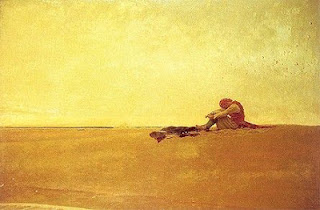
I stand still on a rock, my rock
And watch the roaring sea
Reaching out to me
To reclaim and drench my soul.
The sea is just the opposite of me:
Calm in its depths and clamorous outside.
I stare at the clouds
Both within and in the sky
As they change shapes and moods:
Now a king, then a horse
And finally a hatted witch
Alluring small kids
With her trickster candy floss.
I look at the light-house
Standing witness to and guiding
Ships and boats till miles
Through its white beams
Fading into barely discernible plumes.
I see the fishing boats
Returning from a crimson sunset
White gulls meandering around
Like bees on honey-pots.
I see the crabs camouflaged
And tentacled to the slippery rocks.
And then…
Through the salty atomized vapour
I see her; yes, her.
The hem of her long yellow dress
Playing wantonly with the wetness of the sea.
I see me, boyish and breathless
Walking beside her
To the small boat half buried in the sand.
We upright the boat
Drag it into the water
And whilst it still tosses, like my heart
I lift her up and put her on the seat
And yank me up to the seat opposite her
And row the boat
Into the fading evening twilight.
Resting my oars
I look into her eyes
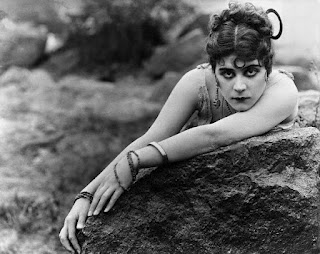
Ah, those kohl eyes
Of the fiery gypsy

Pic courtesy: en.wikipedia.org

Who stole my heart and left me
To be with her affable Escamillo.
Like an oar less dingy
I pitch and am adrift at sea
Of my precocious desires;Wanting to live
And longing to die.
Kill me………Carmen.

CLOSED UP ON THE BRIDGE

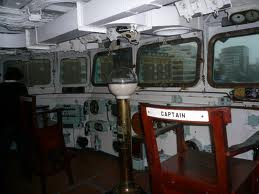
Bridge is a very sacred place for the executive officers on a ship; this is the place from where the ship is controlled navigationally and to some extent for exercises and operations. At sea, Bridge is the place that is humming with activity. There is a swivel chair for the Commanding Officer; irrespective of the rank, he is called ‘the Captain’. If the Fleet staff is embarked, there would be another swivel chair for the Fleet Commander who is of the rank of a Rear Admiral.

The ship’s routine is divided into ‘Watches’; viz, Forenoon Watch, Afternoon Watch, Dog Watches, First Watch, Middle Watch, and Morning Watch. Each watch is of four hours duration (eg, 0800 to 1200 hrs is the Forenoon Watch) except for Dog Watches, which are of two hours each (First Dog and Last Dog) so that in a three-watch system (the normal system on board during peace time) people won’t be doing the same watches over and over again.

The one officer in whose charge the ship is at sea is called the OOW or the Officer of the Watch. He may have an assistant OOW with him, communication staff, navigation staff etc. The Bridge is invariably supported by an Operations Room, which is normally a few decks below, from where all the ship’s operations are controlled (sensors, weapons and operations with other consort ships, submarines, helicopters and aircraft).

A Bridge is to a ship, what cockpit is to an aircraft (Pic courtesy: ww2db.com)

Bridge (Contract Bridge), as you know, is also a cards game. People are as passionately involved with Bridge, the game, as, say, golfers are with clubs, balls and holes. Indeed, Bridge is one game that competes with Golf over the number of jokes about the game and the players and of course their spouses. As a young Lieutenant I served on a ship that had, by a curious coincidence, over a dozen officers (nearly the entire officer complement) passionate about the game Bridge; and that included the Commanding Officer. So, after our sea sorties, when we would return to harbour, we literally secured from one Bridge (the navigational Bridge) and closed up on the game of Bridge. We used to have as many as three foursomes in the wardroom.

On one such occasion, the Fleet Commander was embarked on a sister ship. We came alongside first on a naval berth in Cochin channel and the Fleet Commander’s ship was still a distance off from coming alongside our ship. It is customary for the Captain to receive the Fleet Commander’s ship but seeing that she would take some more time to make its approach, our CO suggested that we don’t waste any time in closing up on our other Bridge in the wardroom. In our foursome, I was partnering the Captain. The first two games went one each between our opponents and us. In the third game, we got very good cards, and between the Captain and I we arrived at a contract of Seven Hearts, a grand-slam. Captain had to play the hand and I was the dummy.

It was very exciting for us since it is not everyday that you bid and make a grand-slam. It required a great deal of concentration on the CO’s part; to make the bid at least two finesses were required, one each from the East and West players. In the meantime, there was an announcement from the gangway that the Fleet Commander’s ship was approaching and berthing party was required to close-up to assist that ship in coming alongside us. The announcement was clearly heard in the wardroom too but our Captain who had just made two tricks only with eleven more to go was in no mood to rush up on the quarterdeck to receive the Fleet Commander.

Bridge game in progress (pic courtesy: en.wikipedia.org)

Imagining that the CO might not have heard the announcement, the Officer of the Day (In harbour, usually, the ship is in charge of an OOD as opposed to OOW at sea) sent a sailor down to tell him about the Fleet Commander’s ship approaching. By this time the game and hence the CO had become very tense. It required a great deal of dexterity on his part to have made four tricks and the grand-slam was nowhere near sight. Sailors are not allowed to enter the wardroom and it was a steward who conveyed the message to the CO. CO told him to convey to the OOD that he was on his way to the quarterdeck.

Meanwhile, we could hear a series of announcements on the main broadcast about Fleet Commander’s ship making its approach, throwing heaving line and eventually passing berthing hawsers. The Captain was also very close now; he had successfully made ten tricks despite the East and the West players trying to make his efforts abortive.

The Assistant OOD came running down to the wardroom that a brow (gangway plank) between the two ships had been secured and the Fleet Commander’s Flag Lieutenant (the Navy equivalent of ADC) had sent a message that the Fleet Commander would be leaving for shore shortly; and, since he’d be crossing our ship to do so, not only that our CO should see him off (as is the custom) but, (seeing that our CO had made no attempt to receive his ship) the Fleet Commander had expressed a desire to see our CO.

The CO successfully made the eleventh trick and now a smile had started forming on his lips as he sighted the first grand-slam in our wardroom (the one that would, no doubt, be talked about for months). He dismissed the Asst. OOD with, “Just tell him I am on my way.”

As the CO made the next two tricks, we heard the four pips (quartermaster’s pipe being blown sharply four quick times) on the ship’s broadcast indicating that CO was required urgently as the Fleet Commander was crossing our quarterdeck.

He had triumph on his face for a job really well done in securing the thirteenth trick as he rushed up and back to the quarterdeck. This was an experience not to be missed. So as the CO went down to quarterdeck from the starboard (right) side, I rushed from the Port side.

He reached the quarterdeck, took in a glance the about-to-burst Fleet Commander, saluted him and said: “Very sorry, Sir; we were still closed up on the Bridge.”

I don’t know whether that bridged the gap between them or not but the Fleet Commander responded coldly, “In any case, it was nothing very important” and left the ship.

I am sure our Captain would have liked to tell him how important a Grand-Slam was to us.

ARMED FORCES AND THE INDIAN SOCIETY

Indian Armed Forces comprise the military services: Army, Navy, Air Force, and Coast Guard, supported by what is called as para-military forces: Assam Rifles and Special Frontier Force. As of 2010, the Indian Armed Forces have a combined strength of 1.32 million active personnel and 1.15 million reserve personnel. In addition there are 2.28 million paramilitary personnel making it one of the world’s largest military forces in the world in terms of personnel.

pic courtesy: sankalpindia.com

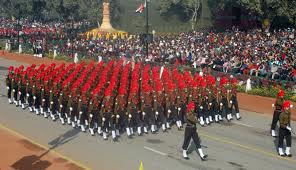
Except for sporadic incidents, like the spat the soldiers recently had with their superiors in Leh; or General VK Singh, the 24th Chief of the Army Staff, trying to sort out the civil-military relationship balance through the curious instrument of his dates of birth, by and large, the Indian public holds its armed forces in great esteem. Many of our countrymen privately fantasize about the armed forces taking over the governance of the country and instill some discipline and accountability in our civic life.

However, sadly, Indian society has lately emerged as the most self-serving and devoid-of-values societies in the world. The reason is that we are too many of us (Read India – Too Many People) and there are limited resources and opportunities, after all. We, therefore, push, fret, scream, take short-cuts and be rude in order to somehow get ahead of others (Read ‘We Are Like That Only). This sort of culture is anathema to the armed forces who largely follow the Chetwode code about one’s own needs, safety and comfort being the last priority in comparison to those of the nation and the service to which the armed forces personnel belong.

But, why is the Indian society in this deplorable condition? On the Republic Day, last year, I wrote an article: How Proud Should We Be of Indian Republic at 62? The article was very well received. Amongst other data concerning how the average Indian is deprived of a good and safe life, the article brought out that the rich, on the other hand, kept on becoming richer. The average Indian, therefore feels, with some justification, that all this has been at his or her expense.

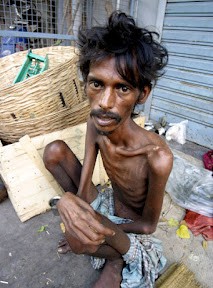
Lets look at the well known figures: The richest ten Indians (with declared assets) enjoy 10 percent of the GDP of the country. The richest 50 Indians divide 30 percent of the GDP between themselves. Lets, for a minute, detach ourselves from the effect of this inequity on majority of Indians; and look at its effect on the armed forces. What is the fundamental duty of the armed forces? It is to uphold the Constitution, ie, as the preamble says, to secure Justice, Liberty, Equality and Fraternity for we, the people of India. Whilst performing this fundamental duty,  don’t they have a right to ask whose Justice, Liberty, Equality and Fraternity are they really securing. In the Navy, for example, one of the tasks that this fine service is asked to do is to secure the Sea Lanes of Communication (SLOCs) so that it would result in fulfilling these aims of the Constitution. But, doesn’t the Navy, in securing these SLOCs, willy-nilly end up serving the best interests of the rich and powerful only since the benefits don’t percolate down to the average Indian?

Don’t they deserve Justice, Equality, Liberty and Fraternity?

With this irrefutable (if I may say so) background, lets see the difference between the armed forces and the mercenaries; a mercenary is a person who takes part in an armed conflict, who is not a national or a party to the conflict, and is “motivated to take part in the hostilities essentially by the desire for private gain and, in fact, is promised, by or on behalf of a party to the conflict, material compensation substantially in excess of that promised or paid to combatants of similar ranks and functions in the armed forces of that Party”.

In short, the one who is not fighting for the country but for the interests of a few powerful people. Well, the armed forces of India, indirectly, are doing exactly what a mercenary does. However, they don’t get paid like mercenaries. So, to start with, if there is a chasm between the Indian society and the armed forces due to different mores, this chasm is increased by the armed forces serving only the rich and the influential and not being paid like others who serve the interests of the rich and the powerful. As an example, we just finished with the Indian Premiere League’s fifth jamboree. Do you think that an armed forces team would get as much as say the Kolkata Knight Riders (after winning the IPL final); in flushing out terrorists holed up in a house in Kashmir; an operation in which some of the team members would inevitably lose their lives?
Hence, if you are being used as a mercenary, why not get paid like one? The Indian Police is already paid like one; most of it underhand and most of it what the rich and powerful don’t mind paying.

At this stage, I am not getting into the raging issue of deteriorating civil-military relations. However, lets consider just one thing, which is that because of the civil government’s lack or inadequacy of good governance and foresight, the armed forces are increasingly being called upon to do what the civil government and the police should have been doing. At the same time, the civil government has a Nehruvian mindset to keep the armed forces as far away as possible from matters of governance. The two stands just don’t sound compatible.

The armed forces used to be shining examples of the righteous few in a society seeped in corruption. However, recently, there has been a number of incidents painting the armed forces too in the same colours. (For example, Adarsh Society, CWG, Corruption in Armed Forces and Public Morality). In an article titled ‘A Few Good Men Can Win the Battle of Morality’ in Tehelka, on 20 Nov 10, the very respected Lieutenant General Satish Nambiar, whom the government honoured with a Padma Vibhushan, brought out that the army has to get rid of the five-star culture that has resulted in the decline of moral values; “where lavish hospitality and expensive gifts are proffered to, and accepted with some alacrity by, senior officers and even their wives.”  My own observation, when I was in the navy, brings out that an average navy officer, up to the rank of Commodore, has just a few mementos in his drawing room collected from his visits to Kashmir, North East and abroad. However, as soon as this officer is promoted to the rank of a flag officer, his life-style suddenly undergoes a dramatic change. He and his wife develop expensive tastes, have in their houses rich curtains, paintings, air-conditioners, furniture and other display items. Most often that not, all parties held at home, are either fully paid for by the Mess or highly subsidized. Also, all visits to the club by him and family are on the house. People below their ranks jump to provide them with all luxuries and comforts of life in the hope that they, themselves, would also reach those exalted heights if they emerge as positive-minded officers. This five-star culture fuels the desire to have more and better and at least match the luxurious living style of the civilians, say, district collectors, ministers, industrialists and bureaucrats.

We have it now from a serving Army chief that there is a culture of cronyism in the army, especially at high levels. We also know it from him that a retired Army Lieutenant General offered to give him a bribe of Rupees Fourteen Crores for accepting sub-standard Tatra vehicles. What do these incidents tell you? You can’t be faulted with forming an impression that such things are not rare and isolated in the army; for, if these are rare, a very senior Lieutenant General won’t be so bold as to offer such a bribe. This indirectly means that earlier Army chiefs and senior officers have, perhaps, been accepting such bribes as matters of routine.

Armed forces in a democracy are both a part of society and also a bit isolated. Some of the charges brought out by Gen VK Singh have more or less confirmed that for at least some of the people in the army, the requirement to stand tall and righteous in comparison to the rot in the civil society, has not been given a high priority; and that, after years of disciplined service, they are vulnerable to similar greed and temptations as their civilian counterparts.

Therefore, the foremost requirement is not to hide behind a mistaken sense of loyalty and holier-than-thou virtue that some of the serving and especially retired armed forces officers have been doing (eg, “we in the armed forces are paragons of virtue and ethics. It is the civilians who need to be taken to task.” and “Gen VK Singh was fighting for correcting the civil-military relationship imbalance” and “Here was a General who was finally doing to politicians and bureaucrats what we as young officers had always dreamt to do but didn’t have the courage; and still we find fault with him” and “it is really idiotic to air dirty linen in public by people who don’t know anything”.

I think setting right the imbalance in civil-military relations and acknowledging armed forces’ contributions to well being and safety of Indian society would require a more focused approach than Gen Singh’s “I am honest and I have two dates of birth.”

Firstly, the armed forces have to decide whether they still want to be respected for being different and virtuous than the average civilian or not? In case the answer is ‘if you can’t beat them, join them’, then, they don’t have any right to feel hurt when civilians treat them at par with rest of the corrupt Indians.

Then, the government has to do some serious thinking about whether they require the armed forces or not as also under what circumstances and situations? Armed forces can’t be continually made to feel small in comparison to police, bureaucracy etc. They, finally, have to live in the same society.

Thirdly, since we have been using the armed forces as mercenaries, thought should be given to strengthening the hand of the average Indian so that whilst doing a thankless job, the armed forces would feel proud of safeguarding Indian interests and not the interests of a few, which indirectly, and without even realising it, they are doing now.

Fourthly, we have to make our society far more disciplined and upright than what it is now so that the armed forces are not isolated examples of virtue and inefficiency in a sea pool of corruption and indiscipline.

Rampant indiscipline in Indian society (pic courtesy: blogs.bettor.com)

Fifthly, it is high time we think in terms of police reforms, bureaucratic and  governmental reforms and ridding theses institutions of unabated corruption and inefficiency. In this way, the gap between the armed forces and their counterparts in police, bureaucracy and government would be reduced.

Centuries back, from amongst the Athenians, only those could become Hoplites or soldiers who would be rich enough to buy uniform, armour and arms. We have come a long way since then. People nowadays don’t join armed forces merely for the love of the country and pride in being a fauji. They are, nowadays, seriously questioning as to whether the government and the country values them or not. If they do, recent incidents have brought out that it isn’t apparent if anyone cares. A sad reflection on our society indeed.

DIMINISHING DAD

It wasn’t very long ago when I was big and rich; really big and rich. Less than three decades back.

I had a small telly, the best I could afford with my Navy pay. I didn’t have a car since I couldn’t afford it. My wife and I used to call our Yezdi 250 cc a donkey since the mobike could carry everything for us including gas cylinders that we used to carry on it from Navy Nagar in Colaba to Worli where, after I got married, the Navy had given me a one room house. It was a large room though. We put a double bed on one side of the room, had a kitchen slab on the other side with a dining table right in front of it. We became very fond of walks along Worli Sea Face since it used to cost nothing. At the end of the walk we used to sit at the breakwater and reward ourselves with two rupees of singdana (peanuts).

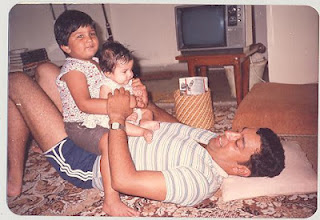
You must be wondering where do ‘big‘ and ‘rich‘ get into the description of me? Well, let me explain ‘big’ first. Immediately after marriage, until several years after that, my wife used to think I was the greatest man she had come across. And then, when the fact of my not being as big and as invincible as she had imagined started to sink in, our two sons were born. I was an instant hero with them until their teens. As an example, the telly was hardly ever switched on; my sons used to think that nothing could be more interesting than what they called Papa TV. After dinner, it was race with them to the bed or the carpet where I used to perch them on my tummy and tell them stories; the most serialised and longest one was the story of the animals in a jungle with such names as Georgie Porgie Lion, Richard Snake, Elizabeth Cow, Charlie Elephant, and Martin crow. They would be breathless to know what happened next when Georgie Porgie took all the animals for a picnic by the Jungle Train. Papa TV had everything: songs, poems, jokes and even commercial breaks when they’d run up to their mom and have milk and come back.


Arjun  & Arun enjoying Papa TV (the actual TV lies switched off)

Interestingly, they were fascinated by everything that I did or said and indeed some of my expressions are still prevalent in the family; for example, whenever I made a proposal, say, about a picnic or to have Kulfi at Punjabi Kulfi at Chowpatty, I’d ask them, “Yes? No? Maybe?” or after explaining something I’d look at their faces and ask, “Not understood?” Recently, Arun, our younger son explained something about what he does at his Animation job and ended up asking me, “Not understood?”

I was  their best toy. With whatever money I had, I had got them the best of toys but they were quiet content playing with me.


Their ‘best toy’

 Also, both the children’s future passions were nurtured in the childhood. Arjun, our elder son, has emerged as one of the leading critics of pop music in India. Below is a picture of Arjun listening to the first of the songs that he would have understood the tune of. It was on my Sony two-in-one that I got in 1975 on my first foreign cruise as a navy  officer.

Arun (the younger son), on the other 

Arjun’s first exposure to music

hand, became adept at a Commodore 64 computer and I got him a few ‘video games’ to play on it. He had to put a magnetic cassette in a corder attached to the computer and type out ‘Load’ on the computer and then type out ‘Play’ and then race those speeding cars with the pointer keys on the keyboard. This he did when he was all of three years old. So, even before he learnt ‘A for Apple, B for Bat’, he learnt ‘L for Load and P for Play’ on the com. Arun, later, became the video-gaming champ in India for seven years and went abroad each time to take part in video gaming competitions. Arun, therefore, wants to design his own games and is presently a qualified Animator.

The best education that my wife and I gave them was to be good human beings and gentlemanly at all times. To be able to look themselves in the eye, at all times; to speak the truth even when it hurt them; to be bold and courageous even when the majority did wrong; and to know right from wrong. What about religion? My wife is a Catholic and I am a Sikh. We never forced the children to strictly follow any or both the religions. They are free to choose on their own. Arjun, therefore, believes in God without following any particular religion. Arun doesn’t believe in God. Both of them, however, agree with me that organised religion is beginning to do more harm to our society and that religion should become more personal and private. It is better to be good and “irreligious” than to be “religious” but evil.

We never encouraged them to babble so as to look cute. Both could, therefore, express themselves well and freely. Also, both did not have to agree to our point of view. I have enumerated several incidents in this blog when I could learn things from them. For example, on one occasion we, as a family, went by our Maruti 800 (we could get a car in 1988; thank God for that) for a picnic at one of the beaches in Vizag. In my enthusiasm I had driven the car close to the beach on the sand. Being on the East coast, the sunset was fairly early and we later realised that dark was setting in fast. The only difficulty was that as I started to race forward, the right side rear wheel made a burrow in the sand, started digging deeper and panic set in with me since it was as a remote part of the beach with nobody around. The more I tried, the worse it became. Arun, in the meantime, kept telling me, “Try the jack, dad.” How idiotic, I kept thinking. This boy of seven had no idea, I thought, that a jack was to be used on a static car and not whilst moving or trying to move. However, finally, after trying various things, I tried the jack for the right wheel. As the car lunged forward with the force of the left wheel, the right too came out of the burrow. The jack of course fell but now the car was out. We collected the jack and drove back without getting into any more panic.

All kids want to step into their dad’s shoes
Incidents like these taught me a lesson: to have more trust in their abilities rather than choose the safe option of always trying to spoon-feed them. It took me some time to learn that a child when he steps out of his childhood and enters boyhood, wants to step into his dad’s shoes. But then, that’s only a transitory stage. Soon, he wants to step out of his dad’s shoes and see the world with his own eyes, make mistakes and move on. In Arjun and Arun, the desire to do things on their own was probably more intense than most other children. They’d get very impatient if I would give them detailed instructions about anything. Here is Arjun on the right trying to learn to tie a necktie on his own. Arun too broke a few teeth but learnt to ride a bicycle without my holding the handle or steadying it for him. How did this absence of spoon-feeding help them? Initially, they used to read my poems and articles etc and marvel at how well I’d written these. Later, I found that they could write much better than me.

There were two big surprises for us: one, when Arjun appeared for his CBSE exam (12th std). Because of my frequent transfers, I thought he had not been able to study much and hence, when the results came; we sat around the computer to check these. I said a silent prayer to ensure he’d pass. Just before his mark-sheet flashed on the screen, I asked him what was his expectation? He said he expected to be amongst the top rankers. I made a mental note of his misplaced expectation and thought I must speak to him about it later sometime. But, lo and behold, Arjun with nearly 93 percent marks had stood first in all Naval Public Schools in India.

Arun too gave us a pleasant surprise. The first one was that he could order his computer accessories and parts on the computer at the age of ten. Only when the courier would come to deliver a part at home we’d realise that Arun had ordered it from thousands of miles away. Then one day he asked our permission to take part in a video gaming competition. We allowed him “as an encouragement” but never knew he’d win and would continue winning for the next seven years.

Arun learnt music entirely on his own. He’d sit for long hours in front of the computer and try to learn the basics from the net. A few years later, he could write his own music and play. With another friend of his he formed a band of his own. Nowadays when he plays and gets a fair amount of audience applause, no one believes that he had no trainer to teach him about music or how to play the guitar.
They finally grew very fast and very soon started rubbing shoulders with me. I had got substantially diminished by that time. But, then  I had to be content with the fact that my wife and I gave them values, told them what is good and bad, gave them means to discover their true potential and then left them on their own 

to make their lives the way they felt the lives should turn out to be. In the end, a diminished dad is not a question of parental ego being hurt. It is a recognition of the fact that life is unique and precious and parents ain’t God who should, at all times control the lives of their children and mould these to produce clones of themselves. My mother still says, “Bachche tanh kaka bachche hi hunde ne.” (Son, children will always be children). True, mom, but they have every right to live their own lives and not their parents’ lives. A diminished father or diminished parents is not such a bad thing after all.

In so many different ways, they’d always be children. But, why should I impose my point of view all the times? I don’t want them to step in my shoes. I want them to make their unique lives independent of me, whatever they choose. One of my friends, when I told him that Arjun has got into music and Arun into animation, told me about the courage that I had in allowing my sons to follow their passions, even when they ain’t earning tons of money, which they would have if they had followed traditional fields.

That brings me to the question of money. At one time, in my childhood, I was very rich indeed. I owned ships, skies, clouds, stars. Here is one of my ships:

I continued being rich in my life; I always had enough. I never scrounged. On my Yezdi, when we travelled, with one son perched ahead on the fuel tank and another in my wife’s arms on the backseat, I was rich. I was rich when, as a lieutenant, I took money out of my provident money and took my wife with me to a two week duty cum holiday to Italy, France and England. I was rich when I married my wife on my own and we didn’t know how we’d run a household without any money between both of us.

My father too was rich when he earned all of Rupees 150 when I was small. His father once gave him advice, “Mani (my dad’s name) I pray to God that you’d spend a lot of money.” Dad, at that time thought of it as an idiotic advice since money would grow multifold if one’d save it rather than spend it. Many years later, he learnt the truth. Of course, you can’t foolishly spend money. Dad never scrounged and somehow had enough. He passed on this richness to me and I, in turn, passed on this God given richness to my children.

Life is a dream, they say. But, I ask you, how many people have the courage to live that dream and…..allow their children to live their own?

Being diminished, as I said, is not a bad thing at all.

CURTAIN CALL

End of a drama,
A comedy, a farce;
The nice cosy chats we used to have.
And bartering of Love with
Your own version of Love.
No sounds, no whispers, no murmurs.
Except you who can hear
Little children playing in the street,
The ring tone of your phone.
The cackle of your innumerable friends,
The honking of cars,
The chirping of birds
The call of the milk vendor
And the squish of the newspaper
As it lands in front of your door.
Bringing you news
From far places.
I can’t hear anything; nor do I try to
I have lost a few senses
I don’t know how many
Since I’ve lost the sense to know.
But, I have to hand it to you,
You really played your part well.
I wish….
I knew
Your lines too
So I won’t have mixed
Real life with acting.
I stand unmoving
Speechless and frozen
Waiting for…….
………..applause?

HOW UNBIASED OR INNOCENT CAN WE BECOME?

Is the world an obstacle course to cross and reach God? Is the purpose of our life or existence only to be with God or finally reach Him? Why is it that God can be obtained by the abnegation or denial of all human feelings, desires and wants? In our scriptures and even in ordinary conversation our baser feelings are described as being “animalistic“. But, who made those animals? Who made us? We tend to feel that whenever we do or think something ‘good’, God is controlling us. Then who is controlling us when we do or think ‘evil’ things? Who decides what is ‘good’ or ‘evil’? Who gives us any knowledge or consciousness? Is it God or does knowledge and consciousness exist in the world like internet; a huge highway?

Lets first examine the concept of consciousness. Consciousness is not an absolute term. Indeed, I have already established that there is no Absolute Virtue in this world (Read ‘Absolute Virtue’) and all virtues, qualities, good or bad, and hence beliefs and knowledge are in relation to others. Consciousness too is defined as ‘the relationship between our mind and the rest of the world with which we interact’. Thus, even though consciousness is awareness, it is subjective. And how do we know about consciousness? It is, we are at pains to say, something intrinsic, something intuitive. Something like our perception of God; an idea that emerged from nowhere but we intuitively know it is the right idea.

Consciousness: a relationship between us and the world (pic courtesy: zazenlife.com)

This then brings us to ‘Intuition‘. Intuition is known as the opposite of reason. And what is reason? It is the ability that we have ascribed to ourselves to think logically or to make sense of the facts presented to us. In other words, being reasonable is the same as being rational. Intuition on the other hand is the ability to have or use knowledge without reasoning. The origin of the word is Latin ‘intueri’ which means ‘to look inside’. Lets say you weigh factors in your mind and then decide on a course of action, your selection is dependent upon reason. However, if without weighing the facts in mind you, some inner voice or gut feeling tells you what you should do, you do so intuitively. Many people have won great fortunes or warriors won great battles by following their intuitions rather than reasoning. Intuition is also called Guardian Angel. It is not clear at whose behest your inner voice or Guardian Angel speaks to you.

Intuition: seeing it with the inner eye (pic courtesy: mindpowermasters.blogspot.com)

Lets subject Intuition to scrutiny, reasoning or logic. Is it really the opposite of rational and hence irrational or unreasonable or illogical? Then, how is it that even consciousness is what is intuitively known to us? What about post-event analysis or reasoning? For example, if an intuition can save you from an accident, what is irrational or illogical about it? Is it that if with your current sensory and extra-sensory knowledge leads you to disaster, then only it is fruit of a rational thought. Else, it is to be explained with the phrase ‘nothing succeeds like success’ or with the derisive ‘the b____r is just lucky’. About a century ago, in 1921, Carl Jung defined intuition as ‘perception by the unconscious’. Jung said that a person in whom intuition was dominant, an ‘intuitive type’, acted not on the basis of rational judgment but on sheer intensity of perception.

Last year, I wrote an article ‘Being Nonsensical May Be Far Sighted’. In this I had argued that since we compare our knowledge with what has been in the past, we limit our future knowledge. Therefore, the world’s knowledge grows only incrementally. Anybody who takes a leap of knowledge far beyond our current or past thinking is called non-sensical since we are limited by our senses. I also wrote that we live in ‘The Virtual World’ since even seeing is not believing and also, things do exist in the cosmos that are beyond our senses and hence, simply because we can’t see, touch, hear, taste and smell them are no grounds for their non-existence.

Okay, lets see what I have established so far in this article; it is that all consciousness, awareness, knowledge, rational, reasoning and logical approach is after all an attempt to compare the current knowledge with other current or previous knowledge so as to make sense of the facts presented to us. However, when we ‘intuitively‘ arrive at a conclusion, even if it turns out to be more right for us than reasoning, it is still the product of an irrational thinking or simply a ‘perception born out of unconscious’.

Intuition, therefore, may be defined as understanding or knowing without conscious recourse to thought, observation or reason. There is a great deal of mysticism or supernaturalism associated with it since we appear to be responding to cues, hints or suggestions given to us by our gut-feeling or without any previous knowledge. However, what if knowledge or awareness or consciousness about this previous knowledge is beyond the ambit of our senses? It would still then be historical data stored in the depths of our mind or hanging in the air, which comes to surface only when we are faced with a particular situation.

Sounds incredible? Well, it is not really so. We already have something called reflex action that makes a child instinctively take its hand away from fire or sharp object without having experienced it before during its short life of say three months. It is because generations of knowledge are imprinted in its nervous system through its parents, grandparents etc. Similarly, could this be that an intuition is nothing but generational knowledge imprinted in our system somewhere and it is designed to surface when it does? In that case, it is still comparing current knowledge with previous knowledge or simply experience. Have we experienced such a thing before? If yes, then how does the current experience compare with the previous one?

Therefore, experience is considered the very essence of consciousness; it is a subjective feeling, something intrinsic with each one of us. We are therefore conscious that there cannot be someone or something devoid of consciousness and still be called human.

Lets return to the original question: ‘who, therefore, gives us the consciousness, knowledge, awareness, and even intuition and reflex action, gut feeling or inner voice?’ Is there something beyond consciousness that drives us? Whenever we subject anything to our senses, we invariably compare it with a template we have in our mind of an earlier experience or history either directly through our memory or through intuition. Hence, we can never be innocent or unbiased since consciousness, knowledge, awareness, intuition etc all are relative and subjective. There is no absolute objectivity.

At this stage, let’s have a look at what exactly is Bias? How many times have you come across the expression, “Saala shakal se hi badmaash lagta hai” (He simply looks like a rogue). Lets give it a thought as to what exactly is contained in this statement? It is a template in our mind about what we think a rogue should look like. Have we got enough personal experience of rogues to form this template; or is it some one’s historic data, or description that has got us swayed?

Bias is, therefore, the tendency to have a one-sided perspective in comparison to other equally valid choices. It is a selfish point of view; something similar to a lover’s devotion towards his beloved. It is more emotional than reasoning. The fact is (this is my bias speaking) that every one of us has a philosophy of convenience and we invariably look for reasons to prove this theory or philosophy right.

A very good way to explain Bias by nirmukta.com

A bias can be cognitive if you take decisions based on cognitive skills rather than through evidence. We take shortcuts to arrive at decisions based on emotional and social factors rather than by seeking the proof of a particular statement, event or person.The term cognition comes from the Latin verb congnosco (con ‘with’ + gnōscō ‘know’), which itself is derived from the Ancient Greek verb gnόsko “γνώσκω” meaning ‘learning’. Hence cognition means: ‘to conceptualize’ or ‘to recognize’. If our mind, through emotional or social process of cognition has decided, even before hearing the evidence, that a certain person is bad influence; we cut out all reasoning and arguments against our decision. That’s Bias without our even stopping to think and analyse. Many a times we are not even aware that our mind does this to us; since, believe it or not, it is auto-programmed to do it without any inputs or help from us.

Take a mother’s love for her child; she gets immune to hearing anything that spoils her impression that she has the most beautiful child on earth.

With the kind of pre-knowledge that we are programmed to have, even before we are born, it is not possible for us to be ever unbiased or innocent. Every thought with us, whether conscious or intuitive, is based on historical knowledge (it may be immediate history or of thousands of years back) and hence, when we tell someone to clear his or her mind of all ideas and then make a decision, we are as far from the truth as we can get. Bias, with each one of us, is present in some manner or the other, in some degree or the other. All thinking is Bias in its larger sense. None of us can ever be totally innocent since all knowledge actually corrupts the mind and keeps the mind from reacting to a new situation or idea based on its own merit and not on historic data in our mind or elsewhere. Also, one can never be completely innovative; for, if one did, it would simply be non-sensical or beyond the scope of senses.

How then can we ever regain innocence? Indeed, this sentence unknowingly suggests that we had innocence at one time and lost it by our own actions, thoughts or inactions. Actually that itself is a myth. Anyway, lets at least examine the chances of our ever becoming unbiased or innocent.

The holy book that I look for guidance is the Sri Guru Granth Sahib. Guruji has described something called haume (Self or Ego) that gets into every thinking of ours and we are never free from it. According to Sri Guru Granth Sahib, if we can be rid of haume, we would be close to param aatma (Supreme Soul) or God.

Sounds very simple, is it? Get rid of haume and we are next to God. To help us examine it, we have to decide whether we have the Free Will to think or do things independently or some force somewhere guides us all the time?

Historically, there has been considerable debate with scholars and spiritual leaders about whether we have Free Will or not. It is a somewhat divided house. Is a person, of sane mind (whatever that means), to be morally responsible for his/her thoughts or actions or is what one does or doesn’t do already determined by a higher force; something that the Sri Guru Granth Sahib calls Kirt (writ already for you for a particular life or determined in advance)? Already, in most courts, a person’s guilt is held to be minimised or even held as zero if he or she was not sane or in a position to decide by himself or herself; for example, a small child suffocating her father through sheer ignorance will be held in the courts as innocent because a child is not expected to know what he/she is doing; and certainly not have mens rea (a guilty mind or an intention to commit wrong). However, if we carry forward this argument further, and come to the collective conclusion that no man or woman can ever be totally free to take a decision or commit a deed, what does it make of our collective reasoning to punish such a man? “For heavens sake, a forty-year old can’t be as innocent as a child”?

Lets study the concept of  Free Will a little more. Free Will is our ability to make choices free from all constraints. What stands in the way of Free Will is metaphysical determinism and what favours is the concept of metaphysical libertarianism.

Determinism broadly means that some form of determinism or pre-set conduct or behaviour is true, and hence there is nothing like Free Will. This takes four major forms: Casual, Logical, Theological and Biological. Lets just take one of these to understand what it is. Logical determinism is the notion that all propositions, whether about the past, present or future, are either true or false. The problem of free will, in this context, is the problem of how choices can be free, given that what one does in the future is already determined as true or false in the present.

In Hinduism, the various schools of thought do not agree with one another on whether we have Free Will or not. Here is Swami Vivekananda about it; one of Hinduism’s thinking and modern saints: “Therefore we see at once that there cannot be any such thing as free-will; the very words are a contradiction, because will is what we know, and everything that we know is within our universe, and everything within our universe is moulded by conditions of time, space and causality. … To acquire freedom we have to get beyond the limitations of this universe; it cannot be found here.”

I found this in Wikipedia: However, the preceding quote has often been misinterpreted as Vivekananda implying that everything is predetermined. What Vivekananda actually meant by lack of free will was that the will was not “free” because it was heavily influenced by the law of cause and effect—”The will is not free, it is a phenomenon bound by cause and effect, but there is something behind the will which is free.” Vivekananda never said things were absolutely determined and placed emphasis on the power of conscious choice to alter one’s past karma: “It is the coward and the fool who says this is his fate. But it is the strong man who stands up and says I will make my own fate.”

So, finally, we have come to the end of this long discourse; which is that we can never be unbiased or innocent. However, there is a Consciousness far beyond the western or common notion of consciousness as given above. If, in some way, we are able to arouse this consciousness, we can get over what is pre-determined for us.

Until then, we can be more unbiased or innocent than someone; and at the same time be less unbiased or innocent than someone else. Also, we cannot be absolutely unbiased or innocent. As Eugene O’ Neill wrote, “No man’s guilt is not yours; nor is any man’s innocence a thing apart.”

Sri Guru Granth Sahib, which I believe, in large parts, is based on the Vedas (the holiest of Hindu scriptures), has this to say about it: “Man jeete jag jeet” (Conquer the mind to conquer the universe).

Easier said than done, since, you can’t free the Mind of Bias (borne out of haume) even for a second.

KACHCHE AAM KA ACHCHAAR (RAW MANGO PICKLE) – A RECIPE BY THE GOVERNMENT OF INDIA

After the recent petrol price hike, the Congress functionaries and supporters – of which there are a few thousand, especially in the media and think-tanks – came out in support of the hike on the grounds that the aam aadmi (common man) suffers or has nothing to gain by extending petrol subsidies that only the middle class and the rich enjoy. They claimed that such subsidies do nothing for the aam aadmi since he has as much use for petrol as the male of the homo-sapiens has for sanitary napkins; he doesn’t bleed (by a petrol price rise) and hence doesn’t have to contain the bleeding in a sanitary napkin of subsidies. Aam aadmi? First of all, I find it rather strange that I and my ilk are not included in the aam aadmi. I am reminded of Spike Milligan who started one of his hilarious books (I think it was ‘Monty – My Part in His Victory’) with this observation, “Every sunday I used to accompany my parents to the church and give money and alms for the poor. I used to find it strange since we were actually the poor.”

What is the definition of the aam aadmi? He can’t simply be the poor man because then he would have been called ‘Garib aadmi’. Thanks to the abysmal failure of our policies and family planning measures, we keep adding to the number of the poor in the country. At last count, in the eight northern states of India, we had more poor than in the entire Africa continent. Could it be that the rural people in the country are called aam aadmi? But then, after spending 37 years in the Indian Navy, I turned out to be the poorest in my village in Shimla Hills. No, it can’t be. I think very possibly, it is a term coined by the Congress to indicate people other than those who make noise about lack of governance, lack of government policies and visions, and about rampant corruption. Anna Hazare, Baba Ramdev and millions of their supporters can’t be the aam aadmi since they are routinely subjected to measures ranging from derision to forceful eviction and even arrest. They are often told that the “supremacy of the parliament should be respected” since parliament has been elected by the aam aadmi. Could it be that aam aadmi is the one who votes blindfolded?

RK Laxman’s aam aadmi or the common man

I think it gets more and more complex and we shall never get to the bottom of what exactly is the aam aadmi, except probably the perception by the government that the aam aadmi has already been rogered enough and can’t be rogered any more. Could aam have anything to do with the king of fruits in India – aam (mango)? Initially, when the idea occurred to me, I brushed it aside as a figment of my contorted imagination (the only type that God was left with after giving the best to Congress functionaries and supporters, as given above). But, the more I looked at it, the more I got convinced that that’s what Congress means: aam aadmi is the one who can afford nothing more than an aam (mango) with the above-poverty-line budget of Rupees 28.65 in urban areas and Rupees 22.40 in rural areas. And certainly not an aam of Alphonso variety; most probably the kachcha aam (raw mango).

Here I must indulge in a bit of nostalgia (to hell with my own ‘Nosey About Nostalgia’). When I was small, this is how my nani (maternal grand-mother) used to make kachche aam ka achaar. She used to pick raw mangoes and chop them into smaller manageable pieces. Then she would keep them spread out on a white sheet on a cot and let the sun season them for several days. This would reduce them to approximately half their size or less. Then, one day, she would garnish and season them with various spices, seasonings and salts and then put them in a jar of sarson oil. Kachche aam in jars would be kept like this for several days in the sun until nani would declare one fine day that they had matured and had been pickled. A similar process is followed by the government for the aam aadmi. You would guess the comparison, starting from cutting them on the lines of religion, caste and creed and ending with seasoning them in oil. Nani could very well have been made a minister in the government.

Here I must let out a secret. Initially, this article was called ‘Kachche Aam Ki Chutney’ but then, one spokesperson from the government, someone named Abhishek Singhvi, got in touch with me and said it would be too revealing after the (shocking) petrol hike of Rupees 7.50 and would give further “fuel-for-fire” to a certain Didi from West Bengal.

One of my friends, in his fit of frustration, went to petrol pump today and the following conversation took place:

Attendant: Kitne ka dallun? (How much should I pump in?)
My Friend: Bus do teen rupaiye ka spray kar de; gaadi ko aag lagaani hai (Only spray worth two-three rupees; I want to set my car on fire)

I was reminded of a RK Laxman’s old cartoon; in this a burly sardar taxi driver had gone to the bank and demanded angrily, “Remember, you gave me a loan to buy this car? Well, I want another to buy petrol now.”

I am told that in India, now onwards, petrol will be called ‘Cough Drops’; a few drops and you have to cough up more money.

Oil drop or cough drop?

The argument that the petrol prices should be raised because the aam aadmi doesn’t use petrol makes me think that the government can raise the prices of almost everything in the country since the aam aadmi, if I have got the definition right, hardly uses anything at all.

pic courtesy: aeonestudy.com
This morning, when, as usual I drove to my office; on the way, I saw some badly bruised people sitting on the road-side. They told me they were hit by a hit-and-run reckless vehicle. I went a little further and saw hundreds of stunned, bruised, injured, robbed and deceived people. I asked them what happened? They said they were hit by a reckless government. (Read ‘How Proud Should We Be Of Indian Republic At 62?’)

THE ARGUMENTATIVE INDIAN

He is everywhere; even before Nobel Laureate Amartya Sen discovered him. He is in India or abroad but he is never too far from getting into the thick of an argument. Public debate? Intellectual pluralism? For heaven’s sake what is the big brouhaha about it? Indians just love to argue. If at any place and time there are two or more Indians sitting, standing, half-asleep, playing, eating, or even just passing time there is potential for an argument developing. It is as simple as that.
Pic courtesy: newslaundry.com

I have come across many an individual who has to take the opposite point of view just to maintain his/her individuality. You can’t agree with him/her at all. Even praise won’t help to make him/her agreeable. The argument would develop in the following manner:

You (at your agreeable best): Mr. Saxena, I really like the shirt you are wearing.
Mr. Saxena (seriously offended by it and releasing steam through his nostrils): Do you have to make fun of me all the time? You should know that this is the worst shirt I have and I normally don’t wear it even though I paid all of Rupees Two Thousand Five Hundred for it. But my daughter, who would be a graduate soon, wanted me to wear this horrible thing for her friends; and I did this as a favour to her. But, you had to notice it and pull my leg. Ah, if friends are like this, what can I expect from enemies?

All along the harangue, you keep scratching your head and curse yourself whilst wondering what was offensive about your compliment. And now, you do the worst ever; although at the time when you say it you have no idea it is leading to further vitriol.

You: All I did was to praise your shirt Mr. Saxena.
Mr. Saxena: Now don’t sound so innocent. You wanted to show me down. You have been trying to do it for a long time though not succeeding because of my reserve. Tell me what exactly is likeable about this shirt? You probably want to pull the rank on me since you have over a hundred shirts. But, I can tell you I too have quite a few though I don’t show them off vulgarly like you do. Ask yourself this: do you really know anything about shirts? Back in America, I get invited as a judge in fashion-shows so often that I have lost count of the number of times. I see best branded shirts from Armani, Arrow, Lee, and Luise Phillip etc. I should know what a good shirt looks like. Ha.

I don’t know which race in India has the crown for becoming the most argumentative since I don’t have experience of all. But, since I have an experience of the Punjabi, let me tell you how to make a Punjabi do a near impossible thing: challenge him that he won’t be able to do it. For example:

You: Bhai sahib, it is virtually impossible to jump from this bridge.
Punjabi: Oh, yeah, who told you that?
You: No one told me; I read it in a book.
Punjabi: Bookish knowledge everywhere with the modern man. Hold my thaila (bag) and I shall show you how easy it is.

The argumentative spirit of the Punjabi is honed with everyday incidents. For example:

Punjabi: Kinne bhra ho tussi? (How many brothers are you?)
Innocent Passerby: Saara (Sir) randa  or two.
Punjabi: Nahin je tin hunde tanh mera ki bigaad lainde? (No, but if you were three what could you have done to me?).

Two Punjabis sorting out an argument between themselves (Pic courtesy: explow.com)

Arguments are taken very seriously in India since they can lead to rage (for example, on the road because of traffic). Two years back, on the Vashi Toll Plaza, a driver killed another driver with a screwdriver over an altercation about jumping lanes. This year, in Gurgaon (Delhi) a driver killed a Toll Collector over dispute about the toll fee. Recently, a boy killed another over a squabble regarding a facebook picture and comments.

Traffic agreements in India start quite innocuously (Read ‘If You Drive In India Part I’ and ‘If You Drive In India Part II’). Lets say you and your family are going merrily in a lane. You won’t have noticed but the lane to the right or the left of you has suddenly gone very slow or stalled totally due to an obstruction. So, the car to the left or the right, without warning, cuts ahead of you, making you brake suddenly and almost lose balance. Within no time the lane-cutter’s earlier lane starts moving faster and you, full of indignation, go across to that lane and come alongside the lane-cutter. You lower the window and tell him as politely as you can, “Bhai sahib aap ko signal dena chahiye tha; accident hote hote bacha” (Brother, you should have shown indicator; it nearly caused an accident). The lane-cutter gives you a look as if you don’t belong. Then he searches and selects the juiciest out of his repertoire of filthy abuses and just to help you get the gist of it, he indicates the meaning of the abuse with his two fingers. You find it very unfair and drive the car in front of him causing him to brake suddenly just as you had to a while back. He comes out of the car and so do you. The other drivers jump into the fray taking one side or the other depending upon their moods. This happens frequently and none of us have been able to find a solution yet. However, whereas the earlier intention was to cut lanes and reach the destination early, now, everyone is delayed endlessly.

That’s really the great beauty of the Indian argument: no one ever lets go. In such a scenario, the vakeel or the advocate advises you to file a suit against the other party so that he can take the burden of the argument from you at your expense, time, and energy. Indians now have more cases pending in the courts than the current lot of judges can handle in a century. (Read ‘The Great Indian Judicial System’)

There is nothing to beat the NRI (Non Resident Indian) arguer. He has the better of both worlds. Whilst in the foreign country he contends how good is the life, customs, traditions, people, places, food, and music of India. Back home, he brings out, without being asked, how good is the life etc of the country of his immigration, say, America. “We have a lot to learn from the Americans” he starts his argument with authority, “I have spent three decades there. It takes a while to understand the American system; but, once you do, you realise it is really the best in the world.”

Then there is the political arguer or arguer about the decline in our values. This breed has the debating skills of a bull on rampage. He dexterously takes the opposite view of whatever you say. There would be people around, who, if they have the presence of mind, would point to him that in his hopping from argument to argument, he has well nigh forgotten which side was he originally. Nevertheless, he is the torchbearer of the nation’s endless debates on corruption, politicians, industrialists et al.

I just want to describe two more perennial arguers in our society. One is the cricketing arguer. He is forever debating the poor strategy on the part of the team he has taken upon himself to back and the unsportsmanlike attitude of the other team, fans and the umpire. This type is a no holds barred argument that leads to a brawl. One’s rank or status in society is considered worth mortgaging to somehow winning the argument even if it is with the security forces.

The other is the arguer who argues for you too; since he doesn’t find you capable of building up an argument on your own. That argument goes like this:

Arguer: And now you will say that I am an idiot. (At this he includes all around him for support) And now you tell, bhai sahib, this fellow is calling me an idiot and should I keep quiet? (He again addresses you) You would probably call me a mother-f—–r too. And mind you, you are calling me names but I am not saying anything. You think people who keep quiet are weak? Just because I am being gentlemanly……etc

There is no way you can ever win an argument in India. The argumentative Indian just loves arguments; winning or losing would end the argument, much against what he wants. That would end all the fun, isn’t it?

The saying ‘Don’t argue with a fool; people around you won’t be able to make out the difference between the two of you’ is never taken seriously in India. At the first hint of an argument developing you jump into the fray and it scarcely matters whether you come out alive or not.

Life goes on.

PRAYER OF THE MAROONED

[lineate][/lineate]How’d you feel,[lineate][/lineate][lineate][/lineate]If one morning you wake up,[lineate][/lineate]And look around;[lineate][/lineate]But, there is no one in sight[lineate][/lineate]You feel you are marooned[lineate][/lineate]And indeed you are shipwrecked[lineate][/lineate]On a remote island[lineate][/lineate]No sounds but the waves breaking[lineate][/lineate]Against the rocks[lineate][/lineate]Or of distant birds and crickets[lineate][/lineate]Dotting the eerie silence?[lineate][/lineate]


Pic courtesy: artcyclopedia.com


[lineate][/lineate]There is sweat on your brow[lineate][/lineate]And fear in your guts[lineate][/lineate]The sun is out now and it scorches your skin[lineate][/lineate]Soon your lips are parched[lineate][/lineate]Hunger and thirst invade you[lineate][/lineate]Like powerful and wicked aliens from Mars[lineate][/lineate]How long would you last?[lineate][/lineate]Will they find you alive?[lineate][/lineate]Or many years later as a skeleton of bones?[lineate][/lineate]Is there any hope of survival?[lineate][/lineate]

But……

[lineate][/lineate]You have grit,[lineate][/lineate]You have faith[lineate][/lineate]You can’t give up so easily[lineate][/lineate]God gave you precious life for a purpose[lineate][/lineate]And lifting your weary arms above you[lineate][/lineate]You reach out to God[lineate][/lineate]And pray to Him:[lineate][/lineate]”God, all that I need here[lineate][/lineate]Is Internet[lineate][/lineate]To connect to my friends again.”[lineate][/lineate]


THE BEST OF ZINDAGI (LIFE) SONGS

One would think that Hindi movies have obsession with Pyaar and Mohabbat (Love and Romance) and Yaad (Memory) and Chand (Moon). However, it shouldn’t come as a surprise that the Hindi movies’ biggest obsession is about Zindagi or Jeevan (Life). In a way it reflects we Indians’ fixation about unravelling the mysteries of Life; which, lightheartedly, is very different from an American’s fascination with Life: “Dad” asked the American son of his father, “Can I ask you something about Life?” Dad, expecting the embarrassing question, gingerly responds, “Go ahead, son; ask without fear.” And the son asks, “Why are we not subscribing to it (Life magazine) anymore.”

1984’s Hit Television Serial

Hindi movies and television, though, are refreshingly different about Zindagi (Life). You’d find songs covering every aspect of Life. Lets kick off with this 1956 movie ‘Jaagte Raho’ (Remain Vigilant). The great Shailendra was the lyricist. Shailendra hada long association with music directors Shankar Jaikishan (Punjabi-Gujarati duo) and the show man Raj Kapoor who liked his poetry in a mushaira (Poetry Recital Meet) in Mumbai when Shailendra was working in Indian Railways. This was in 1947 and Raj Kapoor immediately signed him for his 1948 film ‘Aag‘ (Fire). Jaagte Raho was produced by Raj Kapoor and he was the hero in the movie; but, the movie was directed by Amit Maitra and Sombhu Mitra. The song talks about Zindagi (Life) being a Khvaab (Dream) and hence there is no sach (truth) and no jhoot (lie). Mukesh, who sung almost all songs for Raj Kapoor sung this too. The music though is not by Shankar Jaikishan but Salil Chaodhary. The song is almost a satire on Life. The actor in the song, the one who is drunk, is Motilal:

https://www.youtube.com/watch?v=GQZaG5SZRYk

Lets jump to 1972 movie ‘Piya Ka Ghar‘ (My Husband’s House) about Life in Mumbai (then Bombay) and the lack of privacy when large families stay in small flats with common bathrooms and toilets, and when water is so scarce (nothing has changed in Mumbai after so many years). The movie was a comedy directed by Basu Chatterjee starring Jaya Bachchan and Anil Dhawan. Anand Bakshi as lyricist and Laxmikant Pyarelal as music directors made the most popular hits in the Hindi movies without any extraordinary philosophy. However, the theme song of the movie had Life’s philosophy described in very simple terms: ‘Ye jeevan hai is jeevan ka yehi hai yehi hai rang roop; thode gham hain, thodi khushiyan hain, yehi hai yehi hai chhanv dhoop‘ (This is Life and this is its colour and face: some sorrows, some joys, here only you find sun and darkness):

Now, lets talk about what appear to be two opposite thoughts about Zindagi (Life). The one is by what I regard as the greatest lyricist of all times Shakeel Badayuni (Read ‘The Best of Old Hindi Songs: Rafi, Shakeel, Naushad and Dilip Kumar Together‘) writing these immortal lyrics for 1948 movie Mela (The Fair). The crux of the song is that we, as human beings, are too small entities in the Fair of Life; we are like drops in an ocean and whilst we give ourselves lots of importance, we must remember that the world can go on very well without us as it has done before and will do later. ‘Ye zindagi ke mele duniya mein kam naa honge, afsos hum na honge’:

The other is by the great Sahir Ludhianvi for the 1961 movie ‘Hum Dono‘ (Both of Us). Actually, if you pay attention to the lyrics, both mean the same. In Hum Dono, Dev Anand in this song thinks of Zindagi in the manner of Miller of Dee, ie:

There was a jolly miller once
Liv’d on the river Dee ;
He danc’d and he sang from morn till night,
No lark so blithe as he.
And this the burden of his song
For ever us’d to be
I care for nobody, no, not I,
If nobody cares for me.

Likewise, Sahir in this song says:

Jo mil gayaa usi ko muqaddar samajh liyaa – 2
Jo kho gayaa main usako bhulaataa chalaa gayaa
Main zindagi ka saath nibhata chala gaya.
(What I found, I thought of it as Destiny,
What I lost, I forgot about it
I gave full company to the Life)

What about Zindagi (Life) and Pyaar (Love)? The best on this theme is this Rajinder Krishan written song for the 1953 movie Anarkali () starring Pradeep Kumar and Bina Roy. Pradeep Kumar acted as Prince Salim who later became the emperor Jehangir. Salim revolted against his father, the Emperor of India Akbar over his love for a common girl Anarkali. C Ramchandra gave the music for the song. C Ramchandra was in love with Lata Mangeshkar, who, in order to teach him a lesson, was instrumental in ruining his career; even though he composed music for many songs sung by her including the famous ‘Ai mere watan ke logo’ Lata Mangeshkar though sang the song for Anarkali didn’t pay heed to the lyrics in relation to C Ramachandra: ‘Ye zindagi usi ki hai jo kisi ka ho gaya, pyaar mein jo kho gaya‘ (This Life belongs to the one who belongs to his love and is lost in such love):

https://www.youtube.com/watch?v=1eFso_5-bFc

Talking about Life devoted to Love, how can we forget the other immortal number of Anarkali by the same team of Rajinder Krishan and C Ramachandra. This one, though, is sung by my favourite singer Hemant Kumar. Hemant Kumar Mukhopadhyay or Hemant Mukherjee was a Bengali singer who was born in Varanasi. He sang for the All India Radio in Calcutta and his first movie as Music Director was the 1947 movie Abhiyatri. His first Hindi movie came in 1952, Anand Math. He was a leading exponent of Rabindersangeet. Most of his songs in Hindi movies have a special atmosphere built around them, eg, ‘ye raat ye chandni phir kahan‘ for the movie ‘Jaal’ and ‘yaad aa gayin vo nasheeli nigaahen’ for Manzil. This song for Anarkali brings out that even though Life of Love is short, but it is still a Life worth living. One can have crown, throne, and all the riches in the world; nothing is more precious than Love. “Zindagi pyaar ki do chaar ghadi hoti hai”:

https://www.youtube.com/watch?v=HCViCUyk9-g

When it comes to Life of Love, I don’t suppose one can find better words than the Pakistani lyricist Qateel Shafai for the 1973 Pakistani movie Azmat. I can be forgiven for this not going entirely with the songs from Hindi movies. However, one, the song is a composition beyond compare; and two, Mehdi Hasan, the gazhal singer is as well known in India as in Pakistan. His ghazals such as ‘Ranjish hi sahi dil hi dukhane ke liye aa‘ and ‘patta patta buta buta haal hamara jaane hai’ would set afire any mtiushaira in India. The strain of the ghazal below is: “Zindiagi mein to sabhi pyaar kiya karte hain; main to mar kar bhi meri jaan tujhe chahunga” (In their Lifetime many Love their beloveds; I am the one who’d love you beyond Life too.” It is worth listening to over and over again:

https://www.youtube.com/watch?v=AfBS-8Fs5sI

The next Zindagi song has its music composed by another great Bengali music composer Salil Choudhury who helped Hemant Kumar find his feet in the Hindi film industry. Salil’s genre is to have the music tune go up and down with the emotion of the song. His best, of course is from the 1960 movie Parakh: ‘O’ sajana barkha bahar aayi, ras ki fuhaar layi, akhiyon mein pyaar layi’ (Read ‘Rains And Our Songs’). His music literally pitter-pattered with the rain with the words: ‘aise rimjhim mein ho sanam, pyaase pyaase mere nayan; tere hi khvaab mein kho gaye’. In the 1970 unforgettable movie ‘Anand’, he brought out similar magic in this Zindagi song written by Yogesh: ‘Zindagi kaisi hai paheli hay, kabhi ye hasay, kabhi ye rulaaye‘ (Life, what a riddle it is; sometimes, it makes you laugh, at others, it makes you cry):

https://www.youtube.com/watch?v=3vgDb4TQneA

Whichever way you look at zindagi, whether as a love song or as a sea of sorrow, you have to live it. Here is some sane advice about zindagi given by the lyricist Sawan Kumar whose most popular song in the Hindi movies was ‘Teri galiyon mein na rakhenge kadam aaj ke baad’ for the 1974 movie Hawas. No one, therefore, can give him credit for great philosophy or emotions (eg, ‘shayad meri shaadi ka khyaal dil mein aaya hai’). However, surprisingly, he wrote this gem for the 1983 movie ‘Sauten’ (the other wife). Some credit for the song also goes to Usha Khanna as the music composer. Please pay attention to the lyrics whilst playing this; ‘Zindagi pyaar ka geet hai‘:

https://www.youtube.com/watch?v=M9YGUkKphsg

Zindagi, for some, though can be a painful episode and they pray to the one who has given them Life to cut it short for them and recall them. The first one on this theme is a song by one who wants God to terminate his Life. The song is from the 1953 movie ‘Dil-e-Nadaan’ starring Shyama and Talat Mehmood. Shakeel wrote the lyrics and Talat himself sang since he was the king of ghazals in India. It is plaintive cry to the Creator to hear that his heart is burdened by Life since here in this world he died whilst still living (this happens with those who lose everything in love) (Zindagi dene waale sun teri duniya se dil bhar gaya):

https://www.youtube.com/watch?v=WVI_PsOm84I

The other is about the one whose Life is being terminated prematurely by God due to a terminal disease like cancer: ‘Zindagi ka safar hai ye aisa safar, koi samjha nahin koi jaana nahin…..aise jeevan bhi hain jo jiye hi nahin, jinako jeene se pehle hi maut aa gayi’ (The journey of this life is such a journey that nobody knows, nobody understands….such lives are also there who haven’t really lived, who were visited by death even before living). Indeevar wrote these lyrics for the 1970 movie ‘Safar’ (Journey) and Kalyanji Anandji provided the music. It is a very soulful number sung by the great Kishore Kumar:

I end with the lyricist Shailendra writing these wonderful lyrics for the greatest music duo Shankar, Jai Kishan for the 1971 movie Andaaz. Once again Kishore Kumar sang the song. Kishore Kumar was born as Abhas Kumar Kanjilal Ganguly. His active career was nearly of four decades when he made his debut for ‘Ziddi’. He was the most versatile personality in the Hindi film industry: singer, actor, composer, producer, director, screen-writer and script-writer. His movie ‘Door Ka Rahi’ was a one man show in most of his avatars. The song has a sane advice (though given in flambuoyant style) that Death will any case get you in the end; why should you go through the journey of life by being anything but happy (‘Zindagi ik safar hai suhaana, yahan kal kya ho kisane jaana’):

https://www.youtube.com/watch?v=R_806iQ86Ns

What lesson do we take about Zindagi (Life) then? Is it a dream? Is it a moment of Love, of Sorrow, of Pain? Life goes on without stopping for us to pause and think. Perhaps, if we pay attention to poets as above we can have a few carry-home points how to live Life. There are many really good Zinadagi and Jeevan numbers I had to leave out. However, there is one poem I don’t want to leave out. It is so Lyrical: Henry Wadsworth Longfellow’s ‘A Psalm of Life’:

Tell me not, in mournful numbers,
Life is but an empty dream!
For the soul is dead that slumbers,
And things are not what they seem.

Life is real! Life is earnest!
And the grave is not its goal;
Dust thou art, to dust returnest,
Was not spoken of the soul.

Not enjoyment, and not sorrow,
Is our destined end or way;
But to act, that each to-morrow
Find us farther than to-day.

Art is long, and Time is fleeting,
And our hearts, though stout and brave,
Still, like muffled drums, are beating
Funeral marches to the grave.

In the world’s broad field of battle,
In the bivouac of Life,
Be not like dumb, driven cattle!
Be a hero in the strife!

Trust no Future, howe’er pleasant!
Let the dead Past bury its dead!
Act,— act in the living Present!
Heart within, and God o’erhead!

Lives of great men all remind us
We can make our lives sublime,
And, departing, leave behind us
Footprints on the sands of time;

Footprints, that perhaps another,
Sailing o’er life’s solemn main,
A forlorn and shipwrecked brother,
Seeing, shall take heart again.

Let us, then, be up and doing,
With a heart for any fate;
Still achieving, still pursuing,
Learn to labor and to wait.

In short, as Faani Badauni wrote: ‘Zindagi zinda dilli ka naam hai; murda dil kya khaak jiya karte hain‘ (Life is translated as Liveliness in Heart; those who have Dead Hearts, they cannot call their Living as Life)

NOSEY ABOUT NOSTALGIA

The Present is just a moment – a fleeting moment; whereas the Past is an accumulation of memories. Our memories are based on personal experiences and hence they are dear to us. We, therefore, idealize the past and yearn for it. This is called Nostalgia, a word derived from the Greek νόστος (nóstos), meaning ‘homecoming, and ἄλγος (álgos), meaning ‘pain, ache’. Just like Depression, Nostalgia was, at one time, thought of as a psychiatric condition, a form of melancholy. It is only in the early Modern Era that the word got associated with yearning for the ‘good old days‘.

We have nostalgia concerning all our five senses of Hearing, Seeing, Smelling, Touching and Tasting. We are, therefore, nostalgic about, for example, old songs, sepia coloured pictures especially of our childhood, smell of crayons in our first classroom, the touch of our mother’s hand as she guided us through the busy city streets and the taste of our tiffins carrying lunch that we used to savour sitting under a tree next to the playground.

Are there any scientific studies done on Nostalgia? Yes, there are but not enough. Scientists feel that the recall of our memory about something gives a stimulus to amygdala or that part of the brain that gives us emotions. The trigger for Nostalgia is something from the past. Our emotions about the past can be happy or sad. However, in the present context, Nostalgia is generally about happy memories of the days gone by.

What exactly is Nostalgia broken down to its commonest sense? It is a fact that we do like the present when it becomes past. There is a good one about a mother telling her son who was making fuss about eating what she’d cooked, “Eat it. Years later you’d be telling another woman how good your mother cooked.”
As long as we are aware that we like all Nostalgia about a miserable present until it becomes past, we shall be happy with that old gramophone we struggled with and which still gave screechy sound in comparison to crystal clear digital sound of today.
Pic courtesy: ucl.ac.uk
In our minds, we should go back to those exact times that we are nostalgic about and see if we really liked them at that time. A friend of mine put up a facebook post about the era of the postman and nostalgically reminisced about the postman visiting us leisurely and reading to us our letters and delivering money orders. Others have written about walking to the school (there were no buses those days) and breathing in the invigorating air. It is yet another thing that we hated being chased by the street dogs and hated walking in the scorching sun but the filter of Nostalgia leaves out the bad memories. But I guess if we don’t have nostalgia we can say bye bye to about 50 percent writing in the world; including this one.
 There is, therefore, romanticism about Nostalgia. For example, this Kishore Kumar song from the 1964 movie ‘Door Gagan Ki Chhaon Mein’ (Far Under The Sky):
Albele din pyaare, mere bichhade saathi saareHaay! Kahaan gaye, haay! kahaan gaye(Wonderful lovely days, all my friends I parted from
Oh, where are they now)

Koi lauta de mere beete hue din,
Beete hue din vo hai pyaare pal chhin.

(Someone, return to me my past,
My past, those dear moments)

Main akela to na tha, the mere saath kayi,
Ek aandhi si udhi, jo bhi tha leke gayi
Aaj main dhoondu kahan, kho gaye jaane kidhar

(I wasn’t alone, many were with me
A storm came, what was there it took away
Today, where should I search for those that were lost)
Beete hue din…

Mere khvabon ke nagar, mare sapno ke shehar,
Pee liya jinake liye, maine jeevan ka zehar.
Aise bhi din the kabhi, meri duniya thi meri.

(The towns of my dreams, the cities of my imagination
For them only I drank the poison of life
Those were the days, when my world was my own)
Beete hue din…

And for those who’d prefer to hear this thought in English, here is Mary Hopkins singing ‘Those Were The Days’:

Finally, the Moral of the Story: Treasure every moment when you have it rather than when it is gone.

In short when you get a tooth pulled out you miss the slow pain it used to cause and your tongue goes to the exact spot nostalgically. However, you should relish the moment at the dentist’s chair too.

God, I am becoming a Saint in my old age. Let me love it now rather than later when everyone has finished hating me for writing this post. One of my friends feels that the word ‘Nostalgia’ gives a feel as if it is a nose-related problem. In which case, one can imagine a doctor prescribing a tablet like DCold to have with warm water twice a day after meals. Sounds far fetched? Think again: the other day a drug called scopolamine was in the news. If the powder is blown into your face you have an instant loss of memory and are immediately cured of Nostalgia. Perhaps later scientists will discover a drug whose powder, when blown into our faces will convert all our bad, sad, horrible and unpleasant memories into ‘good old days’.

Nostalgia indeed.

JILL THE RIPPER AND SATYAMEV JAYATE

So now we are told that the 19th century Jack the Ripper was a woman after all. John Morris in his new book ‘Jack the Ripper: The Hand of a Woman‘ has argued that Ripper who ripped the innards of five female victims in ten weeks in 1888 was a Welsh born Lizzie Williams. Mary Jane Kelly was the last of the victims and the book theorises that she was having an affair with Lizzie’s husband Sir John who ran an abortion clinic. So, here was Lizzie who couldn’t have kids killing someone who could have kids not with anyone but with her own husband.If this is true, one would be instantly reminded of the English playwright and poet William Congreve who in his 1697 tragi-drama ‘The Morning Bride’ wrote: “Heaven has no rage like love to hatred turned, Nor hell a fury like a woman scorned,” spoken by Zara in Act III, Scene VIII.

Pic courtesy: disturbia.hubpages.com
Then there is the recent case of Anjali, wife of Ajay Singh, a senior officer in Shipping Corporation of India who refused to accompany her husband on posting to Port Blair. She must have been aware that at one time, during our slavery days with the British, the freedom fighters (rebels as the British called them) were deported to Port Blair (Kala Pani or Black Waters) and whilst men used to be sent there, it was no place for women; certainly not the liberated women who live in Delhi, Mumbai, Lucknow etc and think of taking over the reigns of power; women who are advocates and not only know legal wranglings but are adept at the lingo that go with it; women who when they become chief ministers send the central government cowering in fear and pilots to fly planes to go and fetch their sandals; women who ask for a divorce because their husbands talk to their relatives in his language. The divorce court judge, in the case of Anjali and Ajay Singh invoked Ramayana and asked her, “Sita followed Ram, why can’t you?”With this background, lets now turn to Aamir Khan’s Satyamev Jayate on the television. The first episode on female infanticide was so gripping and ably put up that it left people wondering why such an issue had not been discussed with such fervour before. On the television debates many of the champions of women’s rights and causes went viral about their assertions that Aamir Khan was not the first one to air such views. They also disdainfully predicted that nothing would ever change.

I found all this rather strange. It is acceptable to us to have celebrities model for anything from detergents to cars; but, should they use their celebrity status to provoke active debate on issues that really affect us, they are clearly exceeding their brief. Of course, we know all about dwindling female to male ratios; of course we know all about the situation in Haryana where men don’t have enough women to marry, where women work in the fields when men sit on their khaats (cots) and smoke hukkahs and expect their womenfolk to return and cook their meals too; of course we know how in Patiala in a well female foetuses were found discarded (Is There Reason to Celebrate Women’s Day in India?). But, lets ask what’s wrong with a celebrity asking us to look within and find answers before pointing finger at others? Should we leave to Mamata Sharma (even deadlier than the other Mamata) who, as chairperson for National Commission for Women (NCW) said it was alright to call women sexy? (Read: Hi Sexy – ‘Gateway to Future’ For Indian Women)

That’s really what is wrong with our country: we slang ordinary people debating important issues since we assert that these should be left to experts. What experts? An ordinary citizen Anna Hazare starts a people’s movement against corruption and the parliamentarians take him to task that issues such as these should be rightfully tackled by the elected representatives of the people (each one of them represented by an average of not more than 9 percent of the electorate (read: How Proud Should We Be Of The Indian Republic At 62?))

I think Aamir Khan has done right by instigating public debate (and hopefully action) on a very core issue. Today is the Mothers Day; will we have enough women left to become mothers?

As far as Jill the Ripper and Anjalis are concerned, these too are strange aberrations and certainly take the focus away from the real issue. In the northern part of our country, the incidence of reverse dowry (a phenomenon in which the bride and her siblings demand money and favours from the bridegroom failing which they would accuse him and his parents of demanding dowry and expose them to untold hardships and jail) are now becoming more common. Indeed, I wish Aamir Khan’s programme’s research team had brought out how Jill the Ripper, Anjalis, Mayawatis and Mamatas, by their abrasive and sometimes violent actions, spoil the cases of the majority women who have to suffer indignities and injustices on an everyday basis.

Left to myself I would give a lot of marks to Aamir Khan for Satyamev Jayate and the many unsung heroines who came forward to tell the tales of how they were stopped from becoming mothers simply because they would have given birth to female children.

Happy Mothers’ Day.

Follow

Get every new post delivered to your Inbox

Join other followers:

error

Enjoy this blog? Please spread the word :)

RSS
Follow by Email
YouTube
YouTube
Set Youtube Channel ID
LinkedIn
Share
WhatsApp
Copy link
URL has been copied successfully!