 |
| Sunbyanyname in his own Zindagi Nahin Milegi Dobara |
There are men and women who do sky diving, suspended in the air as birds, opening their parachutes at the last minute. Then there are others who do tight rope walking between high-rise buildings defying death. One slip and precious life ends. However, they have this inner compulsion to accomplish the near impossible.
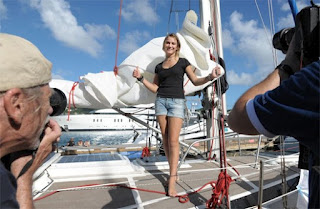
On 21st of January this year, Laura Dekker, a sixteen year old Dutch/German/New Zealander became the youngest person to circumnavigate the globe single-handed. At that age she had the greater part of her life ahead of her. She started in Aug 2010, a year after she had planned, when a Dutch Child Care Council stopped her departure on grounds of shared parental custody between her about-to-be-divorced parents. Dekker later commented about the authorities in an interview, saying “They thought it was dangerous. Well, everywhere is dangerous. They don’t sail and they don’t know what boats are, and they are scared of them.” As soon as I read the news, the first thing that occurred to me was the mental set-up of someone as young as her, braving seas, known and unknown dangers alone, all alone for more than a year. If something was to happen to her, she would have died a solitary and lonely death and probably even her dead body won’t have been found. And yet, after she has accomplished what she set out to do, she would have removed a number of words from her dictionary: Fear, Impossible, Small, and Underage.
 |
| Laura Dekker the youngest person to circumnavigate the globe (pic courtesy: in2eastafrica.net) |
Men and women would do anything to live and soar, even die doing it. When I was in my teens Richard Bach wrote his novella titled ‘Jonathan Livingstone Seagull’. The story is about the gull called Jonathan Livingstone who is bored by routine existence and wants to push his own capability to fly beyond what the seagulls can do. Because he wants to try something different, he is expelled from the flock. However, he persists and one day achieves perfection. “You’ve got to understand that a seagull is an unlimited idea of freedom, an image of the Great Gull.” He realizes that you have to be true to yourself: “You have the freedom to be yourself, your true self, here and now, and nothing can stand in your way.” The idea of Richard Bach’s novella fascinated everyone immensely. Neil Diamond brought out a complete album of songs named Jonathan Livingstone Seagull with such songs as: Be, Flight of the Gull, Lonely Looking Sky, The Odyssey, and Dear Father. Here is Neil Diamond’s ‘Be’ for you:
Well, ladies and gentlemen, there may be other good reasons for men and women to go out on a limb. But, I have given you what I believe to be the best reason to do so.
INDIAN ARMY BEFORE AND AFTER OPERATION VIJAY
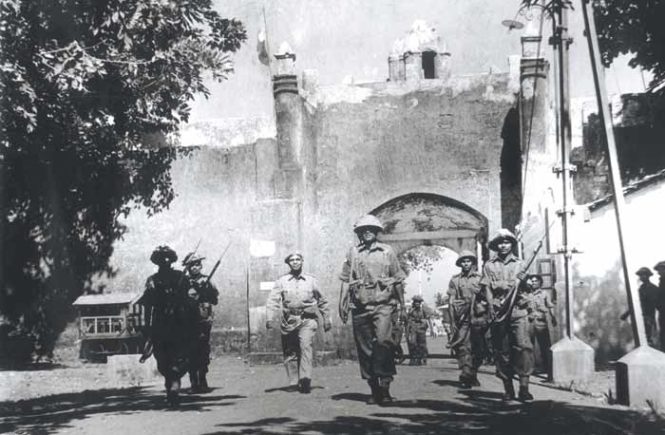
Vijay means Victory, the sacred adage of the Indian Army. In the history of the Indian Army, there have been three campaigns called Operation Vijay. In the first two, the Indian Army tasted total triumph with its head held high. The first one was the liberation of Goa in 1961 and the second one was Kargil War in 1999. Why is this that the Indian Army, at least those men that can still think straight and independent without recourse to undying sycophancy, has to be apologetic about the still-in-progress Operation Vijay (Kumar Singh)? To answer this question objectively, let me relate a personal experience.
 |
| Op Vijay 1961 – Liberation of Goa |
In 1996, on promotion to the rank of Captain in the Indian Navy, I was selected to undergo the 25th Higher Command Course with the Army. The next Army Chief, or Army Chief designate, General Bikram Singh, was my course mate in the AHCC. During our first operational tour, we visited the Northern Sector. General KV Krishna Rao (Retd) was the Governor of Jammu & Kashmir. On the first evening of our visit to Srinagar we were invited to At-Home with His Excellency, the Governor. In the entire AHCC, there were just two Indian Navy officers. As soon as the Governor spotted me, he jokingly commented, “It appears to me that the Indian Navy has a strange way to elect a Chief”. The remark was a dig at the quaint way in which Admiral Vishnu Bhagwat’s impending succession as the Naval Chief on First of October 1996 had started a bush-fire of polemics. As Flag Officer Commanding-in-Chief of the Western Naval Command, from which post Admiral Bhagwat took over as the Chief, he was at the helm of controversies. Earlier, as Chief of Staff of the same command, he had been accused of phone-tapping of his adversaries. Later, on 30th Dec 1998, he had the dubious distinction of having been sacked by the Government of India.
As I felt somewhat regretful about the Navy chief’s succession being hotly debated in the open, little did I know that 16 years later when Bikram would be at the verge of taking over, the heat of controversies would leave the Vishnu Bhagwat episode cold in comparison.
India is not a country where the people at large are generally knowledgeable about defence matters. The dumbing down of our people caused by the relentless diatribe unleashed by the media may be a recent phenomenon; however, Indians have always liked to indulge more in rabble-rousing jingoism than proud patriotism. The attempts to bring down the armed forces to the low levels achieved by the civil administration are only matched by the arrogant ignorance about achievements of the armed forces in general and army in particular. When I visited J&K and was briefed about the incomparable way Army has conducted itself there, my belief became stronger that we have to be thankful to the Indian Army for not only peace and progress in Kashmir but also for keeping it safe as integral part of the country. Most of our countrymen are not at all au fait with the strategic sense, restraint, calm and exemplary commitment displayed by the Army under trying conditions.

How many people are aware that the Army’s strategic sense in Kashmir includes giving credit to the police and civil administration for jobs that army does for the people; eg, Op Sadhbhavna (Operation Goodwill), and safe conduct of elections.
With such general ignorance and neglect of the Army, every once in a while, someone or the other brings out how the country not only does not have a monument to honour its soldiers but most of our countrymen have no idea of what the Army does, its training, operational readiness, achievements etc.
I would say that about ten percent of the people who read the papers and watch the television are aware of the glorious accomplishments of the Indian Army. Ninety percent either are ignorant or ain’t impressed. For example, the Liberation of Bangladesh in the 1971 Indo-Pak War is being taught in the war colleges abroad as one of the finest examples of a most successful campaigns. However, not many are really aware what it entailed to fight a war in which even the political aims were not defined by the government. Many people have forgotten that in 1947-48, when called upon to do a duty that was suddenly thrust on it, the Army achieved the unsaid aims gloriously and that we are in a mess in Kashmir because the political leadership failed to follow up on Army’s Vijay.
 |
| Op Vijay – 1999 Kargil |
George Fernandez as Raksha Mantri (Defence Minister) threatened to send the babus (bureaucrats) to Siachin (at an altitude of more than 20,000 feet; where the Indian Army maintains permanent presence in arguably the most inhospitable conditions in the world) to let them have a feel of what is entailed when their babudom procrastinates decisions to be taken for procuring urgently required equipment to survive at those heights.
Volumes have been written about the ever deteriorating civil-military relationship – a relationship between one of the worst in the world and one of the best in the world. Of course, the thankless nation and national leadership would like to keep the Army as a tethered puppy ready to become a mastiff with the external enemy but otherwise ready to lick the feet of the political and bureaucratic bigwigs.
In this scenario, we have the latest Operation Vijay (Kumar Singh). There is an age old precept that bad news and publicity travels much faster than good news. So, whereas in the years of hard work, dedication, commitment and achievements of the Indian Army, very few people are really appreciative of the army (I put the figure at about 10 percent of the media – watching people), now, nearly 90 percent are aware that a Chief, for “purely personal reasons” has attempted to drag the Army into needless wrangling. No one is denying that the matters of corruption and deteriorating civil-military relations need to be tackled. But, exactly how Admiral Vishnu Bhagwat’s infamous attempts to sort out these issues were an afterthought to his initial and much publicised opposition to the appointment of Vice Admiral Harnder Singh as Deputy Chief of Naval Staff; General VK Singh’s belated pursuits to sort out corruption in army procurements and remedy the worsening civil-military relations, would always be seen by his abortive attempts at upsetting the carefully laid out succession plan.
Hence, the adverse offshoots of Operation Vijay (Kumar Singh) are:
- He has made the task of his successor extremely difficult as far as relationship with the government is concerned. Without any fault of General Bikram Singh, the government and the nation would be suspicious of any move by him, if at all, to set right the balance of civil-military relations; for the simple reason that everyone involved would be assessing how the General personally gains by it.
- The good that the Army did is, as it is, known only by a few. Now, with the personal greed of the General VK Singh, what the countrymen would remember of the Indian Army would be unsavoury wranglings for power, avarice, corruption and megalomaniac ambitions.
- The impression that the rot in the Army is deep rooted is strengthened by the vituperation of the camp loyal to General VK Singh against the heretics and vice-versa. In this milieu the all important issue of setting right the balance of civil-military relations has taken – and will take – a back seat. I don’t know why this simple fact has not sunk in with the loyalists.
- Lastly, let us weigh the effect of this, and such controversies in the past, on the junior leadership of the army. The senior hierarchy often talks disparagingly about the ‘decline in values and moral standards of those who join the army nowadays as compared to the good-ol’-days‘. The junior officers and men, therefore, would be excused if now onwards they have a bias that the seniors should first set their own house in order (Read ‘Leadership in the Navy – Past, Present and Future‘) and stop washing army’s dirty linen in public. A few decades back, in the US Naval Institute Proceedings (USNIP) there was an article titled ‘The Fish Rots at the Head’
I am quite sure that after General VK Singh has taken his well-deserved retirement and finished writing his bestseller memoir regarding how there were matters of national security involved in the “purely personal” issue of his date of birth, he would pause and think about the damage his continued belligerent stand has done at various levels. This would, I am afraid, continue for some time to come.
It is easier to throw a stone in the pond; it is harder to let the ripples die down suddenly.
BOND WITH THE BRAND

So Daniel Craig, as James Bond, is going to be swigging a beer in his next movie and not his trade-mark Martini. Heineken has already thought of it as the best thing that has happened to them since they started brewing the bubbly in 1873. I am reminded of the time when a corporate honcho sought an audience with the Pope and Pope was visibly disturbed and screamed “Noooooo”. All that the corporate boss wanted the Pope to do was to change just one word in the prayer; instead of ‘Give us this day our daily bread’, he had suggested, “Give us this day our daily Kellogg’s”

Whatever way you look at it, Martini suited the Licensed to Kill eminently especially with his bevy of beauties. Great many jokes, limericks and ditties came up about the cocktail of gin and vermouth that James Bond sipped whilst lounging on a beach with danger lurking not far from him. One of these is:
Have two at the most;
Three, you are under the table,
Four, you are under the host.
Opinions would be divided whether a beer drinking Bond would appear as svelte as he appears nursing a glass of Martini. After all, beer is more associated with a belly than with belles; burp more than with melody. However, chances are that beer drinking may get associated with laissez faire after Bond has sipped it and about to throw the can away and sees in the can the reflection of an attacker getting ready to attack him from behind.
Other than Bond with his Martini, the world of advertisement is nostalgic about ads about smoking. How coolly the hero used to take the last puffs of a cigarette, stub it out with his white shoes and then only turn to the pack of ruffians waiting to be thrammed by him. Ah, the promise of Marlboro country where men would be men and horses would be horses. Or the guy who would effortlessly win a sailing regatta and the first thing that he would do after that would be to puff at his Scissors, with his sexy dame on his side, and the voice over would say, “For men of action – satisfaction.”
Cold drinks or soft-drinks are the hot – nay, cold favourites of the ad-makers; nothing has changed from the time a young Rekha sensuously sipped on her Gold Spot and suggestively crooned, “Taazgi ka maza lijiye, pyaas apni bujha lijiye.” (Enjoy the taste of freshness; quench your thirst); and, all of us watching the a mango juice drop, in slow motion, seductively falling on Katrina Kaif’s lips. “What good luck has a drop of yellow juice, as compared to us, who only watch those succulent lips from a distance”, thousands of men bemoaned .
Ads on detergents too have been the kind that do everything except deter gents; ladies’ views are reserved on this since they are often shown to be using the soaps for bringing back the whiteness in the clothes, whilst wiping the sweat on their brows. One can think of Surf Excel, or a numbered detergent like 501, but the ad campaign that took India by storm was, without doubt, that of Nirma Washing Powder. It became iconic and decisively showed what ads can do to the popularity and hence, sales of products:
Other than sensuousness, and coolness, humour in ads has been a great sell. The funnier the ad, the more people see it and like it. I remember the time when Coca Cola was selected as “Official sponsor” of the Cricket ODI World Cup, Pepsi came up with a highly successful, imaginative and comical ad, “Nothing ‘official’ about it.”
So, now that Bond has to ‘Officially’ drink beer, perhaps the day is not far, when Bond, like our own action hero Akshay Kumar, will do anything to ‘Taste the Thunder’. Bye bye, Martini.
HATS OFF TO GENERAL VK SINGH
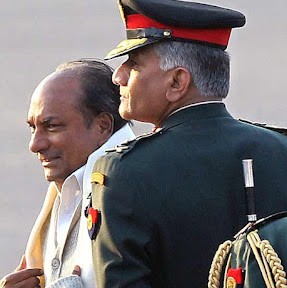
Army Chief General VK Singh, if his supporters are to be believed, achieved the following by his Trishul of Date of Birth assertion, Allegation of 14 Crore Bribe, and Letter to PM regarding Poor Preparedness of Army:
1. He has increased the prestige of the Army and the armed forces.
2. He has become a respected and respectable person in public eyes.
3. He has brought increased focus on the ever-present corruption in defence procurement deals.
4. He has covered himself in glory by his own honesty, and accountability towards the state of affairs of the Army that he controls (The more mud-slinging you do about your own service, the more the country is convinced you are the right person to command it).
5. He is like a lotus in the filth of senior officers before and after him.
 |
| Pic courtesy: blogs.outlookindia.com |
6. Now when any fauji visits the bureaucracy and district administration (say on leave), they would stand and salute him for being member of the same armed forces as have produced role models like Gen VK Singh.
7. The country has emerged stronger because of him.
8. There was no other method left for him to expose all the corruption and deficiencies except through assertions about his date of birth, which he himself said was a purely personal matter.
9. People who oppose him are either corrupt or don’t have country’s best interests in their minds or know nothing about nothing.
10. He averted a situation like that existed before the 1962 Indo-China war simply by asserting his date of birth. Anyone feels differently? Well don’t. Please consider that when you become a Chief there are hardly any options available to you to expose corruption, inefficiency etc except through a “personal issue” of date of birth.
And thank God, he had two dates of birth. A person with just one date of birth would be hard-pressed to start public debates about these extremely important issues of national security.
What changes do we expect due to the relentless campaign by Gen VK Singh to battle evil forces through the controversy regarding his date of birth? Here is a short list:
1. From now onwards, MoD has to carefully scrutinise the dates of birth of all army officers of the rank of Colonel and above.
2. When your dossier is called for by the Ministry to check your date of birth, you can start patting yourself on the back for having credible chance of becoming the Chief in future.
3. All new homeland security equipment including spy cameras and hidden machines should then onwards be utilised to record all conversations with shady officers, that is, all those other than you.
4. Anywhere and everywhere you go, you have to carry the proof of your date of birth with you; particularly when dealing with babus and netas.
5. When anyone says that it is a “purely personal matter“, we should know that he wants to “awaken the conscience of the nation“.
LORD KRISHNA BECKONED – WE VISITED DWARKA
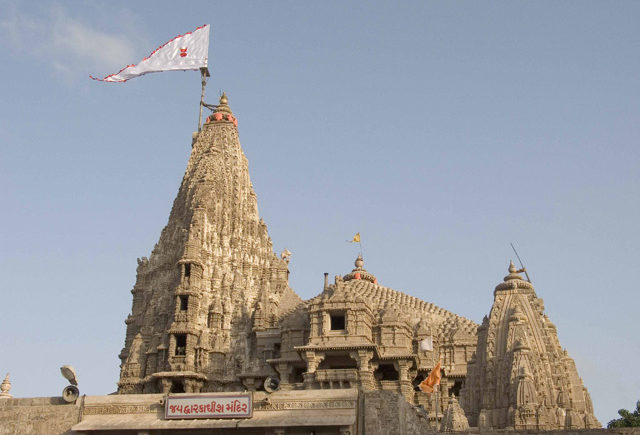
First about the title of this post. I have come to believe, through actual experiences, that whilst we are reputed to have ‘Free Will’, there are things beyond our control. One of these is visits to holy places; I believe that we are called or invited by God to visit them at times selected by Him. Let me relate an incident. I was second-in-command of India’s aircraft carrier Viraat in the year 1994-95. One of my sailors went on a pilgrimage to Vaishno Devi’s Shrine. On his return he brought Prashad (blessings of the gods)for me and an amulet. He said he had prayed for my promotion. He said I must visit Vaishno Devi for thanksgiving once I got promoted. I was duly promoted. I kept thinking about the thanksgiving though and knew it in my heart that this was one promise I won’t be able to fulfill. In the same year I was afflicted by a terrible skin-disease called Psoriasis and I was amongst the five percent people who get Psoriatic Arthropathy (a painful arthritis).
I got selected for the Higher Command course with the Army (at the College of Combat at Mhow in Madhya Pradesh; it has since been renamed the Army War College). The course revolved around visiting the length and breadth of the country in four major tours, understanding terrains, threat scenarios, formations etc and on return to wargame those scenarios. Our first tour was to the Army’s Northern Command, headquartered at Nagrota (near Jammu). We started our tour from Amritsar in Punjab. In addition to the professional visits, we visited the Golden Temple, the holiest Sikh temple, built by the fourth Sikh Guru Ram Das and completed by the fifth Guru Arjan Dev in 1604. Lo and behold, after we landed up at Nagrota, a visit to Vaishno Devi Shrine was organised for us. One has to trek about 12 kms or so from the Base Station Katra and I did it with my arthritic body. My course mates suggested I take a ride on a mule but I noticed my pains had vanished and there was renewed energy in me to climb up the hill. I had tears in my eyes when our group on the way up was greeted several times with the familiar singing by the other groups, “Chalo bulaava aaya hai, mata ne bulaaya hai” (Lets go and visit her, Maa Vaishno Devi has beckoned us).
And now about the Visit to Dwarka. The last when I visited Dwarka was in the year 1993 when the missile vessel that I commanded entered the port of Okha in Gujarat. After I retired from the Navy on 28th Feb 10, I could never even imagine going back there, much less to take my wife there. But, God, as I wrote above, beckons you in ways that appear strange to you. I joined India’s largest corporate Reliance Industries as a Senior Vice President looking after security. RIL’s Jamnagar refinery is the largest in the world served by RIL’s own port with a throughput of 115 million metric tonnes. Lo and behold, as with visit to Vaishno Devi’s Shrine, Lyn (short for Marilyn), found ourselves in the company’s flight to Jamnagar and Dwarka happens to be in Jamnagar district.

This time when we visited we saw vessels in Okha similar to the one that I commanded together with the ubiquitous fishing boats proudly flying the Indian national flag.


The last time I visited Bet Dwarka the Navy had provided a fast boat to go to the Bet (a kind of small island). But, this time my wife and I went by a civil boat. We felt thrilled to be part of dozens of others similarly beckoned:

What a history Dwarka has. It is one of the seven holiest cities of India. The priest Kapil Bhai informed us that its history dates back to five thousand years ago. Krishan ji, after he killed the rakshas (demon) Kansa, who ruled the city of Mathura, made Ugrasen the king. Kansa, as we have read the story a number of times, was Krishan ji’s mama (maternal uncle). Ugrasen was Kansa’s father. However, the king of Magadha, Jarasandha, who was Kansa’s father-in-law was unhappy with Krishan ji’s decision to handover the kingdom of Mathura to Kansa. He, therefore, kept attacking Mathura and every time he was defeated. Seeing what his people had to go through Krishna decided to found the city of Dwarka away from the danger of being attacked. The city was built, at the orders of Lord Krishna by Vishwakarma. Vishwakarma was visualized as the ‘Ultimate Reality’ as given in the Rig Veda. As his title suggests he was given the powers to create Heaven, Earth and other Celestial realms. He was the Lord of Art, Architecture and Engineering.
Dwarka was built on the sea-shore and on the banks of river Gomati. Many times the city was submerged in the sea and re-built. As one crosses to Bet Dwarka, in addition to the air and sand being replete with Krishna’s eternal presence, one is reminded of India’s great maritime heritage (regrettably, the British and other Westerns conveniently try to overlook that). However, Bet Dwarka has artifacts and nautical items having been found there that date back to pre-historic times.
As Lyn and I stepped ashore from the boat at Bet Dwarka and walked through narrow streets and came to the gate of the Bet Dwarka temple, we were immediately transported back in time.


Beyond this point, the camera and the cellphones had to be deposited. I remembered visiting these in 1993 when there were no such restrictions and one could freely walk in. But a lot of water has gone down the Ganges since then. On 25th Sep 02, the carnage in Akshardham temple in Gandhinagar, Gujarat has brought home the point that places of worship in India are on the hit list of terrorists, mainly from Pakistan.
Bet Dwarka has an enormous temple built for Lord Krishna and Radha. It was the residence of the Lord. This is where he met Sudama and gave him the gift (bhet) of rice. We were met by Vishal, a relation of our guide at Dwarkadheesh: Kapil bhai. Vishal’s father is the head priest in Bet Dwarka temple and took us around and explained the history to us. The tradition of giving rice to Brahmins continues even to this day; Lyn and I made a token contribution. The temple, however, is under renovation but largely the porticoes of the patrani, the statues and pillars are still intact.
As we took our boat back, we observed that there is a large mosque there that’s visible from the sea. It reminded us of two things: one, the co-existence of India’s cultural and religious diversity; and two, that gradually there is a demographic shift in the population of Bet Dwarka; out of 5000 people there, as Vishal informed us, only about a 1000 are Muslims now.

Lets now get back to the most beautiful, the most sacred and auspicious monument to see in Dwarka. Undoubtedly, it is the Dwarkadheesh temple. Once again, photographs are only taken outside since, for security purposes, the camera and cellphones are to be deposited outside. Here are some of the pics:


The history of the above temple says that seven times it was submerged under the sea. The original was built by Lord Krishna’s grandson King Vajra. There are two gates to the temple: the Swarg Dwar (gate to Heaven) and Moksha Dwar (the Liberation Gate). We attended the aarti (formal prayer service performed by the priests) and when the aarti lau (fire) came to us and like other eager devotees, we put our hands over it and touched our hearts, eyes and head; this simple ritual immediately transported us into another world. Despite the surging crowds to get a darshan (glimpse) of the idol Kalyan Narayan and of the other idols of Radha, Rukmani, Sudama etc, my observation is that somehow a heavenly tranquility descends on you, especially in the evening. Without being told, everyone talks in a hushed voice so as not to break the serenity.
The flag atop the temple is hoisted five times a day and is a ritual with significance. Kapil Bhai explained to us all the important details as one moves one’s eyes downwards from the top.
Here are glimpses of the sea close to the temple that I took at the sunset time. I was conscious of Arjuna’s account of the city of Dwarka having submerged into the sea (the account is found in Mahabharta), some four decades after Mahabharta in third century BC:
“The sea rushed into the city. It coursed through the streets of the beautiful city. The sea covered up everything in the city. I saw the beautiful buildings becoming submerged one by one. In a matter of a few moments it was all over. The sea had now become as placid as a lake. There was no trace of the city. Dwaraka was just a name; just a memory.”


Lets now move to the other temples and palces of historic importance in the area.
The first of these is Nageshwar Jyotirlinga. What is a Jyotirlinga? It is a huge endless pillar of light created by Lord Shiva to settle the issue of supremacy of Creation between Brahma (God of Creation) and Vishnu (God of Saving). Brahma and Vishnu travelled towards the two ends of the pillar of light called Jyotirlinga but admitted defeat when they could not find the ends. In Shiv Purana, there are 12 Jyotirlinga shrines mentioned. Nageshwar Jyotirlinga near Dwarka was the first one. Without taking you into the history of this historic and famous shrine, let me give you glimpses of what we saw:

A huge statue of Lord Shiva is in the temple premises:


A snake-charmer within the temple premises:

The ubiquitous chhakra or a tumtum driven by Royale Enfield engine is all over in the district:


Lets now move to Gopi talao. The stories of Lord Krishna’s childhood abound with youthful pranks and romance have a connection with this talao or pond. As a young boy, Krishna used to dance the raas with the Gopis (young female inhabitants) in Vrindavana. When he moved to Dwarka, the Gopis could not bear the separation and came to visit him. They united with their Krishna at the Gopi talav, 20 km north of Dwarka on the night of Sharad Purnima (full moon) and once again danced the raas with him. Legend says that, unable to part from Krishna, the Gopis offered their lives to the soil of this land and merged with their beloved. It is said that they turned into yellow clay, known as Gopi Chandan. Even today the soil of the Gopi talav is extremely smooth and yellow in color. Here are some of the pics:


The last place that we visited in Dwarka was the Rukmini temple. This temple stands 2 km away from Dwarka City. According to an old legend, once Lord Krishna and his wife Rukmini went to the sage Durvasha to invite him for dinner at Dwarka. He agreed on the condition that Krishna & Rukmini would have to pull his chariot instead of any animal. The couple happily obliged. While pulling the chariot, Rukmini became thirsty so Lord Krishna prodded his toe into the earth to draw a spring of the holy Ganga water. Rukmini took a sip without offering Durvasha. Annoyed by her impoliteness he cursed Rukmini that she would be separated from her beloved husband. Hence Rukmini temple is located 2 kms away. The temple has a painting describing this historic incident. Here are the pictures of our visit:


If you think it is all religiosity and faith and history and religion and nothing else, you are wrong. Inside Dwarkadheesh temple, for example, there is an inner domed Bhawan that has been constructed with funds donated by Smt. Kokilaben Ambani, wife of Reliance founder chairman Sh. Dhirubhai Ambani. It has a library and a teaching centre to teach two of the four Vedas: the Atharaveda, the Samaveda, the Rigveda and the Yajurveda. Kapil bhai took us there and we saw young would be priests being taught the vedas, in their yellow monk’s clothes. No wonder Kapil Bhai himself is so knowledgeable.
In the night, our driver locked the car with key inside and we slept in the Smt. Kokilaben Guesthouse (being run purely on charitable lines) without having our phones, camera and baggage. We had planned to leave for Somnath temple near Veraval, 235 kms south, by 8 AM. By 10 AM, when our baggage etc had not fetched up, a thought crossed our minds that our planned programme was adversely affected. It is at this stage that Kapil bhai came to see us. He had his total equanimity with him when he told us, “Aate bhi usi ki ichha se hain aur jaate bhi usi ki ichha se hain” (You arrive here at a time desired by Him and you would depart at a time willed by Him).
Kapil bhai, even when we were departing, gave us the truth of life in very simple words.
I am waiting for His next summons to visit another place, temple, and shrine that He has intended for us.
HOME IS WHERE THE HEART IS – KANDAGHAT IN SHIMLA HILLS
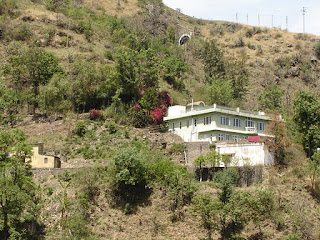

Our present house is visible from this Research Station. My parents built it in 1976. The house and the land around it was named ‘Whispering Winds’ by us because of being in the Ghats with perpetual winds in the area, which tended to tell tales of far lands.

Whispering Winds is also visible as soon as you enter Kandaghat valley. The other house prominent to the right of it is Kissan Bhavan (Farmers Hostel) for the Agricultural Research Station.
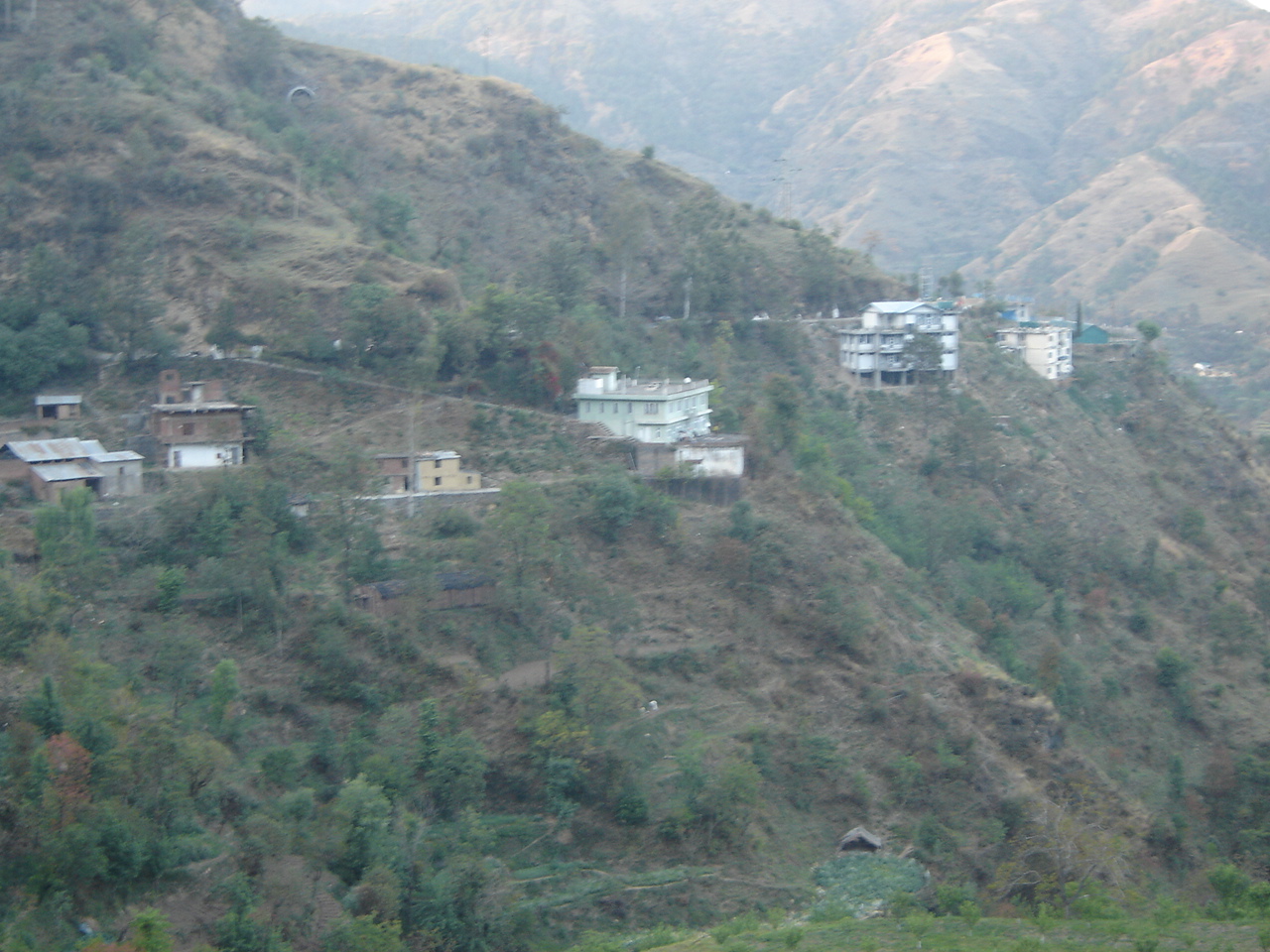
Ours is a rare house with a drive-in road; a luxury in the hils. National Highway 22 leading from Ambala to Khab (near Indo-China border) and Shipkila and Namgial runs just above our house. The Kilometre Stone depicting Kandaghat 2 is very close to our house. The small gauge railway line between Kalka and Shimla (a World Heritage Railway Line) runs above. It has 103 tunnels in all. One of the tunnels is visible just above our house.

My father chose the pistachio colour for the house to jell with the surroundings. However, unlike houses in the hills he preferred not to have a sloping roof with slates. The view from the roof top is exquisite and we love to sit there and have sing-song sessions especially on moonlit nights.


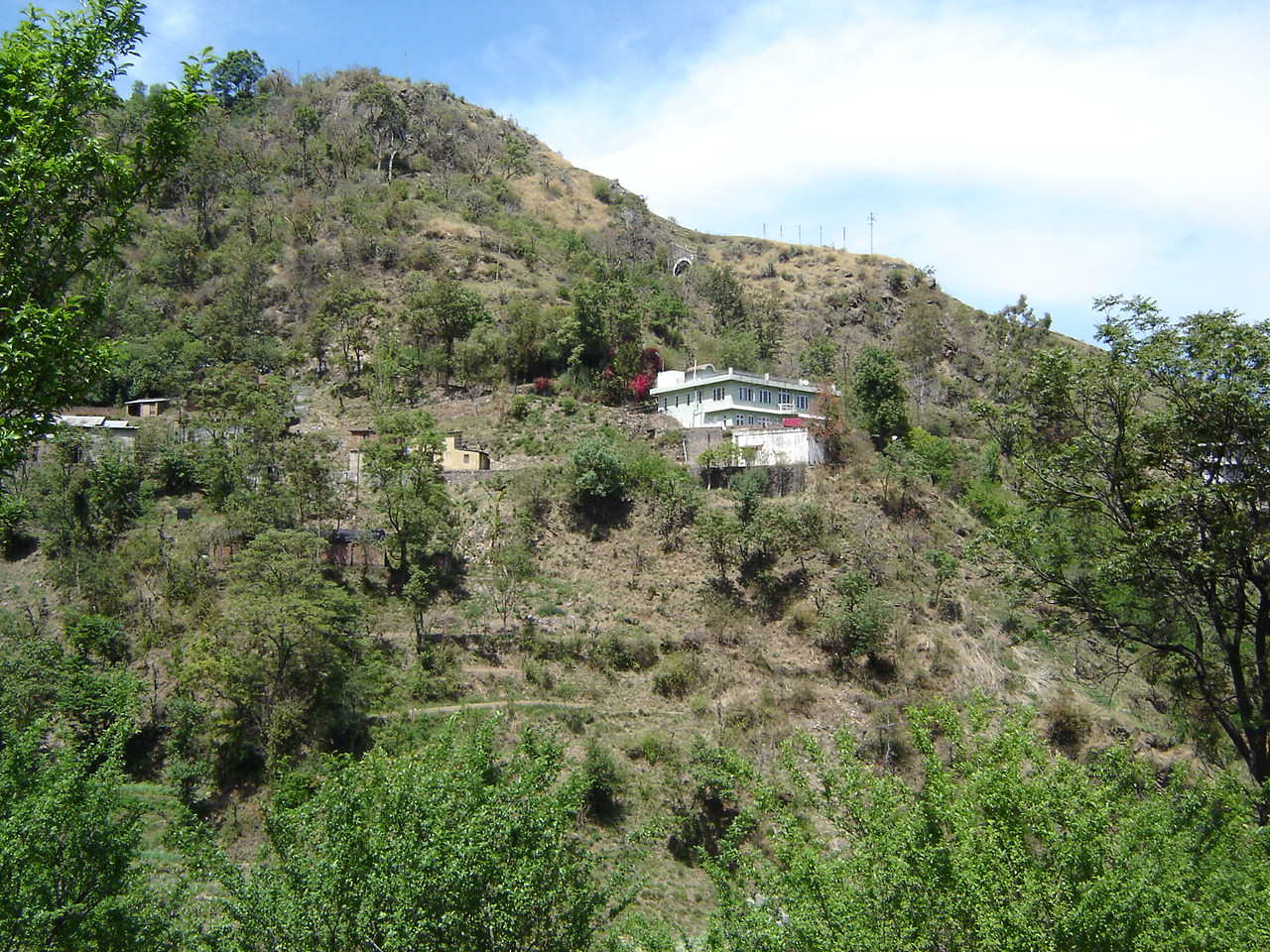

A typical day in Whispering Winds starts with the enchanting twilight reaching out from the hill across our house.

As it lights up the sky, one can see the silhouettes of the trees taking shape.

Finally, it is bright. But, rarely does the sun scorch; it is, on the other hand, inviting and welcome. One could, until just a few years ago go for a walk even after the sun rose. Nowadays, you can’t go for a walk anytime during the day and the night; not because of the sun, but because of the chaotic traffic on the highway that mirrors traffic anywhere in India.

The town of Kandaghat is visible from the next turn on the hill from our house.

Kandaghat is a small sleepy town and the first thing that you see is the Railway Station in the tall Eucalyptus trees.

When I took the picture below in 2007, an Air Force Naval Housing Board (AFNHB) colony had just been sanctioned on the hill where you can see some HP Housing Board houses. Why a Naval Colony in Kandaghat, so far away from the coast? Well, the verdict was that I had something to do with the selection. The truth was that I was as much surprised by the announcement as anyone else.

A closer look of the Housing Colony.

Still closer look. The AFNHB Colony finally came up to the right of it.

The Himachal government did everything to make the colony easily accessible and provided a road all the way there.
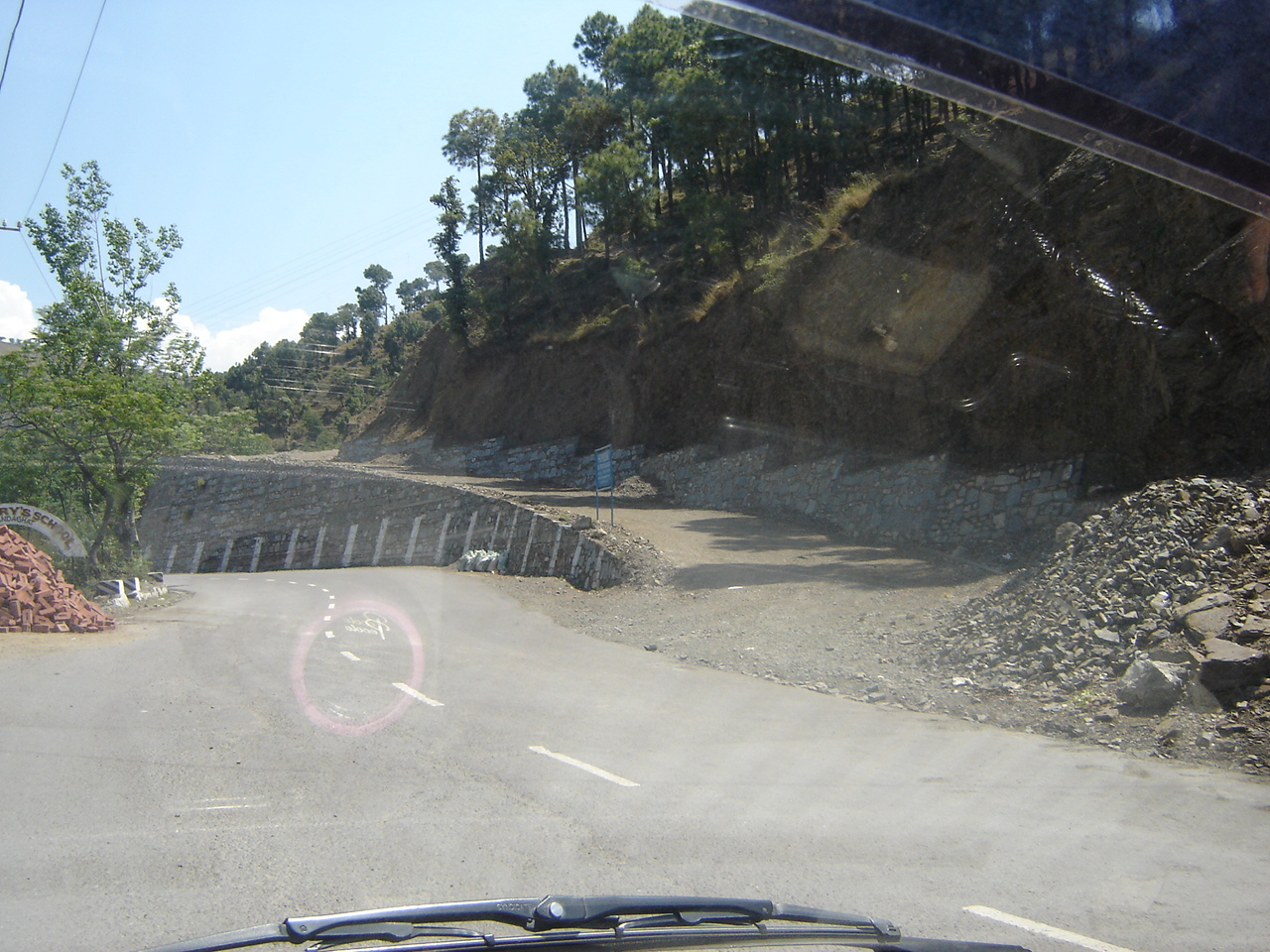
I visited the colony during its early stages and liked the site. Yipee, I was soon going to have friends from the Navy and the Air Force staying there.

A view of the Kandaghat Railway Station. It is so beautiful that when you arrive here waiting for a train you actually want the train to be late so that you can soak in the beauty. For many years after I joined the Indian Navy in 1973 my parents used to come to the station to see me off after my annual leave, rush back to our house and I would wave at them from the train as it passed for about a kilometre stretch above our house. Even now when I see trains from our house, it fills my eyes with tears remembering my dad who died of a jeep accident just 9 kms from our house, in the year 1984, when he was just 56 years old.

Here is a view of the complete Kandaghat town. The top-most building used to be the palace of the Maharaja of Patiala since Kandaghat, Solan, Chail all were areas under the reign of the Majaraja. Later they formed parts of PEPSU (Patiala and East Punjab State Union); until 1967 when the reorganisation of Himachal took place and these areas came to be part of Himachal. Even today PEPSU buses run from Punjab to Chail, a town across Shimla that the Maharaja of Patiala made after he was banned by the British from entering Shimla after the alleged elopement of a British Lady with the Maharaja during the British Raj. Indeed, even till today, the part of the Mall at Shimla from where the Lady and the Maharaja eloped is called the Scandal Point. At the time of my birth, a part of the palace was converted into Officers’ Club and my father was the honorary secretary of the club.

Here is the pic of the Scandal Point at the Mall, Shimla. The guy in the pic is not the Maharaja though; it is me in my Navy cap:

If we look a little to the right of the Maharaja’s palace in Kandaghat, we start seeing the hills sloping down until they merge with the plains of Punjab.

The pic below shows the alignment of the road, NH 22 leading up to Kandaghat where the road crosses over from left hill to right hill of the ghat.

This part of Kandaghat shows a government school for girls and boys (Himachal being No.1 state in the country for spread of primary education) and the court of SDJM (Sub Divisional Judicial Magistrate), Tehsil and Patwari offices and office and residence of SDM (Sub Divisional Magistrate). SDJM’s court has now been shifted to the Mini Secretariat of the HP Govt near the Police Station.

A polytechnic college came up in Kandaghat for the last three decades or so.

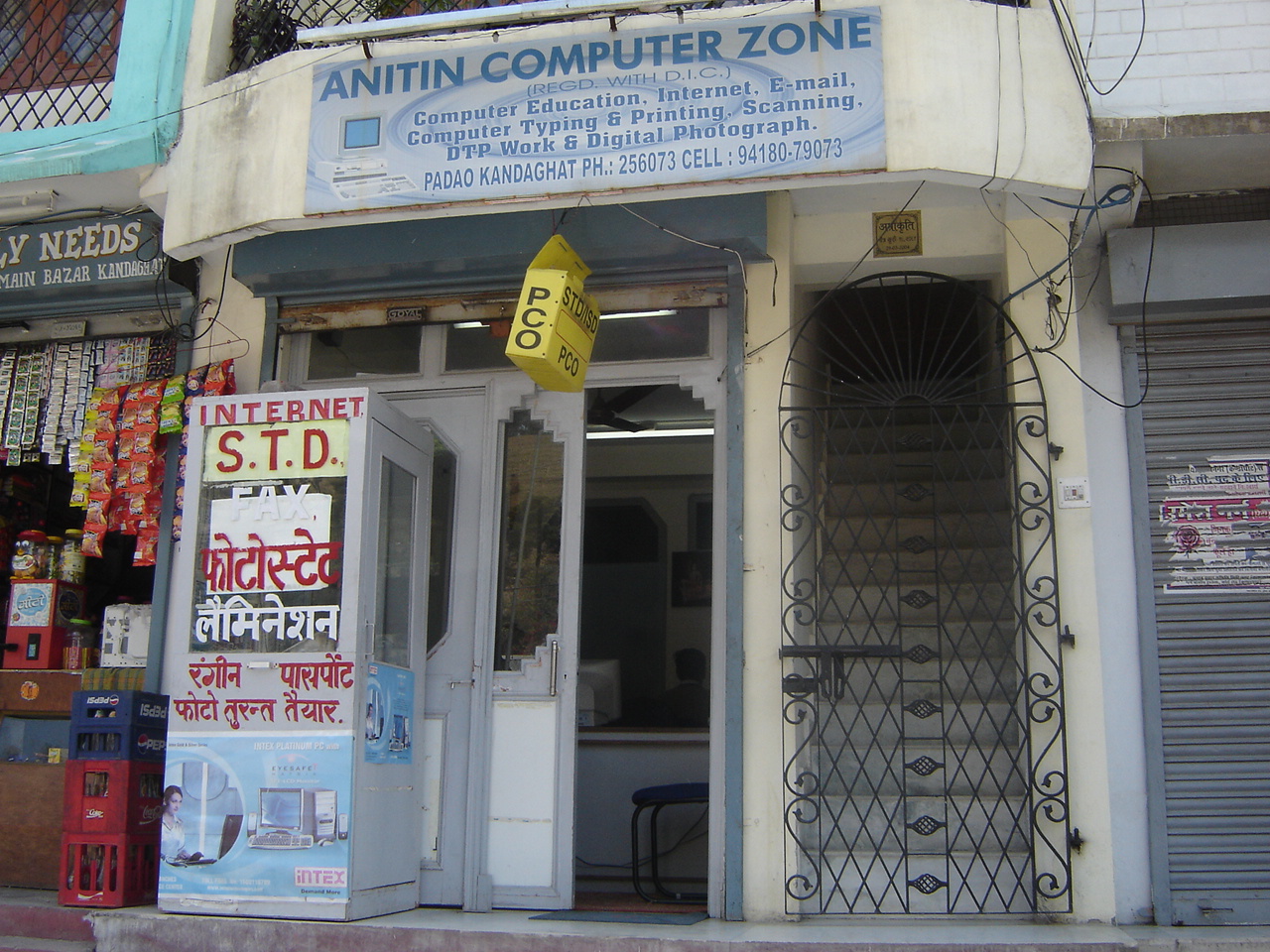
Computers and Internet came to Kandaghat in the last decade.
Alright, lets get back to Whispering Winds as seen from the Agricultural Research Station, the best located house in Kandaghat:

Lets also look at the orchard of the Research Station. The plants as seen in the pic are the Kiwi fruits.


Picture shows my younger son Arun in the orchard.

Kandaghat town has 120 villages. We are in the village Ded (One and a half! Since it is one and a half kms from Kandaghat. Earlier, the village was called Ded Gharat since at the village was an Atta Chakki (Flour grinding machine that ran with the flowing water of the stream)

My son with the ‘Chinese’ tractor at the Research Station.

Lets trace the journey of the train (called Toy Train) as it enters Kandaghat valley from Shimla (the glimpse of which is seen to the right of the train).

It looks so alluring as it winds its way through the hill. The road below the train track is the one that is leading from Kandaghat to Chail.

The train plays hide and seek as it takes turns and goes through tunnels.

The green building in the foreground is the office of the IPH (Irrigation and Public Health department). During my childhood we stayed here for a few years. The yellow building in front has apartments for the officers of the Agricultural Research Station.

The train when it passes over bridges like this brings out loud shrieks of joy from the passengers, most of which are tourists.

After the Station, that have already described earlier, it crosses above our house and is to be seen on the hill across from the house.

I used to continue waving at my parents for about 200 metres…

…..until the train would take a turn and enter a tunnel and leave the Kandaghat valley.

Here is a view of Ghaghar river that flows all the way from Shimla to Panchkula.

That’s the East hill. The palace of the Raj Mata, mother of Maharaja of Patiala is on the hill. The palace is called Blossom and is accessible from Chail. Close to Blossom is a tourist spot.

Just across from Whispering Winds is Thada Moola. Himachal is a land of gods (Dev Bhoomi). The god of Thada Moola looks after the safety and prosperity of people in the area. Indeed, if there is a serious accident on the road, it is widely believed that Thada Moola is angry and need to be appeased. His mandir (temple) is just below the hill.
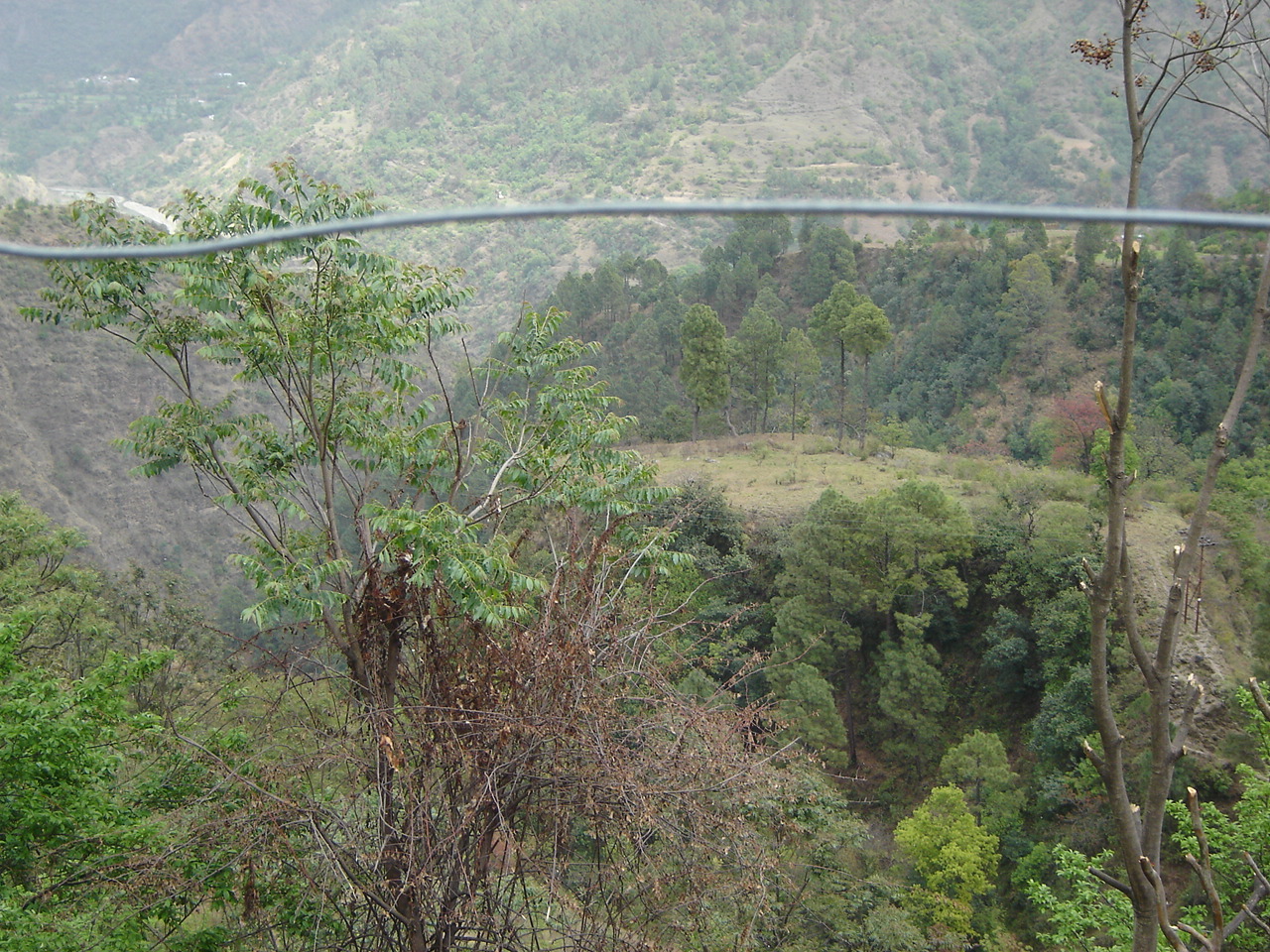
You have seen Whispering Winds from the Agri Research Station. Now, here is a view of the latter.

The tall hill to the right of the Research Station has a temple called Karol temple.
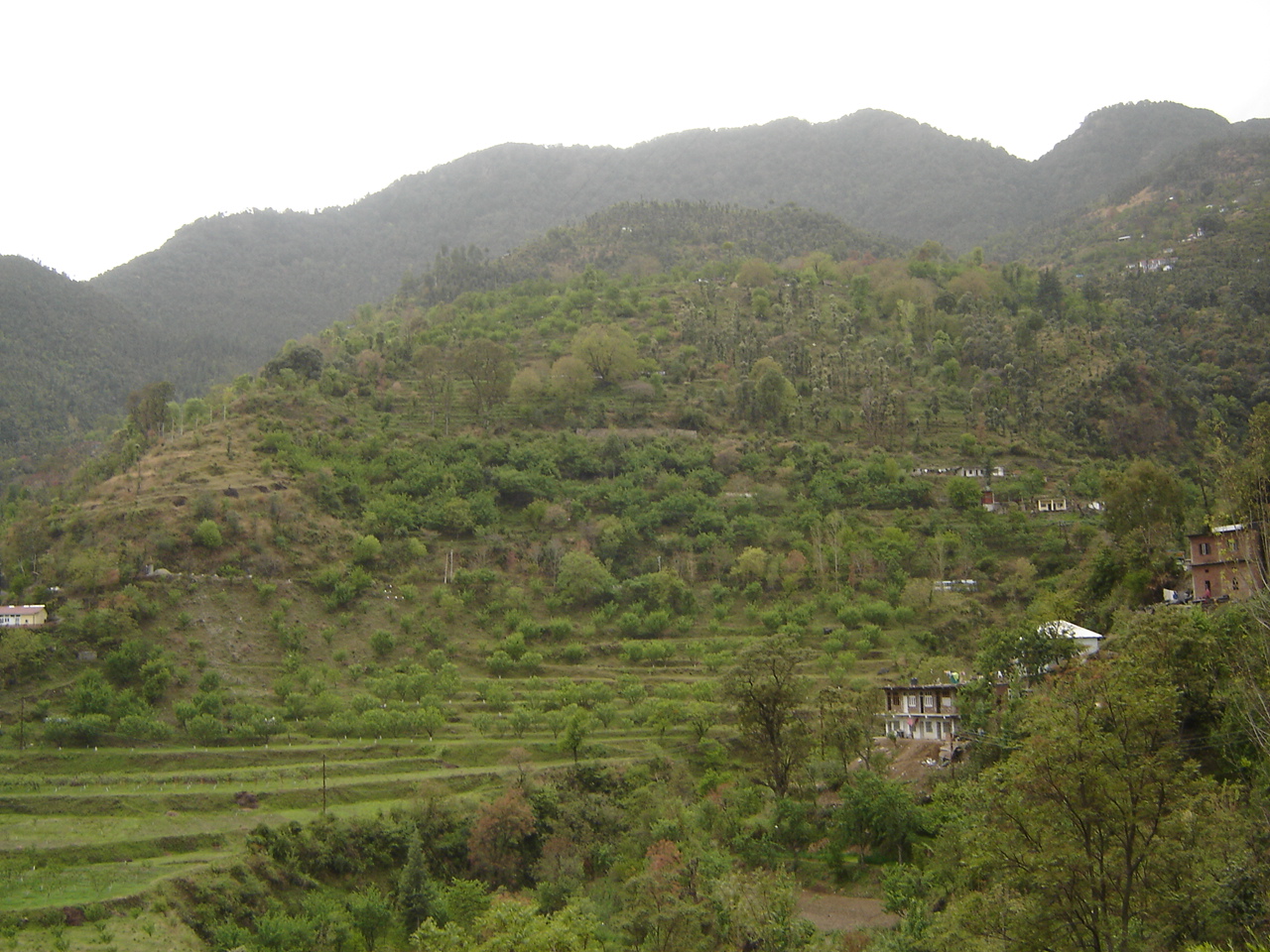
My village Ded has just five families….all the houses are visible in the picture below:

Some of the green-houses of the Research station.

The road leading from Solan to Kandaghat……

……leads to Aab Shar, a place for the weary to take a break.

It even has a service station and guest rooms.

The train that I showed you earlier is just a few metres from Aab Shar.

It is now going towards Kandaghat.

The seasons change and now it is green.

Even the smoke of the train is alluring, though these are diesel fumes

Another train vanishes in the bend.

A view of the Mushroom Farm attached to our house. My father was a pioneer in cultivation of Button Mushrooms in this area. He was Project Director of the first UNDP Mushroom Project in Chambaghat about 12 kms from our house. This one he set on his own:

Look at the hills across, the Chail Hills:

Another Dhaba is about a km from our house towards Kandaghat.
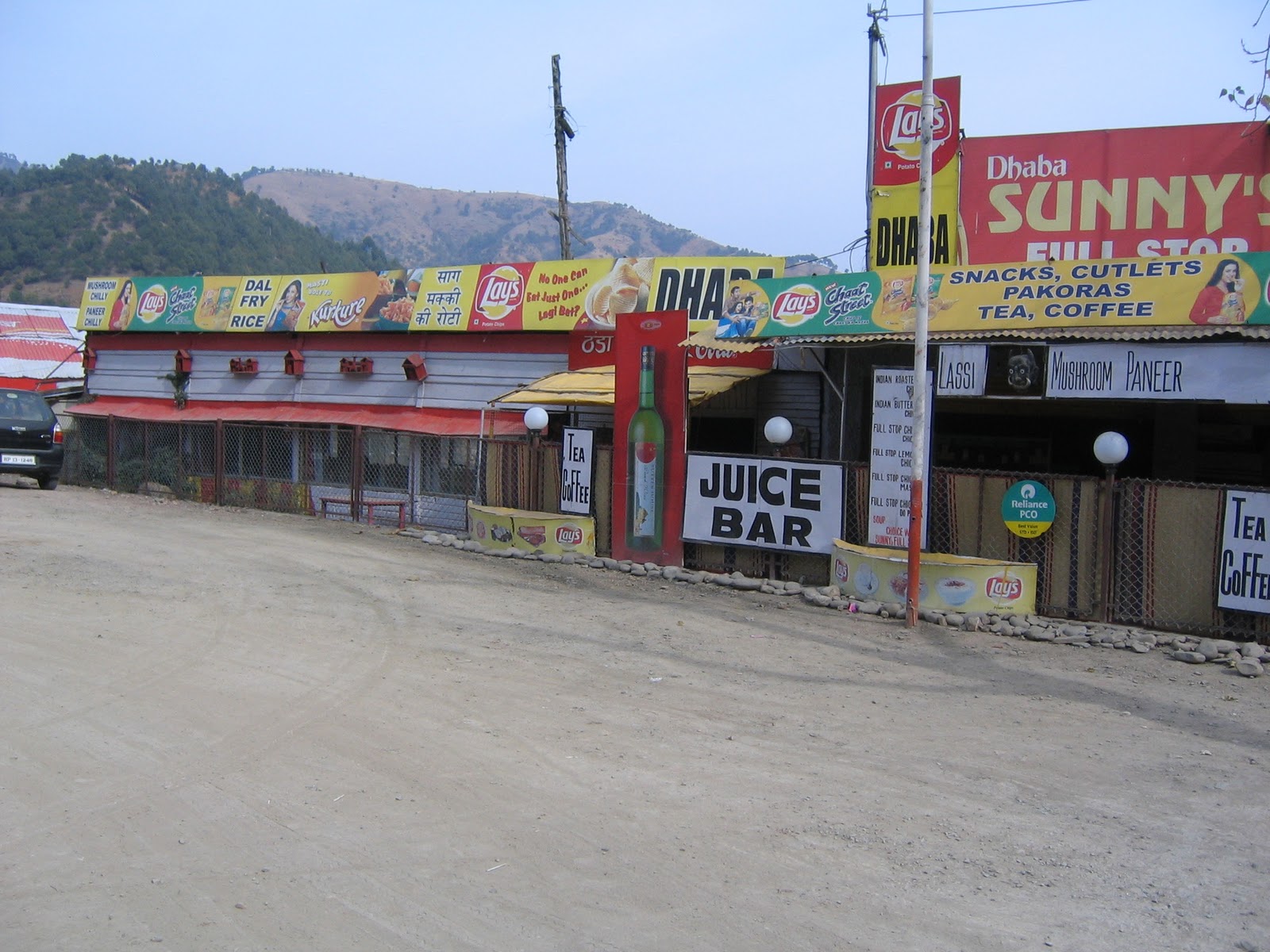

And the road that goes from Kandaghat to Chail

A close view of the Housing Colony:

My mother poses for me here. The town of Kandaghat is in the background.

An alluring site:

I just love to be here:

And here:


Mom poses for me at Whispering Winds. She ensures that there are flowers all through the year:

Flowers and greenery:

The river Ghaghar can be seen in the background:


I can go on and on and there are still about a few dozen varieties left. Lets have a quick look at the places close to Kandaghat. The first is a place called Kiarighat on the way to Shimla. It is just 13 kms from our house. There is a Himachal Tourism Rest House there. The food is good and I particularly like the impressive moustache of our favourite waiter Chaman Lal. Have a look at the following pics:
 |
| Chaman Lal stands next to my mom at the Rest House at Kiarighat |
 |
|
| View from Kiarighat: My son (with his ‘Party Shirt’ with my wife). It is heavenly here. |


If you go further North, about thirty kms from our house in Kandaghat is the city of Shimla. It was the Summer Capital of India during the British rule. Every time I visit Kandaghat, I decide to visit Shimla for the sight of the Ridge, the Mall, Lakkar (Wood) Bazaar, excellent restaurants and just to soak in the sight of the lovely hills surrounding Shimla. Have a peep:


The highest point between Chandigarh and Shimla is Barog. It is as many kms south of our place as Shimla is to the north. It affords a panoramic view of both north and south. The picture above is of an exquisitely placed hotel called Barog Heights where you really feel as if you are airborne. Below are some more pics of Barog:


Shimla Hills, as the whole of Himachal is called Dev Bhoomi (Land of the gods). This is how a day begins at our house:

We have gods virtually at every turn of the hill:

My temporary abode,therefore, can be anywhere. But in the twilight years of my life, I’d love to get back to where my heart is: Kandaghat; and more specifically Whispering Winds:

This is where I feel totally at home and will always feel; as serene as the moon that rises across from the hill and fills my heart with a strange desire to be part of the surroundings.

NAYA DAUR – STILL NEW, STILL NOT RESOLVED
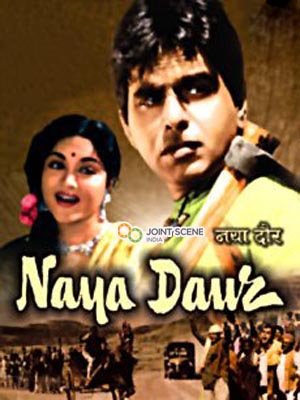
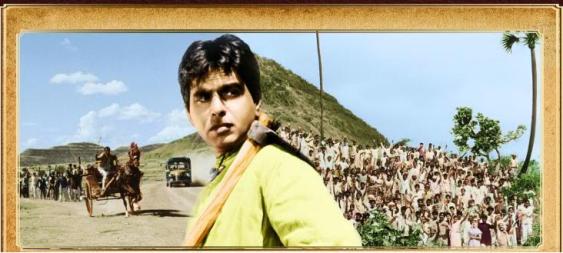 |
| Horse cart winning race over motor bus Photo courtesy: fmetalsreport.com |
The son of a rich landlord starts a bus service in a town that doesn’t bode well for the tongawallahs since the intention is to first drive the tongawallahs out and then to make exclusive profits from potential passengers. This is seen as injustice and unfair competition. Dilip Kumar is their hero who, much like the movie Lagaan accepts a challenge to have a race between the motorised buses and the tongas. The farce of a horse-cart beating a machine kept people on tothe edge of their seats in the ending scenes of the movie; because, on the outcome of the race was dependent whether the tongas would be eased out or not. In the end, despite all the hardships, the tongawallahs win. Hindi movies, with an eye on their popularity and hence profits, have always let the traditional win our modernity, uncouth win our suave, simple-minded win over the clever.
 |
| Courtesy: peta.org |
Naya Daur is translated into New Period, Age, Cycle or Round. Regrettably, 55 years after the movie, Naya Dauris still not a reality both in our infrastructure as also in our collective mindset. We have the penchant to live in the past and choose archaic over modernity in the name of nostalgia; in the name of traditions and heritage.
I brought it out in ‘How Proud Should We Be of the Indian Republic at 62’ on the Republic Day last year how the Indian Republic was meant to be “the greatest political venture” in the history of the world, the greatest “social movement” to uplift millions of the poor of the world into prosperity, safety and security; and how, the politicians and bureaucrats in India failed the people completely by being self-serving. At the time of independence we chose our own version of socialism as the answer to the problems of the impoverished. It failed not because Socialism as an ideology is bad and destined to fail. It failed because the netas and babus ensured that people were kept poor and un-empowered so that the rule or misrule of the babus and netas was perpetuated. These unworthy Indians were busy filling their coffers irrespective of the party affiliations.
India needed to rapidly industrialise so as to emerge a great nation and a world power. Here, the politicians’ and bureaucrats failure to usher in rule of equality made them extract their pound of flesh from the industrialists too. Last year, courtesy Radia tapes, the unholy nexus between the politicians, bureaucrats, industrialists and media was exposed. The fall-out of this nexus is that despite economic liberalisation ushered in by Manmohan Singh, rampant corruption and inefficiency have kept the average Indian mired in poverty.
The wily Indian politician, in a bid to exploit the emotional value of the poverty of the people (just as he exploits the emotional quotient of the caste and the religion) coined a phrase called ‘pro-poor policies’. Hence, whilst he has no real palns to get the people out of the morass of extreme indigence, he politicises pro-poor stance to garner votes and vote banks. Hence, he motivates the masses to extract the maximum from the industrialists; painting them as the culprits of keeping people poor whilst he himself is the real villain.
Take the case of West Bengal’s eviction of Tata’s Nano car factory from Singur. Tata’s promised One Lakh Rupees Nano car was to roll out of their factory in Singur, Hoogly District, West Bengal in the year 2008. The state government, even though a communist government, facilitated acquisition and transfer of about 1000 acres of land for the factory. But, the opposition, under Mamata Banerjee (the present Chief Minister) started the “Save Farmland” movement and drove Tatas’ project out of West Bengal and into the state of Gujarat. Surprisingly, whilst Didi, as Mamata is affectionately called by her supporters, did it for political purposes (as soon as she came to power in West Bengal she wanted Tatas to return), there were many Bengali intellectuals (Sens and Mitras) who supported her movement.
One of such activists that the communists in the country has nurtured is Arundhati Roy. She won the 1997 Booker Prize for her novel God of Small Things. She doesn’t mind being anti-national, seditious, and anti-Indian, in speech at least, as long as the fires of her idealism are fanned and bring in crowds and cheap popularity. Not having been satisfied with her strident support to Medha Patkar, another activist who spearheaded Narmada Bachao Andolan (NBA for short; a people’s movement against the Sardar Sarovar Dam on the river Narmada in Gujarat), because of which the Indian Supreme Court issued her a Contempt of Court notice; she visualised the shock value of her support for the independence of Kashmir fetching her fame and popularity as an intellectual.
With such movies and intellectual support, the poor in India got convinced that modernisation and industrialisation in the country are tools to subdue them. Upon independence, we had movies and songs on the socialist theme showing all rich people as tyrants and shameless exploiters and manipulators. In the 1962 movie Aarti, Meena Kumari sang thus:
“Bane ho ek khaak se to door kya kareeb kya,
Lahu ka rang ek hai, ameer kya gareeb kya?
Gareeb hai vo isliye ke tum ameer ho gaye,
Ke ek baadshah hua to sau fakeer ho gaye;
Khata hai ye samaaj ki, bhala bura naseeb kya?”
(All are made of same clay, who is far, who is near
Blood of same colour flows in everyone, both rich and poor.
Poor is so because you became rich,
When a king was crowned, hundreds became paupers,
It is a social evil, it is not in destiny to be Good or Evil.)
Such ‘socialism’, pro-poor policies only in name, and political activism have extracted a heavy price from our economy. It has promoted indiscipline to the extent that starting an industry in India is now fraught with not only warming the pockets of the netas and the babus but also to make peace with people, largely supported by the politicians (with their vested interests) extracting as much as they can from the rich industrialists; our own version of Robinhood.
On an offshore rig on the Andhra coast, recently, the fishermen felt that they were deprived of their traditional fishing ground and launched a demonstration to extract the maximum welfare money from the GSPC (Gujarat State Petroleum Corporation) rig. Just how the fish can be restricted to a few hundred square metres of area in the vast Bay of Bengal is not for anyone to guess. They boarded the rig with knives in a bid to extort the desired money. And who do you think spearheaded this lawlessness? The elected representatives in that are; two members of the legislative assembly.
 |
| Gujarat CM Narendra Modi during a visit to GSPC Rig (pic courtesy: deshgujarat.com) |
The case of Mumbai is a fine case of this unfinished Naya Daur. The slum-dwellers are the vote-banks of the politicians who vie to make them as indisciplined as possible. In every slum-colony, there are large hoardings of the politicians as a reminded to the people that they are pro-poor and hence their guardians in everything that they do; never mind the law, rules and regulations. Therefore, every now and then the encroachments are regularised. Every now and then new promises are made. The poor do not realise that the policies of these rogues are the ones keeping them poor. But, the Indian society – at least the lower strata – has come to accept the doles that are dished out to them before elections rather than enjoying the fruits of a true democracy.
 |
| pic courtesy: ibnlive.in.com |
How long will the ‘Naya Daur‘ take to materialise under these conditions?
SORRY ABOUT NOT BEING SORRY
 |
| One of the pics of Abu Ghraib with Lynddie England that shocked the world |
 |
| Lynndie England being taken for her imprisonment (Pic courtesy: Wikipedia) |
 |
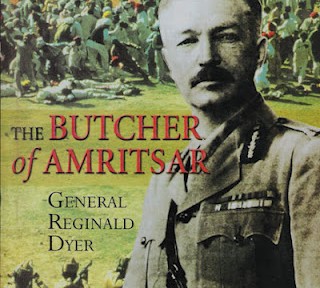
| General Dyer: Sorry About Not Being Sorry at the massacre of the innocent |
Another historical massacre took place from Dec 1937 to Jan 1938 when the Imperial Japanese Army subjected the innocent at Nanjing, China to torture, deaths, rapes and humiliations. The story of Nanjing Massacre is also known as the story of Nanjing Rape; replete with mass murders, rapes etc over a period of six weeks in the Second Sino-Japanese War. I visited the place two years ago and saw how painstakingly the Chinese have maintained the records that would perhaps escape the scrutiny of the Western world and the Japanese.
 |
| At the Nanjing Massacre museum |
 |
| The description of the Massacre at the Entrance |
More than 200, 000 people were victims of these massacres. The most horrible was the Contest between two Japanese officers about who would be the first one to behead 100 innocents with his sword. Photographs of these beheadings are displayed in the Museum including that of the sword, which is now held in another museum. The Chinese have kept records of all those butchered and these are on display in the Nanjing Museum as below:
 |
| Painstaking Records of all those who died in Nanjing Massacre |
What makes men and women to do horrible things to fellow men and women is not the subject of this article. What makes them to be unapologetic even after years of such acts of monstrosity is, however, worthy of introspection. Could it be that each one of us – people and nations – have a philosophy of convenience that makes us call ourselves virtuous, moral and good and find reasons for our own wrongs in the acts of others.
Mahatma Gandhi said, “An eye for an eye makes the whole world blind”. Will we ever regain our individual and collective blindness and see ourselves as what all of us really are. For all the wrongs done, for all the carnage, looting, rapes, massacres, deception, betrayal, cheating, loot, lies and evil, an apology wouldn’t totally heal the wounds. But, we ain’t even apologetic. “They too did to us”, “It was a war necessity” and “They deserved worse” is all we can say, whilst being adamant that there is no point in being sorry.
To end, an atomic bomb called Little Boy was dropped over Hiroshima on 6th Aug 1945 and Fat Boy over Nagasaki on 9th Aug 1945. Nearly 250,000 perished and people still suffer of the atomic fall-out but we are Sorry about not being Sorry.
 |
| Pic Courtesy: tangibleinfo.blogspot.com |
CAN MUMBAI BECOME ANOTHER SHANGHAI?
Indians are great ones at comparisons and at imitating, in their own characteristic style, what people abroad have discovered or invented or made. We are also good at making words that never existed originally in the ‘foreign’ language. For example, if the English have a word called postpone, we feel that pone must be a word by itself and can be used with both post and pre. (Thank God, we don’t have a Preman to deliver mails that we are about to write). So, if they have a Hollywood, we must have a Bollywood. If they have a great city in Shanghai, we must have aamchi Mumbai equally great.
Hence, irrespective of where we are currently (Mumbai placed 116th in world cities for liveability ahead of only Dhaka, Tripoli, Jakarta etc) we have come up with a comparison between Mumbai and Shanghai; believing, as with everything else, that if it rhymes, it must also appeal to reason. We feel that simply by hoping and wishing, some magic wand will be waved and, lo and behold, Mumbai would become Shanghai. The fact is that despite the Western propaganda to forever denigrate China, Shanghai now ranks amongst the best in the world and Mumbai amongst the worst. Foreigners come to Mumabi to transact business as our corporate honchos have headquarters in Mumbai. However, rarely does anyone visit Mumbai to look at anything beautiful here.
Two years ago, in January, I visited China with the Naval Higher Command Course of the Indian Navy (I was the Director of the College of Naval Warfare). The first Chinese city that we touched down at was Shanghai, straight from Mumbai. Here is what we saw.
 |
| An elevated way goes across the city |
We found the city spic and span; with no comaprison with Mumbai whatsover. There are no ubiquitous slums, filth, traffic chaos, dust and confusion. As far as traffic is concerned, they have an elevated way that goes across the length of the city. At least I didn’t come across the kind of perpetual traffic jams that are so common in Mumbai.
 |
| The old existing with the new |
What Shanghai is all about can be seen on Wikipedia or Wikitours and other sites. But, I am giving the pics and description to show my impressions of the city.
Lets start our visit from Xintiandi. It is an affluent, car-free shopping district of Shanghai. Seeing it at night is an exquisite experience. Even though it is the site of the first congress of the Communist Party of China, the narrow streets are marked by restaurants, cafes, shopping malls and theatres. Have a look at the following pictures:
 |
| My wife and I at the Xintiandi |


Nanjing Road is the main shopping street of Shanghai and is one of the world’s busiest shopping streets. The first thing that occurs to you here is that it appears as grand, if not better, than the Times Square in New York. Except for the toy trains, which don’t come in your way, it is a pedestrian’s delight. Have a look at the following pictures and see if Mumbai would ever have something similar:


 |
| Nanjing Street at Night is a Visual Delight |
 |
| Night or day, it is meant for pedestrians only |
 |

 |
| One of the toy trains for the shoppers |
 |
| Despite all the population of China…. |
 |
| ….people dont bump into one another as they do in Mumbai |
 |
| The orderly behaviour of the people is commendable |
 |
| It is a shopper’s paradise |


Shanghai glitters at night and is spic n span by day. One reason why day-dreamers in India and Mumbai ike to compare with Shanghai is because the re-development of the city into one of the top financial capitals of the world began only about two decades back. It is now ranked fifth in the 2011 edition of Global Financial Centres Index published by the city of London. However, even in the beginning of the last century Shanghai was the most prosperous and largest city in the Far East. Three years back, the Shanghai Stock Exchange was ranked third amongst the stock exchanges of he world in terms of trading volumes and sixth in terms of total capitalisation of listed companies.
Central Business District of Shanghai is Pudong. Compare it with Colaba and also compare it with the efforts in last two decades to have a brand new CBD in Belapur, Mumbai:
 |
| Pudong at night |
 |
| Pudong in the daytime |
The sky tower to the left of the picture above is the TV tower in Shanghai called the Oriental Pearl Tower or simply the Pearl Tower. Even though I was not a very senior Indian Navy officer, but, being the head of the College of Naval Warfare (Now Naval War College) from where most flag officers in the Navy graduate, the Chinese accorded me a grand welcome. We, in India, reserve this kind of welcome for the political big wigs only; having no respect for the armed forces, except when we require them.


The Pearl Tower is 438 m high and was completed in four years between 1990 and 1994. For 13 years stood as the tallest structure in Shanghai until it was overtaken by the Shanghai World Financial Center. Even though a symbol of modernity, the design of the building is said to be based on a verse of the Tang Dynasty poem Pipa Song. The poem by Bai Juyi reminds one about the sound of pipa instrument, which is like pearls falling on a jade plate.
The following pictures give the views of the tower, the viewing gallery and of the areas around the tower. Even though it is a tourist place and tourist district (people throng here in thousands), please notice that there are no ubiquitous garbage dumps, litter and filth unlike Mumbai.
 |
| The Oriental Pearl Tower at Pudong, Shanghai |
 |
| My wife with the PLA (Navy) officer Guide ‘Maria’ |
 |
| Ferries at the Huangpu river |
All that you see from the tower is marked on the glass consoles at the gallery. In addition, one can listen to the commentary on an audio-video device. And then, of course, there are guides:

 |
| A view of the Viewing Gallery |


Have a look at the Oriental Pearl Tower in comparison to other TV Towers in the world:

At the ground floor of the Tower is the Shanghai Urban History and Development Musuem. It is really equisitely laid out showing the history of the city of Shanghai, its culture, traditions etc. I found it is better laid out and more imaginatively displayed than Madame Tussaud’s at London. Have a look: the first three pictures are of displays just outside the museum:


 |
| Entrance to the museaum |


 |
| Perserving history; Shanghai style |

 |
| More realistic than Madame Tussaud’s |


 |
There is a display on every aspect of city history and development:


 |
| This is not a picture in the musuem but a large court room with wax figures |

 |
| Ballroom with life-size figures |
Shanghai Expo was going to be held from 1st of May 2010 to 31 Oct 2010. Even though we visited Shanghai in the month of January 2010, everything about the Expo was ready and there was no last minute rush as could be seen at New Delhi Commonwealth Games etc. Picture below is the entrance of the Expo Gallery:

The large real-life displays in the Gallery had visitors see the city, its sights and greatness:
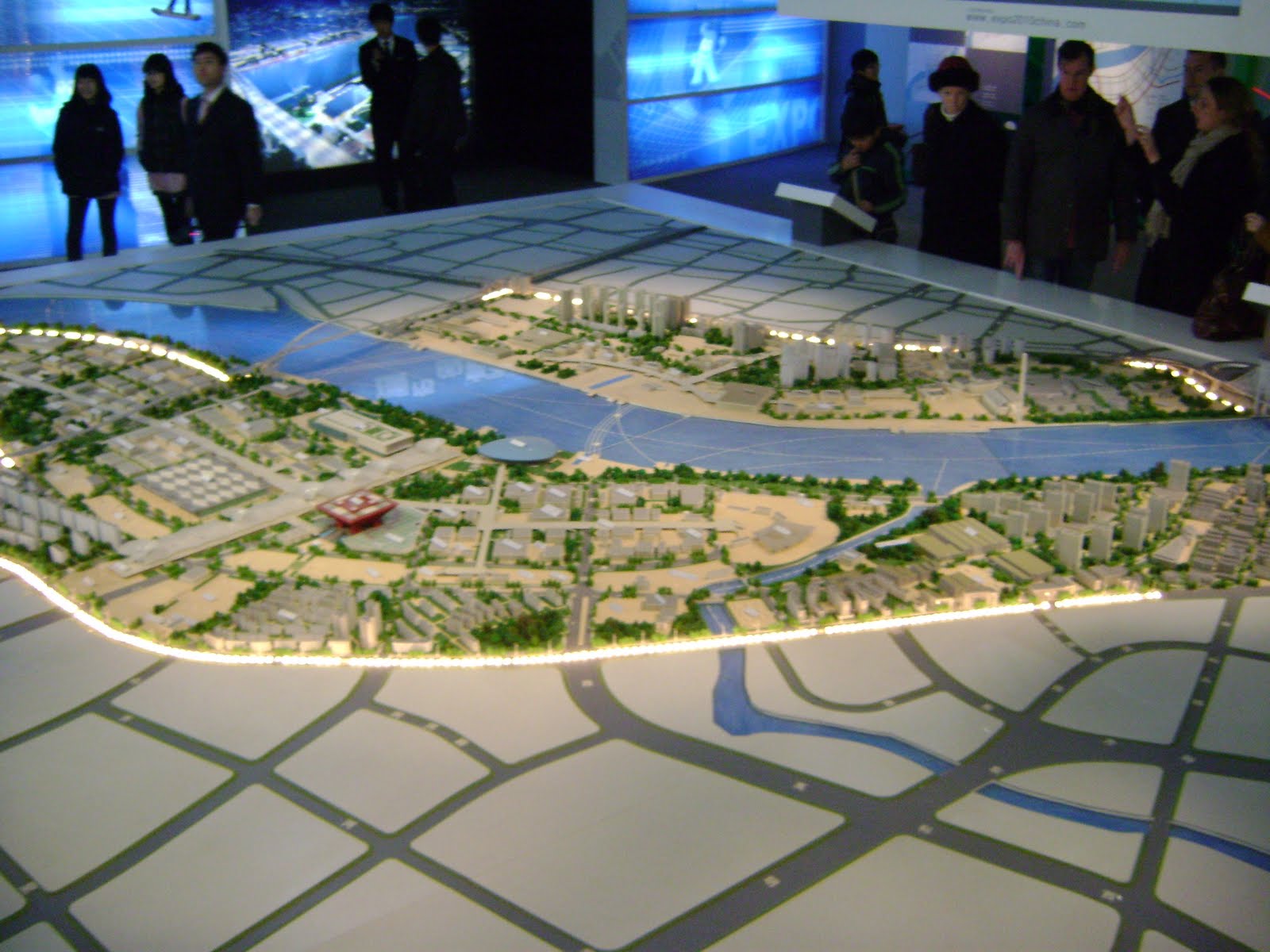


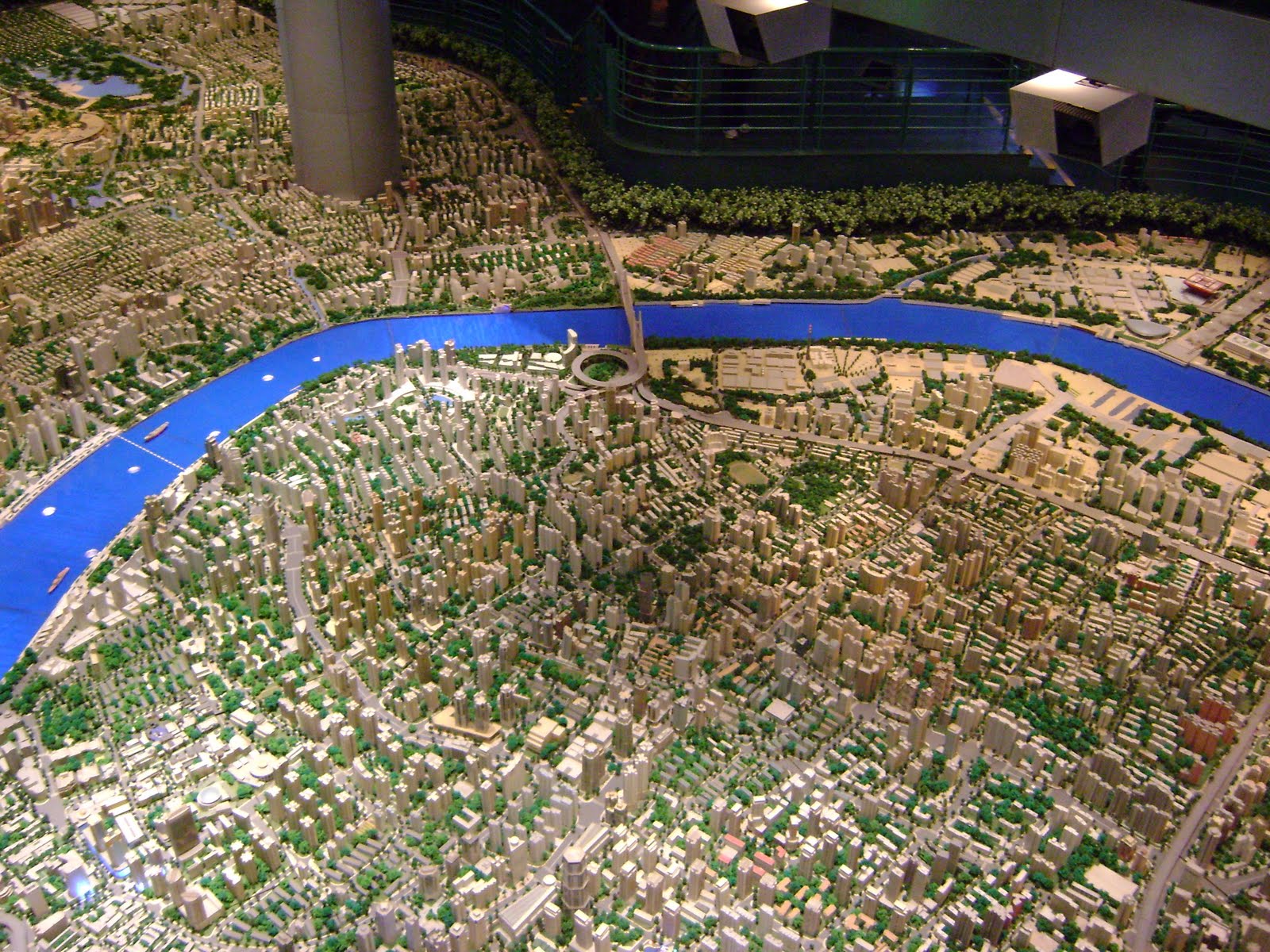
The displays could be lit too to show the city in all its glory at night:


 |
| Signing the Visitors Book at the Gallery |
The Gallery also had a 3D description of the city and the various Expo pavillions.
 |
| Back to the entrance |
Chinese are very fond of pets and these can be seen everywhere. Like people, these too are very well behaved. Mumbai is not the city for pets but for stray dogs:

This is how spic n span Shanghai looks:

Even the old quarters are clean:

Before I end about Shanghai and show Mumbai in comparison, let me take you to the Yuyuan Garden in the heart of the old city, showing taditional Shanghai in the midst of modernity. Here is a description of it from Wilipedia: The garden was first established in 1559 as a private garden created by Pan Yunduan, who spent almost 20 years building a garden to please his father Pan En, a high-ranking official in the Ming Dynasty, during his father’s old age. Over the years, the gardens fell into disrepair until about 1760 when bought by merchants, before suffering extensive damage in the 19th century. In 1842, during the Opium Wars, the British army occupied the City God Temple for five days. During the Taiping Rebellion the gardens were occupied by imperial troops, and damaged again by the Japanese in 1942. They were repaired by the Shanghai government from 1956–1961, opened to the public in 1961, and declared a national monument in 1982.
Views of the old city just outside the Yuyuan Garden:

 |
| Modernity with the tradition |


 |
| Entrance to the Yuyuan Garden |


No photo-essay about Shanghai can be complete without a mention of the famous Sahnghai Acrobatics. The acrobatic performances are held each night and last for about 2 hours. The Shanghai Acrobatic Troupe, established in 1951 is one of the best in China. It frequently tours internationally and perform routinely at Shanghai and other cities in China. An acrobatic show has become one of the most popular evening entertainments for tourists in Shanghai. You can enjoy gravity-defying contortionism, juggling, unicycling, chair-stacking, and plate-spinning acts. It is simply breath-taking and with clockwork precision; two hours without a break and you never know how the time flies.
 |
| The trees and the buildings are beautifully lit at night |
 |
| Entrance to the Acrobatics Theatre |
 |
| It is simply breath-taking |

 |
| In addition to acrobatics skills, items are presented very imaginatively |

With this, lets now turn to Aamchi Mumbai. There are some heritage buildings in Mumabi like the World Heritage Victoria Terminus, belatedly having changed its name to Chhatrapati Shivaji Terminus or the Gateway of India, which was built to commemorate the visit of King George V and Queen Mary to Bombay in Dec 1911.
 |
| Victoria Terminus, now called Chhatrapati Shivaji Terminus |
 |
| Apollo Bunder showing the Taj Mahal Hotel and the Gateway of India |
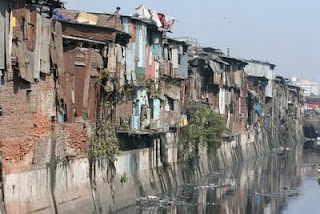
However, what hits you hard about Mumbai is the filth everywhere, the open defecation and urination, the lack of any beautiful or well maintained buildings, pot holed roads, slums, squalor and lakhs of people giving you no space at all.
 |
| All water bodies in Mumbai, without exception, are filthy |
 |
| Slums right next to the airport |
Let alone a foreigner driving in Mumbai, the city’s overcrowded and rickety trains are not at all safe for anyone at all:

Mumbai roads and railways are notorious for their breakdowns; anything more than the smallest rains brings the city to a stand-still.

Mithi river cleaning is going on for quite sometime but in Mumbai, the politics gets into everything and the authorities just don’t have the determination to finish any project:

The last census showed that in Dharavi, there is a toilet to about 750 people and hence open defecation is a norm. Similarly, people living in extreme filthy conditions is a common sight.

The buildings perpetually look black and ugly and people crossing the railway lines is a common sight. Indeed, the authorities shy away from bringing any sort of discipline in civic life.

During the rains, people are virtually by themselves battling against the ravages of nature. (Read Mumbai Rains in the same blog)

Traffic in Mumbai is totally chaotic and one feels grateful to God if one reaches the destination without injury or death (Read ‘Why Must We Love Indian Roads?‘). In addition, Mumbai is amongst the noisiest cities in the world. The general noise is increased manifold during the religious festivals (Read ‘A Quieter Mumbai – Is It A Pipe Dream?)
What Needs to be Done? I can go on and on. However, here is a quick list of things to accomplish the make-over of Mumbai into Shanghai:
- The first thing to do is to get rid of the misplaced notion that Mumbai is livable and a great city. It is really at the bottom of the world’s big cities. With this realisation should come the sobering thought that something needs to be done urgently before people die of plague and other epidemics and of unsafe transportation conditions.
- The second thing to do is to bring some discipline in Mumbai’s civic life. At the present juncture all political parties revel in promoting indiscipline, pandering to such “pro poor policies” as those that do nothing to make the lives of poor better but use them as vote banks.
- BMC or Brihanmumbai Municipal Corporations is the richest municipal corporation in Asia; there is, therefore, no shortage of funds. However, large scale corruption and inefficiency are endemic. Surprisingly, even after the repeated criticism of the people against failure of BMC to maintain even a modicum of civic life, it was recently voted back into power. This shows the hold of the politicians on the vote banks (mostly in slums; after independence, the areas under slums have almost doubled in percentage) and the apathy of the well-meaning people in participating in elections that can change their lot. After 26/11 Terror Attacks in Colaba, when the people vented their anger at the authorities for not doing anything to make their lives safer, Colaba recorded the lowest percentage of voters in the elections.
- Roads in the city are in pathetic state due to rampant corruption in which both the authorities and the contractors participate. This has to be put a stop to and people at large must demand this of the authorities. One method is to display the pictures and names of the concerned contractor and the councillor on every road maintained by them.
- We need to ensure that infrastructural projects don’t keep pace with the past demand but with the future projections. These are to be made corruption free, with transparent implementation.
- There has to be more coordination between various givernment departments so that telephones department, for example, doesn’t routinely dig those roads that have just been re-surfaced.
- The city urgently needs an efficient garbage disposal system.
- Monitoring of traffic and booking of defaulters has to be more efficient rather than based on ad-hoc fining, bribes etc.
- Decongestion of some parts of the city can only be done by providing alternatives. For example, the reason why Mumbai trains are overcrowded is because millions of people commute to South Mumabi everyday where majority of business and government offices are situated. Strong political and corporate will is required to move out some of these to the suburbs and Navi Mumbai.
- Harvesting of rainwater is one of the means to get over Mumbai’s perennial water shortages. Once again, it has to be done with greater sense of urgency.
- Meausres like air-conditioned trains will greatly reduce the car traffic in the city.
- Housing laws need to made more stringent. At the present juncture taking liberities with the laws is more of a rule than exception. The politician-builder link also needs to be breached.
A new dawn for Mumbai to realise its dream of becoming another Shanghai awaits us only if we have the will to bring about changes that may be in conflict with our habitual way of doing things. It is better to do these things now rather than after a number of disasters.

“Young Child with Dreams – Dream Ev’ry Dream on Your Own”


Illusion of fame. A little child in a Tiny Tots nursery was asked his name by the teacher.
He replied, “William Shakespeare”.
The teacher was taken aback and asked, “But don’t you think it is a famous name?”
And the boy replied, “It should be; I’ve been around for two years now.”
The beginning. Sunbyanyname toddled along not knowing where to go on the 1st of March 2010, just a day after I retired from the Navy on 28th Feb 2010. Having a blog whilst in active service in the Navy is sacrilegious and against all sorts of rules, regulations and norms. We are not cleared to publish anything. We are supposed to take three steps backwards, two to the left and four to the right when the Press or the Media asks us a question. The reason is that the people in the armed forces really know their stuff; and hence, if the Press or the Media were to publish what they utter, it would be utter disdain of the Official Secrets Act, which is nearly nine decades old, and can be justifiably called archaic as well as arcane. No such danger exists from the politicians or the bureaucrats as their utterances can never be construed as flouting the OSA. In their case, the country tries hard to keep their ignorance a secret.
This ‘n That. Anyway, let me get back to this two years old baby called ‘Sunbyanyname‘. Initially, in search for a name for my blog, I scratched my head, pulled my hair (a habit I had until very few of the grey matter was actually left) and came up with the name ‘This ‘n That‘. Aha, it sounded best to hide my confusion whilst sounding intellectual. I didn’t know what subject to have the blog on. So, I selected a secion called Humour, another called Poems and Limericks, yet another called ‘Stories’ and another two called ‘Navy – No One Asked Me But…’ and ‘Navy – Nostalgia’. All my serious writing I put under ‘Opinions’ and all that the four letter word called ‘Life’ has conveyed to me under ‘Life is like that’. Later on, I felt that I needed to write about ‘Philosophy’ too to spread my confusion about the ‘truth’ of life amongst all those who can be duped to read it. Finally, I added ‘In Lighter Vein’ for funny anecdotes and ‘Music and Cinema’ to express my love for both these. I also added a section on Travel. The only thing left for me to do is to add Plays in ‘Music and Cinema’. It was a little of This and a little of That.
Change of name. No, it was nothing to do with police and the authorities being after me or a trick learnt from the Pakistani Jehadi organisations. I had to change the name after I realised that the world has lost count of the number of blogs and other artefacts simply called ‘This ‘n That’. It lacked individuality and character. I know that those of you who have read William Shakespeare – not the two year old infant in Tiny Tots nursery, but the bard who regaled the world by anything from Comedy to History to Tragedy to Sonnets – will testify the truth of Juliet’s saying in Romeo and Juliet (II, ii, 1-2) , “”What’s in a name? That which we call a rose by any other name would smell as sweet.” But, I somehow didn’t let Shakespeare interfere with my plan and changed the name of the blog to ‘Sunbyanyname‘. Initially, people thought it was the south Indian Subramaniam spelled wrongly but later people got used to it.
Making the rose smell sweet. This was the difficult part; I had ideas but no time. For more than a year after the blog was born (until end May 2011 to be precise), it lay atrophied like any other public project in India whose foundation stone is laid by a minister with great fanfare, but, whose f stone resembles a tombstone a few years later. Suddenly, one fine day, a Sun Day to be precise, an idea stuck me. It wasn’t as earthshaking as Newton discovering an apple falling from a tree; but, nevertheless its pull was as strong as that of gravity. I reckoned that I was a tad too harsh with myself; thinking that I should write only if it could be published under the ‘World’s Best Dissertations’. Why not just write as it came to me with no frills and repeated editing to make it sound the work of a great intellectual. And the darned rose, the subject of Juliet’s assertion, started to smell if not totally sweet, at least not pungent too.
Joining indiblogger. It is at this stage that I joined ‘indiblogger‘. I heaved a sigh of relief when I realised that there were any number of these prolific writers whose blogposts would take as much space as half of what Juliet said in the quote above. I was reminded of a pair of rabbits being chased by the foxes; the male rabbit told the female, “Shall we out run them or wait here for a while and out number them?” Alright, Sunbyanyname, I addressed the blog, “Go for it, boy; write a blogpost a day and keep the doctor away.” After a few days ‘Sunbyanyname‘ found me, like WW, in vacant and in pensive mood, and rattled out without preamble, “Why do you want to keep the doctor away? She is a Pretty Young Thing (PYT) and worth having better than an apple or a blogpost a day.” “Brilliant” I told Sunbyanyname, “It is ideas like these that have changed the world. Lead on and let them know you are unique and original as the Sun. Don’t worry even if you write a few times a month when the idea strikes you rather than breaking the world record with ‘I breathe in and breathe out blogposts’.”
Miles to go before I sleep. “Are you and that blasted ‘Sunbyanyname‘ of yours happy?” you may ask. Well, ladies and gentleman, now you are getting me into deeper waters than I have been during my Navy career. I admit that I am unhappy about the following:
- I have visited several places in India and abroad but I haven’t got adequate time to recount these.
- The darned pictures take a long time to be inserted and yet they never appear where I want them to appear. From the available time, much precious percentage of it is lost on this.
- When I write Humour and In Lighter Vein people lap it up readily but the number of people who read ‘Opinions’ can be inscribed on the back of a five paise stamp, leaving enough space there for inscribing the number of people who died in both the world wars.
- Sometimes, when original ideas strike me, I am busy in some official meeting or so; and hence, before I can jot them down somewhere, they vanish like snowflakes.
- Existential pangs; that is, what is it all leading to? Is it just This ‘n That?
Light across the tunnel. Still, there is some light across the tunnel. I believe that if a certain political party in India comes to power in the next general elections, they have promised to make days, by an act of parliament, as long as fifty hours and Sun Days as long as hundred. Sunbyanyname and I will have all the time in the world to write some really good stuff. Even at that, on the second birthday of my child, I sing like Waheeda Rehman in 1963 Hindi movie ‘Mujhe Jeene Do‘ (Let Me Live):
Aur dua deke preshaan si ho jaati hoon”
But, after wishing, I become nervous (about you future))
OVERBOARD – OVERSEAS
 |
 |
|
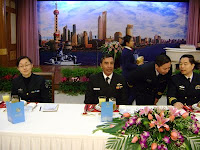
| Young ‘dreamer’ in the Navy |
What? To fix me thus meant nothing?
 But I can't tell (there's my weakness)
What her look said!---no vile cant, sure,
 About need to strew the bleakness
 Of some lone shore with its pearl-seed.
 That the sea feels''---no strange yearning
That such souls have, most to lavish
 Where there's chance of least returning.''
The last two lines have an enigma about them as well as promise of romance. One would think that it is exactly as given in the story books. However, we learnt it the hard way during our trip to Athens way back in 1975 immediately after being commissioned. We were ambling in the Constitution Square when a kind man came to us and asked if we were Indian. He said that he admired Indians and would like us to have drinks in the company of his fair-sex friends. The drinks were nice and the girls were nicer still. We talked about our great nations, our history and heritage, Taj Mahal, Delhi etc (amongst other things, that is) and really enjoyed ourselves. We were under-trainee Acting Subaltern Lieutenants on board. We were convinced that we were smarter, wittier, more interesting company; else, why would the girls be attracted to us as compared to our more senior colleagues from the ship Himgiri? In our megalomaniac trance we did not know that the man who had invited us had quietly vanished and so had our seniors. Later, we were asked to pay an exorbitant bill for the drinks, and we had to part with our entire foreign allowance and more. We were the suckers who had fallen for the obvious ploy. When we returned on board we were ‘ceremoniously’ received with all the seniors lining the gangway and going through the motions of a mock side-pipe.
 |
| At Shanghai, just before retiring |
 |
| At the Great Wall of China |
 |
| Tempo – the type driven by Avtar Singh |
 |
| On duty in uniform but ‘liberty’ in civvies |
I still remember the time whe we landed up at Colombo. In order to shop there we had to first convert our Indian rupees into local currency. Just as it happened in Athens, a kind hearted gentleman came and asked us to put our money in individual envelopes that he had brought, write the names and amounts on the sealed envelopes and then he’d go and get the requisite local currency. He took the envelopes from us only to make a list and then handed these back to us. We held on to these whilst he went on his errand.
 |
| Courtesy: gamerswithjobs.com |
 |
| As a Lieutenant in Florence, Italy |
Finally, with all the sights that we were to see, there was no time left for lunch and we discussed amongst ourselves that we’d just grab some fast food on the way. Primo showed us on the map that, with our permission, he’d like to follow a different route for going back to Rome. He made us understand by gestures that his in-laws stayed in a village and it would not be too much of a detour to go via the village. The only problem was that along the way we didn’t come across a single place where we could stop for lunch.
Primo’s people lived in a farmhouse and the entire family was there to greet us. Within no time, they made us feel like honoured guests from India. We, having been brought up with class-distinctions in India, were pleasantly surprised to see them offering us a sumptuous lunch, champagne and wine and finally carry-away gifts.
Until many years later, I kept thinking of what made Primo do so; possibly the lunch and the gifts were worth more than the hire-charges of his cab. I would like to believe that the concern we had shown for his lunch at Florence, even though expressed in a language foreign to him, made the difference.
Navy is a true international service; it is because most often than not it operates beyond 12 nautical miles of the coast and hence in international waters called the high seas. Our counterparts from the Army and the Air Force rarely leave the country whereas we do it on an everyday basis; in almost every sailing we leave the territorial limits of the country. Navy gave me the opportunity to touch various shores, both by sea and by air. Wherever I went, I never forgot the lesson that Primo imparted us in my grooming years.
 |
| Maori welcome in Auckland, New Zealand |
I remember Captain of our Cadets Training Ship Delhi addressing the ship’s company before entering the port of Aden; my first foreign port. He said each one of us were the ambassadors of our great nation ashore and were expected to conduct ourselves likewise. I thought to myself: ‘What great luck to be called “Your Excellency” at the age of twenty-one’. In the remaining nearly four decades of being in the Navy, we took our ‘ambassadorial’ duties rather earnestly. And guess what? Everywhere we went, the people responded with warmth and affection. The girls? Well, that’s another story.
HI SEXY – ‘GATEWAY TO FUTURE’ FOR INDIAN WOMEN

 Another International Women’s Day is here (Read my ‘Is There Reason to Celebrate Women’s Day in India‘). My article for which I have provided the link was published in Mar 2010. This was around the time when Xinhua reported that Chinese scientists had created the world’s first genetically modified cow, in Jun 2009, that can give milk rich in Omega-3 fatty acid. On the right is a picture of that cow.But, why the moniker ‘Hi Sexy’, you may ask. Well, the fact is that the Chairperson of NCW (National Commission for Women) has, in a recent seminar called ‘Gateway to Future’, in Jaipur, has exhorted women to take it as a compliment if they are called ‘sexy’. Should the genetically modified Indian woman be happy that just before IWD 2012, she is to be excited with the idea of men appreciatively calling her sexy? This should convey to her that she is ‘charming and beautiful‘ and not an object of desire.
In a related news, Bombay High Court has also given a gift to Indian women by giving the legal sanction to retain their maiden name even after marriage. I can visualise the following situation:

There was a time when the double entendre contained in the proposition ‘Aati kya Khandala?‘ for the 1998 Hindi movie ‘Ghulam‘ (Slave) was a subject of heated national discussion about the vulgarity of such a proposition. Even though a boy named Aamir Khan was the slave in the movie, others were salivating about what they could do to or with a girl if she agreed to the proposition. It is only 14 years later – exactly the time taken by Lord Ram to spend time in a forest with his wife Sita and brother Laxman because a ill-tempered and ill-willed woman asked him to do so – and we already have it official that women can now be called sexy without inviting the provisions of a certain Code regarding outraging the modesy of a woman. We are making progress really.
But, I guess, it was long overdue. If a man could be called cocky for being overly self-assertive and self-confident; why can’t a woman be called sexy? But, I suggest, men would be wise to restrict themselves to this one word sanctioned by Mamta Sharma, Chairperson of NCW, and not use any of the synonyms given in the thesaurus: aroused, horny, randy, ruttish, steamy, turned on(predicate), autoerotic, coquettish, flirtatious, erotic, titillating, blue, gamy, gamey, juicy, naughty, racy, risque, spicy-hot, intimate, sexual, juicy, luscious, red-hot, toothsome, voluptuous, lascivious, lewd, libidinous, lustful, lecherous, leering, lubricious, lustful, prurient, salacious, orgiastic, oversexed, highly-sexed, pornographic, adult-provocative, raunchy, sexed, sex-starved.
Conversely, if ‘sexy‘ is to be taken as ‘Charming and Beautiful’, as Mamta Sharma would have us believe, imagine a boy telling his grand-mother, “Granny, even at this age you look really sexy”; and the granny sending him in outer space without the astronaut’s suit and equipment.
On a serious note, yesterday, I was reading the (24th Feb 12) New York Times article by Nilanjana S Roy titled ‘Homosexuality in India – A Literary History’. The last part of the article read, “In her 2010 book, ‘Leaving India: My Family’s Journey From Five Villages to Five Continents’ Minal Hajratwala writes: I have come to understand that queerness is a migration as momentous as any other, a journey from one world to the next … I am the only lesbian, and the only writer, in the recorded history of our clan.”
My comment on the article was: I guess, in every generation, some people would always be “different” because the majority is on the other side. For example, in Indian society, a disciplined person is looked down upon since the majority is used to living in personal and collective chaos. I might just be simplifying the bias but homosexuality is to be seen in that light; it is not the done thing as seen by the majority. The bias against it is as justified as the Christians’ ealier bias against having women as helpers in the church. But, slowly, as more people supported the idea, the bastion fell. As far as ‘history’ is concerned, we don’t have to justify our current beliefs based on the ‘wisdom’ of the past generations unless backwards to the future is the intention.
In the 18th century Royal Navy, since men were at sea for long durations, their women were allowed on board. They used to sleep in the hammocks; which were well suited for comfort and rest but not so well suited for Charles Darwin’s ‘Theory of Evolution’. The only place to practise such Theory was on the deck spaces between the ship’s guns. Willy-nilly, a lot of illegitimate children were born. Such a child, if of the male sex, was callled a Son of the Gun because of his conception in the space between the ship’s guns. However, two and a half centuries later, a man perks up and acts cocky when someone calls him ‘Son of a Gun’.
Likewise, I am sure, after the licence given by Mamta to call women sexy, a time will come when we shall no longer read or write such articles, or call a woman so, by meaning anything other than ‘charming and beautiful’.
Greetings to all my friends on the International Women’s Day; especially to those who are sexy. But, then, I haven’t yet come across a woman who is not charming and beautiful.
WHY THIS VALENTINE VALENTINE DI?

It feels “foreign“-uh
No overboard please-uh

Why this Valentine Valentine di
“Foreign” culture spoil-uh spoil-uh
Watch-uh watch-uh porn-uh porn-uh
And-uh be good Indian boy-uh
Why this Valentine Valentine di
GUARDIANS OF PORN AND MORALITY
Doesn’t it sound a little incongruous to give the charge of Porn and Morality to the same people? It is like electing a rapist to guard women’s virginity. Hence, less than a week before St Valentine’s Day, these Guardians of Porn And Morality (GPAM, like SPAM), were salivating over some “foreign” porn act whilst simultaneously ensuring that their determination to protect the Indian people against such “vulgar” and “indecent display” of love on the day of a “foreign” saint is as steadfast as their oath to do everything for the good of the people.
 |
| Courtesy: Reuter |
You can have a motley of opinions. My opinion is that it is probably good for us that they were watching porn. I can illustrate this by the case of a bartender who was offering free drinks to everyone in the bar. When asked as to what was the game, he replied with determination similar to that of GPAM, “I am doing to the bar what the bar owner is doing to my wife upstairs.” I don’t know what the debate in the assembly and what was the bill to be passed; but, such horny MLAs (Members of the Lecherous Assembly) could have actually sc***ed the people if they hadn’t been watching sc***y acts on their phone. If you follow my reasoning, we should demand that watching porn should be made compulsory for Members of Lecherous Assembly and Members of Pornography (MPs). This would keep them from passing laws that sc*** the daylights out of us.

Indeed, now one knows as to why they have been asking for laptops for every member of parliament and assembly. Firstly, the words (and not single word) lap top must be doing wonders to the libido of these not-so-gentle-men. Then, the lap top certainly would provide bigger images with greater clarity of the intricate scenes. You can also understand the flaming hurry to usher in 2G and 3G so that live action can be streamed to them.
Most people, I am sure, have found nothing out of place about three Lechers watching porn in the assembly. With declining standards of our public morality, such things are only to be expected. When a septuagenarian Governor can be found naked with young girls in his official residence, why not young hornies in the assembly? I think what is being rued is not that. What is being rued is the double-standards maintained by the GPAM.
 |
| Courtesy: articles.thetimesofindia.indiatimes.com |
A few years back I acted in and directed a play called ’30 Days in September’ for a purely Navy audience. When I read Mahesh Dattani’s play, I was taken in by the intensity of the storyline and scenes created by him (he is a really accomplished playwright with a movie ‘Morning Raga’ starring, amongst others, Shabana Azmi and Perizad Zorabian, to his credit. The play was about incest: my initial reaction was that services audiences more comfortable with humour, comedy, mystery and suspense may not like a play about incest (I played the bad guy Vinay). However, we received a standing ovation. The remarkable thing about the play was the ease with which the playwright brought out the double standards displayed by the bad man both as a maternal uncle and finally – in a shocking denouement – as a brother.
 |
| The author as Vinay in ’30 Days in September’ |
Whilst researching the subject, I found that the incidence of incest in India is very high. The then Minister of Women’s Affairs and Child Welfare, Renuka Chaudhary, gave out the government-researched figures and brought out that about 49 percent children in our country are victims of incest and child abuse. The most appalling fact given in the report was that even young boys are not safe.
We have a recent nauseating judgment in the case of a 10 month old having been raped by her neighbour Ramkishan Harijan and the reason that the Bombay High Court gave him lesser punishment was because of taking cognisance of the Counsel for Defense’s plea that ‘the rapist was poor, father of two, living alone, away from his native place and therefore probably lost control over himself’. Disgusting, to say the least.
 |
| Courtesy: examiner.com |
Then we had a Minister in Goa Assembly who inferred that “women deserved to be raped because of wearing provocative clothes”. India and especially the national capital is now amongst the unsafest countries for women.
So, to conclude the deception of double standards, do we let the GPAM make laws on morality and do nothing about their own? Do you think that the children wouldn’t have read the news and seen the pics (you can’t ban the children from reading newspapers, can you?). Do we conclude that the foreign culture of celebrating such “depraved” days as St Valentine’s Day is responsible for the wide-spread degradation in our public morality? Haven’t we become a nation that is always in search of some foreign thing or the other for our general rot of values; something similar to Indira Gandhi’s “foreign hand“?
Like in the case of Mary Magdalene, I don’t know who will and should chuck the first stone? Certainly not GPAM.
Lets have some honest soul-searching and opinions.
GOD AND I

It was dark, very dark. It must have been extra-sensory experience because though there was no light and she wasn’t shining or anything close to it, I could see her. I hadn’t seen her earlier, not even in my thoughts, but, I could recognise her instantly.
“God”, I told her in abject bewilderment, “How can I see you in the dark?”
She looked at me with equal dumbfoundment, “I am elated that you have the gumption to realise that God isn’t a He anymore. But, I am amazed that you can’t realise how you can see me. You see (“what an expression”, I thought) I make all rules, laws, science, philosophy, ideas and thoughts in the universe. So, I can make you see me even without the light.”
 |
| Courtesy: Angel Wallpapers |
I know even my wife has the same power. She too can make me see what she wants me to see even in the dark. However, what an enromous power I would have, I thought, if this woman – sorry God – were to bestow upon me the ability to see everything in the dark? I wasn’t surprised when She read my thoughts and stopped me halfway in my new fantasy, “Don’t even think about it; you ain’t so special. Just because you call yourself sunbyanyname is no reason for me to give you extraordinary powers. First tell me, how did you figure out God is now a woman? It must be an independent thought because I didn’t give it to you.”
My, my, I actually had an ungodly thought. However, I let Her – God – know how I cottoned on to it (no point in having God against you), “I perceived it on facebook, twitter and blog.”
“Very observant, I say” She said, “But I think I made a big mistake. If someone half-witted as you could perceive that God is a woman, soon everyone will understand it. As it is people these days don’t believe in God; if they were to realise that I am a woman, all hell will break loose.”
“God” I reasoned with Her, “Let them know your true face (I nearly said facebook) or profile. Your angels on facebook, twitter and blog already know. So, why not let the men know it too?”
She wasn’t in a listening mood. Her mind was totally made up as most women’s minds. What she said next shocked me immensely, “I am thinking of taking away from men the thinking mind.”
I was flabbergasted; totally speechless. I instantly knew why She was doing it, so as to give a headstart to women in the same manner He or She had given to the men in the stone age. My first reaction was not to keep long hair lest She should reverse Time and have them (the women) go out and hunt and then drag us into the caves by our hair with their clubs resting on their shoulders. Anon I said, “We, men, are a proud lot. We would resent the loss of thinking mind.”
“No, you won’t” She said imperiously, “You won’t even realise the loss. For ages now you have let that thingy do the thinking for you. In any case you don’t use your mind much.”
Mindless, I thought. Really mindless.
Next moment, poof, and she was gone.
As sunbyanyname I am used to seeing the silver lining and I spotted it in a flash. If the women were to jeer us for our mindlessness as we taunt them for some attributes of theirs, we, men won’t have the mind to mind it.
P.S. This is my last thoughtful post. As She – God – decreed, soon men like me, real men that is, will have no mind to think.
Amen.
P.P.S. Come to think of it, She might change Amen to Awomen whilst keeping the meaning same.