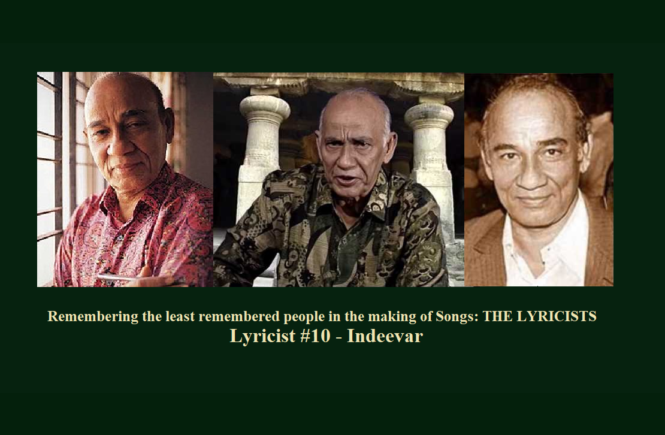
As with all posts on Lyricists, these posts are a compilation of my daily posts on my Facebook page Lyrical.
So far, on Lyrical, I have taken up nine lyricists of great fame:
1. Shailendra. The opening song that I selected was Kuchh aur zamaana kehta hai.
2. Rajinder Krishan with his Mujhase mat poochh mere ishq mein.
3. Kaifi Azmi with his Jaane kyaa dhoondati rehati hain ye aankhen mujh mein.
4. Sahir Ludhianvi with Aurat ne janam diya mardon ko.
5. Majrooh Sultanpuri with Teri aankhon ke siwa duniya mein rakha kyaa hai.
6. Jaan Nisar Akhtar with his Mujhape ilzaam-e-bewafai hai.
7. Hasrat Jaipuri with his Aansu bhari hain ye jeevan ki raahen. (Yet to be published here).
8. Qamar Jalalabadi with his Ai meri zindagi tujhe dhoondun kahan.
9. Raja Mehdi Ali Khan with his Mera sundar sapna beet gaya.
Tonight we take up the tenth lyricist Indeevar. He was born in 1924 as Shyamalal Babu Rai in Dhamna Village of Jhansi district of Uttar Pradesh. He moved to Bombay at the end of 1940s to pursue a professional career as a lyricist.
In a career spanning nearly half a century he wrote 1633 songs for over 300 films. I could find 1589 songs from 446 movies.
Day #1, Song #1
Bade armaano se rakha hai balam teri kasam
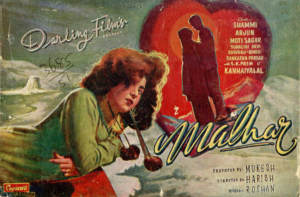 He started writing lyrics for songs with the 1945 movie Samrat Chandragupta. It was with his 17th movie in 1951: Malhar that he finally got recognition with the song: Bade armaano se rakha hai balam teri kasam, a song picturised on Arjun Bakshi and Shammi.
Here is from The Hindu newspaper dated 29 Mar 2012 in a piece titled ‘Blast From The Past: Malhar (1951):
“Starring Shammi, Arjun, Moti Sagar, Kanhaiyalal
On watching “Malhar”, more than six decades after it was released, one cannot but admire the fundamental laws that govern good cinema, which have stood the test of time, proving that they are inviolate and sacrosanct. Despite the considerable time that has elapsed, “Malhar”, directed by Harish, shows no signs of staleness, at least in certain vital areas. The first of two films to be produced by ace singer, Mukesh (the other being “Anuraag” in 1956) under the banner of Darling Films, it had a young and largely inexperienced cast and crew, for many of whom it was their debut vehicle.
The film is a showpiece of technical brilliance, especially the editing by S. Prabhakar, which is taut and precise, and never allows the narrative to slacken or waver, even in the second half, which, on certain occasions tends to meander. Equally deft is the cinematography by M. Rajaram, considering the equipment available to him.
However, piece-de-resistance of the film is its music score, composed by Roshan, grandfather of Hrithik Roshan, who had made his debut just a year earlier, in 1950. For the current generation of viewers, who, through incessant harping might be deluded into believing that film dynasties do not extend beyond the Bachchans and the Kapoors, this will be a revelation. As will be the trivia that Mukesh was the grandfather of the talented Neil Nitin Mukesh. Or Moti Sagar, who essays an important role, is the father of singer Preeti Sagar.
Each song, led by the remarkable “Bade Armaanon Se Rakha Hai Sanam Teri Qasam, Pyaar Ki Duniya Mein Yeh Pehla Qadam” is a gem. Roshan was undoubtedly helped by the lyricists, debutant Indeevar and Kaif-Irfani- who penned sheer poetry, including “Dil Tujhe diya tha Rakhne ko, Tune Dil ko Jala ke Rakh Kiya” and “Tara Toote Duniya Dekhe”. Lata Mangeshkar and Mukesh, needless to mention, made them immortal in their voice.”
Please enjoy Lata Mangeshkar and Mukesh sing the first hit song of Indeevar in the Hindi movies, a song composed by Roshan: Bade armaano se rakha hai balam teri kasam….
ba.De armaano.n se rakhaa hai balam terii kasam
o balam terii kasam
pyaar kii duniyaa me.n ye pahalaa kadam
ho, pahalaa kadam
judaa na kar sake.nge hamako zamaane ke sitam
ho, zamaane ke sitam
pyaar kii duniyaa me.n ye pahalaa kadam
ho, pahalaa kadam
le uThaa pyaar bhii a.nga.Daaii hai, dil bhii jahaa.N
ajii, aise me.n li_e jaate ho tum bolo kahaa.N
duur duniyaa kii nigaaho.n se kahii.n jaae.nge ham
pyaar kii duniyaa me.n ye pahalaa kadam
ho, pahalaa kadam …
terii do aa.Nkho.n me.n dikahte hai.n mujhe dono.n jahaa.N
inhii me.n kho gayaa dil meraa kaho Dhuu.NDhuu.N kahaa.N
chaa.Nd ghaTataa ho ghaTe apanii mohabbat na ho kam
pyaar kii duniyaa me.n ye pahalaa kadam
ho, pahalaa kadam …
merii naiyaa ko kinaare kaa i.ntazaar nahii.n
teraa aa.Nchal ho to patavaar bhii darakaar nahii.n
tere hote hue kyo.n ho mujhe tuufaan kaa Gam
pyaar kii duniyaa me.n ye pahalaa kadam
ho, pahalaa kadam …
Day #1, Song #2
Do hain naina hon chaar kaise
We started with our tenth Lyricist (not in any particular order or ranking): Shyamalal Babu Rai or Indeevar with a great song of his in the 1951 movie Malhar: Bade armaano se balam teri kasam.
Now, lets go on chronologically. His first movie, as I said, was the 1945 movie Samrat Chandragupta. I couldn’t make out exactly which was his songs and which were by Pt Madhur. Hence, I am not giving you any.
His second movie was the first of the two movies in 1946: Double Face. Indeevar wrote all seven songs for the movie that were composed by Shyam Babu Pathak:
1. Abhi hai kuchh deri.
2. Dekhe bin chain nahin.
3. Dil ek hai.
4. Ek din ki suno kahani.
5. Hath mein sagar ho mere.
6. Rehte hain adhure.
7. Uthi uthi ghatayen.
We shall skip all these.
Jungle Ki Pukar was his next movie in 1946. S Banerjee and Goswami composed following songs penned by Indeevar:
1. Aisi aayi ab ke bahar.
2. Chalo piya ke des panchhi.
3. Dekho mera singar.
4. Dono rukhsar mah pare hain.
5. Gar yaar na ho.
6. Pardesi saudagar aaye.
7. Yaad tumhari aayi sajanwa.
Once again, we shall skip these.
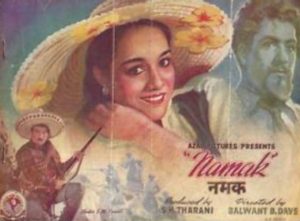 Namak was the first of the two movies having his songs in the year 1947. Once again, Indeevar wrote all five songs for the movie that were composed by Naresh Chandra and Shyam Babu Pathak:
1. Do hain naina hon chaar kaise.
2. Kabhi jab unki yaad aati hai.
3. Aansu na tham sake to dil ko thaam lena.
4. Daal ke dera kare basera.
5. Kisi ke ho jaao.
I am going to give you the first song only to show you the development of a Lyricist in early stages.
This song was sung by Leela Mehta and Yashwant Bhatt.
Please enjoy: Do hain naina hon chaar kaise…
Day #1, Song #3
Tere naino mein nindiya
Black Market was his second and last movie in 1947. He wrote as many as eight songs for the movie that were composed by Shyma Babu Pathak:
1. Dear Dear Darling tumse mujhe love ho gaya.
2. Dekho dekho dil dil mein bas ke.
3. Ho ye ye ho ho ek chai.
4. Kano ke jhumke kehte hain.
5. Mausam ki chhatta manohar ho.
6. Naina geele mat kar pi le.
7. Peene walo aaj jannat ban ke rehti.
8. Saal mein din wo ho
We shall skip all these songs.
Satyanarayan was his first movie in the year 1948. Hansraj Behl was the composer of eight songs, out of which only one was written by him: Dil waale sahib ghazab kar daala.
With this, on the very first day we have covered 39 of his songs in seven movies. Out of these I gave you the 1951 movie Malhar song out of turn: Bade armaano se balam teri kasam.
His next movie in 1948 was Didi in which Mukund Masurekar composed eleven songs; eight of these were penned by Indeevar:
1. Pyari raat pyari raat aaj aayi hai suhag ki raat.
2. Tere naino mein nindiya.
3. Balam mere haaye.
4. Chupke chupke aana mere raja.
5. Mere dil ki duniya se.
6. Bhool jao mere meet.
7. Kal aayenge.
8. Main hoon naar naveli.
The first one is a fine song sung by Amirbai Karnataki (the one who sang Vaishnav janto tene kahiye that was immensely liked by Mahatama Gandhi) and Shankar Dasgupta. However, I searched on the net and couldn’t even get it in MP3.
Hence, please enjoy Lata Mangeshkar singing: Tere naino mein nindiya…
tere naino me nindiya tere naino me nindiya
nindiya me sapne sapne me sajan
dol rahe re dol rahe re tere naino me nindiya
dol rahe re dol rahe re dol rahe re dol rahe re
sapne me sajan dol rahe re tere naino me nindiya
jadu ke teer chale kaleja chir chale
dono hi dilo ko ab tatol rahe re
tere naino me nindiya
gore gal muskurake lal ho rahe
ho gore gal
gore gal muskurake lal ho rahe
mithe mithe man me khyal aa rahe
bezuban labj bhi kuch bol rahe re
tere naino me nindiya
chhedo nahi aasha ko chhedo nahi aasha ko
jud gaye do sans mile honge do
tum abhi se man me ras ghol rahe re
tere naino me nindiya tere naino me nindiya
Day #2, Song #4
Ab to nazar ka naata tujhse hi jod baithe
We started with our tenth Lyricist (not in any particular rank or order) Indeevar day before yesterday. On that day we covered 8 of his movies with 41 songs and I gave you, as everyday, three of them.
His first movie in 1949 was Jagriti. Nine of his songs were composed by K Narayana Rao, the producer:
1. Ab to nazar ka naata tujhse hi jod baithe.
2. Aaye aur jaadu daal chale.
3. Nayi nayi pehchan re.
4. Azadi mili desh ko dukhiya ko kya mila?
5. Din ko hansna raat ko rona.
6. Dushaman hai ye dil hi hamara.
7. Ek jyoti bhuji.
8. Jawani ke path mein ye pehla kadam.
9. Kasam hai tumhen.
All but two songs were sung by Yashwant Bhatt, Lalita Rao and Freni Shroff. Two solos were sung by Omkar Devaskar and Sanjeevani Pai.
The first one has been sung by Omkar Devaskar in the likeness of KL Saigal, the prevalent style at that time. The lyrics are very good.
Please enjoy: Ab to nazar ka naata tujhse hi jod baithe…
ab to nazar ka nata ab to nazar ka nata
tojhse hi jod baithe tojhse hi jod baithe
ab to nazar ka nata ab to nazar ka nata
tojhse hi jod baithe tojhse hi jod baithe
aashik teri gali ke duniya ko chhod baithe
aashik teri gali ke duniya ko chhod baithe
ab to nazar ka nata ab to nazar ka nata
tojhse hi jod baithe tojhse hi jod baithe
ab rahe mohabbat me ab rahe mohabbat me
manzil hai makan tera manzil hai makan tera
duniya ke rashto se rishta hi tod baithe
ab to nazar ka nata ab to nazar ka nata
tojhse hi jod baithe tojhse hi jod baithe
naam aapka le le kar badnaam ho chuke hum
naam aapka le le kar badnaam ho chuke hum
haa haa naam ek aap hai jo hamse
muh apna mod baithe ek aap hai jo hamse
muh apna mod baithe ab to nazar ka nata
ab to nazar ka nata tojhse hi jod baithe
tojhse hi jod baithe
Day #2, Song #5
Mohabbat hote hote ho gayi
His second and last movie in 1949 was Imtihan, a Mohan Sinha movie starring Surendra Nath and Madhubala. Shyambabu Pathak composed ten songs in the movie, most of which were penned by Harikrishna Premi. Only one was written by Indeevar and sung by Geeta Dutt (she sang most of the songs): Dekho dil de ke tamasha dekho.
Aflatoon was the first of his five movies in 1950. Neenu Majumdar composed seven of his songs that were written by him and Buniyaad:
1. Bach bach ke chalungi chhip chhip ke milungi.
2. Chhipo hamse na O meri Laila.
3. Kehna na maana kisi ka tumne.
4. Mera dil tere bas mein.
5. Pyar bhari raat sajan yaad tumhen hai ke nahin.
6. Sun meri baat sun is mein paap hai na punya.
7. Teri yaad ab dil dukhati rahegi.
Achha Jee was his second movie in 1950. He was back with Shyam Babu Pathak and they made the following songs:
1. Apna bana ke rahungi.
2. Apne dilon mein hai ujiyala.
3. Bahut akad ke chalte the wo chhaila ji.
4. Bhar jaaye aasman to aahon ki kya khata.
5. Bhool hai kisi ko apnana.
6. Do din ki bahar pyar mein guzaar do.
7. Kisi ke bholepan ne mere man ko kheencha.
8. Takrar ko badal do pyar mein.
All very good songs as you can make out from the titles. However, we shall skip all these.
In his next movie in 1950 Hanste Rehana, starring Mukri and Heera Sawant, there were six songs composed by Wadhwa: two written by Farooq Qaiser and four by Indeevar:
1. Hai kitna suhana.
2. Matwali ghatao zara tum jhoom ke aana.
3. Ek woh hain humko bhool chale.
4. Ho pam pam.
Rupaiya was his fourth and last movie in 1950 and 14th movie since his entry into Hindi films with the 1945 movie Samrat Chandragupta.
P Ramakant composed nine of his songs:
1. Tiki hui thi jin par nazaren.
2. Mohabbat dard hai.
3. Hamen apna bana lo ji.
4. Insaan banane wale ne kya cheez banayi hai.
5. Jise main pyar karun.
6. Log kehte hain mohabbat mein asar hota hai.
7. Main naari hoon.
8. Na jaane mujhe kya ho gaya.
9. Tu mera Mohan main teri Radha.
We shall skip all these. Once again, you are aware as to how difficult it is to make a break as a lyricist in Hindi movies. I have gone through 38 songs of his six movies and given you only one. I have already told you that his first hit song was in the seventh year of his career after 17 movies and we started with the Malhar song: Bade armaan se rakha hai balam teri kasam pyar ki duniya mein ye pehla kadam.
Aahuti was his last movie in 1950 and the 15th movie of his career in six years.
The film starred Ranjit and Mumtaz.
DC Dutt composed 13 songs in the movie; eight by Tandon and five by Indeevar:
1. Agar Bhagwan tum hamko kahin.
2. Same song (Version 2).
3. Chaar dino ki athkheliyan.
4. Mar ke jeena hamen bhi.
5. Neha laga ke nibhayiyo.
And that brings us to the year 1951 with whose movie song we started with Indeevar yesterday.
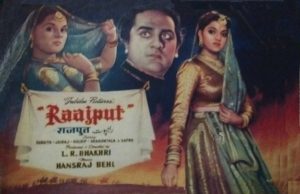
His first movie in 1951 was Raajput. Hansraj Behl composed 12 songs in the movie and one was by Husnlal Bhagatram. Indeevar wrote just one: Ye ghadi tera dil dole kabhi haan bol.
His next movie in 1951 was Phoolon Ka Haar whose eleven songs were composed by Hansraj Behl. Indeevar wrote three:
1. Mohabbat hote hote ho gayi.
2. Lapak jhapak aaye mithi mithi nindiya.
3. Jinke sang preet hai unki hai diwali.
The first one was sung by Mubarak Begum and Devendra Mohan and was written in the humorous style that was perfected by Raja Mehdi Ali Khan.
Please enjoy: Mohabbat hote hote ho gayi…
mohabbat hote hote hote hote
hote hote ho gayi
mohabbat hote hote hote hote
hote hote ho gayi
chale the chhedne ko hum
jo aaya samne jis dum
mili kuch aisi nigahe
jaise milti hai daurahe
na jane kya bikhar gaya
mera man tan se chhut gaya, kab
main kisi ki aankh me aakash me
aakash me jab kho gayi
mohabbat hote hote hote hote
hote hote ho gayi
mohabbat hote hote hote hote
hote hote ho gayi
kisi ne kaha dil lelo
khilauna samajh ke khelo
samajh me meri na aaya
mujhe ye sauda na bhaya
liye dil chal diye jab wo
to kuch aisa laga mujhko, kya
jaise koi chiz mere hatho me
aate aate kho gayi
mohabbat hote hote hote hote
hote hote ho gayi
mohabbat hote hote hote hote
hote hote ho gayi
wahi jab sapno me aaya
mujhe sote se jagaya
kaha usne mujhe rani
bani phir aage kahani
kalayi hatho me dedi
nishani usne mujhe dedi, phir
iske baad yaad nahi aankh lagi
aankh lagi so gayi
mohabbat hote hote hote hote
hote hote ho gayi
mohabbat hote hote hote hote
hote hote ho gayi
khuli jab aankh to dekha
nazara aur hi kuch tha
koi wo chhubuli chhori
gayi dil le jora jori
jigar me raah banake
najar ke teer chalake, phir
man ki kyari me meri preet bij
preet bij bo gayi
mohabbat hote hote hote hote
hote hote ho gayi
mohabbat hote hote hote hote
hote hote ho gayi
Day #2, Song #6
Ek baar agar tu keh de
And that brings us to the 17th movie of Indeevar’s career: Malhar. I gave you an excerpt from The Hindu of 29 Mar 2012 to tell you about how Indeevar really arrived with this movie.
The movie starred Shammi and Arjun Bakshi. There were nine songs in the movie that were composed by Roshan. Indeevar wrote four of them:
1. Bade armaano se rakha hai balam teri kasam.
2. Ek baar agar tu keh de.
3. Taara toote duniya dekhe dekha na kisi ne dil toot gaya.
4. Hota raha younhi agar anjaam wafa ka.
In addition to Bade armaano se rakha hai balam that I have given you yesterday as the starting song, I am tempted to give you a duet between Lata Mangeshkar and Mukesh.
Please enjoy: Ek baar agar tu keh de…
ek bar agar tu kahe de
ek bar agar tu kahe de, tu hai meri ke me hu tera
ham do albele panchhi
ham do albele panchhi, ham dono ka ek basera
do dil dhadke hai, chounk uthi hai jawaniya
kuchh kaha hai nigaho ne, chhed ke pyar ki kahaniya
kuchh kaha hai nigaho ne, chhed ke pyar ki kahaniya
mera dil hi nahi hai mere bas me
mera dil hi nahi hai mere bas me
yeh kis ne jadu phera, kaho ji yeh kis ne jadu phera
ham dono ka ek basera
aa jaye na kahi ham-tum kisi ki nigaho me
sang sang hi chale ham jindagi ki raaho me
sang sang hi chale ham jindagi ki raaho me
tujhe chhin na le koi mujhse
tujhe chhin na le koi mujhse
yeh jag hai bada lutera, suno ji yeh jag hai bada lutera
ham dono ka ek basera
dekho aai hai sitaro ki timtimati yeh toliya
chalo inn ki chhao me ham khele aankh micholiya
chalo inn ki chhao me ham khele aankh micholiya
tute na kabhi jivan bhar
tute na kabhi jivan bhar
yeh bandhan tera mera, oho ji yeh bandhan tera mera
ham dono ka ek basera
ek bar agar tu kahe de
ek bar agar tu kahe de, tu hai meri ke me hu tera
Day #3, Song #7
Aankhon se mili aankhen iqraar ho gaya
Third day of our being with our tenth great lyricist: Shyamalal Babu Rai or Indeevar. I haven’t ranked any lyricist and I am not going to do it.
So far, starting from his first movie in 1945: Samrat Chandragupta, we have covered 17 movies having 88 songs; out of which I gave you just six.
His fourth movie in 1951 was Andolan. It was a Phani Mazumdar movie. Who was Phani Mazumdar? Some of you know him as the man who wrote the story Mare Gaye Gulfaam, based on which Shailendra produced his only movie: Teesri Kasam that he had Abhi Bhattacharya direct it.
Andolan had five songs that were composed by Pannalal Ghosh; one of these was penned by Bankim Chandra Chatterjee and of course all of you know that song: Vande Matram that was sung by Sudha Malhotra, Parul Ghosh and Manna Dey.
Indeevar wrote the following:
1. Prabhu charno mein aaya pujari.
2. Radha ne kiya singar kyun?
Simba was his next movie in 1951. It was a Mohammad Hussain movie starring Babu Rao and Krishan Kumari. DC Dutt composed six songs for the movie; four were penned by Farooq Qaiser and two by Indeevar:
1. Aankhon se mili aankhen iqraar ho gaya.
2. Sunsan jungle manaye ja.
 Both the songs of Indeevar were sung by Sulochana Kadam. What do you know about her? You must listen to her song Wo aaye hain dil ko karaar aa gaya that was written by Farooq Qaiser and composed by Krishna Dayal for the 1953 movie Malika Salomi. In Nainital it was sung at the same spot where a number of songs have been sung; eg Zara sun haseena e nazneen in Raag Pahadi and the Gumrah song Tujhako mera pyar pukare.
Just to give you one song I go through all this! Do you think it is worth it?
Anyway please enjoy Sulochana Kadam singing: Aankhon se mili aankhen iqraar ho gaya…
aankho se mili aankhe ikraar ho gaya
pahchaan hote hote yun pyaar ho gaya
aankho se mili aankhe ikraar ho gaya
pahchaan hote hote yun pyaar ho gaya
armaan hai ye dil ka tu saamne rahe
tu saamne rahe
armaan hai ye dil ka tu saamne rahe
tu saamne rahe
tere bagair jeena dushwaar ho gaya
tere bagair jeena dushwaar ho gaya
aankho se mili aankhe ikraar ho gaya
pahchaan hote hote yun pyaar ho gaya
laali ki kya jarurat kaajal ki kya padi
laali ki kya jarurat kaajal ki kya padi
kaajal ki kya padi
jab pyaar hi jiwan ka singaar ho gaya
jab pyaar hi jiwan ka singaar ho gaya
aankho se mili aankhe ikraar ho gaya
pahchaan hote hote yun pyaar ho gaya
dil me sama gaye ho dhadkan me bas gaye
dhadkan me bas gaye
dil me sama gaye ho dhadkan me bas gaye
dhadkan me bas gaye
jab aankh band kar li didaar ho gaya
jab aankh band kar li didaar ho gaya
aankho se mili aankhe ikraar ho gaya
pahchaan hote hote yun pyaar ho gaya
Day #3, Song #8
Dukhiyare naina dhoonde piya ko
Vanraj was his first movie in 1952. This was another movie in which the songs were composed by Shyam Babu Pathak. Indeevar wrote three out of the six:
1. Main ghumne ki shaukee.
2. Mujhe chume chand ki kirane.
3. Sir pe khada hai kaal.
Nirmohee was his second movie in 1952.
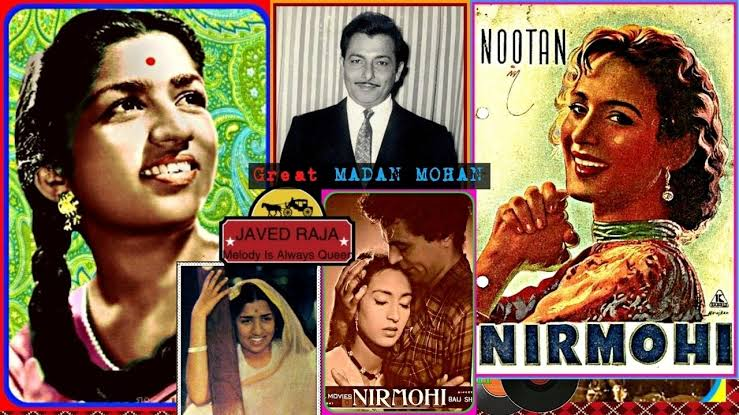
This was the first movie in which Madan Mohan composed two of his songs. Almost all the eight songs of the movie were sung by Lata Mangeshkar. Here are the two by Indeevar:
1. Dukhiyare naina dhoonde piya ko.
2. Ye suhana sama ye umange jawan.
Lets listen to Lata Mangeshkar singing the first song.
Please enjoy: Dukhiyare naina dhoonde piya ko…
dukhiyare naina dhundhe piya ko
nis din kare pukar
dukhiyare naina dhundhe piya ko
nis din kare pukar
dukhiyare naina
phir kya aayengi wo raate
phir kya aayengi wo raate
laut gayi hai jo barate
laut gayi hai jo barate
beete din aur bichhaa saathi
beete din aur bichhaa saathi
bahati nadi ki dhar
dukhiyare naina
dukhiyare naina dhundhe piya ko
nis din kare pukar
dukhiyare naina
raah me naina deeya jalaye
raah me naina deeya jalaye
aap jale aur jiya jalaye
aap jale aur jiya jalaye
jis se jivan bhi jal jaye
jis se jivan bhi jal jaye
wo kaisi jaldhaar
dukhiyare naina
dukhiyare naina dhundhe piya ko
nis din kare pukar
dukhiyare naina
Day #3, Song #9
Satayega kise tu aasmaan
Hamari Duniya was his third movie in 1953 after Vanraj and Nirmohee.
Seven songs of the movie were composed by Shyam Babu Pathak; four by Indeevar and three by Hasrat Jaipuri.
Indeevar’s songs were:
1. Zindagi usi ki hai jo zindagi se khele.
2. Same song Version 2.
3. Chanda ki Chandni.
We shall skip all three.
His first movie in 1953 was Sheesham; a Kishore Sharma movie starring Nasir Khan and Nutan.
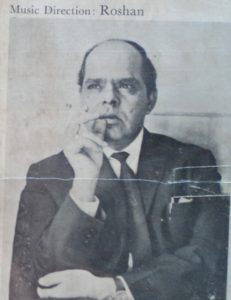 After the 1951 movie Malhar in which Indeevar had his first hit song: Bade armaano se rakha hai balam teri kasam, this was the second movie in which he paired with Roshan. Out of the ten songs of the movie, Indeevar wrote five of them:
1. Satayega kise tu aasmaan.
2. Sapno mein aana chhed chhed jaana.
3. Jab tak sansaar rahe.
4. Muskuraahat tere honthon ki mera singar hai.
5. Machla hua hai dil nigaahen beqraar hain.
All very good songs. We shall take up the first one sung by Mukesh.
Please enjoy: Satayega kise tu aasmaan…
sataayegaa kise tu aasamaan jab ham nahi hoge
diye hai tune aise gam kabhi jo kam nahi hoge
sitaare tutane se aasamaan kaa kyaa bigadataa hai
aasamaan kaa kyaa bigadataa hai
sitaare tutane se aasamaan kaa kyaa bigadataa hai
aasamaan kaa kyaa bigadataa hai
kami kyaa hogi duniyaa me agar ik ham nahi hoge
sataayegaa kise tu aasamaan jab ham nahi hoge
diye hai tune aise gam kabhi jo kam nahi hoge
hai jab tak ham tabhi tak dushmani hai ham se duniyaa ko
dushmani hai ham se duniyaa ko
hai jab tak ham tabhi tak dushmani hai ham se duniyaa ko
dushmani hai ham se duniyaa ko
yahi duniyaa hame dhundhegi ham jis dam nahi hoge
sataayegaa kise tu aasamaan jab ham nahi hoge
Day #4, Song #10
Tere haathon mein
Indeevar was the fourth most prolific lyricist in Hindi movies after Sameer, Anand Bakshi and Majrooh Sultanpuri. He wrote nearly 1650 songs. In the first three days with him, starting from the 1945 movie Samrat Chandragupta and ending with 1953 movie Sheesham or Shisham, we covered 24 of his movies with 105 songs; out of which I gave you just nine.
His second movie in 1953 was Dara. Mohammad Shafi composed seven songs. Indeevar wrote one of them: Bandhan hain haathon ke kangan that was sung by Lata Mangeshkar.
His next movie in 1953 was Dana Pani, a VM Vyas movie that repeated the successful cast of 1952 Vijay Bhatt movie Baiju Bawra: Bharat Bhushan and Meena Kumari.
Mohan Junior composed eight songs for the movie; Kaif Irfani wrote five and Indeevar wrote the following three:
1. Tere haathon mein.
2. Chanda suraj naina tere.
3. Meri kutiya ke deep tere hi.
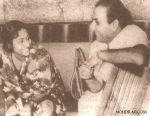 The first one was a duet between Geeta Dutt and Mohammad Rafi and it is worth listening to it. She starts only with the second stanza. Please forgive me for the audio quality. Yet it is an immortal song.
Please enjoy: Tere haathon mein…
jiwan kya hai dhalta suraj pal pal dhalta jaye
is nagri se jane wale lot ke phir na aye
tere hatho me jiwan ki jeet haar hai
tere hatho me jiwan ki jeet haar hai
tu soch ke dunia pe jara dil ko lutana
tu soch ke dunia pe jara dil ko lutana
usse bhi tere talu karar hai
tere hatho me jiwan ki jeet haar hai
tere hatho me jiwan ki jeet haar hai
juari ki mahfil se ayi sada ayi sada
juari ki mahfil se ayi sada ayi sada
jiwan hai ek jua khel tu hasta hua khel tu
tujhe dega wahi jisne sabko diya
eye khiladi tu kyu itna bekarar hai
tere hatho me jiwan ki jeet haar hai
tere hatho me jiwan ki jeet haar hai
gujare na gujre ye jiwan hai kaisa jiwan hai kaisa
jidhar aj dekho kare raz kaisa kare raz kaisa
kahi hai amiri kahi hal aisa
kahi hai amiri kahi hal aisa
ke dunia me jina bhi dushwar hai
tere hatho me jiwan ki jeet haar hai
tere hatho me jiwan ki jeet haar hai
tere hatho me jiwan ki jeet haar hai
Day #4, Song #11
Kisi ki aankh ke aansu hain
His next movie in 1953 was Gharbaar. Vasant Prabhu composed nine songs in the movie and Indeevar penned all of them except one each by Kaif Irfani and DN Madhok:
1. Chhup chhup ke aaya koi.
2. Maa ki mamta pyar pita ka.
3. Udhar hai husn ka jalwa.
4. Barbaad ho raha hai ek ghar.
5. Aaja mere piya mere man mein.
6. Meri shokh nigaahen dil loote.
7. Udhar hai husn ka jalwa (Ver 2).
We shall skip all.
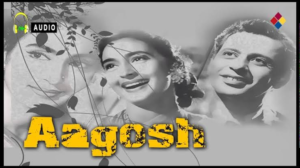 His next movie in 1953, his last one that year, was Aagosh. There were eight songs in the movie composed by Roshan (Indeevar’s third movie with him): Two by Indeevar, four by Shailendra and one each by Kaif Irfani and Uddhav Kumar:
1. Kisi ki aankh ke aansu hain.
2. Tu hai chanda to main hoon chakor.
The first one was sung beautifully by Lata Mangeshkar.
Please enjoy: Kisi ki aankh ke aansu hain…
kisi ki aankh ke aansu hai, sitaare na kaho
najar ka dhoka hai tum, inako najaare na kaho
yeh murawwat hain jo milate hain, muhabbat toh nahi
woh kisi aur ke hain, unako hamaare na kaho
nazar ka dhoka hai tum, inako nazaare na kaho
lagi jo thik hi maujon ki khel mein tut pade
ghani ghani se ye tufan hai, kinaare na kaho
najar ka dhoka hai tum, inako najaare na kaho
Day #4, Song #12
Kaise koi jiye zehar hai zindagi
His first movie in 1954 was Vijay Garh. Mazzafar Shahjahanpuri wrote most of the songs that were composed by AK Prem (5) and Krishan Dayal (2). Indeevar wrote only one: Ruki ruki saanse jhuki jhuki akhiyan that was composed by Krishan Dayal.
Baadbaan was his next movie in 1954; a movie directed once again by Phani Mazumdar (a novelist of Maare Gaye Gulfaam fame that was made into Teesri Kasam by Shailendra). This one starred Dev Anand, Usha Kiran, Ashok Kumar and Meena Kumari.
SK Pal and Timir Baran composed eight very beautiful songs; six of them written by Indeevar and two by Uddav Kumar:
1. Kaise koi jiye zehar hai zindagi (Geeta Dutt)
2. Har roz kaha har roz suna.
3. Aaya toofan, kaise koi jiye zehar hai zindagi (Hemant Kumar).
4. Dekho chanchal hai mera jiya ho.
5. Thukra ke teri duniya ko.
6. Tori preet ke bas ho.
We shall be taking up two; one today and one tomorrow.
The first one is a masterpiece by Indeevar and is one of the best of Geeta Dutt.
Please enjoy: Kaise koi jiye zehar hai zindagi…
kaise koi jiye
kaise koi jiye zahar hai zindagi
utha tufan wo, utha tufan naach ke
sab bujh gaye diye, kaise koi jiye
baadal hai ya dhuwa aag lagi kaha
jalta na ho kahi mera hi aashiya
angare the aansu nahi wo, dil ne jo piye
kaise koi jiye zahar hai jindagi
utha tufan wo, utha tufan nach ke
sab bujh gaye diye, kaise koi jiye
taare na jane unchayi gagan ki
aankhe na samajhe
gehrayi man ki, gehrayi man ki
tare na jane pyase papihe ne aas thi bandhi
ud gaye baadal aa gayi aandhi
gam ne jo chheda dil ne hasi se honth si liye
kaise koi jiye zahar hai zindagi
utha tufan wo, utha tufan naach ke
sab bujh gaye diye, kaise koi jiye
Day #5, Song #13
Aaya toofan, kaise koi jiye zahr hai zindagi
Yesterday was the fourth day with Great Lyricist #10: Indeevar (not in any particular order or ranking). We had gone through 125 of his songs from 30 movies, out of which I had given you just 12.
The last song that I gave you was a Geeta Dutt song for the 1954 movie Baadbaan: Kaise koi jiye zehr hai zindagi; a masterpiece by Indeevar.
I had promised you the Hemant Kumar version too. So here it is.
Please enjoy: Aaya toofan, kaise koi jiye zahr hai zindagi…
aaya tufan aaya tufan
bekadar bewafa hai aasma
kaise koi jiye
kaise koi jiye zahar hai zindagi
utha tufan wo, utha tufan naach le
sab bujh gaye diye kaise koi jiye
baadal hai ya dhuwa aag lagi kaha
jalta na ho kahi mera hi aashiya
angare the aansu nahi wo, dil ne jo piye
kaise koi jiye zahar hai jindagi
utha tufan wo, utha tufan naach ke
sab bujh gaye diye, kaise koi jiye
taare na jane unchayi gagan ki
aankhe na samajhe
gehrayi man ki, gehrayi man ki
tare na jane pyase papihe ne aas thi bandhi
ud gaye baadal aa gayi aandhi
gam ne jo chheda dil ne hasi se honth si liye
kaise koi jiye zahar hai zindagi
utha tufan wo, utha tufan
Day #5, Song #14
Ai meri mehboob maang le jo tujhko
I am sure that in the last two songs that I gave you from the 1954 movie Baadbaan: Geeta Dutt and Hemant Kumar versions of the song Kaise koi jiye zehr hai zindagi, you would have already placed Indeevar in a different league altogether.
There is much more to come.
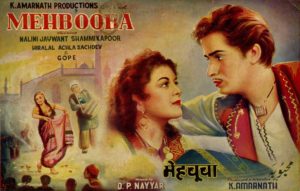
His next movie in 1954 was Mehbooba, a K Amarnath movie starring Shammi Kapoor and Nalini Jaywant.
The movie had nine songs; five composed by OP Nayyar and four by Roshan. Six were penned by Majrooh Sultanpuri, two by Tanvir Naqvi and Indeevar wrote just one: Jo dil ke malik hain mehman banke aane wale hain.
His next movie in 1954 was Dakoo Ki Ladki with Geeta Bali in the title role. For the first time, Indeevar paired with Hemant Kumar but wrote just one song whereas SH Bihari and Kaif Irfani wrote four and three respectively: Gulon ko khilau baharon se khelo.
His second last movie in 1954 was Pensioner and he wrote just one song for Hamsraj Behl: Nacho ri gudiya ri baaje shehnayiyan.
His last movie in 1954 was – hold your breath – Fuji Lama. He wrote seven songs for J Majumdar:
1. Are dil-e-nadaan jaane kya tera anjam hai.
2. Chum chuma mor naache.
3. Dil mera kho gaya hai yahin kahin.
4. Hamne tumse pyar kiya hai pyar.
5. Huye nain hamare bawariya.
6. Teri yaad ka dil ki khile.
7. Yangasi kinare mile chand se taare mile.
That finishes ten years of Indeevar’s career.
His first movie in 1955 was Shikar.
Ten songs were composed by Bulo C Rani and Indeevar wrote four of them:
1. Rangon ke badalne se tasveer.
2. Bahar dekh ke dil aur beqraar hua.
3. Aanchal mein deepak na chhupa tu.
4. Aata hai karar beqraar hone mein.
His first movie in 1956 was Gul-e-Bakawali. If you think the name is unique you have another guess coming because movies with this title were made five times including one in Punjabi.
Gyan Dutt composed eight songs in the movie and Hemant Kumar composed one that was penned by Ravi; a beautiful number: Ye shokh sitaare karte hain ishaare. Hemant Kumar and Ravi went back to their association as Music Director and his assistant in Nagin.
Indeevar’s song was just one and composed by Gyan Dutt: Mera kahan hai man meraa.
In between, please forgive me for having forgotten some of his 1955 movies. After Shikar, the next one was Mano Na Mano. He wrote seven songs for Hansraj Behl and one was penned by Kaifi Azmi:
1. Ai meri mehboob maang le jo tujhko.
2. Hai zindagi ko tera intezaar.
3. Chand mein dekhun apna mukhda.
4. Raat hai kuchh aisi baat hai.
5. Andhiyara andhiyara.
6. Raat se kali kismat.
7. Tumko hi dhoondte rahe.
The first is a duet sung by Madhubala Zaveri and Mohammad Rafi.
Please enjoy: Ai meri mehboob maang le jo tujhko…
ae meri mehbub mang le
jo tujhko manjur
gagan ki sundar chand ka jhumar
subha ke suraj ka sindur
gagan ki sundar chand ka jhumar
subha ke suraj ka sindur
mujhko tera pyar chahiye
sunhari sham se rang udakar rang udakar
badal ke badal ke badal ke mai pankh lagakar
doli sazakar tujhe bithakar le jau duniya se dur
ae meri mehbub ae meri mehbub mang le
jo tujhko manjur
gagan ki sundar chand ka jhumar
subha ke suraj ka sindur
mujhko tera pyar chahiye
mujhko tera pyar chahiye aur na kuch manjur
aakar sajan tham le daman
chhod de duniya ke dastur
aakar sajan tham le daman
chhod de duniya ke dastur
jo tujhko manjur mang le mang le
duniya se dar kar kyu bhagun
dar kar kyu bhagun
tu jo mile kuch aur na mangu aur na mangu
sathi mere pyar me tere
dhul bhi mujhko hai sindur
mujhko tera pyar chahiye
aur na kuch manjur
aakar sajan tham le daman
chhod de duniya ke dastur
jo tujhko manjur mang le mang le
mujhko tera pyar chahiye
Day #5, Song #15
Falaq milega tujhe kya hamen mitane se
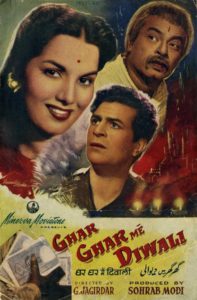
Just imagine that on the fifth day, we are into the 12th year of Indeevar’s career with the 1956 movie Gul-e-Bakalavi. Before that since I forgot a few of his movies of the year 1955 I did that too except the movie just before Shikar: Ghar Ghar Men Diwali.
Most songs were penned by Prem Dhawan and composed by Roshan except one penned by Indeevar and I feel that was the best song of the movie: Falaq milega tujhe kya hamen mitane se. It was a duet between Mohammad Rafi and Lata Mangeshkar.
Please enjoy: Falaq milega tujhe kya hamen mitane se…
falaq milegaa tujhe kyaa hame mitaane se
ye mohabbat naa mitegi kabhi zamaane se
alaq milegaa tujhe kyaa hame mitaane se
ye mohabbat naa mitegi kabhi zamaane se
uthaa ke ranj ye dil chur ho gayaa itnaa
uthaa ke ranj ye dil chur ho gayaa itnaa
ke thes lagati hai haay
ke thes lagati hai kaliyo ke muskuraane se
ye mohabbat naa mitegi kabhi zamaane se
jiye to kiske liye tum hi jab nahi apne
tum hi jab nahi apne
jiye to kiske liye tum hi jab nahi apne
tum hi jab nahi apne
ke ji rahe the haay
ke ji rahe the abhi tak isi bahaane se
ye mohabbat naa mitegi kabhi zamaane se
jahaan ne kah diya baadal hai aasmano ke
dhuan uthaa hai ye haay
jahaan ne kah diya baadal hai aasmano ke
dhuan uthaa hai ye haay
dhuan uthaa hai ye mere hi aashiyane se
ye mohabbat naa mitegi kabhi zamaane se
falaq milegaa tujhe kyaa
Day #6, Song #16
Chand raat hai tu bhi saath hai
Today is the sixth day with our tenth lyricist Indeevar. In the last five days I gave you 15 songs selected from 148 songs of his in 38 movies.
We are now in the 12th year of his career.
His second movie in 1956 after Gul-e-Bakawali was Kismat. It was a Nanabahai Bhatt movie starring Ranjan Peace Kanwal and Nishi.
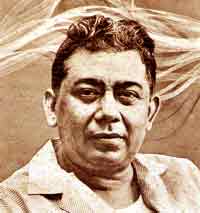 For the first time in his career he paired with Chitragupt and they made the following eight songs:
1. Chand raat hai tu bhi saath hai.
2. Teri unchi unchi unchi unchi hai dukan.
3. Dil mein kisi ki chah kiye ja.
4. Dil tumko diya sarkar amaanat rakh lo ji.
5. Haseen raat sitaron se hua karti hai.
6. Ek jadugar woh hai.
7. Keh le dil ki baat warna raat chali jayegi.
8. Ye sama ye chandni teri thi kabhi.
All very romantic songs to do with Chandni and Raat.
The first one is an adorable duet between Mohammad rafi and Asha Bhosle.
Please enjoy: Chand raat hai tu bhi saath hai…
chand rat hai tu bhi sath hai
kahde aye sanam dil me kya bat hai
chand rat hai
sunte rahe hum yuhi tum kaho
aankho ke tum samne hi raho
tumko dekh kar kab ghadi nazar
hamko kya khabar tum me kya bat hai
chand rat hai
betabiya phir badhate ho kyu
tum is tarah muskurate ho kyu
teer chal gaye dil machal gaye
jeet husn ki ishk ki maat hai
chand rat hai
rangin nazare ishare jawa
aankho me ek pyar ki dasta
mujhko mil gayi zindagi nayi
mere hath me aaj tera hath hai
chand rat hai tu bhi sath hai
kahde aye sanam dil me kya bat hai
chand rat hai
Day #6, Song #17
Dil se hain shehzade ham
Gulam Begum Badshah was his next film in 1956.
There were six songs in the movie that were composed by Sudipt. Two of these were penned by Indeevar:
1. Dil hai ye tera dil liye ja.
2. Dil se mere dil mila.
We shall skip these.
His next movie in 1956 was Taj Aur Talwar in which, once again, Sudipt composed ten songs. Indeevar, once gain, wrote two of them:
1. Aha daanv pe laga ke dil jeet le.
2. Chham chamama chamama chham.
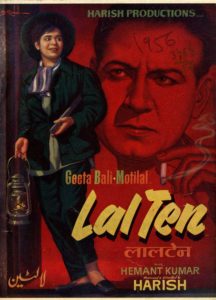
Lalten was his second last movie in 1956. Hemant Kumar composed eight songs for the movie; three of these were written by Indeevar:
1. Dil se hain shehzaade ham.
2. Dil ka tattu ad jaata hai.
3. Lo aaya jani lalten.
Humour and comedy were very much in demand at that time. You would recall how Raja Mehdi Ali Khan delved in these despite sadness of his own. Indeevar did exactly the same here.
Please enjoy Hemant Kumar singing on his own composition: Dil se hain shehzade ham…
dil se hai shahzade hum
hai surat bhale mawali ki
khali pocket rakhte hai
par photo gita bali ki
dil se hai shahzade hum
hai surat bhale mawali ki
khali pocket rakhte hai
par photo gita bali ki
nahi pakane wali ghar me rah jata dil machal machal
apne dam par hi to pyare shahar ke chalte hai hotel
khali pocket rakhte hai par photo gita bali ki
dil se hai shahzade hum hai surat bhale mawali ki
khali pocket rakhte hai par photo gita bali ki
sapno ka ek mahal hai apna
mahal me dil ki rani hai
waise to ye basti gandi
gali bahut purani hai
dada giri bhale kahe koi
humne to rakhwali ki
khali pocket rakhte hai
par photo gita bali ki
dil se hai shahzade hum hai surat bhale mawali ki
khali pocket rakhte hai par photo gita bali ki
humne koi humdard na paya
aur na kisi ka pyar mila
bhatak gaye ham raaho se
jab khula naa koi dawar mila
aankh khuli to pata chala
ye dagar to hai kutwali ki
arey aankh khuli to pata chala
ye dagar to hai kutwali ki
khali pocket rakhte hai
par photo gita bali ki
dil se hai shahzade hum hai surat bhale mawali ki
khali pocket rakhte hai par photo gita bali ki
Day #6, Song #18
Teri chamakti aankhon ke aage ye sitare kuchh bhi nahin
In the year 1956, his last movie was Anuraag. This movie is a very unique movie in that it had ten songs and all ten were composed by Mukesh who was also the hero of the movie with Usha Kiran.
Kaif Irfani and Indeevar wrote five each but the credit for the most memorable song of the movie goes not to Indeevar but to Kaif Irfani: Koi dil mein hai aur koi hai nazar mein…kise yaad rakhun kise bhool jaayun.
Indeevar wrote the following:
1. Aaj hum tumhen sunane wale hain.
2. Tere bina suna suna laage is duniya ka mela.
3. Ho saka do dilon ka na mel re.
4. Man chal man chanchal ho jayega.
5. Ye kaisi uljhane hain.
His first movie in 1957 was Naag Lok. Ramlal Heerapanna composed ten songs for the movie; one of these was penned by Indeevar: Hambala Gambala.
We shall skip this too.
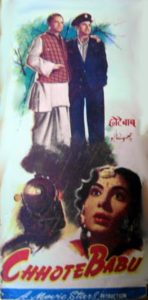
His second movie in 1957, the 13th year of his career was Chhote Babu. Shekhar and Nimmi starred in the movie directed by Harsukh Bhatt.
He paired with Madan Mohan and straightway produced magic even though he wrote just two of the seven songs:
1. Teri chamakti aankhon ke aage ye sitare kuchh bhi nahin.
2. Aane wale kal ki tum tasveer ho.
Please enjoy Talat Mahmood and Lata Mangeshkar singing: Teri chamakti aankhon ke aage ye sitare kuchh bhi nahin…
teri chamakti aankho ke aage ye sitare kuch bhi nahi
tu jo badha de hath zara, dunia ke sahare kuch bhi nahi
teri chamakti aankho ke aage ye sitare kuch bhi nahi
man liya dilkash hai bahut, ye rat hasi ye chand java
man liya dilkash hai bahut, ye rat hasi ye chand java
baat jo dekhi hai tujh me, nazaro me vo baat kaha
samne mere tu ho agar, duniya ke nazare kuchh bhi nahi
teri chamakti aankho ke aage ye sitare kuch bhi nahi
sath hai mere tu jab tak, roshan hai jivan ki rahe
sath hai mere tu jab tak, roshan hai jivan ki rahe
kyu ho mujhe manzil ka gam, patvar hai jab teri bahe
manjhi hai gar tu naiya ka, tufan ke dhare kuch bhi nahi
teri chamakti aankho ke aage ye sitare kuch bhi nahi
bandh liya bandhan me tumhe, bas me kar liya baharo ko
hai ye vo bandhan jo kar de azad gamo ke maro ko
pyar ki tere chav mile to gam ke sharare kuch bhi nahi
teri chamakti aankho ke aage ye sitare kuch bhi nahi
Day #7, Song #19
Kal raat piya ne baat kahi kuchh aisi
On the sixth day we finished taking up 171 of his songs from 45 movies in 13 years of his career. Out of these, I gave you just 18 songs.
His next movie in 1957 was Zamana. There were seven songs in the movie; two composed by Anil Biswas and five by Salil Chowdhary. Indeevar had two songs; one each by the two composers:
1. naiyya ka meri tu hi khewaiyya.
2. Chale bajate seeti jeevan ki raahon mein.
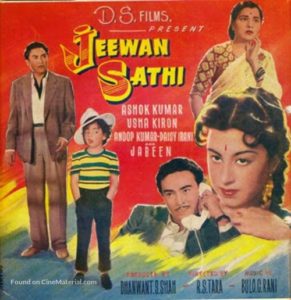
His next movie in 1957 was Jeewan Saathi. He wrote three songs for Bulo C Rani:
1. Hoke bada mera laal.
2. Bahar leke aayi karaar leke aayi.
3. Ai uljhi raahon ke rahi.
His next movie was Abhimaan, a Mahesh Kaul movie starring Shekhar and Ameeta.
He wrote four songs for Anil Biswas:
1. Ghar ki rani hoon.
2. Akdo na humse piya.
3. Kal raat piya ne baat kahi kuchh aisi.
4. Sambhalo palla dori palla.
Songs #1 and #3 were sung by Geeta Dutt, #2 by Asha Bhosle and #4 as a duet between Anil Biswas himself and Asha Bhosle.
No guessing as to which one we are going to take.
The third one is a memorable number sung beautifully by Geeta Dutt.
Please enjoy: Kal raat piya ne baat kahi kuchh aisi…
kal rat piya ne bat kahi kuch aisi
matwala bhawra kahe kali se jaise
kal rat piya ne bat kahi kuch aisi
matwala bhawra kahe kali se jaise
ghunghat utha ke pyar se
boli sharmao na dildar se
mai hu tumhara tum meri ho
tum meri ho tum meri ho
jane jigar o jane jigar
kal rat piya ne bat kahi kuch aisi
matwala bhawra kahe kali se jaise
kal rat piya ne bat kahi kuch aisi
aankho me aankhe kho gayi
mohabbat ki bate ho gayi
sharma gayi mai dhak dhak
dhak dhak dhadka jigar o dhadka jigar
kal rat piya ne bat kahi kuch aisi
matwala bhawra kahe kali se jaise
kal rat piya ne bat kahi kuch aisi
palko se maine aoth ki mithi nigah se ek chot ki
bole balam ji yu na maro yu na maro yu na maro
tire nazar o tire nazar
kal rat piya ne bat kahi kuch aisi
matwala bhawra kahe kali se jaise
kal rat piya ne bat kahi kuch aisi
Day #7, Song #20
Kal kal chhal chhal behti jaun mast nadi ki dhaar
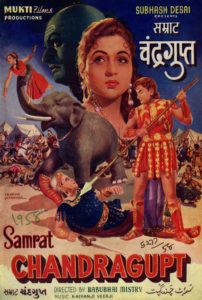
That brings us to the year 1958. Thirteen year after beginning with Samrat Chandragupta, Indeevar was back with the same title in 1958.
This movie is important to us since for the first time Indeevar or Indivar paired with Kalyanji Anandji and that started a most beautiful pairing that gave us some of the most melodious songs in Hindi movies.
It was a Babubhai Mistri movie starring Bharat Bhushan in the title role and Nirupa Roy with him as Princess Helena.
There were eight songs in the movie; three by Bharat Vyas, two each by Indeevar and Hasrat Jaipuri and one by Nirupa Roy. The two songs of Indeevar were:
1. Kal kal chhal chhal behti jaun mast nadi ki dhaar.
2. Rangile more raja dil mein sama ja.
Please enjoy Lata Mangeshkar singing: Kal kal chhal chhal behti jaun mast nadi ki dhaar…
kal kal chhal chhal behti jau mast nadi ki dhaar
kal kal chhal chhal behtil jau mast nadi ki dhaar
main to rukna na janu main to jhukna na janu
kal kal chhal chhal behti jau mast nadi ki dhar
kal kal chhal chhal behtil jau mast nadi ki dhar
main to rukna na janu main to jhukna na janu
kaid chaman ki mujhko na bhaye mujhko na bhaye
mujhko bahaar bhi bandh na paye bandh na paye
apni adao se pyar hai mujhko pyar hai mujhko
gaye matwle geet man ka mere tar tar
kal kal chhal chhal behti jau mast nadi ki dhar
kal kal chhal chhal behtil jau mast nadi ki dhar
main to rukna na janu main to jhukna na janu
khoi ho jaise hirni ban me hirni ban me
badli jase nil gagan me nil gagan me
khoi hui hu man ki lagan me man ki lagan me
khelu main tufa ke mojo se bar bar
kal kal chhal chhal behti jau mast nadi ki dhar
kal kal chhal chhal behtil jau mast nadi ki dhar
main to rukna na janu main to jhukna na janu
rukna na janu main to jhukna na janu
Day #7, Song #21
Piya jab se liya tune haathon mein haath
His next movie in 1958 was Maya Bazar. He wrote seven songs for SP Rane:
1. Ajab hai samay samay ka rang.
2. Chamki na kiranmala.
3. Mohe kyun bisari naath.
4. Saanwri surat sakhi mere hriday mein.
5. Satao na itna dildar.
6. Sharad poornima ki raat sajni.
7. Taale tale nahin honhaar.
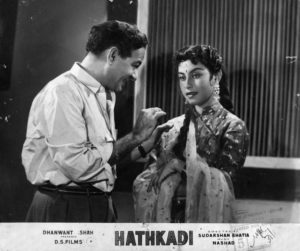
His next movie in 1958 was Hathkadi starring Shakila and Motilal. He paired with Nashad to make songs and made two of the six:
1. Piya jab se liya tune haathon mein haath.
2. Duniya hai badi zaalim.
Both are excellent songs. My favourite is the first one; a duet between Lata Mangeshkar and Mohammad Rafi and that too in Raag Pahadi!
Please enjoy: Piya jab se liya tune haathon mein haath…
piya jabse liya tune hatho me hath
meri aankho me firne lagi hai barat
mere kano me sahnayi bajne lagi
mere kano me sahnayi bajne lagi
dil dhadakne laga doli sajne lagi
chal padi jaise apne piya ji ke sath
meri aankho me firne lagi hai barat
aaaaaaaaaaaaaa ooooo hoye
tujhse badhkar nahi koi sansar me ho ji ho
tujhse badhkar nahi koi sansar me
paa liya maine sab kuch tere pyar me
har kadam pe hai manjil
agar tu hai sath
meri aankho me firne lagi hai barat
teri palko ki chaiya me
mai kho gayi ho ji ho
teri palko ki chaiya me
mai kho gayi
aaj tan man se saiya teri ho gayi
maino sapno me kah di hai
kuch aisi bat
meri aankho me firne lagi hai barat
piya jabse liya tune hatho me hath
meri aankho me firne lagi hai barat
Day #8, Song #22
Dil leke jaate ho kahan hum to hain yahan
We start Day #8 with his last movie in the year 1958: Sanskar. Out of a total of nine songs composed by Anil Biswas, Indeevar wrote the following four:
1. Saath bhanwre jis se padi.
2. Bhagwan bhi khush khush shaitan bhi razi.
3. Kaanp kaanp jata hai.
4. Radhe tere aansu pi ko rok na payenge.
We shall skip all.
His first movie in 1959 was Khoobsurat Dhoka.
Out of the seven songs composed by S Mohinder, Indeevar wrote one: Do kadam aur ae saathi.

His next movie in 1959 was O Tera Kya Kehna in which six songs were composed by Kalyanji Veerji Shah; Indeevar wrote one: Dil leke jate ho kahan hum to hain yahan. It was picturised on Mehmood and Chitra, the lead cast of the movie.
Subir Sen and kamal Barot sang for them.
Please enjoy: Dil leke jaate ho kahan hum to hain yahan…
dil leke jate ho kaha ham to khade hai yaha
kya hai tumhara jisne pukara
usi pe dene lage jaa dil leke jate ho kaha
ham to khade hai yaha kya hai tumhara jisne pukara
usi pe dene lage jaa dil leke jate ho kaha
dekh reshmi bahe ham to bhul gaye rahe
tadpa gayi bahka gayi teri nashili nigahe
kapde saaf dil maila banke phirte ho chhaila
malum hai hame chal ye kyu jaal rahe ho faila
dil leke jate ho kaha ham to khade hai yaha
kya hai tumhara jisne pukara
usi pe dene lage jaa dil leke jate ho kaha
aasman me badal jaise aankh me kajal
kho jau mai so jau mai mere dil pe dal de aanchal
jante hai jo badalna kam jinka hai chhalna
unse aji achha yahi daman ko bachakar chalna
dil leke jate ho kaha ham to khade hai yaha
kya hai tumhara jisne pukara
usi pe dene lage jaa dil leke jate ho kaha
sun lo kahte hai tumse rutho na aji hamse
ye husn ki sab shan hai ham dilwalo ke dam se
tujhse pyar ho kaise aitbar ho kaise
badle piya tera jiya mausan badalta jaise
dil leke jate ho kaha ham to khade hai yaha
kya hai tumhara jisne pukara usi pe dene lage jaa
dil leke jate ho kaha ham to khade hai yaha
kya hai tumhara jisne pukara usi pe dene lage jaa
dil leke jate ho kaha dil leke jate ho kaha
Day #8, Song #23
Bada khushnaseeb hai jise tu naseeb hai
His next movie in 1959 was his 55th: Chandrasena.
This time Kalyanji Anandji were together as a duo. Out of the seven songs composed by them, Indeevar wrote two:
1. Zara sa muskura do to raasta bhula doon.
2. Diljhum jhum lehraye.
His next movie in 1959 was Madari. Out of eight songs composed by Kalyanji Anandji, Indeevar wrote one: Hum to mit jayenge.
His next movie in 1959 was Police Station. He wrote six songs that were composed by Hemant Kedar and Robin:
1. Di dil se mila lo.
2. Tumne jo muskura diya.
3. Bachke zara babu kabhi dil na lagana.
4. Ek teer laga zakhm hua.
5. Koi na sunega teri.
6. Mujhe dekh main hoon.
His next movie in 1959 was Bank Manager, a Rakhan movie starring Shekhar and Kamini Kaushal.
Out of six songs composed by Madan Mohan for the movie, Indeevar wrote just one: Kadam behke behke jiya dhadak dhadak jaye.
His next movie in 1958 was a Ravindra Dave movie Satta Bazaar starring Balraj Sahni, Meena Kumari, Suresh and Vijaya Choudhary.
Kalyanji Anandji composed nine delightful numbers in the movie; one of which is included by me in my series Songs That Tug At Your Emotions on my blog: Tumhen yaad hoga kabhi hum mile the. This was penned by Gulshan Bawra.
Indeevar wrote two:
1. Kaisa insaaf tera sab kuchh luta.
2. Kya raha jaane ko.
His last movie in 1959 was Saahil. The movie had nine songs. Seven of these were composed by Suresh Talwar and two by DS Dutt. Indeevar wrote the ones composed by Dutt:
1. Afsos meri taqdeer bante hi bigad gayi.
2. Dekho ji hamen na dena dokha.
Gun Fight was his first movie in 1960.
Indeevar wrote two songs that were composed by Iqbal:
1. Bagh hai veeran.
2. Neend pardadar hai aankhon mein.
With this we finished sixty of his movies with 212 songs.
His 61st movie was his second and last movie in 1960: Aayi Phirse Bahar. He wrote four songs for Vedpal Verma:
1. Hai ye parda.
2. Hua gulshan veeran hai.
3. Mujhse keh di hai tune.
4. Piya mora budhu piya mora.
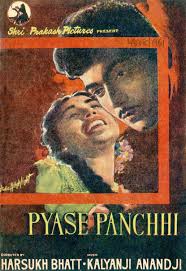
His first movie in the year 1961, 17th year of his career was Pyase Panchhi. There were nine songs in the movie composed by Kalyanji Anandji; eight written by Qamar Jalalabadi and only one by Indeevar: Bada kushnaseeb hai jise tu naseeb hai.
This song was sung by Mukesh, the preferred male playback singer of Kalyanji Anandji. Not many people know that Mukesh sang as many songs for Kalyanji Anandji as he sang for Shankar Jaikishan even though he was the singing voice of Raj Kapoor and had SJ compose the songs.
Please enjoy Mukesh singing: Bada khushnaseeb hai jise tu naseeb hai…
bada khushnasib hain jise tu nasib hai
bada khushnasib hain jise tu nasib hai
use aur chahiye kya jiske tu karib hai
use aur chahiye kya jiske tu karib hai
bada khushnasib hain jise tu nasib hai
use aur chahiye kya jiske tu karib hai
use aur chahiye kya jiske tu karib hai
bada khushnasib hain
sadke jaye teri najar ke
teer chalaye jee bhar-bhar ke
sadke jaye teri najar ke
teer chalaye jee bhar-bhar ke
jee uthe hum tujhpe mar ke
haal-ae-dil na puchhiye
haal-ae-dil ajib hai
haye haal-ae-dil na puchhiye
haal-ae-dil ajib hai
use aur chahiye kya jiske tu karib hai
use aur chahiye kya jiske tu karib hai
bada khushnasib hain
hum toh kahan the tere kaabil
tera karam hai tune diya dil
hum toh kahan the tere kaabil
tera karam hai tune diya dil
khud hi chal ke aa gayi manjil
wo to badshah hai bhale hi garib hai
haye wo toh badshah hai bhale hi garib hai
use aur chahiye kya jiske tu karib hai
use aur chahiye kya jiske tu karib hai
bada khushnasib hain
Day #8, Song #24
Itne bade jahan mein apna bhi koi hota
His next movie in 1961 was Dark Street, a Naresh Saigal movie starring Ashok Kumar and Nishi.
Indeevar wrote two songs for Dattaram Wadkar:
1. Itne bade jahan mein apna bhi koi hota.
2. Pyar se dekhe jo koi.
Both were sung by Suman Kalyanpur.
Who was Dattaram Wadkar? Dattaram Wadkar looked after the rhythm section for Shankar Jaikishan whilst Sebastian D’Souza conducted their orchestra. He emerged as an independent music director with the 1957 movie Abhi Dilli Door Nahin. His music sounded the same as S-J’s even here in the song that I am giving you.
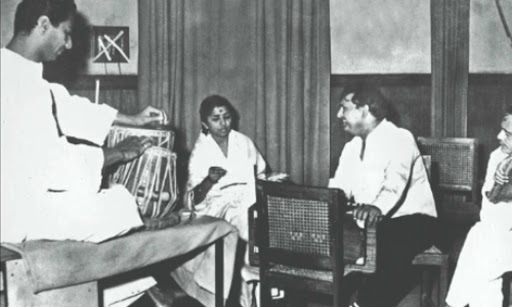
Please enjoy the first one: Itne bade jahan mein apna bhi koi hota…
itne bade jaha me apna bhi koi hota
itne bade jaha me apna bhi koi hota
hum bhi to muskarate apna use banate
itne bade jaha me apna bhi koi hota
mang me sindur hai ya aag laga di
pav me payal hai ya jhanjhr pehna di
shadi ke parde me ye barbadi rachaye
aati hai shehnayi se mausam ki sdaye
haye mosam ki sdaye
itne bade jaha me apna bhi koi hota
hum bhi to muskarate apna use banate
itne bade jaha me
dhan ka jab talak jaha me raz rahega
aadmi ka aadmi mohtaz rahega
lutte hai khof dikhakar lutere
kyu sahe saitan sa insan ke chehre
itne bade jaha me apna bhi koi hota
hum bhi to muskarate apna use banate
itne bade jaha me
logo ne daulat ko khuda kar hi chhod a
logo ne daulat ko khuda kar hi chhod a
insa koi sath juda kar ke hi chhod a
bich se daulat ki ye diwar gira do
utho aadmi ko aadmi se mila do
utho aadmi ko aadmi se mila do
Day #8, Song #24
Roop tumhara aankhon se pee loon
Our last song yesterday was from the 1961 movie Dark Street; his 63rd movie with 219 songs. Since he wrote about 1650 songs, we have covered one eighth of his career in number of songs!
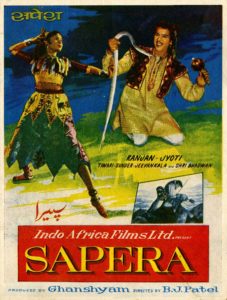
His next movie in 1961 was Sapera, a BJ Patel movie starring Ranjan and Jyoti Tiwari.
Ajit Merchant composed seven songs for the movie and all were penned by Indeevar:
1. Roop tumhara aankhon se pee loon.
2. Raat ne gesu bikhraye.
3. Bairi chhed na aise raag.
4. Bangle ke baahar baag lagaya.
5. Bolo piya kyun liya mera jiya.
6. Kutta peshi peshi niyoka.
7. O re piya mera tadpe jiya.
Some very good songs there.
The first one was sung by Manna Dey.
Please enjoy: Roop tumhara aankhon se pee loon…
roop tumhara aankho se pee lu
kah do agar tum mar ke bhi jee lu
mar ke bhi jee lu
roop tumhara aankho se pee lu
kah do agar tum mar ke bhi jee lu
mar ke bhi jee lu
aankho se chalke teri amrit ki dhara
tera sath gori mujh ko jiwan se pyara
mile dono hum tum jaise lahar se kinara
roop tumhara aankho se pee lu
kah do agar tum mar ke bhi jee lu
mar ke bhi jee lu
nigahe jhuka ke phir se jara muskura do
kaapte labo se dil ki kahani suna do
kya hai tumhare dil me hame bhi bata do
roop tumhara aankho se pee lu
kah do agar tum mar ke bhi jee lu
Day #9, Song #26
Thumak thumak mat chalo
Shree Ganesh was his only movie in 1962.
There were six songs in the movie composed by Bulo C Rani and all of them were solo and all sung by Suman Kalyanpur.
Indeevar wrote one: Kabhi tum paas aate ho.
His first movie in 1963 was Royal Mail; movie directed by BJ Patel and starring Mahesh Kumar and Ambika.
Avinash Vyas composed seven songs for the movie and all were penned by Indeevar:
1. Zindagi dene wale dil to mera leta ja.
2. Nazar qatil jawan surat.
3. Mera dil naach utha re.
4. Chali jaaye re jeevan ki gaadi.
5. Main bholi bhali gori main ghunghat wali.
6. Hum hain musafir.
His next movie in 1963 was Kahin Pyar Na Ho Jaye, a K Parvez movie starring Mehmood and Shakila.
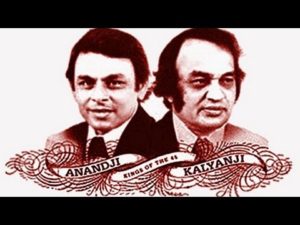 This movie had seven songs composed by Kalyanji Anandji. There was only one written by Indeevar but lately you would have seen how surely and steadily Indeevar is moving with Kalyanji Anandji.
The song that he wrote was: Thumak thumak mat chalo sung by Mukesh. Please enjoy it…
thumak-thumak mat chalo ha ji mat chalo kisi kaa dil tadapegaa
thumak-thumak mat chalo ha ji mat chalo kisi kaa dil tadapegaa
mand-mand mat hanso koi raahi bhatakegaa
haaye koi raahi bhatakegaa
thumak-thumak mat chalo ha ji mat chalo kisi kaa dil tadapegaa
kaajal se kat jaaye kalejaa aankhe hire ki kani
kaajal se kat jaaye kalejaa aankhe hire ki kani
raaho me ho jaaye ujaalaa
raaho me ho jaaye ujaalaa chehare par vo chaandani
gesu khule mat rakho ha ji mat rakho kisi kaa dil ulajhegaa
thumak-thumak mat chalo ha ji mat chalo kisi kaa dil tadapegaa
dil me utar naa jaaen kisi ke shokh nigaahe rok lo
dil me utar naa jaaen kisi ke shokh nigaahe rok lo
aah nikal naa jaaye kisi ki
aah nikal naa jaaye kisi ki apani adaayen rok lo
ban ke ghataa mat utho ha ji mat utho koi pyaasaa tarasegaa
thumak-thumak mat chalo ha ji mat chalo kisi kaa dil tadapegaa
Day #9, Song #27
Roshan tumhin se duniya
His next movie in 1963 was Sunehri Nagin starring Helen and Mahipal. Once again the songs of the movie were composed by Kalyanji Anandji and once again Indeevar wrote just one: Youn na akadiye youn na bigadiye, a song sung by Kamal Barot and Lata Mangeshkar.
His next movie in 1963 was Magic Box. He paired with Bulo C Rani and made six songs:
1. Ghananan ghire ghata ghanghor.
2. Raat ka pyar mila.
3. Teri mast nigahon ne banaya hai mujhe deewana.
4. Bina poochhe aaya hoon.
5. Kahan ho dilwale.
6. Baagon mein mat aana.
We shall skip all these.
Flying Horse was his next movie in 1963. They never run short of titles; do they?
Vijay Honnavar composed seven songs; two of which were penned by Indeevar:
1. Tum bewafa wafa ka iqraar kya karoge?
2. Same song Ver2.
We shall skip it.
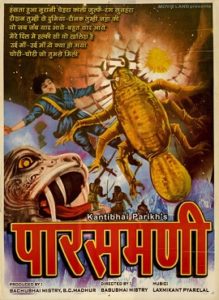 His next movie was Parasmani, a Babubhai Mitra movie starring Mahipal and Geetanjali with excellent songs composed by Laxmikant Pyarelal. The best song of the movie Woh jab yaad aaye bahut yaad aaye was penned by Asad Bhopali.
Indeevar wrote just one but that too was a beautiful number sung by Mohammad Rafi.
Please enjoy: Roshan tumhin se duniya…
roshan tumhi se duniya, raunaq tumhi jahaan ki
phulo me palne vaali raani ho gulsitaan ki
salaamat raho, salaamat raho
roshan tumhi se duniya, raunaq tumhi jahaan ki
phulo me palne vaali raani ho gulsitaan ki
salaamat raho, salaamat raho
naazuk ho naaz se bhi, tum pyaar se bhi pyaari
naazuk ho naaz se bhi, tum pyaar se bhi pyaari
tum husn se hasi ho kya baat hai tumhaari
kya baat hai tumhaari
aankho me do jahaan hai, maalik ho do jahaan ki
salaamat raho, salaamat raho
dil chaahe tut jaaye, mere dil se yu hi khelo
dil chaahe tut jaaye, mere dil se yu hi khelo
jiti raho yu hi tum, meri bhi umr le lo
meri bhi umr le lo
kis din dua na maangi hamne tumhaari jaan ki
salaamat raho, salaamat raho
roshan tumhi se duniya, raunaq tumhi jahaan ki
phulo me palne vaali raani ho gulsitaan ki
salaamat raho, salaamat raho
In the first nine days on Lyrical, I have covered 19 years of his career with 243 songs from 71 movies. This is nearly one seventh of the number of movies in which his songs occurred and number of songs.
I have, therefore, divided the entire period into six nearly equal parts.
Please await Part II.





 Shailendra and SD Burman paired together starting with 1951 movie Buzdil. We fondly recall their pairing for two iconic 1963 movies Bandini and Meri Surat Teri Aankhen. In Bandini they fell apart and hence in addition to Shailendra, SD Burman tried Sampooran Singh Kalra (Gulzar). And then of course Guide was released in 1965 with excellent songs by Shailendra including his trademark delving deep song: Wahan kaun hai tera mussafir jayega kahan?
 And of course in 1965 Guide, he tugged at our emotions with his Din dhal jaaye song; viz:
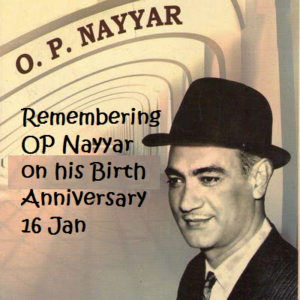 OP Nayyar was born on 16 Jan 1926 in Lahore (now in Pakistan). At the age of 23, OP Nayyar composed the background score for the movie Kaneez. Three years later, in 1952, he was a full fledged music director for the movie Aasman. OP Nayyar perfected songs whose beats (often horse-trot beat such as in 1957 movie Naya Daur’s song Maang ke saath tumhaara) became so popular that people were often heard humming these everywhere. He also delved into raaga based songs although, in all humility, he claimed that he had no knowledge of classical music. Raag Peelu or Pilu, followed by Pahadi, were his favourite raagas in songs.
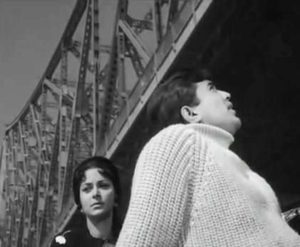 The bridge has featured in many movies and fills all Indians with romantic nostalgia such as in Woh sham kuchh ajeeb thi ye sham bhi ajeeb hai in the picturisation of which Rajesh Khanna in a polo neck and Waheeda Rehman in saree and cardigan pass under the bridge in their boat within the first minute of the song.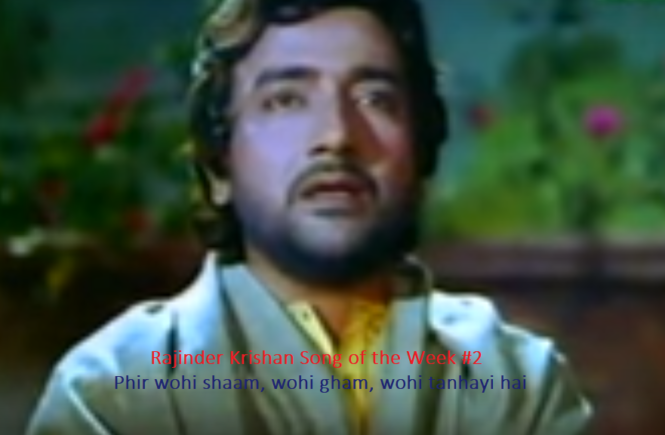

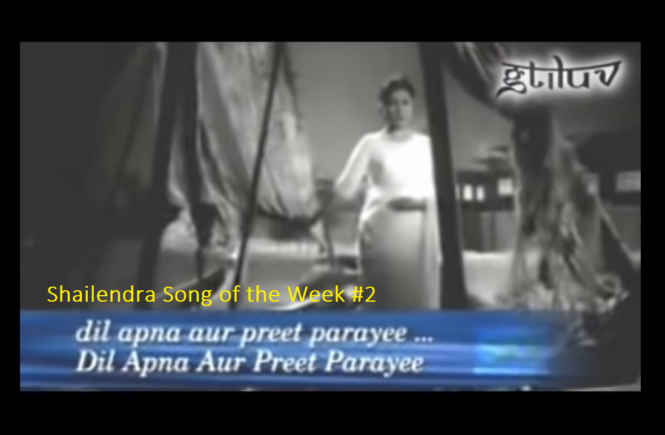
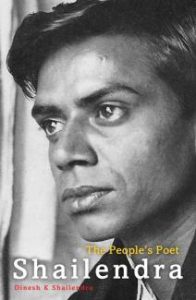
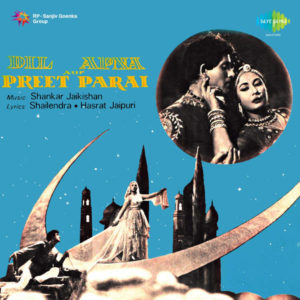 Shailendra had fewer (much fewer) title songs as compared to co-lyricist in Shankar Jaikishan movies: Hasrat Jaipuri. This was an important title song.
 You may be surprised that I selected this song over the popular other song of the movie: Ajeeb dastan hai ye. The reason is that I cannot think of many title songs that can describe the meaning of the title so well. Take Raj Kapoor’s 1949 movie Barsaat, for example; until the end of the movie I kept wondering as to why was it titled Barsaat. Not so with Dil Apna Aur Preet Prayi, especially after this song.