I started this series on my Facebook group Yaad Kiya Dil Ne on 18 Aug 20. Since then, many other members have put up these songs. Here, I shall be giving you one of my own, per day.
We are putting up Raat or Din Songs with the theme-word occurring in either mukhada or antara. However, imagine a song that has been written on Raat itself; that special night in the lives of a couple in love. This is, indeed, the Raat song.
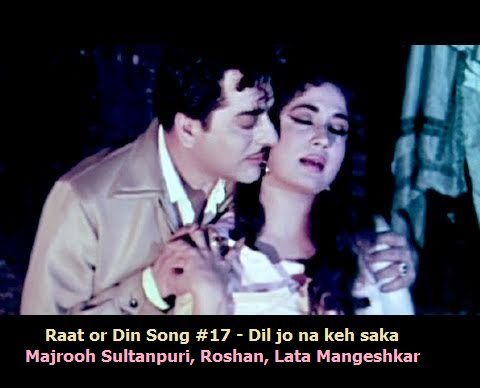
In its sensuous appeal, the only other song that comes anywhere close to it is the Mujhe Jeene Do song performed by Waheeda Rehman: Raat bhi hai kuchh bheegi bheegi chand bhi hai kuchh madham madham. Of course, Waheeda Rehman is a courtesan in that song and is expected to make it sensuous. Here, Meena Kumari, with the least movements and largely based on histrionics conveys the same (I am talking about the Lata Mangeshkar version that I am giving you today), if not more.
One can conclude that she is ravishing indeed and Pradeep Kumar is a very lucky man.
The Song’s Appeal
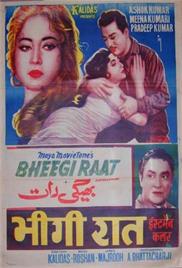
The song is from the 1965 Kalidas movie Bheegi Raat (Imagine having the theme-word in the title itself), which was a remake of the Hollywood movie An Affair To Remember.
Kalidas retained the same cast as was there in the 1962 Phani Majumdar movie Aarti: Meena Kumari in a triangle with Pradeep Kumar and Ashok Kumar and he even maintained some of the supporting cast as Shashikala and Rahendra Nath.
Roshan
But, more than anything else, Kalidas maintained the Lyricist – Music Director pair of Majrooh Sultanpuri and Roshan. Here too Lata Mangeshkar sang for Meena Kumari and in the Pradeep Kumar version, Mohammad Rafi sang for him. (Some sites are erroneously crediting this song to Sahir Ludhianvi. To settle it once and for all, I played the movie and re-confirmed that Majrooh wrote the lyrics).
It is a beautiful night, the fire is on at three places, at least. One can see the visible fire but feel the invisible ones through the lyrics, notes and histrionics. Is it the raat to remember forever? Yes, of course. Is it similar to Roop tera mastana. Yes, of course except that it was many years before RTM.
Look at how expressive the lyrics are:
दिल जो ना कह सका
वही राज-ए-दिल, कहने की रात आई
नग्मा सा कोई जाग उठा बदन में
झनकार की सी थरथरी है तन में
प्यार की इन्हीं धड़कती फ़िज़ाओं में
रहने की रात आई…
अब तक दबी थी एक मौज-ए-अरमां
लब तक जो आई, बन गई हैं तूफां
बात प्यार की बहकती निगाहों से
कहने की रात आई…
गुज़रे ना ये शब, खोल दूँ ये जुल्फें
तुम को छुपा लूँ, मूँद के ये पलकें
बेक़रार सी लरज़ती सी छाँव में
रहने की रात आई…
My Own Poetry
Dil doesn’t say; but, dil always listens. Here is:
Hamare Dil Ka Geet
रातों के ख्वाब दिन में भी लगे आने,
तेरे प्यार में सनम हम हो गए दीवाने।
सांस रुकने लगी,
आंख झुकने लगी,
तन्हाई के पल भी अब बन गए सुहाने।
मुहब्बत की यह धुन,
इसे दिल से सुन।
सेहरा में भी आ गयी बहार,
खिल उठा है मेरा घर संसार।
ठंडी ठंडी हवाएं,
भीगी भीगी फिजायें,
तेरा ही कर रही थी इंतज़ार।
मुहब्बत की यह धुन,|
इसे दिल से सुन।
ज़िन्दगी भर रहेगा अपना साथ,
हमेशा रहेगा मेरे हाथों में तेरा हाथ।
बस यूँ ही यूँ है,
हर तरफ तूँ ही तूँ है,
जन्मों जन्मों की हमारी मुलाकात।
मुहब्बत की यह धुन,
इसे दिल से सुन।
Please enjoy: Dil jo na keh saka….
I hope you liked my choice of Song #17 in Raat or Din series.
I started this series on my Facebook group Yaad Kiya Dil Ne on 23 Aug 20. Since then, many other members have put up these songs. Here, I shall be giving you one of my own, per day.
During the olden days movie, it wasn’t a done thing to express Love openly (something that became a norm later by such songs as Khullam khulla pyar karenge hum dono). Men and women sought indirect means to do so such as Mujhe tumase mohabbat hai magar main keh nahin sakta. Indeed, one of the heart-warming duets from Aradhana had Rajesh Khanna trying his best to make Farida Jalal say it but she keeps saying Na na na na without saying it. Sharmila Tagore in Kashmir Ki Kali went to the extent of ticking off Shammi Kapoor by: Mohabbat jo karte hain woh mohabbat jatate nahin, Dhadkane apne dil ki kahin kisi ko sunate nahin. OP Nayyar went one step ahead and composed: Aap youn hi agar hamse milate rahe dekhiye ek din pyar ho jaayega (Song penned by Raja Mehdi Ali Khan who introduced Aap as a form of address in his songs).
I am sure you got the point that even for the year 1972 when Manmohan Desai made Raampur Ka Lakshman, it wasn’t a done thing to directly talk about Love. In both Mere Mehboob and Barsaat Ki Raat (the songs written respectively by Shakeel Badayuni and Sahir Ludhianvi), the hero had to indirectly address the expression of love for her hoping like hell that she’d understand. Luckily, both Sadhana and Madhubala more than understood.
Majrooh Sultanpuri and RD Burman
Majrooh was the reluctant lyricist (he never wanted to become one until Jigar Moradabadi coaxed him to). However, in his very first movie Shahenshah, in which AR Kardar and Naushad gave him a break, he came up with such memorable songs that the hero KL Saigal wanted one of these to be sung on his funeral (Jab dil hi toot gaya). No wonder that he became the first lyricist to be conferred with the highest award: Dadasaheb Phalke Award. He became a natural lyricist.
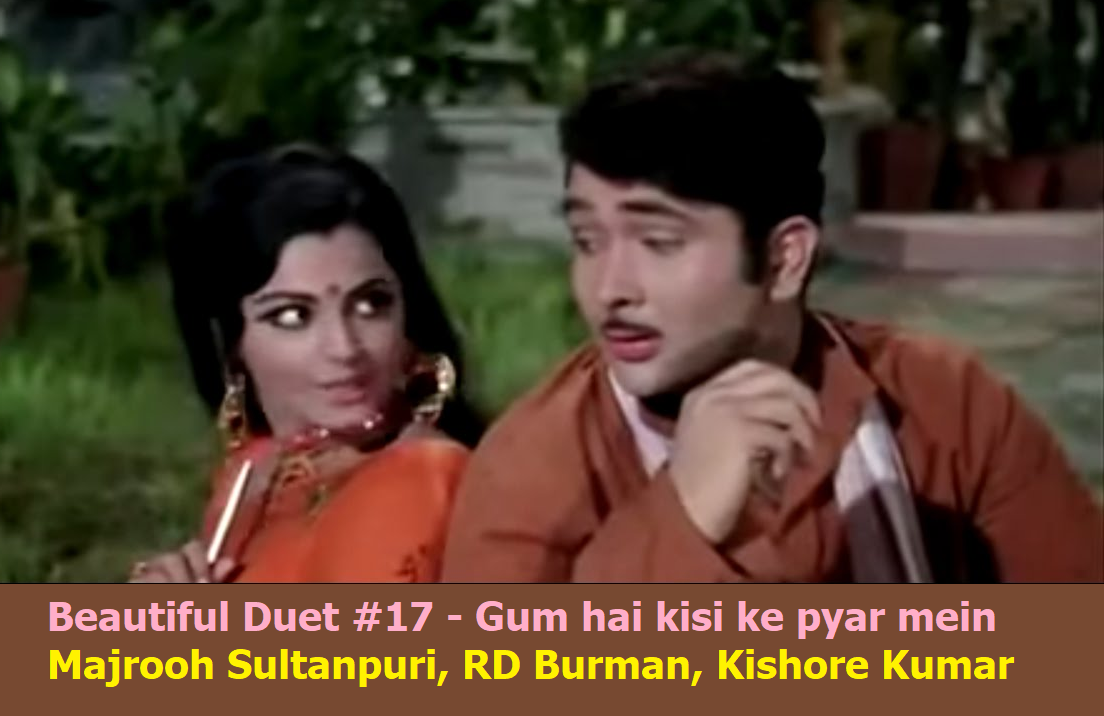
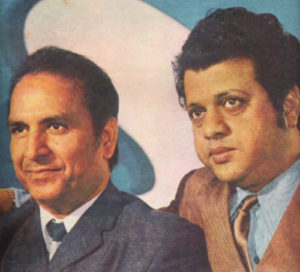
Here he is with RD Burman, the genius music director who gave us some memorable songs in various genre’s including Qawwali in Raag Kalawati in Hum Kisise Kam Nahin, serious songs in Aandhi, and pop songs that he mastered. This duet owes to him to come up with a tune that is still on everyone’s lips nearly five decades after the movie.
Kishore Kumar and Lata Mangeshkar
(Pic courtesy: rediff.com)
Kishore Kumar sang for Randhir Kapoor and Lata for Rekha. Whatever you do, you can’t get both playback singers out of your system. They are simply adorable. Don’t forget their Aandhi songs.
Lyrics
किशोर: गुम है किसी के प्यार में, दिल सुबह शाम
पर तुम्हें लिख नहीं पाऊँ, मैं उसका नाम
हाय राम, हाय राम
रंधीर: कुछ लिखा?
रेखा: हाँ
रंधीर: क्या लिखा?
लता: गुम है किसी के प्यार में, दिल सुबह शाम
पर तुम्हें लिख नहीं पाऊँ, मैं उसका नाम
हाय राम, हाय राम
रेखा: अच्छा, आगे क्या लिखूँ?
रंधीर: आगे?
किशोर: सोचा है एक दिन मैं उससे मिलके
कह डालूँ अपने सब हाल दिल के
और कर दूँ जीवन उसके हवाले
फिर छोड़ दे चाहे अपना बना ले
मैं तो उसका रे हुआ दीवाना
अब तो जैसा भी मेरा हो अंजाम
गुम है किसी के प्यार में, दिल सुबह शाम
पर तुम्हें लिख नहीं पाऊँ, मैं उसका नाम,
हाय राम, हाय राम
रंधीर: लिख लिया?
रेख: हाँ
रंधीर: ज़रा पढ़के तो सुनाओ
लता: चाहा है तुमने जिस बावरी को
वो भी सजनवा चाहे तुम्हीं को
नैना उठाए तो प्यार समझो
पलकें झुका दे तो इक़रार समझो
रखती है कब से छुपा छुपा के
रंधीर: क्या?
लता: अपने होंठों में पिया तेरा नाम
गुम है किसी के प्यार में, दिल सुबह शाम
पर तुम्हें लिख नहीं पाऊँ, मैं उसका नाम
हाय राम, हाय राम
My Own Poetry
Could I have become more indirect than this:
Yeh Kaisa Pyaar Hai?
जो कुछ भी हमारे बीच में है,
क्या इसी का नाम प्यार है?
I started this series on my Facebook group Yaad Kiya Dil Ne on 18 Oct 20. Since then, many other members have put up these songs. Here, I shall be giving you one of my own, per day.
Song #16 Theme-word: Last line: Jeevan naya milega antim chita mein jal ke.
Best Children’s Song by a Poll
This was overwhelmingly voted as the Best Children’s Song in a poll in 2015. To imagine that the song occurred in the 1961 movie Gunga Jumna! Fifty four years later, it was still voted as the best! That says a lot about this song.
It was penned by Shakeel Badayuni, composed by Naushad Ali and sung by Hemant Kumar for the teacher Abhi Bhattacharya teaching a class in an open air class in a village in which children are studying.
Hindi Songs Depicting Ideals in Preamble to Constitution of India
In the year 2016, I included it as a song that depicts all the ideals contained in the Preamble to Constitution of India: Justice, Liberty, Equality and Fraternity. Hats off to Shakeel Badayuni for having thought of that!
Please read all about it and listen to the song in:
I started this series on my Facebook group Yaad Kiya Dil Ne on 23 Aug 20. Since then, many other members have put up these songs. Here, I shall be giving you one of my own, per day.
Sohrab Modi’s 1956 movie Raj Hath (or Rajhath) revolved around two neighbouring empires whose animosity knows no limits. Their children Madhubala and Pradeep Kumar try to convert their enmity into love. I have already told you that if Love is anywhere, Hasrat Jaipuri is to be called and he’d do the needful in his lyrics.
This movie has, for example, another song penned by him that became one of the best of Mohammad Rafi (there are, indeed, quite a few of Mohammad Rafi’s popular songs songs that were penned by Hasrat Jaipuri. The song was: Aaye bahar ban ke lubha kar chale gaye. Madhubala was sent, dressed as a man into the territory of Pradeep Kumar to recover documents. In addition, she managed to steal his heart too.
Shankar Jaikishan
On one hand, Rajhath was all about Shams Lucknowi’s interesting story. On the other hand, in order to carry the story forward, Shankar Jaikishan composed some really memorable songs. The two songs that I mentioned are the best of the movie.
Madhubala and Pradeep Kumar
Sohrab Modi was a Dadasaheb Award winner. However, the only minus of the song is that he wasn’t able to bring out the kind of chemistry between Pradeep Kumar and Madhubala that should have existed on a Chand song.
One must see how Nandlal Jaswantlal was able to bring out in 1954 movie Nagin (on similar story of feud between neighbouring tribes) the chemistry between Pradeep Kumar and Vyjayanthimala.
I have, lately started looking at each aspect of the song and I think the song lacks good direction here. I saw Zikr hota hai jab qayamat ka and saw similar flaw plus average rendition by Mukesh.
Lata Mangeshkar and Mukesh
Here, Mukesh and Lata both have sung it well and have proved that they were great duet singers. Chand as a witness was a common theme for lovers and they confided in Chand whilst talking about their Love.
Please enjoy: Ye waada karo chand ke saamne…
ये वादा करो चाँद के सामने
भुला तो न दोगे मेरे प्यार को
मेरे हाथ में हाथ दे दो ज़रा
सहारा मिलेगा मेरे प्यार को
ये चन्दा ये तारे तो छुप जायेंगे
मगर मेरी नज़रों से छुपना न तुम
बदल जाये दुनिया न बदलेंगे हम
निभाना ही होगा इस इक़रार को
ये वादा करो चाँद के सामने …
बहारों के साये में आ झूम लें
भुला दें ज़माने के ग़म आज तो
ज़माने के ग़म से हमें काम क्या
हमें तुम मिले और क्या चाहिये
कि हम छोड़ बैठे हैं संसार को
ये वादा करो चाँद के सामने …
I hope you liked my choice of Beautiful Duet #16.
Please await Beautiful Duet #17- Gum hai kisi ke pyar mein.
I started this series on my Facebook group Yaad Kiya Dil Ne on 18 Oct 20. Since then, many other members have put up these songs. Here, I shall be giving you one of my own, per day.
Songs #15 Zindagi jab bhi teri bazm mein lati hai mujhe
Happy Birthday Talat Aziz 10 Nov
(Pic courtesy: patrika.com)
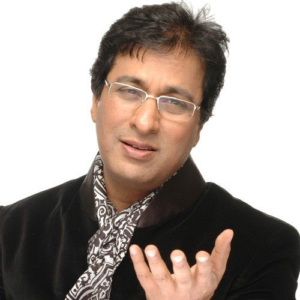
He was born on this date in 1956 in Hyderabad. He started learning music from an early age. Jan Nisar Akhtar and Jagjit Singh were frequent guests to his family’s place.
This song from 1981 movie Umrao Jaan was one of his early successes. This was followed by his Bazaar (1982 movie) Phir chhidi raat baat phoolon ki.
He emerged as a ghazal maestro and has made good name for himself for singing both fiolmy and non-filmy ghazals.
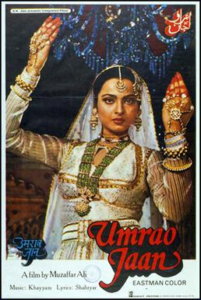
Umrao Jaan – 1981 Movie
(poster courtesy: wn.wikipedia.org)
This was directed by Muzaffar Ali and is quoted as one of the best roles of Rekha.
The story is of 1840 when a girl named Amiran is kidnapped from Faridabad and sold to the brothel madam Khannum Jaan in Lucknow.
She becomes accomplished in writing shayari, singing and dancing and emerges as Umrao Jaan.
Farooq Sheikh as Nawab Sultan falls in love with her but later reveals that he must marry a gilrl of the choice of his parents.
This ghazal is sung by him to show his gratitude to Umrao Jaan for her love and care. It was penned by Shahryar and composed by Khayyam. Khayyam won both National and Filmfare Awards for the music and Rekha too won both the awards as Best Actress. The other songs of the movie as fondly remembered, if not more are:
Dil chhez kya hai aap meri jaan leejiye.
In aankhon ki masti ke.
Justuju jiski thi.
Yeh kya jagah hai dosto.
The Lyrics
ज़िंदगी जब भी तेरी बज़्म में लाती है हमें
ये ज़मीं चाँद से बेहतर नज़र आती है हमें
सुर्ख फूलों से महक उठती हैं दिल की राहें
दिन ढले यूँ तेरी आवाज़ बुलाती है हमें
ज़िंदगी …
याद तेरी कभी दस्तक कभी सरगोशी से
रात के पिछले पहर रोज़ जगाती है हमें
ज़िंदगी …
हर मुलाक़ात का अंजाम जुदाई क्यूँ है
अब तो हर वक़्त यही बात सताती है हमें
ज़िंदगी …
My Own Poetry
Yeh Bhi Jeena Hi To Hai
मरने के बारे में सोच कर,
ज़िन्दगी का ख्याल आ गया।
और जियें या ना जिएं,
फ़िर वही सवाल आ गया।
ज़िन्दगी गुज़र रही थी,
तहरीक ए हयात से मज़ूल।
फकत यही सोच के,
यूं ही उबाल आ गया।
आपको शायद लगता है,
मैं अभी भी जिंदा हूं।
जैसे ही खून ए दिल से,
रुख पे मलाल आ गया।
छोड़िए, रहने दीजिए,
जाने भी दीजिए इसे अब।
आख़िर में वक़्त यूं ही,
थोड़ी तेज़ चाल आ गया।
The Song
Ladies and gentlemen, please enjoy: Zindagi jab bhi teri bazm mein laati hai hamen…
I hope you enjoyed my choice for Song #14 in the series.
I started this series on my Facebook group Yaad Kiya Dil Ne on 18 Aug 20. Since then, many other members have put up these songs. Here, I shall be giving you one of my own, per day.
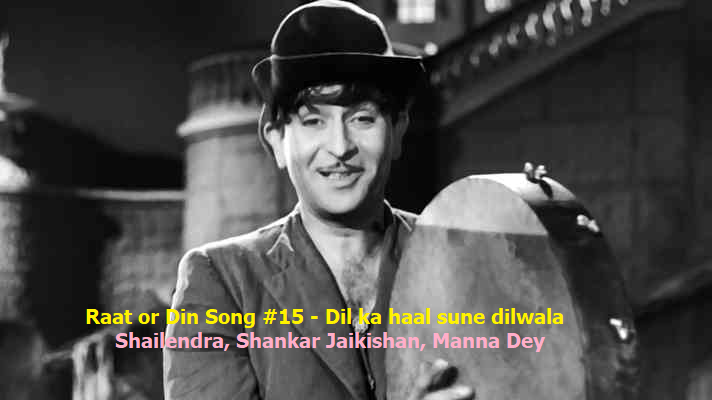
Song #15 Dil ka haal sune dilwala Theme-word: Where is it? You won’t believe it; it occurs right in the end: Aadhi raat ko mat chilana
Comic and Farcical Songs
The hallmark of great lyricists is that he would write comic and farcical songs in addition to all the other genre’s. One must look at the comic songs of a serious lyricist Raja Mehdi Ali Khan, for example. On one hand he started his career with the unforgettable Do Bhai (1947 movie) song: Mera sundar sapna beet gaya (the debut movie of Geeta Roy (later to become Geeta Dutt) as a singer) and went on to make such beautiful numbers as Lag jaa gale ke phir. On the other hand he delved in comicality.
You may like to read his humorous poem that I translated five years ago: Adib Ki Mehbooba.
Shailendra has been a very deep thinking lyricist (he had no independent life as a poet). And yet he wrote the Parivaar song for Kishore Kumar: Kuve mein doob ke mar jaana, Yaar tum shaadi na karna.
This one is as comical.
The situation is that the slum dwellers are protesting against being moved out by the rich industrialist and they are making life hell for him by making unfettered noise.
Manna Dey and Comical Songs
He became the master of the game. Indeed, all great singers tried their hand at singing this genre’. The other day we listened to Ajahu na aaye baalma sawan beeta jaaye in Raag Mdhuwanti sung by Rafi and Suman Kalyanpur and picturised on the comedians Mehmood and Shubha Khote. Manna Dey had sung for the two: Pyar ki aag mein tan badan jal gaya.
When I was still in the Navy, I directed and acted in many plays including comedies. I used to tell the cast during rehearsals that Comedy is serious business; it is comedy for the audience but actors must take it seriously. It is the same with this song. Its composition by Shankar Jaikishan is like any other serious song! And Manna Dey’s singing for Shree 420 Raj Kapoor is exquisite.
My Own Poetry
I too have delved in comedy in my poems. Here is one that I have picked at random:
Mere Ghamon Ka Ilaaj
दुनिया में कोई अपना है तो वो है शराब,
बाकियों ने तो मिल के ज़िन्दगी की है खराब;
एक एक के किस्से सुनाता हूँ मैं आज सब को,
सब के चेहरों से आज मैं उठाता हूँ नकाब।
पहले मेरी बीवी थी बहुत कमसिन और हसीन,
अब लगती है जैसे buffalo in tight jeans;
रवैय्या उसका अब ऐसे जैसे कोई सैय्याद हो,
हर एक बात पे create करती है scene.
बच्चे मेरे ऐसे जैसे अपने नहीं पराये हों,
जैसे ससुराल से श्रीमति जी ने दहेज में लाये हों;
लोगों को तो वो यूँ बताते फिरते हैं,
Daddy के ज़ुल्मों से बहुत तंग आये हों।
रिश्तेदारों के बारे आप को क्या सुनाएं,
ग़म के गीत बार बार क्यों हम गायें;
उन्हें ज़रूरत है तो आ जाते हैं खाली हाथ,
मेरी ज़रूरत में तो वो नज़र भी ना आयें।
दोस्त मेरे हैं एक से एक बड़ के,
आते हैं मेरे पास अपनी बीवियों से झगड़ के;
मेरी दारू, मेरा खाना खाने के बाद,
चले जाते हैं मूँह बनाये मुझसे ही लड़ के।
इस हालात में मेरे पास एक ही है सहारा,
बाकियों से तो हम कर बैठे हैं किनारा,
सारे ग़म, सारे गिले शिकवे हो जाते हैं दूर,
एक जाम को जब गले से नीचे उतारा।
इसलिए शराब बनी है सबसे बड़ी मीत,
ज़िन्दगी से हार के यही है मेरी जीत,
इसी से शामें जो पहले कभी कटती नहीं थीं,
अब तो पल भर में खुशी से जाती हैं बीत।
Please enjoy: Dil ka haal sune dilwala…
दिल का हाल सुने दिलवाला
सीधी सी बात न मिर्च मसाला
कहके रहेगा कहनेवाला
दिल का हाल सुने दिलवाला
छोटे से घर में गरीब का बेटा
मैं भी हूँ माँ के नसीब का बेटा
रन्ज-ओ-ग़म बचपन के साथी
आँधियों में जली जीवन बाती
भूख ने हैं बड़े प्यार से पाला
दिल का हाल…
हाय करूँ क्या सूरत ऐसी
गांठ के पूरे चोर के जैसी
चलता फिरता जान के एक दिन
बिन देखे-पहचान के एक दिन
बांध के ले गया पुलिसवाला
दिल का हाल…
बूढ़े दरोगा ने चश्मे से देखा
आगे से देखा, पीछे से देखा
ऊपर से देखा, नीचे से देखा
बोला ये क्या कर बैठे घोटाला
हाय ये क्या कर बैठे घोटाला
ये तो है थानेदार का साला
दिल का हाल…
ग़म से अभी आज़ाद नहीं मैं
ख़ुश हूँ मगर आबाद नहीं मैं
मंज़िल मेरे पास खड़ी है
पाँव में लेकिन बेड़ी पड़ी है
टांग अड़ाता है दौलतवाला
दिल का हाल…
सुन लो मगर ये किसी से न कहना
तिनके का ले के सहारा न बहना
बिन मौसम मल्हार न गाना
आधी रात को मत चिल्लाना लाना
वरना पकड़ लेगा पुलिसवाला
दिल का हाल…
I hope you liked my choice of Song #15 in Raat or Din series.
I started this series on my Facebook group Yaad Kiya Dil Ne on 23 Aug 20. Since then, many other members have put up these songs. Here, I shall be giving you one of my own, per day.
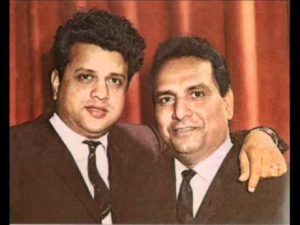
Dedication to the Composers of Millennium – Shankar Jaikishan
Shankar Jaikishan Foundation, Ahmedabad, particularly my friends Chirag Patel, Snehal Patel, Rajan Bedke, and Uday Joglekar are doing an outstanding job to make us forget Corona restrictions and giving us superb programmes of SJ songs to enjoy in Live Fests on Facebook and You Tube.
What is it about Shankar Jaikishan that doesn’t let a day go by when we don’t think of their remarkably beautiful music? The fact is that we can go on and on and still not do full justice to their mastery.
Recently, to them, I commented upon one attribute of theirs that, I think, stands out: it is to do with their imagining, in advance, the effect of their music on the common audiences in the halls.
Take me, for example, I gave you in this series and named a Music Group after what I feel is a perfect duet: Dil ki nazar se. This group is named after another memorable duet of theirs” Yaad kiya dil ne kahan ho tum.
Shailendra
Raj Kapoor fawning over his team of (from L to R): Hasrat Jaipuri, Jaikishan, Shankar and Shailendra
Dil ki nazar se too was penned by him and Yaad kiya dil ne by Hasrat Jaipuri. Hats off to the team that Raj Kapoor made: Shankar Jaikishan, Hasrat Jaipuri and Shailendra; they never competed against one another but always complemented one another’s efforts. Whereas Hasrat Jaipuri would take you into romance, Shailendra would take you a little deeper until you feel your soul is connected to the emotions of the song. They are so many memorable songs that you sit entranced watching them.
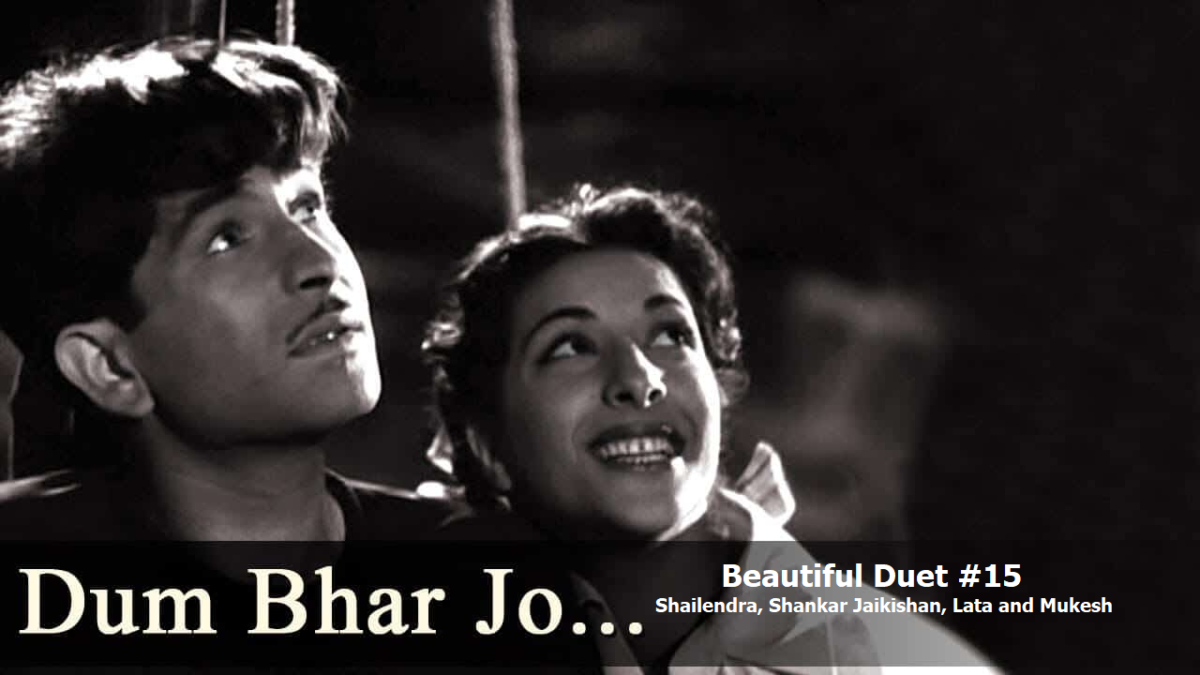
Raj Kapoor and Nargis
He was 26 years old when this movie, Awaara, was shot and she was 21 years old. The way they have enacted the song makes them appear much younger. Of course, she in her ribbons actually gives the appearance of being with her first Love and he is amused that she’d choose an Awaara as her lover!
Look at the mastery of Shailendra; she is the one who wants Chanda (Moon) to look the other way whilst she loves him and he, the Chor (Thief) wants the Chanda to look their way so that he can be witness to their love! Only, Shailendra could have thought of something as unique as this: she as the thief for stealing his heart and he needing someone to stand witness to the act!
Outstanding indeed!
For me, being in the Navy, Nargis had already won my heart by being in a nautical shirt complete with anchors and their choosing to voice their love for the first time in a boat (compare this with another boat in Meena Kumari’s Ajeeb dastaan hai yeh and then Dil apna aur preet prayi.
Can’t let sea and boats get out of Love!
My most memorable in this is my fantasy song’s second stanza: Chand sa mukhada kyun sharmaya, hold your breath, also penned by Shailendra.
The Lyrics
लता: दम भर जो उधर मुँह फेरे
दम भर जो उधर मुँह फेरे, ओ चन्दा
मै उनसे प्यार कर लूंगी, बातें हज़ार कर लूँगी
दिल करता है प्यार के सजदे – २
और मैं भी उनके साथ
चाँद को चन्दा रोज़ ही देखे
मेरी पहली रात, हो … मेरी पहली रात
बादल में अब छुप जा रे ओ चन्दा
मै उनसे प्यार कर …
मुकेश: दम भर जो इधर मुँह फेरे
दम भर जो इधर मुँह फेरे, ओ चन्दा
मै उनसे प्यार कर लूँगा, नज़रें तो चार कर लूँगा
मै चोर हूँ काम है चोरी – २
दुनिया में हूँ बदनाम
दिल को चुराता आया हूँ मैं
येही मेरा काम, हो … येही मेरा काम
आना तू गवाही देने ओ चन्दा
मै उनसे प्यार कर लूँगा, नज़रें तो चार कर लूँगा
लता: दिल को चुराके खो मत जाना – २
राह न जाना भूल
इन कदमों से कुचल ना देना
मेरे दिल का फूल, हो … मेरे दिल का फूल
ये बात उन्हें समझा दे ओ चन्दा
मै उनसे प्यार कर लूँगी …
Lata Mangeshkar and Mukesh
He has been the singing voice of Raj Kapoor even in Dil ki nazar se. Lata has sung here for Nargis and Dil ki nazar se for Nutan. The magic is the same.
My Own Poetry
Chand is my most favourite theme and here is why:
Chand Mere Liye Kya Hai?
कैसे बतायूँ किसीको चांद मेरे लिए क्या है,
चांदनी प्यार बन के बिखरी है उसी की तो दुआ है।
होने को ज़िन्दगी में बहुत कुछ हो चुका, लेकिन
जब जब चांद निकला, लगता तभी कुछ हुआ है।
उनकी आंखों में झलक उठती है किरण माहताब की,
मैं कुछ कहूँ तो कहते हैं जाईये यह सिर्फ हया है।
लोग कहते हैं सदियों से ऐसे ही उगता रहा है,
मेरे दिल में नज़र डालो, हर चांद कुछ नया है।
दिल के ख़ज़ाने रौशन हुए यह चांद की खिदमत है,
पूछते हैं वह चांद ने तुम्हें दिया ही क्या है।
तन्हाई में मुझे और मेरी कलम को इक सहारा मिला,
चांद न हो तो जीने में क्या मज़ा है।
डगमगाता हूँ चांदनी रातों में कुछ ऐसे, रवि,
जैसे चांदनी चांदनी नहीं इक अजब सा नशा है।
I started this series on my Facebook group Yaad Kiya Dil Ne on 18 Oct 20. Since then, many other members have put up these songs. Here, I shall be giving you one of my own, per day.
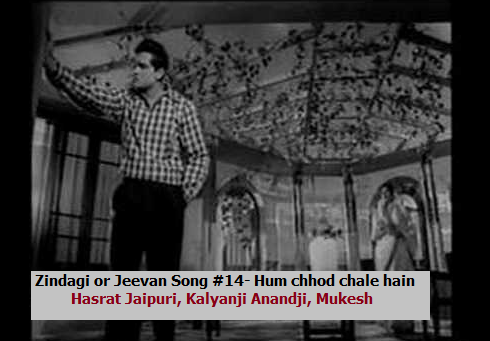
Song #14 Hum chhod chale hain mehfil ko Theme-word: Jeevan ke safar mein tanhayi, Mujhako to na zinda chhodegi
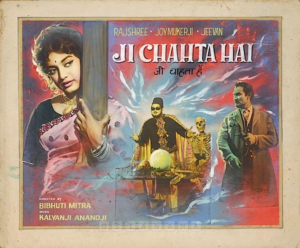
Ji Chahta Hai – 1964 Movie
(Poster courtesy: imdb.com)
This Bibhuti Mehta movie starred Joy Mukherjee and Rajshree in search of a job. They get job with an old couple but have to pretend to be married since the elederly couple cannot trust single people looking after them.
It is the same story as that of 1957 LV Prasad movie Miss Mary starring Gemini Ganesan and Meena Kumari with beautiful songs such as Brindavan ka Krishan Kanhaiya, and O raat ke mussafir Chanda zara bata de.
As a twist from the Miss Mary story it comes out that Joy Mukherjee is actually the son of the elderly couple and that pretensions apart, they actually were married too.
Plenty of scope, if you can imagine, for this song.
This Song
It was penned by Hasrat Jaipuri and composed by Kalyanji Anandji. It is one of my favourites of Mukesh singing for Joy Mukherjee. A number of sites have given credit to Indeevar for having written this song because Indeevar wrote many songs for KA. Perhaps Kishwar Jaipuri behna can confirm if her dad wrote this or Indeevar. Have a look at the lyrics (to me these appear to have been written in the style of Hasrat Jaipuri):
हम छोड़ चले हैं महफ़िल को याद आये कभी तो मत रोना
इस दिल को तसल्ली दे देना, घबराये कभी तो मत रोना
हम छोड़ चले हैं महफ़िल को …
एक ख़्वाब सा देखा था हमने
जब आँख खुली वो टूट गया
ये प्यार अगर सपना बनकर
तड़पाये कभी तो मत रोना
हम छोड़ चले हैं महफ़िल को
तुम मेरे ख़यालों में खोकर
बरबाद न करना जीवन को
जब कोई सहेली बात तुम्हें
समझाये कभी तो मत रोना
हम छोड़ चले हैं महफ़िल को …
जीवन के सफ़र में तनहाई
मुझको तो न ज़िन्दा छोड़ेगी
मरने की खबर ऐ, जान-ए-जिगर
मिल जाये कभी तो मत रोना
हम छोड़ चले हैं महफ़िल को
My Own Poetry
Sab Ajanabee Hain Par Kuchh To Hai Apna
रोने से कुछ न बन सका तो हसने की आयी बारी,
कुछ इस तरह से हमने है ज़िन्दगी गुज़ारी I
वह जब करीब आये तो हम दूर हो गए,
जीती हुयी ये बाज़ी खुद से है हमने हारी I
ज़िन्दगी की कश्म-ओ-कश में यह भी भुला दिया,
फिर कभी न मिल पायेगी, यह ज़िन्दगी हमारी I
साये बढ़ते गए आफताब चले जाने के बाद I
महताब की किरण भी दिखा गयी लाचारी I
दुनिया के शोर-ओ-गुल में परायों से क्या हो शिकवा,
अपने तो जान लेते मेरी यह बेक़रारी I
चमन के फूलों की यादें भी अब मुरझा गयीं हैं,
अब तो खिज़ा ही लेकिन लगती है मुझको पयारी I
सब अजनबी हैं, रवि, पर कुछ तो है अपना,
तन्हाई की यह दौलत मेरी ही तो है सारी I
Ladies and gentlemen, please enjoy: Hum chhod chale hain mehfil ko…
I hope you enjoyed my choice for Song #14 in the series.
I started this series on my Facebook group Yaad Kiya Dil Ne on 18 Aug 20. Since then, many other members have put up these songs. Here, I shall be giving you one of my own, per day.
Song #14 Bhool sakta hai bhala kaun tumhaari aankhen
Beautiful Description of Eyes
There are many songs describing her and sometimes his eyes. One of the most beautiful was created by Majrooh Sultanpuri and Madan Mohan in the movie Chirag. The mukhada was used after Raj Khosla (the director) took permission to use this line from Faiz Ahmad Faiz’s famous nazm: Mujhase pehle si mohabbat mere mehboob na maang (made famous after Noorjehan sang it as a ghazal).
Now lets come to the description of eyes that Shashi Kapoor had to express for Indrani Mukherjee’s eyes. Sahir Ludhianvi wrote it for him (Shashi Kapoor as Dilip Rai writes in the indigenous Indian language Urdu but is, in the movie, a Hindu fundamentalist who hates Muslims. This theme was a favourite theme with Yash Chopra who made his directorial debut with 1959 movie Dhool Ka Phool in which a Muslim (played by Manmohan Krishna) brings up an illegitimate Hindu child and sings to it: Na tu Hindu banega na Musalmaan banega, Insaan ki hai aulad tu insaan banega). Even that song was penned by Sahir and composed by N Dutta just as this one was.
Have a look at the excellent lyrics and see how Sahir related Raat and Chandni to her eyes:
भूल सकता है भला कौन ये प्यारी आँखें
रंग में डूबी हुई नींद से भारी आँखें
भूल सकता है भला कौन …
मेरी हर सोस ने हर सोच ने चाहा है तुम्हें
जब से देखा है तुम्हें तब से सराहा है तुम्हें
बस गई हैं मेरी आँखों में तुम्हारी आँखें
रंग में डूबी हुई नींद से भारी आँखें
भूल सकता है भला कौन …
तुम जो नज़रों को उठाओ तो सितारे झुक जायें
तुम जो पल्कों को झुकाओ तो ज़माने रुक जायें
क्यूँ न बन जायें इन आँखोन की पुजारी आँखेन
रंग में डूबी हुई नींद से भारी आँखें
भूल सकता है भला कौन …
जागती रातों को सपनों का खज़ाना मिल जाये
तुम जो मिल जाओ तो जीने क बहाना मिल जाये
अपनी क़िस्मत पे करे नाज़ हमारी आँखेन
भूल सकता है भला कौन ये प्यारी आँखें
रंग में डूबी हुई नींद से भारी आँखें
भूल सकता है भला कौन …
Mahendra Kapoor Singing for Shashi Kapoor
This movie, the 1961 movie Dharmaputra (based on the novel of the same name by Acharya Chatursen), was the debut movie of Shashi Kapoor as adult actor: he plays Dilip Rai. He sings this song to Indrani Mukherjee as Meena but is finally called upon to make peace with Mala Sinha as Husn Bano.
Shashi Kapoor often had Mohammad Rafi sing such nazms/ghazals for him (He was very cute in his black achkan singing Meri zindagi mein aate to kuchh aur baat hoti in the movie Kanyadan) but here he had Mahendra Kapoor sing for him. I would like to think that his velvety voice suited him in this song.
My Own Poetry
I like to write about eyes; these I consider as the windows to the world of Love and Imagination. Here is one of my own picked up at random:
Meri Zindagi Aapki Aankhon Tale
आपकी आँखों में मुझे वह झलक मिल जाती है,
ज़िन्दगी दफ़अतन और हसीन हो जाती है I
लोग देखते हैं प्यार दिलरुबा की आँखों में,
मुझे तो सारी कायनात नज़र आ जाती है I
ये आँखें नहीं हैं मेरी ज़िन्दगी की रहनुमा हैं,
ज़िन्दगी के मायने यकीनी मुझे समझाती हैं I
कई बार सोचता हूँ कह दूँ इनसे मैं दिल की बात,
क्या कहूं हया मेरी आंखों में छलक जाती है I
सबेरे का सूरज इनकी पलकें खुलने का इशारा है,
रात का अँधेरा पलक झुकने पे ले आती हैं I
ज़िन्दगी में लाखों ग़म इधर उधर बिखरे हों तो क्या,
ज़िन्दगी के सारे ग़म इनकी लौ भुलाती हैं I
मुझे अब इनके सिवा कुछ और न चाहिए, रवि,
जन्नत – ऐ – खुदा खुद बा खुद मिल जाती है I
Please enjoy: Bhool sakta hai bhala kaun tumhaari aankhen…
I hope you liked my choice of Song #14 in Raat or Din series.
I started this series on my Facebook group Yaad Kiya Dil Ne on 23 Aug 20. Since then, many other members have put up these songs. Here, I shall be giving you one of my own, per day.
We all want newness and hence, after having enjoyed Lata – Rafi duets during our entire life, we want to sound novel by liking other singers. However, we know that some of the best duets in Hindi movies were sung by them. Somewhere, in the layers of our memory these are lying dormant until someone like me re-evokes them. I had given you, on 07 Sep, for example, their Teri duniya se door chale hoke majboor and most of you agreed that that was a classic.
This is yet another one.
Vijay Bhatt’s 1959 Movie Goonj Uthi Shehnai
Vijay Bhatt did it once for the 1952 movie Baiju Bawra whose songs are still fondly remembered. He did it again in this movie that had the Bharat Ratna Bismillah Khan playing the Shehnai all throughout in the movie. The 1962 movie Himalaya Ki God Mein and 1965 movie Hariyali Aur Raasta are some other popular movies of his.
Songs of the movies have been a strong attraction in his movies. Baiju Bawra had 13 songs composed by Naushad and penned by Shakeel Badayuni, each one composed in a raag.
Goonj Uthi Shehnai’s story revolved around Rajendra Kumar as Kishan having learnt Shehnai on his own until Ulhas as Raghunath Maharaj hones his talent by taking him as a disciple when he was a boy. Raghunath’s daughter Ramkali (played by Anita Guha) adores him and dreams of becoming his wife. However, Kishan is so deeply in love with his childhood friend Gopi (played by Ameeta) that Rami (Ramkali) soon takes up the role of Kishan’s mother/sister to facilitate their love. Postman IS Johar as Kanhaiya is the fly in their ointment and gradually succeeds in separating the couple. In the end they die and only their souls meet.
Of course, Gopi is enamoured by Kishan’s Shehnai and feels that the right combination for them is his Sur (musical notes) and her Geet (songs).
Bharat Vyas and Vasant Desai
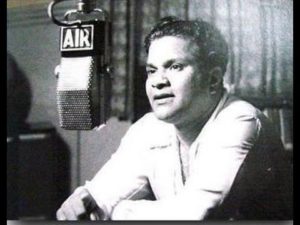
This duo of Lyricist – Music Director have given us some memorable songs; eg, Aye malik tere bande hum in V Shantaram’s classic Do Aankhen Barha Haath. Certainly, some of those cherished songs are in this movie:
“Teri Shehnai Bole” Lata Mangeshkar, Mohd. Rafi
“Tere Sur Aur Mere Geet” Lata Mangeshkar
“Maine Peena Seekh Liya” Mohd. Rafi
“Jivan Men Piya Tera Sath Rahe” Lata Mangeshkar, Mohd. Rafi
“Haule Haule Ghoonghat Pat Khole” Lata Mangeshkar, Mohd. Rafi
“Akhiyan Bhool Gain Hain Sona” Lata Mangeshkar, Geeta Dutt
“Mujhko Agar Bhool Jaoge Tum” Lata Mangeshkar
“Kah Do Koi Na Kare Yahan Pyaar” Mohd. Rafi
“Dil Ka Khilona Hai Toot Gaya” Lata Mangeshkar
The melodious resolve by the lovers to live, love and die together has been brought out beautifully in the lyrics of Bharat Vyas and extraordinarily beautiful composition by Vasant Desai.
The Lyrics
जीवन में पिया तेरा साथ रहे
हाथों में तेरे मेरा हाथ रहे
जीवन में पिया तेरा साथ रहे
जब तक सूरज चन्दा चमके
गंगा जमुना में बहे पानी
रहे तब तक प्रीत अमर अपनी
है ये जनम जनम की दीवानी
ओ रानी याद मिलन
ओ जी हो ओ ओ ओ
ओ रानी याद मिलन की ये रात रहे
हाथों में तेरे मेरा हाथ रहे …
{शृ}ंगार भरा पिया प्यार तेरा
झंकार करे है मेरे कँगना में
लगी जब से लगन मेरे मन में सजन
शहनाई बजे है मेरे अँगना में
ओ पिया याद मिलन
ओ जी हो ओ ओ ओ
ओ पिया याद मिलन की ये रात रहे
हाथों में तेरे मेरा हाथ रहे …
My Own Poetry
Hamare Dil Ka Geet
रातों के ख्वाब दिन में भी लगे आने,
तेरे प्यार में सनम हम हो गए दीवाने।
सांस रुकने लगी,
आंख झुकने लगी,
तन्हाई के पल भी अब बन गए सुहाने।
मुहब्बत की यह धुन,
इसे दिल से सुन।
सेहरा में भी आ गयी बहार,
खिल उठा है मेरा घर संसार।
ठंडी ठंडी हवाएं,
भीगी भीगी फिजायें,
तेरा ही कर रही थी इंतज़ार।
मुहब्बत की यह धुन,
इसे दिल से सुन।
ज़िन्दगी भर रहेगा अपना साथ,
हमेशा रहेगा मेरे हाथों में तेरा हाथ।
बस यूँ ही यूँ है,
हर तरफ तूँ ही तूँ है,
जन्मों जन्मों की हमारी मुलाकात।
मुहब्बत की यह धुन,
इसे दिल से सुन।
Please enjoy: Jeevan mein piya tera saath rahe…
I hope you liked my choice of Beautiful Duet #14.
Please await Beautiful Duet #15- Dam bhar jo udhar moonh dekhe.
I started this series on my Facebook group Yaad Kiya Dil Ne on 18 Oct 20. Since then, many other members have put up these songs. Here, I shall be giving you one of my own, per day.
Song #13 Koi dil mein hai, Koi hai nazar mein (Kise yaad rakhun, kise bhool jayun?) Theme-word: Ari zindagi toone ye kya kiya hai?
Notions of Virtue and Reality
Since the advent of mankind, there has been evolution of the notions of Virtue. Of course, we know that in God’s world, the only Absolute is God Himself and all Virtues are Relative (those of you who are not on conveyor belt may like to read through my essay: Absolute Virtue . I also delve in Philosophy in addition to various other subjects such as Humour, Poetry, and a motley of other subjects.
The fact is that our notion of Virtue goads us to accept One Man – One Woman concept as the bedrock of Goodness. However, human beings are human and are sometimes torn between the love for two; finding each one worthy of their devotion.
This is the thought behind this song.
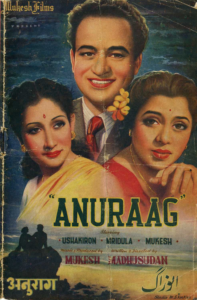
Anuraag – 1956 Movie
(Poster courtesy: cinestaan.com)
This movie was directed by Madhusudan and had two females in the life of the hero: Mukesh: Pratima Devi and Usha Kiran. Both came into his life at times when he needed them and he was torn between their Love.
This song was penned by Kaif Irfani and was composed by Mukesh himself. Hence, as you can make out, this is one song that has Mukesh all the way.
Here are the lyrics for you to understand the situation:
कोई दिल में है और कोई है नज़र में
मोहब्ब्त के सपने मैं किस पे लुटाऊँ
इसी कश्मकश में जिए जा रहा हूँ
किसे याद रखूँ किसे भूल जाऊँ
उधर दिल मोहब्बत में उनको दिया है
इधर फ़र्ज़ का बोझ सर पे लिया है
अरी ज़िन्दगी तूने ये क्या किया है
किसे याद रखूँ किसे भूल जाऊँ
न बस में है मेरे तुम्हे भूल जाना
न बस में है इनको नज़र से गिराना
मेरी बेबसी का बस इतना फ़साना
किसे याद रखूँ किसे भूल जाऊँ
My Own Poetry
Yeh Kahan Aa Gaye Hum?
हम फिर खुद ही खुद से किनारा कर बैठे,
अनजाने में वही गुनाह दोबारा कर बैठे।
कुछ नहीं मिलता हमें यकीनन पता भी है,
जाने क्यूं आज फिर यादों का सहारा कर बैठे।
बार बार वहीं जाता है दिल नज़र ना भी पहुंचे,
फिर उसी गम, उसी बेकसी का नज़ारा कर बैठे।
ज़िन्दगी है, ज़िंदा रहना जरूरी है अपनों के लिए,
फिर क्यूं आज मौत को इशारा कर बैठे।
ख्वाहिशें थी जन्नत मेरी देहलीज़ पे रखेगी कदम,
अब ग़म ए दिल की हकीकत को गवारा कर बैठे।
दौलत ए एहमियत को रखते थे दिल के करीब,
आज उस खुदी को लाचार आवारा कर बैठे।
मिलेंगे तुझे जब खुदा सवाल तो उठेगा दिल में,
उम्र गुज़री जिसे मेरा कहने में, अब क्यूं हमारा कर बैठे।
The Song
Ladies and gentlemen, please enjoy: Koi dil mein hai, Koi hai nazar mein…
I hope you enjoyed my choice for Song #13 in the series.
I started this series on my Facebook group Yaad Kiya Dil Ne on 18 Aug 20. Since then, many other members have put up these songs. Here, I shall be giving you one of my own, per day.
Song #13 Aaja sanam madhur chandni mein Theme-word: Bheegi bheegi raat mein dil ka daaman thaam le
Raat – Chand – Love – Hasrat Jaipuri
If Shailendra did magic in the Awaara song that I had put up on 16th: Dam bhar jo udhar moonh phere, Hasrat Jaipuri wrote this stunningly beautiful song for Chori Chori. Here is the natural succession: Raat leads to Chand, Chand leads to Love and Longing and Love and Longing lead to Hasrat Jaipuri.
Who was Hasrat Jaipuri?
He was simply the lyricist/poet who ruled over the hearts of the lovers. Everyone has loved some time or the others and hence can’t be unfamiliar with Hasrat’s connection with lovers’ hearts. Whatever emotions you go through in Love, he has a song for you including when you shed tears in love or feel sad.
For us, in this group, he is the reason for the title of the group; the song that we consider as the anthem of this group: Yaad kiya dil ne. We, therefore, say with confidence that as long as Love exists, Hasrat Jaipuri lives; even though today is his death anniversary.
What specific emotions is he conveying here:
Nargis, the daughter of a shipping magnate, jumps from his ship in Bombay harbour and races to meet her lover Pran in Bangalore and marry him. Raj Kapoor, as a reporter helps her perform this journey. Gradually, she falls in love with him. This song is sung on the night before they get into Bangalore and she’d marry Pran.
Now look at the lyrics and see if the lovers are talking about her impending marriage:
म: आ जा सनम मधुर चाँदनी में हम
तुम मिलें तो वीराने में भी आ जाएगी बहार
झूमने लगेगा आसमां – २
ल: कहता है दिल और मचलता है दिल
मोरे साजन ले चल मुझे तारों के पार
लगता नहीं है दिल यहाँ – २
म: भीगी-भीगी रात में, दिल का दामन थाम ले
खोई-खोई ज़िन्दगी हरदम तेरा नाम ले
(ल: चाँद की बहकी नज़र, कह रही है प्यार कर
ज़िन्दगी है इक सफ़र, कौन जाने कल किधर ) – २
दोनो: आ जा सनम मधुर …
म: दिल ये चाहे आज तो, बादल बन उड़ जाऊँ मैं
दुल्हन जैसा आसमां, धरती पर ले आऊँ मैं
(ल: चाँद का डोला सजे, धूम तारों में मचे
झूम के दुनिया कहे, प्यार में दो दिल मिले ) – २
दोनो: आ जा सनम मधुर …
You’ll agree with me that she has freed herself from the burden of marrying Pran.
Incidentally, Hasrat Jaipuri wrote (as seen by me) the top most song of Lata Mangeshkar in this movie: Rasik balma.
Shankar Jaikishan
The other day when I was attending a programme by Shankar Jaikishan Foundation, Ahmedabad, a dear friend remarked that my comments were about the singing prowess of the two female singers and nothing about Shankar Jaikishan. I was shocked. I promptly wrote: Sab kuchh unhin ka to hai!
Take away Shankar Jaikishan and all those beautiful songs mean nothing to us. In this song, for example, we hang on to not just their composition but every note of the background music and interludes. As compared to any other composers/music directors, Shankar Jaikishan’s interludes too were so unique that we often hummed these together with the song!
Lata Mangeshkar and Manna Dey
They sang for Nargis and Raj Kapoor respectively and became part of the enchantment; the tune is easy and catchy and doesn’t require changing scales or pitches as you would find in, for example, Aji rooth kar ab kahan jayiyega.
My Own Poetry
I have regaled you with several poems of mine about Chand and Chandni. One is currently on my timeline. Here is another:
Sab Chandramukhi Hain Bechare
आजकल के सूरजमुखी सूरज नहीं देखा करते,
चांद को देख देख रात को हैं आहें भरते।
ताकतवर होने से क्या फर्क पड़ता है,
हसीन है उसी पर हैं लोग मरते।
कौन ताके सूरज को, ठीक है ज़िन्दगी देता है,
पर चांद न होता, तो हम तुम क्या करते?
ज़िन्दगी ही नहीं, रंग भी सूरज ने दिए हैं,
पर अब सूरजमुखी, चांद के लिए हैं संवरते।
माना मैं भी रवि हूं, सूरज से नाम मिला है,
इसलिए लिख रहा हूं मैं यह डरते डरते।
कई ख्वाब चांद के मेरे भी ज़ख्म बन चुके हैं,
आज फिर से ताज़ा हो गए उभरते उभरते।
I started this series on my Facebook group Yaad Kiya Dil Ne on 23 Aug 20. Since then, many other members have put up these songs. Here, I shall be giving you one of my own, per day.
Madhubala (Honey Maiden) and Bharat Bhushan (Grace of India)
She was nominated only once for the Filmfare Best Actress Award, ie, for her role in 18 years of her acting (not counting as child artiste) in Hindi movies, from 1947 Neel Kamal (also the debut movie of Raj Kapoor) until the 1964 Sharabi. However, she was so popular that even when she acted with Dilip Kumar (who she wanted to marry but for her father standing in their way), after the shots, people waited in queues just to get a glimpse of her. A complete movie industry depended upon her charms.
Take the 1958 movie Phagun for instance, made 11 years before she breathed her last at the age of 36 years. She was discovered with a hole in her heart (ventricular septal defect) at the age of 21, in 1954. By the time she acted in this movie, her condition had worsened to the extent that she would vomit blood (her heart was pumping unwanted extra blood). However, in between bouts of bloody cough, she would act and deliver her dialogues. And people swooned. As they did with this song.
Bharat Bhushan, on the other hand, won the second Filmfare Best Actor Award in 1955 for Chaitanya Mahaprabhu, having wrested it from Dilip Kumar who won the first one for 1954 Daag. However, Dilip Kumar wrested it right back next year for Azaad and denied the same to Bharat Bhushan for Mirza Ghalib.
Phagun – the 1958 Movie
Phagun was a Bhibhuti Mitra production and directed movie that also starred Jeevan, Kammo, Nishi, Cuckoo and Mehmood.
Qamar Jalalabadi penned this song. He also penned songs for Raj Kapoor starrer Chhalia including the popular Dam dam diga diga. His song Din hai suhaana aaj pehli tareek hai used to be broadcast from Radio Ceylone for a number of years on the first of every month. My dad used to hum a popular song of his: Jab raat nahin katati zindagi kaise kategi. He also penned the super hit: Jab tumhaari yaad aayegi sanam. My favourite of his is, however, from Shammi Kapoor’s 1966 movie Preet Na Jaane Reet: Main bewafa nahin hoon tere pyaar ki kasam. Indeed, I titled one of my poems: Main Bewafa Nahin Hoon.
His songs in Phagun were composed by OP Nayyar, the music director who has the record of having most hit/super-hit songs in his movies. Take Phagun’s songs for example:
I am sure, quite a few of your own favourites are in this movie including Piya, piya na laage mora jiya (Jungle ki morni aayi baagon ke mor se milne!), Main soya akhiyan meeche (a most enchanting number) and that beautiful Punjabi sounding duet (that’s how OP Nayyar’s songs sounded): Tum rooth ke mat jaana, in the same class as a beautiful duet from Naya Daur: Ude jab jab zufen teri, in which this actress from the South (Vyjayanthimala, that is) also did a Punjabi dance!
I had found this song as a most suitable song for Valentine’s Day. Why is this a suitable Valentine’s Day song? Oh, come on! She is enamoured by a stranger (pardesi) (Jab Jab Phool Khile came later; else Shashi Kapoor would have warned her: Pardesiyon se na akhiyan milana, Pardesiyon ko hai IK din jaana). Not having known, JJPK, she is madly in love with the Pardesi who gave her मीठा मीठा ग़म when he left. She appears to be in love with gham and Dard since even in her Pyar kiya to darna kya, she sang: इस दर्द को लेकर जीता है, इस दर्द को लेकर मरता हैI She was probably describing her own life!
Pardesi or Stranger as a Song Theme
By the way, Pardesi, is not a favourite theme with Indians alone. When Frank Sinatra sang Strangers In The Night in 1966, it made history as Grammy’s Record of the Year. Look at its lyrics:
Strangers in the night
Exchanging glances
Wondering in the night
What were the chances
We’d be sharing love
Before the night was through?
Something in your eyes
Was so inviting
Something in your smile
Was so exciting
Something in my heart told me I must have you
Strangers in the night, two lonely people
We were strangers in the night
Up to the moment when we said our first hello
Little did we know
Love was just a glance away, a warm embracing dance away
And ever since that night
We’ve been together
Lovers at first sight
In love forever
It turned out so right
For strangers…
My Own Poetry
My Good Morning Message #359
Why would anyone love anyone?
Is it just for frolic and fun?
How much of it is sacrifice?
What do you have to pay as price?
How do you know you are in love?
Do you get a signal from God above?
Some say it is a matter of chemistry,
But to most it still remains a mystery.
As to why just one and no one else would do,
If only someone would provide a clue.
Lovers being strangers just a moment ago,
Are suddenly closer than anyone they know.
Everyone knows Love is not a reasoned emotion,
Else, you won’t fall in love but do so in slow motion.
It affects your entire life but it overpowers you,
Without your knowing it totally showers you.
Love doesn’t give you, between several, a choice,
All you can do is to trust God and rejoice.
Love is the only one whence you fall and win,
You glow in its light outside and within.
You’re sure your loved one was born for you
And hence there is no one you can take in lieu.
You suddenly find answers to many a question,
Before long your love is your obsession.
Ladies and gentlemen, please enjoy Asha Bhosle and Mohammad Rafi sing one of the most popular songs of that era with the most popular tune: Ik pardesi mera dil le gaya….
आशा: इक परदेसी मेरा दिल ले गया
जाते जाते मीठा मीठा ग़म दे गया, हाँ, इक…
रफ़ी: कौन परदेसी तेरा दिल ले गया
मोटी मोटी अँखियों मे आँसू दे गया
रफ़ी: ढूँढ रहे तुझे लाखों दिल वाले
कर दे ओ गोरी ज़रा आँखों से उजाले
आशा: आँखों का उजाला परदेसी ले गया
जाते जाते मीठा मीठा ग़म दे गया
आशा: मेरे परदेसिया की यही है निशानी
अँखियां बिलौर की शीशे की जवानी
ठण्डी ठण्डी आहों का सलाम दे गया
जाते जाते मीठा मीठा ग़म दे गया, ओय, कौन…
रफ़ी: ओहो, कौन परदेसी तेरा दिल ले गया…
रफ़ी: उसको बुला दूँ सामने ला दूँ
क्या मुझे दोगी जो तुमसे मिला दूँ
आशा: जो भी मेरे पास था वो सब ले गया
जाते जाते मीठा मीठा ग़म दे गया
रफ़ी: ओय, कौन…
I started this series on my Facebook group Yaad Kiya Dil Ne on 18 Oct 20. Since then, many other members have put up these songs. Here, I shall be giving you one of my own, per day.
Song #12 Beqasi hadd se jab guzr jaaye Theme-word: Zindagi se kaho dulhan ban ke aaj to do ghadi sanvar jaaye
Difficult Being a Woman
I gave you the Raat or Din Song today as tribute to Bhupen Hazarika on his Death Anniversay. The song was picturised on Raveena Tandon who won the National Film Award as Best Actress for her role in 2001 Kalpana Lajmi movie Daman in which Raveena was subjected relentlessly to marital violence, both physical and mental.
This song is from the 1960 RK Rakhan movie Kalpana starring Padmini in the title role. Her sister’s name is the title of the movie and her other sister Ragini (Travancore Sisters) also acts in the movie.
The story is a copy of Nargis’s Adaalat and Suchitra Sen’s Mamta; a poor woman has to take up the role of a courtesan to make both ends meet.
None of the producers and directors would venture into areas wherein women could take up, in their poverty, professions other than prostitution. Mehboob Khan showed the way with Mother India. But that was an exception.
Why This Song Then?
For several reasons. One of the foremost is that a ‘A gentleman is half a lady’ and I am not ashamed of my being a gentleman who would be sensitive towards ladies. This song (not the movie) brings out those pathos (karuna) that I have long associated with Indian women: exploited, made to feel small, and having to choose between wretched life and still more wretched death (Koi ai dil jiye ke mar jaaye).
At one time, I used to regularly borrow Marilyn Ravi’s magazines Femina to read and was shocked to read that Femina touted itself as the magazine: ‘For women of substance’. I have actually seen my mother and her sisters and many other women in our family and I would say these are the ones with substance. These are the ones who won’t give up. We had nothing when my dad died (since he had taken loans to start a project after retirement that never came) and you should have seen my mother, a living copy of Mother India, battling against all odds to make the best of life.
I myself am Sunbyanyname, being my mother’s son. I look at positives. I too don’t look at choice between wretched life and wretched death.
The Song
It was written by Jawed Akhtar’s father Jan Nisar Akhtar. It was composed by OP Nayyar in Raag Desh and Khammaj and Tal Dadra and sung by Asha Bhosle for Padmini who enacted this with her histrionics so well that I have tears in my eyes to see her despondency.
Ladies and gentlemen, please feel for women whilst listening to and seeing the song: Beqasi hadd se jab guzr jaaye…
बेकसी हद से जब गुजर जाए
कोई ऐ दिल जिए के मर जाए
जिंदगी से कहो दुल्हन बन के
आज तो दो घड़ी संवर जाए
उनको जी भर के देख लेने दे
दिल की धड़कन जरा ठहर जाये
हम हैं खुद अपनी जान के दुश्मन
क्यों ये इल्ज़ाम उनके सर जाए
मेरे नग्मों से उनका दिल न दुखे
ग़म नहीं मुझ पे जो गुजर जाए
I hope you enjoyed my choice for Song #12 in the series.
 The song is from the 1965 Kalidas movie Bheegi Raat (Imagine having the theme-word in the title itself), which was a remake of the Hollywood movie An Affair To Remember.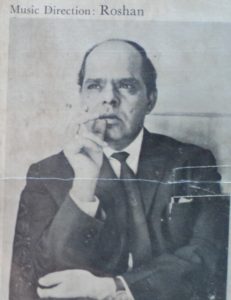
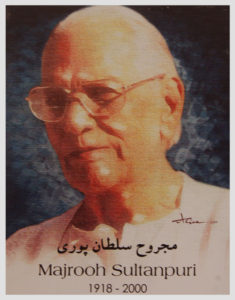 Majrooh was the reluctant lyricist (he never wanted to become one until Jigar Moradabadi coaxed him to). However, in his very first movie Shahenshah, in which AR Kardar and Naushad gave him a break, he came up with such memorable songs that the hero KL Saigal wanted one of these to be sung on his funeral (Jab dil hi toot gaya). No wonder that he became the first lyricist to be conferred with the highest award: Dadasaheb Phalke Award. He became a natural lyricist.
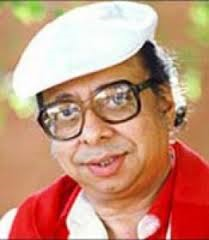 Here he is with RD Burman, the genius music director who gave us some memorable songs in various genre’s including Qawwali in Raag Kalawati in Hum Kisise Kam Nahin, serious songs in Aandhi, and pop songs that he mastered. This duet owes to him to come up with a tune that is still on everyone’s lips nearly five decades after the movie.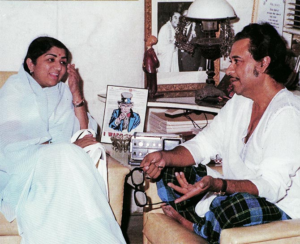
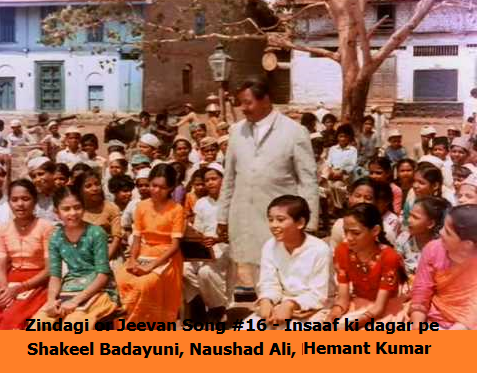
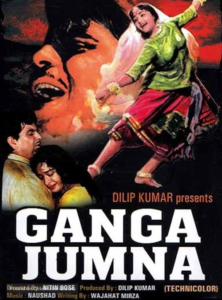 This was overwhelmingly voted as the Best Children’s Song in a poll in 2015. To imagine that the song occurred in the 1961 movie Gunga Jumna! Fifty four years later, it was still voted as the best! That says a lot about this song.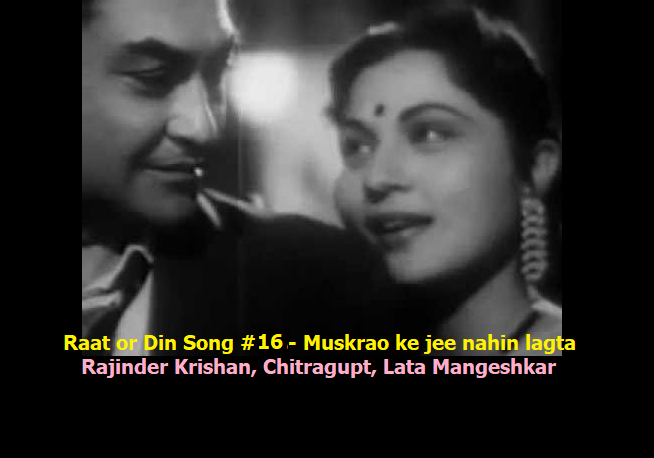
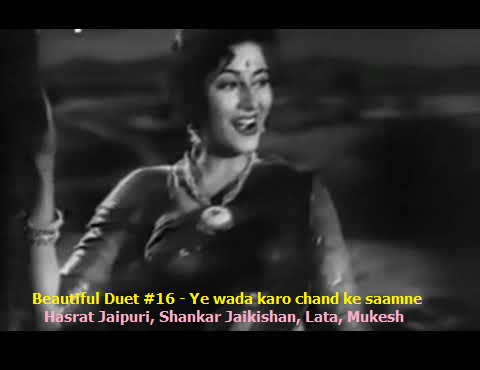
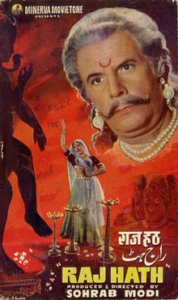
 On one hand, Rajhath was all about Shams Lucknowi’s interesting story. On the other hand, in order to carry the story forward, Shankar Jaikishan composed some really memorable songs. The two songs that I mentioned are the best of the movie.
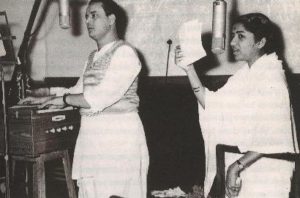 Here, Mukesh and Lata both have sung it well and have proved that they were great duet singers. Chand as a witness was a common theme for lovers and they confided in Chand whilst talking about their Love.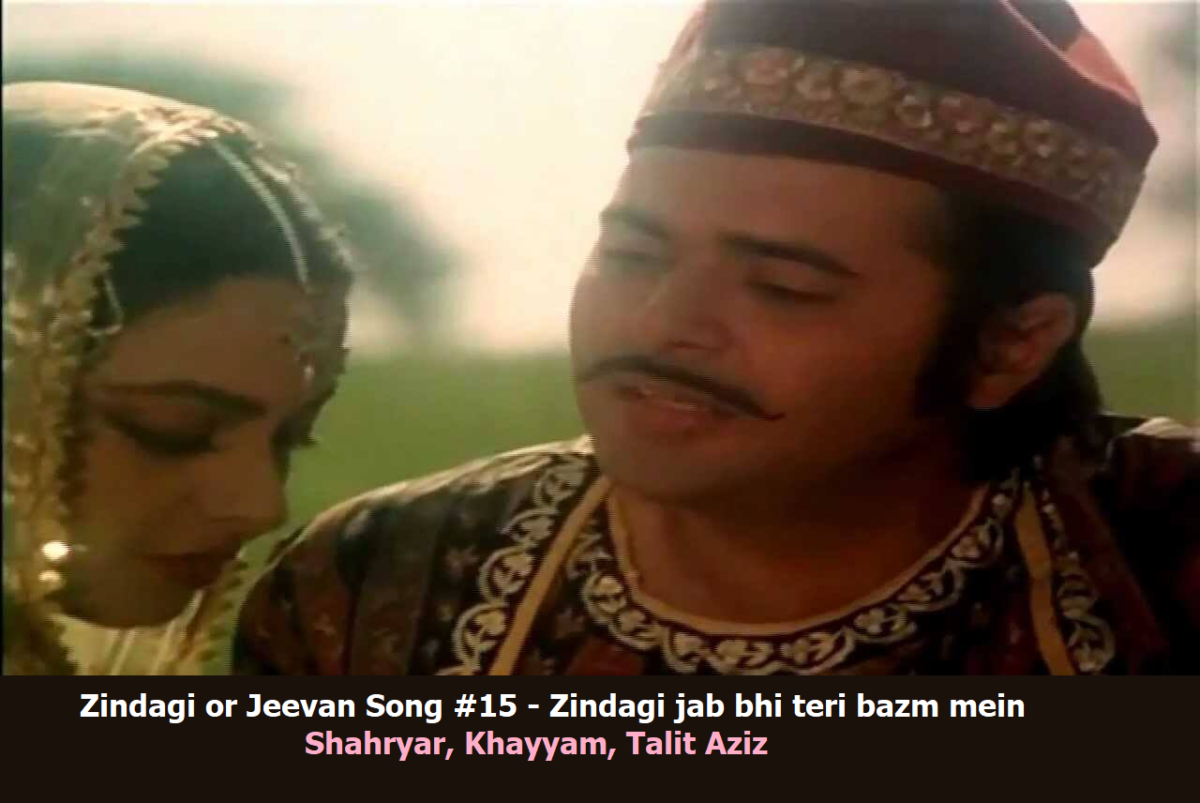
 What is it about Shankar Jaikishan that doesn’t let a day go by when we don’t think of their remarkably beautiful music? The fact is that we can go on and on and still not do full justice to their mastery.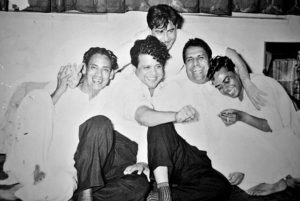
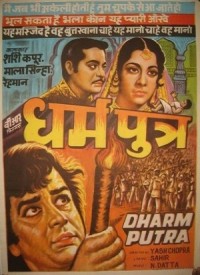 This movie, the 1961 movie Dharmaputra (based on the novel of the same name by Acharya Chatursen), was the debut movie of Shashi Kapoor as adult actor: he plays Dilip Rai. He sings this song to Indrani Mukherjee as Meena but is finally called upon to make peace with Mala Sinha as Husn Bano.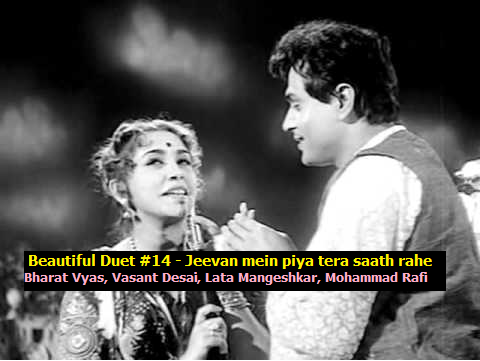
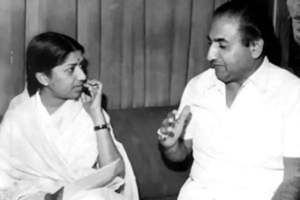 We all want newness and hence, after having enjoyed Lata – Rafi duets during our entire life, we want to sound novel by liking other singers. However, we know that some of the best duets in Hindi movies were sung by them. Somewhere, in the layers of our memory these are lying dormant until someone like me re-evokes them. I had given you, on 07 Sep, for example, their Teri duniya se door chale hoke majboor and most of you agreed that that was a classic.
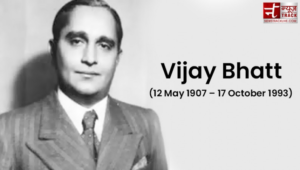 Vijay Bhatt did it once for the 1952 movie Baiju Bawra whose songs are still fondly remembered. He did it again in this movie that had the Bharat Ratna Bismillah Khan playing the Shehnai all throughout in the movie. The 1962 movie Himalaya Ki God Mein and 1965 movie Hariyali Aur Raasta are some other popular movies of his.
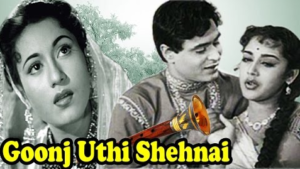 Goonj Uthi Shehnai’s story revolved around Rajendra Kumar as Kishan having learnt Shehnai on his own until Ulhas as Raghunath Maharaj hones his talent by taking him as a disciple when he was a boy. Raghunath’s daughter Ramkali (played by Anita Guha) adores him and dreams of becoming his wife. However, Kishan is so deeply in love with his childhood friend Gopi (played by Ameeta) that Rami (Ramkali) soon takes up the role of Kishan’s mother/sister to facilitate their love. Postman IS Johar as Kanhaiya is the fly in their ointment and gradually succeeds in separating the couple. In the end they die and only their souls meet.
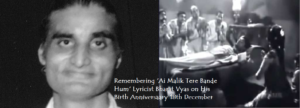 This duo of Lyricist – Music Director have given us some memorable songs; eg, Aye malik tere bande hum in V Shantaram’s classic Do Aankhen Barha Haath. Certainly, some of those cherished songs are in this movie:
 The melodious resolve by the lovers to live, love and die together has been brought out beautifully in the lyrics of Bharat Vyas and extraordinarily beautiful composition by Vasant Desai.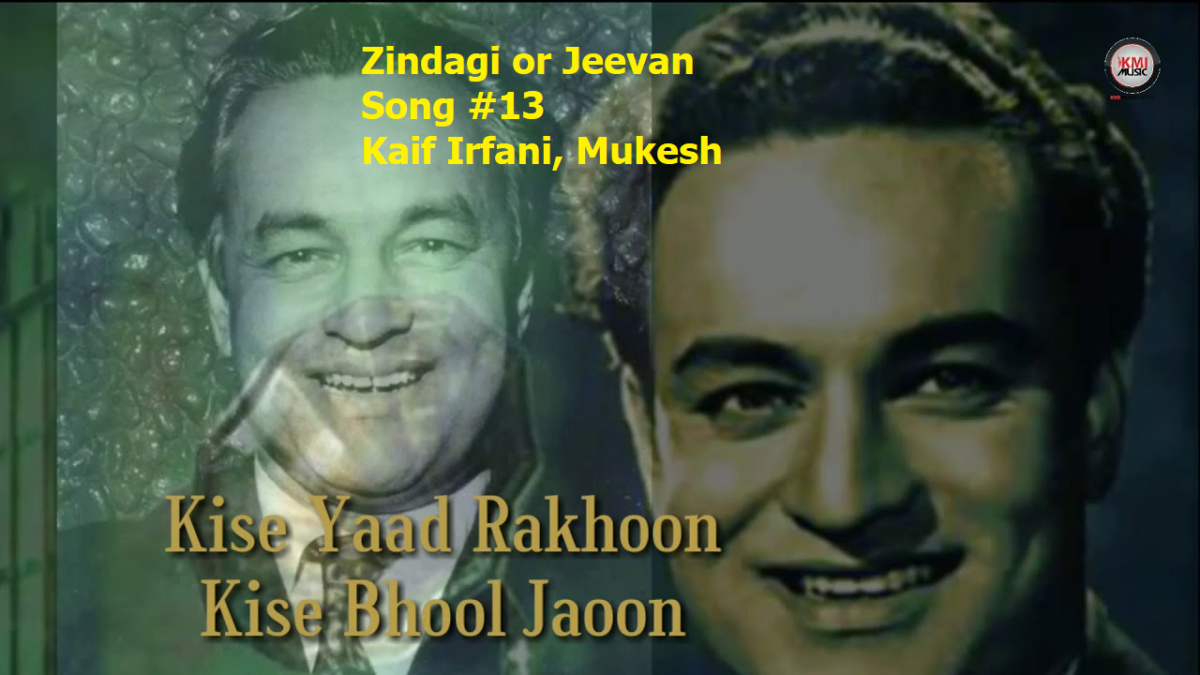
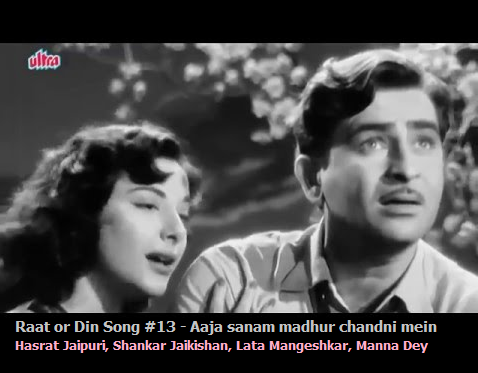
 If Shailendra did magic in the Awaara song that I had put up on 16th: Dam bhar jo udhar moonh phere, Hasrat Jaipuri wrote this stunningly beautiful song for Chori Chori. Here is the natural succession: Raat leads to Chand, Chand leads to Love and Longing and Love and Longing lead to Hasrat Jaipuri.
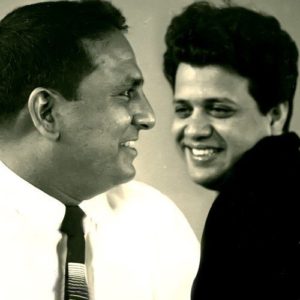 The other day when I was attending a programme by Shankar Jaikishan Foundation, Ahmedabad, a dear friend remarked that my comments were about the singing prowess of the two female singers and nothing about Shankar Jaikishan. I was shocked. I promptly wrote: Sab kuchh unhin ka to hai!
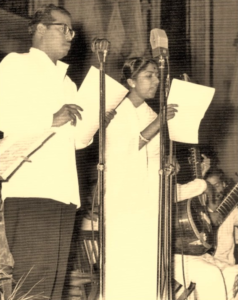 They sang for Nargis and Raj Kapoor respectively and became part of the enchantment; the tune is easy and catchy and doesn’t require changing scales or pitches as you would find in, for example, Aji rooth kar ab kahan jayiyega.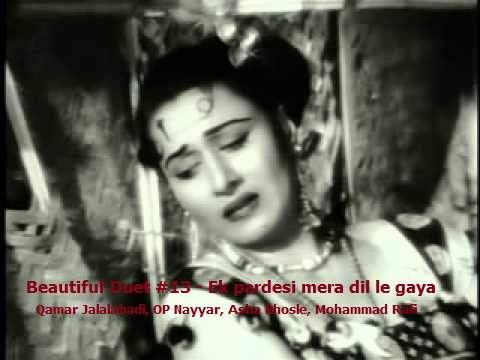
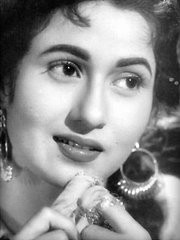 She was nominated only once for the Filmfare Best Actress Award, ie, for her role in 18 years of her acting (not counting as child artiste) in Hindi movies, from 1947 Neel Kamal (also the debut movie of Raj Kapoor) until the 1964 Sharabi. However, she was so popular that even when she acted with Dilip Kumar (who she wanted to marry but for her father standing in their way), after the shots, people waited in queues just to get a glimpse of her. A complete movie industry depended upon her charms.
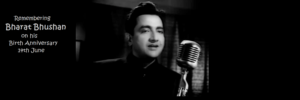 Bharat Bhushan, on the other hand, won the second Filmfare Best Actor Award in 1955 for Chaitanya Mahaprabhu, having wrested it from Dilip Kumar who won the first one for 1954 Daag. However, Dilip Kumar wrested it right back next year for Azaad and denied the same to Bharat Bhushan for Mirza Ghalib.
 Phagun was a Bhibhuti Mitra production and directed movie that also starred Jeevan, Kammo, Nishi, Cuckoo and Mehmood.
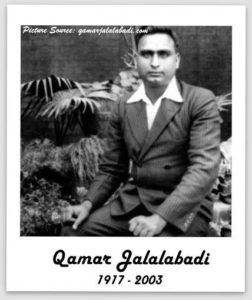 Qamar Jalalabadi penned this song. He also penned songs for Raj Kapoor starrer Chhalia including the popular Dam dam diga diga. His song Din hai suhaana aaj pehli tareek hai used to be broadcast from Radio Ceylone for a number of years on the first of every month. My dad used to hum a popular song of his: Jab raat nahin katati zindagi kaise kategi. He also penned the super hit: Jab tumhaari yaad aayegi sanam. My favourite of his is, however, from Shammi Kapoor’s 1966 movie Preet Na Jaane Reet: Main bewafa nahin hoon tere pyaar ki kasam. Indeed, I titled one of my poems: Main Bewafa Nahin Hoon.
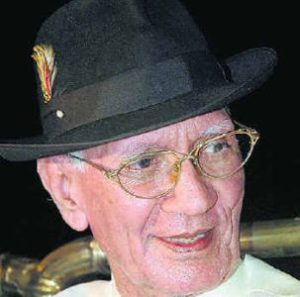 His songs in Phagun were composed by OP Nayyar, the music director who has the record of having most hit/super-hit songs in his movies. Take Phagun’s songs for example: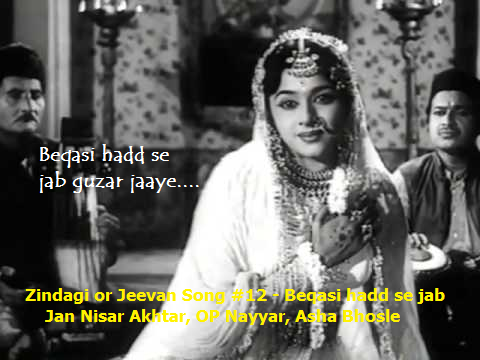
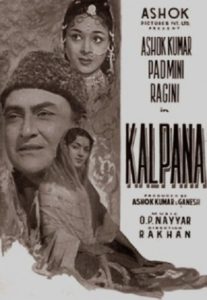 This song is from the 1960 RK Rakhan movie Kalpana starring Padmini in the title role. Her sister’s name is the title of the movie and her other sister Ragini (Travancore Sisters) also acts in the movie.