LOVE – THE GREATEST FEELING ON EARTH

Love and Life are two four-lettered words about whom volumes have been written by poets and writers alike. And yet, like writing about Nature, God and Beauty, there is always something more to write.

There is a great deal of confusion whether Love is a selfless emotion or the most selfish of the emotions. It is selfless because when you love, in near absolute terms, you come to a point when you are oblivious about yourself, your needs and desires. Amongst the popular lovers of yore, Majnu was so much in love with his Laila that when asked to write God’s name in school, he wrote Laila. He was caned so hard by his teacher (maulvi) that it was feared that his hands would start bleeding. Lo and behold, the hands that started bleeding were those of Laila. Love is so selfless that you can lose your identity in love and assume the identity of your beloved.

Duniya pukarti hai mujhe tere naam se…”

It is also a selfish feeling since you love a person to the exclusion of others and that person is called ‘my love’, ‘my life’ etc. As the holy book of the Sikhs, Sri Guru Granth Sahib brings out, my is roughly tranlated to ‘haume’ and loving someone to the exclusion of others is like claiming something for yourself and hence has an element of selfishness about it.

A mother’s love for her child has both elements in it: the selfishness and selflessness. A few decades back, in an earthquake in USSR a woman was buried with her child under the rubble for three full days and nights. She kept her child alive by feeding it her blood! It is a feeling of supreme selflessness. However, the feeling with her, “The life that I am saving is my child, my creation, my life, my love. If I die it would die. So I have to keep myself too alive”, is indeed a selfish feeling.

Lets put it this way: would you expect Laila to bleed for the entire humanity? No, she bled for her own love. Would you expect the mother in USSR to do such a sacrifice for other children? No, she would do it for her own children.

Selfless or selfish or a mixture of both, Love brings out the best in human beings. Yes, one has to get rid of ‘haume‘, as per the scriptures. However, the highest attainments of Leadership through Love are only possible if there is ‘haume’ (my-ness or ego) involved. Soldiers lay down their lives for the love of their country. Cricketers win matches, snatching victory from the jaws of defeat by having the feeling of my-ness for their team, province, state or country. Getting rid of ‘haume‘ is to be rid of belonging and  attachment. However, if you are rid of it Love dies for everyone except for paramatma (Supreme soul) or God.

Love and Ego

So, don’t think too much whether it is Selfish or Selfless to love. If you are thinking of it, you are aware of ‘Self’! It can’t be the purpose of Life to reach back to God. To love one another may also be the will of God.

I have always challenged the oft-held views. In my ‘An Alternate Philosophy of Life‘, for example, I have challenged our obsession with seeking God for ourselves. I have, on the other hand, suggested that we get out of this obsession and think of the society, the way the Westerns do. In India, most people love God but are not so prone to love one another, cleanliness (despite the renewed stress on Swachchh Bharat (clean India), and values. We would if there was some self-interest or ‘haume’ involved in these.

Here are some of the things that I suggest that we love:

1. Love Life. The greatest gift that God has given us is that of Life. We should love ours and those of others. As Indians, when we drive, pardon my saying so, but, it isn’t apparent whether we love ours’ and those of others. Perhaps we should demonstrate it in more ways than the present one of furiously honking and abusing another person off the road. Each one of has the feeling of self-preservation in some degree or the other. Yes, it is selfish to love one’s own life. However, if you don’t love your own and value it, you cannot be expected to value others’. Last year’s Alejandro Inarritu movie The Revenant (a movie that I didn’t like because of its raw and relentless violence) won him the Best Director’s Award as well as Best Actor award for Leonardo DiCaprio. The movie is all about the quest for survival under extreme harsh conditions for Hugh Glass whilst seeking revenge against John Fitzgerald, a fellow trapper who left him (Hugh Glass played by DiCaprio) as dead after stabbing him. Take the opposite extreme, that of a Jehadi or a Mujahid.  He doesn’t value his own life and those of others in the mistaken belief that by killing himself and others he would, perhaps, serve some purpose of God. Loving Life is the first signs of gratefulness towards God for having created beings, mountains, plains, rivers, seas, etc.

Life Live Love

2. Love Nature. God made the Universe very beautiful indeed. We are part of it and we are beautiful too. However, Nature is more beautiful than all of us individually and collectively. It is our beloved. It is not ashamed to have a bath right in the open and emerge even more beautiful. It doesn’t bore us with the same shape, colour, fragrance and hue all the times. One of the most enchanting things about Nature is that it is forever changing. Just when we feel that we have seen the most alluring part of it, it unashamedly reveals another even more fascinating. Nature reflects the endless attribute of God Himself in case we are used to personifying God.

I thank you O God 2

3. Love Music. It doesn’t matter what kind of music you like or love; be it classical, instrumental, Western, Raaga based, or even punk. However, I would be very suspicious of a person who doesn’t like music and considers all music as jarring noise. Music is the expression of the soul. There must be some expression of your own inner self that finds resonance with some music. My family and I consider life without music to be no life at all.
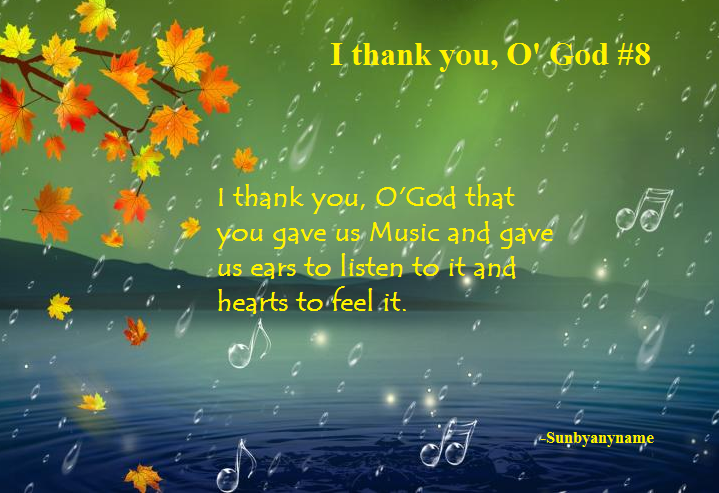
I thank you O God 8

4. Love Children. God gave us innocence at birth and even before it. We had it when we were children. But then, we plunged into worldly knowledge and lost it gradually. That’s the reason that we, with all our knowledge, are farthest from God and little children with their innate innocence are God-like (Please read: ‘How Unbiased Or Innocent Can We Become?’). Therefore, it makes sense to love the child in you as also to love children.
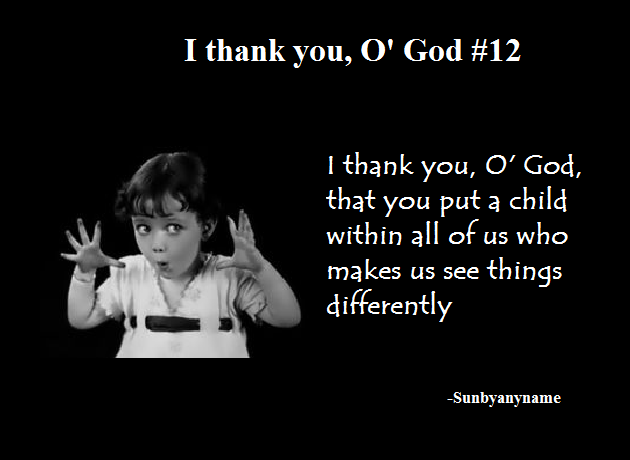
I thank you God 12

5. Love Animals. Many of you must have seen the most successful South African movie ever: the 1980 movie ‘Gods Must Be Crazy’. The movie is about the simple bushmen of Kalahari Desert in Botswana who are happy and content with what God has given them until they are exposed to a Coca Cola bottle (symbolic of the modern world) having been thrown close to them from a plane. And now, the single coca-cola bottle is the source of envy, jealousy, anger, frustration and violence that they had never experienced before. The animal world is like the world of the bushmen as seen in the movie. There is no fear, danger, jealousy, greed and guile. If you can’t be in the wilderness, the next best thing to do is to have a pet and then you suddenly start realising that God made all His beings in His own liking. You can’t help loving them. Indeed, nowadays, scientific and psychological studies have shown that loving a pet relaxes you and enriches your life.
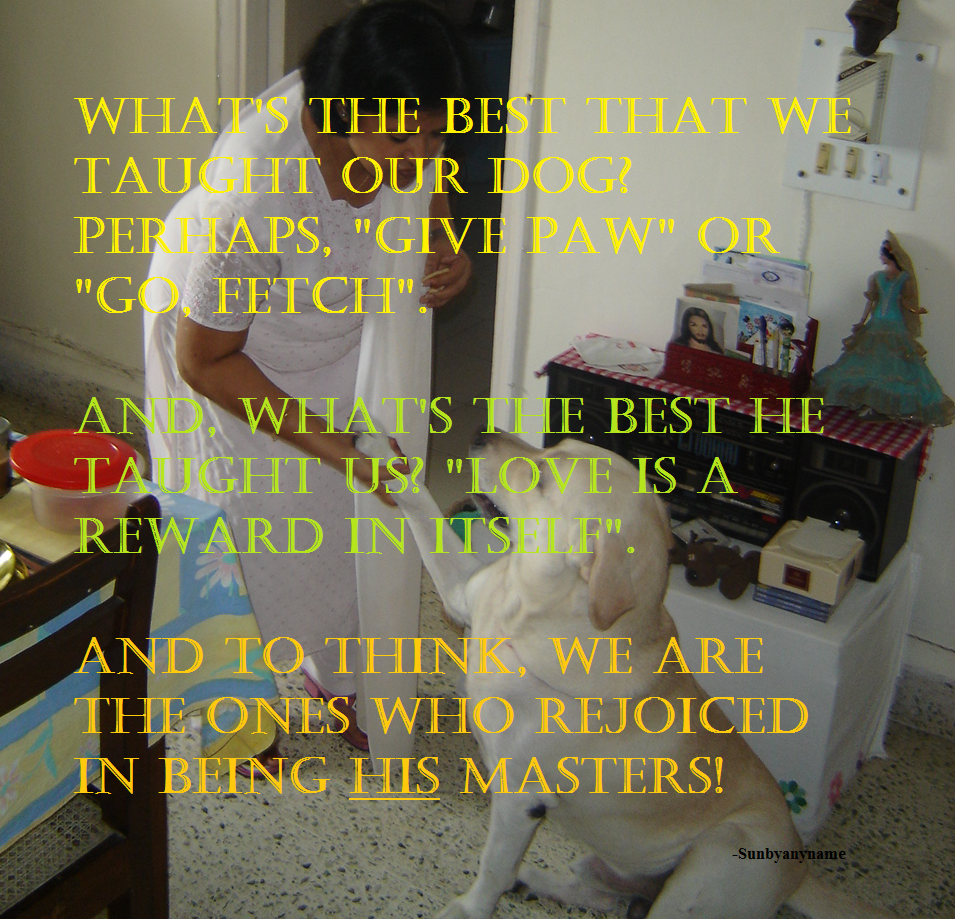
Roger and Us

6. Love Silence and Privacy. We like Sound. Indeed, we like all sensory experiences of hearing, smelling, seeing, touching and tasting. However, there are experiences beyond the senses and these can be found only in silence both outward and inward. You have to make your surroundings and environment around you silent. In modern-day India, for example, we collectively detest silence and are at home with unfettered noise. Considerable part of it is – hold your breath – devotional (Please read: ‘A Quieter Mumbai – Is It A Pipe Dream?’, ‘Noise Is The Newest Form Of Devotion’, ‘Sounds Of Silence’, ‘State Sponsored Noise’, ‘This Patakhawali, This Bombawali Has Nothing In Common With Deepawali’, and ‘Who Are The “People” Whose “Sentiments Need To Be Respected”?’ ) What kind of devotion it must be that uses noise as a medium and doesn’t respect other people’s privacy?
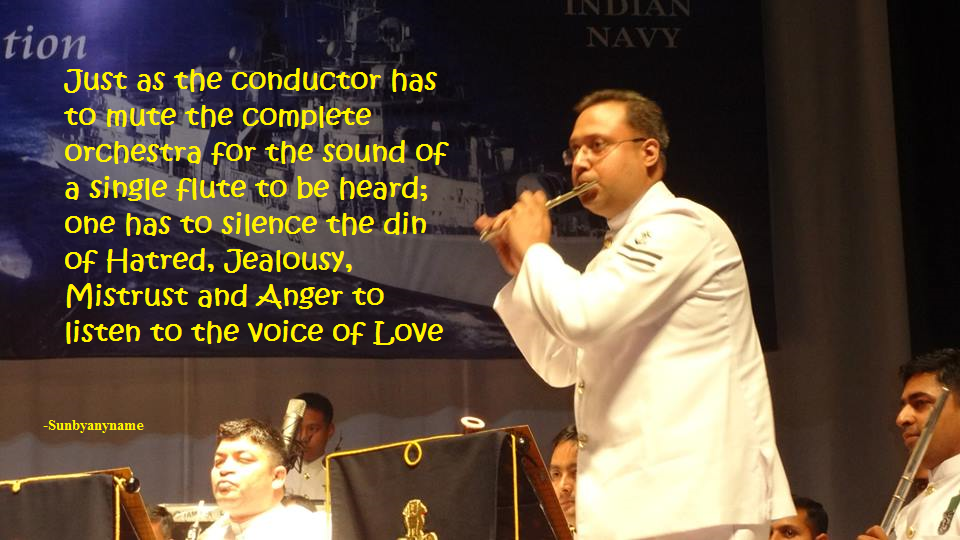
Flute and Orchestra

7. Love the Jawan (Soldier). As long as there is ‘haume’, there is violence. As long as there is violence, someone needs to protect us from being subjugated by violence. That chosen one of God is the Jawan or the Soldier. Whilst others have a profession or vocation, his is a devotion, a sacrifice and way of life. To love a Jawan is to thank him for risking his own life whilst protecting ours. No money, awards, gratitude on earth can ever repay him for what he does 24/7, 365 days in a year.
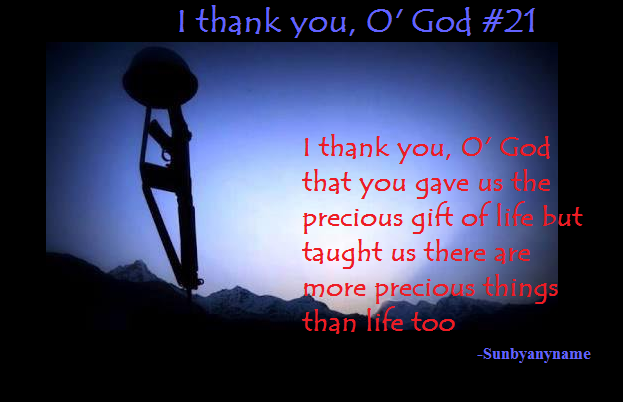
I thank you God 21

8. Love India. We Indians are the most vociferous jingoists in the world. We carry our patriotism on our shirt-sleeves for everyone to see. But, do we really love our country? The answer is a big NO. The person who loves his or her country as his or her own home won’t do any of the following, for example:

  • Dirty it relentlessly and expect someone else to clean up the mess.
  • Indulge in everyday petty corruption and short-cuts knowing that it makes the country weaker.
  • Whiling away time at work knowing that the country’s well-being is dependent upon each one of us working at full efficiency and dedication.
  • Sell the country’s interests both overtly and covertly to the enemies of the country within and without.
  • Have no respect for the law of the land.

There, I have given you my short list of things that we ought to love as our own and cherish that we were given these to love.
I thank you God 27

One of my poems ended like this:

Some live to love,
I love so as to live.

Perhaps you can do it too.
BEST OF ‘MAKE YOUR OWN QUOTES’ – ‘I THANK YOU, O’ GOD’ SERIES

It has been a little more than three  years since I put up in this blog ‘Best Of ‘Make Your Own Quotes’ and fifteen months since I put up here ‘Best Of ‘Make Your Own Quotes’ – Part II’. In these three years or so since the first blog-post and 38 months since I started with the Facebook Page called ‘Make Your Own Quotes’, a lot has happened. One, from a membership of just 30 or so, the Page has a membership of more than 600 now. Two, I started two series: one, about Leadership Lessons and the second about ‘I Thank You, O’ God’. Both are favourite topics with me. I believe that we have to be thankful to God for whatever He/She/It has given us even when we feel that we haven’t got enough. I sincerely feel that gratefulness is the beginning of the journey into happiness,

Why did I start with the page? As I mentioned in the introduction of the first post, “I noticed that on the Facebook and elsewhere, there is a great penchant about putting up Quotes. These range from quotes about Love, Friendship, Politics, Life; indeed about each and every subject. Whilst reading these quotes I was stuck by the realisation that somehow we have this feeling that the sages, saints and wise-people of the past had abundance of sane-advice on all kinds of subjects; but, by a curious quirk of fate, we ourselves and fellow citizens have nothing great to offer in terms of such advice. When I started analysing this, I reached the conclusion that there is nothing simpler than giving sane advice; the answer is really blowing in the wind; it is everywhere. We only have to gather these pearls around us and weave them in a garland”. That’s how I started this Facebook page called ‘Make Your Own Quotes’ with an introduction: “There is nothing simpler than giving sane advice; you don’t have to follow great teachers. Make your own quotes and let others follow you.”

This venture started on the 25th of Feb 2013 and, as I said, I have finished three years of it and it is still going strong. I have received tremendous interest from friends in these Quotes and I am told that around the world these Quotes are being circulated in all kinds of garbs. I have nothing against these since I shall never be making this into a commercial activity.

I like all quotes on Facebook; these provide quick and easy solutions to life’s seemingly complex problems. I believe life is as simple as Facebook; what you get is dependent upon your “settings”.

I started off by giving tips to people on how to make their own quotes, eg,:

Great Quotes Tip #1: Compare Life, Love, Relationships etc to something mundane and infer “great” sounding advice out of it.Here is an (original example): “Friends should be like electricity wires; opposite poles, running parallel and lighting up lives by meeting”. For effect, inscribe this on a totally unrelated picture of, say, a Frog in a Pond. Wanna try your hand at it; go ahead….nothing is simpler! Try comparing Life to Beans!! Go ahead, now that you have joined this site, you will eventually follow your own quotes!!!

Here is therefore the third tranche of Best of ‘Make Your Own Quotes’, but, on a unique topic of finding reasons to thank God.

I may not be a traditional believer in God, the one who personifies God and identifies with Him or Her with innumerable idols and pictures. In the ‘Philosophy’ section of my blog there are a number of posts about how the current concepts of God and Religion are causing more harm and even evil than the evil these were conceived to eradicate. Of particular interest to readers would be a blog-post titled: ‘Whose God Is It Anyway?’ that I wrote five and a half years ago. I am into God as a supreme force that should guide us, bind us together, keep us from doing wrong and look after us as children. I am also a believer in the concept of ‘Ik Omkar’, a concept given to us by Sri Guru Nanak Dev ji, and which translated means: ‘God Is One’ and hence there isn’t a separate God for Hindus or Muslims or for that matter Christians or followers of any other religion (Please read: ‘Nanak Shah Fakir – The Movie And Its Message’).

Now that I have explained my concept of God, please go through the following quotes as addressed to that God and not to Ishwar, Allah, Jesus or Buddha.

Lets begin.

The first one is something that we take for granted: our five senses; particularly the sense of seeing. Here is what a friend Puneet Narula had to write about seeing: “We went to a restaurant in Singapore called “NOX- Dine in the dark”. You are served in pitch dark (No watches and mobile phones allowed) by visually impaired / blind waiters. Amazing experience. You can feel and eat- can’t see a thing. The food tastes better because your entire focus is on taste and not how beautiful it looks. You realize how lucky we are that we can see, hear, feel and smell. Check out http://www.noxdineinthedark.com/”

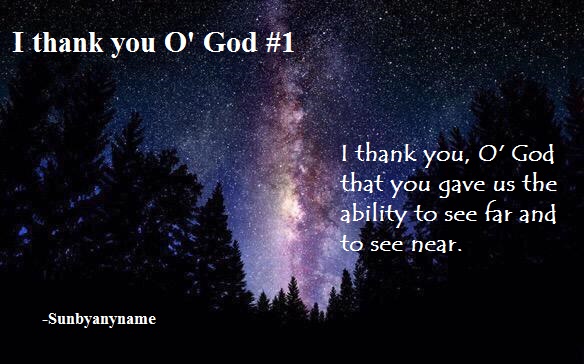
Far and Near

I believe that God has really made this world beautiful. However, all the beauty that God made would have been lost on us if God hadn’t given us the good sense to appreciate this beauty. So here is a quote about it:

I thank you O God 2

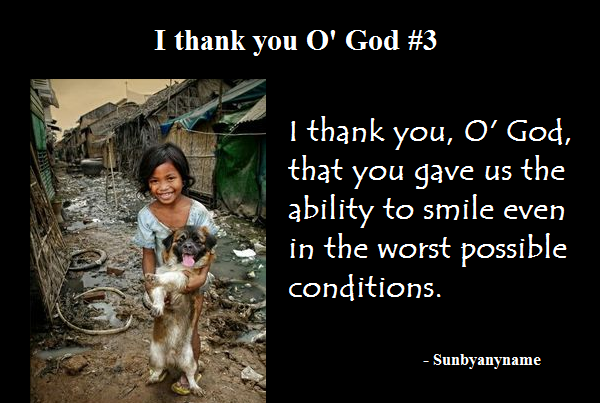
Thank God, we have been given the ability to smile; to make light of our troubles, burdens and situation. If it hadn’t been for this ability, we would have led and lead such hopeless lives:

I thank you O God 3

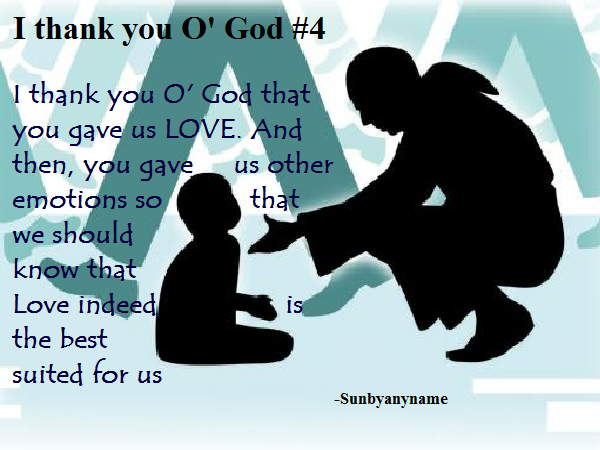
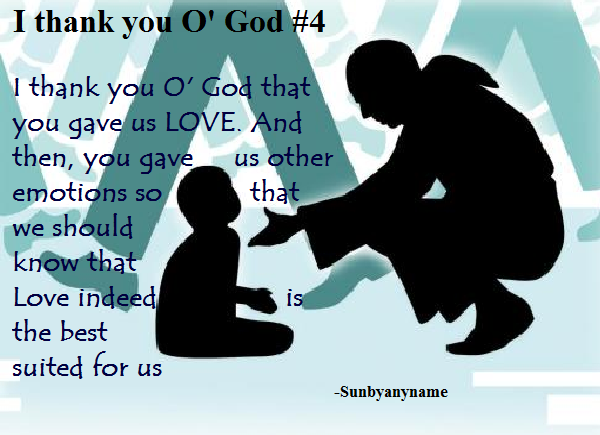
We can never, even if we try our best individually and collectively, to thank God enough for giving us the emotion of Love. God gave us Dark, so that we know the importance of Light. Likewise, God gave us all the other emotions so that we would realise that Love indeed is the best:

I thank you O God 4

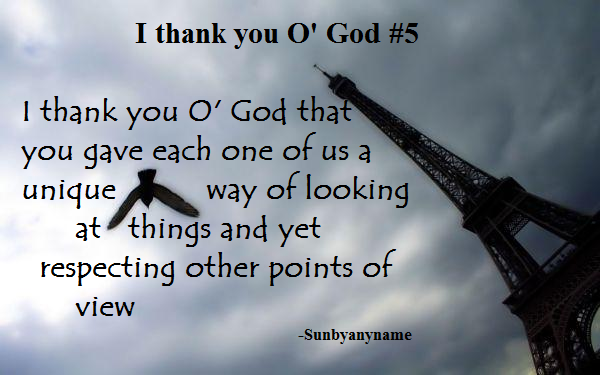
We are often frustrated, especially in arguments, that the other person has a different point of view. But, what if God had given us all the same way of looking at things. It would indeed be such a dull and drab world:

I thank you O God 5

There is no end to God’s Creation. Just at the time when you feel that you have got handle on some part of it, another world opens before your eyes and other senses. It is pointless trying to see the beginning and the end of the universe as if God’s creation is finite. It would be better to adore its infinity and rejoice that there is enough for us for all times to come:

I thank you O God 6

We feel it is intrinsic and innate. However, we refuse to believe that God gave it to us. There is great merit in believing that God gave it to us since, when the chips are down, and darkness engulfs us, we can ask for more. My own experience is that when I have asked for more, God has given it to me:

I thank you O God 7

The holy book of the Sikhs have repeated mention of this Music that is beyond ears. Even if we talk only about the aural experience (within the reach of our five known senses), it is still heavenly. Who else, but God would have thought of giving us this wonderful gift:

I thank you O God 8

There is considerable debate about what is Right and what is Wrong, about Good and Evil. Since all virtues on earth are relative (Please read ‘Absolute Virtue’), it is quite possible that someone’s Wrong is another man’s Right and vice-versa. However, Reverend Emerson once said, “God, don’t let me prove right with arguments that I know to be wrong.” This quote is about that ability and I sincerely feel that God gave to most of us, if not to all of us:

I thank you O God 9

God gave us Life – a four lettered word. He gave us Love – another four lettered word – and most of us love the life that God gave us. For others, God ensured that another four-lettered word was given to them so that even if they won’t love their current life, they would know that the future would be better. God gave us Hope:

I thank you O God 10

We often bemoan the fact that nothing is permanent in this universe. One form is always evolving into another. In some cases it is so slow that we ain’t conscious of it. However, it surely is changing. Whilst we think of it, many a times, as a bad thing, the fact is that it would have been hopeless if we were to encounter a permanent situation and world:

I thank you O God 11

We require worldly knowledge. However, worldly knowledge also confines us and puts limits on our imagination and innovation (I have several posts on this such as ‘How Unbiased Or Innocent Can We Become?’ and ‘Being Non-Sensical May Be Far Sighted’). A child, in this aspect, is better than us. I am fond of giving this example that when a bus tumbles down a hill in an unfortunate accident, often the children and infants are saved. There is, therefore, merit in looking at things afresh as a child; somewhat different from the pejorative expression: ‘Putting one’s foot in one’s mouth’. Have a look:

I thank you God 12

The next one is related to it. We sometime feel that we haven’t been given the requisite skills to live and survive. However, the fact is that God has provided for us to live and survive. Here is from Sri Guru Granth Sahib:

Sail patthar mein jant upaaye,
Taa ka rizk aage kar dharaya,
….Un kavan khilaave, kavan chugaave,
Man mein simran karaya”
(The one who gave birth to creatures in moist rocks,
It provided for their nourishment there too,
…..who makes them feed, who provides for them,
Think about it in your mind)

Here is my quote about it:

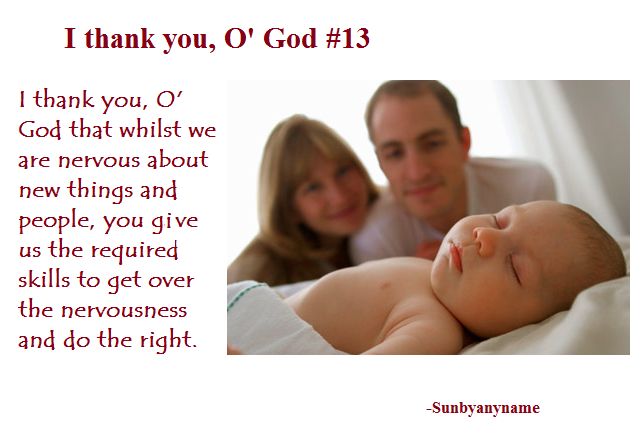
I thank you God 13

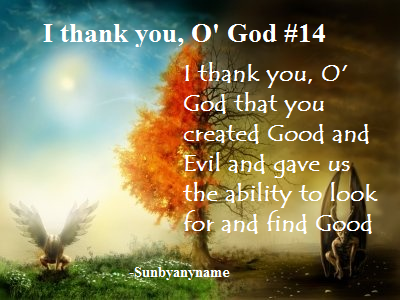
The next one is the simplest of the quotes and should have come much earlier:

I thank you God 14

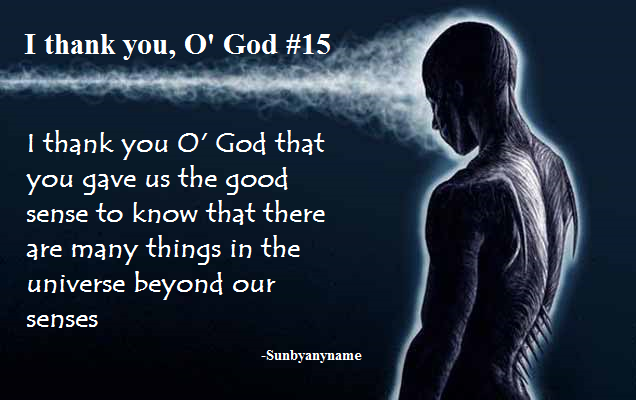
God made no secret of it. God didn’t send us on a wild-goose chase. However, it has made sure that its own abilities (being the Creator) would be far beyond the sum total of all our individual and collective abilities. Here is the quote that was born out of this:

I thank you O God 15

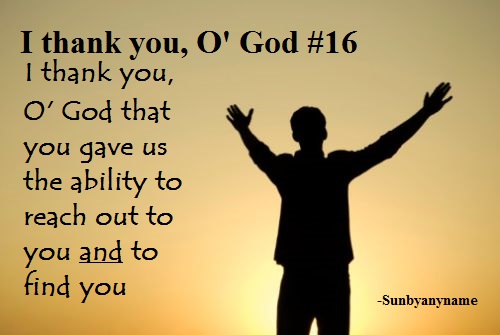
Yes, there is God, if not as a person or a being, but as a Force or Creator. But, of what use these knowledge had been if God had not blessed us with the ability to reach out to it. And since God made everything, it is conceivable that God only gave this ability to us. Hence lets thank God for having given us this ability:

sunset with young man,special toned and color photo f/x, focus point on the man

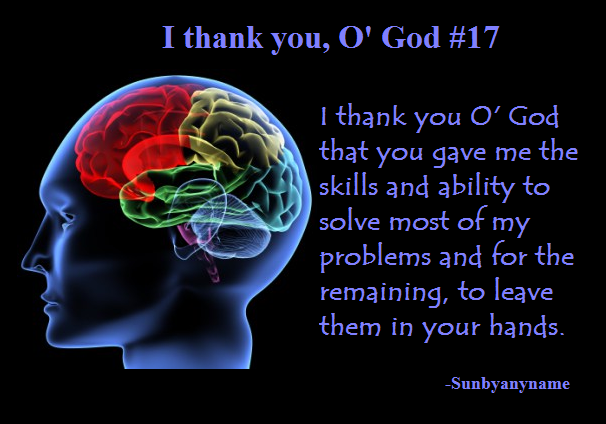
The concept of God as that Force to whom we can pray to solve our problems provides us with tremendous relief. Just imagine that if we hadn’t invented God we would have felt alone and helpless. Here is the quote for that:

I thank you God 17

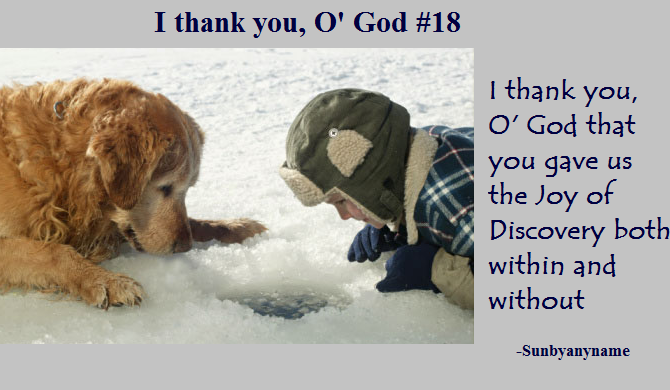
God’s Creation is totally discover-able by us; like they say: Seek and thou shalt find. Here is the quote for thanking God for that:

I thank you God 18

I have discovered – and I am sure each one of you who is reading this would have – that there is newness in God’s Creation everyday, every hour, every moment. It has been medically established that millions of cells in our body are dying everyday and being rejuvenated. Have a look at this, put up by me on the New Year Day of the year 2016:

I thank you God 19

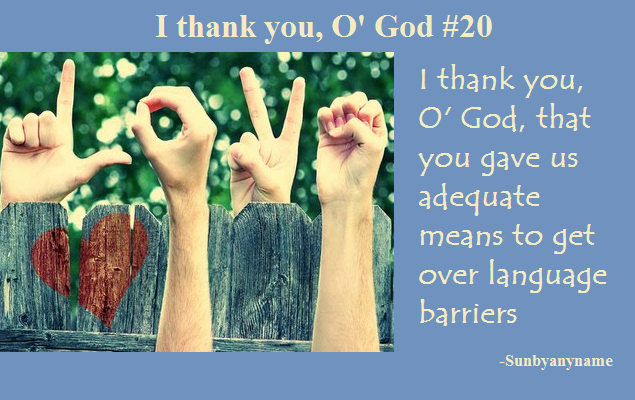
We have thoughts and emotions and ideas and we want to convey to others and listen to theirs. Over centuries, various languages evolved to convey these to others and those who understood these languages had not much difficulty in understanding thoughts, feelings and ideas of others. However, there is a language of humanity that God gave each one of us and it is beyond the languages that we ourselves made. This is a language that is beyond verbal and text means. It is the language beyond all senses too. It is a language between hearts. Here it is:
I thank you God 20

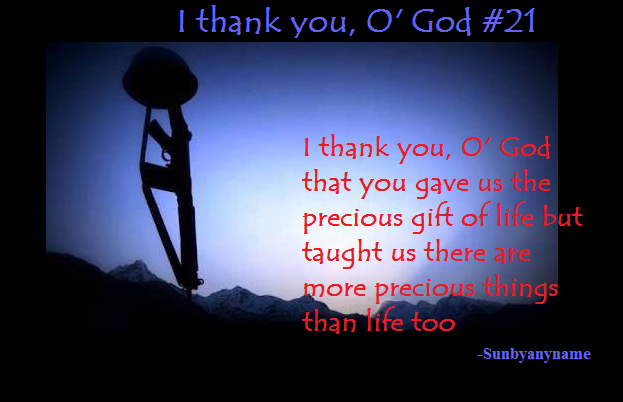
I have maintained that there are more reasons to thank God for than we can think of. We feel that the most precious gift that God has given us is Life. However, each one of us in our lifetime discover that there are many things that God made, for which it is worth giving up life. Taste this:

I thank you God 21

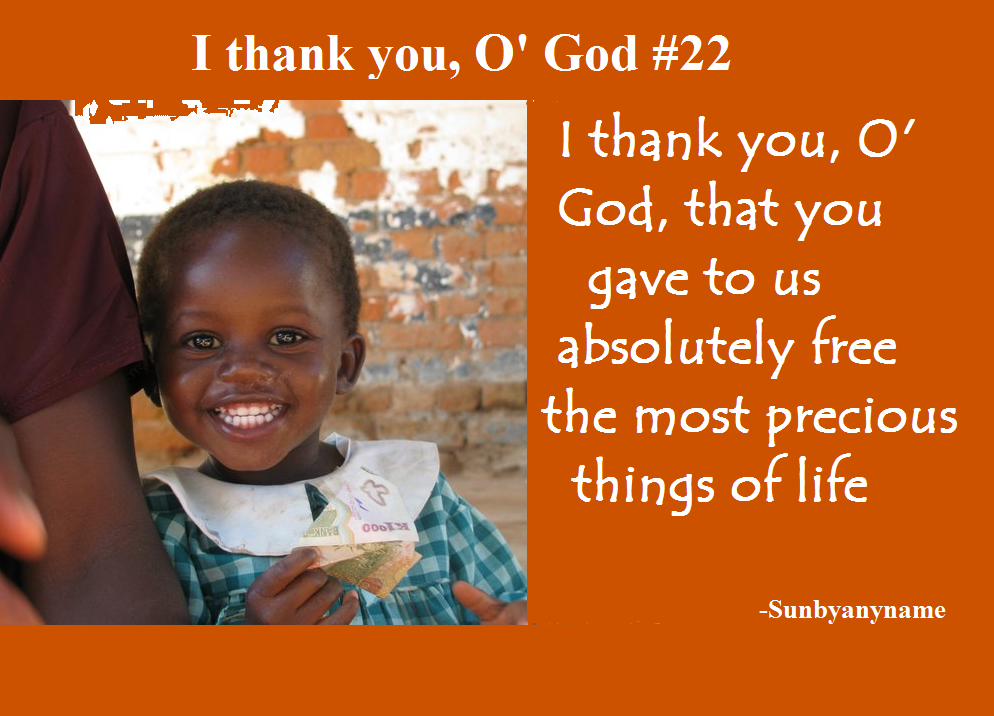
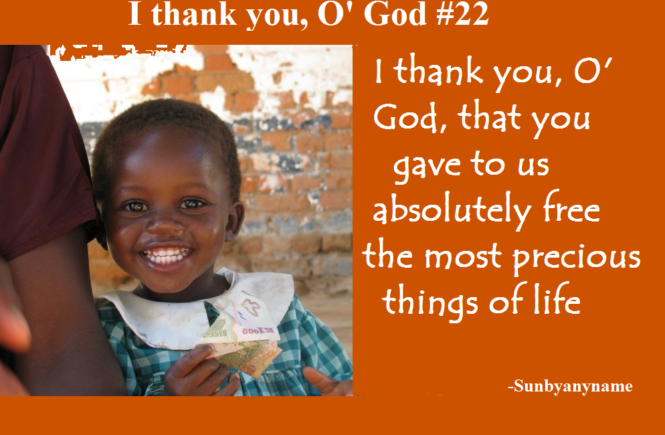
This is something that most of us discover during our lifetime but many of us never think of thanking God for. The fact is that despite our putting a price on many things – the more precious we feel they are, the more is the price – there are quite a few of the most precious things of life that are absolutely free. Have a look at this:

I thank you God 22

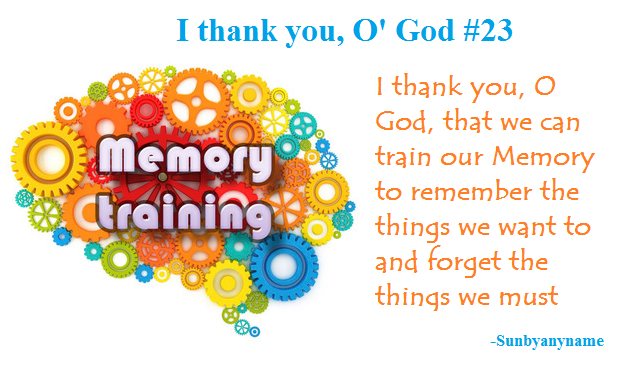
We fall in the habit of cursing our memory and the oft heard crib is: “I don’t seem to remember many a thing”. We reason it out that all that God had to do was to give us elephantine memory so that we would never forget anything. However, think again after seeing the following quote:

I thank you God 23

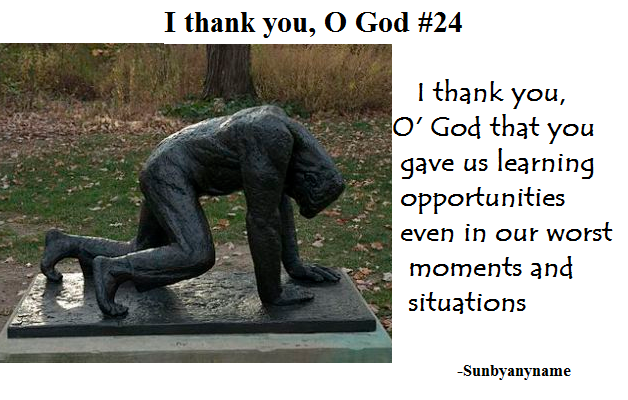
Every once in a while the chips are down for us and we feel that the whole world and even God is lined up against us. I am convinced that God never gives a problem to us without giving us the skills and abilities to solve it. And, it adds to our happiness when we have solved it.

I thank you God 24

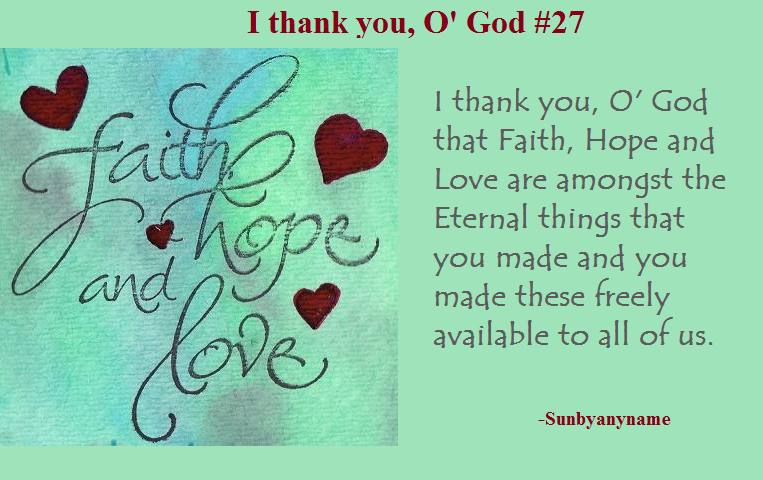
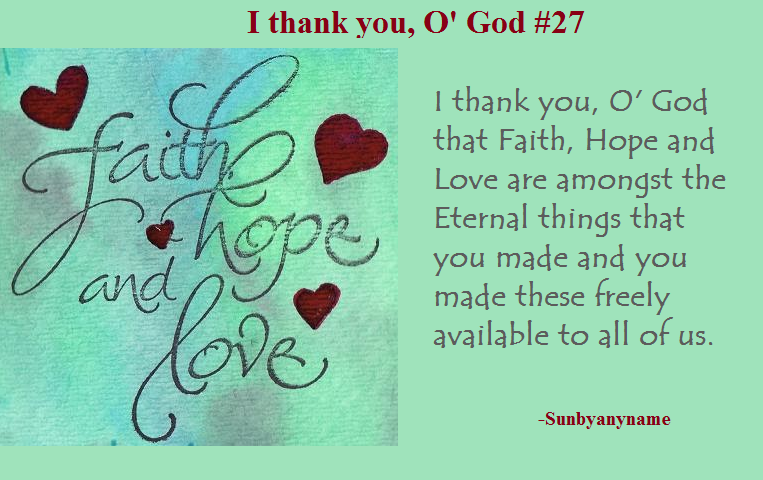
And the last one in this part of the series is about Faith, Hope and Love, the building bricks of the house of our happiness. God is, I am convinced, not like human beings (whatever its shape, size and form be). It isn’t seeking happiness by making us think of it all the while. It is purely in our interest. Hence, if you want to have Faith, Hope and Love without ascribing these to God, there is nothing ungodly about it. That knowledge has also come to you from God that I believe in. I would rather thank it for these since I obtain enormous satisfaction and happiness by thanking it for it:

I thank you God 27

I am sure by now I have convinced you to subscribe to ‘Make Your Own Quotes’. What do you have to pay for the subscription? Nothing; not a cent, pence or paisa. It is totally free. All that you have to do is to like the Page and these Quotes would be delivered to your timeline automatically. You can, on the page, make your own Quotes and share these too with others. Dozens of subscribers have done it already.

FEAR IS THE KEY

I am fond of giving this example in my talks of a frog having fallen into a pit. A rabbit came there and cajoled the frog to come out of the pit by making all out efforts to do so. The frog just sat there at the bottom of the pit helplessly and resignedly. The rabbit motivated him with frequent shouts of “jump”, “yes you can”, “you can’t spend the rest of your life there” and “think of how nice you would feel when you are out of the pit”. But, the frog made no effort to jump and get out since it had already decided that it couldn’t.

Finally, the rabbit asked the frog what help he required to get out. The frog said that perhaps if the rabbit would fetch a ladder, he would climb up the ladder and come out. The rabbit, good Samaritan that he was, went to fetch the ladder and after a few hours managed to get there with his friends carrying the ladder. They noticed that the frog was happily sitting outside the pit. On inquiry the frog replied, “I thought that I could never come out of the pit by jumping. But, after you went to get the ladder, a snake came into the pit and I had no choice but to jump out”.

Fear is the key. It is that all important motivational factor that leaves you with no choice.

I have a senior, a most respected senior, in security industry who feels that deterrence based on fear of being caught and punished is the basic tenet around which security needs to be built. If people get the message that when they do something wrong (petty theft to huge frauds), they would be caught and punished, “97 percent won’t”. The reverse is also true, in that, 97 percent would probably fall into the temptation of doing something wrong if they felt that there were near 100 percent chances of getting away with it.

We used to have a school-time joke of kids attending a Christmas party. Many eatables were laid out on the tables. One of the kids noticed a sign near the cake plate: Take only one slice, God is watching. He went, next, to the chocolate plate and told his friends: “Take as many as you want; God is watching the cake”.

Of course, as societies evolve, respect for law becomes ingrained even when big brother is not watching. In my former service, Indian Navy, when Captain K Pestonji returned from his deputation to West Germany, he told about motorists waiting at the red lights in the middle of the night even when there was no one to see and theirs were the only cars. Similarly, during the 2004 Tsunami, in Japan, a case was reported of a motorist waiting at the red traffic light even when Tsunami was approaching from behind. An Indian, on the other hand would – nine times out of ten – jump the red lights if he knew there wasn’t a cop or a camera guarding those lights.

Two years back, a friend and I visited Vienna, a city ranked amongst the first ten in the world for tourism. Knowing what to expect there, I told my friend that in a day’s time, he should count the number of cops on the roads. By the end of the day, he was not able to spot a single one. And yet, all traffic and people moved with discipline. But, it takes centuries before one can get to that level of self-regulation. I remember having seen pictures of 1971 New York Power Outage and how people, who were not thieves till that time, helped themselves to all kinds of goodies from the malls since all the cameras were switched off due to the outage.

Whenever we talk about Indians rigorously following all traffic rules in Singapore but blithely ignoring them in India, it comes out that the penalties are universally applied in Singapore and cannot be circumvented by paying the cops chai-paani money. In Indian Chalta-Hai manner, the lack of deterrence promotes taking short-cuts and then that becomes the new law.

And it is not that we don’t have it in our culture or religion to use fear as the key. In Hindu religion, the fear of Death and the Punishment that we would get in Hell for our misdeeds often kept us from doing wrong. Indeed, this is the basic tenet, which keeps us on the right and the correct path. Two years back, I had visited this temple in Gujarat and one of the priests was advising a middle-aged man and his wife on the schemes available for charity in the temple. He said that the basic scheme was for Rupees 1100 but added for effect that the scheme worked only for those who hadn’t done any wrong deed. For those who sometimes indulged in wrong, benefit would be gained by donating Rupees 2100. The man was about to take out the sum and offer when the priest added that he should add Rupees 1100 for the welfare and long life of each child. And then, he came up with the clincher: Rupees 5100 would even look after his soul after death. By the time we left the wife was cajoling the man to dish out Rupees 5100 to ensure safety of children and his soul. The priest would have known that fear is, indeed, the key.

Some of the most well circulated posts on Whatsapp are the ones that tell you that good luck would come your way in case you forwarded it to twenty. However, you would rot in the fires of the hell in case you omitted forwarding. And then these give examples of people and what happened to them when inadvertently they didn’t forward the message to twenty. Of course, you don’t believe in this gibberish. But, you reason it out that there is no harm in passing it to your friends. Fear is the key.

Despite our religious practices and what is contained in our scriptures, we Indians are idealistic enough to believe that people and nations would behave nicely with us if we continue to give them homilies about peaceful co-existence and other such virtues. We are fond of giving the example of Porus, the King of Pauravas who fought Alexander the Great in the Battle of the Hydaspes (Jhelum) in 326 BC and was defeated. Having been captured alive, Alexander asked Porus as to how should Alexander treat him (Porus). Porus seemed to have replied, “As one king treats another”. It is said that Alexander was so impressed by his adversary that not only he reinstated him as a satrap of his own kingdom but also granted him dominion over lands to the north extending until the Hyphasis (Beas).

This idealistic and largely non-realistic philosophy – somewhat similar to telling a lion to convert to vegetarianism because of its mutual benefits – has been practised by us as a Grand Strategy. For decades we are trying to convert our neighbour Pakistan to vegetarianism by such promises as good relations, most favoured nation, and peaceful co-existence. And Pakistan terror groups, very routinely, get away with terror killings of our countrymen. We threaten them with – hold your breath – discontinuation of talks. Fear and deterrence are conspicuous by their total absence. Indeed, the only fear that the cross-border terrorists think of is that since killing Indians in terror attacks is such a cake-walk, they (the terrorists) may not get the 72 virgins (houri) in paradise that they would have got if there was some degree of difficulty involved in such jehadi act.

Of course you cannot fight Terror with Terror as was tried out, quite unsuccessfully in Punjab; Gulzar’s 1996 movie Maachis portrayed the ill effects of state-terrorism let loose on innocent people converting them to terrorism. But, fighting Terrorism with Deterrence brought out by Fear of Consequences is another thing altogether.

Fear can be the key if it is supported by Love and not Terror. You cannot, for example, make loyal personnel in a company, by always confronting them with the fear of losing their jobs; some of the companies, for example, revel in their hire-and-fire policies. The employees, of course, pay back such companies in kind. And suddenly, you find, that they are not afraid to lose their jobs but you are afraid to lose them.

Fear is, of course, the key and is a pragmatic security philosophy. However, in the end, I leave you with two thoughts that shall be covered in the follow-up article:

  1. In some regions of Maharashtra, farmers commit suicide unable to pay back crop loans due to failure of monsoons and other factors. What fear of consequences would work against such people; more so, if they were to be wrongly motivated to perform wrong and even terror acts?
  2. What exactly is the difference between Fear and Terror? At what stage the distinction between Deterrence and Terror would appear to blur.

Let me hear your views in the comments below.

On the lighter side, here is an imaginary (I hope) conversation, on the phone,  between a kidnapper and a man whose wife has been kidnapped.

Kidnapper (nastily): We have your wife. We shall not set her free if you don’t give us Five Lakh Rupees.

Man (Matter of fact): And I shall kill you if you set her free!

There is, as you can see, a quick transfer of Fear.


PHILOSOPHIES THAT MAY HELP YOU

At the end of the last year I wrote an article titled: ‘Debatable Philosophies of Life’. I gave you five of them that have become obsolete and don’t make sense anymore.

You may be tempted to ask as to which are the philosophies that would help you. In this article, I have listed some that have helped me.

Philosophy #1 Have a World of Your Own

This follows naturally from the first debatable philosophy: We should be selfless.

It is not possible to be selfless. Hence, make space for yourself where you are by yourself, comfortable, and without having to explain to others the why and how.

Two anecdotes shall make it clearer. One is about our cat Minnie. Out of all the toys that we have for her, she likes an empty cardboard box the first. Every once in a while she goes and sits in her box and imagines that no one can touch her there.

IMG-20160107-WA0053

The second one was related to me by an ex army officer during the recent Pathankot terror attack. He told me about the time when he was in a unit in J&K engaged in anti-terrorist operations. One evening, after they returned from an encounter in which two terrorists were killed, he looked down from his room to the river bank where some children were playing in the sand. He watched them for sometime and noticed they were totally oblivious of terrorists or other distasteful things of life. It won’t have mattered to them where they were: in India or Pakistan; their play was much more important to them. It was a world of their own.

(Pic courtesy: theguardian.com)

Now, I am not suggesting that you become a recluse or isolate yourself from everyone. All I am saying is that you should have a world that you can retreat into when you want.

My world, for example, has music (old Hindi songs) and writing. When I am in this world, for the duration of time that I spend here, the other world ceases to exist even with all its seemingly urgent chores, problems and tribulations.

Try it; it is not escapism. Everyone requires a world of one’s own.

Philosophy #2 Train Yourself Not To Have Regrets

I have proved it in my earlier article about Debatable Philosophies Of Life that the philosophy ‘We shouldn’t live in the past or we should forget the past’ is ludicrous, not pragmatic and is against the progress of civilization through knowledge since all knowledge is essentially past knowledge.

I have also discussed in an article called Absolute Virtue that all virtues in this universe are relative; the only absolute is God. It is the same for evils too. The realisation that neither your virtues and evils nor of any other person or persons on earth are absolute (and can only be better than some and at the same time worse than others) should automatically lead us to the pragmatism of the philosophy that I am suggesting.

Indeed, it is not just a question of more or less; sometimes, it is difficult to make out the difference between good and bad, virtue and evil. As the English say: one man’s meat is another’s poison.

Hence, whilst remembering your past (that you cannot get rid of), you don’t have to have either regrets or false pride; you can be worse off than some and better off than others.

It should also fill you with relatively guiltless existence or life. If you have consciously done what you were convinced was right and good and it actually resulted in a catastrophe for people you know or do not know, you don’t have to constantly or relentlessly curse yourself.

In one of my essays, I have brought out that when Christ on Cross said, “God, forgive them for they know not what they do”, He certainly didn’t mean it spitefully or superciliously. He was conscious that human beings will never have absolute knowledge of the cause and effect of their actions; it would be Godlike if they did.

One can, therefore, keep one’s conscience clear.

In case you haven’t trained yourself, it won’t come to you simply because I suggest. Gradually you will learn to be free of regrets and guilt-feelings. It is a great liberating feeling.

Philosophy #3 Have Least Expectations From People Close To You

You are a good man or woman and you have a world of your own and have not many regrets. However, it gnaws you a lot to know that people are both unreasonable and ungrateful. No matter what you do for them, they do not appear to have any gratefulness at all towards you.

A close friend of mine in the last one year, to his utter shock and horror, found out that the person whose career he had nurtured with his own hands for the last two decades suddenly chose to tell everyone that he had become what he had become due to his own hard-work, professionalism and vision. Now my friend is not the one who is prone to say ‘Et tu Brute’ to all those who ditched him. He is a great leader and a great realist. But, it proved to me that none of us are beyond expectations. The least that we expect is for the recipient of our goodwill to acknowledge and say, “Thank you”.

However, the realisation that being selfish is hardwired into man for his survival over centuries and that to expect a person to see things from your point of view is totally unrealistic should help us to gradually calibrate or moderate our expectations until we bring them to near zero.

Good leaders, for example, do not motivate people by just telling them what they (the leaders and the organisation) would get out of following the leaders’ schemes or plans; but, they do tell them what they (the people) would gain from them.

Your expectations of people become more realistic and viable if you are able to align them with their expectations.

Philosophy #4 Train Yourself To Be Filled With Hope

It is a four-lettered word like Life, Love and Time. Many a times when it sounds most unrealistic (a myth), start believing in it, build stories around it, relentlessly think of it and you will see it works. The fact is that the whole world is a myth too. You are what you believe you are; you see what you believe you see (Please read: ‘The Virtual World’). There is a saying that if you think of a virtue repeatedly; it would soon become yours. Hence, it is possible to be trained to become Hopeful.
Now, you are bound to argue with me that two of the failed philosophies, viz, All men are born equal, and ‘As you sow, so shall you reap’ actually do not leave much room for Hope. People who are meant to get better of you will get better of you, you will argue. Very true; however, Philosophy #2 above: ‘Train Yourself Not To Have Regrets’ should, if followed correctly, should fill you with Hope. We never have complete knowledge of causes and effects concerning us. How can we have this about others? Hope is simply about the wellness of the outcome concerning you. It is not lessened by their doing well too. The more you dream it is all working out well for you, the more it fills you with Hope.
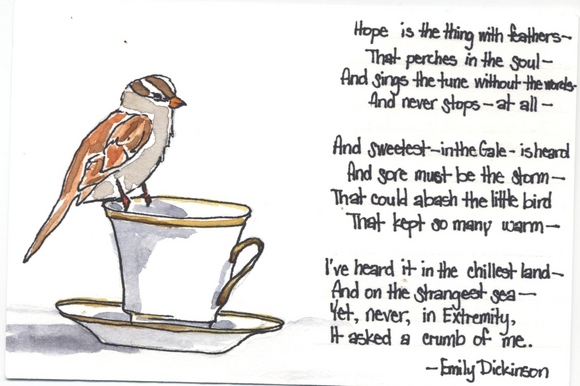
A Bird Called Hope by Emily Dickinson

Philosophy #5 Do Not Chase Friends, Love And Happiness

All these three are a natural fallout of social existence of man. How can Happiness be a fallout of social existence, you may ask. Agree; but, chasing Happiness is. Amongst all the virtues that are relative, the one where we do most comparison is Happiness. Many a times people feel happy and content but are saddened by comparison with those that they think have more.

My close friend whom I have mentioned above in the article is fond of telling about officers feeling happy about being given Excellent grading in their annual performance review. However, such happiness is short-lived when they discover that some others whom they regarded as good-for-nothing have also obtained Excellent grading.

Chasing Happiness is like chasing a rainbow; anytime you feel it is close and you can almost touch it, it appears far away. I have come across many people who would have been happy but the chase after Happiness has left them fatigued and sad. I must have Happiness at all costs even if that makes me miserable they seem to say like the Manna De song in the 1974 movie Aavishkaar: Hansane ki chaah ne itana mujhe rulaaya hai (the longing for laughter made me cry a lot).

Chasing Friends is a hobby that one indulges in similar to collecting stamps and trophies; the more one has, the happier he or she would be. Various philosophies are thrown in such as Life without Friends is meaningless and No one understands you better than your friends.

Yes, indeed, Friends are important in one’s life. However, making Happiness dependent upon having them as friends is not called for. At the back of one’s mind should always be the thought that another person on earth is as unique as you are. No one can really be selfless; it is not in the nature of the man. People would naturally be your friends of their interests and needs coincide with yours. Chasing them won’t get you anywhere. The opposite may actually be the result.

Finally, even though Love is the best emotion on earth, chasing Love is unrealistic. It is a bird that would sit at your window when you don’t go hunting for it.

I read a poignant piece by a middle-aged lady who awaits her children visiting her in the same fashion as she used to visit and spend time with her parents. She bemoaned how the very definition of love between parents and children have changed; the latter don’t appear to have time for the former. Love demands a lot of time thinking about the loved ones and spending with them. This lady should have realised that the nature of people is always selfish; only the degree of selfishness changes with people and time. If this lady had somehow read this article and paid heed to my usable Philosophy #1 about building a world of her own whilst concentrating on building one for the children, it would have never come to this pass. Chasing Love, now, or any time isn’t going to help.

There, I have given you my short list of usable philosophies. When you do a thing over and over again, it becomes a habit. God has intended the world to be like this wherein like the earth rotating on its axis and revolving around the sun, each one of us is required to achieve perfection by repetitions. So, first time in case the practice of these philosophies do not come easily to you, do them again and again and your mind, like a trained dog, would follow your command of Go fetch it.

Best of luck.

FRIENDS, FRIENDS, EVERYWHERE BUT…..

Breathes there a man or woman who hasn’t read Coleridge’s ‘The Rime of the Ancient Mariner’ with its famous line: ‘water, water, everywhere, nor any drop to drink’? I doubt it.

The story of the sailor returning from a long sea voyage can be replicated, with hardly any variations, in the sea of social media and finally in the sea of life.

You may have hundreds and even thousands of ‘friends‘ on Facebook. Some of them may even Like what you put up and once in a while say “nice” “good one” and “hilarious” on your posts. But, it is all so that you will do the same for their posts. Most of them have no idea of what they have liked. Ultimately, on Facebook, as in life, you are by yourself. As Sahir Ludhianvi said in his famous Dev Anand number in Hum Dono (when I started writing this article it was 03 Dec, Dev Anand’s death anniversary):

Kaun rota hai kisi aur ki khaatir ai dil?
Sabako apani hi kisi baat pe rona aaya.
(Who weeps for someone else’s sake?
Everyone weeps remembering something of one’s own)

On Facebook or in life, you are a bore in case you have something to say. Your penchant about saying something fits in well with the definition of a bore: A bore is a person who continues to talk about himself when you want to talk about yourself.

A few years back, when emails just came into vogue, I was one of the early birds who opened an email account. By the time a close friend followed suit, I had a sizable fan following and I used to send each one of them (what I thought) interesting mails. When this close friend joined, I took him in too and started sending these mails to him. One fine day, he sent (forwarded) me a story  about a hotel guest not wanting the housekeeping to keep giving him fresh soaps three times a day. He thus conveyed to me that my mails to him were as much a nuisance as the housekeeping bombarding the hotel guest with new soap bars kept all over the bathroom even when the guest hadn’t used the earlier ones. I took the hint and stopped the supply of mails to him. But, the story doesn’t end there. Very soon, he discovered the joy of sharing mails and felt that his were actually more interesting. So, he started sending mails. I didn’t have the heart of sending him back his soap-story.

Recently, he was a little more direct. He belatedly joined whatsapp and forbade me from repeatedly bombarding him with my posts. He said that his eyes get affected reading posts on the whatsapp. He said he’d rather read them on emails (the expression back to square one was intended for such a scenario).

Sabako apani hi kisi baat pe rona aaya…

These are, of course, lighthearted examples. But, seriously, the very nature of man is such that even for his existence he has to forever be concerned with self-preservation and own survival. Even when a friend doesn’t ask you, when face to face with your story, proposal, request, you can almost hear him ask, “What’s in it for me?”

That brings us to the question, “How many friends do you require in life?” And, the next question is even more harsh: “Do we really require friends in our life?” Here is one of the responses:

fb_img_1447569737365.jpg

Friends are, indeed, like Happiness in one important aspect: you are better off not chasing them.

I have seen people actually displaying friends like trophies; such and such is a really influential person in Modi government or close to Shah Rukh Khan or Deepika Padukone…..we used to play gilli-danda together. I had this VVIP in one of my company’s sites. His name-throwing of friends at important positions in his part of the country used to make me think that the entire political and bureaucratic set-up in the state used to by dependent upon his advice.

Most often than not, people ain’t friendly with you but the position you hold. As soon as you retire or are transferred from the position, the friendship, such as the way it was, becomes more realistic and people realise what a bore (my children’s vocabulary has this word called loser; a very fascinating word) you were all along. The office where I work has this person whom I frequently call as the finest leader that I have come across. All my friends often echoed these thoughts of mine and added quite a few stories of their own regarding his sterling qualities, sagacity, professionalism, human-touch, and result-oriented approach towards everything. A year back the management side-lined him and brought a fire-brand, young and outstanding person in his place. Gradually I was stunned to notice that these friends gushed about the sterling qualities, sagacity, professionalism, human-touch, and result-oriented approach of – hold your breath – the new boss. They would begin every presentation with the oblique suggestion that somehow the wonderful, pragmatic ideas of the new leader were not even thought of by the earlier loser.

The way the world is made, after human life appeared on earth; it is a need that brought people together (You may refer to Abraham Maslow’s ‘Pyramid of Needs‘) . Relationships and friendships are either causes or results of this need. Else, these have no other special basis for existence. Religion and Spiritualism teach us that the sooner we are rid of – or at least less dependent upon – these needs, the better off we are.

Now, I am not suggesting that we go out of our way to offend people or have them as unfriendly. All I am saying is that don’t have friends as obsession or score-cards or trophies. If we can have one or two whose needs (I am using the world in its larger connotation) coincide with ours, these are much better than thousands who like everything that you say without even listening to it or reading it.

In this song penned by lyricist Indeevar for the 1967 movie Upkaar, one gets close to what the scriptures tell you:

Kasame vaade pyaar wafaa sab, baate.n hai.n baato.n kaa kyaa
KoI kisii kaa nahii.n ye jhuuThe, naate hai.n naato.n kaa kyaa
(Vows, promises, love, loyalty, all are mere words; and words mean nothing
No one belongs to anyone, these are false relations; and relations mean nothing)

Hogaa masiihaa saamane tere
Phir bhii na tuu bach paayegaa
Tera apanA khuun hii aakhir
Tujhako aag lagaayegaa
Aasamaan me u.Dane vaale miTTii me.n mil jaayegaa
(The Saviour would be in front of you
And yet you won’t be saved
Your own blood (relation) will ultimately
Light-up your funeral-pyre
O’ ye, who flies high in the sky now, you will be razed to the ground)

Sukh me.n tere saath chale.nge
Dukh me.n sab mukh mo.De.nge
Duniyaa vaale tere banakar
Teraa hii dil to.De.nge
Dete hai.n bhagavaan ko dhokhaa, inasaa.n ko kyaa chho.De.nge?
(They will walk with you in good-times
And turn their face away in bad times
The worldly people who become yours
Will (finally) break your heart
They deceive God too; why would they leave human beings?)

Happy New Year, Friends!

DEBATABLE PHILOSOPHIES OF LIFE

One of the biggest truths about God’s Creation is that He/She/It made all virtues and evils Relative. The only Absolute is God Himself. Thanks to Albert Einstein, the Relativity of Time in the Universe is now somewhat well known to us. For others, please read my Absolute Virtue if you entertain any doubts.

What an essay, at the end of the year, you may remark. The fact of the matter is that end-of-the-year itself is not universal or absolute reality. It exists on Earth simply because of rotation of Earth around its axis and its revolution around the Sun. It doesn’t universally exist. It is a convenient method adopted by us to anchor our lives to a dimension called Time, which too is purely our own creation. You may argue with me that Time does exist; after all, we do get older, trains and aircraft are scheduled by hours and minutes (and sometimes seconds), we get our salaries because of it and if there was no Time, our world would collapse. Fair enough; but do remember that our invention of Time is actually an effort, on our part, to give a beginning and end to things, events and people on Earth only and has relevance only to our minuscule part of the Universe, ie, very micro part of God’s endless Creation as a whole.

One of the fundamental laws of the universe that we have discovered (not invented) is the Law of Conservation of Energy. The law of conservation of energy is a law of science that states that energy cannot be created or destroyed, but only changed from one form into another or transferred from one object to another. This law of science is actually a pointer towards the ludicrousness of considering our self-invented dimension of Time so as to define beginning and end to things and people.

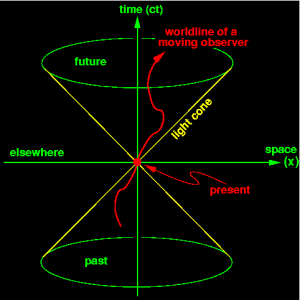
Einstein's Spacetime Cone (All of physical reality is contained within this cone; the region outside ("elsewhere") is inaccessible because one would have to travel faster than light to reach it. (Pic courtesy: einstein.stanford.edu)
Einstein’s Spacetime Cone (All of physical reality is contained within this cone; the region outside (“elsewhere”) is inaccessible because one would have to travel faster than light to reach it. (Pic courtesy: einstein.stanford.edu)

That leaves Events, Ideas, Thoughts, and Emotions. Lets take Events first. All Events actually result in Energy and Mass to be changed from one form to the other and hence it is covered in Law of Conservation of Energy. As far as Ideas, Thoughts and Emotions are concerned, we often claim to be the first person to have come up with a thought or idea; whereas, all these already exist in one form or the other. We only re-discover them. Mercifully, as far as emotions are concerned, we never claim to be the first persons to become angry, happy, fall in love with, hate etc. We have no idea how these evolved and who was the first person to get angry, love-stricken, hated or happy.

From my Facebook Page 'Make Your Own Quotes
From my Facebook Page ‘Make Your Own Quotes

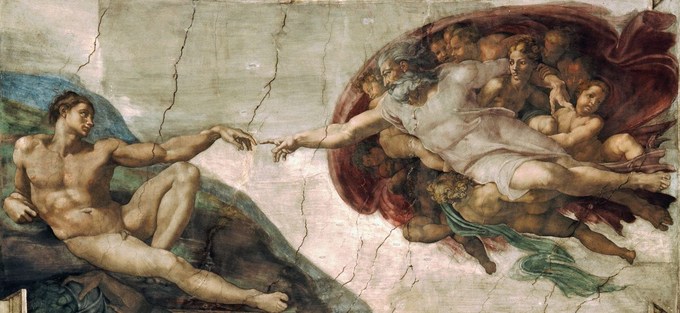
The second last thing to consider before we take up the main discussion is whether there are any universal truths, beliefs or perceptions that have withstood the test of time. There ain’t many; not even the most sacred ones. Consider that Adam and Eve were sent on the earth and they produced a  boy and a girl. For the world to progress, this boy and girl, brother and sister, that is, must have procreated amongst themselves. Likewise, hundreds of beliefs and tenets have changed over centuries. Hence, whilst there are no Absolute Truths in Space, there are none in Time too except one.

The last thing that I want to take up is the distinction between Natural and Artificial that we have made. Natural is defined as existing in or derived from nature; not made or caused by humankind. Artificial is the exact opposite of it; made or produced by human beings rather than occurring naturally, especially as a copy of something natural. On the easier side is the difference between natural flowers with their texture, hues and fragrance and artificial look-alike flowers. On the complex side is the natural way (fire, flood, solar-action, wind-force etc) to convert one form of energy into another and artificial way of doing it say in lighting a bulb. It becomes even more complex when we think of the fact that human beings are part of Nature and there is nothing that they can do that has Free Will (Please read: ‘How Unbiased Or Innocent Can We Become?’). Hence, if Natural is God’s Creation, accepting as something Artificial is like accepting that someone other than God can create. Let alone faith, it is against the science of law of conservation of energy. So much for the distinction between Natural and Artificial. God makes the temperature drop as we move away from the centre of the Earth (increase altitude) and away from the Sun (in earth’s elliptical orbit around the Sun); that is natural. But, we, as human beings made air-conditioning (God had no role to play in it!) and made temperature fall wherever we are even when we are closest to the Sun in the orbit of the Earth. Now, that is Artificial.

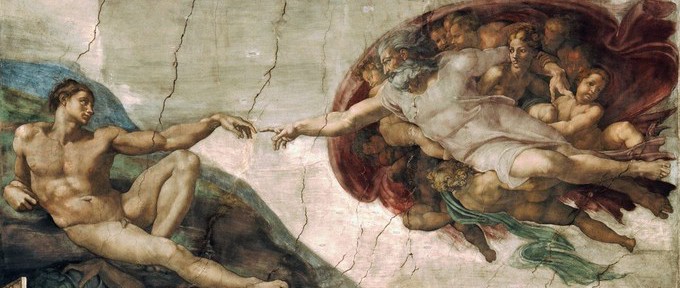
(Michaelangelo's The Procreation)
(Michaelangelo’s The Procreation)

With this background, lets look at some of the debatable philosophies of life; I call all our philosophies as philosophies of convenience to serve specific purposes or objectives. Lets examine if these are anachronisms.

Philosophy #1 We Should Be Selfless

An ideal man, it is said, is the one who is selfless. To start with, if you read ‘How Unbiased Or Innocent We Can Become?’, you would know that to be completely selfless (without ‘haume’ as Guru Granth Sahib calls it) is to find and merge with param atma. Therefore, we can only be partially selfless.

Now, lets examine how being selfless is against the grain of human nature (what a word, you may say, when seen in the light of the discussion on Natural and Artificial.

Every instinct and every reflex action of a human being, over generations and centuries, is honed towards self-preservation and survival. Indeed, Men have come up with Herculean efforts, brave and courageous acts that we have admired in furtherance of their survival instincts.

You take away self from Man and he merges with Param Atma. That means that it is not possible to be absolutely selfless for a man. Would that really be the purpose of Life that God sent us on this earth and we should always be doing everything to merge back with Him? We can only be partially selfless. However, in the bigger definition of selflessness, to do something for the betterment of one’s soul, family, nation and world still has the element of haume’ about it; one does it because it is one’s own. There is still me and mine involved in it. A mother, for example, does everything for her child; it would be somewhat more selfless if she did for other than her own child. It would be somewhat more selfless if she did it without thinking of gains for her own soul.

Philosophy #2 We Should Not Live In The Past or We Should Forget The Past

All our knowledge is in the past. The world is made safer, securer and better place to live in because of past knowledge. And yet, many of those who have the best interests of our society in mind routinely tell us to forget the past.

In our survival instincts, we are hard wired to remember the past and learn from it. We don’t have to, for example, die ourselves to learn the horrors of dying. We have knowledge of people dying and we consciously avoid all those things that can kill us; say, for example, jumping from high-rise buildings.

Think of how dangerous the world would become if all of us we were to forget the past and start discovering everything afresh. Think of how lost we would be if we were to start with a clean slate everyday or every hour. In this case, Ignorance will not be bliss.

There are people and countries such as Taliban in Afghanistan who tried to bury the past. But, these generally have disastrous results.

Another connected advice or philosophy is to live in the present. It is like living in a house made of just one straw. That’s exactly what Present is; a fleeting moment that becomes past like a bubble in a pond. Trying to capture the Present is like holding this bubble in the palm of one’s hand.

Lastly, the Past also enables us to provide an anchor to excel. So, if you are trying to break the world record in high jump, and you have been jumping, say, 6 feet, you are able to make out the gap that you must fill. Other people’s similar feats also enable us to emulate and excel.

Philosophy #3 All Men Are Born Equal

Of all the hogwash that is dished by those who are adept at making feel-good philosophies, this takes the cake.

Millions of years ago when Life started on earth, it is possible that God may have made all men equal. However, over all these years, generational and genetic memory ensured that each became unique and different. It is for this reason that even though the DNA of even twins at birth is the same, it undergoes changes as they grow up and their children do not have the same DNA.

This philosophy of convenience actually fills us with hope that we have the same chances of succeeding as, say, Bill Gates or Narendra Modi.

Every once in a while we have success stories from those who were not born with silver spoons in their mouths but did well through sheer grit and commitment. The fact is that if similar grit and commitment were displayed by the ones born with silver spoons, it would be a totally different story.

Now, I am not suggesting that it should fill each of us with defeatism that we were not born of the same mould as Ambanis or Birlas. All I am saying here is that it is okay to make peace with one’s circumstances dictated by generations of data-memory and move on to do one’s best to achieve the best under the circumstances.

Philosophy #4 As You Sow, So Shall You Reap

There is absolutely no proof of this philosophy except in folklore. It appears to be a plaintive cry for divine justice by the meek and the downtrodden and fills him with hope when he sees that the thugs, ruffians, and cheaters in the world seem to be doing well in comparison to the good guys. The latter imagine the former burning in the fires of the hell and paying for their sins.

In South India there is a respectable chain of restaurants. At the entrance of these restaurants is a picture of the founder with huge sandalwood garland around it. You are filled with great respect for the man whose vision, sagacity and generosity enabled him to set up mass eating joints at affordable prices. Decades later many had forgotten that he had spent time in jail for making counterfeit money and that he was enjoying the fruits of his earlier labour after his jail term.

These days, the rich and the influential don’t even have to go to jail before enjoying the fruits of their deceit and swindles.

In a recent article titled ‘Is Truth Worth Fighting For?’ I had concluded that all that the conscientious and the saintly do get is the hope that, in the end, they would die happily. So the reward for them to have spent their lives in constant toil and misery is the promise of happiness when the body and soul part. Some compensation that.

Most people are nowadays already aware of it and leave the count of those that live wretchedly but are promised happy deaths.

When the evil don’t appear to be getting just punishments, we cover it up by saying that someone somewhere in one of their previous lives has done something good or that they would suffer in their next lives.

The charade goes on.

It is absolutely debatable whether your deeds, good or bad, will repay you in kind.

It is time we found a new philosophy.

Philosophy #5 Religions Started Centuries Back Should Be Preserved Till The End of the World

Lastly, all present major religions in the world are based on the premise that God or Son of God arrived in this world only during a certain period of time in history, started the religion for all times to come and all those who are loyal adherents of these religions are pious and righteous. The rest are as good or bad as pagans. God will one day punish the non-believers.

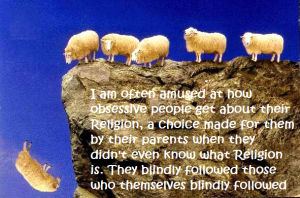
The followers of all major religions also believe in and practice the philosophy that even violence and war, in the name of God and Religion are just and justified. Hence, Religion and God are worth laying down lives for – one’s own and those of one’s enemies.

Lastly, the followers of all major religions in the world believe that since the founders of the religions were God or descendants, these have been writ in stone and nothing in these should ever change.

From my Facebook Page: Make Your Own Quotes

In my ‘Whose God Is It Anyway?’ I had brought out that when, for example, Mohammad told his followers that men should marry many women, he had in mind the war widows of the 7th century AD in Arabia who were young and required shelters, which could be provided to them if men married them. He won’t have made this as a law for all times to come.

There, I have given you at least five philosophies and beliefs that are debatable and suffer from obsolescence. Let me hear your views, if you so desire, in the comments below.

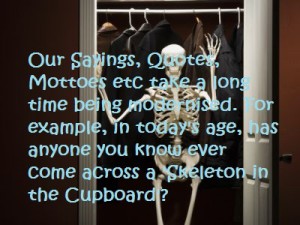
Beliefs, perceptions and philosophies take a long time changing. Why, even expressions do. We still use the expression, for example, skeletons in the cupboard though the last person to see them must have been a hundred years ago.

From my Facebook Page: Make Your Own Quotes

It is high time we change them in keeping with the modern times. Please remember that when religions were founded they changed the existing beliefs and philosophies of those times. It can’t, therefore, be sacrilegious to do so.

Happy new year 2016 to all my readers and friends.


TIME AND RAINBOW

It suddenly appeared across the hill, across the river and the rocks. Before it appeared in its seven visible vibgyor colours, there was a wedding of giddad-giddadi (he and she jackal); as was the folklore to describe rain and sun appearing together.

It appeared so near and yet so far. As a young boy I ran after it, to catch it in my little soiled hands, to bathe in its vivid hues, even to climb up and look down on the world through its prism. At that time it appeared far; it was near when I didn’t want to own it, when I wasn’t very conscious of its existence; it was far when it crept over my consciousness, when I wanted to hold it and possess it.

I have had the same experience with Time.

Before I lost myself in the rapid whirlpool of later-life Time, it flowed like a gentle stream. Indeed, at times it stood still and placid like a pond, like a lake. I didn’t know how much of it I had but it appeared vast, endless, infinite.

I played lukan-chhipi (hide n seek) with my friends and graduated to marbles, gilli-danda, football and cricket. I was small but Time was big. It was everywhere and totally free. I bought kaafal (a type of berry sold near my school, Vijay High School, Mandi), ice on stick, and an anna a booklet of film-songs lyrics. But, I never had to buy Time.

Perhaps because it was freely available, I didn’t place too much of value on it. As a young boy, I read Herman Wouk’s Caine Mutiny and as was normal for me during those days, finished it in a night’s time. How much I still remember; I am surprised. “Wasted hours” it said somewhere in the book, “Are just as painful in the beginning as in the end; only, in the end, it becomes more apparent”.

And now, looking back in time, that halcyon period of my life, when I had all the Time in the world, passed so quickly. I never tried to catch it but it appeared and disappeared like a rainbow; it was here a moment ago: red, orange, yellow and so on and now it is gone; not even the fading colours beyond violet and below red are there now.

Last to last night I saw the Hindi movie Maya that I wanted to see with its beautiful Salil da numbers based on Western classical music beats: Tasveer teri dil mein, jis din se banaayi hai and Jaa re jaa re udd jaa re panchhi. It turned out to be a trash movie and I rued the two and a half hours’ time that I wasted watching it. Two and half hours; in my boyhood days, I used to spend many times that time just day dreaming, writing worthless poetry or catching butterflies.

It is the same sand, passing through the same small opening in the hour-glass; why does it appear to be draining out much faster now? There appears to be lots to do and very little Time to do it. How do I slow it down? Should I catch it now before it gets still faster and makes me akin to a twig being pushed through the flow against my wish? Did I ever have the power to slow it, to stop it; if not to reverse it? Could I have ever caught the rainbow?

Hour Glass

I don’t even think about how it would have been if I had thought, planned and done things differently. I am not even filled with ‘If Only’ regrets. But, it still gnaws me to think about whether I ever had the power to do things independently in my own way or whether I have been in a puppet in the hands of Time, trying to catch rainbows and doing things what have been writ for me including writing this article?

ज़िन्दगी में
ज़िन्दगी की तलाश में
ज़िन्दगी को पाने के लिए
कहाँ कहाँ नहीं गया?
क्या क्या ना किया?
पल पल, छिन छिन,
ज़िन्दगी मोम की तरह
पिघलती रही
ना जाने क्या थी?
ना जाने क्या है?
चंद लम्हे और मिल जाते
लौ कुछ और देर जलती
फिर क्या होता?
वक़्त का सितम
ठहर जाता क्या?
यादों के मरहले
खड़े होके क्या ना बिखरते?
कौस-ओ-क़ज़ाह
हाथ में आ जाता क्या?
ख्वाब की
ख़याल की
सराब की
असलियत समझ आ जाती क्या?
किस को मिली है आज़ादी
वक़्त की ज़ंजीरों से?
कौन समझा  है?

Sand castle

Zindagi mein
Zindagi ki talaash mein
Zindagi ko paane ke liye
Kahaan kahaan nahin gaya?
Kyaa kyaa na kiyaa?
Pal pal, chhin chhin,
Zindagi mome ki tarah
Pighalti rahi.
Naa jaane kyaa thi?
Naa jaane kyaa hai?
Chand lamhe aur mil jaate
Lau kuchh aur der jalati
Phir kyaa hota?
Waqt ka sitam
Thehar jaata kyaa?
Yaadon ke marhale
Khade hoke kyaa na bikharte?
Qous-o-qazah
Haath mein aa jaata kyaa?
Khwaab ki
Khayaal ki
Saraab ki
Asleeyat samajh aa jaati kyaa?
Kis ko mili hai azaadi
Waqt ki zanjeeron se?
Kaun samajha hai?

RHYTHM HOUSE, KALA GHODA, MUMBAI TO SHUT DOWN!

I can’t believe it. It has been such a landmark for us in South Bombay, within walking distance of the Naval Dockyard. I have spent hours going through and buying music at Rhythm House.

We are a family of music lovers. We have neither been rich nor poor. In our middle-class hand to mouth existence, music has been food for us – food for soul that is.

I can relate dozens of anecdotes about this music shop but the one that best describes our junoon concerns my younger brother Dr JP Singh.

I was a Lieutenant posted on INS Talwar as Signal Communication Officer (SCO), on my first posting after undergoing the Long C course at Signal School, Cochin.

JP, my younger brother, was studying in St Xavier’s College, graduating in Economics.

Salaries, at that time, used to be dispersed in cash. I used to get about 1400 rupees in hand, which was enough for me to pay for mess, wines, movies and other sundry expenses to keep body and soul together. JP used to receive money orders from our dad to pay for his studies, hostel etc.

One day, in the beginning of the month, on a make and mend day (Wednesdays and Saturdays are called make and mend days in the navy, from the days of the sail when sailors used to make and mend their sails in the afternoons on these days. Nowadays, these are just half days), I had retired in the afternoon to my cabin after the three Bs: that is, Bridge, Beer and Biriyani.

Sleep had just settled over me like fog over the hills when there was a knock at the door. I opened the door and there stood JP. He had bluffed his way at Lion Gate security and had reached the ship entirely unescorted; an impossibility these days of heightened security.

He was visibly shaken. He said his Money Order from home hadn’t arrived and since he hadn’t paid the hostel mess bill, they were at the verge of throwing him out. I was aghast at their cruelty about throwing out my younger just because his payment was delayed by a few days. But, it came out that JP, due to “some urgency”, hadn’t paid the bill for the last two months.

I reasoned it out with him that although I had just got my salary, I too hadn’t yet paid my mess and wine bills and that’s all the money I had.

He countered that by saying since I was on “permanent (he stressed on this word) commission” in the navy, they were unlikely to throw me out whereas he would be out on the street.

I relented and after keeping just a hundred rupees with me, gave him the remaining money. I went to sleep after seeing him off.

I had merely dosed off, when after about 30 minutes or so, there was another knock and there stood JP again, holding dozens of Long Playing (LP) records in both hands and arms. He wanted keys to our wardroom turn-table so that he could play them. This was his story:

Bhaiyya, after getting money from you, I didn’t take a cab or bus back to the hostel. I said to myself that it is my bhaiyya’s hard-earned money and I have no right to waste it on cabs and buses. So, I started walking back to the hostel. On the way, at Rhythm House, what did I see? There was a sale of records. I peeped in just to have a look and found that all my favourite records were being sold at half the price. I said to myself I would indeed save huge amount of money if I were to buy the complete lot. So, that’s exactly what I did.”

Rhythm HouseIn the next few days we listened to all the records over and over again and got our money’s worth of fun. With the hundred rupees that I had kept with me, I went to the Central Telegraph Office, booked a call to dad and got him five hours after booking the call. I managed to convey to him to expedite sending money to JP. Until then, we lived on love and fresh air and music.

And now, they are thinking of closing down Rhythm House. Why couldn’t the idea occur to them when JP was walking back from my ship to his hostel in St Xavier’s on that make and mend day in 1981?

P.S. To be fair to JP, I might as well admit that if our positions were reversed, the chances of my doing anything different were remote. All’s well that ends well. After a week or ten days, dad’s money order arrived (the only order from my dad that I really liked) and the rhythm of our life was restored.

“WE ARE ABOUT TO GET FULL OROP”

This is in good humour and should be read in that spirit only:

The year is 2023. In a solemn ceremony, veterans (those who are stll alive, that is) have gathered fondly at the venue of their fiercest and bitterest campaign field; not Kargil, not Poonchh or Khemkaran, not even at Siachen, but, at Jantar Mantar. They are celebrating the golden jubilee of their campaign to restore OROP that was taken away from them in 1973.

I am just about to touch seventy but there is still enthusiasm in covering mammoth events and rallies.

I overhear an old veteran telling another with immense satisfaction, “We were lucky that although we won the Kargil War in 1999, lost and wounded nearly 2000 soldiers and it was indeed a great victory, the government of India still didn’t punish us as they did after 1971 War.”

To this, one really old veteran, barely able to stand even with his walking stick, responds, “Indira Gandhi was different. Her way of rewarding the victors in war was to reduce their pensions. But, thankfully she didn’t follow in the footsteps of emperor Shahjehan who cut off the hands of the chief architect who made the Taj Mahal”.

Now, it is the turn of the first veteran to interject: “Yeah, she was a kind lady. No wonder the Congress refers to her as Priyadarshini (delightful to look at).”

They would have continued on and on like…like…well, like talking old soldiers but then Major General Satbir Singh, SM, OM, Retd., arrived at the venue. If you are wondering what OM is, it is an OROP Medal that the government introduced in the year 2016, just to keep the agitators in good humour. This medal, the government was proud of proclaiming, had been made after melting all the other medals that the veterans returned in end 2015, showing their displeasure at the government’s apathy towards veterans.

Soon after that babus, police and para-military personnel demanded OM to be given to them too. The government had tough time reasoning with them that they couldn’t have their cake and eat it too; or in other words, have OROP as well as OM. As always, babus, police and para military personnel were not convinced and demanded that the government should give them too adequate medals so that they too have something to return when they don’t get what they want.

General Satbir is old but his face still has that glow and his eyes still have the glint that only those have who believe in honest and straightforwardness and for the cause of their men more than for themselves.

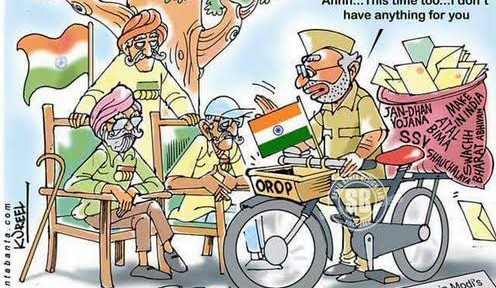
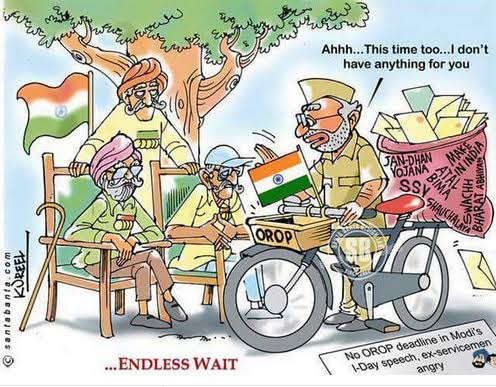
The shouts of, “Sadda haq, itthe rakh” ( Our right, give it now) fill the air. It has been a great war-cry. JP Dutta, the veteran film-maker, in the year 2019 made a movie with this title. The movie had remake of a popular fauji song: ‘Sandeshe aate hain, hamen tadpaate hain’ to tell the plight of the veterans receiving messages from the Prime Minister Narendra Modi that finally the full OROP was just around the corner but the veterans still not seeing light across the tunnel.

image
Sandeshe aate hain, hamen tadpaate hain (Cartoon courtesy: sainikdarpan.blogspot.com)

It is 14th Aug 2023 and they find an extremely frail, 91 years old, Grenadier Vishambar Singh, stumbling across to the venue with a naked torso. General Satbir noticing him shirtless asks, “Vishambar ji aap shirt ghar bhool aaye, kyaa?” (Vishambar ji, you forgot your shirt at home, or what?)

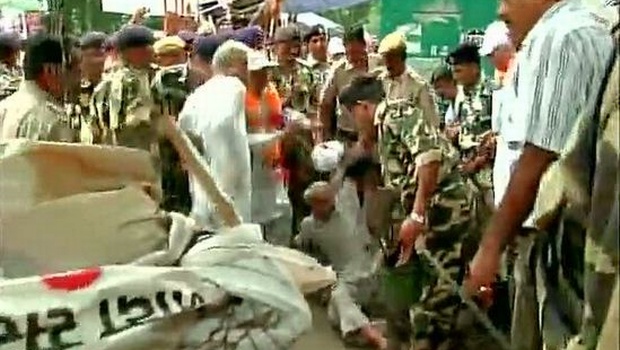
Vishambhar replies, “Nahin saab ji; kal azaadi diwas hai. Aath saal pehle, aaj ke din, pulsiyon ne mil ke meri shirt faad di thi. Ab saab ji itane paise to nahin hai jo har saal nayi shirt banwaayun. Isliye ghar chhod ke aaya hoon.” (No, Sahib ji; tomorrow is the Independence Day. Eight years ago, the police tore my shirt (here). Now, Sahib ji, I don’t have enough money to buy a new shirt every year. That’s why I left it at home.)

Colonel Kaul whispers from behind General Satbir Singh, “Theek hai. But, we should be ashamed. Men are losing their shirts and sleep over OROP but the blasted OROP is nowhere in sight.”

General Satbir, “I have been told it is just around the corner now. They have nearly sorted out the VRS issue by coming up with a formula that decides your share of OROP depending upon your medical category, age, retirement age, rank and number of years left for superannuation. Of course, it would still be denied to you if you don’t follow the family planning norms. That’s the latest clause introduced by the babus“.

In the background, a reporter is heard talking to a Times of India reporter, “Massive rally by the veterans. I hope this time, at least; you are going to cover it”. The ToI reporter replies, “We have normally been giving it space next to the Obituary column as both are serious and dead issues. Let me see, if someone dies we shall give adequate cover to his body and to this grave issue”.

Just then a plush limousine slides to a halt in front of Jantar Mantar. A happy veteran alights in his worsted suit, gold tie-pin etc. All the other veterans are agog with envy and ask, “So, you actually got arrears of OROP, did you?”

“Nothing of that sort” the wealthy veteran replies, “I took General Satbir’s call for Black Diwali seriously. I invested, in the last eight years, money saved from lamps and crackers, in Narendra Modi’s Achhe Din Aa Rahen Hain Fund (Happy Days Are Coming Fund). The bourses gave me hundred to one on my betting correctly on the outcome of the promise and the fund. I also bought 100 shares of Mann Ki Baat Radio Services at 10 rupees a share. Each one is a lakh rupees a piece now.”

Ninety-one year old Vishambar starts crying uncontrollably. He lost his shirt for nothing.

NOISE IS THE NEWEST FORM OF DEVOTION

Life in the armed forces, as anyone would tell you, is tough. Armed forces are not a vocation but a way of life; and hence, one is on duty 24/7 throughout the year. You hardly have any family life. With the perpetual shortage of officers in the armed forces, you actually end up doing the work of your absent friends, in addition to your own. Hence, when you retire after nearly 37 years, as I did, all that you are looking for is some well deserved peace and quiet. You know that with your armed forces’ savings you cannot have too much of a comfort and would get just about 900 feet of accommodation poorly constructed house in an Air Force Naval Housing Board colony; poorly constructed being more a norm than an exception in AFNHB (Air Force Naval Housing Board) houses.

After retirement, I shifted to this flat I had bought through AFNHB  in installments. I soon found out that because of poor construction, most flats leaked and most flats had renovation going on even after eleven years of construction, causing perpetual noise of tile cutting and other machines especially on the weekends. Each one of us had to shell out more than one tenth of the original cost of the flats (available at the same rate as any accommodation in civil areas; thereby doing away with any advantage whatsoever for having found a flat through the armed forces) to leak proof the houses collectively. In addition, each one has spent more than twice the sum in leak-proofing bathrooms and other rooms. And this is for a housing colony in Indian Navy’s station whereat it has its premiere command.

To add to these woes is the fact that some denizens of our society love noise. Indeed, they have promoted, together with many people in modern India, noise as a form of devotion. They get very vociferous and violent if told to curb noise. Their reasoning is that the government, whilst respecting the sentiments of people (Please read: ‘Who Are The “People” Whose “Sentiments Need To Be Respected”?’) have permitted noise up to certain hours and hence they intend to make full use of those hours. Pleas to them that government orders only condone the noise but do not make it compulsory for people to have noise falls on – you guessed it – deaf ears (Please read: State Sponsored Noise). Reminders about the fact that throughout our fauji lives we never made religious noise in the open have no effect on them. When people all around you are making religious noise, you feel left out.

So, now, if there is one thing that the denizens of our colony guard fiercely, it is their right to make noise so that they won’t be seen as less religious in comparison to our neighbouring colonies who make unfettered noise during festivals. Indeed, it appears that if there is one thing that they ruefully missed whilst being in active service in the armed forces, it is noise. So, now that they have come out of the imposed discipline, they want to do with vengeance what they missed all these years.

20151017_09043020151017_09044920151017_090424Recently, when it was proposed that since ours is a colony that already has an indoor community hall for such purposes and that they don’t have to make noise in the open, they took their petition straight to God. It went like this:

God: You don’t have to rely on loudspeaker to make me hear your prayers. I can hear all my devotees even when they silently pray to me.

Noisy Devotee: We know it, God. But, we want people to hear our prayers DTH.

God: What is DTH, for heavens’ sake?

ND (looking shocked and surprised): You don’t have cable TV in heaven? DTH is Direct To Home. When we pray in the open with loudspeaker, people really don’t have to come to pooja pandal since they can hear it DTH. Also, God, what’s the point in praying to you unless maximum people come to know that we are praying to you. This cannot happen in indoor community hall. There only the devotees who are present can hear the prayers.

God: You appear to be confused; are you praying to me or to them?

ND: Don’t abandon us, God; already there are people who behave like as if they are God. Today they would ban noise; tomorrow they may have objection to our breathing too. Ham dharam ka satyanaash nahin hone denge.

God: I am not convinced. I think you are imposing your own style of worship on others who have a choice to worship me in their own quiet way.

ND: We beg you, God; don’t do that. There is hardly any religion left in this world. People hate you. We are the only ones who still have devotion for you; the noisier we are, the more godly we become and the closer we get to you.

God: Sorry. I made each one of my people in my likeness. I cannot make any special concessions for you because of your propensity to make loudspeaker noise.

ND (On his knees now): Please God, don’t take away from us our right to make noise. If you wish, take away anything else that you have given us or intend giving us. But, we are emotionally attached to having us heard on the loudspeakers.

God: You have too many issues; OROP for example…

ND (Eagerly): We can do without it, God. In any case, the politicians and bureaucrats took it away from us 42 years back. Noise is all that is left with us; something that we can call our own. What’s the point in living in a free country if you cannot make noise 15 days in a year?

God: You have water shortage in your colony; what about that?

ND: We are used to being without water. On our ships, water used to be available only once or twice a day for short durations. But, we cannot do without our right to make noise.

Listening to this conversation, I wonder what used to happen to devotion of people when loudspeakers were not invented. I also repeatedly ask myself in the nearly three  months of noise immediately after the rains ‘A Quiter Mumbai – Is It A Pipe Dream?’ It is not just 15 days of relentless noise, as ND told God; it is actually a full season of noise.

Deepawali, for example, used to be a festival of lights (Deep + Awali = Row of Lights) to commemorate our Lord Ram returning to Ayodhaya after 14 years of exile. In our colony, for the last six years that I have been here, it is no Deepawali but ‘Patakhawali and Bombawali That Has Nothing In Common With Depawali’. With incessant explosive detonations during the Diwali week or ten days (it is not a day’s festival in our colony), we often feel that we are ‘In The War Zone’.

IMG00730-20101106-0921 IMG00718-20101106-0905So, now that, about one fourth of the year is taken up by noise, the question is why don’t we raise our voice against this flagrant noise? You cannot raise voice against noise because that adds to the noise. We can only educate people about the ill effects of noise. Fortunately, in our colony, there are also many right minded people who are convinced that we need to carry these people too with us. Already, it has become a worrisome problem and people are engaged in finding solutions.

A number of solutions have been suggested:

  1. When you admonish children not to watch too much of television, the incorrect method is to just rhetorically keep telling them not to do so; the more you tell them, the more they want to watch. The best method is to create an alternative to television that adds to their learning as well as is equally entertaining. Similarly, some of the members have suggested that we engage the community in something constructive in the name of religion rather than in destructive crackers and noise.
  2. We have so much of poverty in our country and we have underprivileged children. We, as a colony, can sponsor anti-poverty programmes and programmes for the education of the underprivileged. We can collect funds to do so rather than wasting these on crackers and loudspeakers.
  3. We can educate the people that chanting hymns and mantras over loudspeakers is not the only method of devotion and worship. We can have indoor discourses about our religion, history and heritage and even plays and drama. After all, we are all religious in our own ways and not pagans.
  4. I am sure making noise in the name of religion or otherwise is a problem not only in our colony but also in thousands of colonies. Already, the High Courts are ruling that people can get together to have pooja pandals at a central place rather (to be shared by many colonies) than at hundreds and thousands of these places making cacophony that doesn’t help anyone. Noise by itself is bad. However, competitive noise that we have got used to now is really harming the society. Perhaps we should listen to the courts and not the politicians who have vested interests in promoting parochialism and religious noise.

When people get used to a way of doing things (Read: Whose God Is It Anyway?), it is generally very difficult to wean them away from their habits. As Abba Eban said: “History teaches us that men and nations behave wisely once they have exhausted all other alternatives”. For every argument that we present to them now, the noise-makers have a counter argument. They would probably listen after they have exhausted all such arguments.

I am, on the other hand, a great believer in the intrinsic goodness of people. I sincerely believe that we have all been made by God in His own likeness and that goodness finally prevails. I can only do my bit to nudge them in the right direction.

If you have any suggestions or even differences of opinion, please do write in the comments below.

KAALI DIWALI KA GEET

Most defence colonies in India, this Diwali, present a desolate look as a mark of protest against the machinations of netas and babus who denied the veterans full OROP despite its approval by two parliaments. The idea of the babus, as we understand, is to discredit and dishonour the faujis in the eyes of the general public. What do they think of themselves? In a country, wherein we are often told that we have the worst bureaucracy in the world, how can these faujis continue being proud of being amongst the best armed forces in the world? It is incumbent on us babus to bring them down to our level. Now how do we do it? Simple, the moment they are long enough on the streets protesting, the public loses respect for them since they are now deemed to be of the same mould as us. If they are assaulted in the Jantar Mantar, their medals snatched, their shirts torn, it shows them in poor light to have been there in Jantar Mantar with ordinary protesters in the country.

This Diwali, the babus are enjoying the fruits of their labour and rejoicing. They feel that the general public is losing respect for the faujis in the same manner as sooner or later people lose respect for rape victims working on the analogy (since then made famous by a Goa MLA) that they deserved to be raped!

(Pic courtesy: www.newindianexpress.com)

Dear Babus, this Diwali, our homes are dark. We are saddened by your continued intransigence towards OROP and veterans. This song comes to you from us on the day of Deepawali, in remembrance of our Lord Ram having returned after fourteen years of exile. I have tinkered with the original song put together by Anand Bakshi as lyricist, Rahul Dev Burman as composer and Kishore Kumar as singer to send this earnest request across to you:

देखो ऐ बाबू, तुम ये काम ना करो
फौजी का नाम बदनाम ना करो, बदनाम ना करो

फौजी ने हँस कर सब सुख त्यागे, तुम सब दुख से डर कर भागे
जवान ने कर्म की रीत सिखाई – २
तुमने फ़र्ज़ से आँख चुराई, ओ राम दुहाई
जय जवान जय किसान (chorus)
उसकी OROP को अपनी NFU का गुलाम न करो
फौजी का नाम बदनाम ना करो, बदनाम ना करो
देखो ऐ बाबू …

OROP को समझो, फौजी को जानो, नींद से जागो ओ मस्तानो
एक दिन झेलना सीने पे गोली
खून की खेलना इक दिन होली
जय जवान जय किसान (chorus)
OROP की मौत का इंतजाम न करो
फौजी का नाम बदनाम ना करो, बदनाम ना करो

देखो ऐ बाबू, तुम ये काम ना करो
फौजी का नाम बदनाम ना करो, बदनाम ना करो

(Pic courtesy: www.spora.in)

Dekho ai baabu, tum ye kaam nA karo
Fauji ka naam badnaam na karo, badnaam nA karo

Fauji ne ha.Ns kar sab sukh tyAge, tum sab dukh se Dar kar bhaage
Jawan ne karm kI riit sikhAI
Tumane farz se aa.Nkh churaa_ii, o raam duhaa_ii
Jai Jawan, Jai Kisaan (chorus)
Usaki OROP ko apni NFU ka gulaam na karo
Fauji kA naam badanAm nA karo, badanAm nA karo
Dekho ai baabu …

OROP ko samajho, fauji ko jaano, nI.nd se jaago o mastaano
Ek din jhelna seene pe goli
Khoon ki khelna ik din Holi
Jai Jawan, Jai Kisaan (chorus)
OROP ki maut ka intejaam na karo
Fauji kA naam badanAm nA karo, badanAm nA karo

Dekho ai baabu, tum ye kaam nA karo
Fauji kA naam badanAm nA karo, badanAm nA karo

WHAT’S THE CONTACT DOING?

How often we have heard our CO ask us this at sea; and now, in the twilight years of our lives, we all know the answer. But, let me explain this to our civilian friends in this group:

When you first sight or detect another vessel at sea, it is like a speck. What interests you most about the vessel (contact) is its bearing as seen on the gyro compass. You have to observe its bearing for the next few minutes in order to see what’s the contact doing. It can be one of the three situations: if the bearing is steady and the contact is closing in range, then one has to worry about action by either or both of the vessels to avert collision. If the bearing is drawing aft (ie, drawing left for a contact on port side, and drawing right for a contact on starboard side), then it is generally a safe situation. If the bearing is drawing forward (ie, right for a port contact and left for a starboard contact), there is risk of the vessel crossing ahead of you at close quarters, especially if it is a large vessel. Hence, when a Captain asks the Officer of the Watch, “What’s the contact doing?” he expects an intelligent reply about what its bearing and range are doing and a quick estimate of its CPA (Closest Point of Approach).

Following conversation took place between CO of one of my ships and a close friend of mine.

OOW: Ship on bearing 120 on far horizon, Sir.
CO: Very good.
CO (after about 3 minutes): What’s the contact doing?
OOW (Looking intently through the eye-piece of the compass): Wait one, Sir, I am observing.
CO (a little taken aback but retaining his cool): Okay, let me know quickly.
CO (after some time): What’s the contact doing?
OOW (Looking even more intently through the eye-piece than earlier): I am observing, Sir, will let you know, Sir.
CO (now visibly not able to keep his cool): How long does it take dammit? Hurry up.

Despite the vastness of the sea, close quarter situations and collisions between ships occur causing mammoth losses. Early estimation of CPA and avoiding action (s) help avert such situations. VLCCs (Very Large Crude Carriers) are between a quarter to half a km in length and carry about 300,000 tons of oil. Similarly large cruise liners can be as long as VLCCs and carry up to 8000 persons on board.

By this time the ship was fully visible: a large passenger liner and it appeared to be drawing closer though not on a steady bearing.

OOW (Applying more strain on his eyes through the eye-piece and even looking through his binoculars hanging around his neck by a lanyard): Just a minute Sir, I am nearly there now.

OOW, my good friend, hadn’t observed that by this time the CO had picked up a parallel ruler as a weapon.

CO (Impatiently now): What’s the contact doing, for heavens’ sake?

OOW (Getting a good look at the contact through the compass eye-piece and the binoculars): Appears to be doing fine, Sir; they seem to have a party on board.

The thud of the parallel ruler on the OOW’s arm was sharp and decisive. It was indeed a close quarter situation with the liner and various orders were given by the Captain to avoid that.

Later in the night, in the JOM (Junior Officers’ Mess), when we were about to sleep in our bunks, I heard the timid voice of my friend asking me, “Don’t you think they should give us more powerful binoculars if they want us to know ‘what’s the contact doing’ at a considerable range?”

I agreed with him whole-heartedly that navy wasn’t turning out to be as wonderful a service as we had reckoned during our school and college days.

ANNUAL INSPECTIONS WITHOUT TEARS

When I was in school, we used to have any number of these small books available helping us to pass our exams without – what they promised – tears or too much of effort. These were named, just like For Dummies series, English Without Tears, Maths Without Tears and so on.

I present you here, based on my extensive observations, Annual Inspection Without Tears.

Annual Inspection of a ship is to the ship’s company (crew) what ACR is to an individual (Please also read ACR Season). It is normally divided into three parts: Harbour Inspection in which over days the Fleet Staff Officers check their respective departments for maintenance of equipment, books, drills etc; Divisions and Rounds in which the Fleet Commander checks the ship’s company for the turnout and compartments for their cleanliness and upkeep; and finally Sea Inspection for the readiness of the ship’s departments for combat.

The preparation starts as early as a month or two before. Generally, the Fleet publishes a calendar of annual inspections of ships. However, bright, upcoming COs, in case they find out that their ships are not scheduled for inspection, call on the Fleet Commander and convince him to inspect their ships. When the Fleet Commander accepts, they return to their ships, call their Heads of Departments and address them in this manner, “I don’t know what’s wrong with the Fleet Commander. I told him that we were inspected by the last Fleet Commander less than 6 months before. However, he insisted on inspecting us next month before I finally hand over command. Anyway, gentlemen, despite my best efforts to wriggle out of it, it has become a fait accompli. Fortunately, I have the best team of HODs in the Fleet and you would hold my hand, I am sure.”

And then start the frantic preparations. The Fleet Commanders generally pass instructions that no fresh paint is to be applied unless necessary. Fortunately, bright and upcoming COs having bright and upcoming XOs (Executive Officers or Second-in-Command) do find that almost the entire ship’s painting is necessary. Their reasoning goes like this that if a ship just before decommissioning can be painted, what is wrong with painting before something as important as Annual Inspection?

What should be the focus of the other preparation? Well, I can think of many significant things.

One of the most significant is to follow Sun Tzu’s advice in Art of War: “If you know the enemy and know yourself, you need not fear the result of a hundred battles. If you know yourself but not the enemy, for every victory gained you will also suffer a defeat. If you know neither the enemy nor yourself, you will succumb in every battle.”

Now, you are likely to tell me that there is no war going on and there is no enemy and hence Sun Tzu is not applicable; it is only an annual inspection. That is where you err and the successful CO doesn’t. He replaces the word War with Annual Inspection and enemy with Fleet Commander and everything falls into place. If you know, and I mean really know your Fleet Commander, you will not fear the result of a hundred battles…er…annual inspections. Do your homework and find out what are the likes and dislikes of the Fleet Commander. Lets say, the Fleet Commander has suddenly taken fancy to fluorescent NBCD (Nuclear Biological Chemical Defence) stickers to be placed along the NBCD citadel in the ship, it should naturally become Priority #1 item. How to get these stickers in case these are not naval stores items? Ha, ha, haven’t you heard of the expression: Beg, Borrow, or Steal? In short, you have to become Bhutto, the PM of Pakistan after India demonstrated capability to explode nuclear devices; he said, “We will starve, we will live on grass; but we must have a nuclear devise ourselves”. And indeed, as history unfolded, they starved, they lived on grass, but they had nuclear bomb. With this kind of tenacity, he would have got ten out of ten in Annual Inspection.

An ad for recruitment in the Indian Navy acknowledges that "Attitude" is the most important attribute.
An ad for recruitment in the Indian Navy acknowledges that “Attitude” is the most important attribute.

You have to make a list of all the Likes and Dislikes of the Fleet Commander and some of the influential members of his staff, eg, FOO or Fleet Operations Officer and ensure that you have answers to those.

The second step is to prepare an Annual Inspection Report. You should know that no one ever reads this voluminous report. Hence, do not waste your time getting all the facts right. It is not going to change anything. On the other hand, everything that the Fleet Commander and his staff ever conveyed to you, however insignificant it sounded, must be addressed in this report in bold or italics or highlighted. The expression that you should use over and over again is: As per Fleet Commander’s directions. For example: “As per Fleet Commander’s directions, the ship now has a full-fledged gym. Last two months’ data shows that officers and sailors alike use the gym regularly. A large percentage has also been visiting on Sundays and holidays. In the last PET (Physical Efficiency Test), conducted on 14 Mar 14, 85 percent of the ship’s company is now in Excellent grading”. You have given the credit to the Fleet Commander, where it is due, and you will live to see this being converted into excellent grading during the Annual Inspection.

Indeed, this report should be comprehensive enough to cover every little thing ever told to the ship by these important dignitaries. Another thing to cover in the report can be explained by me by giving you the example of Sachin Tendulakar as a batsman. He used to play psychological warfare with the bowlers and make them bowl to him the balls that he wanted. Some such thing has to be smartly done in the AI report. You have to carefully steer them in checking you for your strong points and not your week points. For example, lets say, you have recently kitted up all your sailors and spent time and energy in making sure they have all good fitting uniforms, your report must steer them into inspecting you there. If Jai and Veeru can get away with “Jail mein pistaul aa gaya hai” in Sholay, you can smartly channelise their energies into searching for the pistaul on your ship.

In harbour inspection, do not forget to prove the Admiral right; it will pay rich dividends. For example, lets say, the Fleet Commander is very fond of pulling up carpets in order to look for dust underneath; he would never pardon you for making him look idiotic by finding no dust underneath. A smart CO, therefore, makes sure that a handful of dust is inadvertently left there so that the Fleet Commander’s prepared ML (Moral Lecture) about stress on cleanship would not be wasted.

What about the Sea Inspection? Surely you cannot pull wool over anyone’s eyes there. Think again. Here, communications are the most important aspect. Irrespective of what action is taken on the drills and exercises given by the Fleet Staff, they come to know about it only through reports. You may remember this from one of John Winton books. When a Fire Drill was going on one of the ships that he had joined, nothing whatsoever was being done as far Fire Drill was concerned. However, all the reports between various positions involved with the Fire Drill were perfect. Hence, if the Captain was monitoring it on the broadcast he would have been reassured of the correctness of all the actions.

Here I cannot fail to give you two examples. One is of a hot-rod Gunnery Officer on one of the ships wherein I was posted as SCO or Signal Communication Officer. If he had ever come on board the ship on a Sunday to have beer and biriyani with his family and found that CO was also visiting with his guests, he would make a series of announcements about armament drills for the benefit of the Captain. The Captain would now get the impression that his Guns was so hard-working that even on a Sunday he was engaged with his men to improve drills.

The second example is that of a hot-rod CO of a ship of a sister ship. In exercises with aircraft, whilst own Gunnery radars were not picking up any of the incoming strikes, his ship would invariably report aircraft detected on certain range and bearing and then follow it up with all kinds of detailed reports. I too called the dockyard teams to fine-tune my own systems so that they too would pick up incoming strikes as promptly. But, it was of no avail. Finally, I had to invite the hot-rod CO for PLD (Pre Lunch Drinks) in order to learn from him the ropes. Beer loosened the tongue and he told me the truth that actually, even their systems hardly ever picked up the strikes. All that they did was to monitor the aircraft communications and as soon as the aircraft were within communication range, they would make all kinds of reports until they received a Bravo Zulu (Well Done) from the Flotilla Commander.

Alright, enough, guys. This is only a glimpse of Annual Inspection Without Tears. If you are interested, and your Annual Inspection is actually due, write to me and I shall give you more practical hints.

Before I close, I must leave you with a thought. Human-touch stories always are admired. So, if during the Admiral’s Walk Around the ship, you can have the lovely photographs of handicapped children that your ship adopted through Welfare Funds and these kids are photographed in their school receiving the prizes, you – not them – are the winner. Also, a few of quotes by important people (remember there is no one as important as the Fleet Commander) can be put in the alleyways. Admirals are adept at giving pearls of wisdom starting with the same letter; eg, Courage, Commitment, Consistency, Calm, and Clarity. His five or seven Cs, Gs, Ms or Ss – whatever letter takes his fancy – should be prominently displayed everywhere, preferably with his picture showing his own commitment.

If you ever go to Spain and want to watch the macho sports of bull-fighting, you would learn, to your surprise that bull-fighting is a carefully enacted play in three parts. In the third part, the bull hardly has any choice but to die. He knows it, the toreros know it, the matador knows it, the pincers know it and everyone in the bull-ring knows it. There are, however, some amongst the spectators who do not know it. They would do well to read Sun Tzu and The Art of War.

Sun Tzu giving the most important lesson about Annual Inspections!

ACR SEASON

ACR or Annual Confidential Report is the most important report on an officer. In the Indian Navy, depending upon one’s rank, an ACR would be due by a fixed date. The period of say a month or so leading up to this date, the actual writing of ACR by one’s IO (Initiating Officer), is called the ACR Season. There is no other season of the year like this. During Diwali season, for example, one is in festive and somewhat extravagant mood. Similarly, during Christmas season, one is in musical and forgiving mood. During ACR season, one is at one’s best behaviour.  It is a period of great hope; but, it is also a period of great trepidation and anxiety. Thank God it is Annual and hence after one goes through it, one can live it up for the next one year. It is the time of the year when – in case you want to become something in the Navy – you have to put your best foot forward. You can’t hide, as you may do, say, during Holi season. You have to get noticed and noticed in a positive way. It has to be tackled at several fronts including professional, social and domestic.

ACR Season

During the year leading up to the ACR, you know that the Captain (in the Navy the CO of a ship is called Captain irrespective of his rank) has been happy with your performance. But, there is many a slip between the cup and the lip. Unless this happiness is translated into adequate PP (Promotion Potential) and PQ (Personal Qualification) marks, it is somewhat similar to ‘Jungle mein more naacha kisane dekha?’ (A peacock dancing in a forest goes unnoticed).

The Captain, therefore, has to be kept in right mood and humour until the day when he has signed the ACR, sealed and sent to the RO (Reviewing Officer). You also know that last impression is the lasting one and hence what you do in the ACR Month or Season substantially and many a times totally overshadows your performance for the rest of the year. Following measures are, therefore, only too prudent to be kept in mind:

The prudent approach during ACR Season!

There should be no attempt whatsoever to even remotely disagree or differ with the Captain professionally or socially. Lets say his favourite batsman is Kambli and you know he is in the team only because of his closeness to Sachin Tendulkar. Else, you feel he plays only for himself and lacks range of shots. But, is this the right time of the year to point out various inadequacies of this overrated batsman? For heavens’ sake NO, in capitals. This is the time to bring out what a lovely straight drive Kambli possesses and his tenacity in occupying crease for several hours – carefully omitting to add – without scoring a single run.

Similarly, why are new, shining white uniforms and peak caps lying in the wardrobe? Now is the time of the year to start wearing them. Earlier you never had time to have a proper haircut; in any case you fancied yourself looking like Amitabh Bachchan. But, for the sake of the old-fashioned Captain (who feels that an officer with a proper haircut is a smart officer),  you better have a smart crew-cut.

Your Good Morning Sir also should have the requisite zing about it. You should be around to laugh the loudest when the Captain cracks those hackneyed jokes of his for the hundredth times. Your body language should exude your wholeheartedly agreeing with the fact about the Captain is the smartest and wittiest man this side of Suez.

Every opportunity should now onwards be taken to side with the Captain in any discussion. So, if he feels that RAS (Replenishment At Sea through jack-stay between two ships) is a wastage of time, you should have done your home-work to bring out how many ships in the last war, were crippled or sunk by enemy planes and other enemy action just because they were engaged in RAS. “Sitting ducks” is the expression to use with him whilst describing ships engaged in RAS.

ACR Month is also the period of the year when you must remember that Navy is not a vocation but a way of life. Hence, there is nothing like not impressing the Captain and his wife (good-lady as our army counterparts call her) during off working hours. So, when you espy them out out for a walk with their dumb looking Labrador, you and your wife should join them as almost going in the same direction.  “Labs make the best pet dogs” should be your opening shot. Your wife should now chip in to say how you yourself were planning to own one as soon as you finish with the ship’s tenure. Indeed, you should add ruminatively if Lucy (Captain’s bitch) would litter, you would be the first one to take one of the pups as no one could be as adorable as Lucy.

Somehow, the Captain also has to know about your other hidden talents. These would tip the scale in your favour considering that sometimes, to decide the selected candidates in the Promotion Board, the board has been known to go down to the second decimal points of PP plus PQ marks of almost similarly qualified officers.

In this your wife’s utterances come in handy: “Vijay is (fictitious name; no need to take offence in case your or your husband’s name is Vijay in the same manner some of you took offence to mention of Pahargunj in my story Raksha. For heavens’ sake, these are just names) very fond of painting. Coincidentally, his favourite subject is dogs. In our home place Dehradun, his paintings sell like hot cakes”.

And you add with a twinkle in your eyes: “Hot dogs, that is”. There isn’t a Captain worth his salt who doesn’t appreciate humour.

You should also be alive to slipping in your other interests. “Rekha is nowhere near the truth, Sir; I hardly get time to paint these days. One comes home quite late from the ship. Irrespective of howsoever late it may be, I have to go for a few games of squash racquets…ha, ha…old habits die hard….and then, I just can’t go to sleep until I have read something in bed….so painting is only about once in a month or two.”

How about inviting them over socially during this period? A big NO, NO. Your Captain, don’t forget, is also quite cautious during this period. He has to write a pen-picture about you. All that you are doing is helping him with the right words and phrases to describe you. You overdo it and you have hit yourself on the toe with a hammer. In any case, unless you actually have a few dog paintings and books at home, there is no point in inviting them. Possibly what you can do is to take a photograph of Lucy to a local painter, get a painting made, sign it and Rekha can gift it to ma’am.

Now, the story from the other side! No one would tell you this but I am telling you.

(cartoon courtesy: www.pinterest.com)

The Captain has actually gone through this period several times in the past. He knows and has tried every trick that you can come up with. He has already assessed you during the year. However, he tells himself with a chuckle that there is no harm in pushing through important plans on his ship during the ACR season. He knows his officers would never fail him during this period. He doesn’t even have to order; he kind of suggests or requests and lo and behold it gets done. I know of a brother officer on one of the ships that I served on about whom Captain was absolutely sure that he was really sweating for his ACR. Hence, knowing that in his particular department, a whole lot of work was pending, the Captain delayed sending his report (a Captain may do so up to three months depending upon circumstances) by a few months. Everything was accomplished.

ACR is a game, ladies and gentlemen, that two can play……and, hold your breath, both can win.

INDIANS AND DRAWING ROOM WARS

I joined the Indian Navy in 1973. In a decade or so before that we had fought two bloody wars with Pakistan and one with China. The 1962 War with China resulted in shame and embarrassment thanks to the civilian leadership’s shortsightedness including the decision not to use the Air Force. The 1965 war was indecisive though we tasted many victories. The 1971 War, however, had resulted in a resounding victory; in a 12 days swift war, the Indian armed forces sorted out the problem of East Pakistan and of having the same enemy flanking us from the East and the West. The armed forces leadership covered up for the civil leadership’s indecisiveness and lack of foresight as well

The average Indians, having gone through experiences that tangibly and in many cases substantially touched their lives, were grateful and identified with the faujis. Yes, there were the business communities in Bombay and Gujarat who objected to the blackouts at nights, during the 1965 and 1971 wars, since their businesses and resultant money-making abilities were affected. But, the Indians, which had genuine respect for the armed forces, far outnumbered those that were driven by other interests including political compulsions. The atmosphere was replete with patriotic songs such as Ai mere watan ke logo, Watan ki raah mein watan ke naujwan shaheed ho, and Awaaz do ham ek hain.

Since then, there has been gradual and steady tumble downhill in the collective perceptions of our countrymen about the necessary evil called war and respect for the armed forces. Admittedly, this fall is a global phenomenon. As people become more secure, they start questioning the money being spent on and the brouhaha about security. This finds expression in such reasoning as, “Don’t be under the impression that only the armed forces personnel are patriotic. No national boundaries are going to be redefined now. I, working in my office, am addressing even more significant freedoms than a soldier does, eg, economic freedom, freedom of expression, and freedom from moral and social taboos such as homosexuality.” However, the indifference towards the erstwhile saviours of the country, the faujis is more pronounced in India than elsewhere.

These are not the only drawing – room wars that our countrymen fight. The real war against the enemies of the country is as if always elsewhere, and no one other than the faujis is involved. I am reminded of Herman Wouk in The Caine Mutiny: “War is a terrible business in which people get killed and you are damn glad you ain’t one of them.” And mind you, Caine Mutiny was written at a time when the ongoing war affected millions of people.

It is almost like the kids on the net fighting video-game wars. There are planes, guns, missiles, bombs and warships. People do get killed, there is mayhem or massacre. But, there is no real blood, no real danger, no real pain of a mother losing her only son or that of a young, just-married widow. All that the kids are interested in is similar to their interest in cricketing jamborees such as IPL: ‘what’s the score?’ An average Indian today is as close to the image of this video-games kid as you can get.

Kargil War Martyrs - Forgotten images (Pic courtesy: storify.com)
Kargil War Martyrs – Forgotten images (Pic courtesy: storify.com)

There is a fierce war going on in Kashmir. There is one going on in the North-East. There is another in the Maoist belt that extends all the way from Nepal to Andhra. There is yet another war of law and order situations in the country getting out of hand due to bad management by those actually being paid and charged with controlling such situations. But, as far as our drawing-room warriors are concerned, the fauji is fighting his own battle or war without the slightest involvement of people. The other so called freedoms interest and fascinate them more; eg, freedom to see pornography in the confines of their bedrooms.

I hope to be proved wrong but I am already proved right to a large extent by the fact that this same fauji is now fighting helplessly against the injustice done to him in case of OROP by successive governments; and no one other than him and his family is involved. Yes, of course, our countrymen pay lip-service to the courage, values and plight of the faujis. But, why is there no general hue and cry about the step-motherly treatment meted out to them? The same countrymen who were up in arms, for example, against the injustice done to Jessica Lal and about waking up the conscience of the political leadership after Nirbhay’s rape in New Delhi, are silent now and don’t even extend moral support. Possibly, singing paeans of the faujis by the people is just an effort to be counted amongst the patriotic. However, other than this, the people at large, the intelligentsia, and the media steer clear from any expression of support as if it doesn’t concern them. Anna Hazare was able to rally support for his anti-corruption campaign initially and people joined in protest in large numbers across the country and especially in the capital. However, matters of national security don’t seem to concern people. These are fit enough only to be used in run up to elections  as handy tools for the vilification campaigns that our political parties indulge in.

Public outcry against Nirbhay's rape. A soldier, in contrast, has less or no dignity! (Pic courtesy: news.mydosti.com)
Public outcry against Nirbhay’s rape. A soldier, in contrast, has less or no dignity! (Pic courtesy: news.mydosti.com)

The most shameful assault by the police, the henchmen of the political leaders, on aged armed forces veterans and their families, took place on the eve of the 69th Independence Day. However, our countrymen, the drawing-room warriors that they are, left it largely to the veterans to sort this out. The veterans are now forced to sit on fast unto death.

Initially, in the Kargil War, state funerals used to be organised when the body-bags of our soldiers started arriving. Nowadays, such body-bags don’t make much of a dent. It is, more or less, business as usual.

What about the rich industrialists? In my article of three years ago, ‘Armed Forces And the Indian Society’, which I recently circulated again for its relevance today, I had pointed out that the industrialists are the direct beneficiaries of secure environment inside the country and across the seas. Their businesses flourish. However, do you think anyone of them have contributed money or time or support for the OROP agitation? A few of our former services chiefs have gone to the extent of publicly saying that the continued neglect by the political bosses of the veterans and armed forces would eventually have serious consequences for the security of the country. This has ruffled no feathers anywhere.

Never before in the history of a nation the guarantors of the country’s independence have been so slighted. However, so strange is this country that there is nary a public outcry. As one of our political leaders said publicly and haughtily about the faujis: “They are paid to die.”

We, faujis, should be thankful that our countrymen haven’t (yet) asked us to pay for having been given the opportunity to secure their lives and the nation.

Follow

Get every new post delivered to your Inbox

Join other followers:

error

Enjoy this blog? Please spread the word :)

RSS
Follow by Email
YouTube
YouTube
Set Youtube Channel ID
LinkedIn
Share
WhatsApp
Copy link
URL has been copied successfully!