AN ALTERNATE PHILOSOPHY OF LIFE

There is no stronger and more wide-spread philosophy than the Philosophy of Convenience. Indeed, I have proved it in another article: ‘How Innocent Or Unbiased We Can Get?’ that there is only one way to get pure innocence or pure un-bias and that is the Concept of Free Will, which can be achieved only outside this universe. We have self or as Sri Guru Granth sahib calls ‘haume’ writ large on the footprints of our lives.  None of us can hope to get out of this loop of seeking something for ourselves, our interests, our family interests, our community, village, town, nation; indeed anything that is ours.

The Philosophy of Our Convenience was born the day Self, Ego, ‘haume’ ‘my or mine’ were born; ie, the day the universe was created. Lets take the Concept of Happiness for example and lets say you are one of those self-sacrificing saints who does ‘everything’ for others’ happiness. In the end, you still have to reckon with this claim: “It gives me happiness to make others happy.” There is no way you can take ‘me’ out of even seemingly ‘selfless’ deeds.

One fallout of this ‘Philosophy of Convenience’ is that most – if not all – of us wish to be regarded as virtuous, no matter what we are doing. The reason is that most – if not all – of us feel that people when they look at our deeds they don’t really understand what goes through our minds when we do what we do. At other times, we detest the tendency in people to misread the thoughts of our minds and give them a different colour than the one we had intended. And the best part is that our intention is also dynamic that keeps pace with our current and ever-changing philosophy of how to be virtuous and seen as virtuous.

Our collective and generational philosophy of convenience made us invent the following (Read: ‘Whose God Is It Anyway?’, ‘The Virtual World’ and ‘Absolute Virtue’):

  • God.
  • Religion.
  • Good, Bad, Virtuous and Evil.
  • Time.

Each one of these were and is necessary for community or societal living. The first three are easy to understand as the products of our desire to make rules about our lives in a society or community. The last one is also not difficult to comprehend: we invented Time only for our part of the Universe, ie, one rotation of the Earth around the Sun would be 24 hours and during the revolution of the Earth in an orbit around the Sun seasons would be there depending upon if the Earth is closer to the Sun (Summer) in its elliptical orbit, or away (Winter). Living in a society on Earth, Time and Seasons help us to convert a Relative Phenomenon (Time is dependent upon the velocity of light) into an Absolute one; so much so that we tick off people who are late for work by a few minutes; or, call it a New Year at the stroke of midnight, wherever we are.

The Philosophy of Hindu Religion is that God is beyond all emotions, biases and Time; and that if we are to be one with God, we have to detach ourselves from all worldly feelings, possessions, time and even thoughts. Finding Paramatama, therefore, calls for rising above – what we call as – worldly feelings and thoughts, needs and desires. In Sri Guru Granth Sahib this condition is called ‘Jeevatya marna’ (to kill (all worldly thoughts whilst living one’s life). Total abnegation of all worldly things and total surrender to the will of God is the biggest philosophy of convenience that we have derived for ourselves. Let us examine the lines in Sri Guru Granth Sahib:

[lineate]जो नर दुख में दुख नहिं मानै। [/lineate][lineate]सुख सनेह अरु भय नहिं जाके, कंचन माटी जानै।। [/lineate][lineate]नहिं निंदा नहिं अस्तुति जाके, लोभ-मोह अभिमाना। [/lineate][lineate]हरष शोक तें रहै नियारो, नाहिं मान-अपमाना।। [/lineate][lineate]आसा मनसा सकल त्यागि के, जग तें रहै निरासा। [/lineate][lineate]काम, क्रोध जेहि परसे नाहीं, तेहि घट ब्रह्म निवासा।। [/lineate][lineate]गुरु किरपा जेहि नर पै कीन्हीं, तिन्ह यह जुगुति पिछानी। [/lineate][lineate]नानक लीन भयो गोबिंद सों, ज्यों पानी सों पानी।। [/lineate]

It says, in simple words, with the blessing of the Guru, the person who realises and keeps himself away from worldly feelings and things, understands the Creation, and becomes one with his/her Creator just as Water merges with Water.

Buddhism or the Philosophy of Moksha or Nirvana

When we examine the Truth of this advice we realise that being beyond lust, anger, greed, belongingness, sorrow, grief, shame and pride brings us closer to our inner self and hence to God. Lets say because of one’s lust a son is born and one feels a sense of fulfillment and pride in having an intelligent son; one gets angry or ashamed when he does something wrong and one is full of greed for him to do well in life. However, he is killed in an accident and one is full of intense and indescribable grief and helplessness and even frustration with God for being unnatural in recalling the son before the father. That’s the time when the wise and the saintly, through collective and generational philosophy of convenience tell you the following:

  • He was never yours (Only God owns everything and everybody) so why are you sorrowful?
  • God’s creation never dies and hence your son is reborn as someone else’s son now.
  • Grief and sorrow, just like happiness and pride are worldly feelings and God keeps giving us periodic hints to rise above these.
  • Look at the entire srishti (Creation or Universe) as your own and you will realise that you neither gained anything when you had him nor lost anything when he went away.
  • God loves us all and will never do anything to sadden us; it is just that understanding of His ways is beyond us all.

Various rituals were and are born out of this philosophy of convenience. In my village in Punjab, women from neighbouring houses and families used to congregate at the house of a family whereat someone had died and they would beat their chests and do maatam (mourning) so as to help the bereaved to take out intense feelings of grief at their loss. Death is not seen as the final “end”, but is seen as a turning point in the seemingly endless journey of the indestructible “atman” or soul through innumerable bodies of animals and people. Hence, Hinduism prohibits excessive mourning or lamentation upon death, as this can hinder the passage of the departed soul towards its journey ahead: “As mourners will not help the dead in this world, therefore (the relatives) should not weep, but perform the obsequies to the best of their power.” The period of mourning, therefore, last until 13 days and has various stages such as Uthala (Rising), and Chautha (fourth day).

Now what if we have all got it wrong? What if God had given us various feelings and thoughts to face them and not to run away from them? A strangely rebellious thought? No, on the other hand, it is realisation of the fact that nothing can be created by anyone other than by God, if there is one. If He is the all-powerful and the only Creator than He alone made all worldly things, feelings and thoughts. Lets say, over a period of Time (our own invention; else, it doesn’t exist), since the beginning of the Earth, we, human beings, intensified these feelings a hundred times and brought newer thoughts and biases to these. However, nothing can be created out of nothingness; sometime or the other, however weak, these feelings originated and would have been given to us by God. We worship Earth, Sky, Water, Fire etc because these are God’s creations. However, why does our philosophy of convenience goads us to run away from emotions, feelings, thoughts etc in order to discover Him? Did God create these as obstacles so that we’d cross these and then find Him; a sort of cosmic Hide and Seek?

And who are we trying to please by abnegating these God’s creations? Our God, and for the good of our soul. I think the dichotomy lies in the fact that the world has evolved as a society or community whereas such abnegation makes us do something only for one person or one soul that is our own. Where do you want to stay; as an ascetic in the hills and caves or as a social being in the world?

Don’t seek God, therefore, for yourself and for the peace of your soul. It is a downright selfish and un-godly feeling. Seek kindness, and goodness for another person, another soul and leave the rest to God to give your just reward or punishment.

Let alone run away from feelings, thoughts and emotions; I am suggesting that you own someone’s loss, feel his or her grief, face his anger, pride and greed and be kind to him or her rather than at all times being worried about obtaining Paramatama for yourself.

Three years back, Mr. NR Narayana Murthy, the founder chairman of Infosys gave a speech at the Lal Bahadur Shastri Institute of Management, on 09 Oc 2009. The speech was titled ‘Learning From The West’. It is worth reading this speech and I have given you the link. See what a shift of philosophy from the individual to the society can do for us Hindus. It is the need of the hour; we need it more than at any time in our history.

LEARNING ‘THE ROPES’ AT DEFENCE SERVICES STAFF COLLEGE AT WELLINGTON, NILGIRIS – PART II

In the first article of series of humorous takes on the armed forces’ most respected institution, the DSSC (Read: ‘Learning ‘The Ropes’ At The Defence Services Staff College at Wellington, Nilgiris – Part I’), I had brought out how a simple thing like asking a question from a visiting speaker or the DS (Directing Staff) enhances one’s image as a brainy sort. Let me now list out the various ways in which questions are asked at the Staff College. That my civilian friends may see some similarities between these and questions at the other fora they have attended would only help to prove the adage: all cats are grey in the dark.

1.  Just woke up and missed greater part of the lecture. Ever since we started going to a class, when we were small, we have discovered that the soundest sleep comes to us when sitting in a class-room (Read: ‘Sleep And I – Lovers Once Strangers Now’). Indeed, so powerful is this recipe that many people, nowadays, in order to get over their insomnia, have changed the decor of their bedrooms to look like class-rooms. So, when this breed is suddenly jolted from sleep, it has no choice but to ask a question so that it wouldn’t be (unfairly) presumed by the instructor/speaker that he wasn’t paying attention. Of course, he was paying undivided attention and had merely gone into meditation on the subject of Indian Defence Budget.

2.  Question intended to impress. This question goes like this: “Sir, the other day I was reading through the Far Eastern Economic Review about the Asian Tiger Economies (a quick glance at the DSs and SI (Senior Instructor) if it has recorded with them) and of course I couldn’t help comparing it with Jagdish Bhagwati’s ‘A Pure Theory of International Trade’ in The Economic Journal….blah….blah….blah (poor speaker is now wondering what the question is all about)…..so Sir, in the light of all these findings on the economic health of nations, do you really believe that globalization is such a good idea?” The speaker or the instructor is visibly relieved that there is a question after all!

3.  Question of one-upmanship. This one is intended to bring down a rival questioner who seemed to have made a good impression on the speaker/instructor; so much so that the latter mentioned it in so many words whilst replying, “Good question that”. So now a quick fire-fighting is required to subtly put across to the speaker/instructor that the question was based on faulty data/assumption or plain ignorance. The question then goes like this, “Sir, coming back to the Sinking of Belgrano in the Falklands War of 1982 (without naming the earlier questioner), of course it was the earlier theory that……….but, a little more analytical study would bring out the stark fact that the sinking had nothing much to do with the declaration by UK of the Total Economic Zone; don’t you agree, Sir?

4.  Stolen question. This questioner has no idea of what the subject of discussion is and what the question is all about. It so happens that when the Xeroxed notes of an ex student from his regiment reached the regiment, the question was written on the sidelines of the docket. So, on this intelligent sounding question, if the speaker or the instructor asks clarification or asks him to explain, he fumbles.

5. Question during students’ presentations/MRPs (Minor Research Projects). I learnt it the hard way that these are planted by the student presenters themselves so that no genuine question can be asked by the others for which the presenter may not have a prepared reply. This is strictly on you-scratch-my-back-I-scratch-yours basis. Hence, if you have obliged a friend by asking him a question during his presentation, it is only civil that he asks you one during your presentation for which you have already rehearsed the reply.

6.  Question to forestall question by the instructor. The Instructor is about to finish his harangue and he has a bad habit of asking questions to gauge how much the students have soaked in his talk. If the Instructor is allowed to continue with this hare-brained idea without resorting to offence-is-the-best-form-of-defence, it can be disastrous. Hence, asking a question from the instructor and get him involved in further imparting of gyan is as much an emergency as diffusing a terror-bomb at a public place.

7.  Question to buy time. This is similar to #6 above with the difference that the Instructor has already asked you a question and you are searching in your mind for the appropriate or intelligent sounding reply. It goes like this, “Sir, I take it that you are asking me about the number of Tanzeems that are active in Kashmir; but, before I come to that, I wonder if you are enquiring about the Tanzeems that are active now by their original names or should I also include those who have changed names and are now called something else?” In the meantime his right hand is stealthily working to enquire from brother officers the correct reply.

8. Question to confuse the issue. This is resorted to when you have been asked a question about, say, “Should India have more Aircraft Carriers?” But you have not the foggiest  idea of what a carrier does at sea. However, you have, say, vast experience of minesweepers. So your longish question to confuse the issue (this is from a real question actually asked!) would go like this: “Sir, before we come to the all important question of whether we require more aircraft carriers, let me tell you of the data I gathered about the big ships that have been sunk during various wars as a result of mine hits. Indeed, my little research shows….blah….blah….blah……..In the light of this important finding by the RAND corporation, the question that we should be asking ourselves is not how many aircraft carriers that we require but do we have adequate means to protect our aircraft carriers so that this vital national assets are not sunk whilst leaving harbour itself.” Lo, and behold, the DS is often grateful that a new facet has been opened up allowing for greater participation as he himself was finding it difficult to provoke two hours of discussions on the subject of a blasted carrier.

9. Question to show that you are the first one to understand the complex hypothesis of the speaker/instructor. This goes like this, “If I may say so, Sir, this is brilliant expose’ on ‘Decision Making Tools Under Conditions of Ambiguity’. I understood the first five equations straightway; but, about the last equation where you made the Function of Ambiguity as a Subset of Unknown Data, I have not understood if it should include all the Unknown Data or only the ones that have been derived from Equations 2 and 3?” The rest of the class is totally flummoxed and that, precisely, is the intention of the question.

10. Question to settle scores. Yesterday, you were feeling very hungry and Major XYZ stood up to ask a question just before lunch time  and you missed the hot Chana Bhatura in the Mess, your favourite dish. Today, Major XYZ’s favourite dish Asian Fried Rice will be served. Isn’t it only human that you pay back Major XYZ in his own coins?

11. Question to sum-up the ensuing discussion. In this style of asking question, you have nothing whatsoever to add to the ensuing discussion as one by one all your prepared questions have been asked. However, you still have to participate. So you merely observe the discussion and pick up impressive sounding parts of several students’ questions and make an original chow mein question. This question has various telll-tale words such as ‘Whilst’ ‘Firstly’ and ‘However’. Here is an example: “Whilst I agree with Major Bakshi that the complexity of planning cold start doctrine can render its effective implementation very difficult; however, firstly, as brought out by Major Nair, the shock and surprise value far overweighs the planning complexity. However, we also have to take in consideration Cdr Kapoor’s view that small glitches can bring to nought the entire planning. The question, then arises is whether we should use QA techniques in assessing the likely results of a cold start strategy or simply hope for the best?”

If you follow this closely, you would find there is barely any substance in the question. But, it sounds most impressive. The Majors mentioned in the question also feel nice that their zilch was noticed as brainy questions.

However, one particular distinctive style doesn’t take you places; you have to adapt the style appropriate to the situation. And, that’s what separates men from boys in the Staff College. If you have observed other forms of asking questions please don’t hesitate to write in the Comments below.

LEARNING ‘THE ROPES’ AT DEFENCE SERVICES STAFF COLLEGE AT WELLINGTON, NILGIRIS – PART I

Defence Services Staff College or DSSC is one of the oldest armed forces institutions in India. It was started in 1905 as the Army Staff College in Deolali (at present the Army’s School of Artillery is situated there). It then shifted to Quetta (now in Pakistan). After the partition of India, it was shifted to Wellington in the Nilgiri Hills of Madras (now Tamilnadu). By 1950, it bloomed as the DSSC for all three services: Army, Navy and Air Force, together with officers from friendly countries such as UK, USA, Russia, Bangladesh, Singapore, and many African countries; together with officers from Indian Civil Services.

This article is not about the yeoman service the college is doing in imparting training in staff and command duties to the student officers together with a Forward Area Tour (FAT), Industrial Tour (IDT) and the venerable speakers who take pride in speaking at the DSSC. This article is the first of a series of articles, written humorously, about how the serious and the solemn is quickly translated by the students into banal and clichéd, which is totally similar to what the world did with the idea of Religion too.

Therefore, Defence Services Staff College, the venerable institute of the Indian Armed Forces, helps, amongst other things, to produce brown sahibs and mem-sahibs, who quickly learn ‘the ropes’, how to get ahead in peace time with least sweat. In an article in the US Naval Institute Proceedings, many decades back, I learnt that learning the ropes as staff officers helped officers get ahead in life at the cost of the combat officers. However, the article concluded that the US Navy required both: the combat officer and the staff officer, hoping like hell that it would be the former who’d be at sea in times of combat.

DSSC affords the first opportunity, after the Academy days, that the three services’ officers find themselves thrown together in the same milieu. And, one is surprised at the idiosyncrasies of the others’ services. The navy men and women discover a curious fact about their army counterparts: that the raison d’être of the latter is to provide amusement to the former. What about the air-force officers? Well, they only descend from the stratosphere to attend happy-hours.

The experience that I am about to narrate relates to army officers only. Should the air-force officers feel neglected, I assure them I shall do my duty to relate anecdotes about their contribution to eternal humour of DSSC sometime later.

One of the most amusing activities in the Staff course is something called DD or Div (Divisional) Discussions. This is golden opportunity for the bright and the best to show off their knowledge of varied subjects to their Directing Staff (DS) and to other officers. No one bothers about the relevance of your contribution to the subject under discussion as long as you are able to impress everyone with your mastery over the English language. One of the best ways to impress the DSs is to ask an intelligent sounding question at the end of the DS’s having given the background of the subject through a series of view-foils over the Over Head Projector (OHP). The Navy and Air Force DSs in the gallery overseeing the DD usually have a nice nap; but, the Army DSs take DDs very seriously.

When I was at the DSSC in the year 1990-91, before the first of the DDs, the army Senior Instructor told the student officers, “All of you can be very natural and tension-free; none of us are here to critically observe you. So, just enjoy the discussions.” At the end of the DD he said, “Okay, this was alright as the first DD; but, the following officers haven’t spoken at all.” He rattled out about a dozen names and that’s the time the army officers realized that he had fibbed about not observing them. The army officers, hence, are as if on ejector seats; no sooner that the DS introduces the subject that the smart army officer propels himself from his seat and asks, “I am Major Rana from Infantry Sir; whilst I agree with you about India’s need to become nuclear, I feel……” In this melee of officers rocketing themselves out of their seats to ask questions and ticking off points with their DSs, there are these hapless officers whose mothers had drilled into them when they were small that they must think before they speak. These officers are the ones who – to use a nautical expression – miss the boat and are frequently ticked off by their DSs for their non-participation. One such officer was Major A (I am not telling his real name to preserve anonymity). He used to sit next to me and had often marveled at my ability to ask intelligent sounding questions. He asked me the secret behind my “success”. He was a good friend and I blurted out the truth to him that I came prepared with at least three slips of paper with questions already having been formed from the dockets given to us for pre-study. He asked me if I could lend him one of the questions that day. I saw the look in his eyes similar to what I had to see in our Labrador Roger’s eyes, many years later, when he would wait for his food. My heart melted and I agreed to give him the first slip in barter for two bottles of beer at the happy hour that evening.

Unfortunately for Major A, after the DS put up the view-foil, Major Pillai had already ejected from his seat and asked the same question that I had given Major A. His DS from the gallery was already eyeing Major A for yet another ‘non-participation’ in the DD. So, Major A whispered to me that he would double the number of beers if I could part with the second question. I always had this reputation of helping a friend in need as also the vision of what I could do with four full bottles of beer; so I gave Major A my second precious question and whispered to him that as soon as the DS would finish putting the view foil he should launch himself into his ‘participation in DD’ starting with, “I disagree with you, Sir; I feel……..”

The author adjudged one of the most ‘successful’ students at DSSC during his term in 1990-91

It was not one of Major A’s lucky days. The DS put on the view-foil and Major Chaturvedi timed his ejection from his seat so well that Major A was aghast. It had now become a do-or-die situation for major A and he told me that I could get any number of beers from me if I could give him the third question too. I told him that giving him my third slip would entail the badge of “non-participation” conferred on me too at the outside chance of a naval DS being awake, and it was risky for my own reputation too. Major A gave me an indescribable pitiable look and I relented. I was to have the happiest hour ever at the WGC (Wellington Gymkhana Club) that evening. The DS put on the view foil, switched on the OHP and just at that time the lights went off….and we had Major A on his feet with, “I disagree with you, Sir, but…….” The army DS turned around and noticed the defiant Major A and asked, “What do you disagree with young man; I haven’t put up anything?” And Major A replied through tears, “I disagree with anything that you are going to put up.”

I am sure you will agree with me that beer is a lovely drink for one, like me, to celebrate; as also for the hapless to drown his sorrows.

WHO ARE THE “PEOPLE” WHOSE “SENTIMENTS NEED TO BE RESPECTED”?

Rape is horrible; indeed the most horrible of crimes against innocents. It scars the victim(s) for life. During rape one person enjoys and the other suffers and it lasts for a few minutes. Then there is gang-rape in which a number of people seemingly enjoy their having their way over helpless, innocent victim(s). The perpetrators of rape rejoice in their power over those who find themselves cringing in abject helplessness; whose sense of dignity and belief in the goodness of humankind have been torn to shreds.

Noise during Indian festivals is a gang-rape that goes on and on and the authorities respond to your complaints by saying, “People’s sentiments need to be respected.” So, in this rape, rather than the victim’s, the rapists’ sentiments are to be respected. It is a shame really.

Why are people’s sentiments to be respected? Simple: in a democracy, the majority elect the government and there is no way that the elected representatives and those who hope to become elected representatives can ignore the people who not only vote but vote en-mass in the same manner as they en-mass turn up the volumes of the loudspeakers during the festivals with scant regard for the silent sufferers. And that is precisely the reason that everywhere you go in Indian cities, you see large hoardings of political leaders sponsoring this pooja or that and small – much smaller, at least – pictures of the gods and goddesses for whom the pooja is to be held.

Commercial interests during the festivals seem to have overwhelmed religious sentiments. The media routinely reports about how the government keeps pandering to these “sentiments” by subsidizing electricity and making it easier in every which way to hold these super-spectacles whilst the organisers vie with one another as being the biggest gross earners. Some of them even give vent to the specious logic that the money thus collected goes into charitable organisations. It makes you wonder whether making unwanted noise is the only way in which we can be seen as charitable? Does religion have to be the one that is tilted heavily against the right of privacy of individuals? Or is that in this mobocracy individuals don’t matter at all?

Why did the heinous attempt to silence Malala Yousufzai by the Taliban shock the majority of us in India? It is because we intrinsically hate the imposition of an erroneous interpretation of religion by the Taliban on the general population. It is the same in India too. Most of us are deeply religious and have intrinsic reverance for our ancient religion, gods and goddesses. Unlike other religions that have been dictated by the religious originators, our religion followed a gentler evolutionary process. Thus liberalism of religious concepts and reasoning has been an essential part of our religion. The fact is that whenever such liberalism is sought to be done away with, great leaders and reformers have brought us back to preserving it. The foreign concept of aut concilio aut ense (either by meeting or by sword) has not been anywhere close to the essence of our religion.

We have a deep sense of deprivation in our people. More than six decades after the independence the aspirations of the majority of our people to have a better life have been denied (Read: How Proud Should We Be of Indian Republic at 62?). Our leaders have been responsible for this state of affairs in a significant manner. Afterall, if the idea has been prominently to fill their own coffers, then, the nation and the people are to relegated to much lower priorities. In such a scenario whence the conscientious people are increasingly asking questions (a la Kejriwal and Anna and others), the best bets for the political leaders are two. One is to garner the support of people by rallying them against foreign aggression. This ploy of obtaining public support by the fear of the insidious ‘foreign hand’ worked for a number of decades but doesn’t appear to be working any more. The second is to keep them seeped in religiosity (some of them willingly do that) and parochialism of state, region, caste, religion, and community. This appears to be working as it has been proved time and time again that people would do anything to “protect” their interpretation of their religion, caste, creed and community. Indeed, getting rid of all reasoning and logic and locking horns against “non-believers” is the heady ingredient that exploiters of people are happiest with. People when in large communities or mobs also tend to forget the simple fact that they are in that religion or community by birth and not by any intelligent choice.

This then is the truth about the “sentiments of the people” hogwash routinely dished out by the political leaders who themselves gain the most by unleashing of such sentiments. So, whilst most of us are reeling under abject helplessness against unbridled noise, these worthies promise the communities that whilst this year they would have to stick to midnight limit for making noise, next year, they would consider increasing the number of nights when noise would be permitted up to midnight.

Most of my posts always have suggested solutions. Here are the solutions for the ubiquitous bombardment of noise during Indian festival season:

  1. We need to ban all loud-speakers in open-air during all festivals and respect the right of privacy of the silent.
  2. Loud-speakers for religious festivals should also be only permitted indoors and after obtaining permits and licences in the same manner as with other cultural functions.
  3. Religious sentiments need to be expressed in manners other than by making noise and in competing with others in making the biggest noise.
  4. People on their own need to shun ostentation and noise in the name of religion and shift to better and much more effective and useful methods of appeasing gods by feeding the poor and donating money directly to such organisations. Indeed, rather than having awards for the most ostentatious ‘pandals‘, awards should be given to those who come up with novel ways of helping the poor and the needy, eg, by empowering people to earn livelihood by obtaining better skills.
  5. Roads in our cities are already overcrowded and have the most dangerous driving conditions. Having pandals, processions and other festivities on such roads only complicates the problem. Do we want our cities and towns to be totally unlivable due to noise, confusion, chaos, filth and disease?
  6. In the next elections, lets vote only for the non-corrupt and the upright and the candidates who steer clear from agenda that divide our people along the lines of religion, caste, creed, community and region.
  7. Lets not just separate religion from politics but also religion from such commercial activities.

We are a democracy that has not yet put power in the hands of our people. Lets make use of this power now to set ourselves right rather than by a difficult choice being imposed on us; for example, the realisation of keeping our cities clean only after a plague. It is the same with noise: people are already feeling the pinch; a large number of people don’t have to become hearing-impaired or perish before we act.

Until then, I feel, there is one big commonality between the daredevil and recent feat of Felix Baumgartner and Indian festivals………..both can break the sound-barrier!

TEMPLES OR TOILETS?

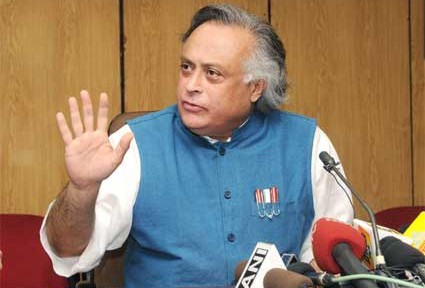
First, let’s have a look at the commonality lest this remark by Jairam Ramesh, the Rural Development Minister should end up comparing two uniquely different things. I think the commonality lies in both being answers to one’s inner needs. Once the call of God or nature is heard, for some, it is difficult to have the feeling all pent-up without release.

But, why did the honourable (sorry, not honourable, since Pranab da has ordained that even the President shouldn’t be called honourable. Indeed, taking a cue from this, most ministers prefer to be called what they are, ie, dishonourable; but are afraid this might invite charges of sedition) minister place toilets a notch above the temples? I feel that the simple reason is that whilst you can satisfy the pressures of your inner voice and yearning for the omnipotent and the omnipresent right in the open; satisfying the needs of your bowels in the open is counted as uncivilised conduct in most countries other than in India.

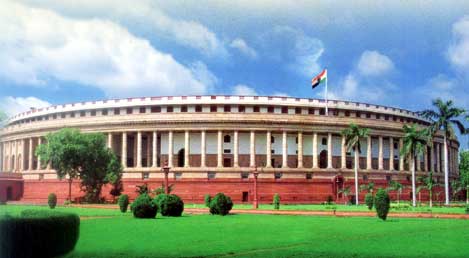
Do the ministers really have this penchant to compare public edifices to toilets? If the answer is yes, as it appears to be, then why did they not take it sportively when one Aseem Trivedi compared the temple of Indian democracy, ie, the Parliament, to a toilet?

Temples and Toilets both are totally secular words; they don’t really give away the religious attachments or sentiments of the visitors: one can be in a temple of any religion; similarly, what you do in a toilet doesn’t give away your religion. Perhaps, the only thing that can be brought out through this attempt to compare is that even religion has outlived its communal stance. It is high time that it too becomes more private (Read: ‘Whose God Is It Anyway?‘). I would rather have my religion in the temple of my heart rather than wear it on my sleeve at all times. It is better to be Good than Religious in the way religion has come to be interpreted these days.

Courtesy: topnews.in

I am apolitical too and have no real bias towards any political party as such. However, I feel that the minister is not driven by the desire to scandalise through the comparison. He has, indeed, brought out a harsh reality of the Indian rural scene. It was only recently in the history of free India that carrying night soil was banned. It was indeed the most humiliating thing for a human being to do. Even after the ban, with our burgeoning population causing severe scarcity of toilets, the scenes of open defecation in our country are ubiquitous. I lived in a much cleaner part of Mumbai, near the Afghan church, when I was in the navy. Even there, dozens of people, from the nearby colony, did their things in the open at any times of the day. I was quick to draw a ministerial comparison that whilst Japan is called the ‘Land-of-the-Rising-Sun’, most of our villages and cities can be called ‘Land-of-the-Rising-Bums’.

Such open defecation doesn’t bring out equal rights of men and women; the former are seen to be doing their things by taking aims at the walls and bushes whereas the latter are handicapped in this pursuit. Women, as compared to men, do require toilets. They often expose themselves to derision and lust when their need overcomes their decency and there are no toilets around for them.

Similarly, lets look at the needs and civic sense of our children. In Dharavi, as of now, there are 750 people to a toilet and hence most children learn their first civic lesson from their parents; which is to consider the whole world as a toilet bowl. When Swami Vivekananda visited the USA and he was asked what regime or religious routine he’d recommend for children, he replied, “I think, for children, football should be more important than religion.” He wasn’t scandalising anyone, exactly how Jairam Ramesh isn’t. We need to build more toilets for our people, especially for women and children.

Why do we, as Indians, pretend to be shocked when someone makes a bold statement which is as factual as that we need more teachers than godmen, or more upright citizens than politicians? Would it have been alright if the minister had said we need more doctors than cricketers and more engineers than actors?

Why do we sulk and protest if someone shows us the mirror? And lets face it; if the Minister for Rural Development hadn’t used this comparison we would have refused to see the mirror.

NIGHT WATCH

We were cadets on the Cadet Training Ship (CTS) cruiser Delhi. We were learning the skills required to do a Watch on the Bridge of the ship, from where the ship is controlled.

The watches on board a ship are divided into four hourly watches dependent upon the time of the day; ie, Forenoon Watch from 0800 to 1200 hrs, Afternoon Watch from 1200 to 1600 hrs, First Watch from 2000 hrs to midnight, Middle Watch from midnight to 0400, Morning Watch from 0400 to 0800 hrs. That leaves the time from 1600 to 2000 hrs; instead of calling it the Evening Watch, it is usually divided into two watches of two hours each called the Dog Watches. It is done so that in a three watch system there would be odd number of watches and people wouldn’t end up doing the same watch over and over again.

In the officers’ roster on Delhi, there was this Lieutenant (Lets call him Lieutenant A in order to maintain anonymity) who had a bad reputation of closing up late on his watch (generally one is supposed to close up fifteen minutes earlier so as to facilitate proper handing/taking over between the outgoing and incoming watches; but, Lt. A had the reputation of closing up 30 minutes or more late. This was especially true for the night watches, ie, First Watch, Middle Watch and Morning Watch.

Once when he was required to close up on Middle Watch, ie, Midnight to 0400 hrs, the officer who was closed up on the First Watch, ie, from 2000 to midnight, sent one of the cadets to wake him up one hour before his closing up time, ie, at 2245 hrs (10:45 PM) so that, for once, Lt. A would be on time. This has to be imagined to get the true flavour of it. Cadets were under mortal fear of Lieutenants on board as they could take it out on the cadets at the slightest pretext. The difference or the seniority gap between the cadets and the Lieutenants was perceived by us to be more than between the Lieutenants and the Admirals.

Now, you imagine a Cadet going into the mess of the Lieutenants, finding the right bunk and then waking him up with all dexterity at his disposal without causing inconvenience and annoyance to the other Lieutenants sleeping there.

Our brave cadet entered the mess and by hook or crook managed to find the bunk of Lieutenant A and whispered to him to wake up. There was no visible effect. So, he raised his voice a bit and said, “Sir, it is time for your watch.”

This earned the Cadet a few angry “shhhs” from the adjoining bunks and no reaction from Lieutenant A.

So, he thought of going back to the Bridge and informing the Lieutenant already on watch that Lt. A was sound asleep. But, he disposed off these thoughts as impracticable since, one, 15 minutes had already gone by and he himself was getting close to being relieved by another cadet; and two, the Lieutenant on watch had already warned him to return to the bridge only after Lt. A had fully awaken and out of his bed.

Hence, our man realised that this kind of challenge was what separated men from boys. He thought of the tales of resolve of intrepid Captains of ships who stood on the decks of burning and sinking ships and unflinchingly went down with the ship rather than abandon. Cadet M decided to stand bravely there and do everything by word or gesture to wake up Lieutenant A.

Some of his exhortations are now famous nautical poems:

“Sir, sir, sir, sir, sir
Please, please, please, please,
Wake-up, wake-up, wake-up
It is time, time, time,
For your watch, watch, watch.”

To his horror, he found that Lieutenant A’s mother had really given birth to a very stubborn child who was as far from waking up as our politicians are in the parliament when discussions on defence budget start.

Cadet M, at this time when more than 30 minutes had gone by, decided that he had to quickly decide whether to be slanged by the incoming OOW (Officer of the Watch) or being sent on the Crow’s Nest (the highest point on the mast) by the relieving OOW. Sterner action was, he concluded, required.

So, he shook the sleeping figure of Lieutenant A hard and started a much louder version of the nautical poem mentioned above.

Cadet M told us later that with this even Kumbhakaran, the sleeping God, would have been awake. But, Lieutenant A was undeterred by this rough treatment and continued to sleep like a baby in its mother’s arms.

Now, for Cadet M, it had finally become a matter of ‘Do or Die’, the kind of challenge that real men serving the nation sometimes face.

He spotted a tumbler lying there, filled it up, and returned to the bunk where the modern-day avatar of Kumbhakaran slept. He poured a handful in his right hand and sprinkled it on the face of Lieutenant A.

Eureka! There was a small movement and Lieutenant A stirred in his bed and in his heavy droll asked Cadet M, “Whhhat isss ittttt?”

Cadet M was close to success and had started seeing visions of being nominated for the gallantry award. So in his best, loudest, firmest voice he said, “YOUR WATCH SIR.”

The stirring in the bunk hadn’t totally died down. Lieutenant A, took out both his arms from under the white sheet, and with the right hand carefully removed his wrist-watch from the left wrist, gave it to Cadet M, and went to sleep again.

Can you picture Cadet M, standing there in Lieutenant’s mess, after 45 minutes of cajoling, being rewarded with having one more watch at his hands than the one he was doing?

PHEW – WHAT SIGNALS!

Communications within visual range (or Line of Sight) between ships are maintained on radio nets on VHF (Very High Frequency) or UHF (Ultra High Frequency). Between warships this radio net is called Tactical Primary or TP. All signals on TP are for such tactical purposes as manoeuvring, station-keeping and tactical exercises.

In order that ships would easily understand the purport of the signals, these are either coded in a standard code or use a language meant especially for signals called Signalese. If anyone gets tempted to use non-standard language, this often results into ridiculous situations and sometimes disastrous results (Also read: Anything For Me).

This happened with me on INS (Indian Naval Ship) Ganga. I was the Signal Communication Officer. In one of the Fleet Manoeuvres, we passed very close to a Durg class corvette at high-speed. The latter uncomfortably tossed around in our wake and felt it was rather a close call. So, the ship made a message on the (TP) Tactical Primary which read, “Phew”. Our Signals Yeoman not familiar with the word or its meaning, asked for repetition from the Durg. That started a spate of signals that went on like this:

Ganga: Durg this is Ganga (of course tactical call-signs were used), say again your last, over.

Durg: Ganga this is Durg, I say again my last: Phew; I say that again Phew; over.

Ganga: (Imagining that the word was ‘few’ and hence it was an incomplete message) Durg this is Ganga, say again all before few, over.

Durg: Ganga this is Durg, there is nothing before phew.

Ganga: (Even more perplexed): Durg this is Ganga, say again all after few, over.

Durg: Ganga this is Durg, there is nothing after phew.

Ganga: (Suddenly realising that Durg must be wanting to know the whereabouts of FOO (Fleet Operations Officer): Durg this is Ganga, FOO is embarked on Rajput.

Durg: (It was his turn to be flummoxed now): Say again all after Phew, over.

Mercifully, the Fleet Commander’s yeoman intervened before a few more phews and FOO could be exchanged.

By the way, ‘Say again your last” was the most frequent message exchanged between the ships. There used to be many jokes about this use. One day we had a high-ranking team from the US Navy visiting us in the Staff College. In a lecture about Tactical Communications, one of them mentioned that the most common signal in the US Navy was: “Say again your last.”

Phew!

GOOD NEWS FOR MUMBAI

There is good news for Mumbai and indeed for most Indian cities. No, no, this is not to do with recent hike in Diesel rates, which proved that the UPA government indeed has spine. Indeed, bolstered by the “success” of the hike and its aftermath, UPA government has now decided that they would be hiking the prices of all essential commodities, if only to prove the existence of the back-bone or the vertebral column. Speaking on the occasion, the Finance Minister said, “We shall not allow the UPA Spine to become a bone of contention between us and the allies and other parties and the nation.”

Nor is the good news for Mumbai due to the fact that UPA’s spinal recovery did wonders to the health of the stock-markets. “Come on, Sunbyanyname” you are bound to say, “Tell us quickly what’s the good news for Mumbai and by extension for most Indian cities; the suspense is killing us?”

Alright, alright, here it goes:

Scientists have now discovered that human waste or excreta can be used as fuel for transport. Isn’t that wonderful news for Mumbai and Indian cities? Our efforts haven’t gone waste, after all. For years we have been gathering filth and excreta in our cities and people abroad thought that we were just being dirty, filthy, uncouth people. Now only they would know that India would have great energy potential. We might just become the energy capital of the world.

And to think that we were trying to get gas by TAPI (Turkmenistan-Afghanistan-Pakistan-India) pipeline or other pipelines that are, well, in the pipeline for decades now. Now, realizing our new potential as having more human waste than any other country in the world, we can start supplying gas to the neighbouring countries. They were getting free gas from our politicians on important international issues. Now, for the first time, they can start getting gas that can actually be used.

Some of the readers can speculate that this may fuel speculation in other countries to produce more human waste and it may result in competition. Let me put all anxieties on this count to rest by bringing out that we, in India, are years ahead of them in our spread of human excreta and they have no chance in hell of catching up with us. Every one in six person in the world is an Indian; now, we shall have every one in six vehicles in the world run on Indian Gas.

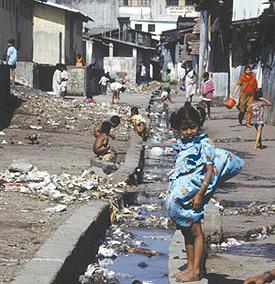
Open defecation in Dharawi (Pic courtesy: ens.newwire.com)


I don’t know why it took the scientists so much time to discover this simple form of energy. The Law of Conservation of Energy should have already brought home the fact to them that Indians couldn’t have been wrong. Indeed, if this gas can be used for cooking, it would complete one full cycle; and, there won’t be any need to get those two cylinders of gas from the government on unsubsidized rates.


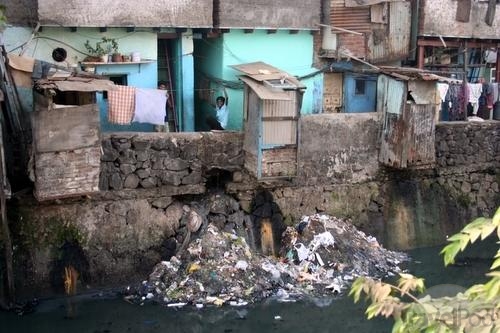
Great ‘Energy Sources’ (Pic courtesy: tripwow.tripadvisor.com)


One more fallout of this discovery:

Already sedition charges have been dropped against the cartoonist Aseem Trivedi. However, he still has to face other charges for insult to constitution etc. Now, all he has to say is that he was only being ahead of his times by portraying the true energy potential of our people.

This discovery will have various other fall-outs; and all for the good:

Do you remember the time you used to sit in a railway compartment or aeroplane or at a public place and there would be this burly man who would, without warning, break wind? Do you remember how you would immediately change seat and hold nose with thumb and index finger of the right hand? Now, if only scientists would come up with portable gas cylinders and you are able to tap this source, your car might be able to go an extra mile, thanks to the burly man. Breaking wind in public may just become a public utility exercise. Bandra Park where people used to gather (until intervention by the court to put a stop to such gatherings) to laugh their guts out in order to recharge their energies, might just become the meeting place of India’s Energy big-wigs.

Also consider how we get after the BMC for having heaps of filth everywhere. Now, people might just be thanking them for the energy source. Our BMC councilors might suddenly find themselves elevated from Zero to Hero. Indeed, I won’t be surprised if someone like Ram Gopal Verma has a forthcoming movie by that name. I won’t also be surprised if they come up with a sequel to Slumdog Millionaire, showing the energy potential of Mumbai’s slums and many millionaires in the making by doing what they do everywhere.

Now, if only they can make energy out of noise too, Mumbai would really become the Energy Capital of the World.

STATE SPONSORED NOISE

Mumbai authorities keep dreaming of Mumbai becoming a world-class city; but, there is a huge gap between dreams, fantasies and reality. A few months back I wrote how far were we from the Mumbai authorities’ dream of converting Mumbai into another Shanghai (Read: ‘Can Mumbai Become Another Shanghai?’). Most people agreed with my opinions but there were some die-hard loyalists who said that though they agreed Mumbai was largely unlivable, they didn’t like it that I hadn’t written anything good about Mumbai. They failed to realise that I had given practical steps for Mumbai’s dream to be realised and hence it was necessary to show Mumbai, warts and all, the way it is; I am not a politician or a diplomat and hence I call a spade a spade.

Just why is Mumbai becoming unlivable? It is not just the ubiquitous filth but also lack of infrastructure, discipline and will to do something about it. Lets take the case of Noise Pollution. I have lived in Mumbai for the last forty years and I have seen the decline of this once great city. The noise levels were not so deafening as now. In southern part of Colaba, for example, there is still a sign declaring it to be ‘A Calm Zone’. However, it is now just a sign with no meaning. The noise levels are at the level of crescendo especially during the festival season that follows immediately after the rains. So, whilst during the rains we have to reckon with the misery of pot-holed roads and water-logging everywhere (Read ‘Why Must We Love Indian Roads?’), just as the rains start getting over we have to reckon with pooja-pandals coming up right on the roads, together with ear-splitting noise (Read ‘A Quieter Mumbai – Is It A Pipe Dream?‘)

Following the principle that majority has to be right and can’t be ignored, we crouch and cringe but have no voice against this invasion of noise and our liberty and safety. Whatever decibel and time limits are set by the authorities are followed more in exception than in observance. Most of us would want the authorities to somehow control the unwanted noise, chaos and unsafe conditions. We have a charitable trust and non-governmental organisation called Awaaz Foundation which has done an enormous dedicated work to keep the authorities and others under check so as not to have unfettered environmental pollution. However, it is always a losing battle. The Foundation was started on 26 Feb 2006 by Sumaira Abdulali and has many successes against “environmental villainy” at personal risk to the founder. Wikipedia has this to say about Noise Pollution:

“Noise pollution can cause annoyance and aggression, hypertension, high stress levels, Tinnitus, hearing loss, sleep disturbances, and other harmful effects. Anti-Social Behaviour such as uses of Loudspeakers is a highly sensitive social issue in India.

Among the major forms of pollution in India is noise pollution. There is no parallel in the world to the noise pollution generated during festivals and religious celebrations in India. For Indians, making noise is a sign of happiness. For politicians the ability to make a big noise, by using huge loudspeakers at any opportunity, is a sign of strength. Festivals in India have become political battlegrounds as politicians try to score brownie points over one another by attempting to host the noisiest festival.The use of loudspeakers, permitted by the courts on certain occasions, often exceeds the permissible decibel limit, causing a great deal of stress and anxiety to the neighbourhoods.”

Pic courtesy: lewisgreek.com

Maharashtra and Mumbai ain’t amongst the success stories of reduction of Noise Pollution. Governments here, following the dictum of “people’s sentiments need to be respected“, often turn a deaf ear towards any pleas to reduce the noise levels. This year, for example, the state government has decided to extend loudspeaker deadline for Ganpati mandals for one additional day. Earlier, whereas loudspeakers were to be switched off by 10 PM and on two days during Ganeshotsav up to midnight, the government has now permitted one additional night of loudspeakers up to midnight and “traditional musical instruments” through the night on Anant Chaturdashi (the tenth day) with decibel restrictions in place.

All this news, as above, was in The Times of India 12 Sep 12 issue. To enable this, another news item said that the BEST (Brihanmumbai Electric Supply and Transport, a government run body in Mumbai, has offered “concession of nearly Rupees 8 per unit on power consumption to Ganpati pandals.” The news further went to add: “The mandals will save a lot of money towards power consumption. Also, they can light up the pandals and use brighter light for decoration” said a BEST official. The BEST electricity, of course, is also used for loudspeakers and generating noise. So, we have a situation where we have state sponsored noise. The very next page in The Times of India had another news item titled: ‘BEST reels under Rs. 3,300cr losses.’

The Awaaz Foundation page on Wikipedia covers instances where the state government was reluctant and even opposed to making rules and laws against Noise Pollution. But, even though these laws, as with most laws in India, are mostly on paper, people are always looking at ways and means to by-pass these too.

I, and I am sure there are many like me, pray that a day will come when people and authorities would realise that Noise Pollution is as bad as any other form of pollution. The festival season is just starting and with one reason or the other will continue almost until the end of the year. Read my take on the Diwali, for example, on ‘In The War Zone‘.

Festivals should be happy occasions for all. I wonder who is happy with loudspeakers and crackers and drum-beats late in the nights?

A DANGEROUS PROFESSION

I visited my friend yesterday. He was sitting morose, with his head in his hands; as if all hell had broken loose. What are friends if not help and cheer up a soul in need. So, I asked him what was the matter. He said his 19 years old son had decided to join ‘A Dangerous Profession’.

I remember about forty years back when I wanted to join the Indian Navy what was the reaction of my father about my joining “fauji” (military man). So, I asked him knowingly:

[lineate]Me: Army?[/lineate][lineate]He: No.[/lineate][lineate]Me: Navy?[/lineate][lineate]He: No[/lineate][lineate]Me: Ah, I got it now; he wants to be a sky diver?[/lineate][lineate]He: No, it is more dangerous than that.[/lineate]

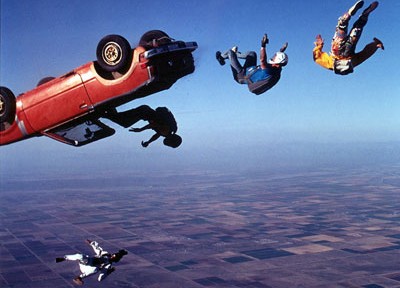
Pic courtesy: lasvegastours.info

[lineate]Me (resuming fresh): I got it; he wants to be a professional bungee jumper?[/lineate][lineate]He: No, nothing as simple; it is more dangerous.[/lineate][lineate]Me: Perhaps he wants to be a worker at Sivakasi Fire-works factory?[/lineate][lineate]He: Even that is safer in comparison.[/lineate][lineate]Me: Maybe he wants to be a nuclear scientist working for Al Qaeda.[/lineate][lineate]He: No, no, no…[/lineate][lineate]Me: Perhaps a driver in Mumbai?[/lineate][lineate]He: That’s dangerous but we still survive on an everyday basis.[/lineate][lineate]Me (I knew this time I was close): He wants to go to Pakistan to teach democracy?[/lineate][lineate]He: No; it is frightfully more dangerous…[/lineate] [lineate]Faujis don’t give up so easily. So I tried again:[/lineate][lineate]Me: River rafting?[/lineate][lineate]He: No.[/lineate][lineate]Me: Deep-sea diving?[/lineate][lineate]He: No.[/lineate] [lineate]I tried for next fifteen minutes, and still the reply was no.[/lineate][lineate]Me (resignedly, finally): What then?[/lineate][lineate]He (with an expression that said, “You will never understand”): He wants to be a cartoonist.[/lineate][lineate]Me: That’s bad; but, at least he confided in you about that. I know nothing can be worse. (remembering friends are there to cheer up friends in difficulty) But, things are a-changing. Who knows, a few years from now, even this profession may just become safe?

[/lineate][lineate]All of us live on hope.[/lineate]

SALARY FOR HOMEMAKERS

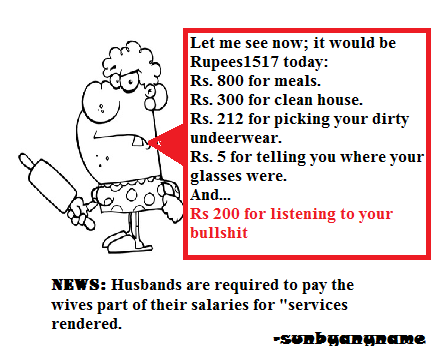
I was late in reading the newspaper today. Hence, I hadn’t yet read the item regarding the idea mooted by Women and Child development and supported by the government for husbands to share a part of their salaries with the wives for “services provided”. Hence, I wasn’t prepared for her response when after the breakfast I simply said, “Thank you; the poha was great.” She looked me straight in the eye and said, with her new-born confidence fortified by the WCD, which could have been WMD in this case, “That would be Rupees Two Hundred and Fifteen; the tea is on the house.”

It is only when I reached the office and glanced at the TOI that the true import of what she said hit me like a wet towel. Now that she too is going to be salaried, it won’t be far-fetched if she maintains a full account of all the services provided by her to me and the family and make me pay for them. Fortunately, I am old now and she often has headache; else, I won’t have been able to afford those bedtime luxuries.I would also have to be careful about inviting friends home; it might just be cheaper to take them to the wayside ‘Bar and Restaurant’ where “ready snakes are available” on 24/7 basis.

Musing about this I also reached the conclusion that this can work both ways; I can now demand better service since I shall be paying for it. Bye, bye, cold meals and hot wife if I turn up late. I am wondering if I can also approach the Consumer Court for those occasions when in her annoyance she bangs the crockery and cutlery and the meal on the table. More than anything else, I wonder if I can seek income tax rebate on such items that I do out of sheer chivalry, which would now be covered under charity and grants.

How do we work out remuneration for common tasks that we both do and tasks that I do for her. For example, I can’t be paying for the lunch if I had to go to the mall for vegetable shopping. What about bringing up children and dropping them at school? Will a wife have to share some part of her “salary” or “profits” for these common tasks? How much leave will she deserve under the Wives Domestic Employment Rules, which are bound to be decided in the parliament when they meet next after the Coal Break? Do I have to pay for the maid-servant, dhobi, sweeper etc or is she expected to pay them through her “salary”? What would be the perks involved with the job?

I can see one very good fallout of the proposal by WCD: when the boy’s family makes their unavoidable dowry demand, the girl’s family can come around and say that the former, indeed, owes them monies; ie, her services for so many years minus the dowry demand.

However, my mind was working overtime: will Lyn and I be called DINKs now that she would be earning too and both the kids are settled independently. Will I be responsible for paying increments?

I have lived most of my life, but, I can imagine the plight of the young husbands paying for the delivery of their children and for utilising the services of the mother-in-law during her pregnancy.

Just then the phone rang and it was she on the phone, “I will give you a free advice (thank God, I thought, something is still ‘free‘), don’t waste your time thinking of how much you owe me for having married a dumbo like you; you will never be able to pay.”

How to tell her that is something any husband pays through his nose?

THE GREATNESS OF INDIA AND ITS DECLINE

A few days back, there was a very good news item in The Times Of India titled ‘Dictionary traces maths concepts to the Vedas’. It brought out how, for eight long years, a few mathematicians and Sanskrit scholars of the Calcutta and Jadavpur universities had been working on a project to establish the veracity of the claim that at least 5000 basic and advanced modern mathematical concepts have their roots in Sanskrit and most have Vedic antecedents.

Some of the fascinating findings of this study or research are:

◾India discovered not just zero but it wasn’t discovered as late as in 5th century AD by Aryabhatta but in the period of Rig Vedas. Even the number Eka or one has its roots in Rig Veda.

◾Most solutions that can be found through algebra, geometry, and trigonometry have Sanskrit roots.

◾A large number of formulae developed thousands of years ago in India are valid even today.

I have a close friend Krishna Varanasi who too does original research in Vedas and Sanskrit etymology. Over a period of last about two years, since the time I know him, he has been able to establish to me that the roots of many modern concepts, science including nuclear, astronomy, aeronautics, and weaponology etc are in our Vedas. A few days before the findings of the research at Calcutta and Jadavpur universities, he wrote on our Facebook group called ‘Jai Hind’ about the Vedic concept of Infinity. This is what he wrote:

Concept of Infinity in Vedas: The concept of infinity was also known during Vedic times. They were aware of the basic mathematical properties of infinity and had several words for the concept-chief being ananta, purnam, aditi, and asamkhyata. Asamkhyata is mentioned in the Yajur Veda, and the Brihadaranyaka Upanishad as describing the number of mysteries of Indra as ananta. These two statements are elaborated in the opening lines of the Isha Upanishad (Shukla Yajur Veda). This shloka is as much metaphysical as it is mathematical:

[lineate]pûrnamadah pûrnamidam pûrnât pûrnamudacyate …[/lineate][lineate]pûrnâsya pûrnamadaya pûrnamevâvasishyate[/lineate]

(From infinity is born infinity. When infinity is taken out of infinity, only infinity is left over.)

Krishna has established, for example, that the modern world owes a lot to Vedas for physics and quantum physics. None of these things are in the nature of speculation. Here is a video to support that claim put up by Krishna:

https://youtube.com/watch?v=c7dAShZCjEY%3F

Here is the one about atomic weapons of the ancient Indian era, much before the world became aware of these:

https://youtube.com/watch?v=dK5qG6bKLCM%3F

Similar is the case with Theory of Creation as given in Vedas, Vedic Mathematics that even our school students are discovering now and theories regarding the age of the earth and the universe. Our people like to see to believe. You merely have to go to You Tube with just two videos that I have put up on top and you will find suggestions about many more to watch regarding our ancient and especially Vedic greatness.

Read Histoire de l’océan Indien by the historian Auguste Toussaint or its English translation ‘History of the Indian Ocean’ and you would be made aware of the fact that India didn’t just have fertile lands but fertile minds who discovered many a nautical concept, instruments and means to traverse the oceans.

The fact of the world’s oldest civilisations of Mohan Jo Daro and Harrappa is known to most people in India and abroad. However, how many people do know about the ancient city of Dwarka, a little distance away from the present city of Dwarka? The city was built by Lord Krishna and I mentioned about it in an article: Lord Krishna Beckoned – We Visited Dwarka.  Here is a mention of it in Wikipedia:

“After Krishna left the earth for Vaikuntha, about 36 years after the Mahabharat War (3138 BC), and the major Yadava leaders were killed in disputes among themselves, Arjuna went to Dwarka to bring Krishna’s grandsons and the Yadava wives to Hastinapur, to safety. After Arjuna left Dwarka, it was submerged into the sea. Following is the account given by Arjuna, found in the Mahabharata:

…imposed on it by nature. The sea rushed into the city. It coursed through the streets of the beautiful city. The sea covered up everything in the city. I saw the beautiful buildings becoming submerged one by one. In a matter of a few moments it was all over. The sea had now become as placid as a lake. There was no trace of the city. Dwaraka was just a name; just a memory.

On May 19, 2001, India’s science and technology minister Murli Manohar Joshi announced the finding of ruins in the Gulf of Khambhat. The ruins, known as the Gulf of Khambhat Cultural Complex (GKCC), are located on the seabed of a nine-kilometre stretch off the coast of Gujarat province at a depth of about 40 m. The site was discovered by a team from the National Institute of Ocean Technology (NIOT) in December 2000 and investigated for six months with acoustic techniques.

Krishna Varanasi put up this video to support the claim:

https://www.youtube.com/watch?v=Z5ucTxS2Vx0

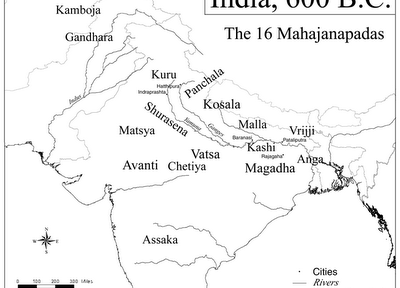
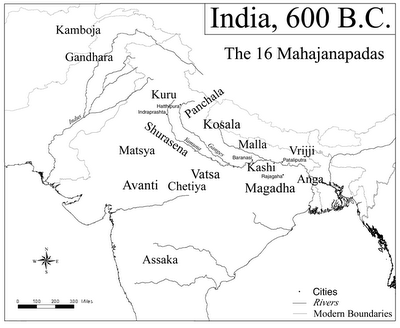
India had the world’s oldest concept of cities and kingdoms. Here is a map showing the mahajanpadas or great kingdoms during the Vedic Period:

Why is all this and more considered mythology by our countrymen? Westerns have had vested interests in dishing out theories about Indian mythology and we believe in these since we don’t have original research in these except for isolated incidents like the ones I have mentioned. Indeed, it is now rumoured that if you want to do original research or soak in fruits of original research in Sanskrit and greatness of ancient Indian heritage, you will have to go abroad.

We were a land of people who were absorbed in scholarly pursuits and hence the name Bharat (a combination of bha: knowledge and rat: absorbed). Kashi (the city of Varanasi or Benares) before it became a kingdom, was the centre of scholastic excellence, rubbing shoulders with such centres in Greek and Roman civilisations. During the Golden Period of Indian civilisation, we were the pioneers in the world in mathematics, astronomy, literature, medicine, and political philosophy. Even until as late as in 1962, we chose a great scholar as Servapalli Radhakrishnan as the second President of independent India. But, many decades later, in 2007, we chose a politician Pratibha Patil as the 12th President.

Lately, our people are as far from the concept of a great India as they could get. There hasn’t been an innovation by an Indian in India that has changed the world in any significant manner. Our people have no idea of our heritage but, consider that a highly parochial and at times Hindu revanchist movement is probably the answer to fill this gap and salvage lost ground from other civilisations and religions. In movies, literature, music etc we simply either plagiarise or come up with something that is touted as ‘fusion’ in the mistaken belief that if we piggy-ride on the more popular western idea, we would be able to sell our own (bastardised) culture.

What went wrong? I have pinpointed five main reasons for the decline of India’s greatness. I am sure historians and researchers would have enumerated many more; but, I shall stick to these five. I shall be grateful if you can cover, in the comments below, what you feel are the reasons for our having fallen from the pinnacle of excellence in various fields to the present nadir. Curiously, our current state of affairs has come about when we take pride in having made great strides in GDP growth.

1.  Population. The average age of Indians is now 29 and we are proud of being a very ‘young nation’ with considerable potential to become a world-power. The 2011 census showed our population being 1.21 people, the second largest in the world. In 2025, it is slated to become the largest population in the world overtaking that of China. Thus, we are not only having fertile lands but fertile people too. India had abundant natural resources but with the population explosion, the resources were not adequate for everyone. This, together with Indian caste system (jati and varna) and subsequent neglect by the rulers divided the Indian society into haves and have-nots. As per the 2010 UNDP report, 37,2 per cent of Indian population lives below poverty line while 68.7 per cent of our population lives on less than $ 2 a day. This has forced a large percentage of our population to take shortcuts to seek “necessities of life”. Thus, a large percentage of our population lives on greed and corruption. Our media fuels it further by reporting how such and such IIM graduate gets salary in crores rather than portraying what he has to change the lot of the countrymen. A few months back, I wrote a humorous article titled ‘India – Too Many People’, wherein I tried to bring out the several ‘advantages’ of having a large population. However, humour aside, if in the next few decades we are not able to provide employment to crores of people, our young population, instead of being an asset to the nation, will turn hostile and violent. Already, one-third of India’s 630 districts are under the Maoist rule/influence. The population explosion and greed have overwhelmed our rulers. We wake up to a threat only when the water goes over the head in the form of large-scale killing of people due to plague and accidents both natural and man-made. For example, with traffic, noise, filth and chaos, most of our cities are now unliveable. However, we are unlikely to discipline people to bring some order and safety and security in our lives until a disaster takes place. It is waiting just around the corner.

2. Lack of Strategic Culture. I don’t want to go into the details of this; but, the fact is that fertile land, prosperity, scriptures, Hindu way of life, and lack of – what our ancestors felt as – any perceptible threat to our country (Auguste Toussaint, for example, brought out that with the abundance of resources in India, the rest of the world brought gold and silver to our country; whereas we had no real need to venture out anywhere. Even when we did, eg, in the period of Ashoka, it was only to spread religion and culture. After the foreign invasions took place with the Moghuls and British, and French, Dutch and Portuguese; we were kind of surprised that someone could usurp our land and territory. This belief that people would see the essential morality and goodness of things and treaties made us too passive and complacent. In a certain way, our culture of being reactive to situations after these would take place continued with the debacle of 1962 War with the Chinese, Kargil War and finally 26/11 and series of terrorist attacks anywhere, anytime. The country’s greatest strategist K Subrahmanyam essayed to bring about this strategic culture and IDSA (Institute of Defence Studies and Analyses) recently brought out a book called ‘Grand Strategy for India 2020 and Beyond’. However, the Indian culture of immediacy and expediency still overpowers any genuine desire to think of a viable grand strategy for India.
3.  Lack of Quality Educational Institutions and Think Tanks. Somewhere along the line we lost stress on quality education and shifted to vocational institutions only. The stress on legitimate and illegitimate means of livelihood took the focus away from innovative ideas that could be truly called an Indian innovation rather than such things as IT revolution that were really re-engineering of western ideas. On the strategic side, not a single Indian institute figures in the top ten Asian think-tanks, let alone Global think-tanks. We are now a nation of copy-cats; eg, BPOs, English literature, songs, music, engineering and technological duplications. There are isolated examples of brilliance but the entire culture has been that of quickly assimilating what the westerns have invented or discovered. We lay no stress on education of our society but have adequate stress on academic brilliance that can be translated into a high-earning job; often this brilliance is as a result of learning by rote. Hence, when it comes to producing clones, rather than innovators, we are miles ahead of the rest of the world. Many Indians now head multi-national companies thanks to their excellence at being clones. There is no incentive in India for academic innovation and education that results in problem-solving. As an example, you will find Indian students doing very well in spellathons or mathematics Olympics where they can demonstrate their excellence at learning by rote; however, in tests like PISA (Programme for International Students Assessment), where the stress is on problem solving in everyday scenarios, our students do poorly.

4.  Caste System, Religious and Spiritual Corruption. No one has any clear idea of when did we become slaves to thousands of endogamous clans and groups called jatis. To start with we had a system of varnas (categories). It kept a sense of order, and peace among the people. There were five different levels of the system: Brahman, Kshatriya, Vaishya, Shudra, and Harijans. Within each of these categories are the actual “castes” or jatis within which people are born, marry, and die. They all have their own place among each other and accept that it is the way to keep society from disintegrating into chaos. This system worked well for Indian people in olden days. However, our over focus on caste and religion made us so parochial that we fought against each other rather than showing such resolve against foreign aggressors. The British, were very quick to exploit this and they came up with a brilliant policy of ‘Divide and Rule’. Mahatma Gandhi and several nationalist leaders won us independence by uniting us into a cohesive movement. But, no sooner that the British left that we resumed our fights. This time through, our own politicians realised the advantage to themselves if they divided people. We see signs of these tendencies everywhere; the latest being a certain Raj Thackeray who is convinced that Maratha pride and sons-of-the-soil policy gets him more votes in Maharashtra and power than a strong India. A RAND study has shown that by 2030 India would comprise as many as 50 states. We really have no time and propensity for national integration; it doesn’t earn votes. A weak centre and strong regional parties has been the result of fanning of such divisive forces.

5.  More Focus on Material Things than Societal Values. This took some time in finding its roots in India but now is firmly in place, Such rampant consumerism at one plane suddenly increased our desire for luxuries of life such as cars, refrigerators, televisions, aircraft, electronic items, cell phones and beauty products. On the other plane, by making these things available, the multi-national companies laughed all the way to the bank and are still laughing. Somewhere along the line, the victims were familial and societal values. At the present juncture, for example, collectively as a nation, we are the farthest away from values. Many people, for example, opined that the reasons for Anna Hazare movement to have failed was because of the skulduggery of the wily politicians. The real reason is that we are all corrupt one way or the other. A rich person, irrespective of how he made money, is respected and emulated. Many of the Indians, if they haven’t become outright corrupt, is not because of any strong values; but, simply, because of lack of opportunity.

I don’t know how long this cycle would last. The solutions are obvious and inherent in the five reasons I have given above. We can either regain our ancient greatness or slip more hopelessly into the morass that we are in.

THE BEST SAD SONGS OF DEV ANAND

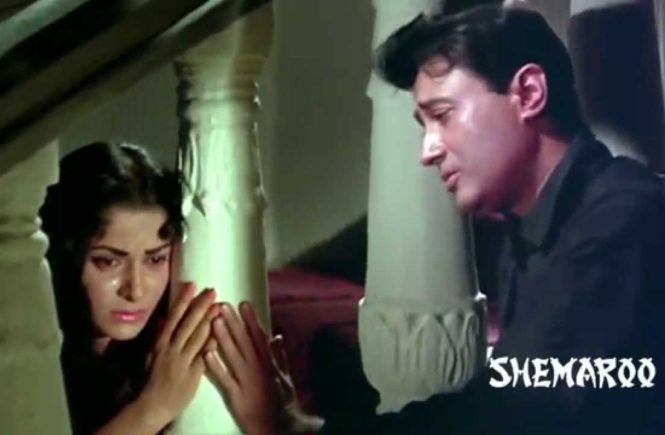
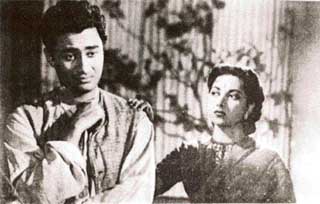
When I wrote about Dev Anand in another article Hindi Songs And The Age of Innocence, I wrote about Dev Anand who had the toothy smile, tilted walk, and a way of being totally at ease with his heroines, especially those who sang those light-hearted, lilting and melodious duets with him. However, there was another Dev Anand in the Hindi movies; the sad, lonely, forlorn Dev Anand, forever looking for love, companionship, togetherness and happiness. Just like he did in his chirpy roles, Dev Anand excelled in melancholic roles too. Lyricists must have loved to write such numbers for him because he enacted them so well. Some of these songs, the sad songs, that is, came about by his acting in movies to prove his talent after an unsuccessful romance with a singer – actress Suraiya who was bigger than him in the Hindi movies and hence rated before him in the credits of the movies. They acted in seven movies together from 1948 (Vidya) to 1951 (Sanam). She fell in love with him and wanted to marry him but her mother opposed the match because they were of different religions: Hindu boy and Muslim girl.

Just as it happens in the movies, Suraiya fell in love with him whilst shooting one of Vidya’s songs ‘Kinare kinare chale jayenge’. She fell in water whilst enacting the number. Dev Anand, forever chivalrous, jumped right after her and saved her from drowning.

Dev Anand and Suraiya

It is not known whether Dev Anand’s perfection in lugubrious roles was as a result of unsuccessful love affair or not, but, the lyricists and directors seemed to have worked on the theme very well for him. Indeed, there is a 1963 movie Kinare Kinare with Dev Anand opposite Meena Kumari. The title song of the movie ‘Chale jaa rahe hain mohabbat ke maare; kinaare, kinaare; kinaare, kinaare’ is one such desolate song.

However, my effort tonight is to give you not just the best sad songs of Dev Anand but also to give you songs that seem to ask the questions ‘What have I got of my own?’; ‘Is it worth wandering through the world without love and happiness?’ and ‘Why can’t I have a single friend, love, companion and mate in the world?’

Here goes then. The songs that I give you all ask these questions; they are all the top sad songs of Dev Anand; but they are not in any particular order – either chronologically or in their popularity or in excellence. The first song is from the 1960 movie Bambai Ka Babu in which Dev Anand acted opposite a young Suchitra Sen. The story was written by Rajinder Singh Bedi and hence you could expect an out of the ordinary story; and yes it was because the story hinted at incest between Dev and Suchitra. The film was directed by Raj Khosla (remember him in such movies as C.I.D., Kalapani, Ek Musafir Ek Hasina, Do Badan, Do Raaste, Mera Gaon Mera Desh, which, some say, inspired Sholay. Majrooh Sultanpuri wrote these lyrics but the actual life in the lyrics was put by Sachin Dev Burman (who gave music for most of Dev Anand movies and thus took his favourite hero’s name as his middle name) and heart with Mohammad Rafi’s passionate singing. The song is ‘Saathi na koi manzil, diya hai na koi mehfil’:

In the 1963 movie Sharabi (Drunkard), Dev Anand excelled himself in a melancholic role. The movie had Raj Rishi writing the story and screen-play and as director too. Keshav (Dev Anand) lives a poor lifestyle in a small town in along with his ailing father, Dinanath, mother, and a much younger sister, Munni. He is an alcoholic but after the passing of his father promises to abstain completely, much to the relief of his mother as well as his sweetheart, Kamala (Madhubala), as well as her businessman dad, Laxmidas, who arranges his employment at his Coal Mine, and arranges for them to get married . Less than a week before the marriage, Laxmidas cancels it and Keshav relapses and his mother threatens to leave the town, and even Kamala refuses to speak with him. Shortly thereafter Laxmidas, on his deathbed, gets Kamala to promise to marry someone else, while Keshav, blacklisted by the entire community is well on his way to self-destruction as well as endangering lives of hundreds of coal mine workers.

The movie had some of the saddest songs of Dev Anand; eg, ‘Mujhe le chalo phir aaj us gali mein’, ‘sawan ke mahine mein’ and this number: Kabhi na kabhi, kahin na kahin, koi na koi to aayega’. Lyrics are by Rajinder Krishan who wrote the maximum lyrics for Madan Mohan and music is by the latter:

The name of this 1956 movie is Funtoosh and in this to help Dev Anand express these feelings of despair and despondence are Sahir Ludhianvi, SD Burman and Kishore Kumar. Dev Anand acted opposite Sheila Ramani. The movie was inspired by Meet John Doe, which was a Frank Capra movie about a man agreeing to impersonate a non-existent person who said he was committing suicide in political protest. The number ‘Dard hamara koi na jaane, Apni garaj ke sab hai deevaane, Kisake aage rona roye, des praaya log baigaane Dukhi man mere sun mera kehhana is the one I have chosen for you since it meets the theme that I have set for the evening:

Two years before the above song and the movie was Dev Anand in and as Taxi Driver. This 1954 movie was directed by his brother Chetan Anand, who directed quite a few of his movies under the banner of Navketan Films. Dev Anand acted opposite his would be wife Kalpana Kartik. The movie, if watched, offers a nostalgic journey through Bombay of 1950s. Same combination of Sahir Ludhianvi with SD Burman in this song too but this time it is Talat Mehmood singing this forlorn number. Maayusiyon kaa majmaa hai dil mein, Kya reh gaya hai is zindagi mein; Rooh mein ham dil mein dhuaan; Jaayen to jaayen kahan kis ko kahen apna yahan?

Talking about Talat Mehmood, who can ever forget this disconsolate number by him for Dev Anand in 1963 movie Kinare Kinare on similar theme? Nyay Sharma wrote the lyrics and Jaidev composed the music. Mere Malik kya kahoon teri duyaayon ka fareb, Mujh pe youn chhaya ke mujhako ghar se beghar kar diya. Dekh li teri khdaai, bus mera dil bhar gaya:

I know all this while you have been waiting for this song from Hum Dono on similar theme and, ladies and gentlemen, how can I ever forget it? Hum Dono has, as depicted by the name, Dev Anand in double role opposite Nanda and Sadhan. Music director Jaidev came up with some of his best music and songs in this movie, many of them having been penned by Sahir Ludhianvi and sung by Mohammad Rafi, who had such magic in his singing that he could actually step into the soul of actors for whom he sang. There were songs like: Abhi na jaayo chhod kar, allah tero naam, main zindagi ka saath nibhata chala gaya and this great number with the ending stanza: Kaun rota hai kisi aur ki khaatir ai dil, Sabako apni hi kisi baat pe rona aaya; Kabhi khud pe kabhi halaat pe rona aaya.

Yes, Dev Anand was popular for his light hearted songs, especially his being totally at home with his heroines in duets, but, he was also outstanding in melancholic roles. Here is one with my favourite singer Hemant Kumar in Manzil. Dev Anand and his childhood love Nutan, are separated at the hands of fate. Thinking that Dev is scandalising his relationship with her, she confronts him at a function where Dev is being honoured as a composer. What follows in the confrontation scene is drama, dialogue, acting, and picturisation at its peak. Dev and Nutan simply excel in their roles. One cannot but mention the classic song ‘Yaad aa gayin woh nashili nigahen’, composed by maestro S D Burman and penned by Majrooh Sultanpuri. Main in zakhmon ko seeke, Kya karun hosh mein jeeke: Yaaro tham lena tham lena meri baahen Yaad aa gayin vo nasheeli nigaahen. I have given for you the scene leading to the song so that you may see their acting at their best.


As late as in 1973, Dev Anand sang on the same theme in Joshila. The movie was directed by Yash Chopra who was ever fond of making movies with a triangle. In this movie the triangle was between Dev Anand, Hema Malini and Rakhi. Dev Anand is imprisoned for a murder that he didn’t commit but it was pinned on him by the evidence of the same witness whose life and honour he had tried to save. The movie, therefore, opens with this song by Dev Anand in the prison. The combination of Sahir, SD Burman and Kishore was the most abiding combination for Dev Anand. Enjoy the song: Kiska rasta dekhe ai dil ai saudaayi, Meelon hai khaamoshi, barson hai tanhaayi…

Lets get back to Sharaabi and I am now going to put up the most romantic and beautiful number sung by Dev Anand: ‘Mujhe le chalo phir aaj us gali jahan se main betaabiyan le ke aaya’. An equally good song from this movie is ‘sawan ke mahine mein, ik aag si seene mein, lagti hai to pi leta hoon, do chaar ghadi ji leta hoon’. However, this one is special to me. Rajinder Kishan, Madan Mohan and Mohammad Rafi have together not just created a song but a complete era; an unforgettable era of such adorable pulchritude that you feel like helping Dev Anand to go back in time and live his love life again…this time with happy ending:

I shall do grave injustice if I don’t choose this number in the top ten sad songs of Dev Anand. The 1965 movie Guide is regarded as a classic, the best of Dev Anand. It was directed by Vijay Anand and starred Waheeda Rehman opposite Dev Anand. The story was by RK Narayan about a man with whom nature conspires to make him a great swamy, after he is betrayed by a woman whom he thought he had won in love from her husband who neglected her. The name Guide, therefore, applied on two planes; one in reel life where Dev Anand as Raju was a tourist guide; and the other as a Guide for the villagers who were dying of hunger and thrust and take him as a saint with miraculous powers. On another plane, Guide is all about finding the guide within ourselves to direct us towards a path of goodness and sacrifice. Once again SD Burman has given outstanding music on Shailendra’s lyrics. ‘Pyaar mein jinake, sab jag chhoda, aur hue badnaam,
Unake hi haathon, haal hua ye, baithe hain dil ko thaam,
Apane kabhi the, ab hain paraaye’. One more reason for selecting this is to bring out the great melancholic singing:

Shall we end tonight with the 1958 movie Kaala Pani? And why not? Majrooh Sultanpuri penned some of the best songs for Dev Anand movies that were composed by Sachin Dev Burman. The scene here is farcical since Dev Anand only wants to play to the good sense of the courtesan Nalini Jaywant so as to get to the secret about his father’s disappearance. He borrowed the song, the tunic, the baton and the cap from his room-mates. Nevertheless, it is a great sad number of Dev Anand.  Tum to naa kaho ham, khud hi se khele, Duube nahin ham hi youn, nashe mein akele, Sheeshe mein aapako bhi utaare chale gaye. Ham bekhudi mein tumako pukaare chale gaye.

SD Burman composed it in Raag Chayanat, Tal Kaherava and see how beautifully Mohammad Rafi delivered:

I have given you the top ten sad numbers of Dev Anand on the theme: what have I got of my own? Should you feel your list is different or I have forgotten your favourite number on the theme, please do write.

“Kaun rota hai kisi aur ki khatir ai dil,
Sabko apni hi kisi baat pe rona aaya”

WHO SHOULD RULE INDIA?

Less than a week back, the Chief Justice of India, Shri SH Kapadia cautioned that judges should not rule the nation. He said, “Judges should not govern this country. We need to go by strict principle. Whenever you lay down a law, it should not interfere with governance. We are not accountable to people. Objectivity, certainty enshrined in the basic principles of the Constitution has to be given weightage.” He said this whilst delivering a lecture on ‘Jurisprudence of Constitutional Structure’ at the India International Centre at New Delhi.

This got me thinking: who should actually rule India? Over a period of time I have made a short list of those who shouldn’t. Here goes:

1. Judges. They can’t be ruling India for the reasons given in Justice Kapadia’s speech. Before the British gave us a central legal system based on Indian Penal Code in 1860 and Indian Evidence Act in 1872, India’s justice system was based on laws as given in The Arthashastra dating back to 400 BC and Manusmriti dating back to first century AD. Indeed, the caste or religion based codes of laws, eg, Hindu code of laws and Muslim code of laws were prevalent even after independence. Then there were – what is known as – customary laws. It is taking India a very long time indeed to become a civilized nation whose people respect the rule of the law. Many archaic laws and rules took considerable time in changing with changing times. Amongst other reasons, we have rampant political exploitation of the masses and thus – as came out in the infamous Shah Bano case – even after four and half decades of independence, we are nowhere near a uniform, easily understood civil laws. Everything is left to interpretations, technicalities and the like. Folklore says that it is better to sort out things between the people themselves rather than going to police, judges and lawyers. All these three categories are not averse to taking money from both the parties and prolonging the cases until the grandchildren of the original contenders opt for compromise (to sort out things between themselves). Then there are certain categories of people in India who consider themselves above the law. When a politician is charged with scams worth crores of rupees, he/she initially says it is “political vendetta” but later says, “Iska faisla to ab janata ki adalat hi karegi” (Only people’s court (mob mentality?) can now decide on this. You may feel that it is contempt of the court to even make a statement like that. However, since the politician feels that he is above the law, he has scant respect for the courts or the judiciary except for those who are on his payroll. India faces another problem in that, for a long time in history, the Judiciary, the Executive, and the Legislature were the same person. It is taking us a long time to get out of this. Our people are, by nature lawless, indisciplined, and prone to taking short-cuts.The reason for me to tell you this reality about the justice system in India is that our judges have hands-full (in more ways than one). We have lakhs of cases rotting in the courts for decades. Our people require newer laws every passing day but have scant regard for laws already enacted. In such a scenario, where is the time, energy, inclination etc for judges to rule the nation. If they are able to sort out the judicial mess we are currently in, that itself is too much to hope for.

2. Military. Sorry, we are very clear about this; we don’t want military to govern India. We don’t want to become like Pakistan. From the time of independence when our Prime Minister Pt. Jawaharlal Nehru had this obsessive mania about keeping military far removed from governance to this year’s ‘exposure’ in a reputed Indian daily turning a routine movement of troops from Mathura and Hissar to New Delhi as likely design by Army under General VK Singh to take over governance of the country, our politicians and people at large have this unexplained mortal fear that one day military would take over the country. We ourselves call military to fill up lack of governance in many parts of the country, which we conveniently cover up by a term we have specifically coined for this purpose, viz, “law and order situation”. But, let alone giving the military a modicum of say in matters of governance, we disdainfully question even Armed Forces Special Powers Act in such states where we expect military to thanklessly sort out mess caused by politics and lack of governance. The armed forces chiefs are now 13th in the Order of Precedence in our nation. When Admiral Joshi took over as the 21st Chief of the Indian Navy, The Times of India, used to giving six column ‘news’ for Yuvraj having hit six sixes in an over, gave it as a small news on page 15. Indeed, Delhi Varsity or St. Stephen’s College not promoting Unmukt Chand, the Captain of the Under 19 team winning world cup, making it a bigger news. Our nation is now in a state that our cricket team winning a match is bigger news than the armed forces winning skirmishes, battles and wars against the enemy; many a times losing their lives (“the ‘b——-s’ are paid for it, so what’s the big deal?”) No, Sir, military should never be allowed to rule India.


3. Politicians. They should, if you really ask most people, be actually ruling India provided they are not corrupt or criminal. Regrettably, there is no other variety of this animal found in India. He or she has proved the English saying wrong, which ended with ‘but, you can’t befool all the people all the times’. There are many who have written volumes about how did the Anna Hazare movement ‘India Against Corruption’ fail; and why a strong Jan Lokpal Bill is still not around the horizon. My reason is simple: how can the corrupt be asked to make a Bill that curtails their own powers and take punitive action against themselves? It is like asking the thieves to lay down traps for themselves. Another big reason for the IAC to have failed is because it was wrong to assume that in our country only the politicians and big-wigs are corrupt. India is at an unfortunate period of time in history when people at large are corrupt and opportunistic; there is a race to somehow become richer, more powerful and more influential. In a democracy people not only get the government that they vote for; they get the government that they deserve. We can never expect and trust such politicians elected by such people to rule India.

4. Babus or Bureaucrats. Many people feel that when the British gave independence to India, it wasn’t complete independence as such. They had already created something called a Babu or a Saheb who, they were sure, would keep India from competing with England or rest of the world. As Winston Churchill said, “If the British left, India will fall back quite rapidly through the centuries into the barbarism and privations of the Middle Ages. If India becomes Independent power will go into the hands of rascals, rogues and freebooters. All Indian leaders will be of low caliber and men of straw. They will have sweet tongues and silly hearts. They will fight among themselves for power and India will be lost in political squabbles.” What an accurate prophecy? By endowing India with the scourge of babudom, in one stroke, the British curtailed the power of India by several centuries. The makers of the Constitution of India defined a term called ‘civil-servant’ or ‘public-servant’. I have finished living nearly six decades in this country; I haven’t yet come across a single babu or bureaucrat who regards himself as a ‘servant’ of the people or in ‘service’ of the nation or public. If you, dear reader, have come across these species kindly mention his/her address in the space provided for comments.

5. Police. No, Sir, we don’t want to become a police state. In 1948, after India became independent, the erstwhile Imperial Police was replaced by the Indian Police. If at one time we used to hear horrible stories about the excesses of the Imperial Police, we had no idea of what our police was going to do to us. Over a period of time, the police by itself and through political and bureaucratic interference, became completely corrupt. As an example, after 26/11, one of the recommendations of the Experts Committee was to have 6000 networked cameras installed at important points in the city. The city policemen, used to taking bribes as with the rest of their ilk, are more fearful of the cameras than the potential terrorists. Indeed, the terrorists know that they don’t have to fear being caught red-handed on the cameras because the police and the babus would make sure that the cameras even if installed would never function. The Indian Police is in dire need of reforms but it suits the politician, the bureaucrat, and the police itself, to continue pussy-footing on the reforms. Police have largely garnered powers to themselves and whilst the Director Generals are now equated higher than C-in-C’s of the armed forces, one has lost count of how many DGPs are there in each state. How can such people be trusted to rule India?

Courtesy: snagesh.com

6. Industrialists. Even though, after independence, mainly to prove ourselves as a society forever fired by the need and zeal to see upliftment of and empowerment of people, we selected a socialist model of economy for ourselves, we soon realised that it was only making poor poorer. So, Manmohan Singh, the great spin doctor, came up with ‘reforms’ and we resumed being a capitalist society that we always were. Capitalism is an economic system that is based on private ownership of the means of production and the creation of goods or services for profit. Look back in the last few decades and you will see the truth of this statement. Recently, whether it was 2G spectrum allocation, or Coal Mining auctions, or even Common Wealth Games, the common wealth of the people quickly went into the hands of ‘private ownership’. As the infamous Radiia tapes brought out there is now an unholy nexus between the politician, industrialist and the media. When John Kenneth Galbraith said, “Under capitalism, man exploits man; under communism, it is just the opposite”, he wouldn’t have ever known how true would it be for India. Irrespective of the type of the economy, in India, the industrialist, in cahoots with the politician (from whom he has to get crores of rupees even to fight elections), makes sure that the goose of the common man is cooked. Quite a few of them have now come out openly in support of Corporate Social Responsibility (CSR) and some like WIPRO’s Azim Premji have donated crores for welfare projects, but it is still miles to go before we can think of an industrialist in India fired by philanthropic intents rather than profit making plans. In such a scenario, it would be asking too much of them to rule the country.

7. Filmstars, Godmen and Cricketers. carried away by their mass-appeal, some people of these categories dream of or are nominated to enter politics, eg, Dhirendra Brahmachari, Hema Malini and Sachin Tendulkar. Some others such as Anna Hazare and Baba Ramdev dream of changing the corrupt system; but, if you ask the corrupt politician he too would tell you that the ‘realities of politics’ made him corrupt whereas earlier he wasn’t. Ruling or governing India is not merely showmanship. These categories of people can pull the masses but what exactly can they promise them other than dance and drama, religious mantras and sixes? No, ladies and gentlemen, these won’t do to rule India.

Sachin Tendulkar as Rajya Sabha member (Pic courtesy: thoughtfulindia.com)

8. Media Personnel. At first glance they appear to be ideally suited to rule the nation; more so, when on debates on telly and talk-shows, they project themselves as the only people who have any idea of how to rule or govern the nation. However, look a little closer and deeper and you will find that they too have been rendered unfit for the job. Even as respected a figure as Padam Shri Barkha Dutt, as seen in the Radiia Tapes, was not beyond degeneration of soul for earthly gains. Collectively or individually, they haven’t shown great penchant for what is good for India. Being slaves of TRPs and industrialists and foreign powers who control the media, they ain’t expected to be more than watch-dogs and poodles of the people who feed them.

Barkha Dutt of NDTV on Radia Tapes (Courtesy: blogs.wsj.com

What’s the Choice? We started off with Justice SH Kapadia telling us that judges shouldn’t rule India. But, in the end, we are left with no choice as to who should rule India. We require the following in men and women chosen to rule India:

  • He or she (henceforth, when I say ‘he’, it would mean both) should place country above his or her own interests and those of his or her family, friends and cronies.
  • He should realise that in our constitution there is a term called ‘Civil Servant’ or ‘Public Servant’ but there is no term called ‘Public Ruler’.
  • The only power sharing formula (our politicians are constantly working on these) he works out would be with people.
  • He would instil discipline, nationalism, religious tolerance, uprightness and honesty in the people through personal example.
  • Every decision taken by him would have people of India as its basic concern.
  • He would make India a corruption free, equitable society.

Any takers? Instead of ruling India, how about serving India and Indians? If you have any suggestions of your own, please feel free to pen them down.

GIVING AWAY MEMORIES

After retirement we moved into a small two-bedroom flat in a far suburb of Mumbai; this is as big as the one that I could afford after being an officer in the Navy for close to 37 years. In my last house whilst still in the Navy, my wife and I took months to sort out things and pack. We knew that we had to give away lot of stuff that we had accumulated. This invariably used to happen with our frequent postings in the Navy.

I saw this 1957 Hindi movie with my parents; one of the earliest ones that I saw with them. The movie was named ‘Bhabhi‘ (brother’s wife) starring Balraj Sahni and Nanda. Rajinder Krishan wrote these most appropriate verses:

[lineate]Toone tinaka tinaka chun kar nagri ek basaai,[/lineate][lineate]Baarish mein teri bheegi palken dhoop mein garmi khaai,[/lineate]Gum na kar jo teri mehnat tere kaam na aayi[lineate]Achha hai kuchh le jaane se dekar hi kuchh jaana[/lineate][lineate]Chal udja re panchhi ke ab ye des hua begana[/lineate]

[lineate](O’ bird, twig by twig you picked a complete nest of a world[/lineate][lineate]Rain wet your brow, and sun made you sweat[/lineate][lineate]Don’t rue that you couldn’t enjoy the fruit of your labour.[/lineate][lineate]It is better to give and go then to take and leave[/lineate][lineate]Fly away bird, now this place is not yours anymore)[/lineate]

So, as we move house, what do we finally end up giving away? Most often we give away junk that was only gathering moss, mildew and dirt. This would include all those notes and dockets from the Staff College that I’d assumed I couldn’t ever do without and which, I had never cared to read even once after leaving the Staff College. Then there would be those mementoes of “love and affection” given to me at farewells without any particular emotion other than the relief at seeing me go. However, like the Master Card ad, there would still be a lot of things that we’d wince if we had to give them away; those things that money can’t buy; because there are so many memories attached to them.

It is not my intention to bore you with a list of such things. I know each one of us has a list of such dear and precious things. However, I shall give you some examples of what it means. I gave away the first vehicle that I ever owned: a Yezdi 250 cc mobike. I still remember the number: KEE 438. I bought the mobike in the year 1980 when, as a lieutenant in the Navy, I was undergoing my specialisation course in communications and electronic warfare at Navy’s Signal School in Cochin (now Kochi). My would-be-wife was at Coimbatore and I made many a trip up and down between Cochin and Coimbatore on this bike during its (my?) running-in period. Once, on a long weekend, we went to Coonoor together.

When she visited Bombay where I got posted, we decided to go to Goa on – we called it – our donkey. One officer had named his bike ‘kilometer eater’; but, we were quite happy about calling it donkey for not only carrying our weights but many other things (for example, at one time we carried a complete cooking gas cylinder on it since waiting for the delivery boy would have been too much). What a trip it turned out to be. We returned from the Navy Ball at about 1 AM and suddenly, without any plan, I asked Lyn if she wanted to visit Goa. Knowing my capricious moods, she was fearful of asking me “when” but, I solved that problem for her by saying, “Tomorrow morning”. We got up at 5 AM, hurriedly packed up a rucksack and off we went “for a few days”, which finally turned out to be almost a month.

Oh, to be young again. Love teaches you togetherness and we were not in any hurry to reach anywhere. We clicked pics, admired the scenery and I even tried to teach her driving. Together with our donkey, we owned the world. Here is Lyn on the Bombay-Goa highway as it used to look in 1980 (not that it is better 32 years later):

We reached Belgaum at about 10 PM and that’s the time Lyn asked me if we should finally find a shelter for the night. At about midnight we found the Military Engineering Services Inspection Bungalow (MES IB). The Major-in-Charge saw our blackened faces (with the soot from the lorries), gave us a room and had only one request: “Please have breakfast with us before leaving tomorrow morning.” We were wondering why; but, the mystery was solved over breakfast. Apparently, just before they turned in for the night, the Major’s wife had a debate with her husband that the spirit of adventure was dying down in the armed forces. Just then we landed up.

The three of us: Lyn, donkey and I, had a most adventurous Bombay-to-Goa trip and stay in Goa. On the way back, we loaded our donkey on a ship (for 90 bucks) and returned to Bombay.

Our donkey instinctively understood us and never gave us any anxious moments. When Arjun, our elder son was born in 1984, that was the first vehicle he rode, perched up between Lyn and me. For one year after Arun was born in end 1986, we still managed on donkey with Arun held in her arms by Lyn and Arjun sitting on the fuel tank. God always gave us enough; in the year 1988 I was sent to Spain on duty and I returned with enough money to buy a car. Good bye, donkey. He went for 3500 rupees. All of us were saddened to see him go and the children even cried. I took solace in Sahir Ludhianvi’s lyrics:

[lineate]Jiyo to aise jiyo jaise sab tumhaara hai;[/lineate] [lineate]maro to aise ke jaise tumhaara kuchh bhi nahin.[/lineate]

(Live in such a way as if everything belongs to you; but die as with nothing belonging to you)

During our days there used to be a song by Trini Lopez with the title: ‘What have I got of my own?’ In the end, life and particularly life in the navy with its frequent transfers has taught me how true are these words:

https://youtube.com/watch?v=ICeHLkaolyI%3Ffs%3D1

Then there was this playpen we got for Arjun. He was never alone there; he was there with his cat and toys. It was large, painted lavender and Lyn even made a mosquito-net for it. The front side could be slid down for helping the baby in and out and, though large, it even had wheels to move it around. Arjun used to love being inside it; the problem was that Lyn and I hadn’t made peace about not having him with us on our own bed. The Friday movies on the doordarshan and Benjamin Spock had prompted us to spend Rupees 1000 in getting this cot cum playpen. Arjun, in the vein of most babies who won’t be neglected, knew when exactly to wail endlessly during our watching the movie on doordarshan that used to start at 7:30 PM. Once evening, when a repeat of Rajesh Khanna’s Anand was to be aired, we planned to play with him in the afternoons so much so that at the appointed hour, Arjun would be fast asleep in the cot-cum-playpen. The movie began and we watched about 30 minutes of it without any interruptions from Arjun. However, both of us knew that our minds were elsewhere. Finally, I uttered what Lyn wanted to hear all the while, “Go and get Arjun; it is no fun watching the movie without him keeping us from watching it.” We moved to Delhi in 1987 and the cot went with us. Arun couldn’t use it initially because we didn’t have a house; we lived in one room with all our baggage lying around us in unopened boxes. When we finally got a big enough house to open the cot-cum-playpen for Arun, it was time for posting; this time for undergoing Staff Course in Coonoor (Nilgiris). We finally had to give it away without Arun using it much. However, we still wistfully remember the fun it used to be to put first Arjun and then Arun there in the first world that was entirely their own:

In the meantime, when it wasn’t possible to open the cot, we had to buy a smaller one for the smaller one. Lo and behold, even the elder one used to like me taking them for a ride in this cot-cum-pram-cum-swing (it had a stand from where it could be hung and the baby rocked to sleep). This was even greater fun for them than the playpen since they could put their toys in it and push it around the house. It was sad to see it go. But, then the relief was that the children didn’t require it anymore.

What a lot of fun they had on this cycle for a few years. Arjun felt like a big boy taking his younger brother around and telling him reassuringly, “Don’t worry; I am a safe driver”.

It was nice to see Arjun grow into a boy on this cycle from an infant. But, our heart was in our mouths when we had to give it away:

I remember giving away my complete collection of Hemant Kumar’s songs on audio cassettes, my PG Wodehouse Books, my collection of Readers Digests, flower pots that had started looking deliciously verdant just when the transfer orders came, photo frames and even paintings each one of those had a story to tell. Would the new owner have guessed how much we paid in terms of minutes of our lives (and not money) in maintaining them, cherishing them and looking after them?

Curiously, there were also things that we didn’t feel a thing about losing; electronic stuff, eg, music systems, televisions, fridges, clothes, shoes and the like. This only goes to prove that things acquire life of their own because of priceless memories attached to them and not because of their money-value. I still miss our first telly: Dyanora 14″ B&W portable, though.

The other day I read a story by a fellow blogger Anupam Patra who writes very imaginatively. In the story a man gave away his eyes to his killer’s son. That got me thinking how can giving away anything inanimate be so hard or difficult?

As Elton John sang in ‘Talking Old Soldiers’:

[lineate]Just ignore all the others;[/lineate] [lineate]you got your memories….[/lineate]

Finally, the pictures – both in the sepia and on the mind’s screen – are still with me; the memories are never given away. I can still relive even my own childhood without any of the material things associated with it let alone that of my children.

Mujhe ab bhi yaad hai kitana ameer tha main…..jab paani mein mere jahaz chalte the (I still remember how rich I was then….when my ships used to ply in the waters):

Follow

Get every new post delivered to your Inbox

Join other followers:

error

Enjoy this blog? Please spread the word :)

RSS
Follow by Email
YouTube
YouTube
Set Youtube Channel ID
LinkedIn
Share
WhatsApp
Copy link
URL has been copied successfully!