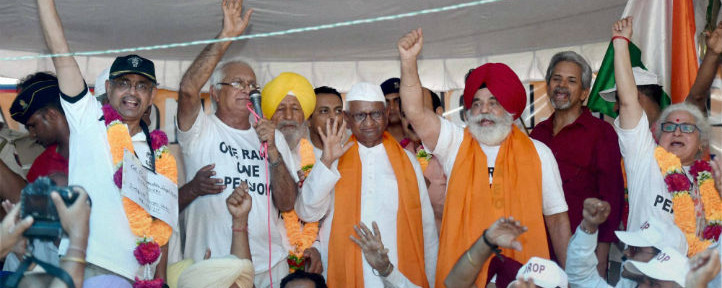
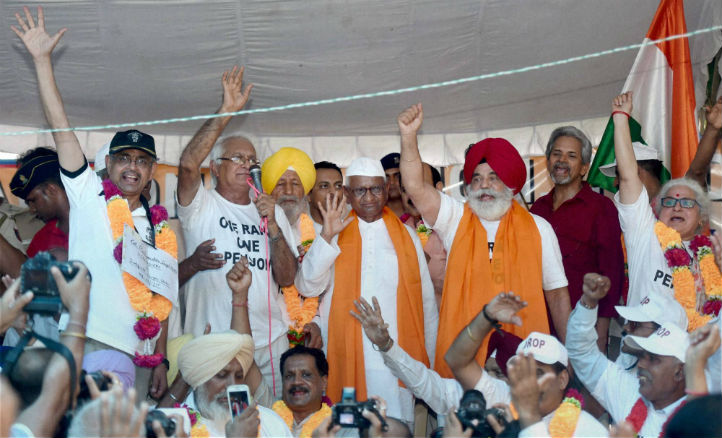
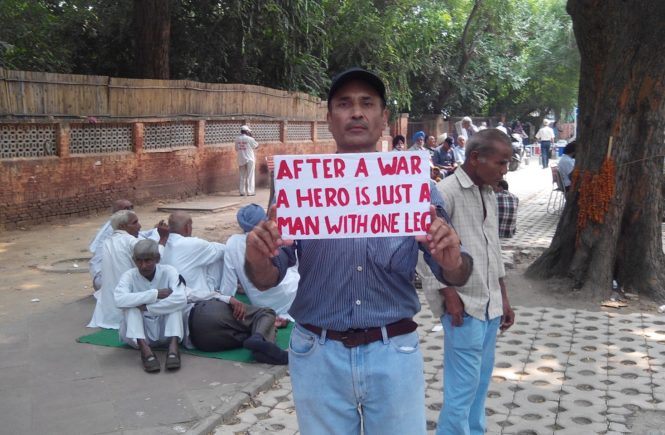
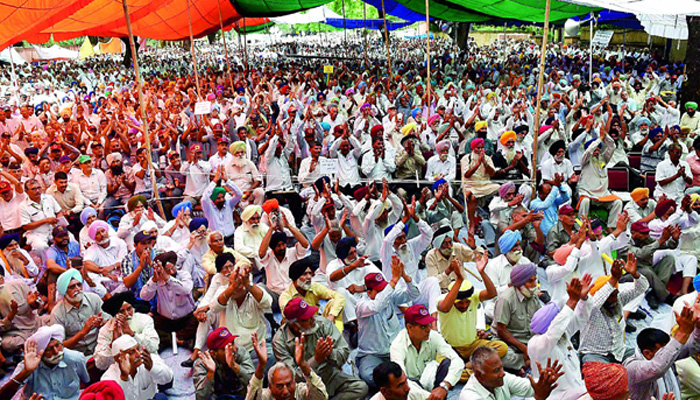
We have pledged to restore the OROP that was denied to the veteran faujis in 1973 by an ex-parte order of the government of India. I cannot do better than to put up the parody of the famous song that was shot in the National Defence Academy (NDA) for the 1970 movie Aadmi Aur Insaan. If you recall it has Sahir Ludhianvi’s lyrics and a very catchy and fauji tune given by my namesake Ravi. The singers were S Balbir, Joginder and Mahendra Kapoor.
Please enjoy the parody of Yaara dildara mera dil karta….
दिल करता, ओ यारा दिलदारा मेरा दिल करता
ओ, यारा दिलदारा मेरा दिल करता
ऐसा कुछ कर पाएं
OROP ले आएं
दिल करता, ओ यारा दिलदारा मेरा दिल करता
हो, सदियों जहान में हो चर्चा हमारा
दिल करता, ओ यारा दिलदारा मेरा दिल करता
आ गए अब तक हम बाबुओं की बातों में
बाबुओं की बातों में
होय होय
काम करते रहे हम आधी आधी रातों में
आधी आधी रातों में
होय होय
हँसते रहे ये बाबू हमारे हालातों पे
हमारे हालातों पे
होय होय
लातों के भूत हैं यह, माने नहीं बातों से
हो, सदियों जहान में हो चर्चा हमारा
दिल करता, ओ यारा दिलदारा मेरा दिल करता
हमारे जैसा फौजी कभी मिले न हज़ारों में
मिले न हज़ारों में
होय होय
पैदल हम मार्च करें यह घूमे हैं कारों में
घूमे हैं कारों में
होय होय
अपनी तो गिनती हो किस्मत के मारों में
किस्मत के मारों में
होय होय
लेकिन ये संग बैठें फ़िल्मी सितारों के
फ़िल्मी सितारों के
हो, सदियों जहान में हो चर्चा हमारा
दिल करता, यारा दिलदारा मेरा दिल करता
तिरंगे की शान हैं हम देश के सैनानी
देश के सैनानी
होय होय
देश की आज़ादी है हम वीरों की कुर्बानी
वीरों की कुर्बानी
होय होय
OROP ले के रहेंगे यह हमने है ठानी
हमने है ठानी
होय होय
याद आएगी इन बाबुओं को अपनी ही नानी
अपनी ही नानी
हो सदियों जहान में हो चर्चा हमारा
दिल करता, ओ यारा दिलदारा मेरा दिल करता
Dil karta, O yaara dildara mera dil karta
O, yaara dildara mera dil karta
Aisa kuchh kar paayen
OROP le aayen
Dil karta, O yaara dildara mera dil karta
Ho, sadiyon jahaan mein ho charch hamaara
Dil karta, O yaara dildara mera dil karta.
Aa gaye ab taq hum baabuyon ki baton mein
Baabuyon ki baton mein
Hoy hoy
Kaam karte rahe hum aadhi aadhi raaton mein
Aadhi aadhi raaton mein
Hoy hoy
Hansate rahe ye babu hamaare haalaton pe
Hamaare haalaton pe
Hoy hoy
Laaton ke bhoot hain yeh, mane nahin baton se
Ho, sadiyon jahaan mein ho charcha hamaara
Dil karta, O yaara dildaara mera dil karta.
Hamaare jaisa fauji kabhi mile na hazaaron mein
Mile na hazaaron mein
Hoy hoy
Paidal hum march Karen yeh ghoome hain kaaron mein
Ghoome hain kaaron mein
Hoy hoy
Apani to ginati hai kismet ke maaron mein
Kismet ke maaron mein
Hoy hoy
Lekin ye sang baithen filmi sitaron ke
Filmi sitaron ke
Ho, sadiyon jahaan mein ho charcha hamaara
Dil karta, yaara dildara mera dil karta
Tirange ki shaan hain hum desh ke sainani
Desh ke sainani
Hoy hoy
Desh ki azaadi hai hum veeron ki kurbaani
Veeron ki kurbaani
Hoy hoy
OROP le ke rahenge yeh hamane hai thaani
Hamane hai thaani
Hoy hoy
Yaad aayegi in baabuyon ko apani hi naani
Apani hi naani
Hosadiyon jahaan mein ho charcha hamaara
Dil karta, O yaara dildara mera dil karta
Yesterday, I put up an article titled OROP Rally, Azad Maidan, Mumbai, Saturday, 31st October explaining the history of the OROP agitation and the reasons for its continuation even after the government’s announcement on 05 Sep 15.
OROP has been a history of un-kept and broken promises by the governments. It started off in 1973 when the OROP was withdrawn unilaterally by the government in 1973 with a promise that it would be restored in the then forthcoming 3rd Central Pay Commission.
The latest of these have been by the present Prime Minister Narendra Modi in his election campaign in Rewari, Haryana in Sep 2013 that OROP would be implemented within 100 days of his government coming to power. Then he made a promise at the heights of the Siachin on the occasion of Diwali last year that OROP would be implemented shortly. Yet another Diwali is around the corner. Lord Rama went on 14 years of exile. The veterans have done 14 multiplied by three, that is, 42 years of exile. And now the latest buzz is that the government intends making the notification before next Diwali.
Promises galore.
I am reminded of this Daag Dehlavi ghazal sung so beautifully by Mohammad Rafi on Khaiyyam’s music: Ghazab kiya tere waade pe intezaar kiya…
https://youtube.com/watch?v=wWSBDsEtQ0Y%3F
Here is my parody on it, to be sung on the same tune:
ग़ज़ब किया तेरे वादे पे ऐतबार किया
तमाम लाइफ OROP का इंतज़ार किया
घटा घटा के मेरी पेंशन को शर्मसार किया
तसलियाँ मुझे दे दे के बेक़रार किया
हम ऐसे चालाक ना थे के होश आ जाता
मगर तेरी दग़ाबाज़ी ने होशियार किया
कमेटियां आप ने बनायी कमीशन आप ने बिठाए
कुछ ऐतबार किया और कुछ ना ऐतबार किया
वह दिन भी आएगा बाबू जब तुम भी जागोगे
अभी तो पैसे और ताक़त ने तुम्हें खराब किया
ग़ज़ब किया तेरे वादे पे ऐतबार किया
तमाम लाइफ OROP का इंतज़ार किया
Ghazab kiya tere waade pe aitbaar kiya,
Tamaam life OROP ka intezaar kiya.
Ghata ghata ke meri pension ko sharamsaar kiya,
Tasaliyaan mujhe de de ke beqraar kiya.
Hum aise chaalak na the jo hosh aa jaata,
Magar tumahaari dagaabaazi ne hoshiyaar kiya.
Kametiyan aap ne banaayi, commission aap ne bithaaye,
Kuchh aitbaar kiya aur kuchh na aitbaar kiya.
Woh din bhi aayega baabu jab tum bhi jaagoge
Abhi to paise aur taaqat ne tumhen kharaab kiya.
Ghazab kiya tere waade pe aitbaar kiya
Tamaam life OROP kaa intezaar kiya.
By an ex-parte order of the GoI, the OROP that the veterans enjoyed since independence was withdrawn in 1973. Because of their peculiar service conditions and short lengths of service (most men retire between 35 to 37 years so as to have them as jawans (young men) in the armed forces), they were at that time given 70 % of last pay drawn as pension and civil service personnel 33 %. By the same order, it was raised to 50 % for civil services and reduced to 50 % for officers and 37 % for men.
Several representations by armed forces followed. Typically, the government appointed committees and commissions such as 3rd CPC in 1973, Estimates Committee, 1980-81, KP Singh Deo Committee of 1984, 4th CPC in 1987, Jafa Committee of 1989, Sharad Pawar Committee of 1990-91, 5th CPC, GoM Committee of 2005, and 6th CPC in 2006. Instead of restoring OROP, the government in 2008 provided OROP to civil and police services in 2008 at highest pay grades and they made sure, by an internal memo, that 100 % of them became eligible to do so because of NFU (Non-functional Financial Upgradation; which meant that if one in a batch was promoted, the others automatically became eligible to draw the increased pay).
This was betrayal of the worst kind. Agitations followed and veterans returned medals to the President at Jantar Mantar, New Delhi. Govt appointed a Ten Member committee under BJP MP Bhagat Singh Koshiyari. In Dec 2011, the committee gave report strongly favouring OROP and gave a definition of OROP accepted by all parties including the parliament. Since then, two parliaments have passed the OROP but is yet to be implemented.
Shri Narendra Modi declared in election campaign at Rewari, Haryana, on 15th Sep 2013, that his government would implement OROP within 100 days of coming to power. Again, on 2014 Diwali day at Siachin, the PM announced OROP to soldiers. However, the RM’s announcement of OROP on 5th Sep 2015 (after 16 months of being in power) was an apology for OROP. It has seven distinct shortcomings and if implemented in the present form it would totally kill the very definition of OROP. The UFESM (United Front of Ex-Servicemen) decided to, therefore, continue with the renewed agitation that started on 14th June 15 at Jantar Mantar including Relay Hunger Strikes from 15th June 15. Rallies are being held across the country to make people aware of the machinations of the babus-netas who have relentlessly denied OROP to veterans after withdrawing it in 1973 within 18 months of the 1971 War victory.
Koshiyari Committee Report and the Flaws in GoI Announcement on 05 Sep 15
Post 2008 agitations, a ten member committee was appointed under the BJP MP Bhagat Singh Koshiyari. It gave its report in Dec 2011 and not just strongly recommended OROP to be implemented but gave a definition of OROP as follows:
OROP “implies that uniform pension be paid to the Armed Forces Personnel retiring in the same rank with the same length of service irrespective of their date of retirement and any future enhancement in the rates of pension to be automatically passed on to the past pensioners.” The concept includes “bridging the gap between the rate of pension of the current pensioners and the past pensioners, and also future enhancements in the rate of pension to be automatically passed on to the past pensioners. In armed forces, equality in service has two components, namely, rank and length of service. The importance of rank is inherent in armed forces as it has been granted by the President of India and signifies command, control and responsibility in consonance with ethos of service. These ranks are even allowed to be retained by the individual concerned after his/her retirement. Hence, two armed personnel in the same rank and equal length of service should get same pension irrespective of date of retirement and any future enhancement in rates of pension be automatically passed on to the past pensioners.”
The Koshiyari Committee definition of OROP was accepted by the government, endorsed by the parliament and by the ex-servicemen organisations. Since then two parliaments approved OROP. But, the government’s announcement on OROP on 05 Sep 15 fell much short of the approved definition of OROP. It has the following serious flaws:
It brought out that those who seek VRS (Voluntary Retirement Scheme) would be kept out of the OROP. This shocked all those engaged in the agitation. It appears that this particular clause has been added at the last minute at the behest of the bureaucracy who is hell-bent to deny the complete OROP to the veterans. Armed forces, unlike some corporates and public sector units, do not have the concept of VRS. They have Pre-Mature Retirement (PMR). Now, if a person has completed his pensionable service and then sought PMR, why should he or she be denied OROP?
The government has declared that a review of the pensions would be done every five years. This means that in this period of five years pensioners would have five different pensions and not one as envisaged in Koshiyari definition of OROP.
The base year for calculation of OROP has been selected as calendar year 2013 and not financial year 2013-14 as is normally the basis of all salary and pension related matters. Again, there is an attempt to deny the increments that would have been due in a financial year.
The government has been petty-minded even for the date of award. They had agreed to the date of 01 Apr 14 in all talks with ESMs. But, at the last minute changed it to 01 Sep 14.
Whilst earlier the government had agreed to provide pension at the highest point of pay band for a rank, the government has done a volte-face and now conceived to provide it at mean average of lowest and highest points.
Government plans to appoint a one man judicial council to decide the matter in six months time against the suggested constitution of five members: one each veterans from each service, one serving armed forces member and one bureaucrat. The ESM have also questioned that six months shouldn’t be required after 42 years and the report should be ready in one month’s time.
OROP should have been awarded in perpetuity and not linked to pay commission as the government has done.
Sense of Betrayal and the Agitation Continues
Many of our countrymen initially, after the GoI announcement on 05 Sep 15, felt that whereas the government seems to have gone out of its way to announce OROP, the ex-servicemen appear to be fussy in continuing with the agitation. Gradually, it has dawned on our people that the chasm between the neta-babu nexus before the announcement seem to have deepened with the announcement. There has been a deep-rooted sense of betrayal that several governments played into the hands of the babus to deny the full and accepted definition of OROP and that, even after 42 years, the BJP government keen to take credit for finally announcing OROP, has taken refuge in petty-mindedness rather than large-heartedness. The government should have also known that the government is not authorised to tinker with OROP after it has been approved twice by two parliaments.
It was, therefore, decided by United Front of ESM (UFESM) to continue with the agitation until full implementation of OROP. There have been promises galore in the last several decades. The latest ones have been by Prime Minister Narendra Modi’s goverment that it would be implemented within 100 days of NDA government coming into power (it did in May 2014 and the OROP is still to be implemented). There are latest ones going around that it would be implemented after Bihar elections, and by Diwali. These really sound hollow after so many betrayals.
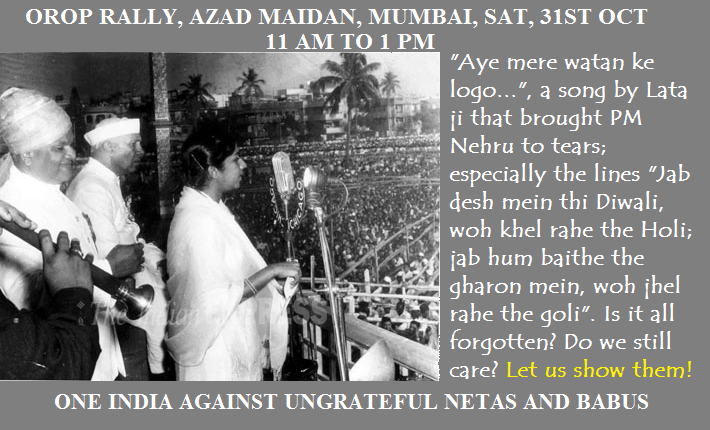
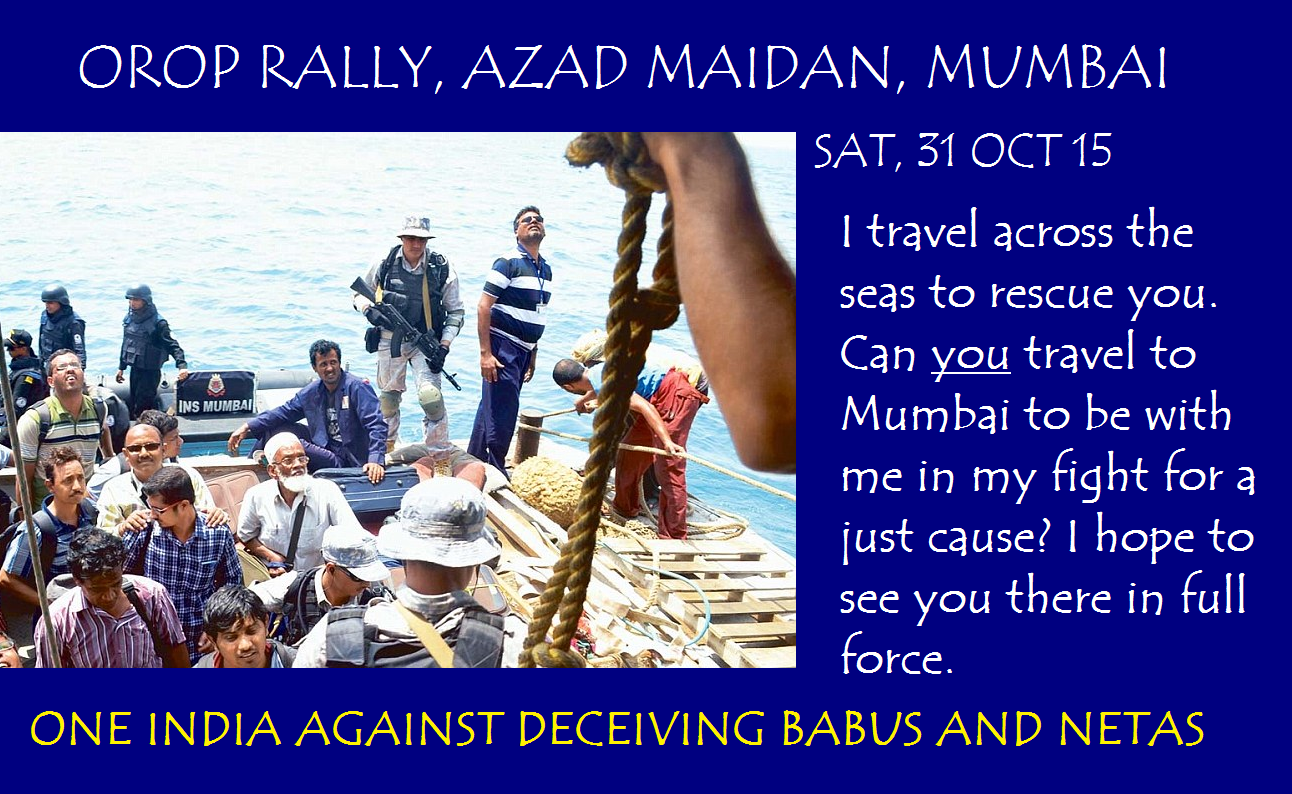
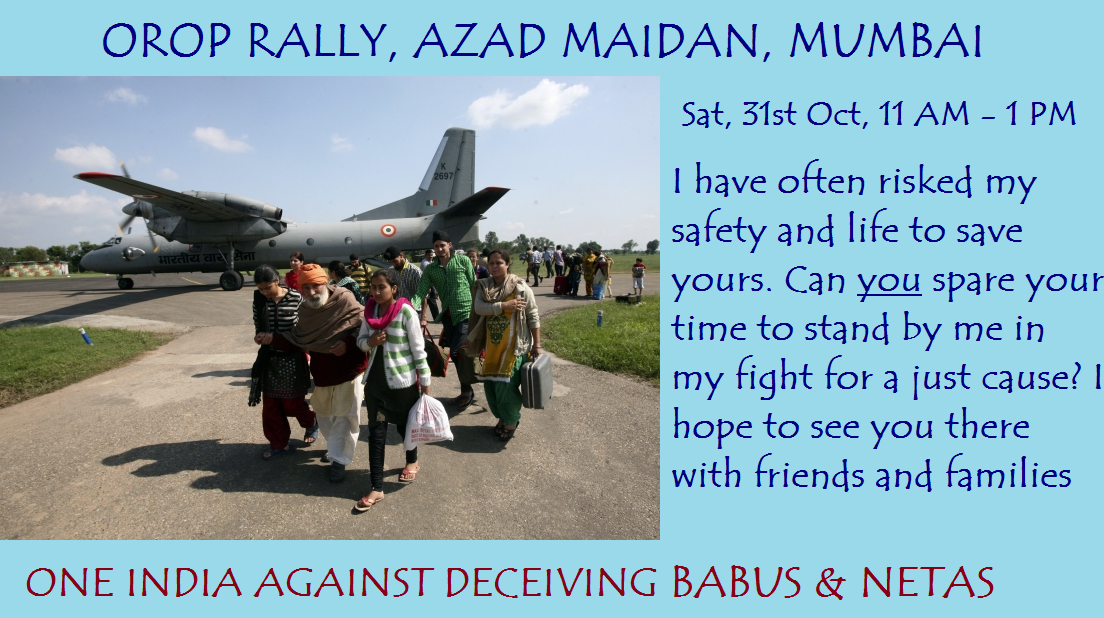
Mumbai Rally at Historic Azad Maidan, Saturday, 31st Oct 15
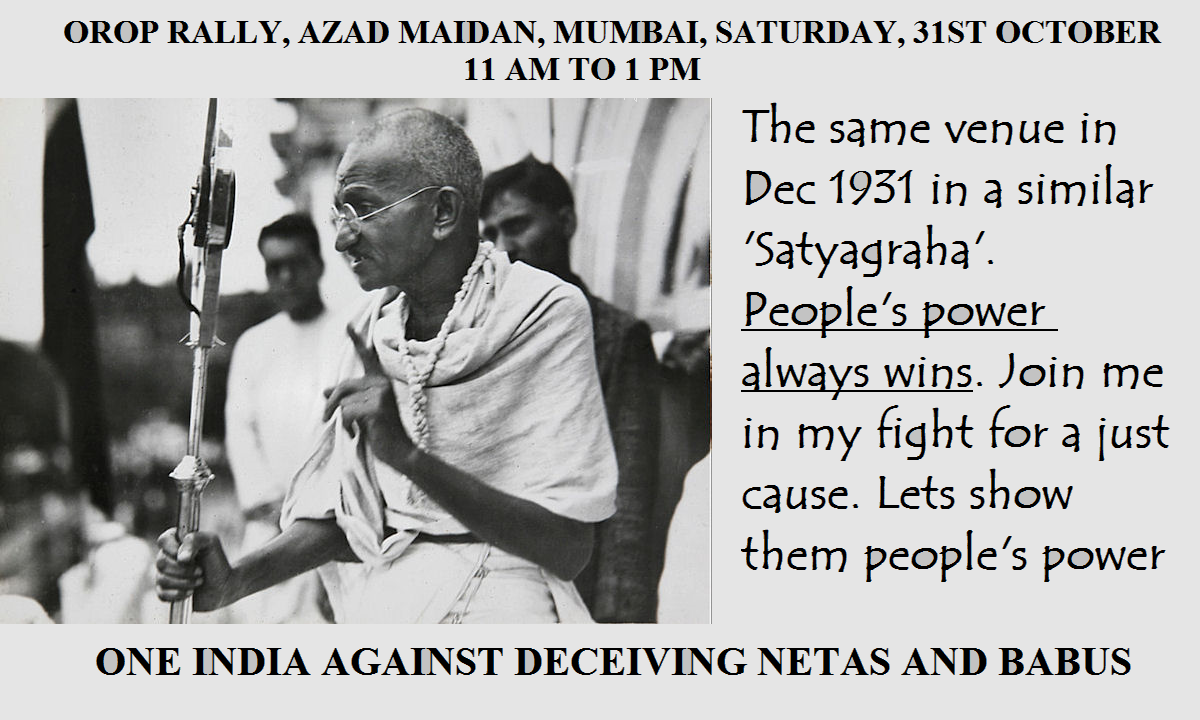
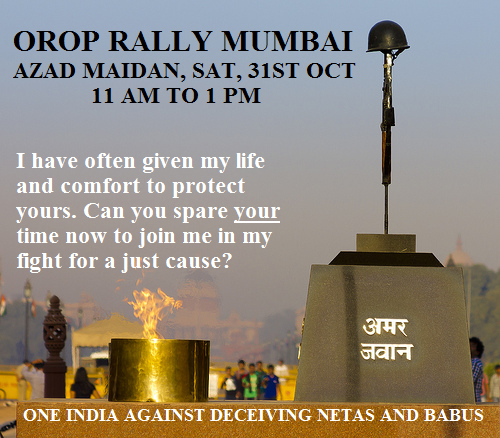
The UFESM under Major General Satbir Singh, SM, Retd., therefore, decided to continue with the agitations and spread awareness amongst the citizens of India by holding rallies in various parts of the country such as Ambala, Dharamshala, and Chennai. The last rally was in Jalandhar, Punjab, and the next is in the historic Azad Maidan in Mumbai on 31st Oct 15. It is the same venue where the Father of the Nation, Mahatma Gandhi held a rally against the British in Dec 1931.
A video of the issues of the forthcoming rally has been prepared by Navi Mumbai TV (NMTV) under the guidance of Commander SH Kalawat, Retd., Convener of ESM in Mumbai, Colonel Harbhajnik Singh, Retd., our point-man for dealing with the press, and self:
https://youtube.com/watch?v=ej2uRX92s9k%3F
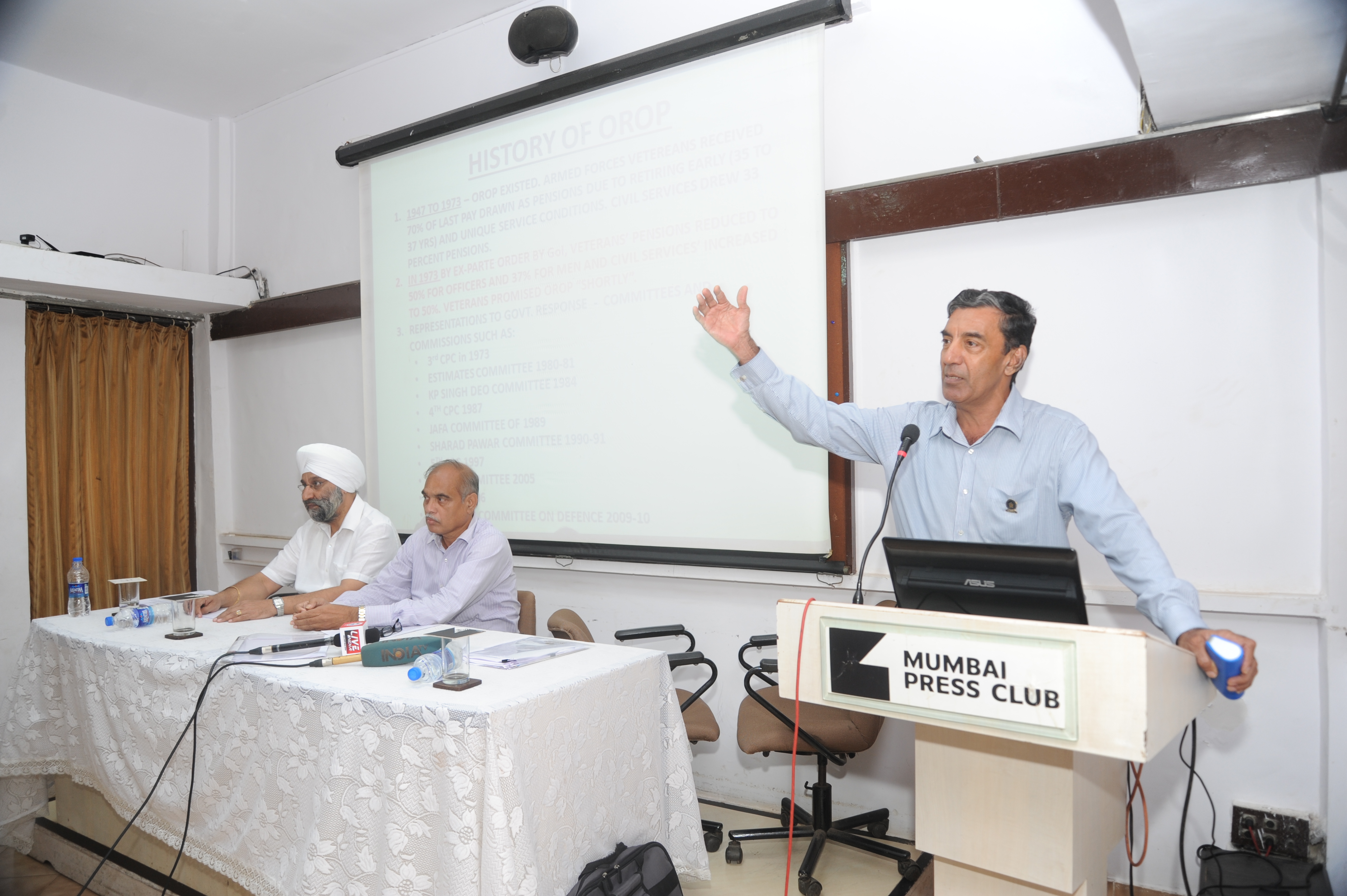
There has been concerted media and social media campaign. We addressed a press-conference on 26 Oct 15:
Some glimpses of the social-media campaign besides articles and stories:
The issues are, therefore, in public domain. We request all veterans and families and citizens of this great city of Mumbai to join us in our fight for the just cause.
In the end, as Major General Satbir and other veterans have often said, it is not an issue of money; it is an issue of dignity and izzat of the veterans.
I run a Facebook page called Lyrical wherein I often give theme based songs. The current theme, since 12th Aug 15, is The Best Raaga Based Songs In Hindi Movies.
The word Raga or Raaga actually means colour or hue but is associated with melody in Indian classical music. A raga uses a series of four or more musical notes upon which a melody is constructed. However, the way the notes are approached and rendered in musical phrases and the mood they convey are more important in defining a raaga than the notes themselves. In the Indian musical tradition, rāgas are associated with different times of the day, or with seasons. Indian classical music is always set in a rāga. Non-classical music such as popular Indian film songs and ghazals sometimes use rāgas in their compositions.
I am going to take Raagas at random and associate them with time of the day and with Hindi songs.
We start with Raag Bhairavi. It is a Hindustani music raaga of Bhairavi Thaat. A thaat is a mode in northern Indian or Hindustani music. Thaats always have seven different pitches (called swara) and are a basis for the organization and classification of raagas in North Indian classical music.
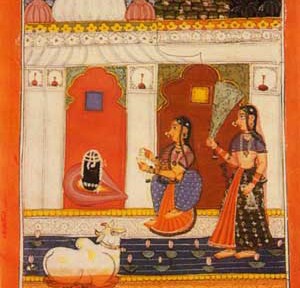
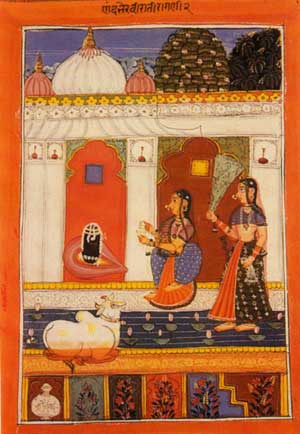
Ragmala Painting of Rag Bhairavi (circa A.D. 1725) (Pic courtesy: chandrakantha.com)
There are many Hindi films music directors who used Raag Bhairavi to base their songs. The most ardent of them were Shankar Jaikishen; so much so that when Jaikishen’s daughter was born she was named Bhairavi after their favourite Raag.
Song #1 Awaara hoon….
We start our journey into the Best Raaga based songs in Hindi movies with this song from the 1951 Raj Kapoor and Nargis starrer movie Awara that was also produced and directed by Raj Kapoor.
This song in Raag Bhairavi became an international hit. The song was written by Shailendra and sung by Mukesh.
aabaad nahii.n barabaad sahii
gaataa huu.N khushiike gIt magar – 2
zakhmo.n se bharaa siinaa hai meraa
ha.nsatii hai magar ye mast nazar
duniyaa .a.a.a
duniyaa me.n tere tiir kaa yaa takadiir kaa maaraa huu.N
aavaaraa huu.N, aavaaraa huu.N
yaa gardish me.n huu.N aasamaan kaa taaraa huu.N
aavaaraa huu.N, aavaaraa huu.N
https://youtube.com/watch?v=VY1pWTek2sY%3F
Song #2 Naache man moraa, magan, dhiigadhaa dhiigii dhiigiiIn this song, I have taken the same Lyricist Shailendra as in Awaara hoon song, but with a different music director: SD Burman. The 1963 movie Meri Soorat Teri Aankhen was a classic as far as its songs were concerned. In addition to this song there were: Tere bin soone nayan hamaare and Puuchho na kaise maine rain bitaayi.
These songs came about in the following story line:
Raj Kumar (Ishwarlal) is a wealthy businessman and dislikes everything ugly. When his wife, Kamla (Achla Sachdev), becomes pregnant and gives birth to an ugly son, he asks the attending Dr. Mathur (Tarun Bose) to inform his wife that their child was still-born. Dr. Mathur places the child in the hands of Rahmat (Kanhaiyalal Chaturvedi) and his wife, Naseeban (Paro), who welcome him with open arms. But misfortune follows them, as the child, who is named Pyare (Ashok Kumar), accidentally burns their dwelling down, killing Naseeban. Rahmat then re-locates to his village when he teaches Pyare the skills required to play musical instruments and sing. Years later, Rahmat passes away, and informs Pyare that he is really a Hindu. Dr. Mathur fills the rest of the blanks for Pyare, and arranges a song and dance play and hopes that Raj will overcome his dislike for his now-grown son. But that does not happen, instead, Raj offers to pay some compensation so that Pyare can look after himself. When Pyare goes to Raj to return the money, Kamla sees him and asks him not to leave and ……
The tragedy of this song is that Pyare (Ashok Kumar) gets the impression that Kavita (Asha Parekh) is probably in love with him and his inner beauty. She loves his inner beauty but is actually in love with Sudhir Kumar (Pradeep Kumar). Pyare (Ashok Kumar) at the end of the movie sacrifices his own life in order to safeguard theirs.
Please enjoy in Raag Bhairavi, Tal: Tintal/Kaherava the most beautiful composition by SD Burman: Naache man mora….
aa aa aa…
naache man moraa, magan, dhiigadhaa dhiigii dhiigii -2
badaraa ghir aaye, rut hai bhiigii bhiigii
naache man moraa magan, dhiigadhaa dhiigii dhiigii -2
dhiigadhaa dhiigii dhiigii, dhiigadhaa
bansuri: tana~~N … tan tan tan tuu~~~~N tuu
sitar: tain tain tain, tataNtaN, tataNtaN, tataNtaN, tataNtaN
kuhuke koyaliyaa, kuhuke koyaliyaa, kahii.n duur papiihaa pukaare
daNaNaNaNaNaN
jhuulaa jhuule.n sakhiyaa.N, jhuulaa jhuule.n sakhiyaa.N, ke ghar aajaa baalam hamaare
ghir aaye, badaraa ghir aaye, rut hai bhiigii bhiigii
naache man moraa, magan, dhiigadhaa dhiigii dhiigii
naache re man moraa re
naache man moraa, magan…
tan ta tan taNa tanatu tan~~ tanatu
tainta taiN, tainta taiN
yahii.n ruk jaaye, yahii.n ruk jaaye, ye shaam aaj Dhalane na paaye
daNaNaNaNaNaN
TuuTe na ye sapanaa, TuuTe na ye sapanaa, ko_ii ab mujhe na jagaaye
ghir aaye, badaraa ghir aaye, rut hai bhiigii bhiigii
naache re man moraa, dhiigadhaa dhiigii dhiigii
e, naache man moraa re
naache man moraa, magan…
chhup chhup aise me.n, chhup chhup aise me.n, ko_ii madhur giit gaaye
chhanchhanchhanchhan chhananchhan
giito.n ke bahaane, giito.n ke bahaane, chhupii baat ho.nTho.n pe aaye
ghir aaye, badaraa ghir aaye, rut hai bhiigii bhiigii
naache re man moraa, dhiigadhaa dhiigii dhiigii
e, naache man moraa, aa aa
naache man moraa, magan…
https://youtube.com/watch?v=CI0QTW4_iBc%3F
Song #3 Do hanson kaa joda bichhud gayo re…
I have given you many a bolg-post by the greats of the Hindi movie industry: Shakeel Badayuni as lyricist and Naushad Ali as the music director. Some of the finest songs in Hindi movies have been courtesy this pair. Naushad Ali’s larger family didn’t like his delving into music and he had to hide the fact of his composing music from them. And yet, he emerged as one of the greatest music directors in Hindi films. His compositions were often based on Raagas. Indeed, in his movie Baiju Bawra, the only movie in which he received the Filmfare Best Music Director award, each one of the 12 songs and a sargam is based on a Raaga. He was also adept in Western instruments such as accordion, clarinet and mandolin in his compositions and he has been credited with bringing Western musical notations into Indian Raagas.
This song from the 1961 movie Ganga Jamuna starring Dilip Kumar and Vyjaynthimala is a classic in Raag Bhairavi. It is penned by Shakeel Badayuni and sung by Lata Mangeshkar.
Please enjoy in Raag Bhairavi: Do hanson kaa jodaa bichhud gayo re….
Do hanso kaa joda bichhad gayo re
Gajab bhayo rama, julam bhayo re
Gajab bhayo rama, julam bhayo re
Do hanso kaa joda bichhad gayo re
Gajab bhayo rama, julam bhayo re
Mora sukh chain bhee, jivan bhee mora chhin liya
Papee sansar ne sajan bhee mora chhin liya
Piya bin tadape jiya, ratiya bitau kaise
Biraha kee aganee ko asuan se bujau kaise
Jiya mora mushkil me pad gayo re
Gajab bhayo rama, julam bhayo re
Gajab bhayo rama, julam bhayo re
Rat kee aas gayee, din kaa sahara bhee gaya
Mora suraj bhee gaya, mora sitara bhee gaya
Parit kar ke kabhee paritam se naa bichhade koyee
Jaisee ujadee hoo mai, ayese bhee naa ujade koyee
Bana khel mora bigad gayo re
Gajab bhayo rama, julam bhayo re
Gajab bhayo rama, julam bhayo re
Jite jee chhodungee saiyya naa dagariya toree
Bit jayegee yuhee saree umariya moree
Naino se hotee rahegee yuhee barsat balam
Yad me rotee rahungee teree dinarat balam
Nagar more man kaa ujad gayo re
Gajab bhayo rama, julam bhayo re
Gajab bhayo rama, julam bhayo re
Do hanso kaa joda bichhad gayo re
Gajab bhayo rama, julam bhayo re
Gajab bhayo rama, julam bhayo re.
https://youtube.com/watch?v=qSbMdrP5xbI%3F
Song #4 Gareeb jaan ke hamako na tum….
In our new series yesterday: ‘The Best Raaga Based Songs in Hindi Movies’, we started with one of the most popular Raagas in Hindi movies: Bhairavi or Sindh Bhairavi or Sindhu Bhiaravi.
In the first song, I told you that it was the favourite Raaga of the most accomplished duo of Shankar – Jaikishen. However, in addition to their song Awaara hoon as an example, I gave you songs of SD Burman (Naache man mora) and Naushad (Do hanson ka joda).
Lets now take up other music directors composing in Raag Bhairavi.
The first of these is OP Nayyar. Even though Raag Pilu and Pahadi were his favourites, he did delve in Bhairavi too.
I love this song of his from the 1956 movie Chhoo Mantar penned by Jaan Nisar Akhtar. OP Nayyar was one director who made some excellent songs for the comedian Johnny Walker. Here, though, he is the hero as Baiju or Baijnath singing to Anita Guha as Ratnavali.
Please enjoy Mohammad Rafi singing in Raag Bhairavi: Gharib jaan ke hamako na tum daga dena….
gariib jaan ke ham ko na tum daGaa denaa
tumhii.n ne dad.r diyaa hai tumhii.n davaa denaa
gariib jaan ke …
lagii hai choT kaleje pe umr bhar ke liye
ta.Dap rahe hai.n muhabbat me.n ik nazar ke liye
nazar milaake
nazar milaake nazaro.n se na tum giraa denaa
tumhii.n ne dad.r diyaa hai …
tumhaarii yaad ham.en har gha.Dii sataayegii
tumhaare bin to hame.n maut bhii na aayegii
tumhaarii yaad ko
tumhaarii yaad ko mushakil hai ab bhulaa denaa
tumhii.n ne dad.r diyaa hai …
https://youtube.com/watch?v=v_0Umxyv7o0%3F
Song #5 Laaga chunri mein daag…..
In the last series, I introduced Roshan (Roshanlal Nagrath) to you quite late in the 1960 movie Barsaat Ki Raat. Here I am re-introducing him quite early by giving you one of the best songs composed in Raag Bhairavi.
Roshan was born on 14th Jul 1917 and lived only for little more than 50 years. He died on 16th Nov 1967, much before many of his modern day fans were even born. And yet, such is his legacy that we listen to his compositions with the same gusto even today. He was the father of actor Rakesh Roshan and music director Rajesh Roshan and the paternal grandfather of actor Hrithik Roshan.
As with most Roshan’s songs, this song’s lyrics were penned by Sahir Ludhianvi. The voice is that of Manna Dey singing for Raj Kapoor in disguise as an old man. The name of the movie is the 1963 movie Dil Hi To Hai wherein Raj Kapoor acts opposite Nutan.
Please enjoy: Laaga chunari mein dag chhupayun kaise….
(ho ga_ii mailii morii chunariyaa
kore badan sii korii chunariyaa ) – 2
aa … jaake baabul se, nazare.n milaaU.N kaise, ghar jaaU.N kaise
laagaa, chunarii me.n daag …
bhuul ga_ii sab bachan bidaa ke
kho ga_ii mai.n sasuraal me.n aake
aa … jaake baabul se, nazare milaaU.N kaise, ghar jaaU.N kaise
laagaa, chunarii me.n daag …
(korii chunariyaa aatmaa morii
mail hai maayaa jaal ) – 2
vo duniyaa more bAbul kaa ghar
ye duniyaa sasuraal
haa.N jaake, baabul se, nazare milaaU.N kaise, ghar jaaU.N kaise
laagaa, chunarii me.n daag …
aa aa~
dhiim ta na na na dir dir taanum
taa na dere na
dhiim ta na na na dir dir taan, dhiim ta dere na …
sapt suran tiin graam ba.nsii baajii
dir dir taanii, taa nii nii da, nii da pa ma, pa ma ma ga
ma dha ga ma ma ga re sa
dha dha keTe dha dha dha keTe dha dha keTa dha keTa
dharat paag pa.Dat nayii paraN
jhaa.Njhar jhanake jhana nana jhana nana
dir dir ta tuum ta da nii, ta na na na ta na na na
dhiim ta na na na na dir dir taam …
Song #6 Hamein tumase pyaar kitana ye ham nahin jaanate….
You are bound to ask me if RD Burman ever composed in Raag Bhairavi. Of course he did; all Hindi music directors did.
RD Burman was as strong in Raagas as his father SD Burman. His very first Lata Mangeshkar song in the Hindi movies was for Chhote Nawab composed in a little known Raag Malgunji. And, what a song it was: Ghar aaja ghir aaye badra saanwariya…
Here is a song close to my heart both for its lyrical excellence by Majrooh Sultanpuri and its composition in Raag Bhairavi by Rahul Dev Burman. It is from the 1981 movie Kudrat starring Rajesh Khanna and Hema Malini. Kishore Kumar and Parveen Sultana have sung it.
Please enjoy: Hamen tumase pyaar kitana ye ham nahin jaanate…
hame.n tum se pyaar kitanaa, ye ham nahii.n jaanate
magar jii nahii.n sakate tumhaare binaa
hame.n tum se pyaar …
sunaa gam judaaI kaa, uThaate hai.n log
jaane zi.ndagii kaise, bitaate hai.n log
din bhii yahaa.N to lage, baras ke samaan
hame.n i.ntazaar kitanaa, ye ham nahii.n jaanate
magar jii nahii.n sakate tumhaare binaa
hame.n tum se pyaar …
tumhe.n koI aur dekhe, to jalataa hai dil
ba.Dii mushkilo.n se phir, sambhalataa hai dil
kyaa kyaa jatan karate.n hai.n, tumhe.n kyaa pataa
ye dil beqaraar kitanaa, ye ham nahii.n jaanate
magar jii nahii.n sakate tumhaare binaa
hame.n tum se pyaar …
hame.n tum se pyaar kitanaa, yah ham nahii.n jaanate
magar jii nahii.n sakate tumhaare binaa
hame.n tum se pyaar kitanaa …
mai.n to sadaa kii tumharii diivaanii
bhuul gaye sai.nyaa.N priit puraanii
kadar naa jaanii, kadar na jaanii
hame.n tum se pyaar kitanaa …
koii jo Daare tumape nayanavaa
dekhaa naa jaaye mose sajanavaa
jale moraa manavaa, jale moraa manavaa
hame.n tum se pyaar kitanaa …
https://youtube.com/watch?v=iJllh7l-D3g%3F
Song #7 Dil ka khilauna haay toot gaya….
Lets now move on to music director Vasant Desai. As you already know, he composed most of his songs on the lyrics of Bharat Vyas. This one too has been penned by him. It is from the 1956 movie Goonj Uthi Shehnai starring Rajendra Kumar, Anita Guha and Ameeta.
Here is Lata Mangeshkar singing this heart-rending song in Raag Bhairavi: Dil ka khilauna haye toot gaya…..
TuuT gayaa -2
dil kaa khilaunaa haay TuuT gayaa -2
ko_ii luTeraa aa ke luuT gayaa
haay ko_ii luTeraa aa ke luuT gayaa
dil kaa khilaunaa haay TuuT gayaa -2
hu_aa kyaa qusuur aisaa sai.nyaa.N hamaaraa -2
jaate huye jo tuune hame.n naa pukaaraa -2
ulfat kaa taar to.Daa
hame.n majhadhaar chho.Daa
ham to chale the le ke teraa hii sahaaraa
saathii hamaaraa hamase chhuuT gayaa
dil kaa khilaunaa haay TuuT gayaa -2
ko_ii luTeraa aa ke luuT gayaa
haay ko_ii luTeraa aa ke luuT gayaa
haay dil kaa khilaunaa haay TuuT gayaa
dil kaa khilaunaa haay TuuT gayaa
aa
kaisii paradesii tuune priit lagaa_ii -2
chain bhii khoyaa hamane nii.nd ga.Nwaa_ii -2
teraa aitabaar kar ke
haay i.ntazaar kar ke
Kushiyo.n ke badale Gam kii duniyaa basaa_ii
zaalim zamaanaa hamase ruuTh gayaa
dil kaa khilaunaa haay TuuT gayaa
ko_ii luTeraa aa ke luuT gayaa
haay ko_ii luTeraa aa ke luuT gayaa
haay dil kaa khilaunaa haay TuuT gayaa
dil kaa khilaunaa haay TuuT gayaa
https://youtube.com/watch?v=NVm6nzbQRsY%3F
Song #8 Mujhako is raat ki tanhaayi mein awaaz naa do….
You must have been stunned by the musical excellence of the last song composed by Vasant Desai and you must be thinking that nothing can be better than Dil Ka Khilauna haye toot gaya.
Okay, now taste this composed by Kalyanji Anandji and you would change your opinion. First of all its lyrics by Shamim Jaipuri are out of this world. On top of that Mukesh has sung it with matching passion. And lastly it is picturised on Dharmendra who acted on such songs rather well.
By this time you must have guessed the name of the movie. Yes, it is the 1960 movie Dil Bhi Tera Hum Bhi Tere, the debut film of Dharmendra made by Arjun Hingorani.
Please enjoy: Mujhako is raat ki tanhaayi mein awaaz na do….
mujh ko is raat kii tanahaaii me.n aavaaz na do
jisakii aavaaz rulaa de mujhe vo saaz na do
aavaaz na do…
mai.nne ab tum se na milane kii kasam khaaii hai
kyaa khabar tumako merii jaan pe ban aaii hai
mai.n bahak jaauu.N kasam khaake tum aisaa na karo
aavaaz na do…
dil meraa Duub gayaa aas merii TuuT ga_ii
mere haatho.n hii se patavaar merii chhuuT ga_ii
ab mai.n tuufaan me.n huu.N saahil se ishaaraa na karo
aavaaz na do…
raushanii ho na sakii laakh jalaayaa hamane
tujhako bhuulaa hii nahii.n laakh bhulaayaa hamane
mai.n pareshaa.n huu.N mujhe aur pareshaa.n na karo
aavaaz na do…
kis kadar roz kiyaa mujhase kinaaraa tumane
koii bhaTakegaa akelaa ye na sochaa tumane
chhup gae ho to kabhii yaad hii aayaa na karo
aavaaz na do…
https://youtube.com/watch?v=pcr1Hh9OFd0%3F
Song #9 Mori chham chham baaje paayaliya……
I have given you two sad songs tonight composed in Raag Bhairavi by Vasant Desai (Dil ka khilauna haye toot gaya) and Kalyanji Anandji (Mujhko is raat ki tanhaayi mein). It is time to give you a happy swinging one now, composed by our ninth music director: Ravi.
If you have noticed a tendency in me to get back to Shakeel Badayuni, then you have noticed correctly; because he is my favourite lyricist. This time though, he is not with Naushad but with Ravi. The name of this 1960 movie is Ghunghat and the song has been sung by Lata Mangeshkar.
Please enjoy in Raag Bhairavi: Mori chham chaa, baaje payaliya….
( ba.Dii muddat me.n dil ke sahaare mile
aaj Duube hu_o.n ko kinaare mile ) -2
kabhii muskraa_e man kabhii sharamaa_e man
kabhii naino.n kii chhalake gaagariyaa
morii chham-chham …
( chaa.Nd-taaro.n ke gahane pahanaa do mujhe
ko_ii aa ke dulhaniyaa banaa do mujhe ) -2
nahii.n bas me.n jiyaa kaisaa jaaduu kiyaa
piyaa aaj hu_ii re mai.n to baavariyaa
morii chham-chham …
Song #10 Ab tere siwa kaun meraa Krishan kanhaiyya….
Lets take up compositions of some older music directors now. The first of these is Anil Biswas who introduced Western notations for Indian Films music for the first time. He was born on 7th Jul 1914 and we lost him on 31st May 2003. He had the first orchestra to his credit, albeit only 12 pieces. He is renowned as one of the pioneers of playback singing in Hindi films
I have taken this from his 1943 movie Kismat. The lyrics are by Kavi Pradeep, Anil Biswas’s contemporary and much recognised for his Ai mere watan ke logo. And the singer is Amirbai Karanataki. Amirbai preceded them by about 9 years and died in Mar 1965. She was a singer and actress of repute those days and her most popular piece was the favourite of Mahatama Gandhi: Vaishanav jan to…
Please enjoy: Ab tere siwa kaun mera, Krishan Kanhaiyya….
( ab tere siwaa
ab tere siwaa kaun meraa kR^iShN kanhaiyaa
bhagawaan kinaare se lagaa de merii naiyaa ) -2
ab tere siwaa
( merii Kushii kii duniyaa baabul ne chhiin lii
mere sukho.n kii kaliyaa.N qismat ne biin lii ) -2
ab tuu hii bachaa laaj merii bansii-bajaiyaa
bhagawaan kinaare se lagaa de merii naiyaa
ab tere siwaa
puujaa nahii.n hai puurii adhuurii hai aaratii -2
o shyaam salone tujhe miiraa pukaaratii -2
tujhe miiraa pukaaratii
kahatii hai baar-baar wo le-le ke balaiyaa -2
bhagawaan
bhagawaan
bhagawaan kinaare se lagaa de merii naiyaa
ab tere siwaa
ab tere siwaa kaun meraa kR^iShN kanhaiyaa
bhagawaan kinaare se lagaa de merii naiyaa
ab tere siwaa
https://youtube.com/watch?v=0r38temWGzw%3F
Song #11 Baabul mora naihar chhooto hi jaye…
We are now taking our earliest music directors who composed Hindi songs in Raag Bhairavi. RC Boral was one of them and composed music for some of KL Saigal‘s songs.
This one is from Saigal’s 1938 super hit movie Street Singer in which he starred in the title role and as was usual for him, sang for himself. Wajid Ali Shah penned the lyrics. RC Boral was an even older music director than Anil Biswas. Rai Chand Boral was born on 19 Oct 1903 and died on 25 Nov 1981. Three years before dying the highest film award, the Dadasaheb Phalke award was conferred on him for his contribution to Hindi cinema. He is credited with being the first one who introduced playback singing in Hindi films with the 1935 movie Dhoop Chhaon.
It also happens to be the most popular of KL Saigal’s songs. KL Saigal was the first singing – superstar of the Hindi movies
Please enjoy in Raag Bhairavi: Baabul mora naihar chhuuto hi jaaye….
baabul moraa, naihar chhuuTo hii jaae
baabul moraa, naihar chhuuTo hii jaae
aa.Nganaa to parbat bhayo aur deharii bhayii bidesh
je baabul ghar aapanaa mai.n piiyaa ke desh
baabul moraa …
baabul moraa, naihar chhuuTo hii jaae
baabul moraa, naihar chhuuTo hii jaae
https://youtube.com/watch?v=ouheLTzfeBc%3F
Song #12 Ai quatib-e-taqdeer mujhe itana bata de…..
Now, lets take up Pankaj Mullick. This is from KL Saigal’s 1944 movie Meri Behan (My Sister). Please forgive me that the only video that I could find has the remaining part of another song before this song starts. Pankaj Mullick was born on 10th May 1905 in Kolkatta and like Anil Biswas and RC Boral, he was peioneer in playback singing in India. He was conferred with the Padma Shri in 1970 and two years later the highest award in films: the Dadasaheb Phalke award. The first Hindi movie that he worked for was the 1933 Yahudi Ki Ladaki.
Pt Bhushan penned the lyrics and KL Saigal sang for himself.
Please enjoy: Ai qaatib-e-taqadiir mujhe itana bataa de…
ai qaatib-e-taqadiir mujhe itanaa bataa de -2
kyo.n mujhase Kafaa hai tuu, kyaa mai.nne kiyaa hai
auro.n ko khushii mujhako fakat dard-o-ra.nj-o-Gam
duniyaa ko ha.Nsii aur mujhe ronaa diyaa hai
kyaa mai.nne kiyaa hai -2
kyo.n mujhase Kafaa hai tuu, kyaa mai.nne kiyaa hai
hisse me.n sabake aa_ii hai.n…
hisse me.n sabake aa_ii hai.n ra.Ngiin bahaare.n
bad-faqtiyaa.N lekin mujhe shiishe me.n utaare.n
piite hai.n
piite hai.n rog roz-o-shab muzzarrato.n kii may
mai.n huu.N ke sataa khuun-e-jigar mai.nne piyaa hai
kyaa mai.nne piyaa hai
kyaa mai.nne piyaa hai
thaa jinake dumak dam se ye aabaad aashiyaa.n
ho chahachahaatii
ho chahachahaatii bulabule.n jaane ga_ii kahaa.N
juganuu kii chamak hai na sitaaro.n kii roshanii
is ghup a.ndhere me.n hai merii jaan par banii
kyaa thii
kyaa thii
kyaa thii bataa ke jisakii sazaa tuune mujhako dii
kyaa thaa
kyaa thaa gunah ke jisakaa badalaa mujhase liyaa hai
kyaa mai.nne kiyaa hai
kyaa mai.nne kiyaa hai
kyo.n mujhase Kafaa hai tuu, kyaa mai.nne kiyaa hai
https://youtube.com/watch?v=nXSNJnB5Rfw%3F
That brings us to the end of the First Part of Raag Bhairavi based songs. We have another two parts that I shall be putting up shortly. I hope you enjoyed the songs I put together for you so far. Please await the next part.
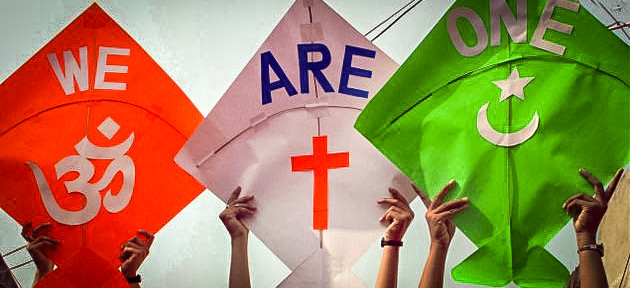
After US President Barrack Obama’s last visit to India in Jan 2015, when he was the chief guest at our Republic day parade, I wrote an article titled ‘Is Communal Disharmony A Challenge To India’s March To Greatness?’ Talking to Delhi University students, he brought out that “No society is immune from the darkest impulses of men,” said Obama. “India will succeed so long as it is not splintered along the lines of religious faith.” I had traced the history of exploitation of religion and religious disharmony in India and had concluded that five diverse reasons existed for latent religious disharmony in India manifesting into large-scale unrest and violence that would undermine India taking its rightful place as an emerging economic and political power.
It has been eight months since I wrote the article. Lets take stock of how far have we reached in the politicisation of religion and secularism. Lets start in the news item of 22 Sep 15, in Hindustan Times:
‘The Rashtriya Swayamsevak Sangh (RSS) believes the concept of being secular was “irrelevant” in the Indian context and the “artificial injection of secularism” was not needed in a social order as hospitable and assimilative as Hindu society.
Sangh publicity chief Manmohan Vaidya said at an event in Chennai that Bharatiya or Indian tradition has from time immemorial regarded all faiths and sects as one.
“Secularism evolved along the themes of separation of the church and state in Europe and since India doesn’t have a history of theocratic states, the concept of secularism is irrelevant in the Indian context,” he said addressing more than 80 columnists from the southern states at an RSS-organised seminar last weekend.
Vaidya’s remarks closely follow RSS chief Mohan Bhagwat’s suggestion to set up a committee to review reservation system. This remark has already evoked sharp political reactions.
“Perversion of the concept of secularism in India has resulted in the terming of nationalists as communal and people with communal thinking being hailed as secular,” Vaidya said in the presence of RSS general secretary Suresh Bhaiyaji Joshi, the second-most powerful man in the outfit which is the BJP’s ideological mentor.’
One would like to believe these proclamations at face value; more so if one belongs to what once was the most benign, inclusive and reasonable religion in the world: Hinduism. However, in the past few decades of Congress rule, and in the more recent BJP rule, the divisive forces are being constantly fanned over what should be non-issues. The result is that over the electronic media, the minorities have openly started saying that they feel uncomfortable and insecure.
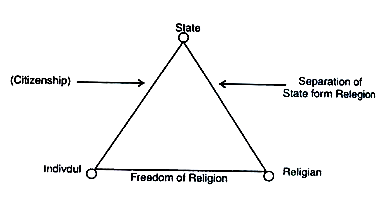
Take a look at the following illustrative diagram:
Despite the obvious spelling mistakes in the diagram, I found it illustrative of how the state must keep clear of religion and individual choices. Yes, as Manmohan Vaidya said, we don’t have a history of theocratic states. But, the state’s interference in matters of religion and individual choices has been on the increase. All political parties in India exploit religions as possible vote-banks. That’s precisely the reason why pooja-pandals have smaller pictures of the gods for whose collective worship the pandals have been made but much larger pictures of the political leaders sponsoring the pandals. One would want to hear from Manmohan Vaidya why wouldn’t the political parties in India leave religion to the people? Why would a BJP MLA make open and publicized remarks against the High Court’s curbs on noise during religious festivals by saying that the courts should respect people’s freedom of religious practices? Why does a political leader feel compelled to be a spokesperson for a particular religion if, as Vaidya said, we do not have, like the Europeans, the merging of the church and the state? Talking about the church, a government functionary in south India preaching the teachings of Christ in his official duties is as bad as the state getting involved in what is euphemistically called respecting the religious sentiments of the people (Please also read ‘State Sponsored Noise’ and ‘Who Are The People Whose Sentiments Need To Be Respected?‘)
I have read any number of articles on the net and otherwise extolling the virtues of idol-worship in India. The virtues range from child like innocence and purity of approach when a person stands reverently in front of an idol in total submission to how the idols help us to concentrate and stay focused. All very well and I would have been for it. However, when the same idol-worship, that should have been a private and personal affair becomes politically exploited communal affair, there are great challenges and dangers. Some of these are:
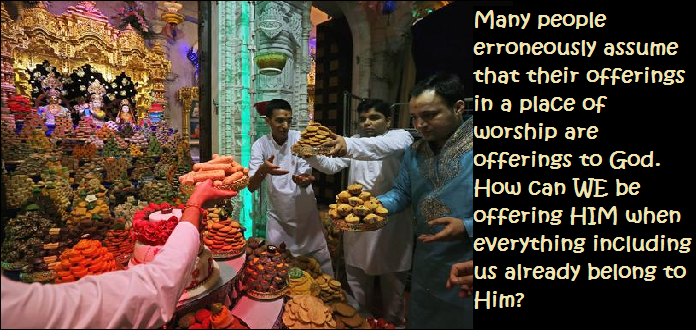
1. Keeping People From Scholarly Pursuits. Hinduism, the religion that I respect most, is all about scholarly pursuits. I wrote in my ‘A Quieter Mumbai – Is It A Pipedream?‘ that the name of the country Bharat is a combination of two Sanskrit words Bha (Knowledge) and Rat (Absorbed in); and that Bharat literally means a country whose people are absorbed in knowledge. People collectively always seek the easy way out and hence most rituals in religion abound in which people can be easily swayed to join. For example, our priests openly exhort us to offer to an idol thinking of the idol as the real God. Scholars are supposed to reason out things; our religion is perhaps the only religion that has encouraged reasoning (Arjuna did it with our Lord Krishna even in the battlefield). So, if you reason out such offerings to the idols, you would conclude, as I did on my page ‘Make Your Own Quotes’:
When the Chinese pilgrims Fa-Hein and Huien-Tsang visited India in the 5th and 7th centuries AD (during the Gupta dynasty), they were impressed by the scholarly pursuits of our people and Brahmins. Indeed, Baidyanath Saraswati has brought out in ‘Swaraj in Education’ how Kashi (now Varanasi or Benaras) grew into a great seat of learning surpassing other civilisational centres of the world including Rome and Mecca. Except for Bihar, they didn’t find a single place in the entire route of their pilgrimage in India where idol worship was being performed. Whenever, people deviated from the scholarly religious pursuits our religious leaders tried to bring us back such as Swami Vivekananda and Guru Nanak.
Take the latter, Guru Nanak, for example. The incident at Jagannath Puri, just before the annual rath yatra has Guru Nanak being invited for the Aarti at the temple has been recorded in our history.
The Guru visited the temple not to offer Aarti to Lord Krishna but to teach the people that the worship of God is superior to the worship of the deity. It was the evening time and the priests brought a salver full of many lighted lamps, flowers, incense and pearls and then all stood to offer the salver to their enshrined idol-god. The ceremony was called ‘Aarti’, a song of dedication. The high-priest invited the Guru to join in the god’s worship. The Guru did not join their service which enraged the priests. On being asked the reason the Guru explained that a wonderful serenade was being sung by nature before the invisible altar of God. The sun and the moon were the lamps, placed in the salver of the firmament and the fragrance wafted from the Malayan mountains was serving as incense. The Guru, therefore, instead of accepting the invitation of the high-priest to adore the idol, raised his eyes to the heaven and exhorted people to worship God directly rather than through the idol of God.
The sad part is that a small percentage of Hindus chose to become Sikh (learned or taught) and chose the easy way out to form a separate religion rather than to seek religious reforms from within.
2. Environmental and Other Damages. There is a great deal of debate, for example, on the environmental degradation due to visarjan of the huge idols, for example, particularly of our water bodies. In congested cities and towns (and we have only that variety), traffic problems get multiplied during such public idol-worship due to both: the pandals coming up on the roads and the almost everyday processions. Noise that affects us all aurally and adding to hygiene and medical problems is now too large to be ignored. Many of our people are now becoming gradually deaf.
3. Dangerous Trend of Intolerance. Most right-minded and sane minded people feel that such public show of idol worship is as far from religion as we can get and is only with vested commercial and political interests. However, such is the demonstrated intolerance of the mobs that are exploited for these that most of these people have to now cower in fear of violence. Imagine religion leading to violence! However, when mobs do such things that should be individual and personal and private choices, reason is often the victim. Such competitive intolerance amongst communities does no good to people but is the bread and butter of politicians and those who have to gain by dividing people along religious lines.
4. Keeping Us From Our Obligation towards Humanitarian Issues and Causes. Yes, idol-worship does provide focus to us. However, now a stage has reached when we can do without such focus. Recently, we have found out through the audits of the four largest temples in India that the offerings in these temples are enough to feed our country for the next 200 years. And yet, we have the largest number of poor in the world in India. In Human Growth Indices our country ranks a lowly 140 or so. The conclusion to be drawn is that our people would do anything to save their own souls by offering to the idols in the temples rather than giving directly to people in need. That’s utterly selfish use of idol-worship, diametrically opposite of the virtues that are extolled in all the articles that I have read.
5. Not in Keeping with the Times. There are other religions which opposed reforms and tried to become as medieval as possible. A flagrant example of these is Jihad in the name of God. We, on the other hand, were much better off with assimilation of modernity in our thoughts whilst doing away with anti-social traditions such as Sati, Untouchability, and Child-marriage. The open idol-worship (as opposed to personal and private) is taking us backwards to medieval times. As I wrote in my ‘Whose God Is It Anyway?’:
‘God is within us and all around us. We neither have to go to mountains, nor churches, mosques and temples to worship Him or Her. Collective worshipping of God or gods helps no one except to divide communities (who are also the same God’s creations and hence related to us) and only helps the politicians or so called custodians of faith who thrive from such polarization.’
If you read the full article, you will agree with me that the reasons to have collective worship of God or gods no longer exist. Religion and such devotion should increasingly become private and personal, if at all.
The need of the hour is for us individually and collectively engage ourselves in poverty-alleviation programmes, education of the deprived and infrastructure building rather than dissipating time, energy and effort in telling God to save us and our should or our community or our nation.
Goodness is another name for God and is the most relevant in the modern times.
Raahi or Mussafir (wayfarer or journeyer) is a beautiful word in Hindi and Urdu and is used in songs not just in its ordinary meaning but also in a deeper meaning, that is, a wayfarer in quest of something. Have a look at this quote from my page on Facebook: Make Your Own Quotes:
Often the word Raahi or Mussafir is used as Pyaar Ka Raahi or to describe oneself as a tramp such as in Main rangeela pyaar ka raahi door meri manzil; and Mussafir hoon yaaron na ghar naa thikana.
Lets begin our journey into the best Raahi or Mussafir songs.
As soon as we think of Raahi, we are reminded of Kishore Kumar: Singer, Lyricist, Music Director, Producer, Director, and Story and Screenplay Writer. He was so versatile and so full of energy. Most commonly, he was the comedian and light-hearted romantic. However, his own two movies as a producer and director: the 1964 movie Door Gagan Ki Chhaon Mein and 1971 movie Door Ka Raahi bring out his inner quest as a Raahi.
Song #1
Door Ka Raahi is a 1971 film not just produced and directed by Kishore Kumar, but it has his music, story and screenplay besides his singing. The film is essentially a one man show but also stars the young boy Amit, Kishore da’s son, who appeared with him in his 1964 movie Door Gagan Ki Chhaon Mein too, Abhi Bhattacharya, Tanuja, Padma Khanna and his eldest brother Ashok Kumar in supporting roles. The film depicts Kishore Kumar’s quest for a world free of poverty, violence, and inequalities. Kishore Kumar does manage to convey the image of an ideal humanity. He is Prashant in the film who is journeying all the while to bring relief to the humanity that he comes in touch with. As per the promise given by him to his swami, he can’t even think of resting until he has accomplished what he set out to do; somewhat similar to Robert Frost’s: And miles to go before I sleep.
This song from the movie tells about his quest as Raahi or Panthi. It has been penned by A Irshad, the only movie in which Irshad was the lyricist. During one of his journeys Ashok Kumar as Joseph wants Kishore Kumar as Prashant to stay on and marry his widowed daughter-in-law Tanuja as Monica. That’s the time, through this song, Kishore Kumar explains to him what kind of wayfarer is he and why.
Please enjoy: Panthi hoon main us path ka, ant nahin jisaka….in Raag Bhimpalasi or Bhimpalashri….
Pa.nthii huu.N mai.n us path kaa
a.nt nahii.n jisakaa
aas merii hai jisakii dishaa
aadhaar mere man kaa
Sa.ngii saathii mere
a.ndhiyaare ujiyaare
mujhako raah dikhaaye.n
palachhin ke phulajhaare
pathik mere path ke sab taare
aur niilaa aakaash
pa.nthii …
Is path par dekhe kitane
sukh dukh ke mele
phuul chune kabhii khushiyo.n ke
kabhii kaaTo.n se khele
jaane kab tak chalanaa hai
mujhe is jiivan ke saath
pa.nthii …
https://youtube.com/watch?v=gdP3_1lU91s%3F
Song #2
Raj Kapoor thought of himself as Joker, Chhalia, Raju etc; Dev Anand said his naam was Johnny. What would Kishore Kumar have liked to be remembered for? He was, as I said, a versatile: Actor, Producer, Director, Lyricist, Music Director, Screenplay and Story Writer and Singer. And yet he thought of himself as Raahi, on the journey to seek Love, Humaneness, Goodness. In his 1964 movie Door Gagan Ki Chhaon Mein, he sought a utopian world for his mute child (Aa chal ke tujhe main le ke chalun ik aise gagan ke tale, jahan gam bhi na ho, aansu bhi na ho, bus pyaar hi pyaar pale). The movie had, arguably, the best Raahi song ever written “Raahi to mat ruk jaana“. Kishore da’s music and Hemant Kumar’s singing makes the journey of us travelers (Raahi) to be similar to a brook’s (Alfred Tennyson’s famous poem: no jokes, close your eyes and listen to the music and it is representative of a brook!). The great Lyricist Shailendra penned these inspirational lyrics.
The movie is about an ex-Army officer Shankar (played by Kishore Kumar) seeking a decent life and cure for his son Ramu (played by his real son Amit Kumar) against all odds.
Please enjoy: Raahi tu mat ruk jaana…..
Raahii tuu mat ruk jaanaa, tuufA.n se mat ghabaraanaa
kabhii to milegii terii ma.nzil
kahii.n duur gagan kii chhAo.n me.n
Maanaa ki gaharii hai dhaaraa
par hai kahii.n to kinaaraa
tuu bhii milaa aashaa ke sur me.n
man kaa ye ekataaraa
kabhii to milegii terii ma.nzil
kahii.n duur gagan kii chhAo.n me.n
Sabakaa hai uuparavaalaa
sabako usii ne sambhaalaa
jab bhii ghire Gam kaa a.ndheraa
usane kiyaa ujiyaalaa
kabhii to milegii terii ma.nzil
kahii.n duur gagan kii chhAo.n me.n
Raahii tuu mat ruk jaanaa, tuufA.n se mat ghabaraanaa
kabhii to milegii terii ma.nzil
kahii.n duur gagan kii chhAo.n me.n
kahii.n duur kahii.n duur kahii.n duur kahii.n duur
https://youtube.com/watch?v=eoJkiN0Nex8%3F
Song #3
Mehboob Khan made a movie on the theme of woman who has to face all odds fighting the ills of the society; the 1940 movie Aurat. He repeated the theme in his 1957 movie Mother India starring Nargis in the title role and helped by Rajendra Kumar, Sunil Dutt, and Raaj Kumar. The movie had as many as 12 songs penned by Shakeel Badayuni and composed by Naushad. Some of these songs are still regarded as some of the best in Hindi movies.
Charged by the success of this movie and especially by its songs, Mehboob Khan made Son of India, five years later. As compared to Mother India, this sequel starred lesser known actors: Kamaljit, Simi Grewal, Jayant and Kumkum. However, he retained the lyricist – composer combination of Shakeel and Naushad and they didn’t fail to give him some really memorable songs.
This song represents the resolve of a young India as it sets on its journey towards having a great nation, a peaceful nation, and an industrial nation with industrious people. This resolve is brought out by the singer Shanti Mathur singing for the young boy Sajid Khan, the son of Mehboob Khan. So, this is the third movie in a row, in this article, wherein the Director’s son plays a significant role in the story.
Please enjoy: Nanha munna raahi hoon, desh ka sipahi hoon…..
Nanhaa munnaa raahii huu.N, desh kaa sipaahii huu.N
bolo mere sa.ng, jay hi.nd, jay hi.nd, jay hi.nd …
Raste pe chaluu.ngaa na Dar-Dar ke
chaahe mujhe jiinaa pa.De mar-mar ke
ma.nzil se pahale naa luu.ngaa kahii.n dam
aage hii aage ba.Dhaau.ngaa kadam
daahine baae.n daahine baae.n, tham! nanhaa …
Dhuup me.n pasiinaa bahaau.ngaa jahaa.N
hare-bhare khet laharaae.nge vahaa.N
dharatii pe faake na paae.nge janam
aage hii aage …
Nayaa hai zamaanaa merii na_ii hai Dagar
desh ko banaau.ngaa mashiino.n kaa nagar
bhaarat kisii se na rahegaa kam
aage hii aage …
Ba.Daa ho ke desh kaa sitaaraa banuu.ngaa
duniyaa kii aa.Nkho.n kaa taaraa banuu.ngaa
rakhuu.Ngaa uu.nchaa tira.ngaa haradam
aage hii aage …
Shaa.nti ki nagarii hai meraa ye vatan
sabako sikhaauu.ngaa pyaar kaa chalan
duniyaa me.n girane na duu.ngaa kahii.n bam
aage hii aage …
https://youtube.com/watch?v=rszFSH6z4Us%3F
Song #4
I am going to recall the musical excellence of a great musical duo Laxmikant Pyarelal. Laxmikant left us on 25 May 1988 at the age of 60, but, Pyarelal, aged 74 is still going strong (God give him long life).
The 1964 movie Dosti won them their first Filmfare Award and really made them popular with such memorable songs as:
1. “Chahoonga Main Tujhe Saanj Savere”
2. “Meri Dosti Mera Pyar”
3. “Rahi Manwa Dukh Ki Chinta”
4. “Mera To Jo Bhi Kadam”
5. “Gudiya Kab Tak Na Hasogi”
6. “Jaanewalo Zara”
The movie was directed by Satyen Bose and produced by Tarachand Barjatya (Rajshri Productions). The film had two young boys Sudhir Kumar and Sushil Kumar in lead roles. The film focuses on the friendship between two boys, one blind and the other a cripple; one, Ramu (Sudhir Kumar) is good at playing harmonica and Mohan (Sushil Kumar) is a good good singer. Crippled as they are by circumstances and accidents, they team up to face the world and become educated and good citizens.
This song, penned by Majrooh Sultanpuri, is the song of their resolve, against all odds, to look at the brighter and positive side of things. Indeed, coming from a cripple duo, this Raahi song is motivational for all of us. It was sung by Mohammad Rafi.
Please enjoy: Raahi manwa dukh ki chinta kyun sataati hai, dukh to apna saathi hai…
Dukh ho yaa sukh
jab sadaa sa.ng rahe na koii
phir dukh ko apanaa_iye
ki jaae to dukh na hoye
(Raahii manavaa dukh kii chi.ntaa kyo.n sataatii hai % Main song
dukh to apanaa saathii hai ) – (2)
sukh hai ek chhaa.Nv Dhalatii aatii hai jaatii hai
dukh to apanaa saathii hai
raahii manavaa dukh kii chi.ntaa kyo.n sataatii hai
dukh to apanaa saathii hai
Duur hai ma.nzil duur sahii
pyaar hamaaraa kyaa kam hai
pag me.n kaa.NTe laakh sahii
par ye sahaaraa kyaa kam hai
hamaraah tere koii apanaa to hai (2)
o…, sukh hai ek chhaa.Nv …
Dukh ho koii tab jab jalate hai.n
path ke diip nigaaho.n me.n
itanii ba.Dii is duniyaa kii
lambii akelii raaho.n me.n
hamaraah tere koii apanaa to hai (2)
o…, sukh hai ek chhaa.Nv …
## (fading voice) ##
dukh to apanaa saathii hai (2)
https://youtube.com/watch?v=J7UK80PQkoo%3F
Song #5
Talking about lyricist Majrooh Sultanpuri, this song stands out as the best in the series of songs on Pyaar ke Raahi (wayfarers of love); so much so that the opening words of this song were made into the title of a latter day movie starring Aamir Khan and Juhi Chawla.
In the 1957 movie Nau Do Gyaarah starring Dev Anand and his real life wife Kalpana Kartik, it is picturised on Dev Anand in a Dodge Station Wagon, singing the song so as to bring out his philosophy in life; which is to befriend all passers-by as one undertakes the journey of one’s life. Please do not miss out on the appropriate number of the truck DLH 9211!
As you undertake the journey with him you not only see the beautiful countryside with lovely village women, but also see Taj Mahal and Fatehpur Sikri.
Being a Dev Anand movie, the music is by Sachin Dev Burman and the singer is Mohammad Rafi. The whistling in the song adds to the melody.
Please enjoy: Ham hain raahi pyar ke ham se kuchh naa boliye….
Ham hai.n rAhI pyAr ke, hamase kuchh na boliye – 3
jo bhI pyAr se milA, ham usI ke ho liye – 2
ham usI ke ho liye
jo bhI pyAr se milA, ham usI ke ho liye
Dard bhI hame.n qubUl, chaina bhI hame.n qubUl – 2
hamane.n har tarah ke phUl, haar me.n piro liye, – 2
jo bhI pyAr se milA …
DhUp thI nasIba me.n, to dhUp me.n liyA hai dam – 2
chA.NdanI milI to ham, chA.NdanI me.n so liye – 2
jo bhI pyAr se milA …
Dil pe AsarA kiye, ham to bas yU.NhI.n jiye – 2
ek kadam pe ha.Ns liye, ek kadam pe ro liye – 2
jo bhI pyAr se milA …
RAh me.n pa.De.n hai.n ham, kabase aap kI qasam – 2
dekhiye to kam se kam, boliye naa boliye – 2
jo bhI pyAr se milA …
Ham hai.n rAhI pyAr ke, hamase kuchh na boliye
jo bhI pyAr se milA, ham usI ke ho liye
https://youtube.com/watch?v=IHIGwUjtfrA%3Ff
Song #6
Lets now turn to another inspirational song on the Raahi or Mussafir theme. This is from the 1974 movie Imtihaan (The Exam or Test). The Test here is not just for the rowdy students of a college in which Vinod Khanna is a professor who has decided to reform them through carefully crafted policy of love and understanding; but, the Test is also for him whether he would succeed or not. The 1967 British movie To Sir With Love inspired this movie. It later inspired television series Jeet starring Ankur Nayyar as Vikram Mall, Aparna Tilak as Janaki Sehgal and Mrinal Kulakarni as Amrita.
Vikram Mall in the television series is Pramod Sharma of Imtihaan, played by Vinod Khanna, who leaves a successful life abroad to retun to India to teach in a college where he graduated from, because he feels that he can make a difference.
This motivational song spurs Vinod Khanna when the going is tough and he has given up hope. The notes of guitar as in the Ghar Ghar Ki Kahani song: Ye jeevan hai, is jeevan ka yehi hai, yehi hai rang roop, are superb. Majrooh Sultanpuri‘s lyrics have been composed by Laxmikant Pyarelal and the singer is Kishore Kumar.
Please enjoy: Ruk jaana nahin tu kahin haar ke…..
Ruk jaanaa nahii.n tuu kahii.n haar ke
kaa.NTo.n pe chalake mile.nge saaye bahaar ke
o raahii, o raahii…
Suuraj dekh ruk gayaa hai tere aage jhuk gayaa hai
jab kabhii aise koii mastaanaa
nikale hai apanii dhun me.n diivaanaa
shaam suhaanii ban jaate hai.n din i.ntazaar ke
o raahii, o raahii…
Saathii na kaaravaa.n hai ye teraa imtihaa.n hai
yuu.N hii chalaa chal dil ke sahaare
karatii hai ma.nzil tujhako ishaare
dekh kahii.n koii rok nahii.n le tujhako pukaar ke
o raahii, o raahii…
Nain aa.Nsuu jo liye hai.n ye raaho.n ke diye hai.n
logo.n ko unakaa sab kuchh deke
tuu to chalaa thaa sapane hii leke
koii nahii.n to tere apane hai.n sapane ye pyaar ke
o raahii, o raahii…
https://youtube.com/watch?v=heZC52CKtLQ%3F
Song #7
Lets take a break from motivational songs and turn to some love and romance numbers.
The first one of these is a tribute to a great lyricist Raja Mehdi Ali Khan, my second most favourite lyricist after Shakeel Badayuni. And why are these lyrics so good? One has to transport oneself to that era: the year 1962, when a pardesi, raahi or mussafir evoked both fascination as well as anxiety; fascination because of being from a strange world, and trepidation whether he would remain true or would be gone with the night. Please remember that when women used to get married and move to the husband’s family, it was considered that she was moving to pardes (distant land) and hence the parting was that much more painful. Raja Mehdi Ali Khan brings out the promise and fascination of the raahi (in this case Joy Mukherjee) and the anxiety on the part of the beloved (in this case Sadhana) very well indeed.
The name of this 1962 movie is: Ek Mussafir Ek Haseena.
OP Nayyar was very fond of Raag Pilu. However, for this song, he chose Raag Kirwani with shades of Pilu. The duet was very beautifully sung by Mohammad Rafi and Asha Bhosle. Raag Kirwani is very well suited for instrumental music and you can hear the musical notes very clearly.
Please enjoy: Main pyar ka raahi hoon…..
ra: mai.n pyaar kaa raahii huu.N
terii zulf ke saae me.n
kuchh der Thahar jaauu.N
aa: tum ek musaafir ho
kab chho.Dake chal doge
ye sochake ghabaraauu.N
ra: mai.n pyaar kaa raahii huu.N
ra: tere bin jii lage na akele
aa: ho sake to mujhe saath le le
ra: naazanii.n tuu nahii.n jaa sakegii
chho.Dakar zindagii ke jhamele
naazanii.n
aa: jab bhii chhaae ghaTaa
yaad karanaa zaraa
saath ra.ngo.n kii umr kahaanii
ra: mai.n pyaar kaa raahii huu.N
ra: pyaar kii bijaliyaa.N muskuraae.n
aa: dekhiye aap par gir na jaae.n
ra: dil kahe dekhataa hii rahuu.N mai.n
saamane baiThakar ye adaae.n
dil kahe
aa: na mai.n huu.N naazanii.n
na mai.n huu.N mahajabii.n
aap hii kii nazar hai diivaanii
ra: mai.n pyaar kaa raahii huu.N
https://youtube.com/watch?v=lelsjDNcqf0%3F
Song #8
It was under SD Burman’s baton that Kishore Kumar (the ultimate Raahi as I have mentioned above, found his moorings as a singer. A proof of that is that in the 1955 movie Munimji starring Dev Anand and Nalini Jaywant there were twelve songs and only one sung by Kishore da; and yet, it is that solo that is remembered the best. Its female version, the sad version, sung by Lata Mangeshkar is considered only second best as compared to Kishore da’s excellence in that number.
Sahir Ludhianvi and SD Burman paired in many movies together including the 1957 Guru Dutt classic Pyaasa that had their best songs. However, even this song is par excellence both in lyrics and music.
Please enjoy: Jeevan ke safar mein raahi milate hain bichhad jaane ko…..
jiivan ke safar me.n raahii, milate hai.n bichha.D jaane ko
aur de jaate hai.n yaade.n, tanahaaii me.n ta.Dapaane ko
jiivan ke safar…ye ruup kii daulata vaale, kab sunate hai.n dil ke naale
taqadiir na bas me.n Daale, inake kisii diivaane ko
jiivan ke safar…jo inakii nazar se khele, dukh paae musiibat jhele
phirate hai.n ye sab alabele, dil leke mukar jaane ko
jiivan ke safar…dil leke dagaa dete hai.n, ik rog lagaa dete hai.n
ha.Ns ha.Ns ke jalaa dete hai.n, ye husn ke paravaane ko
jiivan ke safar…ab saath na guzare.nge ham, lekin ye fizaa raato.n kii
doharaayaa karegii haradam, is pyaar ke afasaane ko
jiivan ke safar…
https://www.youtube.com/watch?v=_9kjx2ngbRc
Song #9
The next one is a great Mussafir song, possibly the greatest ever written and sung. It has been sung by Sachin Dev Burman on his own music. SD Burman used to say that his middle name Dev stood for his favourite hero Dev Anand. And indeed, this too is in Dev Anand’s classic 1958 movie Guide based on a story by RK Narayan.
Full marks to the lyricist Shailendra for the lyrics that are to be seen at two different planes: one, at the plane of the tour-guide Raju (played by Dev Anand) who needs direction or guidance in his own life wherein he gave in to love with a married and neglected woman Rosie (Waheeda Rehman) but she ignores his importance when she, guided by him, becomes a famous dancer (viz, Tune to sabako raah dikhaayi tu apni manzil kyun bhoola‘You showed everyone the way but you forgot your own destination). The second plane is that of Man’s journey through his life on earth and his ultimate destination.
All in all, it is a song that deserves to be in my list of the best Raahi or Mussafir songs. I have included the translation too.
Please enjoy: Wahan kaun hai tera mussafir jaayega kahaan….
wahaan kaun hai teraa,
musaafir, jaayegaa kahaan
dam lele ghadi bhar,
ye chhaiyyaan payega kahaan
wahaan kaun hai teraa
There is no one your own, o traveller
take a breather here,
where will you get this cool shade
there is no one your own..
beet gaye din,
pyaar ke palchhin
sapna bani wo raaten
bhool gaye wo,
tu bhi bhulaa de
pyaar ki wo mulaaqaaten
pyaar ki wo mulaaqaaten
sab door andhera,
musafir, jaayega kahaan
those days are gone
those moments of love
those nights are dreams now
they have forgotten it,
and you too should forget
those love filled meetings,
those love filled meetings..
It’s all dark for long distances..
so where will you go, o traveller
koi bhi teri, raah na dekhe
nain bichhaaye na koi
dard se tere, koi na tadpaa
aankh kisi ki naa royi
kahe kisko tu mera,
musafir jaayega kahaan
No one is there awaiting you
No one is looking forward for your arrival
nobody felt your pain,
no one shed a tear for you
whom can you call your own
so where will you go, o traveller
tune to sabko, raah bataayi
tu apni manzil kyun bhoolaa
suljha ke raaja, auron ki uljhan
kyun kachche dhaagon mein jhoolaa
kyun naache sapera
musaafir jayega kahaan
You guided others
how come you lost your own destination
having solved the problems of others
how come you got entangled in weak threads
why is the snakecharmer swaying on his own tune
where will you go, o traveller
musaafir.. tu jaayegaa kahaan
kehte hain gyaani,
duniyaa hai faani
paani pe likhi likhaayi
hai sabki dekhi,
hai sabki jaani
haath kisike na aayi
kuchh tera naa mera,
musafir jaayega kahaan
dam lele ghadi bhar,
ye chhaiyyaan,
payega kahaan
wahaan kaun hai tera
O traveller.. where will you go..
Learned people say,
this world is a mirage
everything is written on water
it is seen by all, it is experienced by all
(but) nobody could get/control it
nothing is yours, nothing is mine
so where will you go, o traveller
better take a breather here, you may not get this cool shade again
There is no one your own, o traveller
there is no one yours..
Song #10
We return to the topic of Kishore Kumar being the quintessential Raahi or Mussafir in his iwn movies. However, here is a Mussafir song sung by him in a Gulzar movie, the 1972 film Parichay. The movie’s story was written by Gulzar, based on a Bengali novel Rangeen Uttarain by Raj Kumar Maitra.
The film is about chasm between a discplinarian grandfather, Rai Saheb (played by Pran) and his grandchildren headed by Rama (Jaya Bahaduri) and how this chasm is bridged by Ravi (Jeetendra) who is sent as a tutor for the five grandchildren.
Jeetendra and Jaya Bahaduri came up with their finest performances in the movie. The song is picturised on Jeetendra in a tonga headed for taking up his employment as a tutor at Rai Saheb’s.
Please enjoy: Mussafir hoon yaaro, na ghar hai na thikaana….
ek raah ruk ga_ii, to aur ju.D gaI
mai.n mu.Daa to saath-saath, raah mu.D gaI
havaa ke paro.n pe, meraa aashiyaanaa
musaafir…
din ne haath thaam ke, idhar biThaa liyaa
raat ne ishaare se, udhar bulaa liyaa
subah se shaam se meraa, dostaanaa
musaafir…
https://youtu.be/_nCi5kwD1Y8
Song # 11
If you walk alone, you are raahi and the safar is difficult and tedious. However, if you have a hamraahi (a co-walker or companion journeyer), then?
Naturally, if you are in love with your hamraahi, you are bound to say: Jin raahon pe huss ke chalo tum phool wahan khil jaate hain.
That’s the effect of love on something as simple and routine as journeying in this world.
I have taken this romantic duet from the 1963 movie Hamrahi that starred Rajendra Kumar and Jamuna.
The composers are Shankar Jaikishen and the lyricist is Hasrat Jaipuri. Mohammad Rafi and Mubarak Begum have sung this beautiful duet for Rajendra Kumar and Jamuna respectively.
Please enjoy: Mujhako apne gale lagalo, ai mere humraahi…..
Mujh ko apane gale lagaa lo, ai mere hamaraahii
tujhako kyaa batalaaU.n mai.n
ke tumase kitanaa pyaar hai
jab tum mujhase duur rahate ho
jiyaa meraa ghabaraataa hai
nii.nd aa.Nkho.n se u.D jaatii hai
chaa.Nd agan barasaataa hai
dono.n pahaluu jal jaate hai.n
aag me.n aag lagaataa hai
jaise ta.Dape bin jal machhalii
pyaar mujhe ta.Dapaataa hai, pyaar mujhe ta.Dapaataa hai
is uljhan se mujh ko bachaalo, ai mere hamarAhI
tujhako kyaa batalaaU.n mai.n …
jin raaho.n par ha.Nsake chalo tum
phUl vahaa.N khil jaate hai.n
dam lene ko jahaa.N ruko tum
madhushaale ban jaate hai.n
tumako chhUkar pavan jhakore
khuushabuu lekar jaate hai.n
lekin ham to dekhe.n sUrat
dil thaame rah jaate hai.n, dil thaame rah jaate hai.n
dil se dil ke taar milaa lo, ai mere hamarAhI
tujhako kyaa batalaaU.n mai.n …
https://youtu.be/D7vA3gKYIvA
Song #12
Why does the manzil appear far when you are a Pyaar Ka Raahi?
Shailendra and Shankar Jaikishan combination (or for that reason Hasrat Jaipuri and SJ combine) went beyond Raj Kapoor movies and gave equally enchanting songs.
This time it is for the 1959 movie Chhoti Bahen.
It is not difficult to recognise the fort from where the tonga is emerging in the beginning of the song. Let me see if you can guess the fort and the scenery of the song.
The song is a duet between Subir Sen and Lata ji. It is said that OP Nayyar gave some of his best songs to character artistes; eg, Ai dil hai mushkil jeena yahan and Jaane kahan mera jigar gaya ji. However, see this most enchanting song by S-J picturised on relatively minor actors Mehmood and Shaobha Khote.
Please enjoy: Main rangeela pyaar ka raahi door meri manzil….
su: mai.n ra.ngiilaa pyaar kaa raahii
duur merii ma.nzil
shokh nazar kaa tiir tuu ne maaraa
dil hu_aa ghaayal
la: tere li_e hii sambhaal ke rakhaa thaa
pyaar bharaa ye dil
tere ishaaro.n pe chalataa rahegaa
o mere qaatil
su: aa haa haa aa haa haa aa haa haa
la: aa haa haa aa haa haa aa haa haa
su: (terii raah par jo mai.n ruk gayaa
mujhe rahii na apanii khabar) -2
la: (mere saath chal mere hamasafar
ab terii merii ik Dagar) -2
ab terii merii ek Dagar
su: mai.n ra.ngiilaa …
su: (jo aaj hai vo kabhii na thaa
ye chaman pe ujalaa nikhaar ) -2
la: (ye ra.ng hai mere pyaar kaa
jo khilaa hai banake bahaar ) -2
jo khilaa hai banake bahaar
su: mai.n ra.ngiilaa …
su: mujhe luuT liyaa tere pyaar ne
ye gilaa mai.n kis se karuu.N
la: tujhe jiit liyaa, dil haar ke
ab havaa me.n u.Datii phiruu.N
su: mai.n ra.ngiilaa …
https://youtube.com/watch?v=Nnp95ic13GA%3F
Song #13
Raj Kapoor assumed many a name/sobriquet in the movies such as Raju, Chhalia, Joker, Awaara and Anaadi. Yes, Raj Kapoor thought of himself as Kanhaiyya too at least in the 1959 movie in which he starred opposite Nutan, as he did in Anaadi.
The movie is yet another movie that represented the excellence of the quartet of Raj Kapoor as the actor, Mukesh as his singing voice, Shailendra as the lyricist and Shankar Jaikishan as the house musicians of RK Studio.
The movie has some of the best Mukesh numbers: Mujhe tumase kuchh bhi naa chaahiye, Nee baliye rut hai bahaar ki (duet with Lata ji) and Yaad aayi aadhi raat ko.
However, none of them became as popular as the Raahi song of the movie.
Please enjoy: Ruk jaa o jaanewaali ruk jaa main hoon raahi teri manzil kaa….
ruk jaa o jaane vaalii ruk jaa
mai.n to raahii terii ma.nzil kaa
nazaro.n me.n terii mai.n buraa sahii
aadamii buraa nahii.n mai.n dil kaa – (2)
dekhaa hii nahii.n tujhako
suurat bhii na pahachaanii
tuu aake chalii chham se
yuu.N Duubake din paanii – (2)
ruk jaa …
mud.hdat se mere dil ke
sapano.n kii tuu raanii hai
ab tak na mile lekin
pahachaan puraanii hai – (2)
ruk jaa …
aa pyaar kii raaho.n me.n
baaho.n kaa sahaaraa le
duniyaa jise gaatii hai
us giit ko doharaa le – (2)
ruk jaa …
https://youtube.com/watch?v=adZYDGWbPvw%3F
Song #14
And finally the last song of my top choices in Raahi or Mussafir songs.
In the Hindi movies there are many songs sung in a jeep, eg, Mere sapano ki raani kab aayegi tu, Kaun hai jo sapano main aaya, Pukaarta chala hoon main, and Chala jaata hoon kisi ki dhun mein. This one picturised on Rajendra Kumar should be high in the list. This is from the 1969 movie Anjaana. The song has been put together by Anand Bakshi as lyricist, Laxmikant Pyarelal as music-director and Mohammad Rafi as singer.
Please enjoy: Main raahi anjaan raahon ka, o yaaro mera naam mastaana…
mai.n raahii a.njaan raaho.n kaa
o yaaro.n meraa naam anajaanaa
mai.n pa.nchhii anjaan baaGo.n kaa
o yaaro.n meraa naam …
mere saare giit anjaane jaane kyaa ye log diivaane
jaane bas ye kaliyaa.N ye phuulo.n kii galiyaa.N
mai.n raagii anjaan giiito.n kaa
o yaaro.n meraa naam …
raste me.n bahaar mil jaa_e shaayad ko_ii yaar mil jaa_e
nikalaa huu.N akelaa Dhuu.NDhuu.N ko_ii melaa
mai.n saathii anjaan sapano.n kaa
pukaaro meraa naam …
https://youtube.com/watch?v=mKQWsLwDNW4%3F
There, that was my list of the best of Raahi and Mussafir songs. There are dozens of such songs in which these keywords occur either in the mukhada or the antara. However, I have given my list of the top fourteen. If you have a song in mind that you think should have been in the list, please mention in your comments. Who knows, I might just add it or replace one of the songs with it?
First a caution before reading this post: Do you remember what Alfred Einstein said about Mahatma Gandhi? You do! Well, nevertheless I am refreshing your memory; he said, “Coming generations will scarcely believe that such a man of flesh and blood ever walked the earth.” It was the same with CN in the Navy. He was a unique person. He was thinking out of box even before they had devised boxes.
The problem was that he was a TASO (Torpedo Anti-Submarine Officer) and often applied TAS solutions to anti-ship and anti-air problems too. In this aspect, he never grew out-of-the-anti-submarine ‘box’ in which the Navy had placed him as a young Lieutenant.
During those days the Navy had suddenly woken up to the dangers of anti-ship missiles launched by other ships or aircraft. Anti-Missile Defence was such a buzzword that anyone who wanted to be seen as avanguard in his thinking talked about jamming the incoming missiles, chaff and volley of gun shots to divert it from the course.
Suddenly, the TAS guys, who erstwhile ruled the roost in the Navy, found themselves taking the back seats. Not CN though. He felt that TAS would always be relevant.
So, in order to join the AMD debate, he came up with a ‘paper’ that embarked on the concept of boom barriers around the ship on collapsible struts. The idea, as painstakingly explained by him was that if such boom barriers could work against submarines and torpedoes (in harbour), surely these would work against missiles too against ships at sea. The barrier would be in the form of a metal net that would make an umbrella around the ship. It would trap the incoming missile like fish getting caught in the net and the ship would be safe. Q.E.D.
A sea-skimmer missile about to hit a ship. Now, imagine CN’s idea of a ‘net’ in which the missile would get caught! (Pic courtesy: defencyclopedia.com)
Hare-brained? Well, with the name he had made in the TAS world, this ‘paper’ went all the way up to the Chief of the Naval Staff who promptly called me and said, “Lieutenant Commander Ravi; I consulted an astrologer who told me that after you retire from the Navy, you would start a group on Humour in Uniform. Will you please ensure that you tell about this in that group to bring some cheer in the lives of its members? After all, why should I be the only person who should die laughing?”
“Aye, Aye, Sir” I told him.
So here you are, ladies and gents. As for me, orders are orders; can’t break the promise I made to the CNS.
First a little explanation for the civilian and non-navy friends:
A ship is normally controlled from the Bridge. In the accompanying picture you can see what a Bridge looks like. This is where all the navigational and engine controls are there besides some controls for weapons, sensors and countermeasures. The watch (usually extends to four hours) on the Bridge is under an Officer of the Watch (OOW). Everyone is on his feet except the Captain who sits on a swivel chair. It is called the Captain’s Chair. During the time when the Fleet staff is embarked, to the left side of the Bridge, another swivel chair is screwed on for the Fleet Commander. Else, most of the times, only the Captain sits on Captain’s chair.
The watches are named after the part of the day/night: 0800 to 1200 hours is the Forenoon Watch and so on. The night watches are: the First Watch from 8 PM (2000 hrs) to midnight, Middle Watch from midnight to 4 AM (0400 hrs) and Morning Watch from 4 AM to 8 AM (0400 hrs to 0800 hrs). In the night watches too (despite your day’s routine), you remain on your feet. It is the OOW’s duty to keep the ship safe (navigationally and otherwise) during his Watch. He also tests a whole lot of things during his Watch so as to keep the ship fighting-fit.
And now for the anecdote:
An OOW was on Morning Watch (0400 hrs to 0800 hrs) and since nothing much was happening, thought of doing something that is sacrilegious on a ship (during my 35 years I have never done it except when I was the Captain): that is, to rest his weary feet by sitting on the Captain’s Chair. He reckoned that the time was 0530 hrs (5:30 AM) and the Captain was not expected on the Bridge until 0630 hrs (that is, 30 minutes after Hands Call at 0600 hrs).
As he climbed up on the chair, he felt like the most popular music group of our times – Carpenters; that is, on Top of the World. Ah, he said to himself, now this is Life with a capital L. Initially, he was most awkward and afraid but as he immersed fully in the chair and swivelled it around, confidence came to him like Divya Shakti to Arjuna. The more he sat, the more he was convinced that Life’s biggest happiness is defined as: ‘Sitting on the Captain’s Chair in the wee hours of the morning’.
Immersed in his fantasy, he had lost track of something that the Shastras tell us never to lose track of; that is, Time. So, when unknowing to him, the Captain emerged on the Bridge in the darkness, our ecstatic OOW was deep inside the Captain’s Chair. Now, it takes a person some time to get used to the darkness. Captain took perhaps ten seconds and asked in his booming voice: “All well, Officer of the Watch?”
OOW jumped out of the Captain’s Chair as if high voltage live-wire had touched him, regained his presence of mind, and shouted in clear and crisp voice: “Captain’s Chair tested and found correct”.
As OOW, you have to have your wits about to react to any situation and this OOW demonstrated these ably.
The Captain too let it go at that. I am sure he must have tested a few Captain’s chairs during his time of being the OOW.
When you agitate about a cause these days – unlike Mahatma Gandhi in pre-independence India whose strength was always truth and hence he called it satyagraha – you do it from a position of strength. Your position of strength invariably stems from the great harm, inconvenience, and loss that will accrue to people because of disruption of services caused by the agitation. Lets take truckers strike to demand abolition of hike in octroi. The disruption of services initially inconveniences people but eventually, the prices of essential commodities go up, there is all round hue and cry and government is keen to bring the striking truckers on the negotiating table with overt and covert concessions. The brand of democracy that we have perfected is democracy by coercion.
There is no such parallel in the OROP agitation by veterans. As I wrote in ‘Indians And Drawing Room Wars’, this is an agitation in which only the veterans are involved. The media was involved in two ways: one for the political fall-out issue of the leanings of their respective publications and electronic channels; and two, because of their TRPs since nothing sells better than jingoism and any issue of the faujis instantly provokes jingoism. Indeed, the BJP spokesmen, conscious of this jingoism, in panel discussions on the television, tried to gain brownie points by touching the feet of the veterans and making other obsequious noises. The media, however, quickly abandoned the veterans and soon latched on to Indrani Mukherjee shrewdly calculating that murder mysteries and debauchery sell even better than jingoism.
So, the OROP agitation, stays what it was originally – a satyagarha for a just cause, with a difference that no one’s life is affected by it and people at large range from disinterested lot to jingoists.
I am reminded of this scene in Shyam Benegal’s movie Nishant (Night’s End) wherein the idealist village school teacher (Girish Karnad) has his wife (Shabana Azmi) abducted and molested by the the local goons. The school-teacher goes to the town in an attempt to obtain justice from the civil authorities. He meets with no success simply because his wife being raped doesn’t affect their lives or conscience. In any case, my experience of bureaucrats in general and of teaching them in defence orientation courses in particular is that soon after their graduation from Lal Bahadur Shastri National Academy of Administration at Mussoorie, they get rid of their conscience and scruples as no longer necessary for their professional upbringing. So, in an attempt to get over his disgust, anger and frustration, the village school-teacher, on his return journey to the village, throws his weathered black umbrella down and jumps over it and kicks it. The veterans can do similar things unless they can carry the people with them and it starts pinching the indifferent government and the bureaucracy. Even in Nishant, the villagers support is mobilized in the end of the movie though this support turns violent and the oppressors are slaughtered.
The rallying point is, naturally, the incalculable harm being done to the fabric of this nation. There is a beautiful article, for example, by my friend Col Subin Balakrishnan, Retd., titled ‘The Real Cost of OROP‘ and another one by Rohit Agarwal titled ‘Penny foolish, pound foolish’ in which he has worked out that not rewarding pre-mature retirement and keeping oldies in the armed forces not doing any productive would be much costlier than giving them OROP.
But, these are not enough. We, the veterans, have to constantly bring home to them as to what is lost in the din of OROP agitation and continued indifference and machinations by the netas and the babus.
The existential struggles of us Indians, our forever indulging in politics even in matters concerning national security, and our proven preference for short-term gains in comparison to long-term national interests, have made us overlook some of the direct and indirect consequences of the prolonged OROP agitation. These indeed have serious repercussions for us as a nation. In the present mind-set of our people, they would scarcely think of these unless adequate reminders are given:
1. Lack of Strategic Culture. We look at the synergy between various arms of the government in, say, our neighbouring nation China or the most powerful nation United States. The former is widely regarded as our competitor, if not an immediate adversary. The latter is the nation that we secretly want to emulate. There is a long term perspective, a strategic culture, that is clearly understood between various arms of the government. We have always bemoaned the lack of it in India. The result is that even in our immediate neighbourhood no one takes us seriously. Our growth and influence suffer. We were like this in all these years of Congress rule. The BJP promised to be different. However, let alone bringing out and promoting any concert between the three important arms of the government, we now have the biggest chasm ever. This would eventually be detrimental to the interests of the nation in India and abroad.
2. Loss of Trust between Faujis and Politicians. Trust and confidence are built up when you do the right things even if you struggle. It took forty-two years to restore OROP to the services which was withdrawn in 1973 so as to serve the vested interests of the bureaucrats. All along, the faujis felt that they had to reckon with the indifference and animosity of the babus only. It has now come out loud and clear that the politicians, irrespective of the party that they belong to, are wont to dishonour their own promises and clear-cut supreme court rulings. This loss of trust appears to be permanently etched on the psyche of the average fauji now. This would, naturally, have serious consequences for the morale of the armed forces. Our service chiefs have often bemoaned the shortages in equipment and platforms affecting preparedness for war and other eventualities. However, the high levels of commitment, training and the crucial morale used to cover for these shortages. But, now, we have a situation wherein the morale itself is dwindling.
3. Loss of Fascination For Armed Forces amongst the Youth. Who wants to join the services that are treated so shabbily? There are other options available for young men and women. However, what about the armed forces themselves? If the youth of the country make it as one of their last choices, who would defend the country against external aggression and many other prevalent threats? Or is it that these ever increasing threats would vanish like election promises?
4. Loss of Trust Between Jawans and Officers This is such a serious issue that former chiefs brought it out to the government alarmingly. They contended that the jawans feel that not getting their due from the government is actually failure of leadership of the armed forces. When the chips are down, it is this trust in leadership that makes the crucial difference. The loss of this trust has serious consequences, they said. The government brushed it aside as something of little consequence. Indeed, it appears that anything other than vote-bank politics and asserting supremacy of religion is considered inconsequential by the government.
5. Loss of Hope for Countrymen. Narendra Modi provided or promised hope and fair-play as opposed to UPA govt mired in scams and controversy. And then started these machinations by Jaitly and Modi. This and the scams that they themselves have got into has certainly resulted into loss of hope for the countrymen. Many of them are now justifiably asking who should they turn to now that all the fronts have provided the same loss of hope. The country, which had brightened up with Modi’s promise of good governance slowly recedes to despair.
6. Ill Foreboding. This perhaps is the most serious. Modi is a very shrewd, calculating, politically savvy man. I am sure that he is aware of the larger issue involved in the OROP agitation, which is, to set right the balance upset by the systematic degradation of the status of the armed forces personnel at the hands of the babus. And yet, he has openly sided with the babus in approving piece-meal implementation of the OROP at their behest. He has chosen to disregard Supreme Court directives and the sentiments of his armed forces personnel who are traditionally the most loyal servants. Choosing to side with one of the worst bureaucracies in the world can mean only one of the two things. One, that he doesn’t consider himself strong enough to rein in the reckless and largely corrupt bureaucracy. Two, and I hope it is not correct, that he has skeletons in the cupboard and feels compelled to keep the bureaucracy on his right side.
Two of the most damaging images seen by our countrymen in recent times are: One, the police assault on veterans in Jantar Mantar on the eve of independece day; and Two, the government washing its hands off after promise of piece-meal implementation of OROP with an attitude of this far and no further; and then, brow-beating the entire media into submission by asking them not to cover the massive peaceful rallies post the piece-meal announcement. The message that it clearly sends is that the government is fed up of its own armed forces.
Massive OROP rally at Jantar Mantar on 12 Sep 15 largely ignored by mainstream media on directives from the government
I started the article by saying that the veterans don’t appear to be having a position of strength viz-a-viz the government. Perhaps there is one, which is that the tenacity and leadership of the armed forces that made them deliver Bangladesh in 1971 War, in the absence of any clear-cut directives by the government, would hold them in good stead and it is the babu-neta nexus that would eventually lose.
How often we have heard our CO ask us this at sea; and now, in the twilight years of our lives, we all know the answer. But, let me explain this to our civilian friends in this group:
When you first sight or detect another vessel at sea, it is like a speck. What interests you most about the vessel (contact) is its bearing as seen on the gyro compass. You have to observe its bearing for the next few minutes in order to see what’s the contact doing. It can be one of the three situations: if the bearing is steady and the contact is closing in range, then one has to worry about action by either or both of the vessels to avert collision. If the bearing is drawing aft (ie, drawing left for a contact on port side, and drawing right for a contact on starboard side), then it is generally a safe situation. If the bearing is drawing forward (ie, right for a port contact and left for a starboard contact), there is risk of the vessel crossing ahead of you at close quarters, especially if it is a large vessel. Hence, when a Captain asks the Officer of the Watch, “What’s the contact doing?” he expects an intelligent reply about what its bearing and range are doing and a quick estimate of its CPA (Closest Point of Approach).
Following conversation took place between CO of one of my ships and a close friend of mine.
OOW: Ship on bearing 120 on far horizon, Sir.
CO: Very good.
CO (after about 3 minutes): What’s the contact doing?
OOW (Looking intently through the eye-piece of the compass): Wait one, Sir, I am observing.
CO (a little taken aback but retaining his cool): Okay, let me know quickly.
CO (after some time): What’s the contact doing?
OOW (Looking even more intently through the eye-piece than earlier): I am observing, Sir, will let you know, Sir.
CO (now visibly not able to keep his cool): How long does it take dammit? Hurry up.
Despite the vastness of the sea, close quarter situations and collisions between ships occur causing mammoth losses. Early estimation of CPA and avoiding action (s) help avert such situations. VLCCs (Very Large Crude Carriers) are between a quarter to half a km in length and carry about 300,000 tons of oil. Similarly large cruise liners can be as long as VLCCs and carry up to 8000 persons on board.
By this time the ship was fully visible: a large passenger liner and it appeared to be drawing closer though not on a steady bearing.
OOW (Applying more strain on his eyes through the eye-piece and even looking through his binoculars hanging around his neck by a lanyard): Just a minute Sir, I am nearly there now.
OOW, my good friend, hadn’t observed that by this time the CO had picked up a parallel ruler as a weapon.
CO (Impatiently now): What’s the contact doing, for heavens’ sake?
OOW (Getting a good look at the contact through the compass eye-piece and the binoculars): Appears to be doing fine, Sir; they seem to have a party on board.
The thud of the parallel ruler on the OOW’s arm was sharp and decisive. It was indeed a close quarter situation with the liner and various orders were given by the Captain to avoid that.
Later in the night, in the JOM (Junior Officers’ Mess), when we were about to sleep in our bunks, I heard the timid voice of my friend asking me, “Don’t you think they should give us more powerful binoculars if they want us to know ‘what’s the contact doing’ at a considerable range?”
I agreed with him whole-heartedly that navy wasn’t turning out to be as wonderful a service as we had reckoned during our school and college days.
Oh, the memory of those drunken soirées. I sometimes feel that perhaps these didn’t happen. But then, these actually happened and – lo and behold – we survived.
I was posted at the Navy’s Leadership School named Agrani in Coimbatore. I had taken leadership role in many things: stage acting and heavy drinking being two of them.
Once, my friend and senior Amarjit Bajwa and I were sent to Cochin to take part in Southern Naval Command Annual Dramatic Competition. We won the Best Play ‘Hamara Drama’ that year and I won the Best Actor award.
We returned by Bajwa’s Bullet mobike. I must mention that Bajwa used to take Enfield’s nickname quite seriously and drove as if we were shot out from a gun.
On returning in the evening, celebrations started straightway. By 9 PM all friends left and we still had a lot of beer left. Call of duty has always inspired me (one of the reasons I joined the Navy). So, Bajwa and I decided not to let the beer ‘go waste‘.
By midnight, we were quite sozzled and hence in eminently ‘fit state‘ to go for a drive like ‘role models‘ Viru and Jai in Sholay.
We landed up at the Madhukarai firing range for ‘camp inspection‘. After successfully completing this ‘urgent inspection‘, we started back.
Only, since it was dirt road, Bajwa asked me to ride as pillion after a few metres when we would come out of the rough undulated portion. I walked up to there and Bajwa must have thought I had climbed on the seat behind him. So, he took off like a bullet.
I thought he was pulling a fast one and would stop for me after sometime. So I kept walking and he kept driving.
After Bajwa drove for about ten kilometers he realised that Ravi was being very silent; which was most unusual. So he stopped the mobike and turned around to ask me what was wrong. Lo and behold, Ravi was not there. It didn’t occur to him that I hadn’t climbed on my seat at all. He thought I must have fallen. So he started back slowly, looking for me in every ditch and pothole.
Meanwhile, after initially thinking that Bajwa was pulling fast one at me, when he didn’t turn back, I assumed that he had met with an accident. So I was looking for him in every ditch and pothole.
Within about two hours, in the wee hours of the morning, we found each other. What a joy to find each other alive.
We returned to his room in Agrani and celebrated our being alive by ‘doing justice‘ to some more beer that Bajwa discovered under his bed.
Moral of the Short Story: Always keep some beer handy for occasions that life throws at you suddenly.
I was posted on the minesweeper Karwar after completing my Bridge Watchkeeping undertrainee period on the second Leander Class Frigate Himgiri. It was quite a come-down. Himgiri had the latest in radars and sensors and propulsion; whereas, Karwar took you a century behind in time. However, in the end I learnt more on Karwar than on Himgiri.
First of all, on a small ship, you are all by yourself; there ain’t Training Officers and Assistant Training Officers who pounce at you from unsuspecting quarters and at odd times. Secondly, you find yourself suddenly responsible for every action and inaction of yours. And thirdly, there is no one you can turn to in case you land in the gooey stuff.
There was another great thing about Karwar. It was similar to buying a second or third hand Yezdi and forced to learn mobike mechanics the hard way. There were problems galore in every nook and cranny and we were the one who had to find answers. And guess what? We did!
It had an open Bridge with an awning that kept us from sun, rain, winds and gales. We used to jump with collective joy when the Kelvin Hughes radar used to actually paint the land. Expecting it to pick up small boats at sea was like asking a child to journey up to the moon by his paper plane! Also, unlike on Himgiri, we didn’t have to exercise emergencies and contingencies since these used to occur at the drop of a hat.
The worst were the navigation aids. The best nav aids on board were Eye Balls Mk I. This never-fail instrument would never fail us, come hell or thunder storm. It sometimes required protection and we had one readily available: the hood of the Kelvin Hughes PPI. That hood was of no use on the radar since it never picked up anything. Hence, the hood could be used on Eye Balls Mk I for protection against rain and fierce winds.
What about the engines? Well, the diesel reciprocating engines behaved well. However, due to low speeds during minesweeping, there used to be unburnt fuel deposits in the funnel. A lot of excitement used to be caused by frequent funnel fires. But, the men knew what to do and that was a great thing. There was never any panic.
What about the gyro? I used to think that the most common use of the gyro was to give us exercises in breakdowns. After the breakdowns, if the electric people managed to get it going, it would be good enough for pointing out only cardinal directions.
With all this, if you think we were meant for minesweeping duties close to coast in Bombay only, you are mistaken. There is nary a port on the Western seaboard that Karwar didn’t sweep the approach channel to. Going to Goa and other such ports was great fun as one would do some close coastal navigation and hence lack of radar and reliable gyro didn’t stand in the way of our successfully navigating to these ports. However, ports like Porbandar used to pose huge problems since we had to cross large (by Karwar standards) swathes of sea without being in visual touch of any land. We used to feel like Christopher Columbus who had set sail to discover India but had landed in America. We had many such experiences.
Once, we were returning from Porbandar to Bombay. On the way, the weather turned bad. Continuous gales and sea kept us from resting even for a minute. The ship’s dead reckoning position put us at about 55 miles from Bombay Floating Light and then the gyro did its breakdown-act’ that it had perfected. There hadn’t been a ‘fix’ for hours and we were not sure whether we were on the right track to Bombay. Many a times, the fishermen used to help us in similar situations by pointing towards Bombay. But, that forenoon, there was not a fisherman in sight. My CO looked at me and I looked back at him and then he looked at me in despair and I looked at him in despair. He again looked at me in desperation and I was about to return to him an equivalent look when our XO Sanjiv Vasant Kulkarni walked up to the Bridge. SV had – and since I met him recently, has – world’s best smile. When God was moulding men and women, God had very kindly made him the most positive and encouragingly smiling gentleman ever. He took the scene at the Bridge in and then beamed his smile to let it become sunnier. CO and I refused to budge. We were lost at sea and beaming smiles hardly uplifted our mood. So, SV asked us as to what had happened. We told him.
SV went to the side of the Bridge, sniffed the air, looked around and like a seer called to discover water in a parched land, he suddenly pointed towards his right and said, “That’s where Bombay is.”
Totally lost as we were, we didn’t even question him and a few hours later, with his frequent pointed directions, we were at BFL (Bombay Floating Light)
I was curious to know more about this method of navigation since I had not learnt it in ND School or during my watchkeeping tenure on Himgiri. So, after we returned and sat in the wardroom nursing our Oranjebooms, I asked him to explain.
His explanation was as simple as the honest simplicity that was his hallmark: He had recently got married and his wife worked in Bank of Baroda at Cuffe Parade, Bombay. Wherever he went, he knew the precise direction to Bank of Baroda, Cuffe Parade!
I became a communicator in subsequent years. But, I often wondered why the NHQ had to spend so much of money buying navigation instruments when all they had to do was to get people married and let Beacons of Love navigate their ships.
Out of all the evolutions and exercises that the ships participate in at sea, the favourite of the Fleet Commander and his staff is Fuelling. It is because the entire Fleet is at close quarters and easy to take charge of, with beautifully concocted signals such as: “Where are you going?” and “Read back your station” and “Are you always confused like this?”. The feel of being ‘in control’ can never be achieved with the Fleet spread out and out of visual range of the boss and his staff.
Fuelling also gives the Fleet Commander a photo opp of the largest number of ships engaged at close quarters (for posterity) (as in the accompanying photo). These are also nightmares for the communicator because signals fly up and down on all circuits and by all means: Tactical Primary, hand-sets, Flag Hoist, Semaphore and Flashing Light. The only saving grace is that the Navigator is far too busy himself to laugh at “communication inefficiency” on these.
Within a year of my becoming a commissioned officer, the Indian Navy acquired INS Shakti from Germany. This was the second ship named Shakti (the third one was commissioned in 2011). As a Sub Lieutenant, I saw that within five years of the war with the Pakis, so much was the stress on fuelling and utilising Shakti, that I had visualised that in the next war, the entire Fleet, immediately after leaving harbour, would start fuelling from Shakti and the Pakis would be totally flummoxed.
We had a Fleet Commander who was so fond of fuelling that if a ship on the horizon conveyed its respect to the Fleet Commander with the customary: “Request permission to proceed as previously directed”, the Fleet Commander would immediately give her a standby station on the port or starboard of Shakti for “Token Fuelling” and allow it to go only after the act.
My Captain on Talwar, the late AR Dabir (RIP), used to detest these ‘fuelling’ serials. When you are in your fuelling station, you are just about a 100 to 120 feet away from the tanker. Even at that close distance, the entire Fleet Staff including the Fleet Commander, who would be on board the tanker during these serials, would put the binoculars, hanging around their necks, to their eyes and subject your ship to close scrutiny. My Army friends are familiar with the eyeball-to-eyeball situation at Nathula. Well, this is similar to that but much closer. And….the ‘enemy’ is you-know-who.
Signals emanating from the Fleet Commander and his staff don’t await your being hooked on for fuelling. These start with your being at the standby station, to your making approach and continue until you have ‘disengaged’ and proceeded out of the microscopic gaze of the Fleet Cdr and the staff. You feel like one of those frogs that the medical interns are taught to dissect before they (the interns, that is) can try their hands on human beings. Signals used to range from “A porthole is open”, “There is unnecessary movement on the deck”, “Your boat gripes are dirty” and “The fifth man on the haul rope is not wearing half inflated life jacket” and so on. To say that it is an endless volley of signals is not too much off the mark….it is indeed, more like a running commentary during a football match.
Captain Dabir used to smoke a lot under stress. Most of it was during fuelling when it was not permitted to do so. Once, we were connected with Shakti being on our starboard (right) and being subjected to leery gazes by the Fleet Cdr and co. A ship is a ‘she’ I often reasoned in my mind and these kind of glances would invite the provisions of some or the other section of the Indian Penal Code!
Anyway, the latest signal from the Fleet Cdr on Tactical Primary read: “You are slow like Chinese naval men.” I had no experience with Chinese naval men, but, I reckoned this was not the right time to take the signal to the Captain. So I took it from the yeoman and put it in my pocket. Little did I know that this act of mine was also being observed through the binocs. Next, I was called by FOO on PWSL, a walkie-talkie set prevalent during those days, and told that the Fleet Commander wanted that the signal be shown to the Captain immediately.
I had no choice now but to edge closer to the Captain on the Starboard wing. He looked at me and asked, “Another one?” I confirmed this to him by nodding my head. “Well” he said, “Make to Flag: Spare us your derisive ones, for heavens sake.” I dutifully wrote it down if only to give satisfaction to the microscopic gazes of our bête noire. And then I asked him what to do with the signal received from the Fleet Cdr. He said, “Do you remember what we did with his last one? Do the same.”
I came back to the Bridge (out of scrutinising gaze), threw the latest signal into the dustbin and made to Flag: Your last acknowledged.
I still remember the flourish with which Captain Dabir used to salute the Fleet Commander at the time of disengaging after the Still Pipe. The last part of the salute used to be decoded by me (communicators are good at decoding everything), “Good riddance…….for the time being at least.”
But, he never said that aloud. No point in adding fuel to the fire.
I was posted as Assistant Director in the Directorate of Tactics at Naval Headquarters, New Delhi, in the year 1987, after my sea tenure on Indian Naval Ship Ganga.
It was sweltering heat in the capital with temperatures above 40 degrees Celsius on almost everyday basis. Many of us in A Block Hutments dreamt of air-conditioning. But, I was told that air-conditioning was for Flag Officers only. For commoners like me, we only had to do mind conditioning.
Commodore Ravi Sikka joined as the Director and he was a computer whiz-kid. He was to tactics what Captain Paulraj was to technology. Indeed, the original INFI (Indian Navy Fighting Instructions) were devised by him and he was then working on complex mathematical modeling of some advanced tactics.
With that, he was perpetually on his PC. He called me one day and said that he wanted air conditioning installed in his office since his PC was getting over heated every now and then. I dished out my newly acquired knowledge of AC being permitted for Major Generals and above and equivalents only.
He said some of his friends who were Brigadiers had managed to get air-conditioners installed in their offices on the grounds of computer-work and could I visit them in Army Headquarters to study the model with the purpose of emulating it in his office.
I, therefore, dutifully set out to the office of Brigadier X. When I entered the office, I saw the Brig sitting comfortably on an executive chair behind a plush table. I noticed that the AC was on and the temperature was barely half of the outside temperature.
Curiously, to his left, on a smaller table, I saw a clerk working on a PC. Now this was quite a sight and I quickly understood that after getting the AC installed, the Brigadier saab had left the actual working of the PC to the clerk.
I was quite a moonh-phut (loud-mouth) at that time and I could not resist telling the Brigadier that a PC was supposed to be PERSONAL (and I laid due emphasis on the word) Computer.
The Brig wasn’t offended at all. He replied quite amiably in Hindi, “Yeh (pointing out to the clerk) bhi PERSONAL he hai; yeh mera PA (Personal Assistant) hai.”
You just can’t beat the Army men. They have answers for everything.
In the Part I we agreed that the Army personnel are as nice, as professional and as normal as any of us in the Navy. The one thing different or peculiar about them is the penchant to use abbreviations and acronyms in their writing.
Then there is another very peculiar thing about the army. To understand this, one has to recall ‘A Psalm of Life’ by a certain bloke called Henry Wadsworth Longfellow. HWL in this poem exhorts us to make our lives sublime. “And, departing, leave behind us, footprints on the sands of time.”
Army is convinced that spending as much time as possible with the sand shall make the lives of its personnel sublime. Hence, Army has conceived something called Sand Model and seemingly nice, professional and normal people spend quality time around it as one does around a bonfire during the North Indian festival of Lohri. There is not too much difference between Lohri and Sand Model discussions. During the former, many people sing and dance around the fire. During SMD, ditto. Perhaps the only difference is that the Lohri bonfire burns itself out in an evening; whereas, the SMD can go on and on like Tennyson’s Brook. The Army takes its poems very seriously.
I had earlier seen Sand Model discussions during the Staff Course at Wellington; and I thought I had seen it all. None of those had prepared me for SMDs at Higher Command Course in Mhow. As soon as I saw the first Sand Model in Mhow, with my PCK (Pre Course Knowledge) acquired during DSSC, I felt that on the outside chance of prolonging discussions; they may be able to carry on for about 2 – 3 hours. Little did I know that spending a week discussing the course of battle over a sand model is for them as easy as Geoff Boycott playing an entire session during a cricket test match without scoring a run. Sand Model discussions, in Mhow, are not controlled by sand glass shaped for an hour. They wet the sand and make the hour glass dispense it very slowly until it is totally poured out into the lower half in about a week’s time. On the last day, the DS wraps up the discussions by saying that certain aspects could not be discussed properly “due to paucity of time”.
Generally the area is about 50 miles by 50 miles. But, when navy officers goad them to be strategic in their outlook, they increase it to 100 by 100 miles.
The main thing of interest in a Sand Model is an arrow pointing North. Hours into the discussions, the naval officers will still be trying to sort out this all important question: Where are we? On ships, on a radar screen, they know for sure they are at the centre. But, in a sand model, you could be anywhere.
Another thing that I have discovered in SMDs is that an attack can take place from any direction. It is like the discussions on enemy courses of action in an appreciation; Course B is the most likely but A and C also can’t be ruled out. So, if two days of discussions have taken place on enemy attack from North, West and South West and you have observed a vast expense of land between South and South West over which no discussions have taken place, sooner or later some smart aleck would point out that though difficult because of the riverine area, just as it happened in 1943 in Southern France or some other unheard of country, the enemy might choose a feint from West or North and the main attack might just come from that area in the South and South West.
Great professionals who had immersed deep into their seats after saying their bit in the first two days are jolted into sitting straight in their seats with this “unexpected turn of events”. Suddenly, they look at the smart aleck as Mister Wilson used to look at Dennis and wish he would be elsewhere. However, the smart aleck, not unlike Dennis has done his innocent (?) Boy Scout act and is ostensibly oblivious of the fact that another two days of discussions would ensue due to this ‘unexpected’ development.
The staff is busy moving those curious placards indicating battalions and independent companies etc; more such words of “accretions”, “ab-initio”, “advance”, “axis”, “regroup” etc are heard.
I have often thought what would be the naval equivalent of SMDs in Naval Higher Command courses? I couldn’t come anywhere close to these. We have to, perforce, doff our caps at the Army officers for having come out with something that is so unique that there is nothing anywhere close to it that the navy has.
Sand Model Discussions are something where from the sand will never totally run out; at least for the Army.