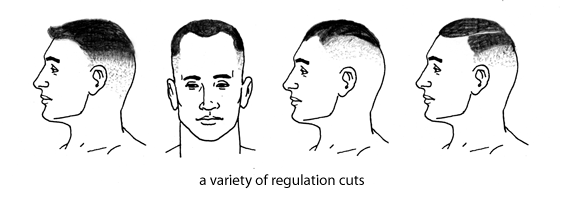
You might think that the title of the article suggests a movie shoot and a burly man sitting on his canvas folding chair shouting these three words through a megaphone, in the manner of a Muslim man shouting to his third (or whatever number) wife, “Talaaq, talaaq, talaaq“.
Well, you are as far away from what this post is about as you can get. This post is about the penchant for haircuts that the armed forces leadership has.
As far as armed forces are concerned, anything at all that needs to be done well requires a haircut – a smart haircut at that.
Lets say, for example, you are expecting a VIP to visit the ship. It is a 5000 Crores of latest destroyer with state of the art weapons and sensors to impress the VIP with. However, we sincerely feel that unless the ship’s company (crew) has a fresh crew-cut, the VIP is unlikely to be impressed. Or, lets say, we want to launch ourselves into Operation Prakaram, going the harm’s way, close to Makaran Coast. Nothing like a fresh haircut, we believe, to put us in the right mood and resolve. You can almost hear the Indian Naval force commander tell his men, “Alright gentlemen, lets tighten our girdles, keep our powder (gun-powder that is) dry and have a close haircut to teach the b——s a lesson.”
This sacred knowledge that wars can be won and success in anything can be achieved by simply having haircuts is passed down from generation to generation – like the gospel truth. It came my way when I was just an Acting Sub-Lieutenant (we acted our roles so well that soon Naval Headquarters finished with the rank itself; but, that’s another story) engaged in earning my watch-keeping certificate on board INS Himgiri. Rear Admiral MR Schunker was our Fleet Commander. The last time when men in his family had hair longer than half an inch was in the 17th century.
The C-in-C in the Western Naval Command was the legendary Vice Admiral Robert Lynsdale Pereira. He was being transferred to Naval Headquarters as the Vice Chief and the Fleet was to give him two farewells: one in harbour with Guard of Honour and Parade and another at sea the traditional way. Parade and Guard rehearsals were being held every morning so that Ronnie (nickname for RL Pereira), as a hardcore gunner, won’t find a flaw. On the penultimate day the Fleet Commander himself was present on the Cruiser Wharf to satisfy himself that everything was ship-shape.
He inspected the Guard and to my horror and utter surprise declared that at least half the men in the Guard required proper haircut. After the Fleet Commander left, these unfortunate men were lined up separately for their unthinkable misdemeanour of not having proper haircut. I went behind the line to have a look and nearly fainted after what I saw. These men were repeatedly given such crew-cuts in the last few days of the rehearsals that the barber would have to probably cut through their scalps to find any more hair.
However, I, a young subaltern, had learnt a valuable lesson about naval readiness states.
Until I left the Navy, this lesson never left me. The truth is that even after leaving the Navy, I associated haircuts with preparation for anything of import. Last to last year I got my son married. Whilst the rest of the family busied themselves in preparations for various functions of the wedding, my primary concern was to have a haircut so that I would look smart as the father of the bridegroom.
What a life we in the Navy lead? We always insist on having short haircuts and never value long hair. Therefore, for most of us, long hair abandon us at a certain age; a kind of hair-today-gone-tomorrow. We keep having haircuts until it is no longer necessary to have haircuts at a certain age.
Hence, whenever the ship’s company is gathered on the deck to read out Warrant of Punishment, it is preceded by a reading of relevant excerpt of the Navy Act 1957. The last line is invariably about haircuts; viz:
“…….or such other punishment as is hair-in-after mentioned….”
Everyone removes his cap at this stage and confirms that there is no hair-in-after.
Jorn Barger is around the same age as me. He coined the term weblog on 17 Dec 1997. Basically, during those days of surfing the net, logging the web would be to leave one’s own imprint on the web rather than merely accessing it. Barger’s weblog became a term to describe a novel form of web publishing. The term was shortened to blog by Peter Merholz in 1999; the shortening process was actually a lighthearted way to pronounce weblog first as we blog and then simply blog.
I was an Indian Navy officer until 28 Feb 2010. From 01 Mar 2010, I joined the blogging community. In Feb 2014, it tickled me to know that I am one of the 172 million bloggers on the net.
In a blog-post titled ‘All Photographers And Writers, No Viewers And Readers’, I brought out that the biggest two techno-social changes that have happened in the last decade or so have affected our lives in a huge manner. Thanks to these two changes, everyone is a photographer now and everyone can write and publish.
Lets compare, for example, shayar (Urdu poets) of yore with the modern day ones. In the earlier days, you wrote when the brainwave hit you; actually since most of the shayars were heart-broken or heart-struck, it was more of heart-wave than brainwave. Now, after writing, you waited for an invitation to a mushaira (a poetic symposium) whereat you hoped to read out your nazm or ghazal amidst shouts of waah waah and mukarrar mukarrar from your audience. Once in a while you got noticed – like Hasrat Jaipuri by the movie mughals Prithviraj or Raj Kapoor – and then life was made for you.
Nowadays, within minutes of your writing you publish on the web. And in case you have nursed your audience, you start receiving waah waah and other accolades straightway. Who are these guys and gals who give you accolades? Well, they are bloggers like you who offer waah-waahs and give the urls of their own blogs so that these would be both ways or many ways rather than one way.
Bloggers on Indiblogger, for example, have excelled in the art of discussion blogs (similar to their personal Facebook Group). By a rough estimate many of these blog-posts wouldn’t take more than ten minutes to write and that too not one’s own writing but – say – quotes picked up from here and there. And then the voting starts; exactly how we elect the parliamentarians or the prime minister. There are ways and means in which you get noticed whilst voting for someone’s post so that he/she would be obliged to vote on your post too.
Nearly three and half years back, after understanding how the blogging community works, I wrote an essay titled aptly: ‘Blogging – Race Or Stampede?‘
In a recent Bloggers Meet, Indiblogger organisation itself brought out proudly how a particular blogger had built up for herself great discussions following. So, whilst Wikipedia describes a blog as a discussion or informational site on the world wide web, most of Indiblogger sites are merely discussion sites. The sheer numbers mitigate against Indiblogger even attempting to assess or encouraging blogs by their quality.
Now, why would you use blogging for the purpose of discussions when better and more efficient means are available such as Facebook or Twitter? I guess the idea is to provide your posts with a degree of permanency rather than most of social discussion sites being transitory; the retrieval is better on a blog – say, by date or title.
I blog differently; it is a means available to me alternate to publishing on the primary media. It matters to me little whether any discussion (comments) takes place on the post itself though I have gone on record that I encourage them. But, I would rather have meaningful comments (however few) from people who have read and digested what I had to say and carry forward the discussion or debate rather than merely complimentary comments.
I run as many as sixteen Facebook Groups and Pages for discussions on varied issues such as songs and music, greetings, poetry, pride in India and its armed forces, quotes and general subjects. My experience shows that majority of the people doesn’t even know what it s liking or commenting on. It is merely what Indibloggers do: you scratch my back and I scratch yours; a reading and writing community all rolled into one.
I have a list of about a dozen blogs (imagine from 172 million) that I seriously read. I don’t leave my foot-prints on those in the fear that I would be counted as one of the thousands of back-scratchers that I have on Indiblogger; with an obligation to vote on, like or comment upon my blog too.
It has been a great discovery with me that there are people who do write to make a difference and are not so much concerned about the web-design, widgets and plugins as much as the quality of their posts.
I go out to eat in restaurants and clubs with the family. Yes, the restaurant decor should be attractive, the crockery and cutlery and serviettes of high and appealing quality, the lighting gentle and soothing and the service prompt. But, over and above all this, the food should be cooked well, tasty and healthy. I never forget that all else is peripheral to the food, the main purpose of a restaurant.
Breathes there a man or woman who hasn’t read Coleridge’s ‘The Rime of the Ancient Mariner’ with its famous line: ‘water, water, everywhere, nor any drop to drink’? I doubt it.
The story of the sailor returning from a long sea voyage can be replicated, with hardly any variations, in the sea of social media and finally in the sea of life.
You may have hundreds and even thousands of ‘friends‘ on Facebook. Some of them may even Like what you put up and once in a while say “nice” “good one” and “hilarious” on your posts. But, it is all so that you will do the same for their posts. Most of them have no idea of what they have liked. Ultimately, on Facebook, as in life, you are by yourself. As Sahir Ludhianvi said in his famous Dev Anand number in Hum Dono (when I started writing this article it was 03 Dec, Dev Anand’s death anniversary):
Kaun rota hai kisi aur ki khaatir ai dil? Sabako apani hi kisi baat pe rona aaya.
(Who weeps for someone else’s sake?
Everyone weeps remembering something of one’s own)
On Facebook or in life, you are a bore in case you have something to say. Your penchant about saying something fits in well with the definition of a bore: A bore is a person who continues to talk about himself when you want to talk about yourself.
A few years back, when emails just came into vogue, I was one of the early birds who opened an email account. By the time a close friend followed suit, I had a sizable fan following and I used to send each one of them (what I thought) interesting mails. When this close friend joined, I took him in too and started sending these mails to him. One fine day, he sent (forwarded) me a story about a hotel guest not wanting the housekeeping to keep giving him fresh soaps three times a day. He thus conveyed to me that my mails to him were as much a nuisance as the housekeeping bombarding the hotel guest with new soap bars kept all over the bathroom even when the guest hadn’t used the earlier ones. I took the hint and stopped the supply of mails to him. But, the story doesn’t end there. Very soon, he discovered the joy of sharing mails and felt that his were actually more interesting. So, he started sending mails. I didn’t have the heart of sending him back his soap-story.
Recently, he was a little more direct. He belatedly joined whatsapp and forbade me from repeatedly bombarding him with my posts. He said that his eyes get affected reading posts on the whatsapp. He said he’d rather read them on emails (the expression back to square one was intended for such a scenario).
Sabako apani hi kisi baat pe rona aaya…
These are, of course, lighthearted examples. But, seriously, the very nature of man is such that even for his existence he has to forever be concerned with self-preservation and own survival. Even when a friend doesn’t ask you, when face to face with your story, proposal, request, you can almost hear him ask, “What’s in it for me?”
That brings us to the question, “How many friends do you require in life?” And, the next question is even more harsh: “Do we really require friends in our life?” Here is one of the responses:
Friends are, indeed, like Happiness in one important aspect: you are better off not chasing them.
I have seen people actually displaying friends like trophies; such and such is a really influential person in Modi government or close to Shah Rukh Khan or Deepika Padukone…..we used to play gilli-danda together. I had this VVIP in one of my company’s sites. His name-throwing of friends at important positions in his part of the country used to make me think that the entire political and bureaucratic set-up in the state used to by dependent upon his advice.
Most often than not, people ain’t friendly with you but the position you hold. As soon as you retire or are transferred from the position, the friendship, such as the way it was, becomes more realistic and people realise what a bore (my children’s vocabulary has this word called loser; a very fascinating word) you were all along. The office where I work has this person whom I frequently call as the finest leader that I have come across. All my friends often echoed these thoughts of mine and added quite a few stories of their own regarding his sterling qualities, sagacity, professionalism, human-touch, and result-oriented approach towards everything. A year back the management side-lined him and brought a fire-brand, young and outstanding person in his place. Gradually I was stunned to notice that these friends gushed about the sterling qualities, sagacity, professionalism, human-touch, and result-oriented approach of – hold your breath – the new boss. They would begin every presentation with the oblique suggestion that somehow the wonderful, pragmatic ideas of the new leader were not even thought of by the earlier loser.
The way the world is made, after human life appeared on earth; it is a need that brought people together (You may refer to Abraham Maslow’s ‘Pyramid of Needs‘) . Relationships and friendships are either causes or results of this need. Else, these have no other special basis for existence. Religion and Spiritualism teach us that the sooner we are rid of – or at least less dependent upon – these needs, the better off we are.
Now, I am not suggesting that we go out of our way to offend people or have them as unfriendly. All I am saying is that don’t have friends as obsession or score-cards or trophies. If we can have one or two whose needs (I am using the world in its larger connotation) coincide with ours, these are much better than thousands who like everything that you say without even listening to it or reading it.
In this song penned by lyricist Indeevar for the 1967 movie Upkaar, one gets close to what the scriptures tell you:
Kasame vaade pyaar wafaa sab, baate.n hai.n baato.n kaa kyaa KoI kisii kaa nahii.n ye jhuuThe, naate hai.n naato.n kaa kyaa
(Vows, promises, love, loyalty, all are mere words; and words mean nothing
No one belongs to anyone, these are false relations; and relations mean nothing)
Hogaa masiihaa saamane tere Phir bhii na tuu bach paayegaa Tera apanA khuun hii aakhir Tujhako aag lagaayegaa Aasamaan me u.Dane vaale miTTii me.n mil jaayegaa
(The Saviour would be in front of you
And yet you won’t be saved
Your own blood (relation) will ultimately
Light-up your funeral-pyre
O’ ye, who flies high in the sky now, you will be razed to the ground)
Sukh me.n tere saath chale.nge Dukh me.n sab mukh mo.De.nge Duniyaa vaale tere banakar Teraa hii dil to.De.nge Dete hai.n bhagavaan ko dhokhaa, inasaa.n ko kyaa chho.De.nge?
(They will walk with you in good-times
And turn their face away in bad times
The worldly people who become yours
Will (finally) break your heart
They deceive God too; why would they leave human beings?)
One of the biggest truths about God’s Creation is that He/She/It made all virtues and evils Relative. The only Absolute is God Himself. Thanks to Albert Einstein, the Relativity of Time in the Universe is now somewhat well known to us. For others, please read my Absolute Virtue if you entertain any doubts.
What an essay, at the end of the year, you may remark. The fact of the matter is that end-of-the-year itself is not universal or absolute reality. It exists on Earth simply because of rotation of Earth around its axis and its revolution around the Sun. It doesn’t universally exist. It is a convenient method adopted by us to anchor our lives to a dimension called Time, which too is purely our own creation. You may argue with me that Time does exist; after all, we do get older, trains and aircraft are scheduled by hours and minutes (and sometimes seconds), we get our salaries because of it and if there was no Time, our world would collapse. Fair enough; but do remember that our invention of Time is actually an effort, on our part, to give a beginning and end to things, events and people on Earth only and has relevance only to our minuscule part of the Universe, ie, very micro part of God’s endless Creation as a whole.
One of the fundamental laws of the universe that we have discovered (not invented) is the Law of Conservation of Energy. The law of conservation of energy is a law of science that states that energy cannot be created or destroyed, but only changed from one form into another or transferred from one object to another. This law of science is actually a pointer towards the ludicrousness of considering our self-invented dimension of Time so as to define beginning and end to things and people.
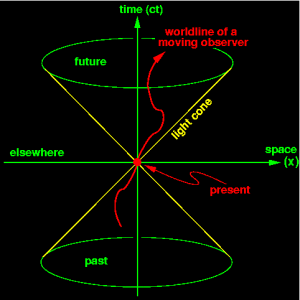
Einstein’s Spacetime Cone (All of physical reality is contained within this cone; the region outside (“elsewhere”) is inaccessible because one would have to travel faster than light to reach it. (Pic courtesy: einstein.stanford.edu)
That leaves Events, Ideas, Thoughts, and Emotions. Lets take Events first. All Events actually result in Energy and Mass to be changed from one form to the other and hence it is covered in Law of Conservation of Energy. As far as Ideas, Thoughts and Emotions are concerned, we often claim to be the first person to have come up with a thought or idea; whereas, all these already exist in one form or the other. We only re-discover them. Mercifully, as far as emotions are concerned, we never claim to be the first persons to become angry, happy, fall in love with, hate etc. We have no idea how these evolved and who was the first person to get angry, love-stricken, hated or happy.
From my Facebook Page ‘Make Your Own Quotes
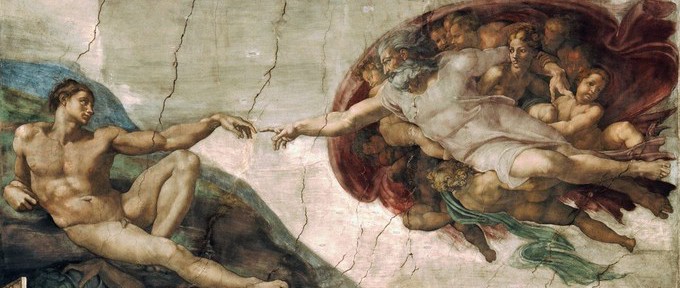
The second last thing to consider before we take up the main discussion is whether there are any universal truths, beliefs or perceptions that have withstood the test of time. There ain’t many; not even the most sacred ones. Consider that Adam and Eve were sent on the earth and they produced a boy and a girl. For the world to progress, this boy and girl, brother and sister, that is, must have procreated amongst themselves. Likewise, hundreds of beliefs and tenets have changed over centuries. Hence, whilst there are no Absolute Truths in Space, there are none in Time too except one.
The last thing that I want to take up is the distinction between Natural and Artificial that we have made. Natural is defined as existing in or derived from nature; not made or caused by humankind. Artificial is the exact opposite of it; made or produced by human beings rather than occurring naturally, especially as a copy of something natural. On the easier side is the difference between natural flowers with their texture, hues and fragrance and artificial look-alike flowers. On the complex side is the natural way (fire, flood, solar-action, wind-force etc) to convert one form of energy into another and artificial way of doing it say in lighting a bulb. It becomes even more complex when we think of the fact that human beings are part of Nature and there is nothing that they can do that has Free Will (Please read: ‘How Unbiased Or Innocent Can We Become?’). Hence, if Natural is God’s Creation, accepting as something Artificial is like accepting that someone other than God can create. Let alone faith, it is against the science of law of conservation of energy. So much for the distinction between Natural and Artificial. God makes the temperature drop as we move away from the centre of the Earth (increase altitude) and away from the Sun (in earth’s elliptical orbit around the Sun); that is natural. But, we, as human beings made air-conditioning (God had no role to play in it!) and made temperature fall wherever we are even when we are closest to the Sun in the orbit of the Earth. Now, that is Artificial.
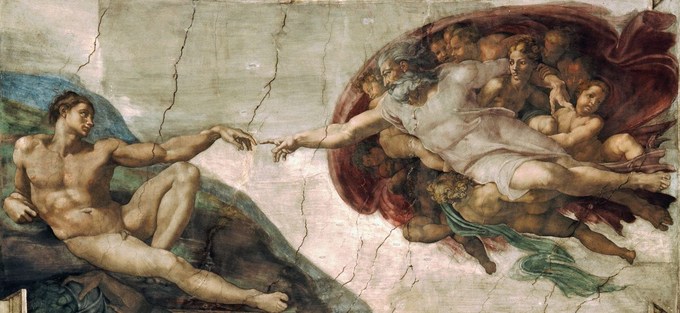
(Michaelangelo’s The Procreation)
With this background, lets look at some of the debatable philosophies of life; I call all our philosophies as philosophies of convenience to serve specific purposes or objectives. Lets examine if these are anachronisms.
Philosophy #1 We Should Be Selfless
An ideal man, it is said, is the one who is selfless. To start with, if you read ‘How Unbiased Or Innocent We Can Become?’, you would know that to be completely selfless (without ‘haume’ as Guru Granth Sahib calls it) is to find and merge with param atma. Therefore, we can only be partially selfless.
Now, lets examine how being selfless is against the grain of human nature (what a word, you may say, when seen in the light of the discussion on Natural and Artificial.
Every instinct and every reflex action of a human being, over generations and centuries, is honed towards self-preservation and survival. Indeed, Men have come up with Herculean efforts, brave and courageous acts that we have admired in furtherance of their survival instincts.
You take away self from Man and he merges with Param Atma. That means that it is not possible to be absolutely selfless for a man. Would that really be the purpose of Life that God sent us on this earth and we should always be doing everything to merge back with Him? We can only be partially selfless. However, in the bigger definition of selflessness, to do something for the betterment of one’s soul, family, nation and world still has the element of haume’ about it; one does it because it is one’s own. There is still me and mine involved in it. A mother, for example, does everything for her child; it would be somewhat more selfless if she did for other than her own child. It would be somewhat more selfless if she did it without thinking of gains for her own soul.
Philosophy #2 We Should Not Live In The Past or We Should Forget The Past
All our knowledge is in the past. The world is made safer, securer and better place to live in because of past knowledge. And yet, many of those who have the best interests of our society in mind routinely tell us to forget the past.
In our survival instincts, we are hard wired to remember the past and learn from it. We don’t have to, for example, die ourselves to learn the horrors of dying. We have knowledge of people dying and we consciously avoid all those things that can kill us; say, for example, jumping from high-rise buildings.
Think of how dangerous the world would become if all of us we were to forget the past and start discovering everything afresh. Think of how lost we would be if we were to start with a clean slate everyday or every hour. In this case, Ignorance will not be bliss.
There are people and countries such as Taliban in Afghanistan who tried to bury the past. But, these generally have disastrous results.
Another connected advice or philosophy is to live in the present. It is like living in a house made of just one straw. That’s exactly what Present is; a fleeting moment that becomes past like a bubble in a pond. Trying to capture the Present is like holding this bubble in the palm of one’s hand.
Lastly, the Past also enables us to provide an anchor to excel. So, if you are trying to break the world record in high jump, and you have been jumping, say, 6 feet, you are able to make out the gap that you must fill. Other people’s similar feats also enable us to emulate and excel.
Philosophy #3 All Men Are Born Equal
Of all the hogwash that is dished by those who are adept at making feel-good philosophies, this takes the cake.
Millions of years ago when Life started on earth, it is possible that God may have made all men equal. However, over all these years, generational and genetic memory ensured that each became unique and different. It is for this reason that even though the DNA of even twins at birth is the same, it undergoes changes as they grow up and their children do not have the same DNA.
This philosophy of convenience actually fills us with hope that we have the same chances of succeeding as, say, Bill Gates or Narendra Modi.
Every once in a while we have success stories from those who were not born with silver spoons in their mouths but did well through sheer grit and commitment. The fact is that if similar grit and commitment were displayed by the ones born with silver spoons, it would be a totally different story.
Now, I am not suggesting that it should fill each of us with defeatism that we were not born of the same mould as Ambanis or Birlas. All I am saying here is that it is okay to make peace with one’s circumstances dictated by generations of data-memory and move on to do one’s best to achieve the best under the circumstances.
Philosophy #4 As You Sow, So Shall You Reap
There is absolutely no proof of this philosophy except in folklore. It appears to be a plaintive cry for divine justice by the meek and the downtrodden and fills him with hope when he sees that the thugs, ruffians, and cheaters in the world seem to be doing well in comparison to the good guys. The latter imagine the former burning in the fires of the hell and paying for their sins.
In South India there is a respectable chain of restaurants. At the entrance of these restaurants is a picture of the founder with huge sandalwood garland around it. You are filled with great respect for the man whose vision, sagacity and generosity enabled him to set up mass eating joints at affordable prices. Decades later many had forgotten that he had spent time in jail for making counterfeit money and that he was enjoying the fruits of his earlier labour after his jail term.
These days, the rich and the influential don’t even have to go to jail before enjoying the fruits of their deceit and swindles.
In a recent article titled ‘Is Truth Worth Fighting For?’ I had concluded that all that the conscientious and the saintly do get is the hope that, in the end, they would die happily. So the reward for them to have spent their lives in constant toil and misery is the promise of happiness when the body and soul part. Some compensation that.
Most people are nowadays already aware of it and leave the count of those that live wretchedly but are promised happy deaths.
When the evil don’t appear to be getting just punishments, we cover it up by saying that someone somewhere in one of their previous lives has done something good or that they would suffer in their next lives.
The charade goes on.
It is absolutely debatable whether your deeds, good or bad, will repay you in kind.
It is time we found a new philosophy.
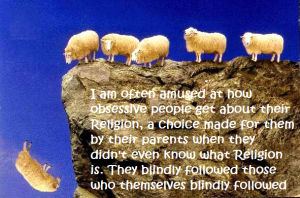
Philosophy #5 Religions Started Centuries Back Should Be Preserved Till The End of the World
Lastly, all present major religions in the world are based on the premise that God or Son of God arrived in this world only during a certain period of time in history, started the religion for all times to come and all those who are loyal adherents of these religions are pious and righteous. The rest are as good or bad as pagans. God will one day punish the non-believers.
The followers of all major religions also believe in and practice the philosophy that even violence and war, in the name of God and Religion are just and justified. Hence, Religion and God are worth laying down lives for – one’s own and those of one’s enemies.
Lastly, the followers of all major religions in the world believe that since the founders of the religions were God or descendants, these have been writ in stone and nothing in these should ever change.
From my Facebook Page: Make Your Own Quotes
In my ‘Whose God Is It Anyway?’ I had brought out that when, for example, Mohammad told his followers that men should marry many women, he had in mind the war widows of the 7th century AD in Arabia who were young and required shelters, which could be provided to them if men married them. He won’t have made this as a law for all times to come.
There, I have given you at least five philosophies and beliefs that are debatable and suffer from obsolescence. Let me hear your views, if you so desire, in the comments below.
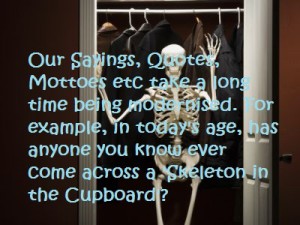
Beliefs, perceptions and philosophies take a long time changing. Why, even expressions do. We still use the expression, for example, skeletons in the cupboard though the last person to see them must have been a hundred years ago.
From my Facebook Page: Make Your Own Quotes
It is high time we change them in keeping with the modern times. Please remember that when religions were founded they changed the existing beliefs and philosophies of those times. It can’t, therefore, be sacrilegious to do so.
Happy new year 2016 to all my readers and friends.
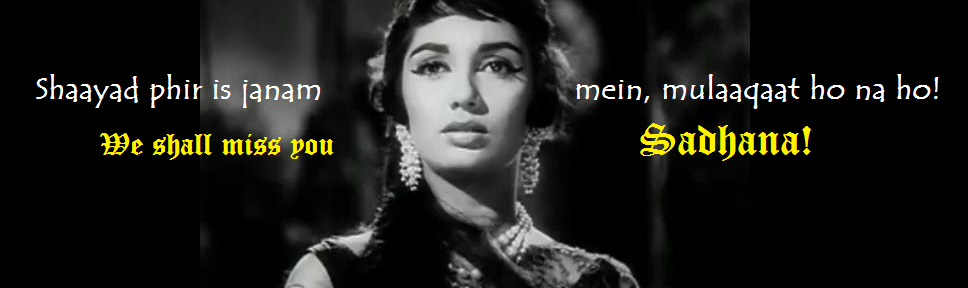
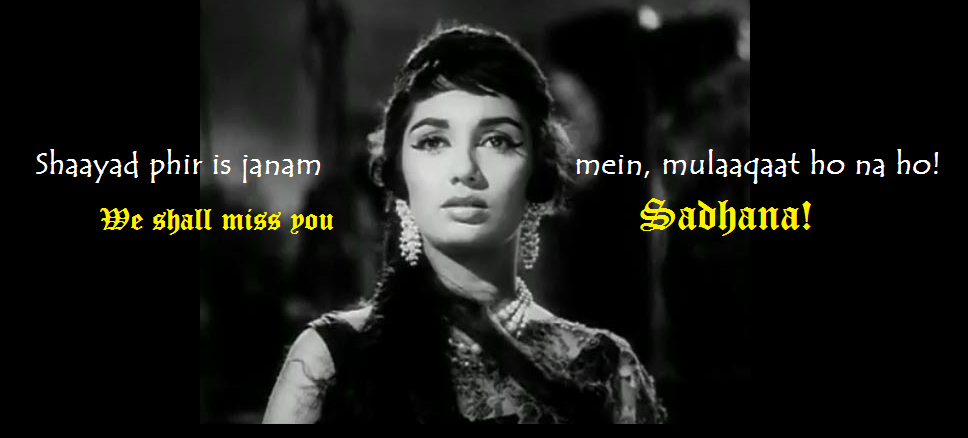
Sadhana – We can’t believe it; it is shocking beyond words. We knew you were battling with cancer; but, still it is shocking beyond words to let you go.
Last night, my wife Marilyn and I returned from what should have been Midnight Mass for Christmas, at 10:30 PM. Silent night, holy night, cannot be allowed to break the peace of Mumbaites beyond 10 PM, once in a year, since they are a very silent community. They never make noise during any of the other religious festivals beyond 10 PM, not on the roads, not in the parks and other public places in the open and hence cannot make an exception for Christmas.
Anyway, our Midnight Mass having finished at 10 PM, I had lot of time at home and so I thought of seeing this Raj Khosla movie that I had missed seeing during my young days: Woh Kaun Thi (Who Was She)? Sadhana played Sandhya in the movie and carried the movie virtually on her shoulders with the strength of her histrionics and enigmatic charm.
My hair now stand on their ends when I think of the fact that when she sang, in the movie: “Lag jaa gale ke phir ye haseen raat ho na ho, shaayad is janam mein mulaqaat ho naa ho“, she actually meant that it was her last night in real world too.
I have never come across such a strange coincidence in my life; the kind that makes me shiver now after hearing about her demise a few hours ago.
The best of Lata Mangeshkar songs have been picturised on her including the three (the first three in the list) from the movie that I finished seeing at about 1:37 AM today:
Lag jaa gale se.
Naina barse rimjhim rimjhim.
Jo hamane dastaan apani sunaayi aap kyun roye.
Chanda ja re ja re (from Manmauji that she did with Kishore Kumar).
Main to tum sang nain mila ke (from Manmauji).
Naino mein badra chhaye (Mera Saya with Sunil Dutt).
Tera mera pyaar amar phir kyun mujhako lagata hai dar (Asli Naqli with Dev Anand).
O sajana barkha bahaar aayi (Parakh with Motilal).
Tu jahan jahan chalega mera saya saath hoga (Mera Saya)
And, hold your breath, my most liked song in Hindi movies: Mere mehboob tujhe meri mohabbat ki kasam is also acted upon by her in the movie Mere Mehboob that had one of her best roles as Husna to Rajendra Kumar as Anwar. Indeed, you need to see this song from Mere Mehboob and another one: Yaad mein teri jaag jaag ke ham, to see the dignity, charm, elegance and beauty that she brought to acting. Anwar only saw her through the burqa (veil) once and that changed his life; that was supposed to be the effect of her striking beauty.
I am shocked beyond words.
Here is how I shall always remember her. This song that is probably her best was written by Raja Mehdi Ali Khan and had been composed in the Raag of my place: Raag Pahadi by none other than Madan Mohan and sung by Lata for her; each word now has another sublime meaning after she left us suddenly.
Please listen to this in Sadhana’s memory: Lag jaa gale ke phir ye haseen raat ho na ho….
Lag jaa gale ki phir ye hasii.n raat ho na ho
Shaayad phir is janam me.n mulaaqaat ho na ho
Lag jaa gale se …
Hamako milii hai.n aaj, ye gha.Diyaa.N nasiib se
Jii bhar ke dekh liijiye hamako qariib se
Phir aapake nasiib me.n ye baat ho na ho
Phir is janam me.n mulaaqaat ho na ho
Lag jaa gale ki phir ye hasii.n raat ho na ho
Paas aaiye ki ham nahii.n aae.nge baar-baar
Baahe.n gale me.n Daal ke ham ro le.n zaar-zaar
Aa.Nkho.n se phir ye pyaar ki barasaat ho na ho
Shaayad phir is janam me.n mulaaqaat ho na ho
Lag jaa gale ki phir ye hassii.n raat ho na ho….
Dil Abhi Bhara Nahin
You decided to leave us, Sadhana on this Christmas day; but, the fact is that we wish we could sing, as Dev Anand did in Hum Dono, for you: Abhi na jaao chhod kar ke dil abhi bhara nahin.
And how can dil bhar jaata? When we loved you so much. You brought in your acting so much of charm, romanticism, elegance and beauty that to call you stunning would be an understatement. Coincidentally, for all of us who hail from Simla, the first major movie of yours was Love in Simla with Joy Mukherjee in 1959. Woh Kaun Thi and Anita were also shot in Shimla in parts.
You dared to be different and not just with your haircut which came to be known as Sadhana cut.
This was the most popular duet of our times and I was fortunate to have heard Rafi and Asha Bhosle live singing it.
Being an evening song, Jaidev composed it in Raag Kalyan. It has the lyrics by a favourite poet and lyricist: Sahir Ludhianvi.
Here is to you Sadhana, a plea that you cannot hear anymore: Abhi naa jaao chhod kar ke dil abhi bhara nahin…..
ra: abhii na jaao chho.D kar ke dil abhii bharaa nahii.n – (2)
abhii abhii to aaii ho – abhii abhii to
abhii abhii to aaii ho, bahaar banake chhaaii ho
havaa zaraa mahak to le, nazar zaraa bahak to le
(ye shaam Dhal to le zaraa – 2), ye dil sambhal to le zaraa
mai.n tho.Dii der jii to luu.N, nashe ke ghuu.NT pii to luu.N
nashe ke ghuu.NT pii to luu.N
abhii to kuchh kahaa.Nahii.n, abhii to kuchh sunaa nahii.n
abhii na jaao chho.Dakar ke dil abhii bharaa nahii.n
aa: sitaare jhilamilaa uThe, sitaare jhilamilaa uThe, charaaG jagamagaa uThe
bas ab na mujhako Tokanaa
bas ab na mujhako Tokanaa, na ba.Dhake raah rokanaa
agar mai.n ruk ga_ii abhii to jaa na paauu.Ngii kabhii
yahii kahoge tum sadaa ke dil abhii nahii.n bharaa
jo khatm ho kisii jagah ye aisaa silasilaa nahii.n
ra: abhii nahii.n abhii nahii.n
aa: nahii.n nahii.n nahii.n nahii.n
ra: abhii na jaao chho.Dakar ke dil abhii bharaa nahii.n
ra: adhuurii aas, adhuurii aas chho.Dake, adhuurii pyaas chho.Dake
jo roz yuu.Nhii jaaogii to kis tarah nibhaaogii
ki zi.ndagii kii raah me.n, javaa.N dilo.n kii chaah me.n
ka_ii muqaam aae.nge jo ham ko aazamaae.nge
buraa na maano baat kaa ye pyaar hai gilaa nahii.n
aa: haa.N, yahii kahoge tum sadaa ke dil abhii nahii.n bharaa
ra: haa.N, dil abhii bharaa nahii.n
aa: nahii.n nahii.n nahii.n nahii.n
For an actress who started as a chorus girl in one of the songs in a Raj Kapoor movie, the 1955 movie Shree 420 (the song being Mud mud ke naa dekh mud mud ke), you came a long way off to become one of the most loved actresses of your times. After the release of your 1959-60 movie Love in Simla wherein you acted opposite Joy Mukherjee (in his debut movie) since the movie was directed by his uncle Sashadhar Mukherjee (Ashok Kumar, Kishore Kumar and Anoop Kumar’s brother in law), you acted in Bimal Roy’s Parakh (1960 movie) opposite Motilal.
Another best song of Lata Mangeshkar was picturised on you and that song happens to be the best in Hindi movies on rain. The song was penned by the great lyricist Shailendra (Raj Kapoor’s find in the movies) and composed in Raag Khammaj by Salil Chowdhury who composed many of his songs on Western Classical beats.
Yes, I am talking about the song: O sajana, barkha bahaar aayi….(its composition is so great that when it comes to Aise rimjhim mein ho sanam, pyaase pyaase mere nayan, you can actually imagine the pitter patter of rain even if you don’t understand the words).
Here is, remembering you, Sadhana, with the best rain song ever: O sajana, barkha bahaar aayi…
(o sajanaa, barakhaa bahaara aaI
rasa kii phuhaara laaI, a.Nkhiyo.n me pyaar laaI ) – 2
o sajanaa
tumako pukaare mere mana kaa papiharaa – 2
miiThii miiThii aganii me.n, jale moraa jiyaraa
o sajanaa …
(aisI rimajhima me.n o saajan, pyaase pyaase mere nayana
tere hii, khvaaba me.n, kho gae ) – 2
saa.nvalii salonii ghaTaa, jaba jaba chhaaI – 2
a.Nkhiyo.n me.n rainaa gaI, nindiyaa na aaI
o sajanaa …
https://youtube.com/watch?v=zSEV7-CqhwI
At a very early stage in her acting career, she acted in a Bimal Roy movie and Bimal Roy’s movies used to have focus on women such as Bandini and Madhumati. However, the person who made a trilogy on her in movies based on the mystery woman was Raj Khosla. He took her in the 1964 movie Woh Kaun Thi, 1966 movie Mera Saya and 1967 movie Anita.
Mera Saya repeated the Lyricist – Music Director team of Raja Mehdi Ali Khan (my second most favourite lyricist after Shakeel Badayuni) and they gave some beautiful songs picturised on her: Jhumka gira re, the title song: Tu jahan jahan chalega mera saya saath hoga, and my favourite: Naino mein badra chhaye.
Naino mein badra chhaye was composed by Madan Mohan in Raag Bhimpalasi and till today remains one of the top songs of Lata Mangeshkar.
Please enjoy, thinking of Sadhana: Naino mein badra chhaye…
prem diivaanii huu.N me.n
sapano.n kii raanii huu.N mai.n
pichhale janam se terii
prem kahaanii huu.N mai.n
aa is janam me.n bhii tuu
apanaa banaa le
naino.n me.n…
Sadhana was born in a Sindhi family in Karachi on 02 Sep 1941. Post partition riots saw the family shift from Karachi to Bombay and that is where all her life was spent. Sadhana married her Love in Simla (her first movie as heroine) director Ram Krishna Nayyar on 7 March 1966. They were married for nearly thirty years, until his death in 1995 from asthma. The couple had no children. After her retirement from the movies (Geeta Mera Naam was her last movie in 1974, a film that she directed), she declined to be photographed and lived like that in her Santa Cruz flat. And the reason for not being photographed post retirement was because she wanted to be remembered as she was in the movies. And that’s why, in today’s tribute, within a few hours of her death, I have tried to remember her by some of the roles that she did.
Here is one that has stayed in my mind. It is from her 1969 movie Inteqaam (Revenge) (directed by her husband RK Nayyar) in which she acted as Rita Mehra a poor girl looking after her sick mother. She was out to take revenge because after her refusal to entertain a rich businessman, her boss managed to send her to jail for one year on trumped up charges of theft.
And here is her revenge song that was quite popular in our era (she feigned drunkenness to bring the high society to mother earth). The song was penned by Rajinder Krishan (responsible with Madan Mohan for half of Lata’s Top Ten songs) and it was composed by Laxmikant Pyarelal.
Please see Sadhana perform in feigned drunken stupor: Kaise rahun chup ke maine pi hi kyaa hai hosh abhi taq hain baaqi…aur zara si dede saaqi…
kaise rahuu.N chup ki maine pii hii kyaa hai
hosh abhii tak hai baaqii
aur zaraa sii de-de saaqii aur zaraa sii aur
kaise rahuu.N chup …
muddato.n kii pyaas aaj ek jaam ban ga_ii
ye Kushii kii shaam shaam-e-intaqaam ban ga_ii
jo baat hamame.n tumame.n thii vo baat aam ban ga_ii
kaise rahuu.N chup …
pataa hai tumako raaz kyaa hai mere is suruur kaa
ke is suruur me.n zaraa saa ra.ng hai Guruur kaa
jo maine pii to kyo.n nashaa utar gayaa huzuur kaa
kaise rahuu.N chup …
The 1963 movie Mere Mehboob saw her at her elegant best. The title song in Raag Jhinjhoti was sung separately, in the movie, by both Rajendra Kumar and Sadhana. It was such a great song by Shakeel, Naushad, Rafi and Lata, that I can never bring myself to actually post it lest I should do dishonour to the song by my ignorance or inanity.
However, in order to depict her characteristic elegance in the movie, I am able to give you another song: Yaad mein teri jaag jaag ke hum….
yaad me.n terI jaag-jaag ke ham
raat bhar karavaTe.n badalate hai.n
har gha.Dii dil me.n terI ulfat ke
dhiime dhiime chiraaG jalate hai.n
jabase tUne nigaah pherii hai
din hai suunaa to raat a.ndherii hai
chaa.Nd bhI ab najar nahii.n AtA
ab sitaare bhI kam nikalate hai.n
yaad me.n terI jaag-jaag ke ham …
luT gayii vo bahaar kI mahafil
chhuT gayii hamase pyaar kI ma.nzil
zi.ndagii kI udaas rAho.n me.n
terI yaado.n ke sAth chalate hai.n
yaad me.n terI jaag-jaag ke ham …
tujhako paakar hame.n bahaar milii
tujhase chhuTakar magar ye baat khulii
baaGabaan hii chaman ke phuulo.n ko
apane pairo.n se khud masalate hai.n
yaad me.n terI jaag-jaag ke ham …
kyA kahe.n tujhase kyuu.n huii duurii
ham samajhate hai.n apanii majabuurii
tujhako maaluum kyA ke tere liye
dil ke gam aa.Nsuo.n me.n Dhalate hai.n
yaad me.n terI jaag-jaag ke ham …
Fianlly, to remember her by, let me give you a song from her 1962 movie Manmauji that she did with Kishore Kumar. Old timers would remember Kishore Kumar’s comic and popular number from the movie: Zaroorat hai zaroorat hai zaroorat hai, ik shrimati ki, kalawati ki, sewa kare jo pati ki; a vacuous fantasy in the modern world.
This song put together by Rajinder Krishan, Madan Mohan and Lata Mangeshkar for her continues to be the kind of song Sadhana would have wanted to be remembered by: young, romantic, intense and with histrionics that made her fans like me lose their hearts to her.
Please enjoy: Main to tum sang nain mila ke….
mai.n to tum sa.ng, nain milA ke ##(slow)##
hAr gaI sajanA, ho, hAr gaI sajanA
mai.n to tum sa.ng, nain milA ke
hAr gaI sajanA, ho, hAr gaI sajanA
kyU.N jhUThe se prIt lagAI – 2
kyU.N chhaliye ko mIt banAyA
kyU.N A.ndhI me.n dIp jalAyA
mai.n to tum sa.ng …
sapane me.n jo bAG lagAe
nI.nd khulI to vIrAne the
ham bhI kitane dIvAne the
mai.n to tum sa.ng …
nA milatI.n ye bairan a.NkhiyA.n
chain na jAtA dil bhI ne rotA
kAsh kisI se pyAr na hotA
mai.n to tum sa.ng …
Truly Sadhana, abhi gayi ho tum chhod ke, par dil abhi bhara nahin.
Some of my most favourite Hindi movies songs have been penned by Shakeel Badayuni and have Naushad’s music. This has been sung by my favourite singer Hemant Kumar and picturised on the village school teacher Abhi Bhattacharya in 1961 movie Ganga Jamuna:
Insaaf kii Dagar pe, bachcho.n dikhaao chal ke
Ye desh hai tumhaaraa, netaa tumhii.n ho kal ke
Duniyaa ke ra.nj sahanaa aur kuchh na mu.Nh se kahanaa
Sachchaaiyo.n ke bal pe aage ko ba.Dhate rahanaa
Rakh doge ek din tum sa.nsaar ko badal ke
Insaaf kii …
Apane ho.n yaa paraae sabake liye ho nyaay
Dekho kadam tumhaaraa haragiz na Dagamagaae
Raste ba.De kaThin hai.n chalanaa sambhal-sambhal ke
Insaaf kii …
Insaaniyat ke sar par izzat kaa taaj rakhanaa
Tan man bhii bhe.nT dekar Bharat kii laaj rakhanaa
Jiivan nayaa milegaa a.ntim chitaa me.n jal ke,
Insaaf kii …
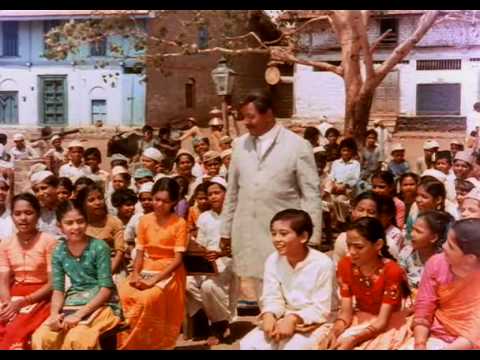
Abhi Bhattacharya teaching village school children to follow the path of Justice and Truth in the movie Ganga Jamuna (Pic courtesy: You Tube)
India had become a free nation less than a decade and half back and there was heady idealism in the air. These young ignited minds of our villages (India lives in its villages!) were being taught to walk on the path of Truth and Justice unwaveringly so as not just to become future netas of the country but also be filled with the promise of changing the world.
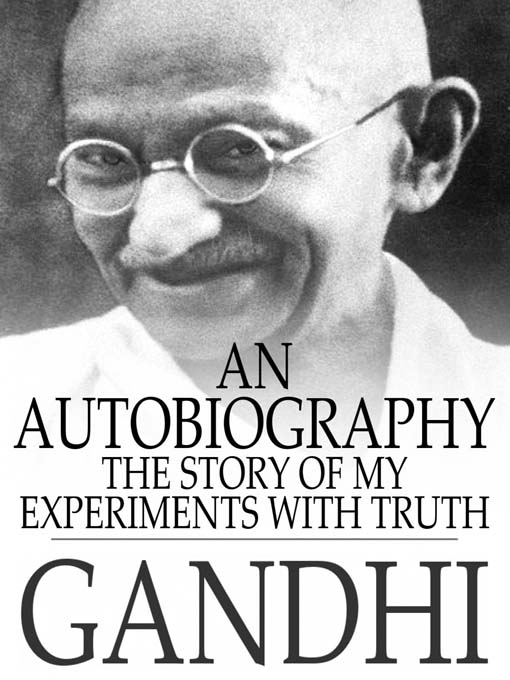
Mahatma Gandhi’s My Experiments With The Truth and Satyagraha goaded us to always seek the Truth and be counted amongst men of stature. Our schools, wherein mottoes generally adorned the walls, had Truth is God and God is Truth painted across in large letters.
It was a lofty objective but there was a sizable number of people who still believed in the Truth and saw merit in fighting for it.
It wasn’t as if that was an ideal or idealist India; the Truthful were then too poor and miserable and Liars ruled then too and lived in comfort and luxury. The path of Truth was then too more difficult than the path of Evil. The difference is that it wasn’t considered totally impractical or to be jeered at as something bereft of realities of life. Those who walked on the path of Truth were respected.
Recently, when actor Salman Khan was acquitted of all charges against him for negligently and drunkenly driving his Land Rover, late night in 2002, that went out of control on to a footpath and killed a labourer sleeping there, there was a public outcry about whether the surviving family of the victim should have sought Justice and Truth or should have shamefacedly accepted the underhand compensation that the accused would have given them and which, allegedly, would have led to the case being allowed to go awry after having been proved beyond reasonable doubts in the High Court judgment of 06 May 2015 that sentenced him to five years imprisonment? It seems that they and others involved with the case followed the more practical path than insaaf ki dagar.
A few years back a person that I am related to accepted compensation for his young son having been killed in a road accident when it was clearly the other party’s fault. I was shocked. But then my relation explained that the family had belatedly made peace with their fate and gotten over the initial trauma; and, they didn’t want to subject themselves to the trauma of seeking justice through the Indian courts.
In April 2012 I wrote an article titled ‘The Great Indian Judicial Circus‘ to bring out the true face of the Indian judicial system. I had brought out that seeking Justice through such a system is not just naive but extremely frustrating, humiliating and devoid of all dignity.
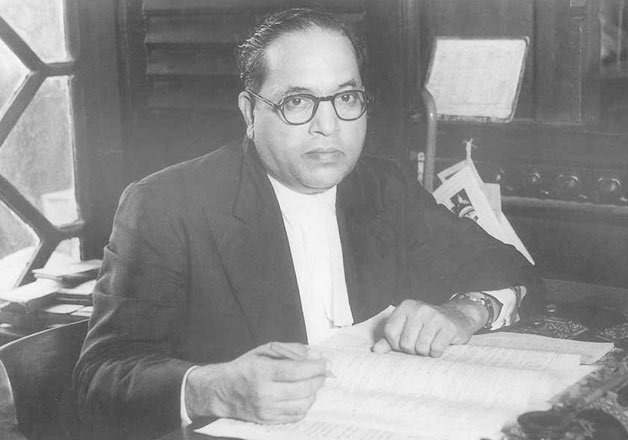
Recently, I started seeing on my computer (through Internet) old Hindi movies that I had missed out during my younger days. In many of these, a barrister was always depicted as a person of high repute. Take Adalat and Mamta as just two examples. Pradeep Kumar in the former and Ashok Kumar in the latter return after their law education in London and on return occupy a most revered position in the society. Their personal integrity and morals were supposed to be beyond reproach. Before that, we had the lofty example of the great barristers like MK Gandhi, BR Ambedkar, Chittranjan Das, Vallabhai Patel, Motilal Nehru, and others whose value system is worth emulating.
What about now? The present day lawyer or advocate is as far from seeking Truth and Justice as can get. Indeed, one of the major reasons that the Indian judicial system is in such a mess is because of the avarice of the Indian lawyer (Please also read: ‘Why Do Indian Lawyers Behave Like Gods?’).
It is because of the Indian judicial system that if you started a case in order to seek justice, it or other cases arising out of it would be pending for the rest of your life whilst both the contending lawyers would have made more money through your cases than your original loss against which you sought justice. The Salman Khans of the nation do not have cases pending against them because their money power ensures that they get expedient justice whilst some 46 Lakh cases are pending in the High Courts and thousands in the Supreme Court. But, if you are an ordinary citizen, to your original misfortune (against which you seek justice) is added the misfortune that you pay for in terms of money, loss of peace, dignity, physical and mental health.
The judicial system provides for judicial immunity enjoyed by the judges and others employed by the judiciary from liability resulting from their judicial actions. Cases where the judges have misused this immunity are increasingly surfacing in the media and public debate nowadays. But immunity generally does extend to all judicial decisions in which the judge has proper jurisdiction, even if a decision is made with “corrupt or malicious intent”. More and more cases are coming out in the open these days wherein the judges had been bought.
My family in general and I in particular have been at the receiving end of trying to get justice through the court for someone having encroached upon our land in Himachal in the year 1999, sixteen years back. We are now mired in so many cases that the original case (five times decreed in our favour but repeatedly challenged in higher court by the other party because of loopholes provided by the lawyers and/or the judges) is now relatively insignificant. The closest analogy that comes to one’s mind is that of making you forget your headache by hitting yourself hard on the toe with a hammer. That, in a nutshell, is the essence of seeking Truth and Justice through the corrupt and inefficient Indian judicial system.
“War” said Herman Wouk, “Is a terrible business in which thousands get killed and you are damn glad you are not one of them”. Likewise, if you have never been a victim of the Indian judicial system you are likely to have that superior air about you and look down at others who are forced to seek Truth and Justice through the system.
All seekers of Justice and Truth through the unending loop of Indian judicial system are not just ridiculed constantly for their impracticability; but also sneered at for not having evolved with the society. You are roughly in similar position as a rape victim. But, whilst people have at least sympathy for rape victims, no one has sympathy for you for being so obdurate as persisting with seeking Truth and Justice through the Indian system.
For the number of years – decades really – when you are fighting for Truth and Justice and your case drags on, you lose sleep, peace, money, dignity, reputation, respectability and as I brought out earlier, physical and mental health. Any time between one-third to half your life is spent in abject misery.
And, what is the reward waiting for you for having been loco enough to follow the path of Truth? Well, the song itself tells you:
Jeevan naya milega, antim chita mein jalake
(A new life after cremation!)
The 1957 V Shantaram movie had this very popular hymn penned by Bharat Vyas:
Ai maailik tere bande hum
(O, Master, we are your people)
Aise hon hamaare karam
(Our deeds should be such that)
Neki par chalen, aur badi se taren
(We should tread the path of Goodness and shun the Evil)
Take hanste huye nikale dum
(So that we should die happily)
Dying happily; is that all that one would hope to get after living in abject misery for greater part of one’s life fighting for Truth and Justice?
Two stark examples come into my mind. One is about the whistle blowers in our country who have sought the difficult, tedious and now increasingly dangerous path of Truth. Their antim chita (cremation) has been much sooner than expected. And second, about the fate of Right To Information activists; many of them lost dum (breath) in Maharashtra alone (just like the police protection officer did later who was traveling with Salman Khan on that fateful night in 2002 in his Land Rover) and one can only hope that they did so hanste huye (happily).
As the Indian society plunges further into the cesspool of hopelessness (today’s news, for example, brings out that 77 percent Indians live in various grades of poverty as per international norms) and more and more districts abandon the Indian law (already in about one-third of our districts, the Maoist belt that is, Indian rule of law, justice and governance is negligible), we have to find newer ways to convince people that virtues and human values still have a place in our society. Fighting for Truth and Justice through the Indian system is already a dodo.
How many more have written such ‘stories’ after he wrote?
As you are already aware, these blogs are being recreated from the posts on my Facebook page Lyrical wherein I started with this theme of giving you the best raaga based songs in Hindi movies on the 8th of Aug 2015. Presently, I am on my 12th Raaga: Raag Bageshri. I have already given you blogs on Raaga Bhairavi, Yaman or Kalyan, Jhinjhoti and Darbari Kanada; which make only four of the twelve Raagas. This means that I am well behind schedule.
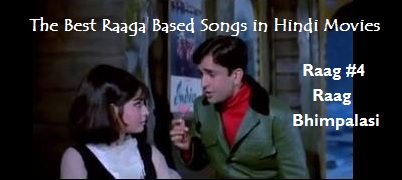
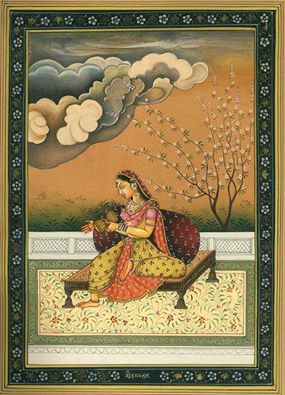
Tonight we start with our fifth Raag: Raag Bhimpalasi. Raag Bhimpalasi is an afternoon raaga, sung from late afternoon to sunset, Bhimpalasi is poignant and passionate, filled with yearning. The raga is reputed to reduce tension and short temper.
Now look at the cover picture depicting the song Khilate hain gul yahan khilake bikharane ko. You get the yearning, the longing, the passion and the poignancy. I have always given you, in the cover pictures of the Raagas, what I feel is the song that comes nearest to the description of the Raaga.
The Raaga is in Thaat Kafi. The other Raagas in Thaat Kafi are Pilu, Kafi and Bageshri. Raag Bhimpalasi is sung in Bhakati, Shringar and Vir ras.
Song #1 Khilate hain gul yahan khil ke bikharane ko…
Sharmilee, the 1971 movie, has Rakhee‘s double role as Kamini (the bad girl) and Kanchan (the innocent one). Shashi Kapoor as Captain Ajit Kapoor falls in love with Kamini when he is returning from Army base and takes shelter in a rest house whereat Kamini and her friends are having a party. It is snowing outside and in order to warm up the party, he sings this song for them. Kamini and Ajit instantly fall in love.
The song has Neeraj‘s lyrics and SD Burman‘s music. It is one of the most passionate songs Kishore Kumar ever sang.
Please enjoy in Raag Bhimpalasi: Khilate hain gul yahan khilake bikharne ko…..
khilate hai.n gul yahaa.N, khilake bikharane ko
milate hai.n dil yahaa.N, milake bichha.Dane ko
khilate hai.n gul yahaa.N …
(kal rahe naa rahe, mausam ye pyaar kaa
kal ruke na ruke, Dolaa bahaar kaa ) – (2)
chaar pal mile jo aaj, pyaar me.n guzaar de
khilate hai.n gul yahaa.N …
jhiilo.n ke ho.nTho.n par, megho.n kaa raag hai
phuulo.n ke siine me.n, Tha.nDii Tha.nDii aag hai
dil ke aaine me.n tuu, ye samaa utaar de
khilate hai.n gul yahaa.N …
pyaasaa hai dil sanam, pyaasii ye raat hai
ho.nTho.n me dabii dabii, koii miiThii baat hai
in lamho.n pe aaj tuu, har khushii nisaar de
khilate hai.n gul yahaa.N …
https://youtube.com/watch?v=HBgKPyi1aXA%3Ffs
Song #2 Aa neele gagan tale pyaar ham karen….
Poignant, passionate, filled with yearning….here is another very good example of it except that I couldn’t find its original video and picture. It has recently assumed iconic proportions as the number one Hindi song for Valentines day.
The song speaks of Shankar Jaikishen‘s excellence in Raaga based songs and Hemant Kumar and Lata Mangeshkar‘s excellence in romantic duets. Hasrat Jaipuri‘s lyrics are so exquisite that they leave you with stunning beauty that stays with you forever. The name of this 1954 movie is Baadshah starring Pradeep Kumar and Usha Kiran.
Please enjoy in Raag Bhimpalasi: Aa neele gagan tale pyaar ham Karen….
aa niile gagan tale pyaar ham kare.n
hil mil ke pyaar kaa iqaraar ham kare.n
aa niile …
ye shaam kii belaa ye madhur mast nazaare
baiThe rahe.n ham yuu.Nhii.n baaho.n ke sahaare
vo din naa aae intazaar ham kare.n
aa niile gagan …
do jaa.n hai.n ham aise mile ek hii ho jaae.n
Dhuu.NDhaa kare duniyaa hame.n ham pyaar me.n kho jaae.n
bechain bahaaro.n ko gulazaar ham kare.n
aa niile gagan tale …
tuu maa.Ng kaa sinduur tuu aa.Nkho.n kaa hai kaajal
le baa.ndh le haatho.n ke kinaare se ye aa.Nchal
saamane baiThe raho shrR^i.ngaar ham kare.n
aa niile gagan tale …
https://youtube.com/watch?v=WnOFZw8wElg%3Ffs
Song #3 Naino mein badara chhaye bijli si chamake haay…
Some of Lata Mangeshkar‘s best songs are picturised on the actress Sadhana. Of course this one is composed by her “bhaiyya” Madan Mohan who was steeped in Raagas. Indeed, on my cellphone, when I listen to this song, I also listen to Lata Mangeshkar’s introduction about how Madan bhaiyya bled from his hand when in disgust he hit it against a glass door; the disgust caused by Madan Mohan observing that some of his musicians were playing against the beat of the Raaga!
The song for which Madan Mohan injured his hand was this song for the 1966 movie Mera Saya. Raja Mehdi Ali Khan penned the lyrics.
Please enjoy in Raag Bhimpalasi: Naino mein badra chhaye….
prem diivaanii huu.N me.n
sapano.n kii raanii huu.N mai.n
pichhale janam se terii
prem kahaanii huu.N mai.n
aa is janam me.n bhii tuu
apanaa banaa le
naino.n me.n…
https://youtube.com/watch?v=moLtGICevDY%3Ffs
Song #4 Maine chand aur sitaaron ki tamanna ki thi….
Okay, we have just started with this Raag and taken up only SD Burman, Shankar Jaikishen and Madan Mohan so far.
Lets take up a beautiful song composed by N Dutta now. Remember N Dutta? He had that beautiful numbers of Dhool Ka Phool to his credit: Dhadakane lage dil ke taaron ki duniya and Tere pyaar ka aasra chahata hoon and some other excellent numbers such as Tang aa chuke hain kashmekash zindagi se ham.
This one sung by Mohammad Rafi is amongst his best. It was there in the 1956 movie Chandrakanta. Lyrics are by Sahir Ludhianvi. The song is picturised on Bharat Bhushan. Once again, I am sorry I couldn’t find the original video but you may listen to and enjoy the song.
Please enjoy in Raag Bhimpalasi: Maine chand aur sitaaron ki tamanna ki thi…..
(mai.n ne chaa.Nd aur sitaaro.n kii tamannaa kii thii
mujhako raato.n kii siyaahii ke sivaa kuchh na milaa ) – 2
mai.n ne chaa.Nd sitaaro.n …
mai.n vo naGamaa huu.N jise pyaar kii mahafil na milii
vo musaafir huu.N jise koii bhii manzil na milii
zakhm paae.n hai.n bahaaro.n kii tamannaa kii thii
mai.n ne chaa.Nd sitaaro.n …
kisii gesuu kisii aa.Nchal kaa sahaaraa bhii nahii.n
raaste me.n koii dhu.Ndhalaa saa sitaaraa bhii nahii.n
merii nazaro.n ne nazaaro.n kii tamannaa kii thii
mai.n ne chaa.Nd sitaaro.n …
merii raaho.n se judaa ho gaI raahe.n unakii
aaj badalii nazar aatii hai.n nigaahe.n unakii
jisase is dil ne sahaaro.n kii tamannaa kii thii
mai.n ne chaa.Nd sitaaro.n …
pyaar maa.Ngaa to sisakate hue aramaan mile
chain chaahaa to uma.Date hue tuufaan mile
Duubate dil ne kinaaro.n kii tamannaa kii thii
mai.n ne chaa.Nd sitaaro.n …
dil me.n naakaam ummido.n ke basere paaye
roshanii lene ko nikalaa to a.ndhere paaye
ra.ng aur nuur ke dhaaro.n kii tamannaa kii thii
mai.n ne chaa.Nd aur sitaaro.n …
https://youtube.com/watch?v=e_Dqn-SLK2w%3Ffs
Song #5 Afsaana likh rahi hoon dil-e-beqraar kaa…
How many of you know that the very first song of my favourite lyricist and poet Shakeel Badayuni was composed by his mentor and music director Naushad Ali in Raag Bhimpalasi?
It is from the 1947 movie Dard starring Suraiyya and Munnavar Sultana and was sung by Uma Devi (who later assumed the name of Tun Tun).
By this time you have guessed the song; haven’t you?
Yes, I am talking about: Afsaana likh rahi hoon dil-e-beqraar kaa…..
jab tuu nahii.n to kuchh bhii nahii.n hai bahaar me.n
nahii.n hai bahaar me.n
jii chaahataa hai muu.Nh bhii
jii chaahataa hai muu.Nh bhii na dekhuu.N bahaar kaa
aa.Nkho.N me.n rang bhar ke tere i.ntazaar kaa
afasaanaa likh rahii huu.N
haasil hai.n yuu.N to mujhako zamaane kii daulate.n
zamaane kii daulate.n
lekin nasiib laa_ii
lekin nasiib laa_ii huu.N ik soGavaar kaa
aa.Nkho.N me.n rang bhar ke tere i.ntazaar kaa
afasaanaa likh rahii huu.N
aajaa ki ab to aa.Nkh me.n aa.Nsuu bhii aa gaye
aa.Nsuu bhii aa gaye
saaGar chhalak uThaa
saaGar chhalak uThaa mere sabr-o-qaraar kaa
aa.Nkho.N me.n rang bhar ke tere i.ntazaar kaa
afasaanaa likh rahii huu.N
https://youtube.com/watch?v=D7XJy4bSNRY%3Ffs
Song #6 Kuchh dil ne kaha, kuchh bhi nahin….
Now that we have taken a song of Shakeel Badayuni, I am tempted to give one of my other favourite: Hemant Kumar; but, this time as music director.
This is from the 1966 movie Anupama with Sharmila Tagore in the title role. She became a recluse in the movie because her father Tarun Bose lost her mother during her delivery and hence her father hates her. Dharmendra as a poet and writer tries to bring her out of her shell. The movie had a remarkably beautiful song sung by Hemant Kumar: Yaa dil ki suno duniya waalo.
This was the first attempt by Hrishikesh Mukherjee to pair together Sharmila Tagore and Dharmendra. So impressed was he with their performance that he did a number of movies with them together such as Chupake Chupake and called this the best pairing in Hindi films. Interestingly, both Dharmendra and Sharmila Tagore celebrated their 80th and 71st birthdays respectively day before yesterday.
Kaifi Azmi‘s lyrics and Lata Mangeshkar‘s singing are both superb too.
Please enjoy in Raag Bhimpalasi: Kuchh dil ne kaha, kuchh bhi nahin….
letaa hai dila a.nga.Daa_iyaa.n, isa dila ko samajhaaye koI
aramaana naa aa.Nkhe.n khola de.n, rusavaa naa ho jaaye koI
palako.n kii Tha.nDii seja para, sapano.n kii pariyaa.n sotii hai.n
aisii bhii baate.n hotii hai.n – 2
kuchha dila ne kahaa, kuchha bhii nahii.n
dila kii tassalii ke liye, jhuuThii chamaka jhuuTh nikhaara
jiivana to suunaa hii rahaa, saba samajhe aayii bahaara
kaliyo.n se koii puuchhataa, ha.nsatii hai.n yaa rotii hai.n
aisii bhii baate.n hotii hai.n – 2
kuchha dila ne kahaa, kuchha bhii nahii.n
https://youtube.com/watch?v=69dnqIFfrnE%3Ffs
Song #7 Mere mann ka bawra panchhi…
In two days of songs based on Raag Bhimpalasi, I have given you songs by six music directors: SD Burman, Shankar Jaikishen, Madan Mohan, N Dutta, Naushad and Hemant Kumar.
Lets proceed further. The first music director of tonight is C Ramchandra. This song is a tribute to the South Indian actress Padmini and her dancing skills (you may recall her from the Raj Kapoor starrer Jis Desh Mein Ganga Behati Hai). The name of this 1958 movie is Amardeep starring Dev Anand, Padmini and Vyjaynthimala. Lyrics of this song were by Rajendra Krishan.
Please enjoy in Raag Bhimpalasi: Mere mann ka bawra panchhi….
mere man kaa baavaraa pa.nchhii kyo.n baar baar Dole -2
sapano.n me.n aaj kis kaa vo bahake pyaar Dole
mere man kaa …
kis ke khayaal me.n ye nazare.n jhukii jhukii hai.n -2
dekho idhar bhii lab par aahe.n rukii rukii hai.n -2
tum ho qaraar jis dil kaa -2
vahii beqaraar Dole
mere man kaa …
dil ko lagan hai usakii miiThii nazar hai jisakii -2
ham paas hai.n tumhaare phir dil me.n yaad hai kis kii -2
tum jo nazar milaao -2
dil me.n bahaar Dole
mere man kaa …
kab se kha.De hue hai.n kah do to lauT jaae.n -2
tumhe duur hii se dekhe.n har dil na paas aaye -2
aa.Nkho.n me.n zi.ndagii bhar tak -2
teraa i.ntazaar Dole
mere man kaa …
https://youtube.com/watch?v=hAFZCN1DwX0%3Ffs
Song #8 Mere pyaar woh hai ke mar ke bhi tumako….
I hope you liked the last song with Lata singing for Padmini and on C Ramchandra’s music.
Lets turn to our eighth music director composing in Raag Bhimpalasi. The pairing of Lyricist SH Bihari with Music Director OP Nayyar in the 1964 movie Kashmir Ki Kali produced some of the most enchanting songs in Hindi movies. Two years later, they were back in Ye Raat Phir Na Aayegi, which, just like Kashmir Ki Kali starred Sharmila Tagore but, instead of Shammi Kapoor, having Biswjeet as the hero.
The song is one of the best songs of Mahendra Kapoor.
Please enjoy in Raag Bhimpalasi: Mera pyaar who hai ke mar ke bhi tumako….
merA pyAr vo hai ke, mar kar bhI tum ko ##(slow)##
judA apanI bAho.n se hone na degA
merA pyAr vo hai ke, mar kar bhI tum ko
judA apanI bAho.n se hone na degA
milI mujhako jannat to jannat ke badale
khudA se merI jA.n tumhe.n mA.ng legA
merA pyAr vo hai
zamAnA to karavaT badalatA rahegA
nae zindagI ke tarAne bane.nge
miTegI na lekin muhabbat hamArI
miTAne ke sau sau bahAne bane.nge
haqIkat hameshA haqIkat rahegI
kabhI bhI na isakA fasAnA banegA
merA pyAr vo hai ke …
tumhe.n chhIn le merI bAho.n se koI
merA pyAr yU.n besahArA nahI.n hai
tumhArA badan chA.ndanI Ake chhUle
mere dil ko ye bhI gavArA nahI.n hai
khudA bhI agar tumase Ake milegA
tumhArI qasam hai merA dil jalegA
merA pyAr vo hai ke …
https://youtube.com/watch?v=R9xoj0E3ZOo%3Ffs
Song #9 Tu kahan yeh bata iss nasheeli raat mein…
Lets now turn to a movie partly shot in my home station Shimla. It is a Dev Anand, Nutan movie Tere Ghar Ke Saamne; just like another movie Manzil starring both of them that too was shot in Shimla: Manzil with the Hemant Kumar number: Yaad aa gayin wo nasheeli nigaahen.
Being a Dev Anand Movie, it wasn’t surprising to have SD Burman as the music director (Indeed Hum Dono was a rare Dev Anand starrer that had Jaidev’s music).
In Tere Ghar Ke Saamne, Nutan has travelled to Shimla from Delhi. Dev Anand follows her on a scooter. In Shimla she cannot be found. So Dev Anand sings this song to find her and of course, by the end of the song, finds her!
Lyrics are by Hasrat Jaipuri and Mohammad Rafi is the singer.
Please enjoy in Raag Bhimpalasi: Tuu kahan yeh bata is nasheeli raat mein….
tuu kahaa.N, ye bataa, is nashiilii raat me.n
maane naa meraa dil diivaanaa
haay re … maane naa meraa dil diivaanaa
he … ba.Daa naTakhaT hai samaa – 2
har nazaaraa hai javaa.N
chhaa gayaa chaaro.n taraf, merii aaho.n kaa dhuaa.N
dil meraa, merii jaa.N, naa jaanaa … tuu kahaa.N …
o o … aaii jab Tha.nDii havaa – 2
maine puuchhaa jo pataa
vo bhii kataraake gaI, aur bechain kiyaa
pyaar se, tuu mujhe, de sadaa … tuu kahaa.N …
he … chaa.nd taaro.n ne sunaa – 2
in bahaaro.n ne sunaa
dard kaa raag meraa, rahaguzaaro.n ne sunaa
tuu bhii sun, jaaneman, aa bhii jaa … tuu kahaa.N …
o o … pyaar kaa dekho asar – 2
aae tum thaame jigar
mil gaI aaj mujhe, merii manachaahii Dagar
kyuu.N chhupaa, ek jhalak, phir dikhaa … tuu kahaa.N …
https://youtube.com/watch?v=wUgMMgANjV0%3Ffs
Song #10 Chalo ik baar phir se ajnabi ban jaayen hum dono…
Nine directors so far who have composed in Raag Bhimpalasi: SD Burman, Shankar Jaikishen, Madan Mohan, N Dutta, Naushad, Hemant Kumar, C Ramchandra, OP Nayyar and SD Burman.
Our tenth one is my namesake Ravi and this is really one of his best, as also the best of the lyricist Sahir Ludhainvi and singer Mahendra Kapoor. It is from the 1963 movie Gumraah starring Sunil Dutt, Mala Sinha and her husband in the movie Ashok Kumar.
Please enjoy in Raag Bhimpalasi: Chalo ik baar phir se….
chalo ik baar phir se, ajanabii ban jaae.n ham dono
chalo ik baar phir se …
na mai.n tumase koI ummiid rakhuu.N dilanavaazii kii
na tum merii taraf dekho galat a.ndaaz nazaro.n se
na mere dil kii dha.Dakan la.Dakha.Daaye merii baato.n se
na zaahir ho tumhaarii kashm-kash kaa raaz nazaro.n se
chalo ik baar phir se …
tumhe.n bhii koI ulajhan rokatii hai peshakadamii se
mujhe bhii log kahate hai.n ki ye jalave paraae hai.n
mere hamaraah bhii rusavaaiyaa.n hai.n mere maajhii kii – 2
tumhaare saath bhii guzarii huii raato.n ke saaye hai.n
chalo ik baar phir se …
taarruf rog ho jaaye to usako bhuulanaa behatar
taalluk bojh ban jaaye to usako to.Danaa achchhaa
vo afasaanaa jise a.njaam tak laanaa naa ho mumakin – 2
use ek khuubasuurat mo.D dekar chho.Danaa achchhaa
chalo ik baar phir se …
https://youtube.com/watch?v=cE5q9kst-Zc%3Ffs
Song #11 Koi nahin hai phir bhi hai mujhako…..
Lets take our eleventh composer composing a song in Raag Bhimpalasi. We have Laxmikant Pyarelal. It is a song from the 1967 movie Patthar Ke Sanam starring Waheeda Rehman and Manoj Kumar. She is alone in the hills but she has a strange waiting for someone. Majrooh‘s lyrics are exquisite and so is Lata Mangeshkar‘s singing.
Please enjoy in Raag Bhimpalasi: Koii nahin hai phir bhi hai mujhako….
ko_ii nahii.n hai phir bhii hai mujhako -2
kyaa jaane kisakaa i.ntazaar ho o o
ko_ii nahii.n hai phir bhii hai mujhako
kyaa jaane kisakaa i.ntazaar ho o o
ye bhii naa jaanuu.N laharaa ke aa.Nchal
kisako bulaaye baar baar
sochuu.N ye hai.n ungaliyaa.N kisake pyaar kii
gaalo.n ko chhuye jo Daalii bahaar kii
chhuye jo Daalii bahaar kii
sochuu.N ye hai.n ungaliyaa.N kisake pyaar kii
kaun hai ai hawaa ai bahaar
ko_ii nahii.n hai phir bhii hai mujhako
kyaa jaane kisakaa i.ntazaar -2
ko_ii nahii.n hai phir bhii hai mujhako
kyaa jaane kisakaa i.ntazaar -2
waadii me.n nishaan mere hii paa.Nv ke
phuulo.n pe hai.n ra.ng merii hii chhaa.Nv ke
hai.n ra.ng merii hii chhaa.Nv ke
waadii me.n nishaan mere hii paa.Nv ke
phir bhii kyuu.N aaye naa aitabaar
ko_ii nahii.n hai phir bhii hai mujhako
kyaa jaane kisakaa i.ntazaar ho o o
ye bhii naa jaanuu.N laharaa ke aa.Nchal
kisako bulaaye baar baar
kyaa jaane kisakaa i.ntazaar -2
https://youtube.com/watch?v=iDNbYdrUTFo%3Ffs
Song #12 Le to aaye ho hamen sapno ke…
Our last composer for the day composing in Raag Bhimpalasi is Ravindra Jain. I am really very fond of this song as I saw the movie with my parents in my home place. Lyrics are also by Ravindra Jain and the voice is that of Hemlata.
The name of the movie is the 1977 movie: Dulhan Wohi Jo Piya Man Bhaaye.
Please enjoy in Raag Bhimpalasi: Le to aaye ho hamen sapano ke gaanv mein….
le to aaye ho hame.n sapano.n kii gaa.Nv me.n
pyaar kii chhaa.Nv me.n biThaaye rakhanaa
sajanaa o sajanaa …
tumane chhuaa to taar baj uThe man ke
tum jaisaa chaaho rahe vaise hii ban ke
tum se shuruu, tumhii.n pe kahaanii khatm kare
duujaa na aaye koii naino ke gaa.Nv me.n
le to aaye ho hame.n …
chhoTaa saa ghar ho apanaa, pyaaraa saa jag ho
koii kisii se pal bhar na alag ho
isake sivaa ab duujii koii chaah nahii.n
ha.Nsate rahe ham dono.n phuulo.n ke gaa.Nv me.n
le to aaye ho hame.n …
https://youtube.com/watch?v=FgEfO7XGycg%3Ffs
There then, that’s my first dozen songs set in Raag Bhimpalasi. This forms the Part I of this blog.
There is a craze on the Facebook to put up old Hindi songs, particularly to share the addresses of the web page (Uniform Resource Locators or the URLs) of the songs. Many groups have mushroomed. In most of these, I have seen, people just share the URL and then the comments follow such as “wow”, “nice”, “love it” and “Dev Anand looks so handsome”.
A few years back I too started a group titled Dil Ki Nazar Se. The song group, with its name having been taken from the title of a duet from Raj Kapoor’s 1959 classic movie Anaadi, was sought to be a group with a difference. I encouraged people to really appreciate various facets of a song; eg, lyrics, music, voice, and actors. Hence, we started paying tributes to lyricists, music directors, singers and actors on their birthdays and death anniversaries. In addition, I started off with music fests on particular themes at least once in a month.
Dil Ki Nazar Se: An enchanting Lata Mangeshkar, Mukesh duet from the 1959 Raj Kapoor classic Anaadi.
And then I came to the difficult part; which is, to request members to put up descriptions whilst sharing the URLs of songs. Facebook and most other social-media has its popularity based on the concept of instant posts; somewhat akin to fast-food. Anything that requires time to either put up or read is not welcome/popular. I have come across even majority of the blogs that are not more than a paragraph; do not share product of any deep study, research or analysis but simply publicity gimmicks (Please read: ‘Blogging – Race Or Stampede‘). Regrettably, many of these, though dumb, are very popular. The fact of the matter is that if you do anything mediocre, the vast mediocrity is instantly on your side since it identifies with it.
I had to leave the group Dil Ki Nazar Se since there was great resistance and aversion to putting up descriptions with the songs. However, I do not give up. I started another group Yaad Kiya Dil Ne with its title taken from the title of another famous duet between Hemant Kumar and Lata Mangeshkar singing for Dev Anand and Usha Kiran in the 1953 movie Patita.
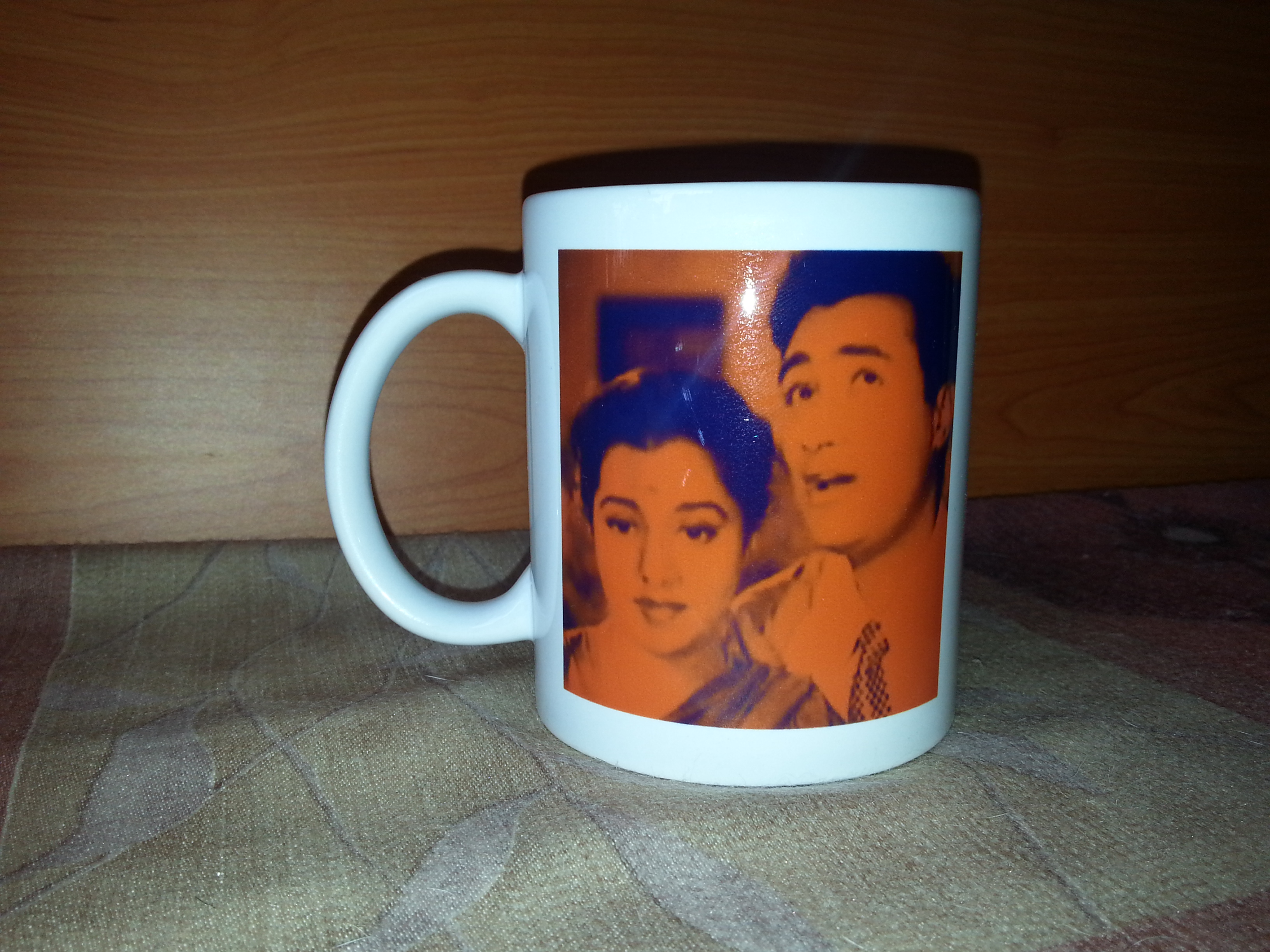
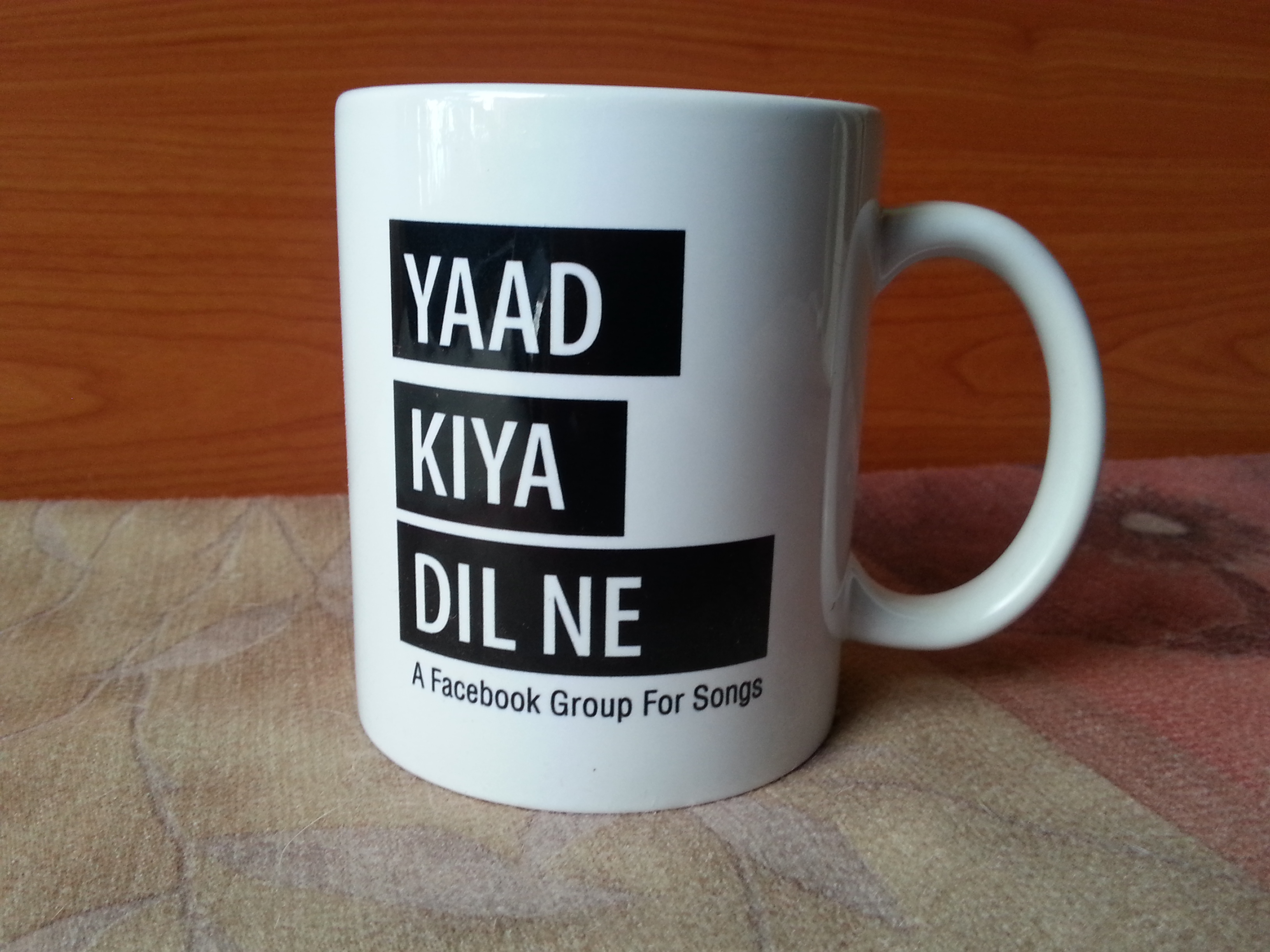
A commemorative mug made on the occasion of the first Meet of the group Yaad Kiya Dil Ne in Mumbai on Sunday, 01 Nov 15
Like King Bruce’s spider, this time I tasted success. There were members willing to put up descriptions; to give out information and learn from the descriptions of others.
We have evolved over a period of time. I am glad that most of the members have now realised that the presentation of a song is much more important than the song URL that they post. The reason is that Facebook is a social media and hence we must socially share what that song means to us.
Whilst there cannot be a uniform yardstick for presentations, I normally look for the following:
1. Member’s personal linkage to that song. It doesn’t always have to be a story or an anecdote. One of the members, Evani Leela’s descriptions in Hindi are a joy to read. She invariably brings out what happens to her when she listens to the song. Another member, Sumedha Nair, for example, even honoured us by sharing her own Hindi poem regarding liberation of women whilst posting Waheeda Rehman’s Guide number: Aaj phir jeene ki tamanna hai, aaj phir marne ka iraada hai (Kaanton se kheench je ye aanchal). Raj Dutta and Vipan Kohli invariably personalise their descriptions and hold everyone’s attention.
2. Information about the song regarding how it was made, actors, singers, lyricist, composer, locale, period etc. One person who has excelled in this is Surekha Saini. Her information is never copy pasted but personalised. It helps us to learn about, eg, the genre’ of the song being presented by her. Sometimes, when lyrics of a song are not available, she has written the lyrics by listening to the song and providing her own translation too?
3. Any tidbits about any of the people connected with the song. You can find these by doing research on the net itself. For example, “Naushad and Shakeel stayed awake the whole night to change a single line in the Mughal-e-Azam song Jab pyaar kiyaa to darna kyaa. One person who has excelled in this is Vipan Kohli. Indeed, he started putting up songs with interesting tidbits by listening to television programmes.
4. Raaga in which the song was composed. Any other similar songs in that Raaga.
5. Genre’ of the music in the song, eg, Salil Chowdhury came up with a beat based on Western classical music and maintained that from Dil tadap tadap ke keh raha hai to Chhoti chhoti si baat. Or that N Dutta’s Dhool Ka Phool song: Dhadakane lagi dil ke taaron ki duniya was based on a Polish marching beat.
6. What are the lyrics are trying to convey? For example, Meera Bai’s Ghunghat ke pat khol tujhe piyaa milenge is not a raunchy number. Here the comparison is between ghunghat ke pat and the veils that an ordinary person has over the eyes of his/her mind that block God. Or Akbar Allahabadi’s Hubgama hai kyun barpa thodi si jo pi li hai…what hungama is he talking about?
7. The story line in the movie that led to the song. For example, Mamta’s song “Rehate the kabhi jinake dil mein hum jaan se bhi pyaaron ki tarah, baithe hain unahi ke kuuche mein hum aaj gunahgaaron ki tarah.” Can you ever think of putting it or similar number by omitting to tell what transpired from past happy situation to present sadness?
Suchitra Sen emoting on Rehate the kabhi jinake dil mein in the 1966 movie Mamta
8. Awards and honours won by the song or those connected with the song; eg, Kahin deep jale kahin dil won for Shakeel Badayuni a Filmfare award for Best Lyrics. Or, that character actor Pran declined his award for Best Supporting Actor for that year when Ghulam Muhammad was ignored by the jury as best music director for Pakeezah.
9. Comparison with an earlier version of the same song or movie; eg, Devdas, Parineeta, and Inhi logon ne…
10. Why did you choose the song over others?
This process has really enriched us in our song group Yaad Kiya Dil Ne. Perhaps, you can take a cue from this in your own song groups and encourage descriptions whilst sharing songs on Facebook.
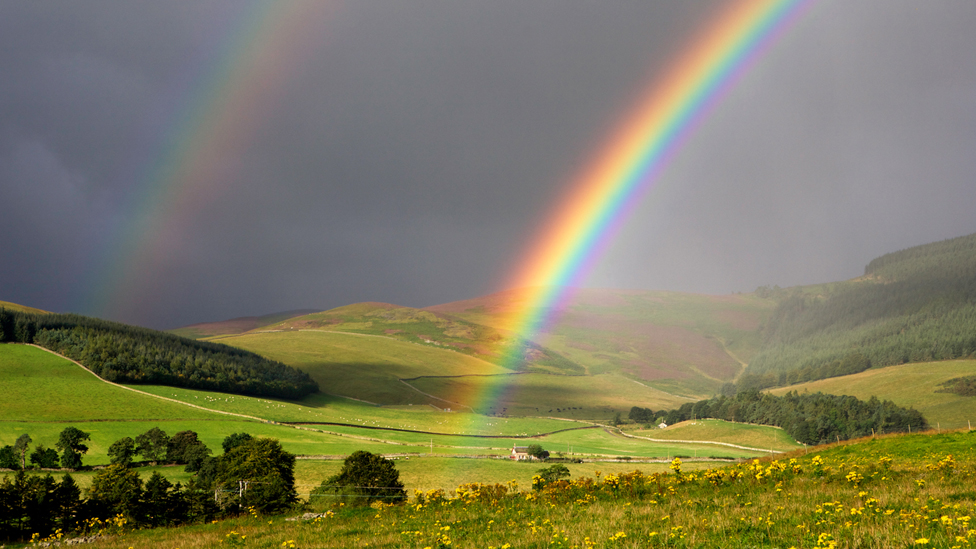
It suddenly appeared across the hill, across the river and the rocks. Before it appeared in its seven visible vibgyor colours, there was a wedding of giddad-giddadi (he and she jackal); as was the folklore to describe rain and sun appearing together.
It appeared so near and yet so far. As a young boy I ran after it, to catch it in my little soiled hands, to bathe in its vivid hues, even to climb up and look down on the world through its prism. At that time it appeared far; it was near when I didn’t want to own it, when I wasn’t very conscious of its existence; it was far when it crept over my consciousness, when I wanted to hold it and possess it.
I have had the same experience with Time.
Before I lost myself in the rapid whirlpool of later-life Time, it flowed like a gentle stream. Indeed, at times it stood still and placid like a pond, like a lake. I didn’t know how much of it I had but it appeared vast, endless, infinite.
I played lukan-chhipi (hide n seek) with my friends and graduated to marbles, gilli-danda, football and cricket. I was small but Time was big. It was everywhere and totally free. I bought kaafal (a type of berry sold near my school, Vijay High School, Mandi), ice on stick, and an anna a booklet of film-songs lyrics. But, I never had to buy Time.
Perhaps because it was freely available, I didn’t place too much of value on it. As a young boy, I read Herman Wouk’s Caine Mutiny and as was normal for me during those days, finished it in a night’s time. How much I still remember; I am surprised. “Wasted hours” it said somewhere in the book, “Are just as painful in the beginning as in the end; only, in the end, it becomes more apparent”.
And now, looking back in time, that halcyon period of my life, when I had all the Time in the world, passed so quickly. I never tried to catch it but it appeared and disappeared like a rainbow; it was here a moment ago: red, orange, yellow and so on and now it is gone; not even the fading colours beyond violet and below red are there now.
Last to last night I saw the Hindi movie Maya that I wanted to see with its beautiful Salil da numbers based on Western classical music beats: Tasveer teri dil mein, jis din se banaayi hai and Jaa re jaa re udd jaa re panchhi. It turned out to be a trash movie and I rued the two and a half hours’ time that I wasted watching it. Two and half hours; in my boyhood days, I used to spend many times that time just day dreaming, writing worthless poetry or catching butterflies.
It is the same sand, passing through the same small opening in the hour-glass; why does it appear to be draining out much faster now? There appears to be lots to do and very little Time to do it. How do I slow it down? Should I catch it now before it gets still faster and makes me akin to a twig being pushed through the flow against my wish? Did I ever have the power to slow it, to stop it; if not to reverse it? Could I have ever caught the rainbow?
I don’t even think about how it would have been if I had thought, planned and done things differently. I am not even filled with ‘If Only’ regrets. But, it still gnaws me to think about whether I ever had the power to do things independently in my own way or whether I have been in a puppet in the hands of Time, trying to catch rainbows and doing things what have been writ for me including writing this article?
ज़िन्दगी में
ज़िन्दगी की तलाश में
ज़िन्दगी को पाने के लिए
कहाँ कहाँ नहीं गया?
क्या क्या ना किया?
पल पल, छिन छिन,
ज़िन्दगी मोम की तरह
पिघलती रही
ना जाने क्या थी?
ना जाने क्या है?
चंद लम्हे और मिल जाते
लौ कुछ और देर जलती
फिर क्या होता?
वक़्त का सितम
ठहर जाता क्या?
यादों के मरहले
खड़े होके क्या ना बिखरते?
कौस-ओ-क़ज़ाह
हाथ में आ जाता क्या?
ख्वाब की
ख़याल की
सराब की
असलियत समझ आ जाती क्या?
किस को मिली है आज़ादी
वक़्त की ज़ंजीरों से?
कौन समझा है?
Zindagi mein
Zindagi ki talaash mein
Zindagi ko paane ke liye
Kahaan kahaan nahin gaya?
Kyaa kyaa na kiyaa?
Pal pal, chhin chhin,
Zindagi mome ki tarah
Pighalti rahi.
Naa jaane kyaa thi?
Naa jaane kyaa hai?
Chand lamhe aur mil jaate
Lau kuchh aur der jalati
Phir kyaa hota?
Waqt ka sitam
Thehar jaata kyaa?
Yaadon ke marhale
Khade hoke kyaa na bikharte?
Qous-o-qazah
Haath mein aa jaata kyaa?
Khwaab ki
Khayaal ki
Saraab ki
Asleeyat samajh aa jaati kyaa?
Kis ko mili hai azaadi
Waqt ki zanjeeron se?
Kaun samajha hai?
I can’t believe it. It has been such a landmark for us in South Bombay, within walking distance of the Naval Dockyard. I have spent hours going through and buying music at Rhythm House.
We are a family of music lovers. We have neither been rich nor poor. In our middle-class hand to mouth existence, music has been food for us – food for soul that is.
I can relate dozens of anecdotes about this music shop but the one that best describes our junoon concerns my younger brother Dr JP Singh.
I was a Lieutenant posted on INS Talwar as Signal Communication Officer (SCO), on my first posting after undergoing the Long C course at Signal School, Cochin.
JP, my younger brother, was studying in St Xavier’s College, graduating in Economics.
Salaries, at that time, used to be dispersed in cash. I used to get about 1400 rupees in hand, which was enough for me to pay for mess, wines, movies and other sundry expenses to keep body and soul together. JP used to receive money orders from our dad to pay for his studies, hostel etc.
One day, in the beginning of the month, on a make and mend day (Wednesdays and Saturdays are called make and mend days in the navy, from the days of the sail when sailors used to make and mend their sails in the afternoons on these days. Nowadays, these are just half days), I had retired in the afternoon to my cabin after the three Bs: that is, Bridge, Beer and Biriyani.
Sleep had just settled over me like fog over the hills when there was a knock at the door. I opened the door and there stood JP. He had bluffed his way at Lion Gate security and had reached the ship entirely unescorted; an impossibility these days of heightened security.
He was visibly shaken. He said his Money Order from home hadn’t arrived and since he hadn’t paid the hostel mess bill, they were at the verge of throwing him out. I was aghast at their cruelty about throwing out my younger just because his payment was delayed by a few days. But, it came out that JP, due to “some urgency”, hadn’t paid the bill for the last two months.
I reasoned it out with him that although I had just got my salary, I too hadn’t yet paid my mess and wine bills and that’s all the money I had.
He countered that by saying since I was on “permanent (he stressed on this word) commission” in the navy, they were unlikely to throw me out whereas he would be out on the street.
I relented and after keeping just a hundred rupees with me, gave him the remaining money. I went to sleep after seeing him off.
I had merely dosed off, when after about 30 minutes or so, there was another knock and there stood JP again, holding dozens of Long Playing (LP) records in both hands and arms. He wanted keys to our wardroom turn-table so that he could play them. This was his story:
“Bhaiyya, after getting money from you, I didn’t take a cab or bus back to the hostel. I said to myself that it is my bhaiyya’s hard-earned money and I have no right to waste it on cabs and buses. So, I started walking back to the hostel. On the way, at Rhythm House, what did I see? There was a sale of records. I peeped in just to have a look and found that all my favourite records were being sold at half the price. I said to myself I would indeed save huge amount of money if I were to buy the complete lot. So, that’s exactly what I did.”
In the next few days we listened to all the records over and over again and got our money’s worth of fun. With the hundred rupees that I had kept with me, I went to the Central Telegraph Office, booked a call to dad and got him five hours after booking the call. I managed to convey to him to expedite sending money to JP. Until then, we lived on love and fresh air and music.
And now, they are thinking of closing down Rhythm House. Why couldn’t the idea occur to them when JP was walking back from my ship to his hostel in St Xavier’s on that make and mend day in 1981?
P.S. To be fair to JP, I might as well admit that if our positions were reversed, the chances of my doing anything different were remote. All’s well that ends well. After a week or ten days, dad’s money order arrived (the only order from my dad that I really liked) and the rhythm of our life was restored.
As you are already aware, these blogs are being recreated from the posts on my Facebook page Lyrical wherein I started with this theme of giving you the best raaga based songs in Hindi movies on the 8th of Aug 2015. Presently, I am on my 11th Raaga: Raag Gara. I have already given you blogs on Raaga Bhairavi, Yaman or Kalyan, and Jhinjhoti. This means that I am well behind schedule.
Anyway, lets re-start with our fourth Raaga here: Raag Darbari Kanada; I have already given you Part I of this blog.
After Bhairavi and Yaman or Kalyan, I have chosen to give you songs composed in Raag Darbari Kanada. Darbari Kanada, or simply Darbari, (pronounced darbāri kānada), is a raga in the Kanada family, which is thought to have originated in Carnatic music and brought into North Indian music by Miyan Tansen, the legendary 16th-century composer in emperor Akbar’s court. This tradition is reflected in the name itself; Darbar is the Persian derived word in Hindi meaning “court.” As the most familiar raga in the Kanada family, it may sometimes also be called Shuddha Kanada or pure Kanada. It belongs to the Asavari thaat.
It is also sometimes written as Durbari and Durbarikanada.
Lets recommence listening to Raag Darbari Kanada based songs. We have so far listened to the following in Part I:
Sarfroshi ki tamanna ab hamaare dil mein hai.
O duniya ke rakhwaale.
Tora man darpan kehlaaye.
Main nigaahen tere chehre se hataayun kaise.
Dil jalata hai to jalane de.
Ye hawa ye raat ye chandni.
Tu pyaar ka saagar hai.
Ghunghat ke pat khol re.
Satyam shivam sundaram.
Meri vinti suno Bhagwan.
Toote huye khwaabon ne.
Teri duniya mein dil lagata nahin.
Here is then, the 13th Hindi song composed in Raag Darbari Kanada:
Song #13 Hum tumase juda hoke mar jaayenge ro ro ke…
Fifth day of Raag Darbari based songs. Lets turn to our 13th music director: Usha Khanna. I have taken this from the 1965 Feroze Khan movie Ek Sapera Ek Lutera that he did with Kumkum. Asad Bhopali penned the lyrics and Mohammad Rafi sang it. The song was quite popular during our days.
Please enjoy in Raag Darbari: Ham tumase judaa hoke mar jaayenge ro ro ke…..
ham tumase judaa ho ke mar jaa_e.Nge ro-ro ke -2
mar jaa_e.Nge ro-ro ke
duniyaa ba.Dii zaalim hai dil to.D ke ha.Nsatii hai -2
ik mauj kinaare se milane ko tarasatii hai
kah do na ko_ii roke -2
ham tumase judaa …
vaade nahii.n bhuule.nge kasame.n nahii.n to.De.nge -2
ye tay hai ki ham dono.n milanaa nahii.n chho.De.nge
jo rok sake roke -2
ham tumase judaa …
sochaa thaa kabhii do dil milakar na judaa ho.nge
maaluum na thaa ham yuu.N naaqaam-e-vafaa ho.nge
qismat ne.n di_e dhokhe
ham tumase judaa …
https://youtube.com/watch?v=xOFwVg-02Xo%3F
Song #14 Tumhen zindagi ke ujaale mubarak….
What about Kalyanji Anandji; you are bound to ask me? Well, he too composed in this royal raaga and did it very well indeed. This is also from a 1965 movie. The movie was called Purnima and starred, if you recall, Dharmendra and Meena Kumari. Mukesh sang for him. Lyrics were penned by Gulzar.
Please enjoy in Raag Darbari: Tumhen zindagi ke ujaale mubaarak….
tumhe.n zindagii ke ujaale mubaarak
a.ndhere hame.n aaj raas aa ga_e hai.n
tumhe.n paa ke ham Kud se duur ho ga_e the
tumhe.n chho.Dakar apane paas aa ga_e hai.n
tumhe.n zindagii ke …
tumhaarii vafaa se shiqaayat nahii.n hai
nibhaanaa to ko_ii ravaayat nahii.n hai
jahaa.N tak qadam aaa sake aa ga_e hai.n
a.ndhere hame.n aaj …
chaman se chale hai.n ye ilzaam lekar
bahut jii li_e ham teraa naam lekar
muraado.n kii ma.nzil se duur aa ga_e hai.n
a.ndhere hame.n aaj …
https://youtube.com/watch?v=4Iq_pfISaEc
Song #15 Suhaani chandini raatein hamein sone nahin detin…
Talking about Mukesh, 12 years after Purnima and more than 30 years after he started singing for Hindi movies, he still had the same voice. In the 1977 movie Mukti starring Shashi Kapoor and Vidya Sinha, he sang this beautiful number that became very popular indeed. It was put together by Anand Bakshi and RD Burman.
tumhaare reshamii julfo.n me.n dil ke phuul khilate the
inhii.n phuulo.n ke mausam me.n ham tum bhii milate the
puraanii vo mulaakaate.n, hame.n sone nahii detii.n
tumhaare pyaar kii baate.n, hame.n sone nahii.n detii.n
suhaanii chaa.Ndanii raate.n …
kahii.n aisaa n ho laga jaaye aag dil me.n paanii se
badal le raastaa apanaa ghaTaae.n meharabaanii se
ki yaado.n kii ye barasaate.n, hame.n sone nahii.n detii.n
tumhaare pyaar kii baate.n, hame.n sone nahii.n detii.n
suhaanii chaa.Ndanii raate.n …
https://youtube.com/watch?v=FKsIfx0GrBk%3F
Song #16 Mere mehboob na jaa, aaj ki raat naa jaa…
Sixth day of Raag Darbari based songs in which we already have taken up 15 composers: Prem Dhawan, Naushad Ali, Ravi, Madan Mohan, Anil Biswas, Sajjad, Shankar Jaikishen, Bulo C Rani, Laxmikant Pyarelal, Hemant Kumar, Salil Choudhury, Roshan, Usha Khanna, Kalyanji Anandji and RD Burman.
I am going to turn to two relatively modern composers now and one not heard much.
Lets first turn to the relatively unknown one: Jani Babu Qawwal whose qawwali Damadam mast kalandar was very popular but who composed only one popular song in Hindi movies; the one in 1965 movie Noor Mahal. This was written by Saba Afghani and sung by Suman Kalyanpur. The movie starred Jagdeep and Chitra.
Please enjoy in Raag Darbari: Mere mehboob naa jaa, aaj ki raat na jaa….
mere mahabuub na jaa, naa jaa naa jaa
mere mahabuub na jaa, aaj kI raat na jaa
hone vaalI hai sahar, tho.DI der aur Thahar
mere mahabuub na jaa …
dekh kitanaa hasIn mausam hai
har taraf ik ajIb aalam hai
jalave is taraha aaj nikhare hai.n
jaise taare zamI.n pe bikhare hai.n, mere mahabuub …
mai.nne kaaTe.n hai.n intazaar ke din
tab kahii.n aaye hai.n bahaar ke din
yU.N naa jaa dil ki shamaa gul kar ke
abhI dekhaa nahI.n hai jI bhar ke, mere mahabuub …
jab se zulfo.n kii chhaa.Nv paaI hai
beqaraarI ko nI.nd aaI hai
is taraha mat jaa yU.NhI sone de
raat Dhalane de subaha hone de, mere mahabuub …
is tarah pher kar nazar mujh se
dUr jaaegaa tU agar mujhase
chaa.NdanI se bhI aag barasegI
shammaa bhI roshanI ko tarasegI, mere mahabuub …
dhaDkano.n me.n yahii taraane hai.n
tere rukane ke sau bahaane hai.n
mere dil kii zaraa sadaa sun le
pyaasii nazaro.n kii iltajaa sun le, mere mahabuub …
https://youtube.com/watch?v=KVt7eG4AyWw%3F
Song #17 Dekha hai pehli baar saajan ki aankhon mein pyaar…
Lets turn to the two relatively modern composers now: Composer #17 and 18. The first one is Nadeem Shravan and once again, the song is a favourite from the 1991 movie Saajan starring Madhuri Dixit with Salman Khan and Sanjay Dutt.
As with many of Nadeem Shravan songs, the lyrics are by Sameer. Singers are Alka Yagnik and SP Balasubramaniam.
Please enjoy in Raag Darbari Kanada: Dekha hai pehli baar, saajan ki aankho mein pyaar….
dekhaa hai pahalii baar saajan kii aa.Nkho.n me.n pyaar
tab jaa ke aayaa mere bechain dil ko karaar
dilabar tujhe milane ko kab se thaa mai.n bekaraar
ab jaa ke aayaa mere bechain dil ko karaar
dekhaa hai pahalii baar …
palake.n jhukaa_uu.n tujhe dil me.n basaa_uu.n
ab bin tere mai.n to kahii.n chain na paa_uu.n
tuu mera jigar hai tuu merii nazar hai
tuu merii aarazuu tuu meraa hamasafar hai
dekhaa hai pahalii baar …
merii adaa_e.n ye merii javaanii
bas tere li_e hai ye merii zi.ndagaanii
tuu merii gazal hai tuu meraa taraanaa
aa terii dha.Dakano.n pe likh duu.N dil kaa fasaanaa
dekhaa hai pahalii baar …
dekhaa hai pahalii baar jaanam kii aa.Nkho.n me.n pyaar
tab jaa ke aayaa mere bechain dil ko karaar
dilabar tujhe milane ko kab se thii mai.n bekaraar
ab jaa ke aayaa mere bechain dil ko karaar
dekhaa hai pahalii baar …
Song #18 Pag ghungroo baandh Meera naachi thi…
And the last one tonight, before we take up the last three tomorrow composing in this Raag, is Bappi Lahiri.
This movie is very nostalgic for me since this was the last movie that I saw with my father before he died in a jeep accident. The 1982 movie Namak Halaal possibly had the best of the songs composed by Bappi Lahiri. I can still recall how my father laughed and laughed with Amitabh‘s acting in the song. It was sung by Kishore Kumar.
buzurgo.n ne,
buzurgo.n ne, faramaayaa ke pairo.n pe apane kha.De hoke dikhalaao
phir ye zamaanaa tumhaaraa hai,
zamaane ke sur taal ke saath, ba.Dhate chale jaao
phir har taraanaa tumhaaraa, fasaanaa tumhaaraa hai
are to lo bhaiyaa ham, apane pairo.n ke uupar,
kha.De ho gae,
aur milaalii hai taal
dabaa legaa daa.Nto.n tale u.Ngaliyaa.N … liyaa.N …
ye jahaa.N dekh kar, dekh kar
apanii chaal… vaah vaah!
dhanyavaad!
ke pag ghu.Ngharuu …
ke pag ghu.Ngharuu baa.Ndh, miiraa naachii thii
aur ham naache bin ghu.Ngaruu ke
ke pag ghu.Ngaruu baa.Ndh, miiraa naachii thii
vo tiir bhalaa, kis kaam kaa hai
jo tiir nishaane se chuuke chuuke chuuke re
ke pag ghu.Ngharuu …
sa sa sa ga ga rii rii sa nii nii sa sa sa (3)
ga ga ga pa pa ma ma ga rii rii ga ga ga (2)
pa nii sa (4). ma pa nii (4)
re re re re re ga re ga re ga
## (Kishore stops) ##
pa pa pa pa pa ma ga re sa nii sa dha
sa nii sa dha sa nii sa dha
sa nii sa dha sa nii sa dha
sa dha nii sa sa dha nii sa
sa dha nii sa sa dha nii sa
pa ma pa ma ga ma ga re
ga re sa nii sa nii sa ga
sa re sa ga re ga re ma
re ma ga ma ga ma pa ma
pa ma ga re sa nii sa pa sa
pa ma ga re sa nii sa pa sa
## (Kishore continues) ##
## Mmmmmmm… ##
aap a.ndar se kuchh,
aur baahar se kuchh aur nazar aate hai.n,
barakhurdaar shakl se to, chor nazar aate hai.n,
umr guzarii hai saarii chorii me.n
saare sukh chain band, jurm kii tijaurii me.n
aap kaa to lagataa hai bas yahii sapanaa
raam naam japanaa paraayaa maal apanaa (2)
vatan kaa khaayaa namak to, namak halaal bano,
farz iimaan kii zi.ndaa yahaa.N misaal bano
paraayaa dhan, paraaii naar pe nazar mat Daalo
burii aadat hai ye, aadat abhii badal Daalo
kyo.n ki!! ye aadat to, vo aag hai jo
ik din apanaa ghar phuu.Nke phuu.Nke phuu.Nke re
ke pag ghu.Ngharuu …
## (Some English lines here………) ##
mausam-e-ishq me.n machale hue armaan hai.n ham
dil ko lagataa hai kii do jism ek jaan hai.n ham
aisaa lagataa hai to lagane me.n kuchh buraaii nahii.n
dil ye kahataa hai aap apanii hai.n, paraaii nahii.n
sa.ngemaramar kii haay, koii muurat ho tum
koii dilakash ba.Dii, khuubasuurat ho tum
dil dil se milane kaa koii muhuurat ho
pyaase dilo.n kii zaruurat ho tum
dil chiirake, dikhalaa duu.N mai.n,
dil me.n yahii, suurat ha.nsii.n
kyaa aap ko lagataa nahii.n, ham hai.n mile pahale kahii.n
kyaa des hai, kyaa jaat hai,
kyaa umr hai, kyaa naam hai,
are chho.Diye in baato.n se,
hamako bhalaa kyaa kaam hai
ajii suniye to… ham aap mile
to phir ho shuruu
afasaane lailaa, majanuu lailaa majanuu ke
ke pag ghu.Ngharuu …
https://www.youtube.com/watch?v=cTvUrpSr9ck
Song #19 Kitana haseen hai mausam….
Seventh day of Raag Darbari based songs in which we already have taken up 18 composers: Prem Dhawan, Naushad Ali, Ravi, Madan Mohan, Anil Biswas, Sajjad, Shankar Jaikishen, Bulo C Rani, Laxmikant Pyarelal, Hemant Kumar, Salil Choudhury, Roshan, Usha Khanna, Kalyanji Anandji, RD Burman. Jani Babu Qawwal, Nadeem Shravan and Bappi Lahiri.
Lets start with C Ramchandra today.
This is a beautiful duet between C Ramchandra and Lata Mangeshkar singing for Dilip Kumar and Meena Kumari for the 1955 movie Azad. Lyrics are by Rajinder Krishan.
Please enjoy in Raag Darbari: Kitana haseen hai mausam, kitana haseen safar hai….
l: kitanaa hasii.n hai.n mausam, kitanaa hasii.n safar hai
chi: sAthI hai khUbasuurat, ye mausam ko bhI khabar hai
kitanaa hasii.n …
chi: milatii nahii.n hai.n ma.nzil, rAhI jo ho akelaa
do ho to phir jahaa.N bhI, chaahe lagaa lo melaa
dil mil gaye to phir kyA, j.ngal bhI ek ghar hai
sAthI hai khUbasuurat, ye mausam ko bhI khabar hai
kitanaa hasii.n …
l: nA jaane havaae.n kyA kahanaa chaahatii hai.n – 2
pa.nchhii terI sadaaye.n kyA kahanaa chaahatii hai.n – 2
kuchh to hai aaj jisakaa, har chiiz par asar hai
chi: sAthI hai khUbasuurat, ye mausam ko bhI khabar hai
kitanaa hasii.n …
chi: kudarat ye kah rahii hai, aa dil se dil milaa le
ulafat se aag lekar, dil kA diyaa jalaale
sachchii agar lagan hai, phir kisakaa tujhako Dar hai
sAthI hai khUbasuurat, ye mausam ko bhI khabar hai
kitanaa hasii.n …
https://youtube.com/watch?v=EecCzvJkaxM%3F
Song #20 Mitwa laut aaye ri…
19 songs by 19 different composers so far. Here is our 20th composer in Raag Darbari Kanada: SN Tripathi.
This is from the 1962 movie Sangeet Samrat Tansen starring Bharat Bhushan and Anita Guha. Lyrics are by Shailendra and singer is Manna De.
Please enjoy in Raag Kanada: Mitwa laut aaye ri….
aa~ ta na Om
mitavaa aa jaao
mitavaa lauT aaye rii
aaj mero jiyaraa kyo.n na aaye
subh din dash.ran paaye
mitavaa laut aaye rii
nainaa jo the niir bhare
piyaa ko dekh phir se muskaaye
aaye rii, aaye rii
aaye mitavaa lauT aaye rii
divaa laa de bujhaaye ko_ii
jaaguu.N priit kii jyot jagaaye
aaye rii, aaye rii, aaye rii
mitavaa lauT aaye rii
% tej gati
mitavaa lauT aaye rii
aaj mero jiyaraa kyo.n na gaaye
subh din dash.ran paaye
mitavaa laut aaye
mitavaa laut aaye
mitavaa laut aaye
https://youtube.com/watch?v=l2gIE8r10fs%3F
Song #21 Hungama hai kyun barpa thodi si jo pi li hai…
And our last composer in this Raag, the 21st, is singer-composer Ghulam Ali. It is not really a Hindi movie song but I am giving it here because of its background and popularity. It is a creation of the poet Akbar Allahabadi.
Akbar Allahabadi’s song is clearly about the pleasures of imbibing alcohol, it is claimed that its genesis is in the social context of the British Raj in India, at a time when the Muslim League had begun to exert its independent approach to interacting with the British, against the wishes of the Congress. Some Muslims, including Akbar Allahabadi, hoped for Hindu-Muslim unity. This caused others to suggest that he had been given alcohol by the Hindus. (Muslims are forbidden to drink alcohol.) His ghazal was intended as a response to those insinuations.
The ghazal was made famous by Ghulam Ali lending his voice to it.
Please enjoy in Raag Darbari Kanada: Hungama hai kyun barpa thodi si jo pi li hai….
Hungama Hai Kyon Barpa, Thodi Si Jo Pii Lii Hai
Daakaa Toh Nahin Daalaa Chori Toh Nahi Kii Hai
Naa Tajurbakaari Se Vaais Kii Ye Baatein Hai
Is Rang Ko Kyaa Jaane Puchho Toh Kabhi Pii Hai
Us Ma’ay Se Nahi Matlab, Dil Jis se Hai Begaanaa
Maqasudd Hai Us Mai Se Dil Hii Mein Jo Khinchati Hai
Har Zarra Chamaktaa Hai Anwaar-e-Ilaahi Se
Har Saans Ye Kehati Hai Hum Hai To Khuda Bhi Hai
Suraj Mein Lage Dhabba Fitrat ke Karishme hain
But Hum ko Kahein Kaafir Allah Ki Marzi Hai
Here is my translation for those who require it:
Why is there so much hue and cry if I have had some alcohol?
I haven’t robbed someone, nor have I committed any theft.
Inexperienced are the words of the preacher/saintly(Va’iz).
For someone who has never tasted alcohol, can never rightly comment about it.
Us Ma’ay Say Nahin Matlab,
Dil Jis Say Ho Baygaana
Maqsood Hay Oos Ma’ay Se,
Dil Hee Main Jo Khinchtee Hai
(In the next lines he tries to respond to the dogmatic politicians)
Ma’ay here meaning, Wine.
I am not concerned with that wine (ma’ay), whose consumption does not touch the heart. It does not bother me as it is just for the sake of drinking.
I am bothered with, or by saying ‘wine’, I intend (maqsood) that entity, using which some people are trying to play dirty politics and dividing hearts.
Every thing that exists (har zarra) in this universe, is due to the grace of the almighty.(Anwar-e-Elaahi, meaning Grace of God). Then very beautifully the poet says, Har Saans ye kehti hai, Hum hai to Khuda Bhi hai..Its like we are a part of the Lord, and we exist and breathe within his shadow of Divinity.
https://www.youtube.com/watch?v=enoX89bQvug
Song #22 Aap ki nazaron ne samajha pyaar ke kaabil mujhe…
Now that we have taken up the compositions in Raag Darbari of as many as 21 composers, we are going to take up, songs chosen by me to end Raag Darbari based songs; three songs in this part and some more in Part III.
The first is from Madan Mohan with lyrics by Raja Mehdi Ali Khan. The song is from the 1962 movie Anpadh with Mala Sinha in the title role and Dharmendra as the professor.
The song is listed amongst the top ten songs of Lata Mangeshkar.
Please enjoy in Raag Darbari: Aap ki nazaron ne samajha pyaar ke kaabil mujhe….
aap kii nazaro.n ne samajhaa, pyaar ke kaabil mujhe
dil kii ai dha.Dakan Thahar jaa, mil ga_ii ma.nzil mujhe
aap kii nazaro.n ne samajhaa
jii hame.n ma.nzuur hai, aapakaa ye faisalaa – 2
kah rahii hai har nazar, ba.ndaa-paravar shukariyaa
do jahaa.N kii aaj khushiyaa.N ho ga_ii.n haasil mujhe
aap kii nazaro.n ne samajhaa …
aap kii ma.nzil huu.N mai.n merii ma.nzil aap hai.n – 2
kyuu.N mai.n tuufaan se Daruu.N mere saahil aap hai.n
koii tuufaano.n se kah de, mil gayaa saahil mujhe
aap kii nazaro.n ne samajhaa …
pa.D ga_ii dil par merii, aap kii parchhaa_iyaa.N – 2
har taraf bajane lagii.n saika.Do.n shahanaa_iyaa.N
ha.Nsake apanii zi.ndagii me.n, kar liyaa shaamil mujhe
aap kii nazaro.n ne samajhaa …
https://youtube.com/watch?v=iGwdq0pbEWc%3F
Song #23 Yaad mein teri jaag jaag ke hum….
The second has been composed by Naushad and is from the 1963 iconic movie Mere Mehboob. As with most Naushad songs, lyrics are by my favourite lyricist: Shakeel Badayuni and the duet is between Mohammad Rafi and Lata Mangeshkar singing for Rajendra Kumar and Sadhana respectively.
Please enjoy in Raag Darbari: Yaad mein teri jaag jaag ke ham….
yaad me.n terI jaag-jaag ke ham
raat bhar karavaTe.n badalate hai.n
har gha.Dii dil me.n terI ulfat ke
dhiime dhiime chiraaG jalate hai.n
jabase tUne nigaah pherii hai
din hai suunaa to raat a.ndherii hai
chaa.Nd bhI ab najar nahii.n AtA
ab sitaare bhI kam nikalate hai.n
yaad me.n terI jaag-jaag ke ham …
luT gayii vo bahaar kI mahafil
chhuT gayii hamase pyaar kI ma.nzil
zi.ndagii kI udaas rAho.n me.n
terI yaado.n ke sAth chalate hai.n
yaad me.n terI jaag-jaag ke ham …
tujhako paakar hame.n bahaar milii
tujhase chhuTakar magar ye baat khulii
baaGabaan hii chaman ke phuulo.n ko
apane pairo.n se khud masalate hai.n
yaad me.n terI jaag-jaag ke ham …
kyA kahe.n tujhase kyuu.n huii duurii
ham samajhate hai.n apanii majabuurii
tujhako maaluum kyA ke tere liye
dil ke gam aa.Nsuo.n me.n Dhalate hai.n
yaad me.n terI jaag-jaag ke ham …
Song #24 Sau baar janam lenge……
And the last song for the Part II of the blog on Raag Darbari Kanada based best songs in Hindi movies has been composed by my namesake: Ravi. I often marvel at the beautiful, somewhat enigmatic picturisation of the song. It is from another 1963 movie: Ustaadon Ke Ustaad starring Pradeep Kumar and Shakeela. Asad Bhopali wrote the lyrics and Mohammad Rafi sang it.
Please enjoy in Raag Darbari: Sau baar janam lenge….
sau baar janam le.nge, sau baar fanaa ho.nge
ai jaan-e-vafaa phir bhii, ham tum na judaa ho.nge
qismat hame milane se, rokegii bhalaa kab tak
in pyaar kii raaho.n me.n, bhaTakegii vafaa kab tak
qadamo.n ke nishaa.N khud hii, ma.nzil kaa pataa ho.nge
ye kaisii udaasii hai, jo husn pe chhaaii hai
ham duur nahii.n tum se, kahane ko judaaii hai
aramaan bhare do dil, phir ek jagah ho.nge
https://www.youtube.com/watch?v=CTprvBjARLY
That brings us to the end of Part II of The Best Raaga Based Songs In Hindi Movies – Raaga Darbari. Please await Part III.
As you are already aware, these blogs are being recreated from the posts on my Facebook page Lyrical wherein I started with this theme of giving you the best raaga based songs in Hindi movies on the 8th of Aug 2015. Presently, I am on my 11th Raaga: Raag Gara. I have already given you blogs on Raaga Bhairavi, Yaman or Kalyan, and Jhinjhoti. This means that I am well behind schedule.
Anyway, lets start with our fourth Raaga here: Raag Darbari Kanada.
After Bhairavi and Yaman or Kalyan, I have chosen to give you songs composed in Raag Darbari Kanada. Darbari Kanada, or simply Darbari, (pronounced darbāri kānada), is a raga in the Kanada family, which is thought to have originated in Carnatic music and brought into North Indian music by Miyan Tansen, the legendary 16th-century composer in emperor Akbar’s court. This tradition is reflected in the name itself; Darbar is the Persian derived word in Hindi meaning “court.” As the most familiar raga in the Kanada family, it may sometimes also be called Shuddha Kanada or pure Kanada. It belongs to the Asavari thaat.
It is also sometimes written as Durbari and Durbarikanada.
Song #1 Sarfroshi ki tamanna ab hamaare dil mein hai…
My most favourite song in this Raag forms the cover picture of this Raag: Sarfroshi ki tamanna ab hamaare dil mein hai…
An Urdu poem written by an Arya Samaji? Well, that was the strength of my Bharat or India before politicians on both sides of the border divided us along religious and casteist lines for their vested interests.
Ram Prasad Bismil was born on 11th June 1897 in Shajahanpur. He was merely 30 when he was hanged to death by the British at Gorakhpur Jail. His crime? Well, he, along with a few others such as Ashfaqulla Khan, Roshan Singh and Rajendra Nath Lahiri sought to break the shackles of slavery for India and let its people live in Freedom.
He was one of the founding members of Hindustan Republican Association. The association and his writings later became the inspiration for Shaheed Bhagat Singh.
Bismil wrote about many poems and Ghazals (both in Hindi and Urdu) inspiring people to revolt against the British. This Urdu Ghazal (his most famous) is written in Beher-E-Ramal/Mazahif Musamman. This type of Beher in Urdu poetry was the favourite meter of Ram Prasad Bismil. He had written almost 35 ghazals in this meter.
Here is his famous poem…
Sarfaroshi ki tamanna ab hamaare dil mein hai
Dekhna hai zor kitna baazu-e-qaatil mein hai
aye watan Karta nahin kyun doosra kuch baat-cheet
Dekhta hun main jise woh chup teri mehfil mein hai
Aye shaheed-e-mulk-o-millat main tere oopar nisaar
Ab teri himmat ka charcha ghair ki mehfil mein hai
Sarfaroshi ki tamanna ab hamaare dil mein hai
Waqt aanay dey bata denge tujhe aye aasman
Hum abhi se kya batayen kya hamare dil mein hai
Khainch kar layee hai sab ko qatl hone ki ummeed
Aashiqon ka aaj jumghat koocha-e-qaatil mein hai
Sarfaroshi ki tamanna ab hamaare dil mein hai
Hai liye hathiyaar dushman taak mein baitha udhar
Aur hum taiyyaar hain seena liye apna idhar
Khoon se khelenge holi gar vatan muskhil mein hai
Sarfaroshi ki tamanna ab hamaare dil mein hai
Haath jin mein ho junoon katt te nahi talvaar se
Sar jo uth jaate hain voh jhukte nahi lalkaar se
Aur bhadkega jo shola-sa humaare dil mein hai
Sarfaroshi ki tamanna ab hamaare dil mein hai
Hum to ghar se nikle hi the baandhkar sar pe kafan
Jaan hatheli par liye lo barh chale hain ye qadam
Zindagi to apni mehmaan maut ki mehfil mein hai
Sarfaroshi ki tamanna ab hamaare dil mein hai
Yuun khadaa maqtal mein qaatil kah rahaa hai baar baar
Kya tamannaa-e-shahaadat bhi kisee ke dil mein hai
Dil mein tuufaanon ki toli aur nason mein inqilaab
Hosh dushman ke udaa denge humein roko na aaj
Duur reh paaye jo humse dam kahaan manzil mein hai
Wo jism bhi kya jism hai jismein na ho khoon-e-junoon
Toofaanon se kya lade jo kashti-e-saahil mein hai
Sarfaroshi ki tamanna ab hamaare dil mein hai.
Dekhna hai zor kitna baazuay qaatil mein hai.
And, here is the translation
The desire for revolution is in our hearts
Let us see what strength there is in the arms of our executioner
Why do you remain silent thus?
Whoever I see, is gathered quiet so…
O martyr of country, of nation, I submit myself to thee
For yet even the enemy speaks of thy courage
The desire for struggle is in our hearts…
When the time comes, we shall show thee, O heaven
For why should we tell thee now, what lurks in our hearts?
We have been dragged to service, by the hope of blood, of vengeance
Yea, by our love for nation divine, we go to the streets of the enemy
The desire for struggle is in our hearts…
Armed does the enemy sit, ready to open fire
Ready too are we, our bosoms thrust out to him
With blood we shall play Holi, if our nation need us
The desire for struggle is in our hearts…
No sword can sever hands that have the heat of battle within,
No threat can bow heads that have risen so…
Yea, for in our insides has risen a flame,
and the desire for struggle is in our hearts…
Set we out from our homes, our heads shrouded with cloth,
Taking our lives in our hands, do we march so…
In our assembly of death, life is now but a guest
The desire for struggle is in our hearts…
Stands the enemy in the gallows thus, asking,
Does anyone wish to bear testimony?…
With a host of storms in our heart, and with revolution in our breath,
We shall knock the enemy cold, and no one shall stop us…
What is that body that does not have hot blood in it,
How can a person conquer a Typhoon while sitting in a boat near the shore.
The desire for struggle is in our hearts,
We shall now see what strength there is in the boughs of the enemy.
In the 1965 movie Shaheed starring Manoj Kumar as Shaheed Bhagat Singh, this poem was composed in Raag Darbari by Prem Dhawan. Mohammad Rafi, Manna Dey and Rajendra Mehta sang it for Bhagat Singh, Rajguru and Sukhdev in the movie.
Please enjoy in Raag Darbari: Sarfroshi ki tamanna ab hamaare dil mein hai….
https://www.youtube.com/watch?v=bwuXM31XjPE
Song #2 O duniya ke rakhwaale….
I am sure you enjoyed my most favourite song in Raag Darbari: Bismil’s nazm: Sarfroshi ki tamanna ab hamaare dil mein hai.
Now, let me turn to Naushad whose composition in this Raag always leaves me spellbound. It is absolutely easy for you to guess it: Yes, it is from 1952 movie Baiju Bawra starring Bharat Bhushan and Meena Kumari. Naushad was the music director for several movies and each one of these, eg, Mughal-e-Azam, has songs composed in various Raagas. He received his only Filmfare award for Best Music Director for Baiju Bawra. Each one of those 13 songs was composed in some raaga or the other. Raaga Darbari Kanada occurs twice: once in this song that I am giving you, and once in the sargam by Ustad Amir Khan; it was a master-stroke by Naushad Ali to have roped in the great classical singers Ustad Amir Khan and DV Paluskar to sing in the movie.
The song that I have selected for you is: O duniya ke rakhwaale. To call it merely a song wopuld be insulting its lyricist, composer and most of all the singer: Mohammad Rafi. It is a cry of the heart by Baiju Bawra to God to give him that dard in his singing that would make him take on Tansen (coincidentally, the man who brought the Raag from the South!) and avenge his father’s death because of him. It is not one of the best of god of songs: Mohammad Rafi; it is indeed his best ever. No one has ever been able to raise his singing voice to that kind of high pitch as in the end of this song.
No, no one can write like Shakeel from Badayun in UP.
Please enjoy in Raag Darbari Kanada: O duniyaa ke rakhwaale….
bhagavaan, bhagavaan … bhagavaan
o duniyaa ke rakhavaale, sun dard bhare mere naale
sun dard bhare mere naale
aash niraash ke do ra.ngo.n se, duniyaa tuune sajaaI
nayyaa sa.ng tuufaan banaayaa, milan ke saath judaaI
jaa dekh liyaa harajaaI
o … luT gaI mere pyaar kii nagarii, ab to niir bahaa le
ab to niir bahaa le
o … ab to niir bahaa le, o duniyaa ke rakhavaale …
aag banii saavan kii barasaa, phuul bane a.ngaare
naagan ban ga_ii raat suhaanii, patthar ban gae taare
sab TuuT chuke hai.n sahaare, o … jiivan apanaa vaapas le le
jiivan dene vaale, o duniyaa ke rakhavaale …
chaa.nd ko Dhuu.NDhe paagal suuraj, shaam ko Dhuu.NDhe saveraa
mai.n bhii Dhuu.NDhuu.N us priitam ko, ho naa sakaa jo meraa
bhagavaan bhalaa ho teraa, o … qismat phuuTii aas na TuuTii
paa.nv me.n pa.D gae chhaale, o duniyaa ke rakhavaale …
mahal udaas aur galiyaa.n suunii, chup-chup hai.n diivaare.n
dil kyaa uja.Daa duniyaa uja.Dii, ruuTh gaI hai.n bahaare.n
ham jiivan kaise guzaare.n, o … ma.ndir girataa phir ban jaataa
dil ko kaun sambhaale, o duniyaa ke rakhavaale …
o duniyaa ke rakhavaale
rakhavaale
rakhavaale
rakhavaale … % (throat bleeding pitch !!)
https://youtube.com/watch?v=GygqxgYqwQc%3F
Song #3 Tora man darpan kehlaaye….
Meena Kumari was the one who was Gauri in Baiju Bawra whose song I have given you above. Talking about Meena Kumari takes me to her role in 1965 movie Kaajal. The bhajan that she sang in the movie is ranked amongst the best bhajans ever. Asha Bhosle sang it for her. The composer was my namesake Ravi. Lyrics are by another great lyricist: Sahir Ludhianvi.
Please enjoy in Raag Darbari Kanada: Tora man darpan kehlaaye….
praaNii apane prabhu se puuchhe kis vidhii paauu.N tohe
prabhu kahe tu man ko paa le, paa jayegaa mohe
torA man darpaN kahalAye – 2
bhale bure sAre karmo.n ko, dekhe aur dikhAye
torA man darpaN kahalAye – 2
man hI devatA, man hI Ish{}var, man se ba.DA na koy
man ujiyArA jab jab phaile, jag ujiyArA hoy
is ujale darpaN pe prANI, dhUl na jamane pAye
torA man darpaN kahalAye – 2
sukh kI kaliyA.N, dukh ke kA.nTe, man sabakA AdhAr
man se koI bAt chhupe nA, man ke nain hazAr
jag se chAhe bhAg lo koI, man se bhAg na pAye
torA man darpaN kahalAye – 2
tan kii daulat Dhalatii chhaayaa man kaa dhan anamol
tan ke kaaraN man ke dhan ko mat maaTi mein rau.nd
man kii qadar bhulaanevaalaa viiraa.N janam gavaaye
torA man darpaN kahalAye – 2
https://youtube.com/watch?v=c44Ah24hr9M%3F
Song #4 Main nigaahen tere chehre se hataayun kaise….
Madan Mohan has composed remarkably beautiful songs in Raag Darbari; so beautiful that I would probably end up giving you quite a few.
Most of these are on the lyrics of Raja Mehdi Ali Khan. This one sung by Mohammad Rafi for the 1964 movie Aap Ki Parchhayiyan (in which there is another one too: Agar mujhase mohabbat hai mujhe sab apane gham de do) is really one of the best of Rafi.
Dharmendra sings it in the movie for Shashikala.
Some people feel that the song has actually closeness to Raag Gara. There is nothing strange about that. Many of the Hindi songs, not being in pure Raaga, would have closeness to more than one Raaga.
Please enjoy in Raag Darbari: Main nigaahen tere chehre se uthaayun kaise….
mai.n nigaahe.n tere chehare se haTaa_uu.N kaise
lut ga_e hosh to phir hosh me.n aa_uu.N kaise
chhaa rahii thii terii mahakii hu_ii zulfo.n kii ghaTaa
terii aa.Nkho.n ne pilaa dii to mai.n piitaa hii gayaa
taubaa taubaa taubaa taubaa taubaa taubaa
vo nashaa hai ki bataa_uu.N kaise
shoK nazare.n ye sharaarat se na baaz aa_e.ngii
kabhii ruuThe.ngii kabhii mil ke palaT jaa_e.ngii
tujh se nibh jaa_egii mai.n in se nibhaa_uu.N kaise
https://youtube.com/watch?v=ADiu3W1vgOM%3F
Song #5 Dil Jalata hai to jalane de….
Lets now take this outstanding composition of Anil Biswas for Mukesh to sing. Mukesh was at that time copying KL Saigal. After he sang it and KL Saigal heard the song, he remarked, “I don’t remember having sung this song”!
The song is from the 1945 movie Pehli Nazar. It was written by Aah Sitapuri.
Please enjoy in Raag Darbari: Dil jalata hai to jalane de….
dil jalataa hai to jalane de
aa.Nsuu nA bahaa fariyaad nA kar
dil jalataa hai to jalane de
tU paradaa nashii.n kA aashiq hai
yuu.n naam-e-vafaa barabaad nA kar
dil jalataa hai to jalane de
maasuum najar ke tiir chalaa
bismil ko bismil aur banaa
ab sharm-o-hayaa ke parade me.n
yuu.n chhup chhup ke bedaad nA kar
dil jalataa hai to jalane de
ham aas lagaaye baiThe hai.n
tum vAdaa karake bhuul gaye
yA suurat aake dikhaa jaao
yA kaha do hamako yaad nA kar
dil jalataa hai, dil jalataa hai, dil jalataa hai …
https://www.youtube.com/watch?v=mJ5wi339HvE
Song #6 Ye hawa ye raat ye chandni….
Let me now give you a very popular number picturised on Dilip Kumar set in this Raag. It is from the 1952 movie Sangdil. The composer was Sajjad. So successful was he in this composition that Madan Mohan himself copied this!
Dilip Kumar is a rich, reckless guy in the movie who hates women except to use them as objects of desire. He sings this for an affluent woman in his party circle. However, the song has inspired a number of videos depicting his and Madhubala’s real love (she too acted in the movie!)
Rajinder Krishan penned the lyrics and Talat Mehmood sang it.
Please enjoy in Raag Darbari: Ye hawa ye raat ye chandini…
(ye havaa ye raat ye chaa.Ndanii
terI ek adaa pe nisaar hai ) – 2
mujhe kyuu.N nA ho terI aarazuu
terI justajuu me.n bahaar hai
ye havaa ye raat ye chaa.Ndanii
tujhe kyA khabar hai o bekhabar
terI ek nazar me.n hai kyA asar
jo gazab me.n aaye to kahar hai
jo ho meharabaa.n vo qaraar hai
mujhe kyuu.N nA ho terI aarazuu
terI justajuu me.n bahaar hai
ye havaa ye raat ye chaa.Ndanii
terI baat-baat hai.n dilanashii.n
koI tujhase ba.Dhake nahii.n hasii.n
hai.n kalii-kalii me.n jo mastiyaa.n
terI aa.Nkh kA ye khumaar hai
mujhe kyuu.N nA ho terI aarazuu
terI justajuu mai.n bahaar hai
ye havaa ye raat ye chaa.Ndanii …
https://youtube.com/watch?v=xQCMe6ZDifs%3F
Song #7 Tu pyaar ka saagar hai….
The royal court Raag Darbari that Tansen imported from the South, and that’s why it is called Darbari Kanada, is into its third day tonight here on Lyrical. We have so far taken up the compositions of Prem Dhawan, Naushad Ali, Ravi, Madan Mohan, Anil Biswas and Sajjad.
I must remind you at this stage and periodically that in Hindi movies it is very difficult to find pure Raaga compositions. My cover picture normally shows the composition that comes closest to the pure Raaga.
Let me start tonight by giving you one from Shankar Jaikishen. This is really a favourite of mine, as always, sung so well by Manna De. The lyricist was Shailendra whose birth anniversary we celebrated on 30th Aug.
The name of the movie is Seema starring Balraj Sahni and Nutan.
Please enjoy in Raag Darbari: Tu pyaar ka saagar hai….
tuu pyaar kaa saagar hai
terii ik buu.Nd ke pyaase ham
lauTaa jo diyaa tumane, chale jaaye.nge jahaa.N se ham
tuu pyaar kaa saagar hai …
ghaayal man kaa, paagal pa.nchhii u.Dane ko beqaraar
pa.nkh hai.n komal, aa.Nkh hai dhu.Ndhalii, jaanaa hai saagar paar
jaanaa hai saagar paar
ab tuu hi ise samajhaa, raah bhuule the kahaan se ham
tuu pyaar kaa saagar hai …
idhar jhuumatii gaaye zi.ndagii, udhar hai maut kha.Dii
koii kyaa jaane kahaa.N hai siimaa, ulajhan aan pa.Dii
ulajhan aan pa.Dii
kaano.n me.n zaraa kah de, ki aaye kaun dishaa se ham
tuu pyaar kaa saagar hai …
https://youtube.com/watch?v=e2D-kjOMNF0%3F
Song #8 Ghunghat ke pat khol re…..
Some of you understand this mood that I frequently get into of listening to bhajans; not to proclaim my being virtuous or anything like that, but, for the cleaning of my own soul.
I have posted this Meera bhajan many times. I am in love with it since the direction of the bhajan is to open the veil of one’s heart so as to receive God. I sometimes think how great Meerabai must have been to renounce her princely life in order to love Lord Krishna single mindedly. In this bhajan, she has actually given us the key to receive God: Ghuunghat ke pat khol re tohe piya milenge!
Music is that of Bulo C Rani and the singer is Geeta Roy (before she became Geeta Dutt). The movie is the 1950 movie Jogan starring Nargis in the title role and Dilip Kumar.
Please enjoy in Raag Darbari: Ghuunghat ke pat khol re tohe piya milenge…..
( ghuu.NghaT ke paT khol re
tohe piyaa mile.nge ) -2
ghuu.NghaT ke paT khol re
( ghaT-ghaT me.n tore
saa_ii.n basat hai.n ) -2
kaThuu bachan mat bol re
tohe piyaa mile.nge
ghuu.NghaT ke paT khol re
tohe piyaa mile.nge
ghuu.NghaT ke paT khol re
dhan-joban kaa garb na kiije -2
jhuuThaa inakaa mol re
tohe piyaa mile.nge
ghuu.NghaT ke paT khol re
tohe piyaa mile.nge
ghuu.NghaT ke paT khol re
jaa ke jatan se ra.ng-mahal me.n -2
piyaa paayo anamol re
ghuu.NghaT ke paT khol re
tohe piyaa mile.nge
ghuu.NghaT ke paT khol re
suune mandir
suune mandir diyaa jalaa ke -2
aasan se mat Dol re
tohe piyaa mile.nge
ghuu.NghaT ke paT khol re
tohe piyaa mile.nge
ghuu.NghaT ke paT khol re
https://youtube.com/watch?v=9yZOArXPlP8%3F
Song #09 Satyam shivam sundaram….
In keeping with the mood of tonight, let me give you one last bhajan penned by Pandit Narendra Sharma for the 1978 movie Satyam Shivam Sundaram. Laxmikany Pyarelal composed it in Raag Drabari and Lata Mangeshkar sang it for Zeenat Aman
Please enjoy in Raag Drabari: Satyam shivam sundaram….
la: iishvar satya hai
satya hii shiv hai
shiv hii sundar hai
jaago uTh kar dekho
jiivan jot ujaagar hai
satyam shivam sundaram -2
ko: iishvar satya hai
satya hii shiv hai
shiv hii sundar hai
satyam shivam sundaram
la: satyam shivam sundaram -2
raam avadh me.n
raam avadh me.n kaashii me.n shiv kaanhaa brindavan me.n
dayaa karo prabhu dekhuu.N inako
dayaa karo prabhu dekhuu.N inako har ghar ke aa.Ngan me.n
raadhaa-mohan sharaNam
satyam shivam sundaram
aa.a
ko: satyam shivam sundaram
la: ek suurya hai
ek suurya hai ek gagan hai ek hii dharatii-maataa
dayaa karo prabhu ek bane.n sab
dayaa karo prabhu ek bane.n sab sabakaa ek se naataa
raadhaa-mohan sharaNam
satyam shivam sundaram -2
aa.a
ko: satyam shivam sundaram
la: iishvar satya hai
satya hii shiv hai
shiv hii sundar hai
ko: satyam shivam sundaram
la: aa.a
https://youtube.com/watch?v=BdU3qP5EYoY%3F
Song #10 Meri vinti suno Bhagwan….
Fourth day of Raag Darbari that Tansen imported from the South, and that’s why it is called Darbari Kanada. In the last three days, we have so far taken up the compositions of Prem Dhawan, Naushad Ali, Ravi, Madan Mohan, Anil Biswas, Sajjad, Shankar Jaikishen, Bulo C Rani and Laxmikant Pyarelal.
Lets start with Hemant Kumar today evening.
I have taken this song from 1956 movie Taj. Rajinder Krishan was the lyricist and Mohammad Rafi was the singer.
Please enjoy: Ab mori vinti suno bhagwan….
aaaa aaaa aaa aaa
aa aa aa aa aa
mori vinti suno bhagwaan
abb mori vinti suno bhagwaan
aaj meri tooti veena mein
phir se daaro praan
abb mori vinti suno bhagwaan
abb mori vinti suno bhagwaan
na maangoon yeh mahal khazaane
na maangoon yeh taaj
aaj bhare darbaar mein swaami
rakhiyo meri laaj
raagi ko bas saat suron ka aa
raagi ko bas saat suron ka
daata de vardaan
abb mori vinti suno bhagwaan
abb mori vinti suno bhagwaan
aaj meri tooti veena mein
phir se daaro praan
abb mori vinti suno bhagwaan
abb mori vinti suno bhagwaan
sooraj ki raftaar badal de
maan tu rakh le mera
jab tak toota saaz na boley
jag mein rahe andhera
shabnam se niklen angaare
daal daal jal jaaye
kaanton se bhar jaaye bagiya
reti phool khilaaye
jis jag mein sangeet nahin
woh ho jaaye shamshaan
woh ho jaaye shamshaan
woh ho jaaye shamshaan
woh ho jaaye shamshaan
Song #11 Toote huye khwaabon ne….
After Hemant Kumar, this evening, lets turn to Salil Choudhury. This is from the 1958 movie Madhumati, which was directed by Bimal Roy.
Madhumati (Vyjayanthimala) is the love of Anand (Dilip Kumar) who is an estate manager in the estate of Raja Ugra Narayan (Pran). Raja Ugra Narayan, in order to molest Madhumati, gets Anand out of the way by sending him on a tour. After Anand returns from the tour, he doesn’t find Madhumati and is sad. Little does he know that she has jumped off the roof of Raja’s palace after the Raja made an attempt to rape her. Anand in his down cast mood, enacts this song penned by Shailendra and sung for him by Mohammad Rafi.
Please enjoy in Raag Darbari: Toote huye khwaabon ne….
TuuTe hue Kvaabo.n ne, hamako ye sikhaayaa hai
dil ne, dil ne jise paayaa thaa, aa.Nkho.n ne ga.nvaayaa hai
TuuTe hue Kvaabo.n ne
ham Dhuu.NDhate hai.n unako, jo milake nahii.n milate
ruThe hai.n na jaane kyuu.N, (mehamaan mere dil ke – 2)
kyaa apanii tamannaa thii, kyaa saamane aayaa hai
dil ne, dil ne …
TuuTe hue …
lauT aaI sadaa merii, Takaraa ke sitaaro.n se
uja.Dii huI duniyaa ke, (sunasaan kinaaro.n se – 2)
par ab ye ta.Dapanaa bhii, kuchh kaam na aayaa hai
dil ne, dil ne …
TuuTe hue …
https://youtube.com/watch?v=i1LdlO_WzxI%3F
Song #12 Teri duniya mein dil lagata nahin….
For the last song of the evening composed in Raag Darbari and the last song in this part of the blog, lets turn to music director Roshan. This is from the 1950 movie Bawre Nain starring Raj Kapoor with Geeta Bali. The singing voice of Raj Kapoor in the movies, Mukesh, has sung this. Lyrics are by Kedar Sharma.
Please enjoy in Raag Darbari: Teri duniya mein dil lagata nahin waapis bula le…..
terii duniyaa me.n dil lagataa nahii.n, vaapas bulaa le
mai.n sajade me.n giraa huu.N, mujhako ai maalik uThaa le
terii duniyaa…
bahaar aaii thii kismat ne magar ye gul khilaayaa
jalaayaa aashiyaa.N saiyyaad ne, par noch Daale
terii duniyaa…
bha.Nvar kaa sar na chakaraae na dil laharo.n kaa Duube
ye kashtii aap kar dii maine tuufaa.n ke havaale
terii duniyaa…
https://youtube.com/watch?v=ddnvHPicOHo%3F
That brings us to the end of Part I of songs based on Raag Darbari. We started with the quiet resolve of Ram Prasad Bismil’s Sarfroshi ki tamanna ba hamaare dil mein hai, and ended with the lugubrious Teri duniya mein dil lagata nahin, one of the saddest songs of Mukesh.
Please await another bouquet of songs in Raag Darbari Kanada in Part II.