Our Raj masi ji was 95 years old. We were looking forward to another five
Raj masi ji and Pal masi ji, the eldest and the youngest
years when we would be celebrating her century; the first in our larger family. It was not to be. An early morning call from Daljit mama ji, on Thursday, 13th June 24, followed a few hours later by a call from our adorable Pal (short for Jaspal) masi ji, confirmed the sad news that Raj masi ji left us. An era ended. Memories remain; these will never die.
Raj masi ji was the eldest of the six surviving children (out of ten) of our Pita ji and Beeji (my maternal grandparents); five sisters and a brother. In Indian middle class families and particularly in Punjabi families, a male child was a sought after asset (many years ago I was shocked to read a news item about female fetuses having been discarded in a well in Patiala). Pita ji’s and Beeji’s family is a proud exception. All of us were and are in awe of Raj masi ji and her sisters. Indeed, we the children bonded in the family largely due to the sisters. I don’t remember a single occasion when one of them was heard talking ill of the other(s) even in private. Some of us have tried (purely in jest), but we soon learnt that driving a wedge between them was more difficult than climbing the Everest.
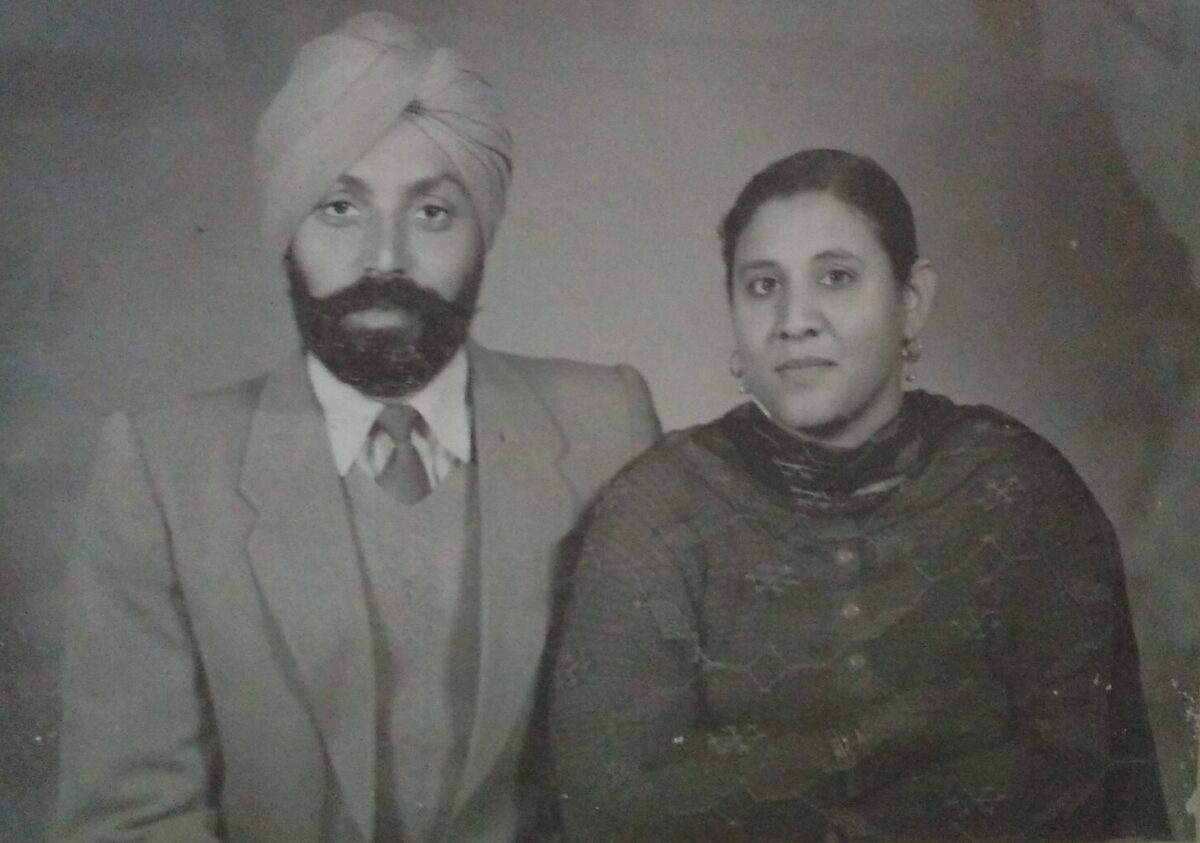
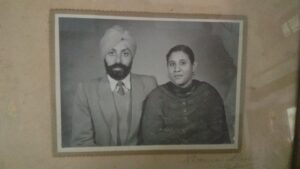
Picture of my Pita ji and Beeji at Urapur
With the present focus (of education) on acquiring as many degrees as possible, particularly from abroad, lets pause to look at the upbringing and education imparted by my ostensibly anpadh Pita ji and Beeji. I would wish that the kind of values and character that they imparted in their children would be a national pursuit. It is not my aim to go into each one of them. I would take just three that my Raj masi ji and her sisters and brother epitomise: One, being forever truthful (in the most holistic meaning of the word); two, finding and implementing solutions to problems; and three, never shirking responsibility.
The entire family was grief stricken when Beeji died. That’s the time when Raj masiji told her siblings: “Maa tanh meri gayi hai; thuade layi tanh main haan (I am the only one who has lost a mother; for all of you I am still here).” This was far from being a vain promise. Throughout her life, Raj masi ji was a mother to her siblings and a godmother to all of us. This particular sense of responsibility was not restricted towards her siblings but towards the larger family of her husband, too. Indeed, the number of people that she nurtured would easily run into hundreds. And when, all of us could stand on our feet, her attention turned to the grandchildren; they received even more love and care than all of us did. A very, very large family got used to the assurance that individual and collective problems conveyed to Raj masi ji were considered resolved.
Through all this, if you are picturing a sad, burdened, and stodgy person, then you don’t know my Raj masi ji. She, with her joie de vivre, wit, and deep-rooted affection for all who came in contact with her, was easily the life of any gathering. This was to be seen at its best during wedding parties. During Lyn and my wedding, for example, she broke into boliyan and gidda with her sisters; our most cherished memory. Her presence at any family gathering promoted laughter, positivity, warmth, and kindheartedness. Raj (Rule) didn’t rule with a heavy hand; but always gently and with enormous compassion.
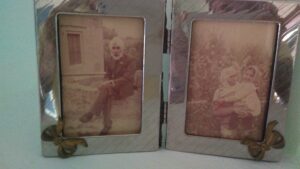
Picture of my masad ji and masi ji as found in her parent’s house in Urapur
My masad ji, Inder Jeet Singh, was the most blessed and proudest person. Having Raj beside him was so heavenly that all of us felt it all the time. Their loving togetherness was legendary. They easily found ways and means of supporting each other in every which way. We compared them with the best in Indian history and folklore: Radhe Krishna, Heer Ranjha, and Sassi Pannu. An anecdote comes to mind when our family visited them in Pathankot from our town in Mandi (HP) in the year 1961. There were signs of early morning altercation and commotion between them with such clarion calls as: Masad ji: “Main chhadna nahin hain ajj (I am not going to leave (her) alive)”; and Masi ji: “Main bhi nahin chhadna (I, too, am going to kill (him).” Our family crouched in fear that the unthinkable had taken place with our most beloved couple. It, soon, came out that the target of their rage was a cat who used to enter the kitchen and polish off their milk for the day and they were in hot pursuit of the wily feline.
Incidentally, visiting them was a veritable pleasure next only to visiting Pita ji and Beeji in Urapur. In addition to all the familial gup-shup, and fun and frolic, we used to see movies in special boxes of cinema halls (masad ji was a respected Excise and Taxation Officer). In addition to the movies, we used to be served mouth watering snacks and cold Coca-Cola. Two of these movies left quite an impact on me: Hrishikesh Mukherjee’s Anuradha that we saw with them in Phagwara, and DD Kashyap’s Dulhan Ek Raat Ki that we saw in Dalhousie (at that time in Punjab). The first had music by the Bharat Ratna Pandit Ravi Shankar and the second had music by the maestro, Madan Mohan.
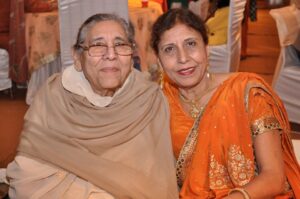
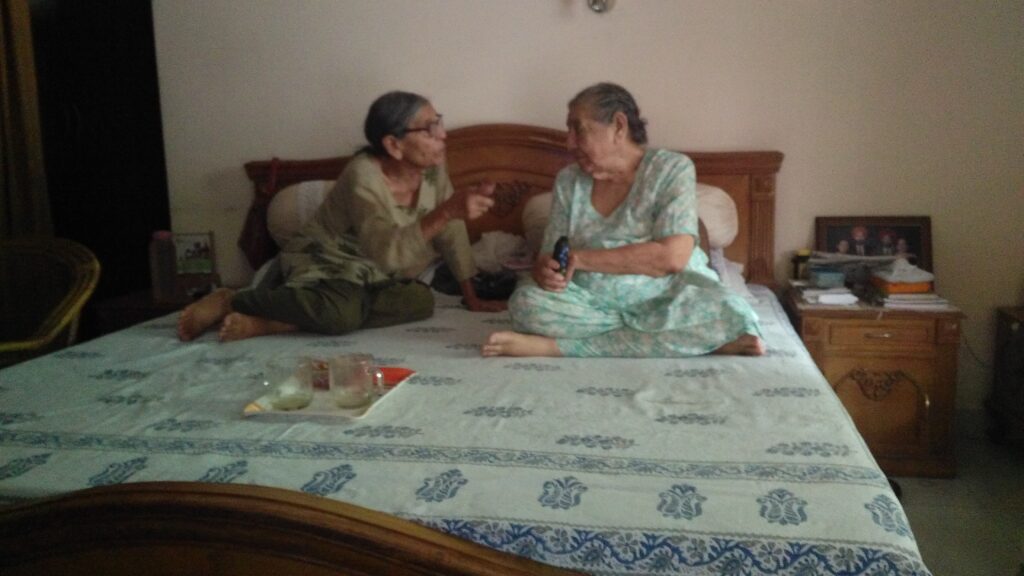
My mother (L) with Raj masi ji (R) on her bed in Ludhiana
I am sure that the hundreds of people who were helped in need by Raj masi ji must be talking about their personal, one-to-one relationship with her (masi ji always made each one of us feel special and the only one); but I would like to think that masi ji had the warmest place in her heart for her sister (my mother) Herkrishan and family. I was the first male in the family who cut off my long hair (now many have); something that Sikhs ain’t supposed to do. After that, when I planned to visit Raj masi ji, I was cautioned by relatives to desist from it. Else (knowing what a devoted Sikh she was), she would launch me into outer space like a rocket. I still went to see her. She was as loving and warm as before after I confirmed when she asked, “Nitnem karda hain ki nahin (Do you (still) say your daily prayers as a Sikh)?”
All hell broke out in the family when I married a Catholic girl from the South. Her name, Marilyn, suggested ultra-modern, self and beauty conscious woman. As I said, masi ji attended the wedding. But, my parents were fearful that after the festivities would get over she would pass her judgment that was expected to be severe and taunting. We went together to India Coffee House at Solan. She had the occasion to see Lyn at close quarters as also to engage her in conversation. After we returned home, and when we were expecting the worst, she simply said, “Mainu pata si Ravi di choice galat nahin hovegi (I knew that Ravi’s choice won’t be wrong).”
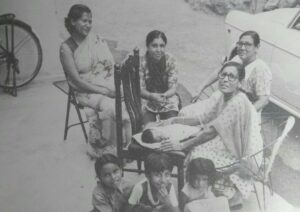
Picture shows, from L to R: Lyn, Pal masi ji, Raj masi ji, and my mom (Arjun is the centre of attraction as the newborn boy, two weeks after my dad died)
When my dad died suddenly and tragically of a jeep accident on 01 May 1984, the kind of support that we got from Raj masi ji and my cousins was many times more than what she had earlier done for us. We were totally shattered. She visited us many times in Kandaghat all the way from Ludhiana and provided succour in the form of soft loans, use of her car, physical and moral support. There was a time when I went to her house in Ludhiana to obtain one such loan. Whilst I was there a police raid took place (I learnt later that it was masterminded by someone as political vendetta. The ostensible cause, later proved to be totally unfounded, was that her driver had contacts with terrorists). Neither Raj masi ji nor my cousin lost cool even though it was so humiliating and disturbing as the police went around rummaging and chucking things around. As soon as the posse of policemen left, here is the first thing that Raj masi ji said smilingly, “Shukr hai, Ravi, tere loan de paise safe rahe (thank God, Ravi, your loan money is safe).” On my return bus trip with the loan money, I cried; all through the raid, she could only think of my mother and our dire need.
A small mention about the gifts that were showered on us by her. In addition to buying new things for us, I was the recipient of all the clothes that my cousin (six months elder to me) grew out of. My favourite was a woolen sleeveless sweater. It was given to me when I was just 15 years old. I used it for the next 15 years, first as a pullover and later when it faded, as an inner warm vest. It has, now, holes in it. But, a sweater knitted by my Raj masi ji is more dear to me than the three great honours I received in my naval career; so, it is still with me. Finally, when I meet her in God’s house, I am going to tell her to knit me another.
Raj…what an apt name. All through my life she had raj (rule) over my heart and over hundreds of other hearts. It is unlikely to change.
P.S. I am writing this from Mumbai whereas all the albums with my masi ji’s pics are in Kandaghat (Shimla Hills). I have retrieved some of these pics from the Facebook.
P.P.S. More pics for this piece would be put up when I visit Kandaghat.
कहानियाँ बनतीं हैं लहरों की तरह,
झूम के उठती हैं चली जाती हैं l
और हम साहिल पे खड़े सोचते हैं,
चंद यादें हैं जो मन्द मन्द मुस्कराती हैं l
लफ्ज़ साँसों में फंसे यूँ दिखते हैं,
जैसे सूखी ज़ुबाँ कुछ कह ना पाती है l
कोई तो हो जिसे ज़िंदगी बता सके,
रह रह के जो राज़ हमें समझाती है l
अब ना तो वह तूफान, ना वह फ़िज़ायें,
दूर दूर तक गर्म रेत ही नजर आती है l
और वह हसरतें जो उभरती थीं दिल में,
ना वह गाती हैं, ना लुभाती हैं l
खुदा, मेरी जान, मेरे प्यार को रखना सलामत,
मेरी धड़कने उन्हीं से ही थरथराती हैं l
मेरी उम्र मेरी ज़िंदगी भी उन्हें दे देना,
उनके बगैर तो मुझसे एक शब भी ना जीई जाती है l
Nearly forty-weeks of labour,
Three trimesters of increasing pangs,
Anxiety, hopes, desires, and dreams,
And then one fine morning,
In the month of June,
At the Angel Number 666,
The umbilical was finally cut
Between me and my God:
Mother.
Dad said, “He is a Bubble of joy.”
Mom said, “He is the Sun god, Ra.”
The Eleventh Guru
Confirmed the name:
Ravinder or Ravi.
Born in the likeness of God?
Like everyone else?
Ha…
…..and not Ra.
He is…different,
Almost “a maverick.”
Nothing seemed to have
Put him in any known mould.
He can even think
In a world where brilliance
Of learning past knowledge by rote
Counts.
He isn’t just different.
He is evil,
Supercilious,
Egotistical,
Megalomaniac,
Even dangerous.
Actually…..
…..good for nothing.
How can he think
As if he is the only one?
How can he see beyond,
Hear unheard voices?
Travel to places no one dreamt about?
He spurns
Friends, family, society.
We can’t let him live
In a world he calls his own.
He breaks our walls.
He shatters our images.
He is detached, distant, aloof.
Unsociable.
Even anti-social.
It has taken us eons
To build something
We can be proud of:
This society.
This bedrock of civilization.
This paradigm of virtue.
No one,
Not even in the name of creativity
And innovation
Can go beyond.
In our derived and set standards
He is and will always be
A failure..
He will always be…
….good for nothing.
My prayer:
God, in my next life
Don’t give me
A mind that can think,
A heart that can feel.
Just make me a clone,
Of Survival of the Fittest Theory.
And send me on Life’s highway,
Like any other remotely piloted car,
Going generally
In everyone’s direction.
Admired
Loved
Respected
Idolised
Even remembered.
I shall respect all their rules,
And they shall adore me.
From nothingness we emerge,
And into nothingness we go.
But, this way,
The only way,
Tested and tried,
We shall be
Anything, but…
….good for nothing.
Most of us have
Nothing to say.
Silence is gold, and we have
Discovered a mine.
Nay, many mines.
But, look closely.
Our calm and quiet
Are only when others
Suffer and are in pain.
Those tales don’t touch us.
Waters down the mackintosh
Without a moist spot within.
But, own pain is real.
That blood drips agony.
Those piercing nails
Torment more than
Even Christ on the cross.
Every moment is torturous.
I am the world.
When I suffer
My world suffers.
The same world
Whose pangs and woes
Left me untouched.
Nary a whisper of dew
On the petals of my cheeks.
Love is that magic wand.
Me becomes they.
They become us.
There are no pains
Separate and different:
One real and the other imagined.
You feel, you cry.
On the cross you die.
Even when He is the one
Who is nailed.
Everything is real
Within and without.
You own his or her pain.
His world is yours.
Your world is his.
You own the universe.
You’ve never been so rich.
How bizarre it can get:
I am
When I am not.
There are times,
More often than before,
When I feel lonely and sad.
When friends, relatives and circumstances,
Are ranged against me,
Like brothers, cousins, and uncles,
In Mahabharta.
There are times,
When tears want to break out,
Like feral animals from wicket cages.
When everything looks alien,
Everything looks inimical.
When words from either side,
Are chucked as pointed stones.
There are times,
When rose petals have blown away,
Leaving thorns – stark and sharp.
Hopes have dried,
Like the autumn tree leaves.
Darkness of my heart,
Engulfs everything in and around.
There are times,
When nothing seems to work.
Even gods and my guardian angel,
Appear to have deserted me.
With my soul bruised,
My limbs fatigued,
My voice hoarse,
My lips parched,
I whisper, barely audible, “Mom, I need you….”
I hear that loving voice,
Clear and kind,
Even in the howling storm.
It is near me,
It is within me;
My mother, my God,
My Creator, my Protector,
My joy, my succour:
“Kaka, I hear you,
Put your head in my lap,
Close your eyes and rest.
All your problems will go;
I’ll make sure of that.”
Suddenly, I am aware,
Of my dormant strength.
My mother is beside me,
My God is within me.
My tears and sadness,
Despair and despondency,
Problems and evils,
Deceit and chicanery,
Are outwitted and weakened.
There is just serenity,
Hope and happiness.
It’s name is Maa.
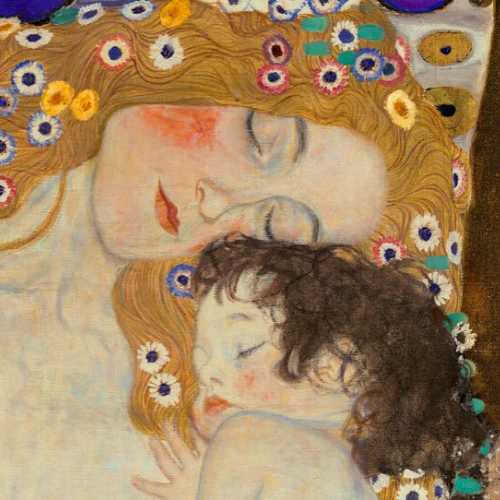
(The featured image is a copy of the 1905 painting titled: ‘Mother And Child’ by Gustave Klimt and is housed in National Gallery of Contemporary and Modern Art in Rome since 1912.)
Many of the expressions in the English language are either nautical (that’s how they ruled greater part of the world) or based on the game they invented in the 16th century: cricket. The expression “not cricket” is popularly used to denote: not fair, honest or moral, and in bad, poor, or worst possible taste.
After its inception in 2007, my curiosity got the better of me and I started watching Indian Premier League 2024 matches. Soon, “not cricket” is the expression that came to my mind.
Michael Holding, the former West Indian cricketer and commentator was asked as to why he chose not to commentate on T20 matches. His response was: “I commentate only on cricket.”
During our era, in a 1964 match against England, Indian all-rounder Bapu Nadkarni bowled a record twenty-one consecutive maiden overs. In today’s game standards, it means that a complete T20 innings would have gotten over without scoring a run. Cut to today, here is a commentary on a bowler: “A very tight over from him; he has just given away only seven runs in this over.”
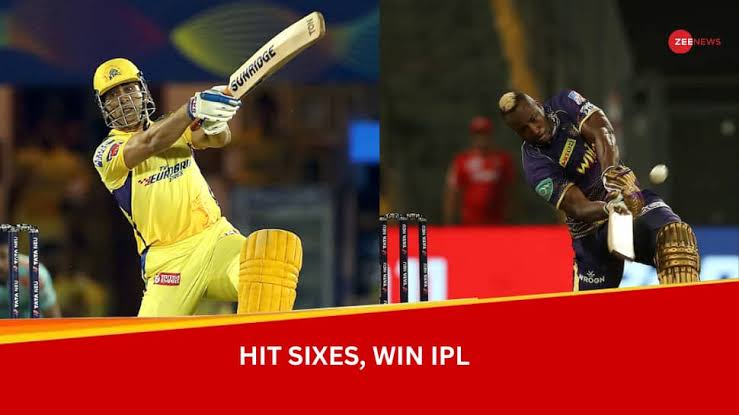
I also recall that in a test match against the mighty West Indies (I think it was in Dec 1966 in Bombay), Bapu Nadkarni hit a sixer. An excited fan, listening to the commentary on his radio, broke his transistor-radio in excitement. We lost the match thanks to a 400 plus first first innings total by the WI. However, that sixer (a rarity those days) glorified our resistance against the best cricketers in the world. In contrast, the IPL T20 matches are so heavily tilted in favour of the batters that, recently (on 27 Apr 24), in Eden Gardens, in a match between KKR and PBKS, 42 sixes were scored (252 runs in just sixes!) A total of 532 runs were scored in the match; nearly half being in sixes.
Such sixes and fours are because of pitches being especially made batter friendly and the reduced boundaries in length. It has to be a spectacle or a tamasha that wins the moolah for BCCI, the richest cricket club in the world. It is not all; watching the IPL T20 matches over TV has been made into a punishment for the viewers by making them watch advertisements over and over. I can visualise, for example, a man telling us to convert his credit card into CRED UPI, “Please, please, please, please………..please a thousand times, convert your credit card to CRED UPI. It will earn us crores of rupees and may also get you discounts ranging from one to five percent. We are prepared to run this ad for you, the Guantanamo way, of playing it over and over again even in your sleep. Just don’t forget CRED UPI.”
Here is the truth about these ads versus watchability of IPL: with the repeated ads and strategic times-out, we run an over, on an average, in 5 minutes; ie, 50 seconds a ball. As it is, there are only a handful of countries in the world who play cricket. Doesn’t BCCI have any responsibility towards promoting this game, the only game that we actually excel in? How can anyone be interested in watching this game @ 50 seconds a ball? Does money mean everything to BCCI?
One of the most popular ads is that of Kamla Pasand Elaichi, a proxy ad for the unhealthy Pan Masala. Who are the cricketers who have succumbed to the lure for money to these ads for unhealthy products? Well, hold your breath, our cricketing role models: Virendra Sehwag, Sunil Gavaskar, Kapil Dev, and Chris Gayle. What a fall!
Has the IPL tamasha really made us into better players world wide? Aha, we won the ICC T20 World Cup only once in 2007, the inaugural one in South Africa when we bowled out Pakistan for 152 runs in 19.4 overs and won by 5 runs. In 2021 ICC T20 World Cup, the seventh one since its inception in 2007, the highest number of runs, 345 that is, were scored between Australia and New Zealand. Australia made 173/2 in 18.5 overs and won. The team playing second won the cup a total of seven times out of eight. In IPL T20 2004 edition, ever since 27 Mar, when in a match between SRH and MI, more than 500 runs were scored, it has happened four times. Surely, our performance in IPL and the rampant run fest indulged in by our players don’t appear to be helping our abilities and potential in winning the world cup.
In democracies people pay for everything: armies, roads, railways, education, and entertainment. BCCI doesn’t become the richest cricket club in the world without people paying for it, whether in the stadia or on the net. I don’t suppose that BCCI can ascribe credit to itself for befooling all the people all the times. It is only a matter of time before people, at large, realise that IPL T20 tamasha isn’t cricket.
I recall my visit to Spain and curiosity to see a bull-fight. There appeared to be so much of bravado involved in killing a bull in a bull fight until I learnt that what appeared to be sport is primarily a play in three parts (tercios): Tercio de Varas, Tercio de Banderillas, and Tercio de Muerte. In the first two acts, with the help of picadors and banderillas, the bull is sufficiently weakened so that in the final act, an accomplished estocada (swordsman) gives the bull a clean and quick death by thrusting a sword into the already weakened hump in the shoulder. I was among the large percentage of people around the world who see the cruelty of the bull fight only once.
I wonder how many more of IPL T20 matches I shall see before the bull is finally killed?
Poverty, in India, was gender neutral. But, as seen by Hindi movies, it forced men into menial jobs, but it forced women to the oldest profession on earth. So, poor men in Hindi movies would sing such songs as “Main rickshawwala, main rickshawala, main char ke barabar main do taang wala, kahan chaloge babu, kahan chaloge lala?”
Only real music aficionados like me would remember such songs that portrayed dignity of labour whilst being poor.
Poor women, in Hindi movies, had absolutely no choice but to become prostitutes. They were forced, but their songs were super-hits. Indeed, all heroines had to pass the litmus test of being in the kotha to be considered as serious actresses: Meena Kumari, Nargis, Suchitra Sen, Vyjayanthimala, Padmini, Mumtaz, Smita Patil, Rekha, and Hema Malini. Their songs competed with one another’s, eg, Suchitra Sen’s Rehte the kabhi jinke dil mein with Nargis’s Yun hasraton ke daag, and so on.
There were hardly any actresses who were not forced into it but actually enjoyed their profession. Shashi Kapoor’s Utsav and Lekh Tandon’s Amrapali were different. Those two brought out how courtesans were actually respected in our ancient culture.
However, over centuries, it became such a hated profession that Rajinder Singh Bedi’s Dastak portrayed the turmoil of a couple who rented a room in a red-light area.
Lastly, men falling in love with prostitutes was a common theme and resulted in the producers laughing all the way to the bank. Pyaasa, Devdas, Kala Pani, and Amar Prem are some examples. Prostitutes were always shown as golden hearted. There was no other kind.
Many people regarded the rain dance in the saree as the ultimate titillation. But, I can prove that nothing was more profitable for the producers than prostitution. Both kinds of songs could be there: one, depicting her art, eg, Jab chhaye mera jaadu, koi bach na paaye, Yeh hai reshmi zulfon ka andhera na ghabrayiye, and Jaata kahan hai deewane sab kuchh yahan hai! Two, the miserable ones: Rehte the kabhi jinke dil mein, and Jaana tha hamse door bahane bana liye.
Mehboob Khan’s Mother India (it nearly won an Oscar) tried to depict the Indian woman in her poverty, trying to fight her destiny through honesty and hard work. But, by that time, the ubiquitous picture of poor Indian woman choosing prostitution to beat poverty had already done the damage.
Q.E.D.
Movies are supposed to depict real life. This is one instance of movies changing real life.
Song #1 Jaata kahan hai deewane sab kuchh yahan hai sanam
This song was censored from the 1956 movie C.I.D. It was a Guru Dutt production directed by Raj Khosla.
It was the debut movie of Waheeda Rehman, the first of the five movies that Guru Dutt signed Waheeda Rehman for after seeing her in a college in Hyderabad. He was preparing her for her role as a golden hearted prostitute in his 1957 iconic movie Pyaasa.
The song was censored due to her openly soliciting as a prostitute as also for the use of the slang “fifi” in the song. It was made to look like as if “fifi” was an innocent Goan slang. However, it came out that “fifi” had become popular as an effeminate man as also to refer to a female part.
The song couldn’t see the light of the day during those days. However, these days, such songs would be totally acceptable.
The song was penned by Majrooh Sultanpuri and composed by OP Nayyar. It was sung by Guru Dutt’s wife Geeta Dutt whom he married on the 26th of May 1953.
Song #2 Yun hasraton ke daag muhabbat mein dho liye
Prostitutes and courtesans were always a very profitable theme for the Hindi movies. But, the success of C.I.D. and Pyaasa with debutante Waheeda Rehman as a golden-hearted prostitute threw the floodgates open for prostitutes in the Hindi movies. Rajinder Krishan, the lyricist, wrote the story and the screenplay for the 1958 movie Adalat directed by Kalidas.
Nargis who was fighting poverty and unfortunate circumstances in the 1957 Mehboob Khan movie Mother India acted as a prostitute one year later. Whilst Mother India tried to correct the image of Indian woman as the hard-working, self-sacrificing woman, Adalat and subsequent movies confirmed that they were ill treated to the extent of being sold in brothels. Hindi movies’ makers loved this latter image and laughed all the way to the banks just as commercial Hindi movies on poverty made the film-makers rich.
Rajinder Krishan made sure that his best lyrics were penned for the songs of the movie. The songs were composed by the maestro Madan Mohan who excelled to such an extent that OP Nayyar, in later life, said that two of the songs of the movie (this and Unako yeh shikayat hai ki hum kuchh nahin kehte) composed were better than all his works.
As an aside, I bring out that Nargis’s lover in the movie, before she was forced into a brothel, was a barrister to show the contrast between his most respectable profession and her latter day status. It is because of the utmost respect earned by Mahatma Gandhi as a barrister. Nowadays, in India, between the two professions there isn’t a contrast; earn money whichever way.
Song #3 Rehate the kabhi jinke dil mein
Once the Hindi movies’ makers get hold of a cash cow, they don’t let it go until they have milked it dry. Take the case of an honest man turned dacoit in Dilip Kumar’s only production, Gunga Jumna. In latter films heroes from Sunil Dutt to Vinod Khanna vied with one another to play the dacoit. So also with becoming prostitutes. In the 1966 Asit Sen movie Mamta, Krishan Chander merely rejigged Rajinder Krishan’s story of Adalat and passed it off as a remake of the 1963 Bengali movie Uttar Falguni.
In this song Majrooh Sultanpuri writing for Roshan and Lata Mangeshkar singing for Suchitra Sen brings out her condition due to unfortunate circumstances that made her choose the brothel.
Song #4 Beqasi hadd se jab guzar jaaye
Even when OP Nayyar praised Madan Mohan for the 1959 movie Adalat’s two songs, he himself came up with this gem in Raag Desh in the 1960 RK Rakhan movie, in which Padmini played the role of a courtesan and surprised (shocked) her lover Ashok Kumar. The lyrics of the song by Jan Nisar Akhtar point towards her helplessness in being forced into the role. None of OP Nayyar’s songs were sung by Lata Mangeshkar. This too was sung by Asha Bhosle.
The highlight of the song is also Padmini’s histrionics:
Song #5 Neel gagan ki chhaon mein
Lets change scene from being forced into prostitution to being proud of being a courtesan. Take the 1966 Lekh Tandon movie Amrapali, for example. The story of the movie draws from our culture. Amrapali, played by Vyjayanthimala, was a nagarvadhu (courtesan) in Vaishali (Bihar). Her excellence in her art made her the rajnartaki (the favoured courtesan of the kingdom). She nursed Ajatashatru (played by Sunil Dutt) when he was wounded and he fell in love with her. Little did she know that he was the emperor of Magadha. He destroyed Vaishali in order to get her.
The songs of the movie were penned by Shailendra and composed by Shankar Jaikishan so well that these are still considered some of the best. Credit must also go to Vyjayanthimala for carrying the movie almost entirely on her shoulders.
Please enjoy in Raag Bhupali, this beautiful song sung by Lata Mangeshkar and outstandingly danced in the king’s court by Vyjayanthimala:
Song #6 Jab pyar kiya to darna kya?
The actual story of Amrapali took place in 500 BC. Nearly 2000 years later, in the court of Mughal-e-Azam, Akbar, a courtesan named Anarkali has his only prince Salim fall in love with her. Akbar imprisons her and Salim rebels against his own father with a battle against him so as to rescue the love of his life.
Such was our culture regarding the importance of courtesans; and it was not restricted to the Mughals. In the 1984 Shashi Kapoor movie Utsav (based on Sanskrit play Mrichakatika (The Little Clay Cart) by Shudrika of ancient times (some evidence points to his being an Ahira king!), in ancient Ujjain, courtesan Vasantsena (played by Rekha), in the court of the king. She is respected and idolized by the king’s subjects. She has a chance meeting with a Brahmin Charudutt. In the song Man kyun behka re behka aadhi raat ko (it won two Filmfare awards: one for the lyricist Vasant Dev and the other for the singer Anuradha Paudwal), Charudutt’s wife Aditi (played by Anuradha Patel) is grateful to the courtesan Vasantsena for reigniting sexual desire in her husband!
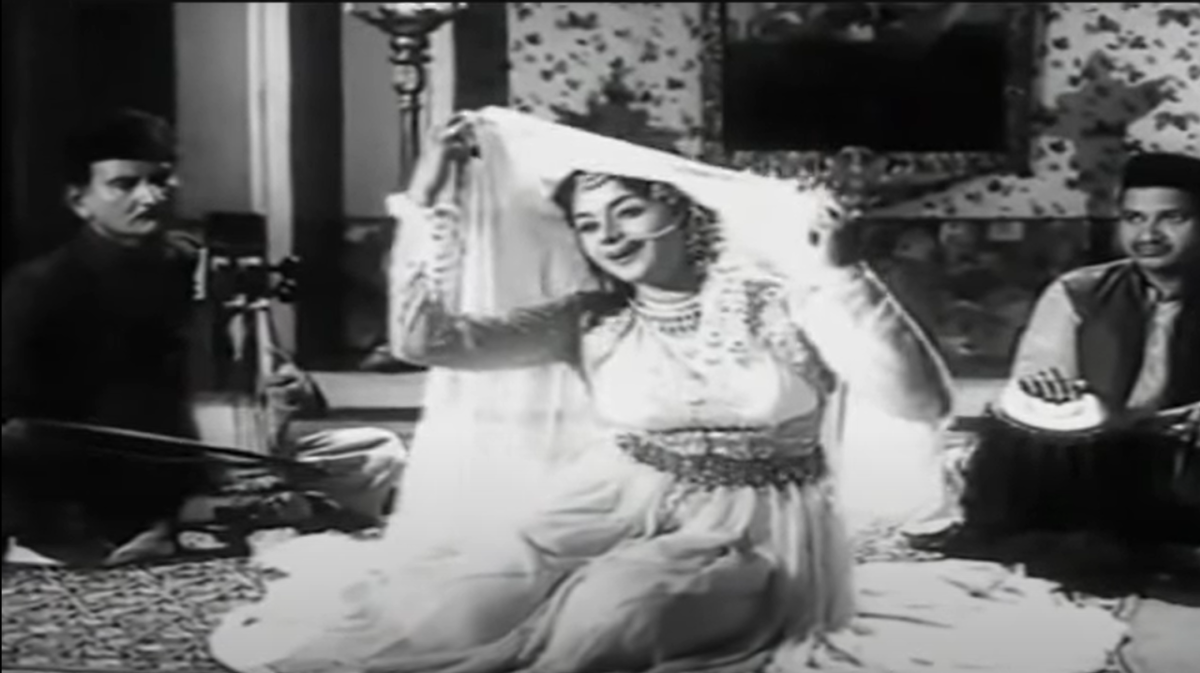
Anyway, lets get back to Pyar kiya to darna kya penned by Shakeel Badayuni, and composed by Naushad Ali in Raag Durga. This song sung by Lata Mangeshkar for Madhubala as Anarkali is actually the most iconic song ever in Hindi films performed by a courtesan in the emperor’s court:
This movie, shot in black and white was the first movie to be digitally colorised at phenomenal cost.
Song #7 Jaa jaa re jaa balamwa
Talking about courtesans in the king’s or emperor’s courts, lets talk about the 1956 movie Basant Bahar, Raja Nawathe’s answer to Vijay Bhatt’s 1952 movie Baiju Bawra. In Baiju Bawra, Naushad had all 13 soundtracks based on one raag or the other. Shankar Jaikishan came up with similar soundtracks in Basant Bahar and actually excelled in Ketaki gulab juhi champak bana phule (in Raag Basant Bahar), for example. In this, Manna Dey had the ignominy of defeating Bharat Ratna Bhimsen Joshi in a singing competition. Duniya na bhaye by Mohammad Rafi in Raag Todi, Punjabi Theka is a favourite, too.
But, my all time favourite is this one by Lata Mangeshkar. Indeed, I have selected it as her Top Song #2 in her five of my favourite songs by her. This is in Raag Jhinjhoti, Tintal. It was penned by Shailendra and composed by Shankar Jaikishan. Kumkum as the courtesan Radhika performed it for the Emperor Chandra Shekhar played by Chandrashekhar:
Song #8 Woh chup rahen to mere dil ke daag jalte hain
Lets turn to the sub-theme of men jilted in love either visiting courtesans on their own or taken there by their well-wishers. There are hundreds of songs in this genre’, too. My vote goes to this classic one from the 1964 Vinod Kumar movie (his debut attempt) Jahan Ara.
Shahjahan’s daughter Jahan Ara (played by Mala Sinha; she nearly won the Filmfare Award for her role) is in love with Mirza Yusuf Changezi (Bharat Bhushan) since childhood. However, Mumtaz, Shahjahan’s favourite wife (one of his four) had taken a dying promise from her that she (Jahan Ara) would look after her father, Shahjahan, and not marry.
So, Yusuf is a jilted lover. In order to get over his separation from Jahan Ara, he is coaxed into visiting a courtesan Roshan Ara (played by Minoo Mumtaz).
The song she sang to make him forget his sad silence is one of the best and most difficult of Lata Mangeshkar’s. It was penned by Rajinder Krishan and composed in Raag Ramdasi Malhar by Madan Mohan. Indeed, Minoo Mumtaz perfected this role. In another movie, the 1961 movie Chhote Nawab, she has Mehmood visiting her as a courtesan rather than being with his beloved, Ameeta. Her song, in that case, expressed Ameeta’s feelings: Ghar aaja ghir aaye badra saanwariya, composed by RD Burman in Raag Malgunji, his first with Lata Mangeshkar.
Anyway, please enjoy the Jahan Ara song:
Song #9 Raina beeti jaaye Shaam na aaye
What about hero falling in love with the courtesan? Once again, there are hundreds of songs in this sub-theme. But, there is none to beat Shakti Samanta’s 1972 movie Amar Prem. It called it as Eternal Love the relationship between Sharmila Tagore as courtesan and Rajesh Khanna as a kind hearted drunkard Anand who is used to visiting kothas. He, in a song tries to question the double standards of the society by comparing her to goddess Sita: “Hamne unako bhi chhup chhup ke aate dekha inhin galiyon mein.”
His first encounter with her is this song by Lata Mangeshkar singing for Sharmila Tagore in Raag Todi. This, too, has been listed under the most difficult songs of Lata Mangeshkar:
Song #10 Chalte chalte yunhi koi mil gaya tha
Now, in the end, lets turn to two movies that were made on the lives of two courtesans; ie, these didn’t have courtesans as breaks in between but as the whole movie.
The first one is the 1972 Kamal Amrohi movie Pakeezah (The Pure One or The Chaste One). Kamal Amrohi wanted to make a movie as a dedication to his wife, Meena Kumari. The movie was the longest in the making Hindi movie that was completed in 15 years. During this period, Ghulam Mohammad, the original music director of the movie died and some of the movie and its songs were then completed by Naushad Ali.
Nargis (Meena Kumari) is a courtesan of Lucknow. She dreams of marrying Shahbuddin (Ashok Kumar), but, it is opposed by Shahbuddin’s father on the grounds that his son cannot marry a tawaif (courtesan). She gives birth to a daughter and dies. This girl grows up into another tawaif (courtesan) Sahibjaan (also played by Meena Kumari). In a train journey, Raj Kumar as Salim Ahmed Khan sees her naked feet and falls in love with her. In the end of the movie, Shahbuddin accepts her as his daughter and she and Salim are happily married.
This song was penned by Kaifi Azmi, composed by Ghalam Ahmad and sung by Lata Mangeshkar. It has reference to Meena Kumari and Raaj Kumar’s encounter in the train:
Song #11 Dil cheez kya hai aap meri jaan leejiye
Finally, lets turn to the 1981 Muzaffar Ali movie Umrao Jaan in which the actress Rekha excelled to such an extent that she won both the National and Filmfare awards. Indeed, her portrayal of the courtesan Amiran in the movie is quoted as the most impressive performance by an actress in such a role.
In the year 1840 Amiran was kidnapped from her home in Faizabad (UP) and is sold into a kotha in Lucknow. She emerges as an extraordinary poet and courtesan. The movie is about all her poetry performed by her as songs.
The very first one is this: Dil cheez kya hai aap meri jaan leejiye. It was penned by Shahryar, composed by Khayyam and sung, for a change, by Asha Bhosle. Khayyam, too, won both the awards. Asha Bhosle, for this song, won the National Award:
Hindi movies’ makers obsessions with courtesans is unlikely to die in a hurry. Heroines, even today, are keen to do such roles.
In addition, thanks to Sunny Leone’s efforts in popularising pornography in India, it is unlikely that the one of its kind projection of Indian woman as Mother India would register with the West. As projected in Hindi movies, the courtesans and the golden hearted prostitutes are the ones that are the representative image of the Indian woman.
What is the biggest weakness of a woman? Well, as seen in Hindi songs, it is jewellery. Indeed, if she loses jewellery, she tries to look for the lost piece in song and dance form. Several examples: Jhumka gira re Bareilley ke bazaar mein, Dhoondo dhoondo re sajna mere kaan ka baala, and Nigah maarda jayin ve mera laung gwacha.
Song #1 Jhumka gira re Bareilley ke bazaar mein
This is from the 1966 Raj Khosla movie Mera Saya featuring his favourite actress Sadhana performing this number penned by Raja Mehdi Ali Khan and composed by Madan Mohan:
Song #2 Dhoondo dhoondo re sajna, dhoondo re saajna mere kaan ka bala
This is a great favourite with me; a song from Dilip Kumar’s only production and an iconic movie: Gunga Jumna starring Vyjayanthimala with him. He has been driven to become a dacoit; the first Hindi movie with this idea. She visits him in his den in the forest. This song is about the coming of age when Vyjayanthimala steps into womanhood from being a girl.
These excellent lyrics (the word bala in the song depicts a maiden girl as well as the earing that she lost) were penned by Shakeel Badayuni, composed by Naushad and sung by Lata Mangeshkar. Vyjayanthimala’s dance leaves you in awe:
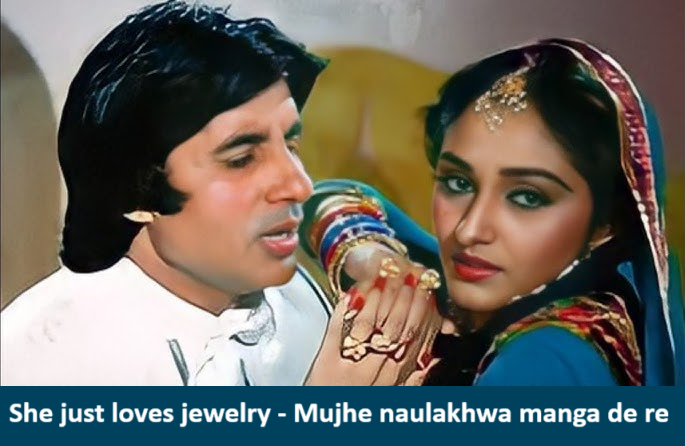
Song #3 Mujhe naulakha mangwa de re O sainyan deewane
He (Amitabh Bachchan) is the son of a very rich man, in the 1984 Prakash Mehra movie Sharabi. She, Jaya Prada, asks him through an exclusive dance only for him to get her jewelry worth Rupees Nine Lakhs (an astounding sum in 1984).
Lyricist Anjaan, composer Bappi Lahiri, and singer Asha Bhosle put the song together:
Song #4 Mera laung gwacha
This is a Punjabi folk song. Many artistes have sung this. Neha Bhasin really made it very popular:
Women, in this respect, are very materialistic. Men bemoan the loss of…hold your breath…heart. Eg, Dil mera aaj kho gya hai kahin…aapke paanv ke neeche to nahin. Jewellery or other material things are farthest from their minds. Even Johnny Walker sang, “Ek mussafir ko duniya mein kya chahiye, sirf thodi si dil mein jagah chahiye!”
Song #5 Dil mera aaj kho gaya hai kahin
This is from the 1964 Devendra Goel movie Door Ki Awaz starring Joy Mukerji and Saira Bano.
Lyrics are by my favourite Shakeel Badayuni and composition is that of Ravi. This was sung by Mohammad Rafi:
Song #6 Jaane kahan mera jigar gaya ji
This is from the 1955 Guru Dutt movie Mr and Mrs 55 starring Guru Dutt and Waheeda Rehman. The song is picturised on Johnny Walker as Johny and Yasmin as Julie.
It was penned by Majrooh Sultanpuri and composed by OP Nayyar. It was sung by Mohammad Rafi for Johnny Walker and Geeta Dutt for Yasmin:
Song #7 Ek mussafir ko duniya mein kya chahiye
As I wrote, no jewelry for men; they are only loking for dil mein jagah.
This is again from the 1964 Devendra Goel movie Door Ki Awaz starring Joy Mukerji and Saira Bano. It was penned by Shakeel Badayuni and composed by Ravi.
It was picturised on Johnny Walker:
Women have no idea to what extent men will go to please them. No small things such as Jewelry, clothes, and ghar. They can get women, chand, sitaare, and do jahan ki khushiyan.
Song #8 Chalo dildar chalo chand ke paar chalo
The pull of a man telling her about chand and sitaare, sometimes, has its effect on her. As in this song from Pakeezah, a movie written, produced and directed by Kamal Amrohi as a tribute to his wife, Meena Kumari. This song was penned by Kaif Bhopali and composed in Raag Pahadi by Ghulam Mohammad who died during the making of the movie for as long as 15 years. Listen to the song. She is ready to go to chand with him with or without jewelry:
Song #9 Saat samundra paar se, gudiyon ke bazaar se
Also, women, when they are small are less materialistic, eg, this song of the 1967 movie Taqdeer. Papa is abroad and the girls want him to bring back a doll from the Doll Bazaar. However, they are ready to let go of the doll if he would return early, he being their biggest gift.
This was put together by Anand Bakshi, Laxmikant Pyarelal, Lata Mangeshkar and Sulakshna Pandit:
सात समुद्र पार से,
गुडियों के बाज़ार से,
अच्छी सी गुड़िया लाना,
गुड़िया चाहे ना लाना,
पापा जल्दी आ जाना l
Song #10 Hamse to achhi teri payal gori
Knowing that women love jewelry more than men, men are forced to sing:
हमसे तो अच्छी तेरी पायल गोरी,
जो बार बार तेरा बदन चूमे I
This is from the 1970 Naresh Kumar movie Ganwar starring Rajendra Kumar and Vyjayanthimala. It was penned by Rajinder Krishan and composed by Naushad Ali. The song was sung by Mohammad Rafi and Asha Bhosle:
Song #11 Maine tere liye hi saat rang ke sapne chune
Remember Anand? Why did his beloved leave Rajesh Khanna? Simply because he was offering her dreams and she wanted jewelry:
मैंने तेरे लिए ही सात रंग के सपने चुने….
Hahahaha!!
Poor Anand! He was left with her dried flower in his book of poetry!
Avtar is a batch mate from Punjab Engineering College, Chandigarh.
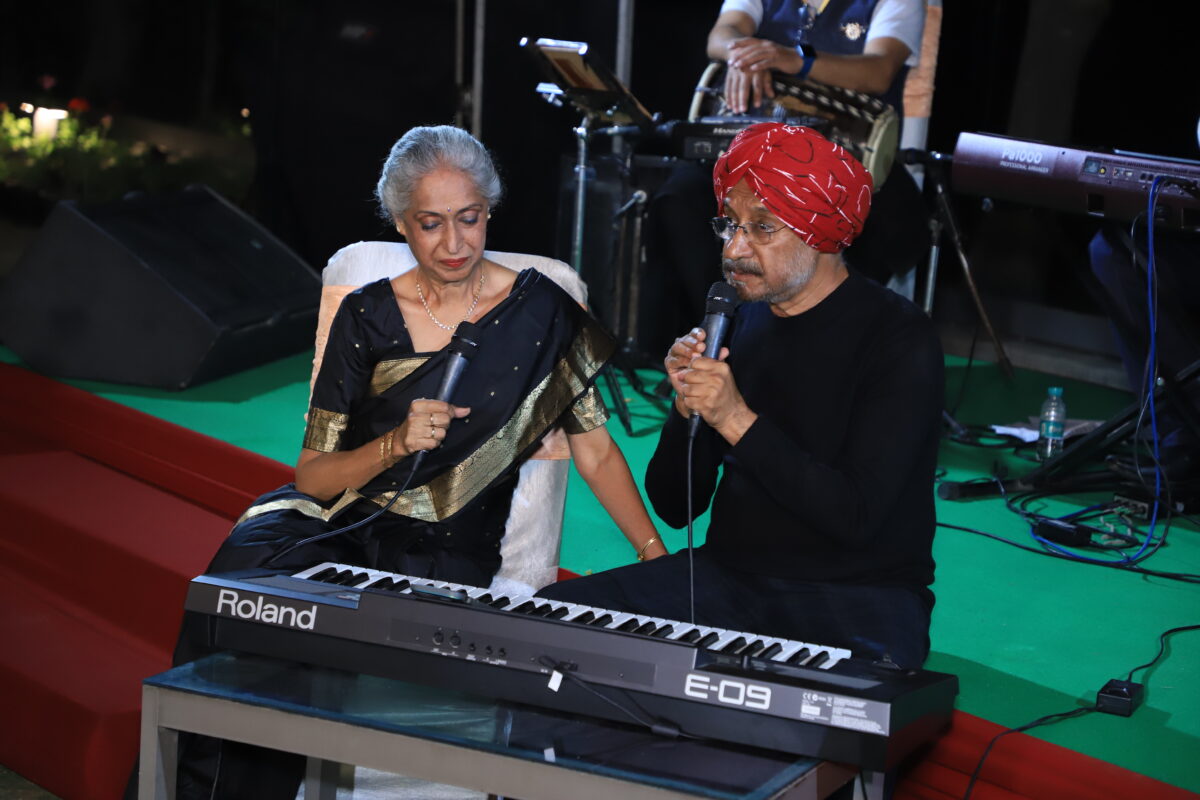
Presently settled in Sydney with his wife Jyoti, he continues to regale us with his outstandingly beautiful singing. Jyoti often joins him whilst singing.
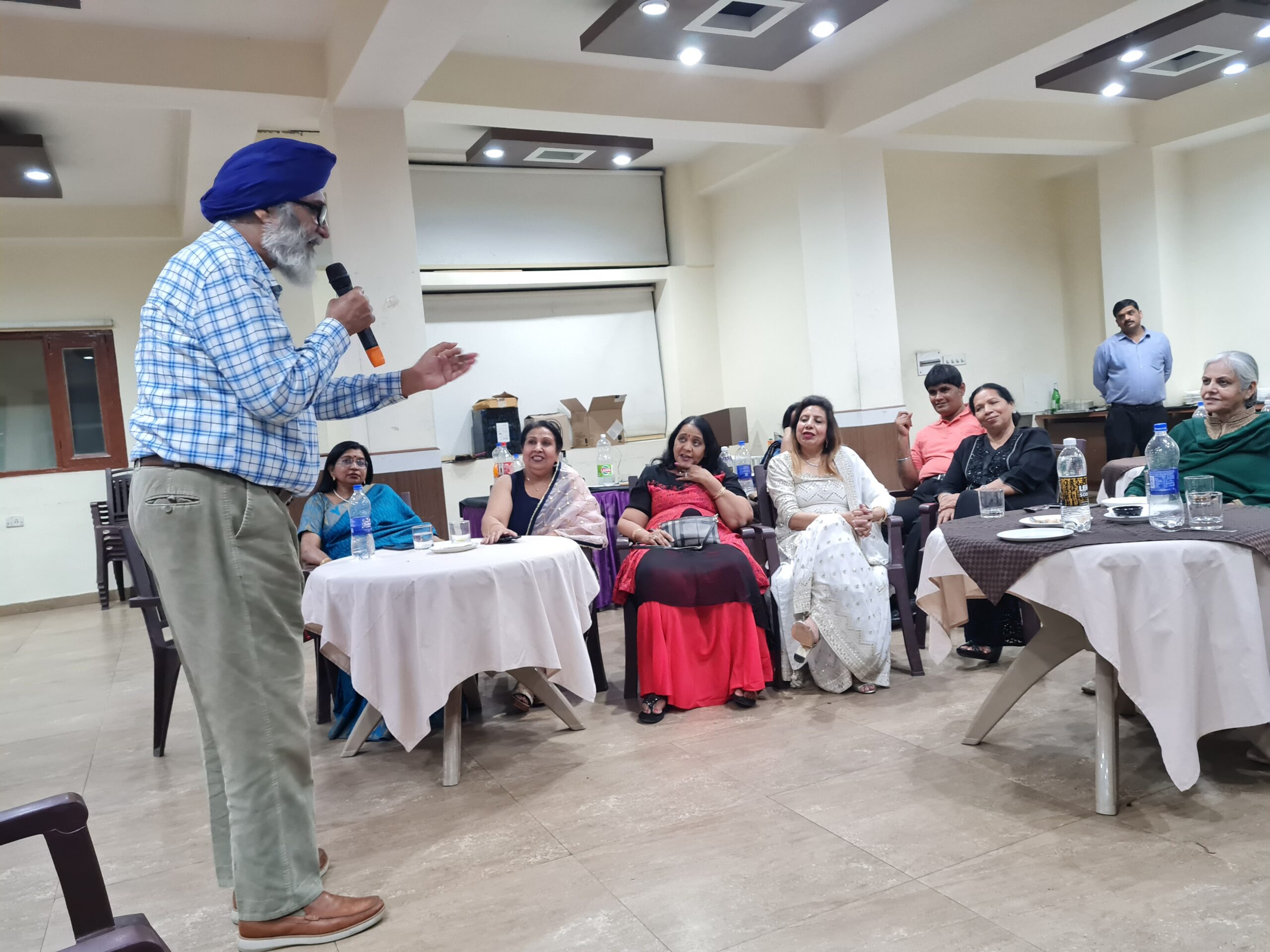
Recently they were in India. Our batch mate Sharanjit and his gracious wife, Dolly organised a Doston Ki Mehfil for them and invited nearly a 100 friends over.
The following poem in Punjabi is to bring out the effect of Avtar’s singing:
शरणजीत ने बिठाई दोस्तों की महफ़िल,
अजनबी भी गए एक दूजे के गले मिल l
बड़ा नोएडा, बड़ा चाँद, बड़ा घर देखा,
और सबने देखा शरणजीत का सबसे बड़ा दिल l
गायक आए एक से बढ़कर एक काबिल,
कईयों के गाने से खिड़कियां गईं हिल l
पर कुछ थे हमारे अवतार की तरह,
चारों ओर जैसे फूल गए हों खिल l
उदास थे कई जो हो ना सके शामिल,
कईयों की थी कुछ अपनी ही मुश्किल,
बहुतों ने गहरे सागर में लगाए गोते,
पर हम जैसे छोड़ ना सके साहिल l
मोदी ने हाथ में पकड़ी पेंसिल,
और ऐलान ऐ भारत लिख डाला बिस्मिल:
“कूचे कूचे, बस्ती बस्ती, DKM करवा दो,
गर देश ने महानता करनी है हासिल l”
अब हिन्दुस्तान में कोई ना रहे ऐसा जाहिल,
जिसे मिलने ना पाए दोस्तों की महफ़िल l
जो हाज़िर हैं वही असली शेर हैं दोस्तो,
बाकी तो हैं नाकाम, नाचीज़ और बुजदिल l
आज पहली दफ़ा अपने चहेते गीतकार शकील की वजह से दरी पैर के नीचे से निकल गई l बैठे बैठे उनका एक गीत सुन रहा था और गीत से पता लगा के शकील या तो vegetarian थे या बाद में बन गएl
कैसे पता चला?
Simple. उन्होने गाने में लिखा था:
“दिल लगा कर हम यह समझे ज़िंदगी क्या cheese hai”
अगर vegetarian ना होते तो पक्का लिखते:
“दिल लगा कर हम यह समझे ज़िंदगी क्या ham है या bacon है l”
Q.E.D.
So here it is:
Song #1 Dil laga kar hum yeh samajhe zindagi kya cheese hai
I am giving you my own rendition of this. Originally sung by Mahendra Kapoor on the lyrics of Shakeel Badayuni and composition of C Ramchandra for the 1965 NA Ansari movie Zindagi Aur Maut starring Pradeep Kumar and Faryal.
The one on top is merely in good humour; the double entendre being between Hindi चीज़ (thing) and English Cheese.
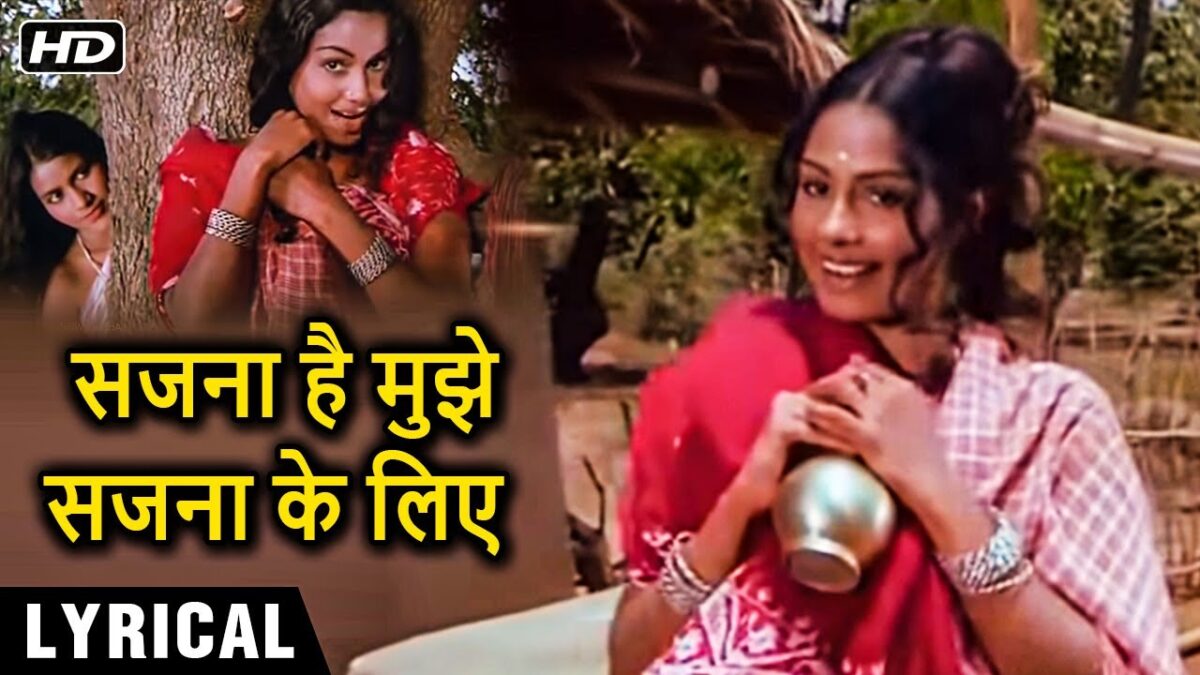
Song #2 Sajna hai mujhe sajna ke liye
The first sajna has the meaning of dressing up or beauty treatment. The second sajna is the lover or the loved one. So, in this song from the 1973 Sudhendu Roy movie Saudagar, Padma Khanna as Phoolbanu sings the song for Amitabh Bachchan as Moti. The song was written and composed by Ravindra Jain and sung by Asha Bhosle:
Song #3 Ke jaan chali jaaye jiya nahin jaaye
The double entendre is in the mukhada itself: the first jiya is dil or heart and the second jiya is to do with living.
This song is from the 1969 Mohan Kumar movie Anjaana starring Rajendra Kumar and Babita. It was penned by Anand Bakshi and composed by Laxmikant Pyarelal. The singers are Mohammad Rafi and Suman Kalyanpur:
Song #4 Choli ke peechhe kya hai
This is double entendre at its suggestive or provocative best. This is from the 1993 Subhash Ghai’s iconic movie Khalnayak (Villain). Madhuri Dixit is the one who enacted it. She provocatively asks “Choli ke peechhe kya hi, chunri ke neeche kya hai.” You are sensuously carried to your height of imagination and then she brings you down with,”Choli mein dil hai mera. Chunri mein dil hai mera.”
This is one of the record 302 movies that Anand Bakshi as lyricist and Laxmikant Pyarelal as composer did together. The singers are Alka Yagnik and Ila Arun:
Song #5 Khada hai, khada hai, dar pe tere aashiq
I would avoid putting up this type though the fact is that such risqué songs are a plenty in Hindi movies and are often seen as the ones that directly add to the box office attraction of the movie.
This is from the 1994 David Dhawan movie: Andaz. The song is provocatively enacted by Anil Kapoor singing it to Juhi Chawla. Bappi Lahiri covered himself in glory composing trash songs and this is one of them. Indeevar, who had made such gentle songs as Jeevan se bhari teri aankhen, from the year 1987 onwards, giving in to lure of money, made over 500 such trash songs with Lahiri:
Song #6 Kahin pe nigahen kahin pe nishana
This is from Waheeda Rehman’s debut movie: the 1956 movie C.I.D., produced by Guru Dutt and directed by Raj Khosla. Waheeda Rehman was Guru Dutt’s find from a college in Hyderabad. All of 17 years, Guru Dutt was so impressed with Waheeda Rehman that he signed her up for his next five movies.
Guru Dutt was preparing her for the role of a golden hearted prostitute in his next movie Pyaasa and gave her this role of a prostitute here too. When one of the bad guys’ ruffian reaches her to entrap Dev Anand, through this song she is warning Dev Anand to escape. The lyrics of the song, through their clever double entendre are warning him and also suggesting the escape route.
These double meaning lyrics were penned by Majrooh Sultanpuri, composed by OP Nayyar and sung by Shamshad Begum:
Song #7 Raaz ki baat keh doon to jaane mehfil mein phir kya ho?
This is from the 1973 movie Dharma starring Pran in his multi roles as Sevak Singh / Dharam Singh “Dharma” / Chandan Seth / Nawab Sikandar Mirza. Rekha, the heroine is also in double role as Asha Singh and Radha. Bindu, the vamp, is trying to expose Rekha in this song. But, she has sought protection from Pran as the don Chandan. Bindu, in her double entendre is trying to tell the party the truth about Rekha and Pran is trying to tell her to come to her senses. Finally these double entendre by both reach a climax and Pran cleverly reveals to Bindu that he is, indeed, the don Chandan and it won’t be in Bindu’s interest to resort to such skullduggery!
The song was penned by Verma Malik, composed by Sonik Omi and sung by Mohammad Rafi for Pran and Asha Bhosle for Bindu:
Song#8 Apni to har aah ek toofan hai
Whilst I have given a song from Guru Dutt production C.I.D., here is one from Dev Anand’s Navketan Films’ production: the 1960 movie Kala Bazar starring Waheeda Rehman with him.
This is really brilliant double entendre is by the Lyricist Shailendra. He and she are travelling by train and she is in the upper berth. His singing “Ooper wala” is actually about her but made to look like as if it is about the Ooper Wala: God.
The song was sung by Mohammad Rafi on a superb composition by his favourite composer: SD Burman.
Here is my own rendition of it:
Song #9 Kis kis ko pyar karun?
This is from the 1969 Pramod Chakravorty movie Tumse Achha Kzun Hai starring Shammi Kapoor and Babita.
The way Mohammad Rafi as playback for Shammi Kapoor sings Kis, it is more like an invitation to Kiss. The lyrics are by Rajinder Krishan and the composition is that of Shankar Jaikishan:
Song #10 Inhi logon ne le leena dupatta mera
This is from the 1972 Kamal Amrohi movie Pakeezah starring, in the lead role his wife Meena Kumari. The film took a decade and a half to make. Ghulam Mohammad, the composer, died whilst the movie was being made and some of the songs in the movie were composed by Naushad.
Even though Majrooh Sultanpuri is credited with the lyrics, the lyrics are a lift off from folk-lore. Dupatta is supposed to be the izzat of a maiden. Having lost it is, at one hand, pointing to her having stepped into prostitution, but on the other hand demurely bringing out her experience with the cloth merchant who sold it, the dyer who gave it colour, and hold your breath, the policeman who robbed it off her. Brilliant indeed.
The same song was used in 1941 movie Himmat and 1943 movie Aabroo:
Song #11 Mera naam hai Shabnam
Bindu, the vamp again. This time in the 1971 movie Kati Patang starring Rajesh Khanna and Asha Parekh and Prem Chopra. The story was roughly based on I Married a Dead Man, a 1948 novel by American crime writer Cornell Woolrich under the pseudonym William Irish.
This Shakti Samanta movie had, in the beginning, turning down a family marriage proposal with Rajesh Khanna without seeing him at all. It was because she was in love with Prem Chopra. But, soon she became aware of his villainous reality and ran off to a hill station under another name. Bindu knew her reality and as a singer-dancer in a hotel she, through the double entendre in this song, was trying to expose her:
Song #12 Titli udhi udh jo gayi
This song was sung by Sharda Iyengar for the 1966 movie Suraj. The song was enacted by Vyjayanthimala and Mumtaz.
Lyrics are by Shailendra and composition is that of Shankar Jaikishan.
Most of Shailendra songs have very deep meaning. So, for once, he was told to make a simple, children type song. Everyone felt that he delivered a plain song. It dawned upon everyone later that he was talking about the relationship between body and soul!
I have given you only representational songs for each type of double entendre. I hope you liked these.
Wait for Aaj Ka Geet Gyan #2 on a different topic.