- How is it that when some other child cries incessantly we find it so repugnant; however, when our own Tinku cries it is music to our ears?
- How is it that fathers don’t want their daughters to do with their dates that they themselves wanted to do with their dates when young?
- How is it that when you think you can’t take anymore life surprises you with the reminder that what you had until then were good times and the worst is yet to come?
- How is it that there is no breeze until you open your newspaper?
- How is it that the vehicle ahead of you is slow like a snail but the one approaching from behind is in indecent haste?
- How is it that your dog invariably senses the mood you are in; but your spouse never does?
- How is it that your boss decides to go home early when you have decided to work late?
- How is it that the telephone numbers of Enquiries at Railways and Airlines are always engaged?
- How is it that everybody you have met has lost money at the Stock Exchange?
- How is it that guests invariably arrive early when you haven’t dressed up after cooking but make you wait for hours when everything is ready?
- How is it that when you have paid in advance the vendor finds it so hard to remember the time of delivery but his memory shows tremendous improvement if he discovers you owe him money?
- How is it that buses are too few when you have to wait for them but the roads are littered with them when you have to drive?
- How is it that when the electricity is there the fan hardly provides any air but after the lights go off you have problem in lighting a candle due to excessive breeze?
- How is it that you remember the telephone number of your ex-flame even after years but have problem remembering your present number?
REAL BEAUTY – A FEELING OF PURE JOY
Somerset Maugham, the great novelist I used to read in my school and college days, could never understand the brouhaha about Beauty. According to him a glass of beer on a hot summer day was beautiful. “Beauty is an ecstasy” he wrote, “It is as simple as hunger. There is really nothing to be said about it. It is like the perfume of a rose: you can smell it and that is all”.
Rabinder Nath Tagore, on the other hand, felt that real beauty is to be felt and not just seen, because:
“Eyes can see only dust and earth,
But feel it with your heart, it is pure joy.
The flowers of delight blossom on all sides, in every form,
But where is your heart’s thread to weave them in a garland?”
So, then, how does Beauty elevate from ‘something to satiate hunger’ to feeling of ‘pure joy’? The answer was provided by the Hindi films lyricist Hasrat Jaipuri writing for Badshaah (Monarch), a 1954 movie:
“Tu maang kaa sinduur tuu aankhon kaa hai kaajal
Le baandh le haathon ke kinaare se ye aanchal
Saamane baithe raho shringaar ham karen
Aa niile gagan tale pyaar ham Karen”
((My Love,) you are the vermillion in my hair, the kohl in my eyes,
Come, lets love under the blue sky.
Real Beauty, therefore, according to me, involves at least two people: the object and the beholder. It doesn’t exist in the absence of either.
Real Beauty also has a certain degree of innocence attached to it. William Wordsworth brought out in the lyrical ballad ‘Three Years She Grew in Sun and Shower’:
“The Stars of midnight shall be dear
To her; and she shall lean her ear
In many a secret place
Where rivulets dance their wayward round,
And beauty born of murmuring sound
Shall pass into her face”.
Does this mean that Real Beauty is just an abstract for me, a dream or fantasy, an ideal to reach; but untouchable, unreachable? Nay, quite the opposite. I feel that Real Beauty is actually found in seemingly most ordinary things and people and animals. Indeed, if I were to come across an exquisite object or being that looked remote and isolated, like a ‘twinkle-twinkle-little-star- how-I-wonder-what-you-are’, I may be fascinated by it; but, I’d hesitate to call it beautiful. Real Beauty to me is like a gentle rain: it has to touch me, drench me, change me, want me to walk in it. Real Beauty, I believe, makes all beings and things more beautiful by its touch, by its presence.
Unless you revel in misery or forlornness, Real Beauty must also make you smile. At what? No, not at anything or anyone but simply smile, acknowledging the beauty of God’s creation.
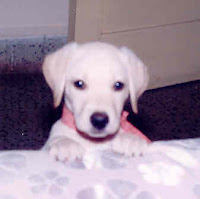
In our recent life, in our family, our yellow Labrador Roger was the most beautiful being in our lives. He looked at you with such pleading, beautiful and innocent eyes that one had no choice to hug him, fuss him, kiss him. Unobtrusively, he made such a place for himself at home and in our hearts that we couldn’t imagine life without him.
Recently, when he died at the age of twelve, and we cremated him, for quite some time the entire family sat on a cement bench in front of the crematorium. A few days later my elder son Arjun rang me up and said, “Papa, so many of our beautiful memories are connected with Roger that even the period when he was not with us appears to have his presence”.
That one sentence, I would think, describes Real Beauty better than an essay. Real Beauty transcends Time.
Real Beauty also must have a degree of tenderness; a vulnerability that anyone would want to protect it against. As Ben Johnson said, ‘It is Not Growing Like a Tree’ that makes a plant beautiful:
“A lily of a day
Is fairer far in May,
Although it fall and die that night—
It was the plant and flower of light.
In small proportions we just beauties see;
And in short measures life may perfect be”.
If it is Real Beauty in a being, the feature that I’d look for the foremost is the Eyes. Eyes are windows to a being’s world. Since there is a saying that beauty like ugliness is skin-deep, I feel eyes bring to fore the inner beauty of a person. If that not be so, why is it that many blind women have the most beautiful eyes? They say when a woman is pregnant her eyes become beautiful. It is a fact that what she imagines her child to be gets reflected in her eyes. Who could have said it better than Byron:
“She walks in beauty, like the night
Of cloudless climes and starry skies;
And all that’s best of dark and bright
Meet in her aspect and her eyes,”
A beautiful person, hence, must have beautiful imagination and deeds. These are what gets reflected in the person’s eyes. Was Mother Teresa beautiful? Indeed, she was. She imparted beauty to everything that she touched. At beauty pageants, for example, every girl wanting to win the title, has a quote from Mother Teresa.
Being the romantic sailor that I am, Real Beauty must also hold a certain enigma for me; connecting me to yonder, to life and beyond. As Robert Browning said in Cristina:
What? To fix me thus meant nothing?
But I can’t tell (there’s my weakness)
What her look said!—no vile cant, sure,
About “need to strew the bleakness
“Of some lone shore with its pearl-seed.
“That the sea feels “—no strange yearning
“That such souls have, most to lavish
“Where there’s chance of least returning.”
And lastly, one beautiful look can enslave you for the rest of your life. You just see her standing there and like Beatles you are hooked:
“Now I’ll never dance with another
Since I saw her standing there.”
You carry that beautiful image with you wherever you go.
DO OUR FLIGHT ANNOUNCEMENTS REFLECT OUR CULTURE?
Once in the aircraft, since you have opted for a reclining isle seat, you would think that there would be respite from announcements. It is not to be. The very reason they ask you to shut down all electronic devices is that after hours, you will still not have time for yourself. You should constantly be paying attention to everything that the cabin crew and the Captain have to say to you.
Enough of announcements? No, with my experience of having been a “guest” at various domestic flights, and keeping in mind the conduct of the fellow passengers, I feel that following announcements may be added to the existing ones. All these are based on actual incidents:
- We told you that in case you need anything you shouldn’t hesitate to press the overhead call button. However, please remember there is no need to test it every now and then. Also, please don’t let children play with the button.
- Please don’t throw the orange peel on the floor, especially in the aisle.
- Please don’t go to the pantry to pick things on your own. We confirm to you that it does not help the cabin crew.
- Conversing with people three rows behind you or in front may disturb other passengers.
- Jackets/pouches in fronts of your seats are specific for each seat. Please ask the person directly behind the pouch before reaching out to take magazines and newspapers or even headphones from the pouch.
- Please refrain from playing transistors, portable music players, and cell-phone music without headphones.
- Holding hands of couples across the aisle may hamper movement of other passengers. We are sorry for the inconvenience caused.
- Whilst sitting down and getting up, please don’t jerk back the seat in front of you with great force especially when refreshments have been served.
- Please avoid putting legs on the seat in front of you even if your feet don’t smell. If your feet or socks do smell, please don’t take out your shoes. If you are not sure whether they smell, assume that they do.
- Spread your newspapers, magazines etc in such a way that they don’t hamper the other passengers especially if they are watching in-flight entertainment.
- The flight is only about one hour forty minutes or so. Hence, you don’t have to stretch your legs in the aisle or walk briskly up and down.
- Isle seat does not give you the right to spread your legs in the aisle especially when the air hostesses are serving meals.
- Please avoid sneezing when the person sitting next to you is being served coffee.
- Please remember that toilets are to serve the needs of other passengers too.
- If you are fond of singing, please pass your visiting card around to passengers around you so that they can come to your office or home to listen to your performance. Your talents are wasted in the aircraft.
- When you find an overhead locker full, please don’t start re-adjusting the entire locker to make space for your box of mangoes. This will keep the other passengers from reaching their seats.
- It won’t help if you vent on the cabin crew your unhappiness over the flight having been delayed.
- Please don’t insist on speaking personally to the Captain of the aircraft if you want to air your grievance about the service in the aircraft. Someone has to fly the aircraft too.
- Each flight carries a limited number of pillows and blankets; and certainly not one per passenger.
- We would appreciate if you can finish the coffee/tea/water poured in your cup rather than giving these back to the cabin crew when they come to collect the trays.
- If you have your baggage in a locker far behind you, it would be better to let other passengers already in the aisle to disembark before venturing your way against the general flow of people. Please bear with us that the total time taken from first to last passenger is never more than five minutes.
Thank you; it was a pleasure (we are great liars) having you on board and we look forward to being given an opportunity to serve you again (like a hole in the head).
OSAMA, OBAMA, O MAMA
They finally found him not in a cave in a mountain but in a huge mansion in Abbottabad, a few hundred metres away from Pak Military Academy. I was reminded of this scene in Mel Brooks’ Silent Movie in which they are looking for Burt Reynold’s house whilst standing in front of a huge mansion with a large sign atop the house with his name on it that even the blind would have had difficulty in missing. Obama wasted no time in taking credit for it. This was reminiscent of Al Qaeda, LeT, JeM and other terror organisations quick on the draw for taking credit for terror killings and explosions in a city square or temple.
The comparison doesn’t sound very right, is it? Well, the fact is that when Godse killed Mahatma Gandhi or James Earl Ray killed Martin Luther King or Oswald killed John F Kennedy, there was so much of contrast between the personae of the killer and the killed that the world was in total shock. A retaliatory killing of the killer was thus a non-event. He wasn’t a hero by any stretch of imagination. However, in the present case by defining the terrorist act of 9/11 as ‘War on America’ and later the retaliatory actions as (Global) War on Terror, both the players had become adversaries or contenders in War, bringing them, willy-nilly, on an equal plane, except perhaps for their methods. Even in this, if the methods of one adversary are totally above-board, in keeping with international norms and UN conventions, and with due regard to unnecessary killing of civilians and innocents; then only the adversary has moral ascendance over the other. Else, if both parties follow the good old English dictum ‘Everything is fair in Love and War’, then neither party has a right to moral ascendancy or ethical superiority or jus ad bellum (justification to engage in war) or pass judgement on someone’s jus in bello (whether war conducted justly).
Ankur Sood, in an article ‘Establishing A Philosophical Foundation for the Osama Movement’ (p 112, World Affairs, Spring 2007, Vol II, No. I) brings out that all major religions (including Buddhism) admit that violence in any form may be used to resist and defeat an oppressor. Based on this philosophy, it is not just Al-Qaeda and Iranian Revolutionary struggle that find justification in indulging in violence; but, come to think of it, the so-called civilized world too. Take for example, how the US has ascribed to itself ‘the right of self-defence’ by carrying our drone strikes in Waziristan or armed struggle (by proxy) in Libya. The intrinsic thing wrong in this kind of doctrine is that if others too follow this doctrine, it would be the case of ‘an eye for an eye’ making the whole world blind.
In Oct 2010, on the eve of Obama’s visit to India (a begging bowl visit?) I wrote an article ‘Is America Losing Legitimacy of Power?’ I had given a number of examples how US obduracy, double standards, and desire to protect ‘American strategic interests’ by all available means had begun the (moral) decline of this great power. Subsequent events proved me right.
Lets come to the third part of the title: O Mama, ie, what does it mean for us in India?
Ever since the Partition, Pakistan sought to internationalise the Kashmir issue. India wanted to sort it out by mutual dialogue. Pakistan was hell bent on mediation by its ally US. Having lost in all wars it fought with India, it tried out the terrorism tool (Death by a Thousand Cuts). It had witnessed the success of it by the Mujahedeen’s (sponsored by the US) victory against the Soviets in Afghanistan. Thus, post 1989, such terrorist attacks against India increasingly became routine. Pakistan’s importance to the US was dwindling post Soviet pullout from Afghanistan. But 9/11 came as a blessing in disguise for it. The ‘no-brainer’ given to Musharraf by Bush suddenly propelled Pakistan as a leading ally in the (Global) War on Terror. India kept insisting that Pakistan was the major Originator of Terror globally but US turned blind eye towards it to facilitate its operations in Afghanistan. US was also annoyed with India for having conducted nuclear explosions three years prior to that. Pakistan enjoyed siphoning off funds from the US as “compensation” for its contribution in GWOT.
What were the side-effects of this arrangement? Well, Pakistan lost its sovereignty in exchange for promise of security and money and importance. Even before the Operation Geronimo by the US SEALS, the US forces were, at will, using Pakistan territory for launching operations either within Pakistan or in Afghanistan. Skeletons that emerge from the Pak cupboard now reveal that Pak Army was not “surprised” by these but was party to it.
Pakistan sponsored 26/11 Mumbai Attacks made US sit back and take notice of the Pakistan’s tacit involvement in the terrorist attacks; more so since it came out that the terrorists specifically targeted American tourists. However, as the David Coleman Headley episode brought out, it is India that was ‘surprised’ and not the US. Soon, American operations in Swat and Waziristan became more important than the cross-border terrorism that Pakistan was subjecting us to. Indirectly, it provided India too with ‘security’ in that as long as US was involved in AfPak, it would not tolerate Pakistan re-starting any major mischief (the Kargil variety) in Kashmir; not because of Indian interests but because it would take the focus away from US AfPak operations.
Let’s now, for a moment, turn back to Osama and Obama. It is more than likely that OBL’s presence in Pakistan did not surprise the US (come to think of it, it hardly surprised Afghanistan and India). In that case, the timing of the US operations would suggest three things: one, to tick off success and provide it with reason to pull out of Afghanistan; two, US Presidential elections next year; and three, to finally acknowledge Pakistan’s role as a major sponsor of global terrorism.
The first and third have serious ramifications for us. After the indirect deterrence provided to us is compromised, what is to afford us deterrence against full scale terrorist attacks emanating from Pakistan with, as is always the case, tacit support from Pak Army, which is dying to take the focus away from its perceived failure to protect Pak sovereignty? Post 1998, Pakistan perfected what Uday Bhaskar termed as NWET (Nuclear Weapons Enabled Terrorism). In the face of it, India, very quickly lost the deterrence value of its own nuclear arsenal by NFU doctrine, ambiguous statements and capability to absorb nonsense emanating from across the border. Deterrence value of Pak nuclear weapons was, however, enhanced by its irrationality and proven irresponsibility.
So then what is the solution?
I think the first step is a realisation that US is neither a solution nor the enabler of one, despite the current change of heart in US media about India. The second more difficult step is to convince Pakistan of the same. It would appear shocking, at first glance, but, despite their failure, Pakistanis are our ilk. Perhaps if we were to make our democracies (of/by/for ‘common’ people) more representational and stronger we would be better off. As far as imperialism is concerned we should endeavour to convince Pakistan to keep these forces at bay by a) Realising that they are still following the ‘divide and rule’ and to sort out our differences by ourselves b) Economic development c) Making a dream of one Asia or at least one South Asia be realised and become as strong as, say, EU. For this, politicians and strategists in both the countries have to eschew suspicion and promote people to people contacts. Recent events have provided us with a unique opportunity to pursue these goals. If we fail, it is my guess, unless I am proved totally wrong, that after Pakistan breaks up (within a decade) such a realisation will in any case seep in despite the imperialists’ efforts to ensure it does not.
CORRUPTION KI BAAT MAT KARO BHAI
Issne croron rupaye swiss bank mein laga daale.
PUBLICLY PRIVATE
During the WW II, a German spy had to detrain at a little known English village whereat he was to contact a counterspy. He knew the password or phrase and its reply and also the name of the person he had to contact. On alighting at the station, he approached a porter and enquired about this person, “I have to meet a Mr. Smith. Would you know anything about him?” At this the porter replied, “Here, Smith is a very common surname; the Station Master is Smith, the Ticket Collector is Smith; the Bookshop vendor is Smith and, even I am Smith”. “Oh, you are Smith?” asked the German spy hopefully and straightway tried the secret phrase, “Well, ‘I have a corn on my left toe’ ”. At this the porter replied, “So, it is Smith the Spy that you desire. Why did you not tell me before?”
You may also recall the good old joke about a Russian calling President Brezhnev a fool; he was tried on two serious charges: one, for showing disrespect to the highest authority, and two, for revealing a state secret.
In the Navy, my erstwhile employer, we took secrets and classified information and books rather seriously. Photographs and Photostats were a big no no. I remember the time when the first of the Photostat machines came to the Navy; well, one had to make an application in sextuplicate to ask for a page to be xeroxed. Many a times, what was already in Jane’s or newspapers was marked SECRET. I remember a fascinating middle in a newspaper penned by Jesse Kochar about the most reliable sources for naval wives about ships’ sailings: the newspaper vendor and the LIC agent.
However, nowadays there are prying eyes everywhere and protecting privacy has become a full time job. As soon as one goes on to the Internet, one is naked to the whole world. The other day I wanted to learn about something that I never had, that is, ‘a flat stomach’. I checked a few articles on the Google. One year later, irrespective of the nature of my Google research, say, Iranian Elections’ or ‘UAVs’, the ads on the sidelines have curiously been about ‘flat stomach’ and these still pop out most innocuously. For example, “Want a flat stomach? Annie tells you how. Cheapest rates in the world”; and all I wanted to find out was whether a certain Poonam Pandey had kept her promise or not.
These days what is available on facebook and Twitter debates and hence known to millions of viewers would have put a person in trouble if he/she had disclosed to a few friends.
It used to be a serious offence to even try to learn about military locations. Nowadays, one can download everything from Google Earth or other equally revealing sites. Many a times, senior officers are answering questions on the television about matters which they had thought even their own personnel did not know about; though, it is a fact that the media mixes facts and fiction into an ever changing concoction; so much so that one is never sure where fiction ends and reality begins or vice-versa. ‘Let it all hang out’ is the catchphrase of the media whereas the armed forces, bureaucracy and government offices would like to have a fig-leaf of secrecy about varied matters. Fig leaf? It reminds me of the time when a group of old ladies went on a botanical tour and came across this tree the kind of which they had not seen earlier. When told that it was a fig tree, one of them could not help remarking in a shocked voice, “My, my; I’d always imagined the leaves to be bigger.”
There is, thus, these days, nowhere to hide. Ratan Tata, for example, moved a petition in the Supreme Court that he had a right to his privacy; and how was it that his Personal & Confidential mail to Karunanidhi was available everywhere? Nira Radia and others who interacted with her; and a certain B Dutt realised that there is nothing like having private conversations and that one has to be guarded all the time. Someone, somewhere is always snooping. Everything is public, everything is common knowledge.
Passwords? Well, words fail me to describe how these have taken over our lives. Remember the good old: “Halt, who goes there” and the reply, “Friend with a bottle”, and the final security clearance – “Pass friend. Halt bottle”? Nowadays, for everything there are hurdles of Login IDs and Passwords; be it bank accounts, emails, secured nets, forums and groups. Many of these are to be changed periodically and mandatorily. Hence, to keep track of your current IDs and Passwords is as difficult as to name the current boyfriends of some of our popular actresses. If you try the wrong combination a number of times, your account gets locked, in the manner of the Chastity belt I told you about, or the draw bridge over the moat, denying you further access.
In all this, what are the chances of unintentionally matching Passwords? Here is a scenario:
One day, at the border with our ‘Friendly Neighbour on Western Side’ (By the way, this is how this country is described in exercises in the armed forces for, hold your breath, reasons of security), the security question and reply for the border sentries matched. A soldier on sentry duty on FNWS met his counterpart on Indian side, without realizing the sides were opposite and boomed, “Kali chhatri” (Black umbrella). On receiving the response, “Neela aasmaan” (Blue sky), both relaxed and started chatting. They described how their officers were b_ _ _ _ _ _ s of very high order, which too matched totally and added to the developing bonhomie between them. Every now and then they exchanged ‘Kali Chhatri” and “Neela Aasmaan” and felt reassured that they were on the same side, until, they came to specifics. And then…despite cries of KC and NA, they were at each other’s throats.
Far fetched? You won’t be too sure if you stop to think that Faridkote is a town each on either side of our border with FNWS.
Shahid Afridi recently aired some private views publicly, which warmed the cockels of Indians’ hearts. No sooner had he finished doing it when he was privately taken to task for being anti-national and anti-Pakistan. He was reminded that the raison d’etre of Pakistan was relentless hatred towards its Unfriendly Neighbour on the Eastern Side (UNES). He then publicly retraced his steps and spat out venom.
The other day, many of my Passwords for various sites turned out to be Fail-words. I tried again and again and was totally frustrated when the account was locked. Exasperated, I turned to God and prayed, “God, I am your humble servant. Keep me from the false security and frustration caused by Passwords.” To my bewilderment, there was lightning and thunder and then I heard God tell me, “Please try again to register prayer; your name and password don’t match.”
Last year when I left the Navy after thirty seven years, I left with a nightmarish thought that if I were ever to be taken a POW by the agents of the FNWS and I had to reveal a secret to save my life, I won’t really know of any.
Are there no secrets anymore? Is there no private life? How much do we want the society and the world to be regulated? Let alone spoken and written words, the other day I read an article that there is research going on to get into the minds of the people so that even before they take a decision their ideas should be known.
God, how is it that when we want to be heard no one hears us? But, when we want to keep something personal or private they don’t let us?
I am reminded of the time when a government official was trying to sell a radio set to a farmer in far corner of USSR. The farmer was not impressed. So the official told him, “Look at it this way. With this you can be in any part of USSR and still hear Moscow.”
The farmer had only one request, “Nah; but, do you have anything by which Moscow can hear us?”
All those who regularly snoop on other people’s conversations, affairs and bank accounts; all those who snooped on Radia and her friends with such dexterity, do you have anything by which you can overhear millions of our countrymen dying of hunger and crying in pain? Do you have anything to make their private misery public?
CRICKET HAMARI SHAAN HAI
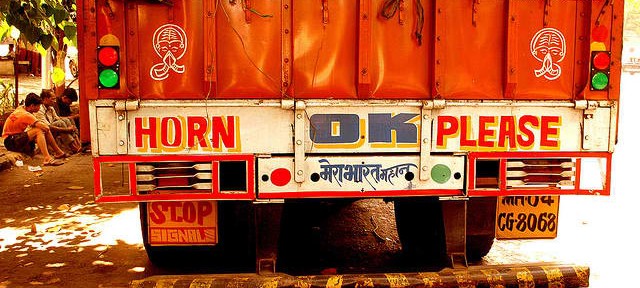
INDIANS LOVE TO HONK – DON’T THEY?
The number one use of the horn is the proclamation of the desire to move faster. We are convinced that accelerator and horn are to be pressed together. Accelerator makes us go faster without any assistance from others; but, the horn declares to all and sundry that we are in a hurry. So, then, why don’t they hear us and give us way? Simple, because they too are in a hurry and pressing the horn equally blithely. We may be in the midst of a huge traffic jam (caused more often than not because of our curious driving skills); but, we are convinced that somehow the incessant honking would brighten up things.
The second use is to tell all the people around that we can see things more clearly than them. For example, ours may be the farthest vehicle from the traffic lights; but, the nincompoops ahead of us need to know that we saw the lights turning green before them. Similarly, if we see an opening in the slow moving traffic (which is always the case) we must indicate to the ignoramuses that a detour to the pavement would make them and consecquently us reach ahead of the slow-moving lane.
Then there is the frequent honking to drive some sense in the driver whom we suspect is intending to take advantage of us; eg, by slowly edging towards our lane which he perceives is moving faster than his lane. Also, if he too is eyeing a spot in the traffic that gives the person some advantage (maybe a few feet) vis-a-vis others around, we must bring home the misconception to him. Finally, if he is heading towards the only parking place that we had viewed much before him, shouldn’t we claim the spot like the Arizona gold-hunters? It is just a natural instinct – no big deal.
The above are types of specific honking with specific aims, however unattainable these might be. However, there is one general honking, very regular, loud and may sound irritating. It is to tell people around us how important we are and how unworthy they all are. During the days of the rajahs, when the rajahs used to move on elephants, they used to have footmen walking in front blowing conches and horns to signify the king’s arrival. Because of austerity measures and also because of the speed of vehicles, it is not possible to have footmen walking in front of their vehicles announcing their arrival nowadays. Hence, these modern day monarchs have to rely on vehicle horns. What is wrong with that?
Honking is also used to bring home others’ mistakes. For example if the vehicle ahead of us is stopping to let pedestrians cross, we have a choice either to overtake him and wade through the unruly lot; or we can honk and let the vehicle ahead realise the wrong he is about to commit. What is wrong with that? It is just a natural instinct. Also, when our lights are turning red and the across lights are turning green, shouldn’t we honk to indicate to the uncouth lot that we are allowed to cross until a few seconds after the lights have turned red, following the trail of those who are crossing in green lights? Shouldn’t they wait?
Some honking is just to break the monotony of the journey. Have you ever thought of how boring a drive is without honking; everybody minding their business, everybody giving way to everyone, everyone keeping to their lane etc? It would make people go to sleep and make them less alert. Such societies with such niceties are doomed to dullness. Indians are the only brainy people who have realised that some entertainment, fun, challenges, surprises are really required whilst driving to keep you awake. The expression, “There is never a dull moment” was born as soon as they introduced driving in India and a great part of it is to do with the horn.
Lastly, what do you do with things that you have paid good money to buy? If you have bought a TV set, would it serve anyone’s purpose if no one plays it? Similarly, if there is a horn in the vehicle, isn’t it wasteful expenditure not to use it? Can a poor country like India afford such wasteful expenditure?
Please note I have not even recorded such legitimate honking as after winning a match or during processions; or to express joy at finding no cop; or a lorry, bus or cab driver sighting his gaanv wala (country-cousin); or to regain a spot that you previously held in a lane when you moved to the other lane erroneously thinking traffic was moving faster there.
So, next time when you tend to get amused or irritated by Indians compulsively honking, think of all the purposes it is serving, including national interest. Don’t just be judgmental because you don’t know the aims of this glorious obsession we have with the horns. We could be wearing them, you know.
THE GREAT ESCAPE
There was a knock; at first it was faint, barely distinguishable but later it grew louder and more authoritative. He ignored it, not because he was too tired or too sleepy to get up and confront the person knocking with all its might. He knew the person; he liked her and everything about her. But, he was very skeptical about allowing her in. Last time he had allowed a similar one in and there was hell to pay. His house was in disarray for considerable time after she had left. He knew that more than her, he had only himself to blame for having opened the door. As long as he was inside he had relative comfort, relative security, and exclusivity. The moment he opened the door, she would slowly conquer his space. He had no fear of his loneliness. He was quite comfortable with himself; he had never hated the person he saw in the mirror everyday. She knew she had a great chance of succeeding if she’d keep knocking. If at all life had taught her anything, it was the realisation that knocking always helps. She had, hence, emerged a great knocker. Her favourite quote was, “If God closes a door, he opens a window“. She had the force of great conviction behind her. She had simply walked in many an open window. God, she maintained, had been kind to her.
He knew she could not walk through his windows; he was on a higher floor, and he never opened the windows.
The incessant tapping at the door became too loud to be ignored. He knew that his heart beat had already started responding to it; hence, for every thuck thuck, there was an equivalent dhak dhak. Finally, he realised that it was futile to keep pretending she could not enter. She was already there.
Initially, there was no problem about the closeness of the space. This was the exploration phase. Indeed, even though he had a two room flat, she was quite content in being with him in a single room. It was rather cosy and there was no question of either of them feeling claustrophobic. When she sang, it echoed from all the walls and he soared; no one had ever sung exclusively for him. He was convinced she had the most beautiful eyes in the world. Hence, whenever he wanted to fly, he only had to look into the ocean of those deep eyes.
However, after she came in, the world – their world – changed. Initially, both were content about living with each other in the present, enjoying each other’s company and everything connected with each other. Of course they had squabbles but these could at worst be called mere tiffs. But gradually, she started living more in future. Therefore, a time came when both of them were geographically in the same location but were in different times.
It was a constant tussel between them. She wanted the future – her future – to be discussed, to be secure. He wanted to love, to be loved, to cherish the present. She went along with him at times and more often than not enjoyed what the present held for her: he had an innate wit that she liked, compassion, and other finer feelings and a strange appeal. But no sooner that she’d finish enjoying the present she’d go back to the future.
He never wanted Love to be conditional. If he had known that she had other plans he wouldn’t have ever opened the door…or the windows.
Initially, she tried to go out of their space only mentally…not really on a fantasy ride but on an escape to the world that she craved. She debated with herself that an Indian woman, in a male dominated society, does have to worry about her future.
Later, she actually started going out….
She was attractive and there were any number of men who were fascinated by her charm. She reasoned that if it was all about living in the present with no commitment, then present certainly can be made more colourful, more acceptable, more exciting. Indeed, she often confronted him with, “If you have ideas, I have ideas of my own.”
This ruffled him badly. Who said anything about commitment? Love is a supremely selfish feeling, he argued. One cannot be loving everyone. One has to love one…and hence, there is commitment.
Later, when she used to return to the room – their world – in the night, he could sense her deception. She continued to make light of it and often said that because of him she couldn’t be expected to cut ties with everyone. She asserted her independence. Why is it, she demanded, that in Indian society, men could do anything but women were to toe a rigid line? Why is it that in a male-dominated Indian society women are to be castigated for even talking to men?
He kept quiet. He knew the truth.
He reckoned that when she had invaded his privacy by knocking at his door he had welcomed it so that they could make a world of their own. But, now, there was hardly any space or even time for themselves. For all practical purposes they lived in different worlds.
One day, she woke up as usual and turned towards his side of the bed. She used to love getting up just a few moments before him and look at his handsome face when he was totally defenceless. She couldn’t find him in the bed. Perhaps he had gone to the toilet, she thought. But minutes later she didn’t hear the familiar sound of the flush or the door. She got up and checked; he wasn’t there. She went to the other room and he wasn’t there too…or in the kitchen.
The door was still bolted from inside. This meant he was there in the house somewhere. She searched and searched but couldn’t find him.
She called out his name frantically. There was no response.
She threw open the window and looked out. No, he couldn’t have. It was too high to jump and there was nowhere to hide…anywhere.
And yet…he was gone…just at the time when she felt she had him; when she felt he’d never leave.
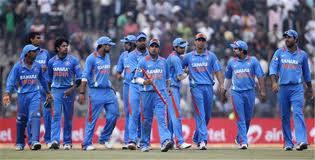
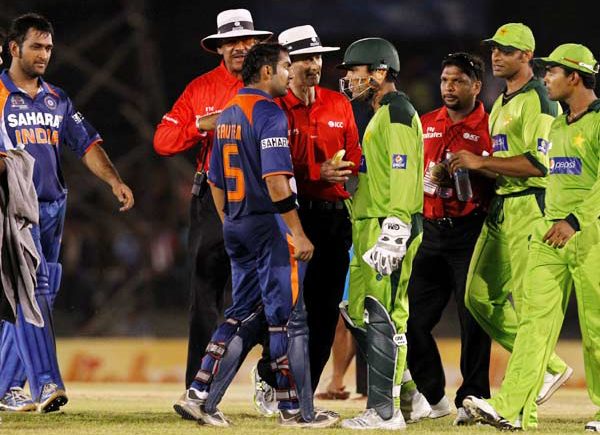
INDIA PAK ODI PREVIEW – JUST A MATCH?
There are still ten minutes for the game to start. In the VVIP stand Pakistan PM Yousuf Raza Gilani, on his cellphone, is urgently discussing something with President Obama. He is whispering so low that no one can hear him. Manmohan Singh is not even making an attempt to overhear because, on his phone, the RAW is providing live text of the conversation.
Gilani: President Sir; forget about any other financial aid to compensate us for our sterling and sacrificing role in your Global War on Terror (Aside, that too is picked by RAW: Global and War are yours and your allies but Terror is totally ours). We want your help in winning this match.
Obama: But why is winning so important to you?
Gilani: Several reasons. The most important is that from the earlier aid you gave us for floods etc, my cabinet colleagues and I have bet nearly a thousand crore on Pakistan winning. Two, the team and us want to go back alive after the match, and…
Obama: Okay, I get the idea. But what can we do?
Gilani: What can you do? How are you asking, what can you do? We have seen for ourselves what you can do, Sir. Davis, an ordinary US embassy technical and administrative staff showed us what you can do. Your display of humanitarian assistance to Libyans has hinted to us what you can do. Sir, we know there is nothing that US cannot do.
Obama: Let me see; should we send some one in disguise to the Indian dressing room?
Gilani: Aha…now you are talking. I leave the method to you, Sir. But please hurry, President Saheb, the match is about to start.
The din is excessive; which is only appropriate for two countries in the world that make maximum noise between themselves. Indeed, when they refuse to make noise (in some circles this noise is called ‘talks‘), others have to intervene to ask them to re-start making noise…..and gas.
Umpires Simon Taufel of Australia and Ian Gould of England walk up to the middle. Both the Captains join them. The cheering has broken the sound-barrier.
At the toss, Afridi has asked for ‘Heads’. He knows there is something typically Pakistani about asking for heads; their history from ancient times is replete with instances when they have demanded heads. Dhoni, like what Indians are always used to, gets the ‘Tails’. The coin is tossed.
Gilani pulls out his cellphone (ever since 26/11, men in authority in Pakistan know the importance of cellphone): President Sir, let me see proof of your being with us. Make us win the toss.
Pakistan wins the toss and elects to bat.
Manmohan to Gilani (as always in the appeasing tone so that they would listen to reason): Great, you have won the toss. Congratulations…
Gilani ignores it as Pakistan does with every attempt to placate them.
Indian team takes up positions. Mohammad Hafeez and Kamran Akmal walk to the crease. There is pin-drop silence even on the TV except for one B Dutt who has perfected the art of saying the obvious: “The match is about to begin. History is about to be written….may Pakis….I mean, the best team win”.
Her comments go totally unnoticed as people have learnt long ago not to pay her attention.
Zaheer Khan goes on top of his run – up. Prayers take on renewed vigour. Every ball counts. He bowls and it is hit for a four. There is uproar from the Pakistani fans. Gilani is on his feet.
The going is good with both the openers fluently hitting the bowlers all over the field. So happy is the going that Gilani has no need to make any calls.
Bhajji is brought in early and he too is hammered all over the place.
An aide reports to Chidambaram that some Pakistani fans quietly left the field and are headed towards Srinagar. Chidambaram asks the Security to keep a watch on them. Army Chief calls to say there is large scale infilteration from across the border. Manmohan tells him to keep a watch on the situation since there is an important World Cup match in progress.
“But, Sir”, persists the Army Chief, “It is just a match whereas the situation here is turning grave”.
PM, “I know it is just a match; but, we have to give the impression everything is normal. The whole world is watching us. Ring me up after four-five hours”.
Meanwhile there has been a change of bowling. And Yuvraj, as expected, has struck. Gilani is about to reach for the cellphone but Younis puts the train back on track.
Later, the wickets keep falling at regular intervals but the batsmen in an act of supreme defiance – the one that they ususally assume when playing against India – take the score to 267 in 50 overs, ably helped by a swashbuckling innings of 52 runs by Shahid Afridi.
It is not a very big score but under the conditions everyone agrees that it is a fighting score.
B Dutt also agrees.
After the break, Sehwag and Sachin take the field. Akmal before taking up his position behind the wickets says something to Sehwag. Most of it is inaudible but Sehwag hears the word “ma” clearly. This inspires Sehwag to send the first two deliveries of Shoaib Akhtar to the boundary. Shoaib goes across and tells Akmal to refrain from the “ma” word and….. switch to other relatives.
Sachin goes early on a no ball by Umar Gul. All Indians are crestfallen.
Air Force Chief rings up the PM, “Sir I have bad news.”
PM: “I know…Sachin just got out…”
Air Force Chief, “Sir, actually one of our planes on routine mission was hit by a missile from across the border…..”
PM: “You manage the situation. What are you Air Force Chief for? Here there is do or die”
Air Force Chief: “Sir, it is just a match..”
PM: “Don’t I know it? Now let me concentrate please…”
Despite all the tamasha, the match goes on. Fortunes swing, sometimes this side, sometimes that side.
And then….
It is the last over. India requires 5 to win…
Tension is everywhere. “Why does an India – Pakistan match resemble a cliff-hanger?”, everyone asks. Everyone knows the answer. Bookies laugh all the way to the …..well, not the bank since they can never put these kind of winnings in a bank….maybe, laugh all the way to…well, you know the answer; why do you require me to tell it?
The first ball of Abdul Razzaq, takes the wicket of Yousuf Pathan who had made a quick 43 in 27 balls.
There is hushed silence.
Will India lose again?
In various parts of India, B Dutt reports, as many as 6 people have died of heart-attack.
It is just a game….they had said.
Bhajji is the next batsman in. Akmal tells him, “Teri ma…” etc.
Bhajji is quite used to it and just before Razzak bowls his next delivery, he tells Akmal a ripe one.
Akmal misses to catch the snick by Bhajji in the confusion and Bhajji and Ashwin take two runs.
Four balls to go and three to be scored.
Camera shows a girl in the stand closing her eyes and praying to Allah to make India win.
Gilani does the same but asks for Pakistan to win. Allah too is confused. He tells his assistant, “You had told me it is just a match“.
Can they do it? Or won’t they?
Bhajji takes one run on the next ball against all odds and now the match is nearly in India’s favour with three balls to go.
Gilani reaches for the phone: “President Sir; the Indians are about to cross the threshold”.
Obama assumes he is talking about nuclear threshold. His worst fears are coming true.
There is an urgent call to Manmohan even as Razzak is walking up to the top of his bowling run-up: “Listen Singh; call off the ruddy match. We don’t want mayhem on our hands”.
Manmohan: “But, Mr President, it is just a match…..”
BHAG BHUAJI IS NO MORE – AN ERA ENDS
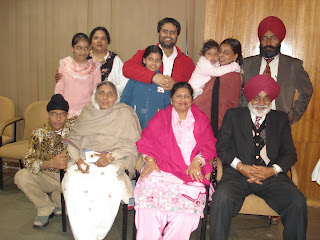
| Bhag Bhuaji Left Sitting with her entire family |
My Bhag (short for Bhagwant Kaur) bhuaji (in Punjabi we pronounce it thus rather than the Hindi ‘buaji’; father’s sister, in Hindi) died at about 10 pm on 30 Jan 11. With that an era has come to a close. She was the youngest of my father’s three sisters; the elder one, Jaswant bhuaji, was the eldest in the family of five brothers and three sisters (all dead now except Meji chachaji, the youngest of the siblings). Then there was Ratno bhuaji, younger to Jaswant bhuaji. She died a few years back; at a relatively younger age.
My bhuajis were the reincarnation of love and kindness. My grandfather’s family had strong charactered men; each one a perfectionist in his own way. The men, including my father, were extremely ambitious and hence given to anger and frustration. It was thus left to my bhuajis to bring some semblance of compassion and calm in the family. They had these in abundance. It was natural for them to think of others without asking for anything in return. I cannot remember a time when I saw them without a radiant smile on their faces and the desire to make the best of any situation.
![]() |
| Bhag bhuaji (L) and my mom (R) |
Bhag bhuaji, just like her two sisters, was very beautiful indeed, both from within and outwardly. When she smiled, which she did all the time, her nose stud would shine and make her look even more radiant. She was in awe of my father; what with his always being in a hurry (he died young; he won’t have wanted to keep God waiting). But, she loved him unconditionally, as she did the rest of the family.
| Bhag bhuaji loved family gatherings |
Hospitality came naturally to her. Bhuaji and my uncle lived in Chandigarh. There were no occasions when we passed through Chandigarh on the way to Himachal (where my dad served) without looking them up. As we would enter the house, without ever seen by us or seemingly ordered by her, one of the kids would run up to the sweet shop to fetch fresh ghulab jamuns, jalebis, and samosas for us. These would be in addition to the goodies at home such as gajrella (sweet carrot dish), pinnis (round sweets like laddus made with wheat and dry fruits) and kheer (sweet made with rice and milk and dry fruits). Irrespective of the number of people for whom bhuaji would have to suddenly make meals, bhuaji would do so smilingly, and indeed whilst cracking jokes. Her youngest son Monty’s wife Manjit has inherited these virtues. Last time when I visited Bhag bhuaji, as if she knew it was going to be the last time, she had invited all the near and dear ones for lunch with me. Manjit cooked delicious food for everyone; there were nearly three dozens of us.
| She was fond of Rana, Ratno bhuaji’s son |
Bhag bhuaji, mummy, and sisters would be at their best during weddings. They would enjoy dancing and bolis and tappes (folk singing with a view to invite rejoinders) and indeed encourage others to do so. One of them would play the dholaki (traditional Punjabi drum) and the other would rythemically beat it with the back of a spoon. And this with all the work at home.
On one of the occasions when I visited her, she made me climb up the loft to fetch a carton of beer with just two bottles
| Bhag bhuaji and my mom at Rana’s party |
in it. She explained, “Munde khunde beer pee rahe si; main ohna nu keha Ravi layi do botlan rakh layo” (The boys were having beer one day and I told them to keep two bottles for Ravi). I was touched. Generally, bhuaji looked down on anyone drinking. But, since it was offered to her jawaai (son-in-law), her quick reaction was that me being a fauji (armed forces man) would probably relish it. There was nothing strange about her keeping beer for me; she did it for everything that would make others happy. For example, if anyone would appreciate the taste of her saag (spinach), kheer or anything, she would freeze it and keep for me.
![]() |
| Our last picture together |
In our recent life, after my father died, Bhag bhuaji visited us in the hills only once since she was very scared of driving in the hills. She enjoyed the scenery, the freshness of air, trees and flowers. Encouraged I thought of taking her and others for a picnic to the forest around Chail. We made a small fire for heating up the goodies that we had carried for lunch. Suddenly, Bhag bhuaji looked around and remarked about the remoteness of the place and the likelihood of a sher (lion) jumping on us. I thought she might be joking but the more she talked about it the more she convinced herself that there was ample likelihood of sher surprising us (even though there were none in that forest). Finally, we quickly packed up our stuff, not because of being surprised by sher but by rain. After the rain stopped I took her to the Chail cricket ground atop a hill (reputed to be the highest cricket field in the world during the days of the rajas). As she climbed the last of the steps to the cricket field, she came up with her characteristic remark, “Aithe cricket kidan khed de honge; aithe tanh uppar chad de hi saah chad jaand hai?” (How would anyone have played cricket here; one is breathless just by climbing up here).
| Bhag bhuaji in America, just prior to 9/11 |
Truly, in her observations, fears and anxieties she would become a small girl. She would be a small girl in the family gatherings too. A few years back my youngest uncle Meji in America invited the surviving siblings, that is, Pitamber Uncle, Dilgir Uncle, Bhag bhuaji and my mom (representing my dad who died in 1984 of an accident) to spend time with him there. Their visit coincided with 9/11. Bhag bhuaji was very excited telling all of us about the US and its quality of life; but, she also added, “Main nahin uthe wapis jaana. Asin uthe gaye tanh ohna ne saare paase bomb sutne shuru kar ditte.” (I am not going back there; they started chucking bombs all over when we were there). Indeed, Bhag bhuaji, her three brothers and my mom were there in Washington when the attack on Pentagon took place. Some of her fears were not so girlish afterall.
| Bhag bhuaji and me |
For the last two years or so Bhag bhuaji had lost a few teeth. She had a renal problem and had to go for dialysis twice in a week. One would think that with her age and this problem she would have complained or forgotten to crack jokes. No; when she laughed through her missing front teeth, it made her look even more cute. There was never any problem that would make her complain or forget to enjoy life and company of those around her.
For me, just like my dad, I never missed out on visiting her even if it were for a few minutes. She would often tell everyone, “Ravi nahin maiton milne bgair jaa sakda.” (Ravi would never cross this place without seeing me).
So tell me bhuaji, when I visit Chandigarh next, where should I come to see you? You always thought of everything; did you think about this too?
IF DAD AND MOM HAD TO CELEBRATE VALENTINE’S DAY
We don’t have to go as far back as my grandparents times; if Valentine Day had to become popular during my dad’s times, how would it have been? My dad died of an accident when he was just 56, one year younger than I am now. During his days, except for in movies, couples never publicly expressed love for each other. It would be indirectly hinted rather than ‘in-your-face’ proclamation. There were no Valentine Day cards or other accessories.
Now lets suppose it was to be imposed on my parents, how would they have reacted? The entire conversation would have been in Punjabi but I think we would understand it better if I translate this imagined conversation:
Dad: In the office there is lots of talk these days about Valentine Day. I wonder what it is?
Mom: How should I know? I have tough time remembering all the other days: Republic Day, Independence Day, your birthday, our Anniversary Day, Holi Day, Baisakhi Day, Diwali Day, Christmas Day…
Dad: But, Ladi, there are all thinking of partying and singing love songs and saying I love you.
Mom: Chhi, chhi. What kind of zamaana (world) we are coming to?
Dad: They are also thinking of buying gifts, and…
Mom (cutting him short): That’s a wonderful idea ji. We should get new shoes for Ravi, another frock for Mona and…
Dad: No, Ladi, the gifts are for us, that is each other.
Mom (seriously and smelling him): Did you have a drink in office?
Dad: No, I am serious, we should get something for each other.
Mom: Who told you that?
Dad: I believe this Valentine was a saint and he told that.
Mom: He actually told to waste money on unnecessary gifts? He couldn’t have been a saint. These western saints will next tell you to forget all decencies of life, will you do that?
Dad: But, Ladi…
Mom: Suno ji; you should forget about this Valentine thing at the earliest. We are happy without him and his crazy ideas. Our children are growing up now; don’t forget that. Mona has already started wasting a lot of time in front of the mirror and Ravi has started growing feathers. What if they come to know their parents are getting influenced by some foreign sadhu? We would have cut our noses in public.
Dad: I think you are right. I got carried away.
Mom: (not giving up too soon): What else were they saying?
Dad: They were talking about appreciating one’s partner?

Mom: (wistfully) This you will never be able to do. For the last twenty years I have been cooking for you; you have never told me it was good what you ate.
Dad: (shocked at this ‘unfair‘ inference) But, I ate everything without complaining, didn’t I? What more do you want?
Mom before going to sleep, totally satisfied with the argument, would have known that words/cards/songs/memorabilia were never necessary to convey deep emotions.
Even to this day she tells us, “Your dad would never eat out anywhere without me. And when we went out for parties, he would always return home complaining. So, in comparison, I knew that he liked my cooking.”
Mom: (Later at night, holding my dad with all her strength) You don’t require lessons in love from some phoren saint. You would have taught him a thing or two.
Dad: (half asleep) Main tanh makhaul kar rahiya si (I was only saying in jest).
I know why no outwardly gifts, V-Day cards etc were considered necessary during pre-Valentine days. The reason is that they gave each other something that modern couples can’t give, that is, time. They did not require a day to compensate each other for all the lost moments of togetherness….of love.
Happy Valentine’s Day. Perhaps, we should love all the year through like my dad and mom did. And yours too.
TRAVEL LIGHT IF YOU MUST
HOW PROUD SHOULD WE BE OF INDIAN REPUBLIC AT 62?
What exactly does the republic day signify? It is the day when the Indian constitution came into effect on 26 Jan 1950. The opinion expressed by an American Constitutional authority, Granville Austin, was significant. He said that the Indian constitution was “perhaps the greatest political venture since that originated in Philadelphia in 1787.” He described it as a “social document”. We should never forget that the Constitution, as envisaged by a committee under Bhimrao Ramji Ambedkar, was to foster a social revolution.
A few years after the declaration of the Indian republic, Sir Anthony Eden, the Prime Minister of the United Kingdom said, ‘Of all the experiments in government, which have been attempted since the beginning of time, I believe that the Indian venture into parliamentary government is the most exciting. A vast subcontinent is attempting to apply to its tens and thousands of millions a system of free democracy. It is a brave thing to try to do so. The Indian venture is not a pale imitation of our practice at home, but a magnified and multiplied reproduction on a scale we have never dreamt of. If it succeeds, its influence on Asia is incalculable for good. Whatever the outcome we must honour those who attempt it”.
Republic Day is, thus, an affirmation of common aspirations, hopes, strengths, responsibilities, and will of our people. Therefore, one cannot and should not celebrate R-Day unless one pauses to take stock of how far we have come with the vision of the forefathers of the Indian constitution. Let us, therefore, not look at the Constitution of India as a holy cow but pause and critically assess the social revolution that the constitution was meant to bring about. Where are we at the end of 61 years of this social revolution? Here are the facts:
Eighty percent of the Indian population lives on less than two dollars a day. We have nearly 500 million people who live Below the Poverty Line (BPL, a term used to describe those who have less than the UN stipulated $1.25 a day), which constitutes nearly 45 percent of our population. This amounts to one-third of the world’s poor. We have more poor in just eight states of India than in all the African countries together.
Why does it not compare well with our “spectacular” GDP growth? It is because, as brought out by Mani Shanker Aiyer (the then Minister for Panchayat Raj), about four years back, our so called 9% GDP growth had not made dent in the lives of more than 0.9% people. MSA was of course made a pariah in his party for this and other statements. I tried doing a check on the veracity of the statement and found startling facts: One, about 10% of the GDP is because of the richest 10 Indians; and two, the richest 50 Indians control as much as 30 percent of the country’s GDP. As a contrast, on the day Madam Pratibha Patil became the President of India (and hence owner of this social revolution called the Constitution) two farmers in her home place committed suicide, unable to pay the loans they had taken to raise their crops.
At the time we declared ourselves a republic, we coined a term called ‘Public Servant’. Broadly, the definition describes a person who holds a government position either by election or by appointment. Sixty-one years after the constitution came into effect, have we cared to think, to how many of our political leaders, bureaucrats, doctors, engineers, technocrats etc can this moniker be applied. For instance, can we call a certain A Raja, the former Telecom Minister, as a “servant of the people”? Did he cause the loss of `1.76 Lakh Crore in issuing licences for 2G spectrum in the interest of the Indian public? Did Suresh Kalmadi make crores of rupees in preparation for the commonwealth games (CWG) in New Delhi last year so as to distribute these amongst the poor? Now that the Finance Minister Mr Pranab Mukherjee has taken cognisance of the public concern in bringing back black money stashed away in Swiss banks, do you think that this money has been stashed away by ‘Public Servants’ or by those we elect to rule over us?

What exactly went wrong with the best of the intentions of the makers or drafters of the constitution? I think the origin of the problem lies with the way we have implemented democracy, the sacred cow of our Constitution. We are very fond of saying that India is a shining example of democracy, a lotus flower of democracy in a pond of autocracies around us.
I am not going to give my perceptions but some facts and figures that would make us all sit up and take notice. The only perception that I want to give is that democracy or rule of the people is conveniently used by our leaders to escape the clutches of the law. Initially, when a minister is accused of a scam, his response is a very noble, “Let the law take its own course” (smug in the knowledge that if law is an ass, Indian law is the biggest snail in the world; very few get justice during their life-times). As soon as this minister is convicted, he displays his total contempt for the law by declaring, “This is a political vendetta; is ka faisla to ab janata ki adalat hi karegi” (I shall go to the people’s court for justice). He succeeds there because of the shortcomings of our democracy. He succeeds because the collective memory of our people is short. Elections these days are an exercise in deciding – what we feel as – the least evil.
So here are the promised figures. In our esteemed democracy, on the average, about 50 to 60 percent of the electorate votes. What is an electorate? Since it comprises the registered eligible voters, it would be naïve to assume that 100% of the eligible voters are registered. The correct figures are close to only about 80%. So when 60% (the higher average) of the electorate votes, it means only 48% of the eligible voters do so.
With multiplicity of candidates, a candidate is declared a winner if he/she gets between 13 to 25% of the votes cast. This would make him represent between 7 to 12% of our electorate. This means that about 90% of voters have not voted for him/her. And yet, when he becomes a minister, as A Raja did, he does not feel any need to consult the other parties, let alone common people, about a subject that is going to affect their lives in a big way. What kind of democracy is it? Why are we so proud of it? How can we forget that due to this, we rank 119 in Human Growth Index out 169 countries in the United Nations Human Development Report released on 4th Nov 10, just eighty three days before the celebration of our 62nd Republic Day. How can we forget that we rank not just below China but also below Sri Lanka, Namibia and Nicaragua?
Now let’s look at the issues with which this winning candidate (who secures, on the average, backing of maximum 12% of our eligible-to-vote people) fights his election. Do you think that he/she takes to people pragmatic solutions to their poverty and lets them decide whether he/she should be elected on the basis of these plans and programmes? No, on the other hand, the primary issues on which he fights elections are the denigration (verging on mud-slinging) of the other parties.
I am not going to bring out other issues about secularism, respect for all castes and creeds, and other fundamental rights. All I am saying is, without giving vent to perceptions and biases, that the lot of the Indian common man, after 61 years of our social revolution, sought to be fostered by our constitution, brought into effect on 26 Jan 1950, has not improved. There is no remedy in sight because he/she does not exercise a choice.
On the 62nd Republic Day, let’s all put our heads together and think how can we empower our people. All facts and figures prove that so far we have scarcely empowered them.
Here are some of the arguments used to bolster our feel-good factor: “these days even the road-side cobbler has mobile phone”, “even those in slums in Mumbai watch colour television”, “Slumdog Millionaire won many Oscars”, “our fashion industry is growing at a stupendous rate” etc. These are arguments given by the political class and the elite to make us forget the failures of Indian democracy.
“Hum honge kamyaab” (We shall succeed). Sure, pal, first let’s decide on what we want to succeed at. I am sorry but on the 62nd Republic Day, we still have only a vague idea, let alone a firm plan.
HAPPY NEW YEAR
There is absolutely nothing to suggest that God had intended any particular day or event to be more important or significant than the others. It appears that in God’s scheme of things every month, hour, minute and second is an old one dying and a new one being born.
And yet…
And yet we have special days: our birthdays and those of people close to us, our anniversary, graduation day and days of festivities.
New Year is really different. It appears that if we didn’t have something to peg our lives to there won’t be any beginning or end to anything.
The Guru Granth Sahib talks about God being there before the Universe and that He would be there after the Universe. In the Bhagwat Gita there is a description of God saying that He is the Beginning and the End. Therefore, in order to avoid ourselves into falling into the illusion (actually reality!) of a Universe without Time, we have ourselves devised the Calendar year.
The other day I shared a discussion in latest issue of the Time magazine that until the sixteenth century there was no particular date to celebrate the Birth of Christ. According to the Bible He was born sometime in Spring. It was only then that the Pope decreed that it should be universally accepted as twenty-fifth of December. Nowadays, we have become so sacrosanct about this date that at the stroke of midnight on twenty fifth December we burst into sudden rejoicing for Christ having been born.
India too got its freedom from the British at the stroke of midnight, universally accepted as the beginning of a day.
It is really very convenient for us. Timelessness, as God had intended, would have killed us; we won’t have known what to do with it. In the olden days, we measured time by the Sun and the Moon or the changing seasons. Indeed, there are many Hindi songs about measuring time likewise; eg, “Chaand phir nikla, magar tum na aaye.” (Moon is out again, but my Love has still not returned); or “Tere bin saawan kaise beeta” (Love, do you have any idea of how I the monsoons weighed on me without you).
There is an article in my blog titled ‘The Virtual World‘ on this issue. It may just be worth reading it to remember that the concept of Time that we have devised, just like any other virtue, makes all of us to live in a Virtual World. And yet, when a lover gets affected by Time playing tricks on him awaiting his love, we tease him for living in a world of his own.
So, there is as much New about the New Year as is about every moment.
However, having said that, lets realise that Time is amongst the best known discoveries or inventions of Man. If it hadn’t been for it, Life would go on without any newness! Everyone would use relativity of time (which it is) than absolute terms to describe events, eg, Boss to Employee, “You are later than Sunita in coming to office but, you are earlier than Rakesh. Next time, be earlier than the most”.
Or, the train is late today but is earlier than it was last summer.
Or, Happy New Year to those in India now. In Europe, wait for another few hours.
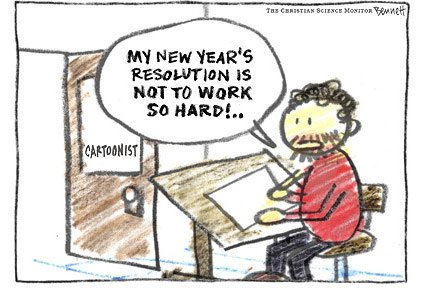
Since all this is, in any case, an illusion (maya), there is one thing that depicts it really well; it is the New Year Resolution. Since, we set the meter to beginning or start again, we are filled with great resolve to reset our Life starting….well, you guessed it…the stroke of midnight. Some of the popular resolutions are:
- I shall lose weight.
- I shall give up smoking/drinking.
- I shall stop worrying.
- I shall be kinder to my parents.
- I shall become leaner and fitter.
- I shall stop lying about small things.
- I shall become more punctual.
The illusion of these resolutions lasts for a few days and then we realise that the year has become as old as everything on earth must and we don’t have to treat it with renewed resolve. We slip back into timelessness!
So, friends, Happy New Year 2011
I resolve that in 2011 I shall write at least fifty percent articles about things that at least fifty percent of the people around me can understand if they find time to read them. For the others who actually rejoice in ‘Ignorance is Bliss’ (which is exactly how God intended it to be):
“Aage bhi jaane na tu,
Peechhe bhi jaane na tu;
Jo bhi hai, bas yehi ik pal hai”
(Future is unknown to you,
Past is not known,
What IS, is only this moment)
Rejoice!