 One of the biggest mistakes that parents sometimes commit is to think that their kids are not old and smart enough to know or understand. This often has some amusing fallouts. A little girl was asking her granny how did her papa arrive on earth. The granny replied that the stork brought him. Then the li’l girl wanted to know how was grandfather born. Once again granny said that the stork brought him. The third time the girl asked how did great grandfather happen to be born. For the third time the granny confirmed that the stork brought him too. A this, the li’l girl, fresh from her class at the school exclaimed,”Granny, are you trying to tell me that for the last three generations in our family there has been no natural reproduction?”
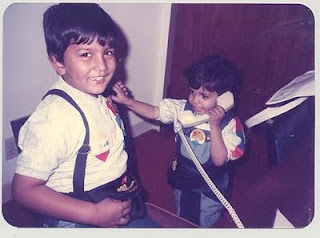
I too have had some amusing incidents with my sons: Arjun and Arun when they were kids. On one of the occasions it was a peaceful scene in the drawing room. Both were making drawings, which I had given them as assignment so that I could watch a cricket ODI on the telly. What should we draw, they had asked. So I had told them to draw a scenery with hills, trees, birds, sun, house and children playing football in front of the house. This I had reckoned would take at least 30 minutes, and I would be able to watch 7 to 8 overs. I was right; it took them about half an hour with all kinds of colour pencils. Finally both came to me to ask what I thought of their drawings. I told them their drawings were good. So far so good. However, there was potential for a sticky  situation when the younger one, Arun – all of four – asked me which one was better. I insisted both were good; he insisted on knowing which one was better. Like all sensible fathers I was not going to fall for this. So I tried explaining it with a metaphor, “Arun, son, you have two legs; can you tell me which one is better?.” Before even the words were out of my mouth he responded, “The right one, of course, because I can kick with it.”
Then there was the time when I tried to impress upon the elder one, Arjun, the pleasure one can get by going for long walks that I used to go for. On our very first walk, we had barely walked two kilometres when Arjun told me that he was tired and could we please turn back? Ah, but naval officers have lot of tact that comes in handy under these circumstances. So, in order to keep him going I engaged him in conversation. I asked him if he knew about something called pleasure-pain? This was a tough one for him at the age of eight. He knew pleasure, he knew pain but what was pleasure-pain? So, I explained to him about long-distance runners. At the end of, say, thirty kilometres of running, when the limbs are fatigued, a substance called Endorphin secretes into the brain and they get a high; intensely pleasurable feeling whilst the limbs are aching. This, I said, was pleasure-pain. I secretly patted myself on the back for motivating him for another few kms at least. We must have gone only a few steps when Arjun stopped and said, “Guess what, pa? I am already getting the pleasure-PAIN.”
 Then there was the time when we had gone on a holiday to my mother’s place in the hills. Arun wanted to go to the market to play video-games (he later became the video gaming champ for India in Need for Speed for seven consecutive years); but, we wanted to keep his mind of it by indefinitely postponing it. One of the surest method of doing it was to tell him, “As your uncle JP next time he calls.” JP, my brother was in the US and used to call once in a fortnight. During those days calls to the US used to cost ninety rupees a minute and it was a big hole in the pocket to call frequently. That same afternoon, after lunch, Arun, all of three, picked the handset of the phone and was having animated conversation with JP. We all knew that it was only a mock conversation because he would be too small to know the ISD code and JP’s number etc, let alone the procedure. After more than ten minutes of conversation suddenly he said, “Ok, JP chacha; now tell my dad to let me go for video games.” I, playing along with him, took the handset from him only to realise that JP was actually on the other hand and that Arun had correctly dialed his number, apparently in the middle of night for JP.
When I was small I used to read Dennis the Menace comics. When Arjun and Arun were small I didn’t have to read any comics. Here is what Arun said as he burst into the house after his playtime, “Mama, I love you…” but then he saw her face in a mudpack nad he added, “…but I also hate you.”
Pleasure-pain, anyone?
MUSINGS IN A NAVY HOSPITAL
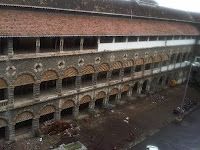
The word hospital, Wikipedia informs us, comes from the Latin hospes, signifying a stranger or foreigner, hence a guest. Another noun derived from this, hospitium came to signify hospitality, that is the relation between guest and shelterer. Hospes is thus the root for the English words host (where the p was dropped for convenience of pronunciation) hospitality, hospice, hostel and hotel.
I was recently admitted in the Navy’s hospital Asvini in Mumbai because of a complicated and potentially dangerous Psoriatic (skin) condition. I record some of my musings as a stranger, foreigner or guest of the Navy.
The first thing that occurs to you in a hospital is that you are now confirmed sick. There is no fig leaf of pretension anymore. A hole in your socks is a mere accident; but, getting it darned is a sure sign of poverty. Similarly, the moment you are admitted you realise that your illness is beyond your own control and the docs have to do the darning. You are a proclaimed patient.
The second thing is that whilst earlier you could do your work simultaneously and attend to your complication, in a hospital, your complication is the only focus of attention for yourself and those around you. You don’t have many options in a hospital; certainly not in Asvini whereat most cellphones don’t even have a network. You are cut off, isolated, and entirely at the mercy of the staff. Fortunately the Navy has the best of the doctors and nursing officers, who are not just completely professional but devoted. Most of them you have grown up with and they are more your warm-hearted friends than specialists at other hospitals who often subject you with cold-blooded detachment.
You are made to feel special and cared for in a Navy hospital much better than you would in a civil hospital. The doctors and the staff actually conduct themselves as hosts giving you the confidence that you are in safe hands. I have compared notes with even cancer patients. All of them have the confidence that nowhere they can get treatment comparable to Navy’s own hospitals.
However, the same can’t be said of the maintenance of the hospital infrastructure by the MES (Military Engineering Service) staff. These worthies often compete with the nation’s worst in inefficiency and corruption; but, the Navy often finds that it doesn’t have any choice. Curiously, with the best that the Navy offers in various aspects, eg, strategic thinking, operational efficiency, naval diplomacy, disaster relief, camaraderie and esprit de corps, it becomes helpless in inefficiently spending crores of rupees in new projects and in maintenance of existing facilities through MES. Everyone knows that it costs nearly thrice as much to get anything done by MES and that MES designs and methods are archaic, but, such is the stranglehold of MES that there is no escape.One of the reasons it lands itself in this mess (MES?) is because of the penchant to do everything itself. For example, the same persons who are operationally engaged (and these days with ever-increasing responsibilities from coastal security, anti-piracy to war, these personnel are hard pressed to even do justice to their primary responsibility) are also made responsible to oversee that works undertaken by corrupt and inefficient MES are executed properly and in accordance with laid down standards. It is the same in the naval hospital Asvini, which was inaugurated only a few years back as one of the finest in Mumbai, but, is already coming apart. The doctors, hard pressed for time with other responsibilities, are also made responsible for overseeing works (which is a highly specialised job) and are often taken for ride by the MES. Please have a look at the pictures of the ward that I was in. What a coincidence that the patient and the room were both getting darned at the same time
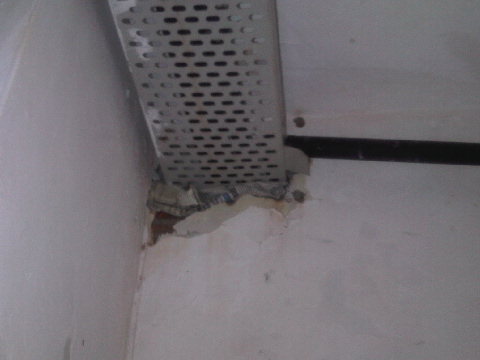


The last two pics are two cupboards on either side of same room. And here is the wonderful view from my window; MES has, like its civil counterpart PWD (Perpetual Works Department) has mastered the art of perpetually engaging itself in meaningless works. They often engage themselves in breaking walls and pavements and banisters and re-building them.


Despite the proven sub-optimal track record of the MES, and naval officers and sailors constantly moaning their indifference and inefficiency, as soon as a naval officer gets promoted to a Flag Officer’s rank he/she suddenly develops tremendous respect for MES. The reasons are not difficult to find. A retired C-in-C once told me that during his tenure, to his dismay, he found that “each of these officers spent an average of Rupees Five Lakhs in doing up their already well maintained houses”. During our visit to one of them the lady of the house proudly took us to the bathroom and fawned over her colour choice of floor and wall tiles. The last occupant, she asserted, had such awful taste in colour.
Talking about bathroom, here is what I found in the toilet of my ward in the hospital:

I think the main reason for being in this mess is because the Navy feels that since it is so efficient in its core areas of responsibility, it has to somehow prove that it is equally efficient in administration, maintenance, catering, house-keeping, logistics and other allied activities. It is high time that we offload these to people (even if civilians) who are good at it. By this if the Navy loses a bit of power and control, it should be acceptable.
Let me just give three examples. The Navy runs shore messes at great cost to itself (if one has to take in the overall cost of infrastructure, training and running costs). All it has to do is to outsource these activities to civilians. It may fear two things whilst doing so: one, the Flag Officers who feel obliged to lavishly entertain civilians and uniformed personnel, will not have similar options as they now have of being large-hearted about such entertainment. Two, the naval tradition of great style, pomp and glory will see a come-down. I think both these are misplaced anxieties. As a corollary, a mall like Big Bazaar, for example, is able to provide more discounts than the Indian Navy Canteen Service and yet make more profit.
The second is the concept of supporting establishment to the headquarters, eg, Indian Naval Ship Angre to Headquarters Western Naval Command. Gone are the days when this establishment used to provide support for pay and clothing of sailors and general administrative support. At present it is expensive to keep it both in terms of manpower and infrastructure. However, we often are stickler to naval tradition (a euphemism for not accepting desirable change) and must keep this stone-ship alive. Most of what Angre does these days can be easily outsourced except perhaps to parade guards of honour to visiting dignitaries. But that doesn’t really warrant a full-fledged establishment.
The third is the Naval Transport Pool. In today’s environment when cabs and particularly radio cabs are freely available, it would be much cheaper (as compared to the overall cost of owning vehicles, looking after their fuel, maintenance and most inefficient drivers and maintenance staff) than providing personnel with “naval transport”. Oh, but the Navy personnel have to move in transports with stars and flags. I am sure an arrangement can be made with the transport hiring agency and they would easily oblige.
In 2009, together with the present Chief of Naval Staff I visited the Naval War College of the US for a Sea Power Symposium in which Chiefs of Navy and Coast Guard of over a hundred countries participated. I was pleasantly surprised to see that despite the Newport, Rhode Island US Naval Base being larger than most of our bases, it didn’t have the equivalent of our Command Mess or for that matter an Officers Mess. All of us were accommodated in a hotel adjacent to the base. All of us were transported to and from the venue of the symposium by buses and there was no unnecessary and misplaced pomp and glory.
Indian Navy is one of the finest institutions of our nation, if not the best. It is fairly quick to assimilate changes, especially in comparison to its sister services (Indian Army and Indian Air Force). It is already making some transition into outsourcing non-critical services. For example, it is common, these days, to see officers stay in starred hotels on temporary duties rather than in the naval messes. However, it is high time that it goes whole hog and gets rid of its flab and white-elephants like the MES and support or depot establishments.
This will enable the Navy to concentrate on its core competencies and further excel at things that it is good at. My being admitted in the Navy Hospital after 17 months of retirement redeemed my faith in the excellence of Navy doctors, near angelic MNS (Military Nursing Staff), and medical assistants. But the state of my ward got me thinking about the baggage that we unnecessarily carry and must rid ourselves of now.
Lets not pride ourselves in having Toilet Paper specially manufactured for the Indian Navy.
ANNA HAZARE AND THE INDIAN DEMOCRACY

I brought it out, a few months earlier, in an article (How Proud Should We Be of Indian Republic at 62?) that despite the dream and objectives of the Indian Constitution, brought into force on 26 Jan 1950, the lot of the common Indian has not changed even 61 years later. The article was based on facts and figures (say, from UN Human Growth Index Report) rather than my perception or anyone’s bias. One of the main reasons that I found responsible for it is that the Indian style of democracy is not representational at all. With the multiplicity of parties and the average percentage of voting pattern in constituencies pan India, an elected representative, on the average, represents only 10 percent of the voters. These 10 percent too do not elect the MPs/MLAs on some issues that would make the lot of the common Indian better. The major issue, in our elections, as seen from the trend of the last two decades, is primarily the denigration of the previous or other party/candidate; so much so that our politicians nowadays talk about the inevitability of anti-incumbency factor as much as, say, the chances, in the bad old days, of one’s contacting cholera whilst traveling through an area hit by the cholera epidemic.
This single factor has made our elected representatives not just immune to the hopes and aspirations of our people but has also made them arrogant. Hence, even though we coined a phrase ‘public servant’ in the Constitution (the term used to describe a person who holds a government position either by election or by appointment), no one holding a government position has ever considered oneself a servant of the public. Both the elected and the appointed public servants have mainly been serving their own interests and those of their families. As far as the public is concerned, the main job these so called servants have ascribed to themselves is to exploit the public either collectively or by polarising it. Sardar Patel’s essay on British Policy had just three words: Divide and Rule. The modern Indian public servant did exactly the same. Elections are fought and appointments in government are made more on issues of caste and creed than on detailed programme and plans to improve the lot of the people.
Wikipedia describes governance (what governments are supposed to do) thus:
“The word governance derives from the Greek verb κυβερνάω [kubernáo] which means to steer and was used for the first time in a metaphorical sense by Plato. It then passed on to Latin and then on to many languages.”
Steer towards what? A government must steer the people and the country towards a better and more secure future. However, because of the self-serving nature of the Indian democracy, our public servants have steered the country towards chaos, poverty, corruption, polarisation and inefficiency.
An Indian electorate, it can be thus argued, does not exercise a choice when he goes to vote. After an average 10 percent elect the government, they are helpless and defeated by those who were to serve them. The result is that as a nation, we are a dismal 141 in the Human Growth Index. However, the elected representative, just like the appointed representative or even more so, often gives vent to the supremacy of the parliament. Recently, if you recall, Kapil Sibal and Manmohan Singh endeavoured to display this arrogance based on the mistaken notion of such supremacy; at least until people’s power, under the leadership of Anna Hazare manifested itself into a sobering effect for the government.

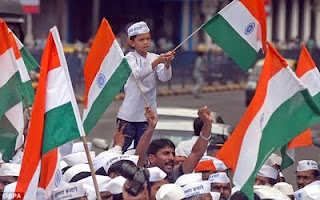
Team Anna has, directly or indirectly, conveyed to us that the momentum of the movement has now encompassed (or at least aimed at) much more than Jan Lokpal Bill, wherein the government and the so called civil-society differ over six points and not merely the inclusion of the PM and the judiciary in the ambit of the bill. People’s expectations, as manifested in the large crowds and rallies across India, have risen to the point of hope for 1.2 billion Indians, good governance, and a responsive democracy rather than only in numbers. To that extent each one of us should welcome the movement and await its strengthening, as opposed to its abatement that the politicians seek. I am not going to extol the good points and good fall-outs of the movement. By and large, the media has done it extensively.
I am, therefore, going to concentrate on the pitfalls and other considerations of the movement vis a vis the Indian democracy. I feel that if these are not taken into consideration, we may again have our hopes and aspirations belied despite the passing of the Jan Lokpal Bill.
The first and foremost is that it even though it may not have been originally intended, it has degenerated into a we versus they movement. The government’s mishandling of the response to the movement, Anna’s arrest etc, made it even more so. The movement is, therefore, seen as a expression of our contempt towards the elected representatives particularly the ‘corrupt‘ and the ‘inefficient‘ UPA government. Whilst all this is totally justified, it has the potential to change the focus of the movement into a narrower objective of tasting victory by bringing the politicians to heel. The media has even started keeping a score sheet such as Anna – 1, Govt – 0.
The other reason why the movement must steer clear of we vs they is that people at large (and not just the politicians) must share the blame for the rot or loss of character of Indians. Indians are, by nature, opportunists. From our driving habits of being just a few feet ahead of the next vehicle by hook or by crook, to getting ahead in business, school, college, debates, contests, and indeed life by taking short-cuts has come to be seen as a national character. Of course, the politician, or the bureaucrat, or the businessman is a crook but he/she does not stand apart unlike as portrayed in the movement. He is of the same stock as we are (We Are Like That Only). We have to do many a thing ourselves whilst asking this of him/her. We too have to show equal discipline in our individual and social lives.
The second is that our middle-class, the main pillar of the movement, has become quite impatient. It is true that we have been conditioned to it. But, the catch here is that in its impatience it may very well regard some quick wins (as passing of Jan Lokpal Bill) as the ultimate solution to set right our democracy. I laboured over the current shortfalls in Indian democracy to bring home the point that, at best, the movement and the passing of Jan Lokpal Bill can be only the beginning and not an end by itself.
The third is potential for polarisation. One reason why we have been exploited by the netas, babus and the like is because we can be easily exploited. The government after failing to peter out the movement by disdain, high handedness, and by labeling Team Anna as corrupt itself, will surely stoop to polarising it on lines of religion, caste and creed. We Indians are easy prey to such tactics.
 |
| Pic Courtesy Mail Today |
The fourth is the rights of the minority. The movement must not get bloated in the belief that surging crowds, mobocracy and rights of the majority are all that matters. Indeed, once of the shortcomings of our current interpretation of democracy is the contorted belief that the rule by the majority is always right. We must be able to listen to that small voice of reasoning even when we are riding high on the wave of public support. In this, it may do us good to remember that the movement is primarily that of middle class and the majority is still the poor.
Lastly, the need to strengthen democracy. Civil disobedience cannot be the dharma of the Indian people, a cure or remedy for all ailments of democracy. We have to finally make our institutions stronger and then respect them.
I, like all other members of middle class, am breathless and excited abour Anna movement. I do wish it strength. But, at the same time I pray that it would steer clear of pitfalls as enumerated above and give serious thought to the considerations of this article.
Jai Hind
SLEEP AND I – LOVERS ONCE STRANGERS NOW
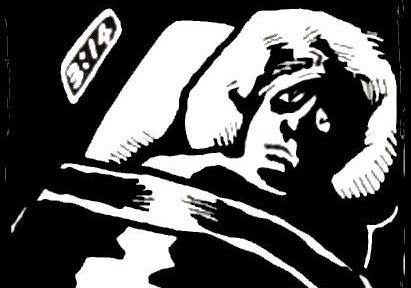
Last night, with body full of Psoriatic lesions, as I tossed around in my bed, waiting for (what I thought to be) my beloved Sleep to come to me, take me in her arms, and give me the much-needed relief from pain and itchiness, I found that – what has become common now – Sleep had abandoned me. Like a jilted lover I have now decided to make my affair with Sleep public so that the readers can decide what went wrong. I can’t keep it under wraps anymore. Here are the two mails that were exchanged between me and her. You be the judge.
I am still calling you ‘Dear’ because of the priceless memories of the past. You had, in the past, proved to be a reliable partner, a friend I could turn to in joys and sorrows, a beloved who gave me long hours of happiness, and many a times, ecstasy. I don’t mind admitting that there were moments when I didn’t want to leave the coziness of your arms and face the world. You had given me enough evidence that you cared for me.
I wistfully remember many memorable moments spent with you in the privacy of my bedroom when you caressed me and I reciprocated with eagerness and defiance of the world. There were times, during my boyhood, when I had to attend to a lot of things: school work, reading newspapers etc that my dad insisted on, writing mails and so on. But, such was the urgency of your demands that I capitulated to your charms. My only demand was that you would keep it private and clandestine. I didn’t want the world to know that I dreamt of you in my spare time.
But, did you keep it under wraps? No, slowly and surely, you were hell-bent to let the whole world know about our love or affair. There were times when it was most embarrassing to have you around.
I recount just a few of these whilst waiting for you to come to me tonight. Do you remember the time when the Maths teacher in the class was telling us the most interesting algebraic equation, in which the mystery of an unknown figure called ‘x’ was unfolding? I should have been agog, like others, for the denouement. But, no, at that precise moment you came to me. “Shh” I told you, “Go away, love; everyone can see you. It has been just three hours when I was your slave. I promise you tonight we shall be together again.” But, it had no effect on you. You were determined to have me again. Looking back, I think that you were an obsessive beloved, deriving loads of happiness to see me cringe in public. Do you remember, dear Sleep, what the Maths teacher did to me in finding you with me? I denied it, but, he could see my love for you in my eyes. I was publicly rebuked.
Now that I am at it, how can I forgot the night before the matriculation History exam. There were battles, places, dates and personalities to be remembered. You knew the urgency; didn’t you? Because more often than not in the classes you had kept me from remembering the incidents of the Battles of Panipat and Quit India movement. The night before the exam was my only time to prove to the world that I cared for Indian and World History. I begged you to leave me alone. But did you do that? No, darling, once again – as always – you considered the demands of our love more important than my paying attention to Mughal Zahir ud-Din Muhammad Babu or Dadabhai Naoroji or Wilson Woodrow. The whole night you played with me and I nearly failed in the exam. You were so selfish about our love, so engrossed in it that you didn’t give a damn.
You continued demonstrating your overwhelming power over me even after I became a man. I wanted the world to take notice of the fact that I too was an intellectual, caring as much for art movies, as a lot of knowing people around me did. So, I went to see a Shyam Benegal movie; a sure shot way to be counted amongst the cerebral lot. In order to distinguish his movies from commercial ones, he had (probably no choice, but) to make the dialogues in the movie even slower than that of – many years later I discovered – Prime Minister Vajpayee’s. For example:
A: Gaanv gaye the? (Did you go to the village?)
B (after an eternity): Gaya tha. (Yes, I went)
A: Kya dekha? (what did you see?)
B (after much thinking): Kuchh bhi nahin. (Nothing)
A (looking at B hard): Kuchh bhi nahin? (Nothing?)
B (confirming): Kuch bhi nahin.
I am sure if I had looked around I would have seen the arty audience at the edge of their seats with the gripping dialogue. But, nay, I couldn’t see any of them because long before you had claimed me. I had paid all of Rupees 40 (at that time a princely sum) to sit in the Dress Circle. Later, in order to rub shoulders with some of my learned friends I had nothing to add to the conversation about the merits of the movie. Thanks to you, dear, my money and time had been wasted.
Even after I joined the Navy, your penchant about being seen with me in public got me into serious trouble. I remember the time when the Gunnery Instructor was telling the class about the intricacies of 40/60 Bofors (much before the company was made infamous by RG and the clan) Anti-aircraft guns, you decided to visit me. I had hell to pay. Gunnery Instructors are unlike Algebra teachers. They don’t punish you by making you stand at the back of the class. Up rifle and going around the parade ground five times in heavy drill boots is for them the mildest chiding. Many of them are probably employed in places like Guantanamo; but, that’s another story. And, dear Sleep, you rejoiced.
Whenever I have essayed to point out your thoughtlessness in getting me into deep trouble you have gleefully told me that I am the only lover you have who complains. You have tried to show me down by rubbing into me about parliamentarians (in more important positions than I am in) who have slept through the complete sessions of, say, Women’s Reservation Bill. Recently you have told me about a certain Qasab and his cronies coming to us in Mumbai all the way from our neighbour Pakistan and how all those involved in giving them a grand reception were closeted with you. You also told me that when trillions of our nation’s public money was being siphoned off to foreign locales, how the government and those whose duty it was to stop this illegal outflow just frolicked with you.
All this is very fine, Sleep, but why is so much time to be given to you when you are not true to anyone? Do you visit A Raja in Tihar Jail, for example? No, he probably tosses around in his bed (even the air-conditioning has been removed now) waiting for you.
Are you a friend or a beloved only in your lovers’ good-times? I would think so. They told me that awaiting your promised arrival all I have to do is to count sheep. Last night I reached the figure of 210,114 and yet you didn’t come.
What’s your excuse?
Yours truly,
Sunbyanyname
I received the following reply in the wee hours of the morning.
Dear Sunbyanyname,
I pity you. I pity your name. You are the kind of lover who ‘uses‘ a beloved when you want. The problem with you is that you always want to be in control; you always wanted me in the Master to Mistress relationship: asking me to come to you when you felt like and trying to shoo me away when you’d had your fun. So, dear Sunbyanyname, you can’t have it both ways. I detest clandestine affairs. I want you to want me, love me and respect me all the time, and in front of everyone.
You have given me a number of incidents that have embarrassed you in public. Let me tell you how many times you have let me down. In comparison my other lovers have desired me more and kept me with them in full public view without any shame. Take for example, councillors of BMC (Brihanmumbai Municipal Corporation). They did not hide their affair with me even when people were and are complaining about perpetually pot holed roads in Mumbai. There are Ministers I am in love with who were never ashamed to be with me when complete forests vanished and people encroached on public property. There is a favourite Prime Minister of mine who opted to be with me when such important decisions were to be taken and implemented as CWG, 2G and many other Gs.
And don’t give me A Raja bullshit. I am with him always. Don’t believe the media who always scandalise my affairs with such important people. By the way, who do you think you are? I have had an abiding affair with President Obama too for which the results are just coming out.
You complain now. But, to tell you the truth, I am fed up of your double standards. You want to cuddle me only in the privacy of your bedroom, as if I am some highly paid call girl. But, otherwise, you don’t want to have anything to do with me publicly.
I hate you. Many others in India and abroad are better than you. Go about tossing in the bed now. I am not coming. I too have moved on.
Yours fed-up-with-you,
Sleep
DEMENTIA – IS IT AN INDIAN NATIONAL DISEASE?
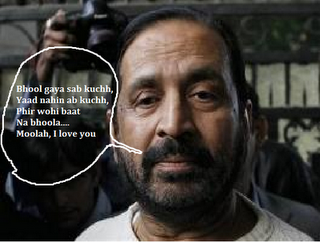
So, other than common National Anthem (Jana Gana Mana..), National Currency (Rupee), National Bird (Peacock), National Animal (Lion), what are the other things that can be bestowed with the ‘National’ status?
 |
| Suresh Kalmadi singing his own version of famous ‘Julie’ song |
 Morarji Desai and Atal Behari Vajpayee. The State of Emergency was imposed on people not because we were attacked or at war (we decisively won the 1971 war against Pakistan, liberating one half of Pakistan and calling it Bangladesh); but, because a political leader was being unseated. Such is the reaction of “the most efficient PM of the country” in case she is being unseated by the power of the court of justice. She was not the only one who had scant regard for the judicial process. Most of our Netas even when convicted by the court disdainfully assert that they would rather go to “Janta ki Adalat” (People’s Court). They are absolutely certain that people of India, like they themselves, have contrived severe Dementia; and they actually have, as Indira Gandhi’s case would prove. Read on.

Problem solving? You know as much as me how many problems of the people we have sorted out since independence. Forgetting language? Well, you should see our Netasin the Parliament or State Assembly. The only cognitive skill that they retain is that not a single one has forgotten that our ancestors were monkeys.
- A few years back in a bar in Delhi a bar girl named Jessica was shot dead by a man in front of 350 people. All of them suffered from Dementia as soon as the investigations began.
- A few years back when CBI raided the residence of our Communications Minister and found suitcases full of currency notes, the Minister did not remember who and why anyone left these in his residence.
- Indira Gandhi dead was as dangerous as Indira Gandhi alive. On 31 Oct 1984, when she was assassinated by her own security guard, a pogrom of Sikhs took place in the national capital. More than 3000 innocent Sikhs were massacred. Her elder son Rajiv Gandhi, who succeeded her as the Prime Minister (dynastic rule is the most enduring policy of the Congress), justified this carnage by saying, “When a big tree falls the earth shakes”. The collective Dementia thereafter not only resulted in no conviction but two incidents described how acute is this disease amongst Indians. First, the Sikhs themselves presented shropas (a scarf of honour) to those accused of directly instigating the mobs to kill the Sikhs. Two, after a number of years when a similar pogrom (this time against Muslims) took place in the state of Gujarat, the Congress completely forgot that they themselves had participated in a similar and more heinous one in the national capital.
- Many political parties, both at the Centre and at the States levels, routinely have alliance with those against whom they had started various enquiries of corruption and complicity. They forget.
- Our External Affairs Minister at the UN didn’t know that he was reading the speech of Portugal until well over five minutes of the speech was read out.
- India’s erstwhile PM, Atal Behari Vajpayee, couldn’t remember what he was saying at the beginning of a sentence even as he came to the end. Even people listening to him often forgot what he had embarked on.
- Our countrymen have the sharpest intelligence to demand for their rights. But, suddenly, by the end of the financial year, a large percentage of them forget to file Income Tax Returns.
- Most politicians whilst evaluating their assets, which they are required to do by the law, often forget to add a few hundred crores.
- One of our airlines pilots, last year, did the country proud by sleeping through and forgot to land at Mumbai and continued undisturbed for another 500 kms to Goa.
Therefore, Indian Health Ministry and World Health Organisation have probably got it wrong when they bring out facts about India having the larget cases in the world of Malaria and Tuberculosis. These are nothing in comparison to cases of Dementia.
Should we not do something about it, if we care and remember, that is?
ANNE’ NA RAHO (DON’T REMAIN BLIND) (POEM IN PUNJABI)
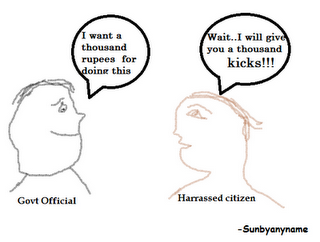

Main kehan laga, “Tussin anne ho saare.”
Per aise badmashan nu ate moorkhan nu,
Kyun vote dinde ho tussi baar baar?”
Eh bojh thuanu ate mainu hai saihna.
Je iddan hi asin anne bane rahe,
Te ik Anna Hazare ne ki hai ker laina?”
Saare leadran de bulb karo fuse,
Rishwat mangan waale no khol ke maro chhittar,
Ta ke corruption da reh na jaaye excuse.”
Uthe bhrisht leader aape hi honge nange.
So agli baar us nu kadi daana na payo,
Jehda karamchari underhand paise mange.”
JAI HIND
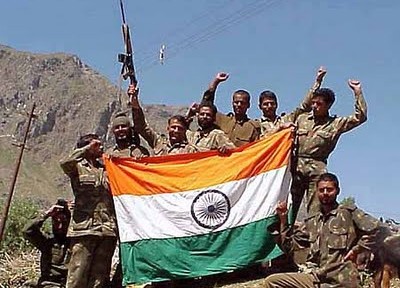
Reproduction of a poem I wrote in May 1999 when Pakistan perpetrated the most heinous infiltration into Kargil, the Indian side of Line of Control (LOC):
जाना है तुमको आज इक फ़र्ज़ निभाने की खातिर,
इस देश की मिटटी का क़र्ज़ चुकाने की खातिर,
उठो ए जवानो सर पे बाँध लो कफ़न,
शहीदों में अपना नाम दर्ज़ कराने की खातिर I
दुश्मन ने इक बार है फिर तुम्हे ललकारा,
दोस्ती के नाम पे है फिर तमाचा मारा,
क्या भूल गया वो इक मुसलमान शायर का कहना:
सारे जहाँ से अच्छा है हिन्दोस्तान हमारा I
विजय हो तुम्हारी ये देश की है कामना,
करना वीरता से तुम दुश्मनों का सामना,
उठो ए जवानो सर पे बांध लो कफ़न,
सारा जहाँ करेगा तुम्हारी वीरता की सराहना I
इस देश के लिए मिट जायेंगे मर जायेंगे हम,
इक इंच भी अपनी ज़मीन का होने न देंगे कम,
सुनो नवाज़, सुनो मुशर्रफ, सुनो ए सरताज,
सीने यहाँ फौलाद के और बाज़ुयों में है दम I
अब कभी इस तरफ न डालो नज़रें बुरी,
इक तरफ लाहौर यात्रा, और बगल में हो छुरी,
इस बार छोड़ देंगे अपने पे काबू करके,
अगली बार LOC पार न करने की, शायद न हो मजबूरी I
जय हिन्द हमारा नारा है, हिन्द हमारी शान है,
खून का हर तिप्का हिन्द के लिए कुर्बान है,
तुमने सोये शेर को जगा डाला है मूर्ख,
दुश्मन, अब तू चन्द दिनों का मेहमान है I

Jaana hai tumko aaj ik farz nibhane ki khatir,
Is desh ki mitti ka karz chukaane ki khatir,
Utho ai jawaano sar pe bandh lo kafan,
Shahidon mein apna naam darz karane ki khatir.
Dushman ne ik baar, phir tumhen lalkara,
Dosti ke naam pe hai phir tamacha maara,
Kya bhool gaya vo ik musalmaan kavi ka kehna:
“Saare jahan se achha hindostan hamaara”?
Vijay ho tumhaari ye desh ki hai kaamna,
Karna veerta se tum dushmano ka saamna,
Dekho bach ke paaye na ab yeh ghuspathiye,
Saara jahan karega tumhari veerta ki sarahana.
Is desh ke liye mit jaayenge mar jayenge hum,
Ik inch bhi apni zameen ka hone na denge kum,
Suno Nawaz, suno Musharraf, suno ai Sartaz,
Seene yahan faulad ke aur baazuyon mein hai dum.
Ab kabhi is taraf na daalo nazrein buri,
Ik taraf Lahore Yaatra, aur bagal mein ho chhuri,
Is baar chhod denge apne pe kaabu karke,
Agli baar LOC paar na karne ki, shayad na ho majboori.
Jai Hind hamaara naara hai, Hind hamaari shaan hai,
Khoon ka her tipka Hind ke liye qurbaan hai,
Tumne soye sher ko jaga daala hai moorkh,
Dushman, ab tu chand dino ka mehmaan hai.

IF ONLY

Sometimes I feel life is blasé
An alluring mirage that I chase.
Sounds of fun and laughter are
Like gunshots
Piercing through my heart.
Sometimes I feel I lost you long ago
You were near and yet so far;
Knowing that I needed you
But imagining that I’d live without you.
“Let me, then, throw another dart.”
The last time, our last time, when we talked,
I found you far, very far.
I wanted this, I wanted that,
I wanted nothing;
And you had nothing to give me, on your part.
I could hear many voices,
I could see many sneering faces,
And you sitting with them,
Laughing and chatting,
Your cunning perfected to an art.
If only….
If only, I could sit with you
And talk to you
And look into your eyes
And find me there.
As the only one in your heart.
If only…
If only, I could die.
And mingle with the breeze
And touch you anywhere, anytime;
And caress you within and without
Without seeing you apart.

If only….
They’d destroy the world,
Leaving just the two of us alive.
If only, God Himself would command
You and I
To be a new world’s start.
ADMIRAL AND MANTRI JI
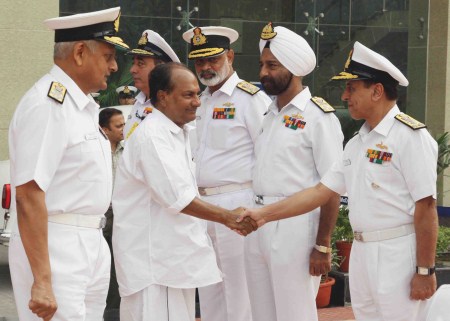
Now that our Raksha Mantri (Defence Minister), Shri AK Antony, has, like all politicians before him and probably after him, shown aversion to talk to his service chiefs we need to examine why is it so. Even our bureaucrats are used to putting the uniformed personnel in their place. We have reached a situation in our country when the collective neglect, indifference and aversion of the government, administration and police towards the armed forces has made this honourable profession one of the least attractive of all professions in India for the youth of the country. One would think that the countrymen, at large, would hold the armed forces personnel, resplendent in their uniforms, in awe and esteem. Yes they do. But, eligible men don’t want to join the forces and eligible women don’t want to marry faujis. When I was in the school, there was a popular Punjabi song whose words were: “O, fauji nu bayaah de babula, chaahe boot sanhe lat maare.” (O Father, I want to get married to a soldier even if he kicks me with his boots). In contrast, a decade back, a survey done amongst eligible brides showed that they ranked armed forces personnel as the tenth choice for marriage.
It is really not understandable because Indian Armed Forces rank amongst the finest in the world in achievements, training, caliber and efficiency of their personnel. In comparison, the Indian politicians, bureaucrats and police personnel, who might just have begun from the same stock in schools and villages, are ranked amongst the worst in the world. And yet, an Indian Police Officer, for example, reaches the rank of a DIG in about 12 to 14 years of service but his armed forces equivalent requires twice as much service.
Could it be that in India that is increasingly become materialistic and dumbed down, money, power and status, together with stability of posting near one’s home place, are considered more important than honour and dignity that comes with having a President’s Commission? Also, since the levels of commitment, rectitude and training in the armed forces viz-a-viz their civilian counterparts are extremely high, the latter feel that the former and their impractical fauji ways should be kept at several arms’ lengths.
The awe is obvious when civilians – used to their environment of filth, chaos, casual dresses and chalta hai (couldn’t care less) attitude – are suddenly exposed to order, discipline, efficiency, shining uniforms and professionalism of the armed forces.
A Raksha Mantri, many years ago, was visiting the Indian Flagship Vikrant (an aircraft carrier; now a museum ship). After the forenoon’s intense flying operations, as he came to the wardroom for drinks and lunch, he had the Master Chief Petty Officer Steward, looking smart in his tunic and pants (worn for the ceremonial occasion) serving him small-eats from a tray. The RM looked at the MCPO Steward and decided that he must be a very senior officer (most of them have no idea of ranks in the armed forces, let alone in the Navy). So he took the tray from the nonplussed MCPO and offered to him the delicacies in return by saying, “Pehle aap” (You first). The senior sailor nearly died of mortification.
I am also reminded of two boys who grew up in the same town and studied in the same school. The politician’s son hated the other who wanted to join the navy. Their hatred and aversion continued till well after they finished their schooling.


Many years later, the politician’s son had himself become a politician of some fame – nay notoriety; whereas, the other had become an Admiral. One day the Netaji (politician) or Mantriji (Minister) saw the Admiral, resplendent in his uniform in the lobby of a hotel. Mantriji recognised the latter straightway when the latter wasn’t looking and with the power that came with his post, wanted to show down the Admiral. So he called him thus, “Bell boy, please get me a taxi.”
The Admiral turned around and confronted his boyhood bête noire, saw the shabby attire and the belly that many Indian politicians have, which looked like that of a pregnant lady, and responded, “Certainly ma’am; but, in your condition should you be traveling?”
WHY READ WHEN YOU CAN ‘LIKE’?

God, do me a great favour
Offering to you I will hike,
Let people read the stuff I put up,
And not just press the ‘Like’.
Also, God, this is straight from heart,
With no offences meant,
Why don’t you goad them on sometimes,
To press the button called ‘Comment’?
There are others who don’t even ‘Like’ God,
So, those who do are better;
But, whilst I like their spirit God,
I also want to see their letter.
If we are not careful, God,
We’ll soon reach a time,
When people will press buttons at random,
With no real reason or rhyme.
So, let everyone who likes this post,
Tell us his own valued point;
So that rather than being one-sided,
This effort will be joint.
Who knows, while doing so,
We may actually discover the gold;
That is hidden somewhere in the heart,
But is patiently waiting to be told?
Lets have one day of the week,
When we shall actually share our thought,
And simply not press the button ‘Like’,
And hope to convey all we’ve got.
TERRORIST AT HOME

Terrorists, it is said, are people like us; human beings with similar interests in school and college and office and everywhere; and in everything. Indeed, if you have looked at the profiles of some of them; their neighbours, relatives and friends have been surprised that such and such turned out to be a terrorist. The earlier revelation, with immense scandalising potential, was if someone had to tell us that Mr. Saxena (name withheld for obvious reasons), who sang songs about the virtues of his wife and who carried a glad-eye for females in our colony, was actually gay. Homosexuality doesn’t scandalise us anymore. Nowadays, we are half preparing to be confronted with the revelation of someone or the other in our colony or known to us turning out to be a terrorist.
It could be the guy who spends a lot of time on facebook. It could be the one who contributed the maximum to your colony’s Ganesha idol. Yet again, it could be the one who likes Pakistani singer Hadiqa Kiyani better than Lata Mangeshkar. Or, could it be the guy who is always helping women and old people in the building, especially when the lifts are not working? It could be the boy from two blocks away who repaired your computer for free; they are known to be tech savvy, ain’t they?
Would the terrorist’s immediate family know that he is one? If he is married, would his wife know? I remember this one from Hagar the Horrible comic strip:
Hagar: I am off to invade England. Rough and lonely seas, strange shores, and immense glory and wealth await me.
Helga: On your way out, will you take the garbage to the bin please?
Likewise, would the terrorist’s wife have average marital interests whilst our man is reading ‘Ten Easy Ways to Make Bombs’ in bed? “Darling, you are always reading something or the other in bed. Now switch off the lights and come into my arms.” And our fellow feels irritated because he has just come to the fascinating part where the red wire has to make contact with the blue one from the small alarm clock. “You go to sleep” he pleads, “I am studying for an exam. I don’t want to fail.”

Fail at what, Mr. Terrorist? At blowing the daylights out of innocent men, women and children; just like your wife and kids. But he doesn’t let these thoughts make him weak. He is doing a job just like everyone else; the paanwaala making paans, the Best driver driving his bus, or the coolie carrying someone’s load to make a living.
She has not given up yet; no woman does. She continues undettered: “Darling, when will we go and see ‘Zindagi Na Milegi Dobara’ (A movie: ‘You Can’t Live Your Life Again’) . Sarita and her husband have already gone and seen and they say it is a good one.
Mr. Terrorist has come to the point in the book when the explosion is more or less assured, extinguishing many lives. He is about to tell her irritatingly, “Of course we shall go to see the movie as soon as I have finished killing dozens of people in Zaveri bazaar. Their Zindagi (Lives) will never be dobara (Again). Why do you always interrupt me only when I am planning something big?” But; at the last minute replaces it with, “Don’t worry, we shall go and see it after I have finished with the current assignment.”
Does she suspect him? Does she know what he is up to?
Her next utterance is reassuring, “Salma broke her chappal strap today. Will you have it repaired tomorrow?”
“Oh, for heavens’ sake, woman”, he nearly blurts out, “Here I am about to make a bomb and you are worried about your daughter’s broken chappal strap.”
She didn’t expect a reply to the last one. She knew the answer. Finally she only would have to get it repaired just like she did with Aslam’s satchel. ‘Why can’t the husbands take interest in anything other than their Office Work, she muses.
“Darling”, she asks next (she hasn’t finished with the questioning that he finds tougher than what his apprehended friends were subjected to by the Police, “Where are you going tomorrow?”
“Zaveri Bazaar”, he says involuntarily.
“Ah then” she says, “Since you are going there in any case, how about getting me a diamond ring that you had promised me two years back?”
“Woman”, he says, “Will you please shut up and let me read this interesting book. It is really a bomb”.
She is about to give up when a really bright idea occurs to her. This would be just perfect. They deserve a break. The last time they took a holiday was many years back when they went to Nainital. But, of course, that was before they shifted to Mumbai.
“Hey, I have an idea”, she coos in his ear, “Aslam and Salma are going to have term break. Why don’t we go and spend sometime at Matheran? It will be great fun, pony rides, hills, fog and gentle rain…”
“Shut up”, he tells her mentally, “If all goes well, our next holiday will be in Murree.”
CHINA – IMPRESSIONS OF MY VISIT
To most Indians China is a quaint country. One hears of it, admires its culture and food but does not routinely plan to visit it. It is only recently that we have had a renewed interest in China, thanks to a series of postures and events culminating in the efficiently conducted Beijing Olympics; and later Expo at Shanghai. China fills us with emotions ranging from awe to anxiety. Last year we concluded the Commonwealth Games and sobriety about our oft repeated comparison with this emerging superpower would have hit us like a wet towel.
 |
| Our reception at Pudong Airport, Shanghai |
 |
| Commander Shanghai Naval Base RAdm Xu Weibing hosting banquet fro u |
We had a grand reception at the airport. Suddenly, we were told that Commander Shanghai Naval Base, RAdm Xu Weibing, would be our chief host in place of the Deputy Commander as had been planned
 |
| Breathtaking Acrobatics |
 earlier. The next evening we had a visit to the Shanghai Naval Base where we were received by the Base Commander himself. During the banquet dinner, as he sat next to me and I thanked him for looking after us so well, he said he had received a call from Admiral Shengli and the latter had told him to spare no efforts to make our visit successful, fruitful and comfortable. At one time, before leaving for China, we were worried whether the naval delegation would be welcome there. But, once there, thanks to the Admiral, even the ladies were looked after in a grand manner. We visited the Pearl Tower, the main tourist attraction at Shanghai. In a public place we were received by a reception party accompanied by a military band. In the evening, we were told that the Admiral had gifted tickets for the world famous Shanghai Acrobatics show for all of us. And what a show it was. For nearly two hours we sat spellbound as we watched the acrobats perform their miraculous acts in a continuous flow of music and performances.
 |
|
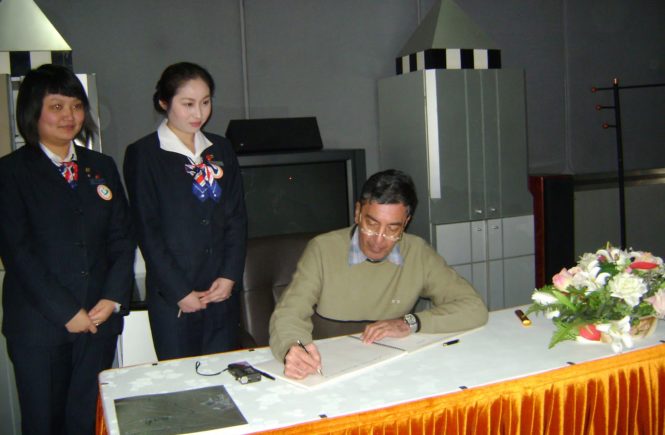
| Signing Visitors’ Book at Shanghai Expo |
The city was spotlessly clean and extremely presentable. It must rank amongst some of the world’s great cities such as New York and Sydney. There were no slums anywhere and the traffic ran smoothly. Young men and women moved around as freely as in any western country. We saw all the sites for Expo 2010 to be held from May to Oct 10. And yet, all the centres and infrastructure were ready good five months before the Expo. There was a sense of pride in the Shanghai people to put their best foot forward. Most of them said that the Expo would be to Shanghai what Olympics were to Beijing.
 |
| Brocade Museum – Nanjing |
Our next city visit was to Nanjing. Rear Admiral Li Zhouming, Commandant, Naval Command College, was our host there. I had received the Commandant in my capacity as Director Maritime Warfare Centre, Mumbai, in Feb 05. He remembered that and also said that Admiral Shengli had phoned him to make our visit successful. In addition to official interactions we visited the Nanjing Massacre Museum showcasing the Japanese atrocities; and the Nanjing Brocade Museum.
 |
| PLA (N) Hqs at Beijing |
At Beijing, thanks once again to the personal instructions of Admiral Shengli, we interacted with a high level delegation comprising the Chief of Staff, General Staff, PLAN Headquarters, VAdm Su Shi Liang, and his entire team of senior staff including the Deputy Chief of Staff, RAdm Liuo Shining.
 |
| The fare at ther Duck restaurant |
A visit to the Great Wall of China and to a Chinese Duck restaurant were thrown in at Beijing. Even though the weather is reputed to be bad during January, in keeping with the warmth we had generated, wherever we went it was nice and sunny. I was relatively junior in hierarchy but I was treated with a protocol befitting an Admiral; complete with police pilot escorts wherever we went.
 |
| At the Great Wall of China |
We hear a lot about Chinese incursions in the Indian Ocean; their doggedness in what they call their private lake, that is, the South China Sea, string of pearls theory and refusal to let LtGen BS Jaswal, Northern Army Commander, visit China on a planned visit. But, we of the CNW, for those seven days in January last year completely forgot about the Dragon and were as much home there as we would be, say, in Mauritius. Naval diplomacy worked and worked well. There was no great wall between us.
SAILORS WILL BE SAILORS
Okay, guys and gals, I am back again. As you probably know, ‘Leave’ in the Navy is called ‘Leave’, whereas short leave ashore is called ‘Liberty’. Unlike the Army, which has a lot of manpower, ships don’t have much to man all Action Posts and, at the same time, send people on Leave. From the time I joined the Navy in 1973 until I left last year, ‘Leave’ was always restricted. This is in sharp contrast to our Army brethren who not only get full Annual Leave but also Casual Leave, Study Leave etc.
Therefore, various kinds of excuses are often devised to somehow get leave or extension of leave.
I was on duty as an Officer of the Day (OOD) on board a ship in Cochin (the spellings had not yet been changed to Kochi) harbour. ‘Liberty’ is permitted for Senior Sailors until thirty minutes past midnight and for Junior Sailors until midnight. It is the job of the Duty Chief Petty Officer to report to the OOD at forty-five minutes past midnight that all Libertymen have returned aboard safely. The OOD in turns makes a report, only if there is default, to the Executive Officer (XO, the second in command). On that particular night, I was hovering around the gangway when the Duty Chief came to report to me that all Libertymen were correct except for Leading Signalman Pillai.
I was furious and being a young and enthusiastic Subaltern Lieutenant that I was I thought of waiting at the gangway itself so that I could give Pillai a good dressing down as soon as he’d step on board. Fifteen minutes went by and there was no sign of Pillai getting back, drunk or otherwise. I had already built up to the harangue that I would give him. Another fifteen minutes went by and now steam had already started coming out of my ears. Still no sign of the errant boy.
It was getting late; but I reckoned if I had waited this long, I might as well wait a little longer to participate actively in the fireworks on his arrival.
At about 1:40 AM when I had tough time in keeping awake, the gangway phone rang (there were no cell phones during those days). The quartermaster picked up the receiver, listened for a while, nodded his head, and then handed the receiver to me.
There was a feminine voice at the other end whose opening query was to ask me if I was the Odd Man. Calmly I confirmed that I was the OOD. Next she wanted to know if Pillai was from my ship. I expected the worst; what if Pillai had met with an accident? She said I and the ship should be proud of Pillai. Once again I confirmed to her that yes indeed we were and he was to get his just reward (at least seven days of No. 11 punishment, that is, extra work and drill for an hour each in the morning and evening; but that I didn’t tell her).
Next she enquired if Pillai was ever let off from the ship without completing his assigned task. I confirmed to her that such an eventuality never took place. Now, she switched to her sexiest tone and said that if I was so proud of Pillai, then how was it that I wanted him to return on board without completing his task….with her?
The Navy trains you well but nothing in my naval training had prepared me well to answer that query.
 |
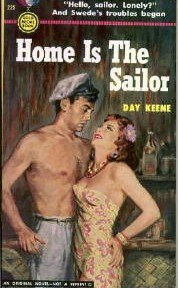
| Pic courtesy: Stinkbrown.org |
I believe one of my superiors on another ship did well to answer a similar query. A telegram was received on board, “Request extension ten days; wife not satisfied.” This officer had the good humour to send response, “Extension granted until wife satisfied.”
Another telegram received on board for a sailor read: “Mother serious; come home immediately for Diwali.”
Then there is this one that was told to me:
A sailor returned late from Liberty and was produced in front of the OOD as a defaulter. The OOD asked him to tell what went wrong. The sailor explained that he had gone home only to find that his wife was having a bath.
“So?” boomed the OOD.
“So, sir, I opened the door a little and saw her” replied the sailor.
“And naturally you got aroused. But that shouldn’t have taken you all of six hours” blasted the OOD again.
And the sailor replied, “That’s correct Sir, but, it took me that much time to dry my uniform.”
WHY ARE WE RAPED AGAIN?
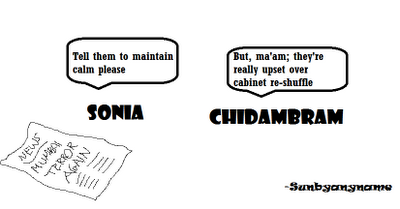
What exactly is a rape? It is essentially an act of force and violence perpetrated against a weak being who has no choice but to submit. It causes great trauma and changes the victim’s behaviour, hopes, anxieties, responses, beliefs, suspicions, complexes, proclivities, and emotions forever.
The keyword above is ‘weak‘. The carnage and trauma caused by repeated rape of Indians, through acts of terrorism, doesn’t fill us with resolve to never to allow such acts to be perpetrated against our people again. In contrast, each act of terrorism makes us weaker and impotent.
I think the reasons and the solutions (intrinsic with each reason) are multi-fold:
1. To start with there is a complete failure of our type of democracy that elects governments that not only do not protect the lives of their people (their primary responsibility) but are increasingly out of sync with the hopes and aspirations of people. I brought out the cause of the malaise in an article in this blog: ‘How Proud Should We Be of Indian Republic at 62?’
2. Secondly, terrorist acts come under ‘law and order’, that is, a states subject. However, much of it is in the purview of the central government, especially when it is Pak sponsored. In case of Pakistan, as with most other things, we don’t appear to have a clear policy except for one point agenda (given to us by the US) of somehow to continue with talks.
3. Thirdly, from a politico-military point of view, Pakistan appears to be exercising Deterrence against us (through irrationality and Nuclear Weapons Enabled Terrorism) but we have willfully let go of our Deterrence despite our considerable superiority in conventional war means and potential. For a deterrence to work, we should be ready to demonstrate it sometimes (at least through signalling an intent); whereas, our national and military think-tanks routinely convey to Pakistan that we have lost the battle even before it begins. We are not averse to using our Army against our own people. But, against Pakistan, anyone who moots the idea is promptly labelled as a hawk (implying loony).
4. Fourthly, the primary security force here is Police. Over a period of time, Police has willy-nilly conveyed and demonstrated that they are there to discipline us through various ways (from bribes to lathi-charge). Protecting lives of citizens is not very high priority.
5. Fifthly, let us put the blame squarely on the media, which has not matured enough. The kind of coverage it gives of a terror incident is like playing into the hands of the terrorists. Did anyone see gruesome pics of terror victims in, say, London terror blasts? Our media’s main focus of coverage is that. The terrorist causes half the panic. The other half is caused by the media. The media also goes overboard in projecting the ineptness of the security agencies as if the enemy actually is the security agencies.
6. Lastly, lets not forget all of us. When peace prevails, we resist any measures by security agencies that would bring some order in our lives. For heavens sake, lets not forget that our people even oppose wearing of helmets on two-wheelers being “imposed” on them.
Therefore, when we get a statement from the PM, on visiting Mumbai, “I share Mumbaikars’ pain and anger”; we know that what he means is that he has shared this many times in the past, and will share many times in the future too.
LIKE

A similar thing has happened in India with the words ‘Scam’, ‘Adarsh’, ‘Incumbency’, ‘Plot’, ‘Loot’, ‘BHK’ ‘Budget’, ‘Bollywood’ etc. Irrespective of the language being used, such words creep in the discussions and everyone understands their meaning and context.
One recent word made famous by ‘Facebook’ is ‘Like‘. Millions of people now ‘Like‘ things – photos, comments, news, events, people, songs, videos more than they ever did in their lives. Let us say there is a news item that reads: ‘India’s national capital Delhi is the most unsafe for teen girls’. You don’t want to record your comments; no, not as yet. So you press the ‘Like‘ button mechanically. Now, if someone were to ask you if you really like teen girls being unsafe in Delhi, it would fill you with surprise. You look for various explanations to defend your ‘reflex‘ action. “Oh, that? I pressed ‘Like‘ to record my appreciation of the plight of these girls being ‘finally’ highlighted.”

Now that the word ‘Like‘ has become so commonplace, lets reflect on what all does it denote. Here are some translations:
- I truly appreciate the item.
- I don’t have time to read it fully or record a comment.
- I couldn’t care less one way or the other.
- ‘Like’ a hole in the head.
- I have read your comment.
- I am bookmarking this item to read at leisure.
- Stop it NOW or else.
- Okay, I have ‘Liked’ it, what now?
- Does it really matter?
- I am ‘Liking’ it but don’t get me involved in it, for heavens sake.
- I expect you too to ‘Like‘ when I put up something.
- There was no other choice and so I pressed ‘Like‘.
If you ever ask people to explain what they have ‘Liked‘, my guess is that a considerable percentage of them wouldn’t have even read the article or gone through the pictures or video. They would be like the boss asking the secretary to give him a list of people that he calls by their first-names.
Life has, therefore, becomes easier for all us who press ‘Like‘ and get it over with. How nice and convenient it would be if Life would actually become like that? What all meanings we would be able to convey to people if we were to use the facebook ‘Like‘ in real life? Here are some examples:
- We really ‘Like‘ your visiting us on a sunday afternoon. (No, no, it is so boring to have our siesta on the only day of the week we can)
- I ‘Like‘ the beautiful dress that you are wearing. (You picked it up from the roadside didn’t you?)
- We ‘Like‘ your children having got 95 percent marks in matriculation. (Doesn’t look like they have any other interersts; in any case, these days the more you cheat, the more you get rewarded)
- We ‘Like‘ the three hundred seventy eight pictures of your son’s graduation ceremony. (Come to our house sometime and let us return the honour)
- We ‘Like‘ your invitation for a lecture on ‘Breeding Habits of the Common Fly’.
- You are ready to jail corrupt Indian politicians? We ‘Like‘ it. (As long as they are from the opposition)
- Actress A, B, or C bares all? I ‘Like‘ it. (In private, I can’t tell you what would I do with her nude picture)
- India declares another holiday to commemorate another national leader? We (really) ‘Like‘ it.
- Pakistan refused aid by US after yet another evidence of the former’s involvement in terror plot? We ‘Like‘ it. (However, very soon Pakis would find other means of siphoning aid)
One of my friends, on facebook, is the most ‘Like able’ guy. There is nothing that he hasn’t ‘Liked‘ from Priyanka Chopra to CBMs between India and Pakistan. There are times, however, when I actually want him to read or see something. Any suggestions how should I go about it?

Enjoy this blog? Please spread the word :)







 Set Youtube Channel ID