HIPPOCRATIC OATH AND THE MODERN INDIAN DOCTOR

Following is taken from Wikipedia:
The Hippocratic Oath is an oath historically taken by doctors and other healthcare professionals swearing to practice medicine ethically. It is widely believed to have been written by Hippocrates, often regarded as the father of western medicine, or by one of his students.
A widely used modern version of the traditional oath was penned in 1964 by Dr. Louis Lasagna, former Principal of the Sackler School of Graduate Biomedical Sciences and Academic Dean of the School of Medicine at Tufts University:
I swear to fulfill, to the best of my ability and judgment, this covenant:
I will respect the hard-won scientific gains of those physicians in whose steps I walk, and gladly share such knowledge as is mine with those who are to follow.
I will apply, for the benefit of the sick, all measures [that] are required, avoiding those twin traps of overtreatment and therapeutic nihilism.
I will remember that there is art to medicine as well as science, and that warmth, sympathy, and understanding may outweigh the surgeon’s knife or the chemist’s drug.
I will not be ashamed to say “I know not,” nor will I fail to call in my colleagues when the skills of another are needed for a patient’s recovery.
I will respect the privacy of my patients, for their problems are not disclosed to me that the world may know. Most especially must I tread with care in matters of life and death. If it is given to me to save a life, all thanks. But it may also be within my power to take a life; this awesome responsibility must be faced with great humbleness and awareness of my own frailty. Above all, I must not play at God.
I will remember that I do not treat a fever chart, a cancerous growth, but a sick human being, whose illness may affect the person’s family and economic stability. My responsibility includes these related problems, if I am to care adequately for the sick.
I will prevent disease whenever I can, for prevention is preferable to cure.
I will remember that I remain a member of society, with special obligations to all my fellow human beings, those sound of mind and body as well as the infirm.
If I do not violate this oath, may I enjoy life and art, respected while I live and remembered with affection thereafter. May I always act so as to preserve the finest traditions of my calling and may I long experience the joy of healing those who seek my help.
The most significant ommission from the original is:

In every house where I come I will enter only for the good of my patients, keeping myself far from all intentional ill-doing and all seduction and especially from the pleasures of love with women or with men, be they free or slaves.

There is, therefore, nothing in the modern version of Hippocrates Oath to directly remind the modern doctor that all seductions (of money and sex, for example) are to be avoided. There is, however, a pointer towards his social responsibility.
 Lets consider a few things, which were in the news recently:
  • The first one is that the doctors specify to patients from where to get medicines so that they would get a commission from the chemists.
  • The doctors ask a series of expensive tests to be done such as MRI, CT, blood tests and others by specifying where or in which lab these are to be done because they receive their cut from these labs.
  • Mumbai administration had to remind an elite hospital that the land for making the hospital was given to the hospital on subsidised rates on the understanding that at least 25 percent of the patients being treated in the hospital would be poor; however, the hospital had been turning away all poor patients.
  • After completing MBBS the doctors are required to serve in the rural areas. However, a large percentage of them circumvent this provision by hook or by crook.
Lets also take into consideration the exorbitant fees that some of the doctors charge. If, after all this, you reach the conclusion that medicine or being a doctor is now big business, you may not be far from the truth. There are many reasons for this:
  • It was in the news recently that to obtain a Post Graduation seat in a medical college in Navi Mumbai a candidate had to dish out Rupees 1.4 Crores.
  • Many of the medical insttritutions are either owned by the powerful like the politicians or they have substantial representation in the board of directors of the institutions either directly or through their kith and kin.
  • Most payments to the doctors are made in cash. Indeed, even the labs insist on cash payment so that no trace of payments can be made. Hence, in the Income Tax returns most doctors and chemists and labs show only a miniscule percentage of their actual earnings. It is so easy to insist on cheque payments but then even the patients or their relatives don’t insist on it lest the doctors should spoil their cases in anger. It is, afterall, many a times, matter of life and death.
  • As with the lawyers, the doctors often get away with this arrangement since everyone wants to keep the doctors on their right side. These include the authorities responsible for keeping tabs on their illegal earnings.

We have a situation now, for the first time after independence, whence Anna Hazare’s movement has given hope to the people of the country. Should we not try to break this vicious cycle of doctors spending astronomical sums of money to obtain their degrees and then fleecing the patients to recover such monies?


CHALLENGES OF SECURING INDIA’S ENERGY NEEDS

We are moving through very interesting times as far as India’s Energy scene is concerned. In the last few years, after the Indian economy was unshackled from some of the restraints (the period called ‘economic liberalization’), our spectacular GDP growth has been globally noticed. To fuel this fast growing economy, India needs to secure its Energy needs, both indigenously and through imports. The most exciting of the indigenous discoveries have been offshore. 

To keep pace with India’s growing energy needs, the government in 1997 came up with NELP (New Exploration Licensing Policy). For over four decades after independence, offshore exploration was dependent upon nomination by GoI mainly to ONGC. In the pre NELP period (from 1990 to 1996), India had just 28 offshore blocks with 29 oil fields. However, NELP saw a sudden surge in Offshore Development Area (ODA). From 12 companies engaged in the year 2000, India now has some 82 companies engaged in E&P (Exploration and Production). Licenses have been given for 263 blocks, with 200 blocks being operational, and 10 under production. With NELP IX, blocks will move as far away as Andamans and Mumbai Deepwater. 

The Directorate General of Hydrocarbons (DGH) was established in 1993 under the administrative control of Ministry of Petroleum & Natural Gas through a Government of India Resolution. Objectives of DGH are to promote sound management of the oil and natural gas resources having a balanced regard for environment, safety, technological and economic aspects of the petroleum activity. The latest DGH data shows that India’s offshore production now accounts for 2,16,000 BPD of oil and 65 MMSCMD of Natural Gas. These account for 28% and 48% respectively of India’s total indigenous production. So, therein lies the importance of offshore E&P. At a glance, the data for 2010-11 shows:


Crude Oil
MMT
Natural Gas
MMSCMD
Domestic Demand
141.8
82.1
Production
37.6
52.2
Self Sufficiency
26%
63%
 Mind boggling? Well, not really unless you think of the next 20 years. Today, US oil consumption is 1/4th of the world consumption. India’s is only 3% and China’s 8%. India’s oil consumption growth in 2006-07 was around 3.5%, much lower than that of China. India today is the fifth largest consumer of energy in the world, but accounting for 3.7 per cent of the world’s consumption. Per Capita primary energy consumption is still fairly low in the country (520 kilograms of oil equivalent, which is less than a third of the world average), with large disparities in the energy consumption pattern.
To sustain its slated GDP growth, its total primary energy demand is expected to almost double by 2030. Its primary commercial energy consumption in 2004 stood at 375.8mtoe (million tones of energy equivalent) and involved coal, oil, gas, and electricity generated from nuclear, hydroelectric, and renewable sources.  India’s commercial energy consumption is expected to more than double to 812mtoe in 2030.India’s indigenous production is unlikely to keep pace with the growing consumption and it is estimated that by 2030 India would be importing 87% of its demand. This, coupled with the increasing share of offshore production in overall indigenous production would stipulate that almost the entire Energy scene would shift to sea; that is import or offshore production.Together with this come challenges of securing India’s Energy needs. Protection of SLOCs is already well-known. However, with the Somali pirates moving away from Somalia and increasingly coming closer to India’s West coast, the task of securing these SLOCs, even in peace time, is becoming more trying. The Indian Navy has had some success in the last two years against the pirates. It has promulgated BMP (Best Management Practices) if vessels are confronted with pirates. However, as is probably natural, our countrymen remember the so-called failures more than the successes. This is even more so since the IN is also responsible for Coastal Security. So, in the last two months, the media and nation went to town demanding reasons for Navy’s failure to detect drifting MV Wisdom and MV Pavit that finally ran aground off Mumbai.


We have a VATMS (Vessel and Air Traffic Management (or Monitoring) System for the ODA in the West. Efforts are in hand to have one for ever-increasing assets on the Eastern seaboard. However, the fact that the Navy cannot be everywhere to protect these growing assets throws newer challenges in cooperative security. These are multifold for Indian seaboards since despite 26/11 and urgent need for the same, our fishing activity is still unregulated. Who knows that in the garb of fishermen we may have the terrorists deliberately trying to do damage to the offshore assets? We have to become more serious about both coastal security and security of offshore assets. The Somali pirates have, off late, reached our western coast, at least. We have to quickly have an effective security scheme in place, lest we should be surprised again. The sooner we start being serious about it the better it is for us. For the last two years, for example, we have read newspaper reports of 23 fast patrol boats to be acquired by ONGC for manning by Navy personnel for patrolling the ODA. It is understood that these are still more than a year away to become reality.

ANYTHING FOR FOOTWEAR

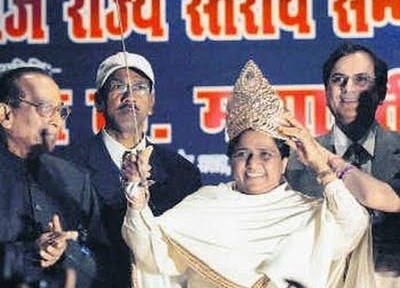
We, in India, from ancient times till now, hold footwear in great awe and respect. I don’t know about earlier times, but, from the time of Lord Rama, sandals are regarded as good as the king himself, the ruler, the monarch. Bharat, in the absence of Lord Rama, ruled Ayodhya through the latter’s sandals.Seen in this light one cannot understand the brouhaha about Mayawati sending an aeroplane to fetch her sandals. Looked at it in a certain way, it is just an expression of her desire to usher in Ram-rajya in her state Uttar Pradesh.

Mayawati’s genuine desire to quickly get at her sandals goes well with her dalit image honed perfectly by putting the symbol of poverty and frugality, the elephant, all over the state. This, in a way, can be described a Gandhian way of doing things; if you recall that it used to cost a lot allowing Gandhi to travel with the common man in the third class in the trains.

Mayawati – bringing in Ram-rajya. Pic Courtesy: India Daily

Afterall, if Mayawati was not giving out a lesson in frugality she would have shown scant respect for fellow Indians by going the Imelda Marcos way and have a number of planes fetch a number of her sandals; if the readers care to remember Imelda and her husband when they fled Philippines didn’t wait for their countrymen to shower their footwear in rememberance of a job well done as President and Mrs President, but, merely took a few hundred of her own whilst fleeing. Likewise, Mayawati won’t be too sure if the populace of UP would like to part with their footwear to show respect for her rule. So, her attachment to her own sandals can be excused. Lets also be thankful that she has merely fetched sandals and not hurled it on anyone, which is also becoming quite common. But, she won’t stoop so low.

Talking about Presidents, how can we forget His Excellency, Giani Zail Singh, the hon’ble President of India? His claim that if Smt Indira Gandhi wanted him to sweep the floor, he would do so happily. Each one of our dignitaries, from the President to Parliamentarians to Chief Ministaers to MLAs (Members of Legislative Assemblies) have brought great dignity to their posts by such acts as Zail Singh Ji’s, by hurling footwear and other removable things at one another, and by offering and accepting underhand cash for what they are supposed to do. So possessive they are about the lofty reputation they have built up, that when a commoner like Anna Hazare and his team, do the unthinkable of getting people on their side, they instantly talk about dignity and supremacy of parliament.

In the end we have to consider who is more important, a Foreign Minister of a failed state like Pakistan, Hine Rabbani Khar (who spends a huge sum of money on her Birkin bag) or a Chief Minister of India’s largest state, Mayawati. A pair of sandals is actually a useful item; whereas a bag is just a fashion statement.

By requisitioning a plane to get her sandals Mayawati is also signalling that we Indians take tradition more seriously than wasting planes to be used as missiles against unfriendly nations. It is such an innocent act that we don’t have to start a GWOF (Global War on Footwear).

NO PIPE DREAMS

[lineate]

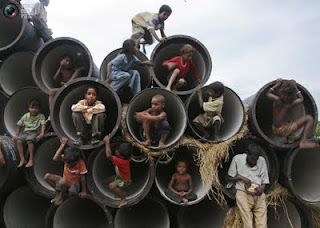
No, corruption doesn’t affect me,
I am happy and satisfied,
To live in my world that I own,
Where I’ve smiled and cried.

[/lineate]

[lineate]

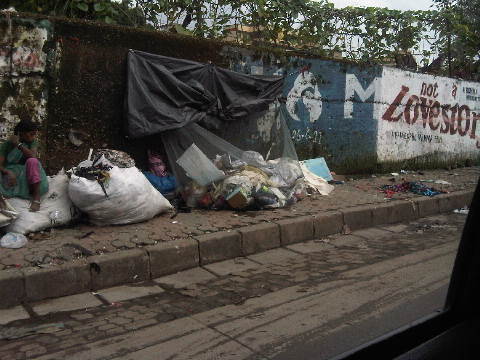
‘I don’t have to worry about netas,
Nor for the babus I care,
They can’t fleece me anymore,
As I lie in my home half bare.

[/lineate]

[lineate]

The election promises are fairy tales,
We don’t believe in what they say and do,
My grandfather used to live here,
My grandchildren will live here too.

[/lineate]

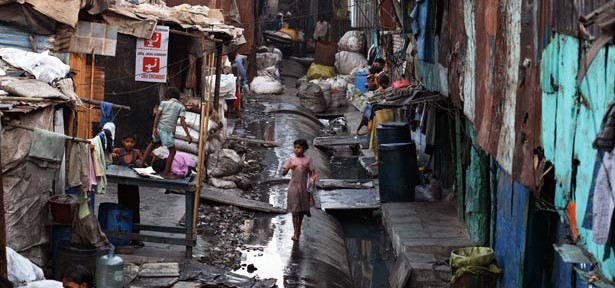
Pic Courtesy: Totally Cool Pix

[lineate]

I don’t dream of the year 2050,
When we shall be world’s biggest power,
Or the year when they will finally think of us,
No, Sir, we here live by the hour.

[/lineate]

[lineate]

All people are born equal,
So does our religion tell us,
But, we can’t be the ones they talk about,
So why simply should we make big fuss?

[/lineate]

[lineate]

Only, next time you sit in your home,
And curse the gods for your bad lot,
Just think of us in our homes here,
And be thankful for what you’ve got

[/lineate]

[lineate]

When you crib about insipid food,
And not having anything good on telly,
Just give a thought to how we live,
And sleep mostly on empty belly.

[/lineate]

IS AMERICA THE PERFECT WORLD THAT WE IMAGINE?

India is 141st in the world in Human Development Index; it is 135th most dangerous nation out of 153; Mumbai is 116th in world big cities in livability. However, whenever we have to compare ourselves we don’t stop at any other nation but compare ourselves straight with America. It is not just with the media or the intelligentia. You go to the remotest village in the country and the commonest of the men would tell you, “Yahan jo ho raha hai vo umreeka main nahin hota. Traffic bade niyam se chalta hai vahan.”(What happens here does not happen in America. Traffic has to follow certain rules there)If you now ask this person when did he last go to America; the chances are that he has never been there. Ask him next if he has any friends or relatives there? Once again you are likely to draw a blank. It is just that he imagines everything will be well in the “best country in the world – America“.

I am reminded of this yokel who returned to his village after extensive “world tour”. He was showing off about how he spent a week in umreeka, a week in London, a week in Germany, a week in Hongkong, a week in Paris and so on. The others just stared at him until one of them who had studied in primary school commented, “Bahut achhe. Aapka geography ka knowledge to bahut improve ho gaya hoga.” (Very good; your knowledge of geoagraphy must have improved a lot). The yokel’s immediate response was, “Ek hafta vahan bhi rahe” (Stayed for one week there (in geography) too).

The armed forces, politicians, bureaucrats, industrialists, actors, actresses and other film people, music people, scientists, teachers and academicians; virtually each and everyone has America as an ideal. We denigrate America in public life; in and out of parliament. However, whenever a neta has an illness the first country that he/she runs to for treatment is America.

We fondly draw comparisons between the US and India; how we are natural allies: world’s largest democracy hobnobbing with the most functional one. “And by the way, theirs is as messy politics as ours“, we say proudly.

In public life we take a person or institution to task for sharing any secrets with America. But, as in the case of David Coleman Headley’s case, we privately share secrets and hope like hell it won’t be public because of such nuisances as Wikileaks (who have even given names of politicians belonging to both ruling party and opposition having large accounts in Swiss and German banks; but that is another story).

One country that we want America to sort out for us is our half-brother Pakistan. We imagine they have the power as they did during Kargil War. Once again, we do not want America to intervene. However, we expect it to sort out nuisances around us without intervening.

The only thing that we don’t want America to sort out is the mess that we have made of our own country: in corruption, governance, city planning, traffic (that kills more people in a year than most wars around the world), intelligence, human rights, police reforms etc because these would be interfering inthe “internal matters” of the country. That America gives support to Su Kyi in Myanmar, and dissidents in China, is lauded by us. But, we are a democracy; we have every right to quell dissidence by invoking “supremacy of parliament.” Obama ji, please keep clear of our domestic matters. These are the only things that give us a sense of power.

Our NRIs in America have a similar love-hate relationship towards US of A. Whilst in America, they extol the goodness of Indian way of life; however, should they decide to take a trip (the annual one to meet relatives) to India, they show off how backward India and Indians are to America and Americans.

The relationship, then, trudges along like this; blowing hot in private, blowing cold in public. Irrespective of what they do in AfPak region; when an American in authoritative position, during visit to our great nation, dances with the village women in Rajasthan, close to Delhi, all is forgiven and forgotten.

Yeh dosti hum nahin chhodenge…..”

MY YOUNG DAYS OF WATCHING MOVIES IN SOUTH BOMBAY

I joined the Indian Navy in 1973 and in 1975 I was a commissioned officer. I have many happy memories of the first few years of my career in the Navy that were spent in South Bombay. I was never into politics but it is my belief that internecine and dirty politics had not spoiled Bombay at that time. Bombay Police, for example, used to be compared with Scotland Yard in efficiency and reputation. In the services club, when we used to discuss such hair-raising incidents as advent of rogues and killers like Billa and Ranga in Delhi, we used to speak with great deal of satisfaction that such incidents won’t happen in Bombay due to the pro-active approach of Bombay Police.

How safe South Bombay was can be made out from the fact that it was a common sight to see young girls watch late night shows (though South Mumbai movies had to finish by 12:30 AM by local law) by themselves and then walk back home.

South Bombay prided itself in having the finest of the theatres patronised by decent crowds; the type who would be aware as well as well mannered: Regal and Strand in Colaba, Eros at Church Gate, Metro at Dhobi Talao, New Empire, Liberty and Sterling and later New Excelsior near Flora Fountain. There was Akaashvaani near LIC Building and one could watch good repertoire of movies there devoted to a theme. For example, I saw many of Raj Kapoor movies there during a fortnight devoted to his movies.

And what were the movies of those young days? In 1974, still an Acting Sub Lieutenant, I saw  The Towering Inferno in Eros. It was a done thing during those days to read the book and then see the movie. The movie ran in Eros for over a year. During the first few months it was impossible to obtain tickets in current booking. My uncle, my dad’s eldest brother, Tej Bhan Singh, had arrived from New York with his American wife, Betty aunty, and two daughters Kiran and Maninder. Kiran and Maninder had missed seeing the Inferno in New York and requested uncle if I could take them to see the movie. They hadn’t reckoned, though, that we couldn’t just walk in to see a movie in South Bombay without prior reservation. Anyway, uncle came to our rescue. He just walked to the Booking Counter where a large sign said ‘House Full’, and addressed the Booking Clerk thus, “Sir, would it be possible to get three tickets in the Dress Circle for my daughters and nephew?” There must have been something in my uncle’s personna because the Booking Clerk dished out three tickets. It was actually House Full and he put three moulded plastic chairs for us in the Dress Circle.

A scene from Towering Inferno
We were on the edge of our seats watching rescue operations

And what a movie it was; starring Steve McQueen, Paul Newman, William Holding and Faye Dunaway. We were at the edge of our seats with the excitement caused. The movie won three Oscars but left to us we would have given it many more. Hollywood was really very good at making disaster movies. Many years later when they made The Titanic and it was appreciated for its technical excellence, I was not surprised at all.

The Poseidon Adventure, a rescue from a ship that scuttled after meeting with cyclone at sea was another great experience. I saw it in Sterling. I hadn’t read the book before seeing the movie starring Gene Hackman, Ernest Borgnine, Shelley Winters, and Red Buttons. Once again the sitting on edge quality was the hallmark of the movie.

A tense scene from The Poseidon Adventure

One movie that really changed my life was One Flew Over the Cuckoo’s Nest. Jack Nicholson got the Oscar for it. Louise Fletcher played Rached and did it so well that I instantly hated her. The movie was so powerful that you didn’t walk out the same person from the hall. I saw it in Regal. The last scene where the supposedly loony Red Indian uproots the wash-basin in the hospital so as to throw it at the window and escape (and thus the name of the movie) is so intense that you had your hair standing on ends. You were silently willing him to do it. I would rank the movie amongst the best that I have seen. I read Ken Kesey’s book many years later.

By far the best movie that I ever saw: One Flew Over the Cuckoo’s Nest
She did her role to perfection and you felt like strangling her alive.

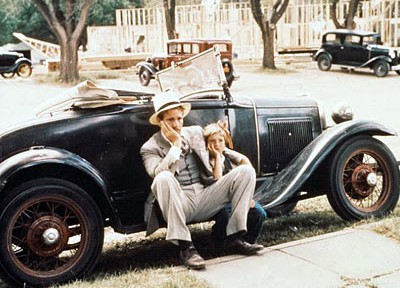
It wasn’t all disasters and hateful stuff all the while. Paper Moon was a gentle movie that I saw in New Empire. The movie was based on the novel Addie Pray and starred the father and daughter pair of Ryan O’Neal and Tatum O’Neal. Tatum, as Addie Loggins was born to a prostitute. It was rumoured that Ryan as Moze Pray was the actual father of Addie since he had had an affair with her mother. Ryan, however, was a conman and was determined to deny it. The last scene of them driving off together as father and daughter was touching.

Ryan and Tatum O’Neil in Paper Moon

Talking about conman, how can I forget The Sting that, once again, I saw in New Empire. Both Paul Newman and Robert Redford were there and the suave manner in which Sting was conducted would be probably in the same league as Count Victor Lustig who sold off the Eiffel Tower.

Superb acting by Paul Newman and Robert Redford in The Sting

Surprisingly neither Paul Newman nor Robert Redford got the Oscar for their acting in the movie.

I can go on and on since it was such great pleasure seeing movies at that time. However, let me just bring out two more before I go on to tell about some of the Hindi movies that I saw. Both these movies are important to me. Fiddler On The Roof was one of the greatest musicals that I saw, in Sterling theatre. The movie was an adaptation by Norman Jewison of a 1964 Broadway play about a Jewish family living in Tsarist Russia. The movie had an unforgettable role by Topol as head of the family with five daughters. As a poor Jewish father he had the task of finding the daughters their matches. The movie had most memorable songs such as Matchmaker, If I Were a Rich Man, Sunset Sunset, Do You Love Me?, To Life, and Far From the Home.

Topol with his wife and five daughters in Fiddler on the Roof

The other movie is really very dear to me: Chariots of Fire, story of two English track atheletes, one a devout Jew and the other a proud Christian. This was the first movie I saw with my newly wedded wife in Bombay. We had married in a mandir in 1981, prior to my parents according their permission almost two years later. As she joined me in a one room (bedroom, dining room, kitchen, and sitting room all-in-one) flat in Naval Coastal Battery Worli, I had bought a cutlery set, a few utensils, a fridge, bucket and mug, gas stove etc on instalments. Even in such indigence we went to see this movie. The movie won four Oscars.

A scene from 1981 movie Chariots of Fire

Let me now turn to some of the Hindi movies seen by me in South Bombay. South Bombay had the distinction, at that time, of not screening the run of the mill Hindi movies about rich daughter of smuggler in love with poor but upright hero; some of these financed by the smuggler Haji Mastan at that time. It would show Hindi movies with a difference. By far the most powerful of the lot was Garam Hawa (Hot Winds), a 1975 movie that I saw in Regal. The film, directed by MS Sathyu, dealt with the plight of a North Indian Muslim family in the years after partition of India in 1947. Balraj Sahni as shoemaker Salim Mirza, the head of the family, came up with a most memorable performance of his career. As one by one, Muslims left for Pakistan, Salim’s daughter found that her betrothed Farooq Sheikh (having migrated to Pakistan) couldn’t marry her since he had found someone else in Pakistan. She then turned her attention to Jalal Agha. Nothing was decided between them until they went to Fatehpur Sikri where a most poignant scene was enacted. Jalal Agha as Shamshad told her (Geeta Siddharth as Amina) about the Emperor Shahjehan entrusting the Queen Mumtaz with two pigeons whilst he’d be away for a short while. When he retured he found that she had only one pigeon in her hand. A little annoyed he asked her, “What happened?” And she says, “It flew”. He asked, “How did it fly?” and Mumtaz released the other one saying, “Like this.” However, since the story was already known to Amina, she held Shamshad’s hand half way by saying, “I won’t let the second one fly.” In the end Shamshad is arrested and she commits suicide by cutting her vein.

Balraj Sahni in the role of his lifetime in Garam Hawa

Once again in Regal Theatre I saw a great movie called Shatranj Ke Khiladi (the Chess Players). The movie directed by Satyajit Ray and based on Munshi Premchand’s short story by the same name, had a super cast of Amjad Khan as Wajid Ali Khan, Richard Attenborough as General Outram, Sanjeev Kumar as Mirza Sajjad Ali, Syed Jaffrey as Mir Roshan Ali, Shabana Azmi as Nafisa, Mirza’s wife, Farida Jalal as Mir’s wife and Farooq Shaikh as Aqueel. Mir and Mirza get so obsessed with the game of chess that they negelct their wives. There is a famous scene in the movie when Shabana starts having an affair with Farooq but Sanjeev insists, “Hum aaj kal bahut door ki sochte hain kiyunki hum shatranj khelte hain” (We look far into the future because we play chess). Because of such far-sightedness, they continue to play chess when the British marched their forces to take over Awadh.

Sanjeev Kumar and Syed Jaffrey in Sahtranj Ke Khiladi

Another movie that I saw during those days was a Vinod Khanna starrer Achanak (Suddenly) directed by Gulzar. Vinod Khanna as Manjor Ranjeet Khanna was to face gallows for having killed his wife Lily Chakravarty and her lover Kamaldeep who were having an affair when Vinod Khanna was away fighting for his country. When Vinod Khanna, running from the police, is finally caught, he is heavily wounded. Dr Chaudhary played by Om Shivpuri is entrusted with the task of reviving him so that he could face gallows in good health. An excellent movie with ironies galore.

How can I ever forget another one directed by Gulzar called Aandhi (Tempest) that I saw in Metro? The movie starred Suchitra Sen supposedly as Prime Minister Indira Gandhi and Sanjeev Kumar as a hotelier with whom Suchitra Sen had a love affair but with her engagement in politics it was not expedient to carry on. The movie had three excellent songs penned by Gulzar and music composed by RD Burman: Tere bina zindagi se koi shikva to nahin, Is mod se jaate hain, and Tum aa gaye ho noor aa gaya hai.

Suchitra Sen and Sanjeev Kumar in Aandhi

Once again, I can probably go on and on. However, let me end this by saying how an actor came on the scene like a breath of fresh air and during those days we were floord by the light heartedness of those movies. Yes, I am talking about Amol Palekar in Chotti Si Baat and Rajnigandha. During those days, heroes and heroines like Rajesh Khanna (I saw quite a few of them in Liberty, eg Ajnabee with Zeenat Aman), Dharmendra and Amitabh Bachchan (Sholay), Rekha (Umraao Jaan), Hema Malini (Sholay) were so larger than life that small timers like Amol Palekar and Vidya Sinha didn’y stand a chance in making a box-office hit. But such was Basu Chatterjee’s direction, Amol Palekar’s effortless acting, and Salil Choudhury’s lilting music of such popular songs such as Jaane man jaane man tere do nayan, Na jaane kyun hota hai yeh zindagi ke saath (title song), and Yeh din kya aaye; that the movie was a super-hit.

Amol Palkar in Chhoti Si Baat – breath of fresh air

Chhoti Si Baat was the second movie of that genre. Basu Chatterjee had earlier made Rajnigandha with the same cast and music by Salil Choudhury. It received the Critics Award in 1975, the year of my commissioning in the Navy. It too had two memorable songs: Rajnigandha phool tumhaare, and Kai baar youn hi dekha hai.

I live in Kharghar now, far from South Bombay; it is not even Bombay anymore. Every now and then I get overwhelmed with nostalgia of that era when I was young, when life was uncomplicated, when seeing a movie was such indescribable fun that it would create timeless memories. I feel like singing Gulzar’s exquisitely written lyrics for a 1975 song for the movie Mausam starring Sanjeeev Kumar and Sharmila Tagore:

“Dil Dhoondta hai phir vahi furasat ke raat din,
Baithe rahe tasavvur-e-jaanaan kiye hue”
(The heart once again yearns for those leisurely days and nights
When we could just sit back leisurely, and let our imagination wander)

OUT OF THE BOX THINKING?

This is the dilemma the armed forces face. In a uniformed service we choose to promote the uniformity of training, response, actions; in short everything. It is a virtual cloning. DSSC tells you that even letters have to be written a particular way: “I have the honour to state that we are not getting anywhere” etc. Then, suddenly, at a particular rank and seniority, we hope that some would still have some innovative grey matter left, and would be able to think out-of-the-box. The only solution is to separate the occasions that require uniformity from those that can be done in various ways, right from the beginning; say, if someone writes a Letter of Procedings like a blog we will not call him to task and use the “standard” armed forces response: “What s__t have you written?”The entire thing arises from our sense of insecurity that if ‘One Flew Over the Cuckoo’s Nest’, it would be end of discipline in the armed forces; “For heavens sake, today, if we allow him do things differently, tomorrow there will be nothing left of our culture, traditions, and heritage.”

Think about a simple thing like ‘contact with foreign nationals’. Have we amended the Navy Order knowing that every time you go on Internet you are in contact with foreign nationals? Or AC cars for Commodores and above only; knowing that these days, even if a Ag SubLt wants to buy a car, there is hardly any choice but to buy an AC car.

Are armed forces resistant to change but at the same time expect that its people would think out-of-the-box?


“Ah, but there is ample scope for innovativeness even in the strait-jacketed atmosphere of a hierarchical structure. Some officers really turn out to be innovative” is the oft heard refrain of some senior officers. The answer is, “Sir, we don’t want a handful to become innovative. We want a larger percentage to be thinking out-of-the-box. And, in any case, Sir, those who turn out to be innovative do so not because of the system but despite the system.”

We don’t want out-of-box thinking as an accident or aberration. We want it as a norm. For this not only that we have to start thinking of it at fairly early stages (formative years) of officers careers; but, also send signals that it would be rewarded just as, if because of it, we land up into failure, we shall not do witch hunting.

HOW CORRUPT OR HONEST ARE WE?

Suddenly, due to Anna Hazare’s movement, the subject of Corruption is everywhere. The focus or the target is still the Powerful and the Rich. It has been taken for granted that all of us are upright; but, like the good, sati-savitri, bathed in milk, Hindi movie heroine who is forced into prostitution by the cruel samaaj (society), we are somehow forced into giving bribes. Hence, we’d make ourselves believe that giving bribe has never been our first convenient choice but the last recalcitrant one.I don’t know how many really believe in it and can really say with conviction that they were forced into taking short-cuts; that their conscience didn’t go through an upheaval when they reached smartly for the wallet to sort out a minor, insignificant aberration of jumping a red-light and being stopped by the traffic cop; when, if he had any sense, he’d be really concentrating on those who do bigger and more serious offences? You reason it out with your conscience, “Red light hi jump kiya na; daka to nahin dala, chori to nahin ki hai?” (Only red light I jumped; (for havens sake) I didn’t commit dacoity or theft?)

I am reminded of the my young Sub-Lieutenant days. I was travelling by a train from New Delhi to Bombay. The train had started from Amritsar and there were these young students as my co-passengers in the Second AC compartment. They were playing cards and the subject was extolling the virtues of the TTE. Amongst other things, here is what I heard, “Marvellous and well behaved TTE (Traveling Ticket Examiner) really. Took a hundred rupees from each one of us and provided reservation without any fuss.” At this, another solemnly observed, “People like him are becoming rare these days.”

Then there is another incident I brought out in Adarsh Society, CWG, Corruption in Armed Forces and Public Morality; I am re-producing it here because of its relevance:

Most of the First Class compartments had been booked for our course as we headed towards Jamnagar. To pass time, we played Bridge and drank beer and rum. When the TTE (I still remember his name on the his name telly: V Srivastava) came to our compartment he saw that we were drinking. He was visibly shocked at this and addressed us in chaste Hindi which is translated thus: “Young men, you should be ashamed of yourself. You are passing through Mahatma Gandhi’s state wherein drinking liquor is prohibited. And yet, here you are – young men who would be responsible to defend our nation – shamelessly breaking the law and drinking.”I was, at that time (perhaps I still am) an idealist and moralist. I was so mortified by this that I left the gang, collected my Ayn Rand and climbed to the upper berth to hide my head in shame. I was so immersed in ‘The Fountainhead’ that after some time when I looked down I found the TTE having a drink with my friends. I got down from the berth and berated him, “Srivastava ji, you had no right to be pseudo moralistic. Look at you, now, a TTE on duty having liquor. I think at the next station we shall hand you over to the Vigilance people”.

His reply is pointer towards the central theme of this essay, “Ab chhodiye bhai sahib. Main to ek do peg pi ke chala jayoonga; vigilance wale kam se kam poori botal lenge aapse“. (Just forget it, brother. I shall (quietly) go after one or two pegs; the vigilance people would demand a full bottle, at the least).

Is this what we are, honest and upright by comparison to the bigger fish? If that is the case we should be conscious of the fact that where we are today and the nation is, is not merely because of the neta and the babu. In the Indian society, as of now, it is a smart thing to be a man (or woman) of the street and know the tricks of the trade.

Have you ever considered asking your lawyer or doctor for a receipt of the fees paid to him? Are you scared that in case he/she get annoyed with your effrontery he/she would spoil your case or your health, or worse still that of your children or aged parents? Does your not asking for receipt make a difference? Of course it does because he/she then obtains – what is called – black-money and the government doesn’t get tax on his black income. Have you ever thought why is it that whilst a doctor or lawyer gets large amount of fees he/she is shy of receiving these in cheque or even by credit/debit cards? Is it because all these instruments leave a trail that he doesn’t want to leave?

Have you looked the other way when the vendor tells you the price of a thing and that it would be cheaper by a certain amount if you don’t insist on a bill or receipt or invoice? Have you ever considered that the cumulative sum involved of these kind of sales is much more than the loss to the state caused by A Raja?

Well, chances are that you actually thought of these things but have argued that a drop is really a small thing as compared to the ocean of corruption. Isn’t it the same convoluted reasoning we give for not voting or for littering or for playing our loudspeaker?

Yesterday I was listening to Kabir’s dohai (couplets) and the most appropriate to the situation that I heard was:

“Bura Jo Dekhan Main Chala, Bura Naa Milya Koye
 Jo Mann Khoja Apnaa, To Mujhse Bura Naa Koye”
(I went looking for an evil one, I couldn’t find one;
Then, I looked into my inner self, I found I was the most evil.”

Lets do everything to set right public corruption. However, lets set right ourselves too.

SHATTERED DREAMS

Shamli was  a quaint village. From across the hill it would appear as if huts and houses were rolled down from the top of the steep hill and they somehow managed to hang on to a relatively flatter portion. This was fortuitous because a few metres more they would have surely fallen over a cliff into the silvery river far below.Lakshmi was born into a traditional farmer family. She was the youngest of six daughters before her parents were finally lucky to get a son, her brother Mohan. Farmer community often waited for a son to be born for keeping possession of the land within the family as also to have a male member to till the land.

Lakshmi, however, used to wonder why her parents ever wanted a son. She and her sisters worked at an apple orchard and a canning unit about five kms from the village and brought enough money home every month for the family to somehow afford two meals a day. They also studied up to sixth standard in the government run primary school. She and her sisters, when they received their monthly salary from the ‘factory‘, were allowed by their father to keep up to 50 rupees to indulge in such things as buying bangles, ear-rings and bindis. Mohan, on the other hand, grew to be a lout. He never helped their father on the field. Even when he was sent to the school, he started spending the money given to him for fees and books on buying a glue like intoxicant simply called nasha.

Initially, Mohan was drugged only during school-time; but, lately, many a times Lakshmi had seen that he was in a stupor even at home. Despite his uselessness and hopelessness, Lakshmi noticed that her mother was partial to Mohan, being a boy. He was the heir-apparent of the family; when he would get married, he would demand and get dowry, whereas, for lakshmi and her sisters dowry had to be to offered to the parents of their bridegrooms. Even in the orchard where Lakshmi worked, men were paid ‘daily-wages’ at least thirty rupees more than women; all because men had greater physical prowess or so they thought.

Lakshmi knew this was not correct at all. She had seen the Border Roads Organisation (BRO) women, with their kids tied to their back, doing such ‘manly’ works as lifting and breaking rocks, using pick-axes, spades etc and then return home and cook meals for their men-folk. Mohan, her brother, might have been physically stronger but she could do twice the work that Mohan could do.

Lakshmi was not into nasha at all. However, She was not above fantasizing. She had seen a few Hindi movies and was fascinated by the life-style of the actresses. They looked like goddesses; she felt even better. No one in their village had ever seen an actress (they often referred to them as heroines) but, Lakshmi had heard that in a village called Ghata, about a hundred kilometres away, once a famous actress Madhuri Dixit had arrived to shoot a movie. People said she looked even more ‘sundar‘ than she looked in the movies. Lakshmi never let her fantasies get the better of her. She was a great believer in her religion and kismet (fate) and knew that it was entirely Ram’s will that she, Lakshmi, was born in Shamli and Madhuri and others lived in the City of Dreams, Mumbai.

Mohan, however, was different. His dreams had not stopped at seeing the movies. He actually dreamt of going to Mumbai and tasting life of that filmy city. He and his pals strongly believed that in Mumbai, money was literally lying on the roads and was waiting to be picked up. He had, helped by liberal doses of nasha, come to the conclusion that his future would never be in Shamli, but, in his dream city Mumbai. He had made good friends with a lorry cleaner Subhash. During the apple season, many lorries left from Shamli and other villages for Delhi and Subhash told Mohan that some were even sent to Mumbai too. Mohan had asked Subhash if he could take a lift with them up to Delhi and then, if possible, up to Mumbai. Subhash had informed him that their lorry was small, meant for hill roads; whereas, the ones that left for Mumbai were bigger and had three to four drivers who drove in turns so that the apples would reach without much time delay. Since Subhash was also in nasha, Mohan, during all his visits to Shamli had frequently procured it for Subhash. Therefore, he felt he had the right to ask Subhash if he could find for him a lift all the way from Delhi to Mumbai.

One day, it was all arranged, and Mohan simply went missing. Lakshmi was quick to realise that so was her carefully saved kitty bank. Her father also reported a few hundred rupees stolen from his almirah. The family was crestfallen, but, fell shy of lodging a police complaint. Everyone in the village knew that it didn’t help to have the police involved in one’s woes; for, the woes were sure to increase after police’s interjection. It was, indeed, fortuitous for them not to have gone to the police because a few days later, during his next trip to Shamli, Subhash told them that Mohan had left for Mumbai. He assured them that Mumbai was a city of great fortune, like no other city in India, and very soon Mohan would be a big man.

It took them some time to get over the loss of Mohan. The father, as always was impassive but the mother was inconsolable. Lakshmi too missed her brother. He could sing the pahari songs really well and was a great hit at family gatherings and even at other people’s celebrations. Now that he was gone, she reminisced about the time when he tried teaching her how to ride a bicycle, and other memorable acts of his.

One day, when Lakshmi returned home for lunch from the factory, she found Bhumi Ram sitting there and being treated to kheer by her mother. She really perked up at the sight of Bhumi Ram since he was the postman and his being there signalled a letter from someone. She couldn’t believe her eyes that the letter was from Mohan to her father. He apologised for his sudden departure but said he had dreams, which could only be fulfilled in the great city of Mumbai. He said he was already doing good bijnus, and would have them all there in Mumbai in a big bungloo. At dinner time when the thalis were served to them in front of the choolha, the father was once again quiet as usual but the mother just couldn’t hide her ‘I-told-you-so’ look. She said she had predicted that her honhaar (accomplished) son would one day bring joy and great fortune to the family.

It became a ritual receiving Mohan’s letters periodically. The mother couldn’t read but made one or the other daughter read them several times especially in front of the father. One day, it came out that Mohan had moved into a house and requested that one or more of them should visit him there to see the lovely sights of Mumbai. The father was ailing and mother couldn’t ever think of leaving him alone. Gradually, it was decided that Lakshmi would visit Mohan in Mumbai. However, it was easier said than done. For Mohan it was easy to hitch-hike on apple lorries;  but, she was a girl and it was not practical. Finally, after much debate in which the other villagers too participated, it was decided that she would take a bus to Shimla, another to Kalka and then take a train to Mumbai. They told Subhash to take a letter to a relative in Kalka who would help with the train reservation.

Lakshmi had never been on such a long journey and she was both fearful and excited. Up to Shimla she had in the bus her own type of people. Even though the bus was very crowded, they guided her nicely. She had to wait a lot for a connecting bus to Kalka. Outside the Kalka Railway Station, her anxiety was the most intense but she met her uncle Sewak there whom she had seen when he had visited them last year with his family. He had even brought packed dinner for her since the train was to start late in the night.

She had an upper berth on the side in Second Class. She didn’t mind it at all. Most often than not she slept. Sometimes only she sat with the old lady on the lower berth who was going to visit her daughter and son-in-law in Mumbai. But, she was more interested in looking out than talking to the old lady. She hadn’t seen so much of flat land ever and her reaction was that it would be much easier tilling the plains than the hilly regions.

On the first night she slept peacefully because of the tiredness of two bus rides in the hills. However, on the second night she hardly slept with the anxiety of meeting Mohan at a strange station in a strange city.

As the train came to halt at Mumbai Central the morning of next to next day after they started, the din and flurry of activity were more than any that she was used to; even more than the time Mohan had taken her to the mela (fair) in the village. Mohan had written to her to wait for him in front of the compartment till he’d find her. But, such was the rush and confusion that it was difficult for her to stand there with her suitcase. Finally, she spotted him. He looked weaker and haggard but she was glad to see him. She hugged him. As they walked outside the station, she noticed that many coolies exchanged greetings with Mohan. She was alarmed. So, when they sat in the taxi, she asked him, “Mohan, are you a coolie too?” He said no; he had a fine bijnus.

It is only days later that she found that his bijnus was to stand in a queue everyday at the Reservation Counter, and get reservations done in fictitious names and sell them to passengers in need who gave him commission on every ticket. “But, doesn’t the booking clerk suspect this?” she had asked. “No, he doesn’t suspect. In fact he knows. I have to give him a cut on every ticket just like all the other agents do.” She had another valid doubt, “What about the police?” He very confidently responded, “Police too have their cut.”

She insisted that it didn’t sound like a very good bijnus. He said he was lucky to be promoted. Earlier, at the same railway station he was a Pusher. She wanted to know what a Pusher did. It turned out that many people travel in the General Compartment, where they are allowed to travel without reservation. The only problem is that the number of people getting in normally exceeds by a few hundred the capacity of the compartment. Hence, a Pusher, well versed with the right push at the right time, charges a passenger about Rupees Fifty or so, to be pushed inside the comaprtment. Once inside, there is never any chance of anyone being pushed out since the traffic is always one way. Many weeks later when she travelled by the local trains, she found that one has to get in and get out with the general flow of other passengers. Else, one can be stranded either inside or outside.

When they reached his house, she was in for another shock. It was in Dharavi, Asia’s biggest slum, with such inhuman conditions that she nearly vomited. He shared a ten feet by eight feet room with three other men; two were Pushers and one was an Agent like him. When they spread their mats on the floor to sleep there was hardly any place for anything else. When the mats were lifted, a kerosene stove was brought out from under a stool (the only piece of furniture in the room) to make meals. The washing of dishes was to be done common at the end of the floor where there were also toilets and baths. Water was available for about ten minutes in the mornings and evenings. There were some utensils and plastic bottles kept in the room for storing water. The four trunks of the four men were kept on one side in a row. Mohan asked her to keep her suitcase there and to ensure that just like the trunks it should be always locked.

Gradually, Lakshmi came to know that Mohan didn’t want to waste money on toilet and bath (one has to pay everytime for the use). He and his friends found that there are always leaking pipes at the Railway Station and all you require was a small soap to make yourself clean. As far as urinating and relieving oneself was concerned, Mohan had found that Mumbai is a very friendly city. Nearly all his friends (and not just the room mates) did it anywhere and everywhere.

She was normally left in the room when he went on bijnus. However, on the sunday after she came, he took her sightseeing. There were people in mad rush even on a sunday but it was nice and a little peaceful at the Gateway (a 1911 monument to commemorate the visit of King George V) and she saw the sea for the first time. Mohan bought her singdana (roasted peanuts) and she felt that was life. For the duration of time she sat there and looked at the Taj Hotel, the ships at anchorage, the people gayly walking by, the cameramen asking her if she wanted her and Mohan’s picture to be taken, the boats on the side of the Gateway, which Mohan told ferried people to famous Elephanta Caves; she forgot all about the life at the chawl, the daily struggle to live, cook, bathe etc. She looked at the cars of the rich people coming out of Taj hotel. They looked exactly like what she had seen in the movies.

Mohan had gone to see a taxi driver friend just a few metres away and told her to wait for him at the other end of the Gateway. That’s the time when she heard the explosion; no actually felt it in her bones. Suddenly, there was carnage all around her. She had blood splattered on her face and she was knocked unconscious. Her last recollection was that of a girl being killed  by shrapnel at a spot where Lakshmi had stood only a minute ago.

When she came to her senses it was in a hospital. She screamed. Where was Mohan? It was much later she found that he was not only instantly killed but his body was blown to bits.

Mohan’s room-mates were all from Bihar. They were very nice to her and arranged for his cremation when after much delay they could receive the body. It was in no condition to be kept for funeral later. She had sent a telegram home but she knew no one could have made in time for the funeral. After the funeral, the next day, she sent another telegram informing them about the date of her return. There was nothing much to be sorted out since Mohan didn’t have much.

Next week, she was on her way back by train to Kalka. She didn’t have to be pushed in the General Compartment as Mohan’s friends had managed reservation for her through their contacts.

When she seated herself, this time on the lower berth, through her tears she took out from her suitcase the picture of Mohan and her taken at the Gateway just before the explosion. He looked so happy as if he owned the Gateway, if not the city of Mumbai.

She, however, felt, that in the City of Dreams you don’t really own anything except your dreams. And one day, you have a rude awakening. As the train picked up speed she looked at the chawls next to the train track, some as precariously placed, as the dreams.

Note: All characters in the above story are imaginary and have no resemblance with any person dead or alive. However, the incident of explosion at Gateway of India actually took place on 25 Aug 2003.
IS YOUR BLOG YOUR CHILD?

This is mainly for the blogging community.

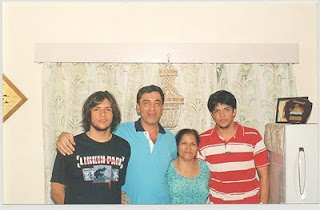
I have often wondered what does my blog mean to me. Finally, the comparison that comes to mind is that of my sons Arjun and Arun when they were small. How I worried about them. How I wished they would do well.

Because of them it became common for me to show interest in other people’s children so that they too would show interest in mine. Earlier, I may have detested people showing volumes of pictures of their children on every conceivable occasion: birthdays, bath, picnic, simply in the cot, drinking milk, standing and looking cute, putting on hat and lapping up attention. But, after Arjun and Arun were born, I welcomed the show of pride of other parents as it gave me opportunity to show them their pictures too. Earlier, when we visited friends and their children wanted to recite ‘twinkle twinkle little star’, we would abruptly change the topic. But, later, with Arjun and Arun, we had something to recite and show of our own. I guess, it is the same with blogging.

Arjun and Arun we had to mind our language. Earlier, when friends were home we could speak all kinds of gibberish. With the blog it is the same. You have to be careful lest you should be misquoted or held accountable for something. If your child, for example, wets his knickers, you’d be embarrassed even though other people also have gone through the same or similar experiences. But wetting knickers, ugh.

But, I think, the biggest similarity is that the wailing of other infants used to cause us considerable discomfiture, if not annoyance. However, after our own child was born, not only that his incessant crying appeared absolutely appealing and cute, but, we had something good to say about other kids crying too. In blogging too, we do find renewed zeal about other bloggers’ utterances or even screams. There appears to be lots of merit in these as long as they forgive us our own trespasses.

Lets not forget surprises. You discover things about your children virtually on everyday basis, especially when they are small. It is not different with your blog. Wherever you go, you want to take your child with you, as close to your chest as possible; and so it is with your blog.

Your child’s marks in exam were as if your own marks. Your blog’s rank too reflects the same emotions. Nothing of your blog, just like nothing of your child, can be a secret. You are known by both.

Here is another great similarity: you have enormous anxiety about whether your child would do well; whether he would be appreciated; whether he’d speak, walk and run. Ditto with the blog.

Names are important for both. As Guru Granth Sahib says, “Changa naam rakhayi ke jas kirat jag le.” (By keeping a good name you (hope to) earn a lot of fame and repute in this world). Similarly, the name of your child or blog has to be in sync with what you want him/it to become.

And what about the first time? Do you remember the first time your child said something? For whatever it is worth, all he may have said was “goo”, but, you were walking on cloud nine. Don’t you think it is the same with the blog? It appears inane to you, Sir? Well, don’t forget it is not cut and pasted. It is as original as my son’s “goo” or “ta ta ta”. Today, it is “goo”, ma’am. Tomorrow, he’d write poetry better than Shakespeare.

There used to be any number of children of Arjun’s age who would rattle out poetry, history, current affairs and facts and were accomplished in games or other hobbies such as photography. Parents used to show off their medals and awards and trophies. I used to spend sleepless nights thinking why was my child not as smart. Now too, I look around and see superbly laid out blogs with excellent google page ranks, Alexa ranks and other ranks. And then I look at my own; why can’t my child do as well?

I feel like Waheeda Rehman singing to her newly conceived child in ‘Mujhe Jeene Do’ (Let Me Live):

Tere bachpan ko jawani ki dua deti hun,
Aur dua deke preshaan si ho jaati hun.”
((My child), I pray for your childhood to step into youth,
But after praying, I become full of anxiety)

Could I have adopted a fully grown blog? But then, it won’t entirely have been my own. Also, it would probably signal to the world that I don’t have the spunk to father one of my own.

So, dear readers, as my child fumbles its way through its childhood, forgive it if its babbling and baby-talk does not have the intellectual bent that you all are used to. It stands and falls, falls and stands; but, eventually it would learn to run and even climb hills.

Sunbyanyname, my child, I am your father and mother rolled into one. Come last in the class, if you wish to. Be a laggard in sports if you can’t help it. Dawdle your way through. However, don’t ever cheat. Also, don’t ever be afraid to say what you feel is right. Whatever you become, I want you to stand on your own.

It isn’t a race, my son. In your style of doing things, you would always be Number One to me.

Your rank will always be the highest to me.

Twinkle, twinkle little star,
How I wonder what you are.
Up above the world so high,
Like a diamond in the sky.

WHY MUST WE LOVE INDIAN ROADS

Fed up of driving on Indian roads? Frustrated with our driving habits? Well, we have a good thing going and you are either not aware of it or don’t have respect for Indian values. In your hurry to denigrate us you have missed out the following:

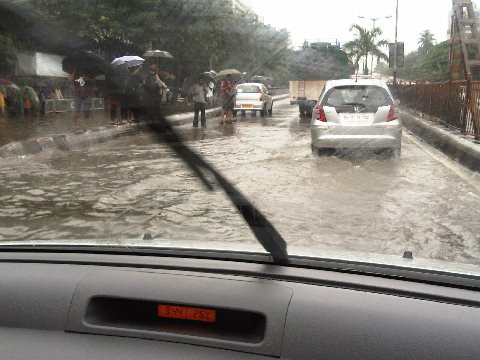
1. India is the only country in the world where we have “environmentally friendly” roads. You are never too far from mother Nature.

Environmentally Friendly Road in Mumbai

2. If it hadn’t been for these roads, people living in cities would never know what it is like staying in villages. These roads, therefore, inadvertently result in “national integration”.

Village? Well, no, it is in the heart of Mumbai

3. We heard Neil Armstrong on the moon with his “one small step for me, one big leap for mankind” and wondered when would an Indian be able to say that. Now, at least in Mumbai, we say it everyday when we take our “big leap” over the craters that invariably start with a small step.
Pic courtesy Hitxp Blogzine by Gurudev

4. There are hardly any chances of meeting with accidents which can’t be ruled out if one goes at crater-less roads with high speed.
5. These roads make you believe in God; indeed, several times during your journey you will think of Him. “Hey Ishwar, us paar (used to be said for our life on Earth) pahuncha de.” (O’ God, make me reach the other side(most Indian scriptures think of this world as an ocean that we have to cross))
6. These roads provide means of living/employment for several people including politicians, municipal councillors, contractors, labourers, and motor mechanics. Taste this:

Overheard the following conversation between two vendors of toys at Chunna Bhatti Junction:

Vendor1: Sales are really good these days. 

Vendor2: Why shouldn’t they be? The traffic hardly moves and we have all the time in the world to convince motorists to buy our stuff.

Vendor1: The most favourite toy they want to buy is aeroplane. Fed up with the stalled traffic they go on flights of fancy.

Vendor2: We ought to thank the BMC guys for their generosity. 

Vendor1: Yeah, lets silently salute them for the traffic snarls year after year. However, lets not say it loud lest the guys should demand their cut as they do in everything.

Vendor2: I agree with you; ain’t we sick of paying hafta (weekly bribe) to the cops?


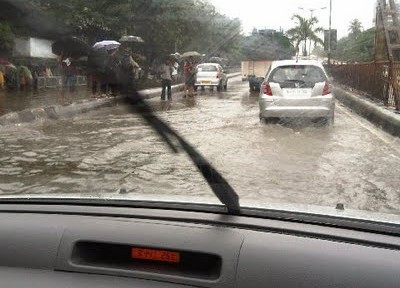
7. In various other countries – I don’t know why they call them advanced nations when we Indians are far more advanced – they have to drive to get to water sports. We in India have water sports along the way.

Pic courtesy PTI

8. Many people in these so called advanced countries just reach their destination. Nothing great or big deal about it. For us in India reaching a destination is a celebration of sorts. Many of us want to go straight to the temples to thank the gods. Here too we have looked at the people’s convenience: most of the pandals (a temporary structure) for gods are right at the roads.

A pooja pandal in the middle of the road at Turbhe (Mumbai)

9. Indian roads, just like Yoga and meditation, teach us power of concentration. Can anyone ever think of taking their eyes of the road?

10. Finally look at the “socialist” nature of these roads: between cities the upper middle class and the rich go by air. However, in a city they have to reach home just as the poor man has to reach his chawl (shanty). It is a great leveller.
Actually, anyway you look at it, the benefits far outweigh the “small inconvenience” caused to you.


PITFALLS OF MAJORITY RULE

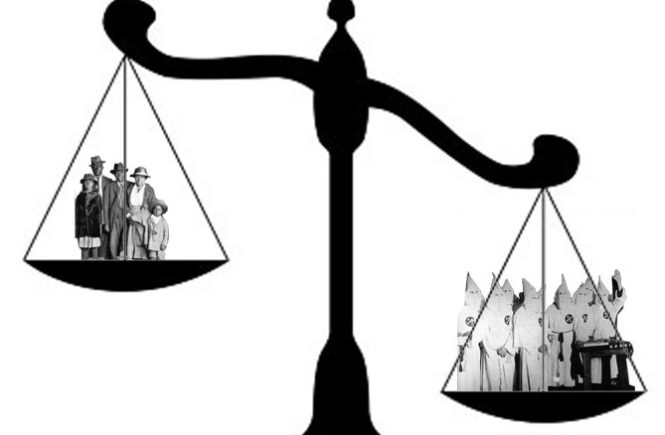
Winston Churchill once said that Democracy is not really an ideal system of government. However, he quickly added that it is better than other systems that we have tried out. One big pitfall of democracy is that since it is a government chosen by the majority, at least in theory, the others have to make peace with their wishes, desires and needs being subsumed by those in majority. It also assumes that the majority is the good lot.Let me try to explain this point through a hypotheitical situation. A train is approaching at full speed and you notice that there are a dozen kids playing on the track. They are seemingly oblivious of the approaching train and you reckon that the train would run over them. In the available time you have only one option. You spot a lever next to the track by which the train can be diverted to a disused track on the left. The only problem is that there is a lone girl playing on that track too. You have only a few seconds to take a decision.

When this hypothetical problem is given to people, majority of them opt in favour of diverting the train to the disused track to the left thereby saving the lives of a dozen kids. In the process, their logic goes, if one small girl on the disused track is killed, that is a small price to pay for saving the others.

At first glance that appears to be the acceptable solution. However, think and you will find the following things wrong with the majority solution:

  1. The dozen kids who are playing on the used track are knowingly doing something wrong. The lone girl playing on the disused track is actually right.
  2. In the majority solution we have opted to punish the lone girl who is right and reward the majority who is wrong.
  3. The dozen kids who are wrongly playing on the used track should be expecting a train passing and hence expected to jump off the track, even if at the last minute. On the other hand, the lone girl would never expect the train on the disused track and would surely be killed.
  4. Lastly, why is it a disused track? By diverting the train on the disused track we would willy-nilly make the lives of hundreds of people on board in danger; and all for the sake of a dozen kids doing the wrong thing.
Hypothetical situation it may be; however, in our everyday life we come across situations that intrinsically favour the majority even if they are doing wrong and even illegal things. Let me give you just one example. During the last festival season the noise levels were simply unbearable. If India were a civilized nation, and Mumbai a civilized city, these kind of unhealthy noise levels would be banned. Well, they are banned in India and Mumbai. However, the majority indulge in it and none of us have a say. One Dr Sanjay Bedekar, in Mumbai, a few weeks ago, took up a PIL (Public Interest Litigation) that in several parts of the city the noise levels were far in excess of the maximum prescribed and the authorities should be asked to intervene. Firstly, he was heckled in and outside court. Secondly, the court ruled that such mobs as those making excessive noise during festival season are to be treated with great care lest we should have an unpalatable situation. As far as the government is concerned, it loves the majority (votes) and brushes away such nuisances by, “The sentiments of the people (in majority) are to be respected.”

Last season, at 0130 hrs (loud-speakers have a time limit only up to 2200hrs), with excessive noise of loud-speakers, I complained at the nearest police-station. After a series of questions about my name, address, phone number etc, the cop finally wanted to know what I wanted to do. I told him, “Mujhe sona hai.“(I have to sleep). Here was his prompt response, “Nahin, Navaratri ke time sone ka nahin.“(No, please don’t sleep during Navaratri). With this he disconnected.

Here is another incident. In the year 1990 I got posted to Naval Headquarters in New Delhi. I drove to visit a relative close to Rohtak Road. At one of the traffic signals when we stopped for the red light, a burly looking sardar got out of the taxi behind me, walked up to me and let me have it for my “poor traffic sense”. This is what he told me, “Naye aaye ho dilli mein? Ek hi lane mein chale jaa rahe ho; accident karwayoge kya?” (Are you new in Delhi? You are merrily continuing in one lane; do you want to cause an accident?) I looked at him. There was a genuine look of being wronged on his face. And, guess what? I realised that I might actually be a traffic hazard with my lone tendency to follow rules. The English were very good at devising mottoes that were not only practical but safe. One of these is, “Whilst in Rome do as the Romans do.” A friend of mine in Delhi has this sticker on his car, “Caution: I drive like you do”.

Lets, for a minute, turn to Anna Hazare movement against Corruption. The movement has (erroneously) assumed that only a handful of politicians, bureaucrats, and government servants are corrupt. The majority who are with Anna and take part in processions, fasts etc are good lot who look down on bribes, short-cuts, dishonesty etc. What if the majority are like-that-only? How will they right themselves?

In the end, I also want to bring out that historically great things that have changed the world are not accomplished by majority but people who thought and did differently than what the majority believed in. Take just a handful: Copernicus, Galileo, and Darwin. If we had continued believing in the majority we would have continued believing, say, the Sun revolves around the Earth. However, to reach there, they had to face castigation, mockery, and derision.

It is the same many centuries later.

A FATHER IS JUST A FATHER, BUT A MOM IS LIFE

If friends try to detect just a wee bit of the ‘J’ word in this article, let me tell you I won’t be writing this if I was jealous. I have spent the best years of my life in the company of my own mother, and how can I be jealous of my own kids thinking no end of their mom?Talking about best years of one’s life, I am reminded of this anecdote, I am sure apocryphal, that I heard when I was in school. India’s Prime Minister Nehru was giving an after dinner speech in London. He started off by saying, “The most memorable years of my life are spent in the arms of another man’s wife”. There was, naturally, disbelief and shock at this sudden explosive confession. Enjoying their discomfiture, Nehru took another fifteen seconds or so before he concluded, “My mother, that is.” There was, as was to be expected, resounding applause. The External Affairs Minister Swaran Singh noted this for its sheer audacity and ultimate punch-line. Hence, on arrival in India he insisted on an after-dinner speech. He started, “I have a confession to make: the best years of my life are spent in the arms of another man’s wife”. He enjoyed the hushed silence, the shock and incredulity and concluded, “Nehru’s mother, that is.”

Jokes apart, there is much to be said about the security of being in one’s mother’s arms. I remember the time when we were in Wellington in Ooty Hills and Lyn, my wife, had to leave us for three days to meet her relatives in Chennai. As the train departed with her at Coonoor, Arun, our younger son, stuck close to me and was almost at the verge of tears. When I asked him what happened, he responded tearfully, “Mama is leaving and three of us are going to be alone.” I reminded him that it was she who was going alone and we three were together. However, his reasoning was unshakeable.

The ‘tallest’ amongst us all.

Here is an excerpt from a Catholic prayer. Catholics think of God as a Father and Jesus is seated on the right side of the Father. The prayer starts with extolling the various qualities of the Father. However, half way through it says, “Father, I feel safe with you like a baby in its mother’s arms”.

If any proof is required in our house about the virtues of the parents, and not that anyone has any doubts, our dog Roger too felt securer with mama. During the festival season, with the noise of loud-speakers, conches, singing, and crackers, he was to be found under my wife’s bed, the safest place for him in the world.

As I said, fathers will never be jealous, because they too have happy nostalgia of their own moms. One of them, when he was making a fuss about eating his mother’s cooked food, was gently told by her, “Eat it, son; many years later you will be telling your wife that she can’t ever cook how your mother did.”

Where would we be without our moms?

ANNA HAZARE AND THE INDIAN MIDDLE CLASS

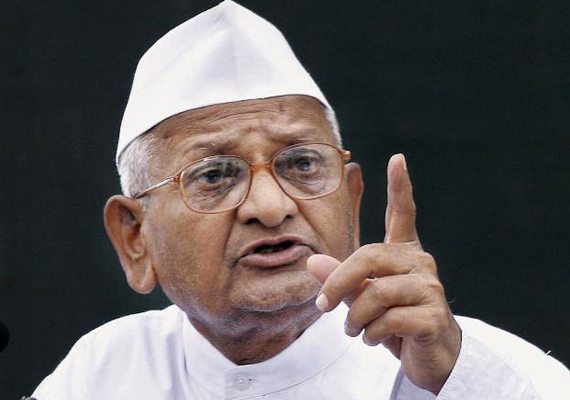
Last night as soon as the letter by Indian Prime Minister Manmohan Singh was read out by his emissary Vilasrao Deshmukh, Anna Hazare on the twelfth day of his fast, thanked the people for having come this far that they can rejoice about what he called “half victory“. 


Who are the “people” that he thanked? Well, largely these are middle class people of India who have made Anna’s movement against corruption so hugely popular. I also want to reflect on half victory later.

Middle class is variously described but the most recent definition is based on its earning capacity, that is, anything between Rupees 3 to 17 Lakhs per annum. In the pyramid of Abraham Maslow’s Hierarchy of Needs, starting from Physiological Needs and going up to Safety Needs, Belongingness & Love Needs, Esteem Needs and finally Self Actualization Needs; the middle class perceived that it is being neglected as far as Safety, Belongingness and Esteem Needs are concerned. To some extent the rich and the poor are responsible for taking the focus away from the middle-class needs, but to a large extent, the other middle class is responsible for the loss of esteem and belongingness of the middle class. Who is the other middle class? Well, the babus in government offices, the railway TTEs, the policemen, the patwaris, tehsildars, magistarates, collectors and the like. What A Raja and Kalmadi do affect the middle class only indirectly. However, what the other middle calss does affects the middle class directly.

Let me give you just one personal example to make a point. A few years back I went to my home place, Kandaghat, in the Shimla Hills. My mother, after the demise of my father, stays there alone. Because of her helplessness in being a widow, some people have encroached on her land. Thereafter. whenever I went on leave, I had to run from pillar to post, with local bureaucracy, police and judiciary to get justice for my mother. Was it provided? You are mistaken. The local patwari, in order to show me down, even whilst acknowledging my rank Commodore, derisively told me, “Us din mujhe milne ek Brigadier Sandhu aaya. Maine kaha bahar baith; jab main bulayoon to aana.” (The other day one Brigadier Sandhu came to see me. I told him sit outside; when I call you then only enter). In the court, I took a request under Article 23 of the Navy Act requesting the judiciary to settle our case expeditiously during my leave period. Indeed, as per this provision the judiciary is required to record as to why the case was not settled during the leave period. The truth is that after more than a decade it is not settled. Navy Act is an act of Indian Parliament but they had no respect for it. There is a letter written by the Indian Home Minister to all the state governments to provide assistance to the members of the armed forces who can get things done only during their leave period. But, they care two hoots for it. Hence, the disrespect for the Indian Parliament, is erroneously being pinned on Anna Hazare and his team and movement. This disdain is to be found with the other middle class in villages, towns, cities, states; indeed, everywhere.

The focus of the middle class, therefore, should not be merely politicians, and bureaucrats or the big fish. But, those who defeat it and keep it from realising its needs; and that is the other middle class. Anna Hazare movement must realise that middle class is both the focus of its movement as well as the target.

The Indian middle class is defined not just in economic terms; but also by being the middle of nowhere; its voice not being heard at all. The authorities have no choice but to be seen as pro-poor (which includes even ignoring or permitting indicipline and lawlessness so that “people’s sentiments are respected“. The rich look after themselves. But, the middle class gets step motherly treatment. Who is responsible for it? Well, it doesn’t require knowledge of rocket-science to conclude that the middle class itself is responsible, to some extent, for this sorry state of affairs. During the very first elections held after 26/11, when the middle class in Colaba (the scene of carnage by Kasab and co.) took out candle-lit marches and other vociferous protests against the neglect of politicians towards such issues as terrorism and security, a dismal 40 percent voted in Colaba. Largely, this 40 percent comprised the poor in such localities in Colaba such as Murthy Nagar and Geeta Nagar. The middle class just didn’t bother.

Therefore, for the movement to succeed and really bring relief to the people, the moment has to be a catalyst for change for the middle class both within and without and not just target the politicians and babus at higher places. In short finally the middle-class awakening has to help the middle class become more effective in people regaining their national and individual character.
 Will the middle class, exultant at “half victory” of Anna Hazare, be able to look within as well look without?
Lets now focus on “half victory”. Have we really achieved half of what we wanted to achieve? Is a vague assurance by the parliament really “half victory”? Is passing of or even voting on Jan Lokpal Bill then full victory. Nothing can be farther from the truth. Here is what I wrote just a week back (Anna Hazare and the Indian Democracy):

The second is that our middle-class, the main pillar of the movement, has become quite impatient. It is true that we have been conditioned to it. But, the catch here is that in its impatience it may very well regard some quick wins (as passing of Jan Lokpal Bill) as the ultimate solution to set right our democracy. I laboured over the current shortfalls in Indian democracy to bring home the point that, at best, the movement and the passing of Jan Lokpal Bill can be only the beginning and not an end by itself.

So, I don’t think it is anywhere close to “half victory”, unless what Anna ji meant is the “half victory” of the first phase.

Anna Hazare’s movement has done for us Indians what nothing else in independent India did. It has suddenly given us hope. He has shown the kind of character and perseverance that all of us, particularly the middle class, must emulate. Lets not belittle the movement by assuming that all our problems will be sorted out by targeting the rich and the powerful. The middle class’s fight is mainly against the other middle class and the demon within. Anna Hazare has shown us the way. Lets now take the movement to the next logical stage.

LOST

Where should my friend
I search for thee?
You have been lost in me.
Should I search in my heart?
But, lo, my heart is not in me.
You stole it and took it away,
And left me…..lost.
Where shall I find thee now?
Where shall I find me now?”
Follow

Get every new post delivered to your Inbox

Join other followers:

error

Enjoy this blog? Please spread the word :)

RSS
Follow by Email
YouTube
YouTube
Set Youtube Channel ID
LinkedIn
Share
WhatsApp
Copy link
URL has been copied successfully!