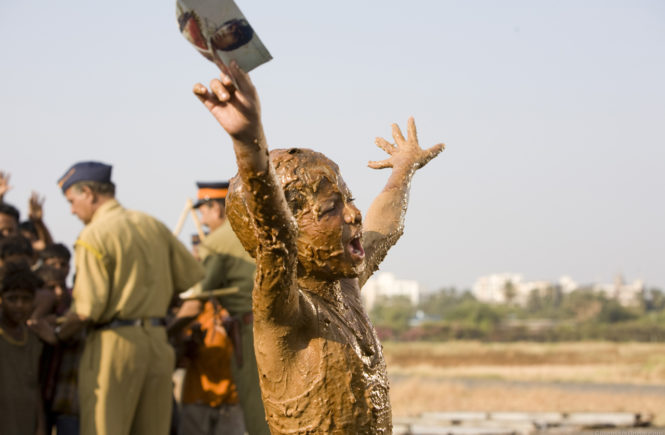
‘Slumdog Millionaire’ did for us Indians something different from an article in the Readers Digest, a few years back. The article had labelled Indians as some of the rudest in the world based on an international survey. We went to town confronting the western perception about politeness. What good is western politeness, we asked challengingly, when no one comes to anyone’s rescue? Indians, on the other hand, we asserted, would naturally help anyone in difficulty, be it during floods, earthquakes, stampedes or whilst waiting for trains or aircrafts several hours late. It is at this stage that ‘Slumdog Millionaire’ invaded our collective consciousness. Without going into the merits of the movie and its concept, I would like to venture that yet another time we have been duped into believing that perhaps there is some sort of virtue (the feel good factor) in being what we are. We may be living in squalor, we may be rude or uncouth, cruel or ill-tempered, but, finally the prizes of unheard of riches and a charming beauty would fall at our feet.
Coincidentally, when I joined the Navy, I, together with all other Indians, lauded the innate simplicity of Rundi K Bakshi played by Peter Sellers in The Party. Now, when I am about to leave the Navy, Slumdog has done something similar. In between, we had Aamir Khan in ‘Rangeela’ and a host of other movies portraying the uncouth Indian winning everything that was at stake.
Nothing has changed over these thirty-four years; nothing in India ever changes. We still believe in miracles and fairy tale endings. We are like that only. A great nation? A great people? Well, there is no harm in opening our eyes sometimes and looking at ourselves as what or who we really are. Here is a short list.
Poverty and Squalor. The last five years have been a period of unprecedented GDP growth for India, second only to China. Yet, the number of poor in the country has increased. Where has all the money and growth gone? Well, the richest 10 Indians have 10% of the GDP and the richest 50 Indians have 30 % of GDP. In Mumbai, the areas under slums have increased since independence. We don’t have our poverty to blame for our being filthy. We take immense pride in personal hygiene and bathe frequently, many a time in the open. However, our cities are filthy because of our collective habit of littering. Most of our tourist places are now huge trash bins. We frequently perceive an eating place to be expensive if it is clean and are very much at home in muck. The last census showed that nearly half the population of Mumbai does not have access to toilets. We repel clean surroundings so much that the first paan spittle appears even as a new building is being white washed. Even naval areas are not immune. We are like that only.
Chaos. One reason why we have this uncanny ability to take things in our stride is because we love chaos, especially on the roads. The state of most of our roads tells us that roads in India are meant for many purposes other than for traffic. Roads are, for example, virtual playgrounds, pastures, garbage dumps, promenades, procession routes and meeting places for people and animals. There is perpetual maintenance going on. We are very environmentally friendly people. Hence, if roads are where rivulets and agricultural fields used to be; these are kept as close to their original purpose and condition as possible. Even where we have four-laning of a road, a greater part of this would still be used as two lanes because of never-ending repairs on two of the lanes that keep alternating. Our driving habits constantly remind us that life as a journey (suhana safar) can’t be taken too seriously. Many of us finish this journey without losing life or limb and that is more by chance than design or intention. Signboards and road markings are for decorative purposes only. Anyone new to our places has to repeatedly ask people for directions. Thus we transform even simple journeys into adventure trips. We are like that only.
People in a Hurry. Any foreigner coming to India is instantly taken aback by the sheer number of people on the streets. We have perfected the art of individually being in a flaming hurry whilst collectively standing still. With all our manpower every task assumes the proportions of a project, which goes on forever. Recently in Dubai I learnt that a four lane undersea tunnel took just four months from the award of contract to completion. In that much time, we have not been able to complete laying tiles on a pavement between Afghan and RC Churches. Yet, no Indian would wait for a second to let the vehicle ahead of him to cross the traffic lights before him. Announcements such as, ‘Please do not open the overhead lockers until the aircraft comes to a complete standstill’ or ‘Please allow the passengers ahead of you to disembark first’ are necessitated only in India. Perhaps, the frustration that we feel about our files not moving at all in public offices or our court cases not coming to any conclusion goads us to at least be ahead of the next person. We push, we fret, and we break queues to somehow get ahead. At every level crossing in our country, as soon as the gates are closed to allow a train to cross, from both sides, the vehicles joining at the rear start moving towards the closed gate on the opposite lane. Within no time, the road is now totally blocked since both lanes from both sides are full. Thus the entire traffic gets delayed by minutes, if not hours. However, those who jump the lanes have this satisfaction that delayed or not, they are now ahead of others. This goes on, without fail, at every crossing, every time. We never learn. We are like that only.
Everyone is Someone. We have no respect for the rule of the law. Taking shortcuts and to somehow “adjust” things are astuteness for us. If and when caught on the wrong foot, instead of feeling guilty, we are prone to ask, “Pata nahin main kaun hoon?” (Do you know who I am?) Reminds me of the hefty Chinese in a restaurant picking up cudgels with everyone in sight with the haughty proclamation, “No one can stand up to me; I am Chow Mein from China”. This continued for some time until a really massive sardar confronted him, “Hello, Chow Mein from China, You want to have a bout with me?” Looking at the massive hulk of the sardar, our Chinese hero stuttered, “But, actually I am Chicken Chow Mein.” How we wish someone would tell our paper tigers too as to who they really are.
Worshipping Heroes. An Indian hero is worshipped better than a god. Indeed, many erect temples for these heroes. In many part of the world, heroes are said to have larger-than-life existence. But, in our case it is literally true. God forbid if anything should happen to our hero; we can commit suicide or burn our homes or those of others. Curiously, many a times, lives are lost in protecting not just the hero but also his statue. We are like that only.
Chai-Paani Bakshish. Indians now rank amongst the most corrupt people on earth. The chai-paani bakshish has assumed gargantuan proportions. Everywhere and for everything palms are to be greased. There is a greater sense of acceptability of this type of gratification in public life. Indeed, a few years back I saw a cartoon in which the cop had stopped a driver and demanded money to let him off his petty traffic offence. When told by the driver that he did not have money, the cop told him, “Don’t have money? Don’t worry, we accept credit cards.” Another cartoon is equally revealing. It is about crores of rupees of scams that we so regularly unearth. In this cartoon a cop is taking a handcuffed petty thief to jail and is telling him, “You are unlucky that you stole a few rupees. If you had stolen lakhs, I could be your security guard.” A notorious bandit-queen-turned-politician had amassed more riches in a few years in politics than in all the years of her being a dacoit. We just love scams and speed money. We are like that only.
Everyone is Involved. There are no private transactions – everyone is somehow involved in everything. Take a street fight for example. Let us say Mr. A has an altercation with Mr. B. Very soon, realising that arguments are not getting them anywhere, A reaches for B’s neck or vice versa. Mr.C who was all this while applying katha in his paan shop jumps to B’s rescue. This stops A in mid track since by this time he had already started seeing visions of B having been reduced to pulp. Mr. D, at this stage, is on an urgent errand to Electricity Office for asking for reduction in his monthly bill. He quickly takes in the situation and does not like the unfair play of two (B and C) against one (A). He temporarily forgets his errand and jumps in the fray. This is totally to the liking of E who sees in this an opportunity to settle scores with D for playing the music too loud when he is doing his Paranayam. Gradually, therefore, the crowd becomes bigger and shouts of ‘Maro saale ko’ (Beat the brother-in-law) shriller. In the outer circle of this ruckus, no one is quite sure about whose side he is on, but, that does not deter him to actively participate in the proceedings. A happy ending is reached when everyone goes home after paying chai-paani money to the indulgent cop. A not so happy ending is when the politicians and religious heads jump in and something called an Inquiry starts. We are like that only.
Inquiries Galore. Inquiries are taken rather seriously in India. I’d go so far as to venture that these are best job opportunities for retired judges, politicians and bureaucrats. The purposes of Inquiry? Well, it is rather simple – an inquirer does exactly what a court writer used to do in the reign of kings, that is, to record history as viewed by the king. In a democracy, however, the ruler can’t go on forever. So, as soon as the ruler changes, thirty thousand or so pages of this recorded history (called Inquiry Report) is consigned to flames and a new Inquiry on Inquiry is constituted. Meanwhile, most of the people who are subject or victims of the earlier Inquiry either are either themselves consigned to flames or become powerful government officials. The cycle goes on and on. We are like that only.
People’s Sentiments. Whether or not, in India, law, rules, ethics and procedures are to be respected, there is something called ‘people’s sentiments’ that is always to be respected. So whilst on one hand we earmark crores of public money for cleaning Ganga or Yamuna, we respect people’s sentiments to continue polluting rivers and seas by immersing anything they may consider sacred. Talking about religious sentiments, how ironic it is that we have to display pictures of gods and goddesses on public walls, not to worship them but to somehow stop people from urinating and defecating against the walls? Many still don’t care, realising that their bowel needs are stronger than their spiritual leanings. We do the same for noise during religious festivals. Most of our cities are now close to being un-livable. If the stench does not get you, the noise will. We are like that only.
“Agli Baar Chhodenge Nahin”. Whatever you may say about India’s past or present, the future is always bright. After every scam, insult to national pride, failure to do well in sports etc, defeat and despair, we are filled with renewed resolve to tackle it better next time. Many of these hind sights are due to volumes of Inquiry and Investigation Reports. We debate, discuss and argue threadbare every aspect of the unpleasant situation that we have gone through. This takes days and months and years. And then? Nothing changes. We are like that only. Meanwhile, reality changes into fiction and fiction changes into reality. I saw a cartoon in which some of our netas were seen coming out of a cinema hall after seeing Richard Attenborough’s ‘Gandhi’. One of them remarked, “Stupendous really.” And the other one commented, “And I believe it is based on a true story.”
What if ‘Slumdog Millionaire II’ is made in the year 2050, when our GDP is slated to become the highest in the world, and it shows another young Jamal voluntarily falling into shit to get the autograph of Big B’s grandson?
Jai ho!