THE BEST OF OLD HINDI SONGS – RAFI, SHAKEEL, NAUSHAD AND DILIP KUMAR TOGETHER

How proud I am that I lived in an era when Mohammed Rafi sang the songs whose lyrics were written by Shakeel Badayuni, music composed by Naushad and Dilip Kumar enacted those songs? There are other great lyricists such as Hasrat Jaipuri, Sahir Ludhianvi and Majrooh Sultanpuri. Similarly, there are other great music composers such as Ravi, Hemant Kumar, Salil Choudhury, Shanker-Jai Kishen, and Laxmikant Pyarelal. However, this article is only about the greatest ever quartet of Rafi, Shakeel, Naushad and Dilip Kumar being together.

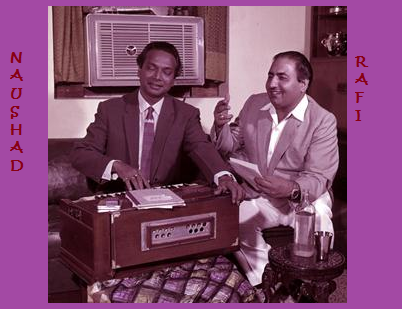
The best musical trio ever: Naushad, Rafi, Shakeel – I would give anything to meet them

Sadly, out of the four, the first three are no more except Dilip Kumar who celebrated his 89th birthday on the 11th of Dec. Mohammed Rafi died three and half decades ago (31 Jul 1980) at the age of 56. If he were alive, he would have celebrated his 87th birthday on 24th of Dec.Similarly, Naushad who died on 5th May 2006 would have been 92 on 25th of Dec. Can you imagine that the three of them had their birthdays this month? Shakeel didn’t even reach the age of 54: born on 3rd Aug 1916, he died on 20 Apr 1970

As far as songs not including the complete quartet are concerned, by far the number one song in Hindi movies has been the 1963 movie Mere Mehboob’s title song. Its lyrics are the finest written by Shakeel and Naushad has given the most heart-touching music. Rafi’d rendition is the best ever. But I am not putting it here because instead of Dilip, the film had Rajendra Kumar.

Once again you are bound to ask me: what about ‘Suhani raat dhal chuki’ from 1949 Dulari. Once again it has Shakeel-Naushad and Rafi but not Dilip Kumar. I think by this time you get the point hat this article is all about.

Let me begin with the oldest of the four: Shakeel of the village Badayun in UP. Initially he started as a shayar (poet) but moved in 1944 to Bombay to find a career in films. He met Naushad. During those days shayars were full of songs about upliftment of society. But Shakeel chose to write about love and Naushad liked his romantic poetry immediately and signed for AR Kardar’s 1947 movie Dard. The songs were a hit especially Afsana likh rahi hoon. Shakeel had arrived in the Hindi film industry with a bang. Shakeel wrote for Ravi, Burman, Hemant Kumar, C Ramachandra etc too but his favourite always was his first: Naushad. Unlike shayars of that era, Shakeel didn’t drink. However, he died young at 53 years of age in diabetes related problems.

The greatest lyricist of Hindi movies. He wrote Mere Mehboob

Naushad was the next younger, having been born three and a half years after Shakeel. However, he was in Hindi film industry as an independent music director for close to seven years before he paired with Shakeel. He too was from UP; the city of Lucknow famous for its old Urdu etiquette and refinement. Naushad was the most versatile music director the industry ever saw. His genre was to base his music on classical raagas. His career spanned more than six decades. He was awarded the Dadasaheb Phalke award in 1981 and Padam Bhushan in 1992.
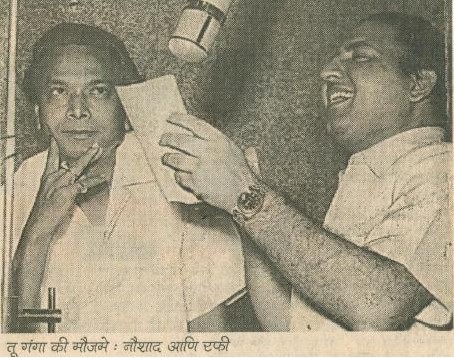
The Greatest with the Greatest – Naushad with Mohammad Rafi

Next is Dilip Kumar who is still alive having been born as Muhammad Yusuf Khan in Peshawar (now in Pakistan) on 11 Dec 1922. Satyajit Ray called him the ultimate method actor. He too began his career in the same year as Shakeel did. He was the first actor to win Filmfare Best Actor Award; ultimately he won the highest number, ie, eight, an honour that he shares with Shah Rukh Khan. He was awarded the Padam Bhushan in 1991, Filmfare Lifetime Achievement Award in 1993 and Dadasaheb Phalke Award in 1994. He remained a good friend of Shakeel and Naushad.

Dilip Kumar – there hasn’t been a better actor than him in Hindi films

The youngest was Rafi, born on 24 Dec 1924 in village Kotla Sultan Singh near Amritsar in Punjab. He has sung nearly 8000 songs including 112 in non Hindi and 328 non filmy private songs. He too started his career in Hindi movies in 1944 and became a contemporary of the other three. However, his career lasted nearly half of Naushad’s. He, however, had started singing at the age of 13. He sang 149 songs for Naushad. Other than Hindi and Urdu (the languages of the Hindi songs), he has sung songs in Konkani, Bhojpuri, Orya, Punjabi, Bengali, Marathi, Sindhi, Gujarati, Kannada, Tamil, Maghi, Maithili, Assamese, English, Persian, Spanish, and Dutch. His genre too was Hindustani and he was reputed to have moulded his voice to suit the character of the actor. I do not consider myself qualified to describe his talent. He is simply God of Hindi songs and there would never be a time when I shall not want to hear a song sung by Rafi.

The gretest Hindi films singer ever – Rafi was also the most humble

The first of the movies in which the quartet was together was the 1948 Mela. Its title song Yeh zindagi ke mele duniya mein kam na honge afsos hum na honge is still the standard in Urdu poetry. Taste this:
Duniyaa hai mauj-e-dariyaa, qatare ki zindagi kyaa
Paani mein mil ke paani, a.njaam ye ke paani
Dam bhar ko saans le le, ye zindagi …

The next movie of the quartet was 1951 movie Deedar. The song that I love the most is a duet between Rafi and Lata:
Dekh liya maine kismet ka tamaasha dekh liya.
Milakar bhi rahaa main mushkil mein
Milane ka natijaa dekh liyaa
1952 Aan became a super-hit movie of that time. It was produced and directed by the legendary Mehboob Khan. Amongst all the song that best describes the theme of the movie, ie, a poor villager Dilip Kumar overcoming the pride (Aan) of the princess Nadira is Maan mera ehsaan arey nadaan ke maine tujhse kiya hai pyaar. Enjoy:

Two years later the great Mehboob Khan got the quartet toegther again for the movie Amar. The song close to my heart is the bhajan ‘Insaaf ka mandir hai ye bhagwan ka ghar hai‘. Just imagine all four Muslims getting together and making a mandir (Hindu temple) song. This was the essential greatness of the society, the movies and songs of that era: people of all communities participated in hymns of all religions. Two years earlier, for Baiju Bawra, Shakeel-Naushad-Rafi had combined to make one of the best Hindu bhajans: ‘Man tadpat Hari darshan ko aaj’.

The next movie of the quartet was the 1955 movie Uran Khatola that was produced by Naushad. The story-line was about a plane that crashed near an isolated town that is ruled by women. I have a problem now. There are so many good songs in this movie that I don’t know which one to select. There are, eg, Na toofan se khelo, na sahil se khelo’, ‘Hue ham jinake liye barbaad’ and ‘O door ke musaafir’. My choice is Mohabbat ki raahon mein chalna sambhal ke. It is about the hopelessness of love. There are these immortal lines in the song:

Hamen dhoondhati hain, bahaaron ki duniyaa
Kahaan aa gaye ham, chaman se nikal ke.

And if you can see better acting than Dilip Kumar, do let me know.

Then there was a five year period in which no movie of the quartet together were released though there were others for them to accept movies separately. It was worth the wait. The 1960 Mughal-e-Azam, written by Kamal Amrohi (amongst others. Kamal went on to make his own classic Pakeezah a few years later) and directed by K Asif. It was the biggest box office hit ever (Rupees 133 Crores after adjusting for inflation) until Sholay broke its record. The movie was about the love affair between Prince Salim (who went on to become Emperor Jehangir) and Anarkali. The movie belonged to Lata Mangeshkar who bagged the best and most popular songs like ‘Mohe panghat pe Nandlal’, ‘Mohabbat ki jhooti kahani pe roye’, and ‘Jab pyaar kiya to darna kya’. Rafi had only one important song but it became very famous: ‘Zindabaad, zindabaad; ai mohabbat zindabaad’. Enjoy:

The year 1960 also saw the light-hearted Kohinoor; a movie with Dilip Kumar and Meena Kumari. Dilip Kumar had, by this time, earned the reputation of a Tragedy King with movies like Devdas and had actually gone into depression with the intensity of his roles. This movie was, therefore, to break the monotony of tragic roles. He won the Filmfare Best Actor award for this too. The movie had two very beautiful duets: ‘Chalenge teer jab dil par’, and ‘Do sitaaron ka zameen per hai milan’ and Rafi’s ‘Koi pyaar ki dekhe jadugari’ and ‘Zara man ki kewadiyaa khol’. My choice is: ‘Madhuban mein Radhika naach re‘, one of the best songs sung by Rafi:

Just a year later, in 1961, was released Dilip Kumar’s musical romance with Vyjantimala in the shape of Ganga Jamuna. Asha Bhonsle sang ‘Tora man bada paapi’, and Lata sang ‘Na maanu, na maanu na maanu re dagabaaj tori‘ and the all time hit song ‘Dhundo dhundo re saajna mere kaan ka baala’. However, Rafi’s Nain lad jainhe to manavaa mein kasak hoibe kari showed the rustic dancing by Dilip at its best. Here it is then:

We had to wait for another three years until 1964 to find the quartet again in Leader starring Vyjantimala once again opposite Dilip Kumar. The duet ‘Ek Shahenshah ne banwa ke hasin Taj Mahal’ was famous. But the movie belonged to Rafi with songs such as ‘Apni aazaadi ko hum’, ‘Hamin se mohabbat hamin se ladaayi’ and ‘Tere husn ki kya taareef karun’. I am, however, putting up ‘Mujhe duniya waalo shraabi na samjho’ if only to see Dilip in a drunken stage and Rafi matching the drunken voice in his singing:

One year later, the quartet was back again with the movie ‘Dil Diya Dard Liya‘ based on Emile Bronte’s ‘Wuthering Heights; this time with some of the best songs that Mohammad Rafi has sung. Dilip acted opposite Waheeda Rehman. Rafi’s songs that became famous and are still famous are: ‘Koi saagar dil ko behlaata nahin’, ‘Dilruba maine tere pyaar mein’, and a duet with Asha Bhosle, ‘Sawan aaye na aaye’. My choice is an all time favourite of mine: ‘Guzre hain aaj ishq mein‘. I adore these lines:

O bewafaa teraa bhi youn hi toot jaae dil
Tu bhi tadap-tadap ke pukaare haay dil
Tera bhi saamnaa ho kabhi gam ki shaam se

Two years later, the quartet were back in the super-hit movie Ram Aur Shyam. The theme of twins separated at birth and united later in life made its debut and continue unabated for many years. The movie had a soul-stirring song by Rafi: Aaj ki raat mere dil ki salaami le le‘. Enjoy:

We could see the quartet for the last time in 1968 movie Sunghursh. The movie about thugee (conning) in Varanasi was based on a story by Jnanpith Award winner Mahasweta Devi; and starred Dilip Kumar and Vyjantimala. Rafi sang: ‘Jab dil se dil’ and ‘Ishq Diwana’; but, Dilip’s rustic dancing was once again to be seen in Mere pairon mein ghungroo‘:

Well folks that is all from me for the quartet of Shakeel Badayuni as lyricist, Naushad Ali as Music Director, Mohammad Rafi as singer and Dilip Kumar as an actor with all four being together. How I wish that era had never ended. But, like Shakeel wrote in Mela: ‘Ye zindagi ke mele duniya mein kam na honge, afsos hum na honge’.
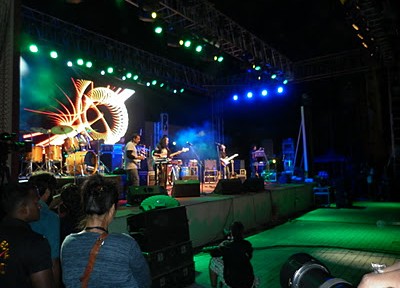
NH7 BACARDI WEEKENDER – ROAD TO HEAVEN

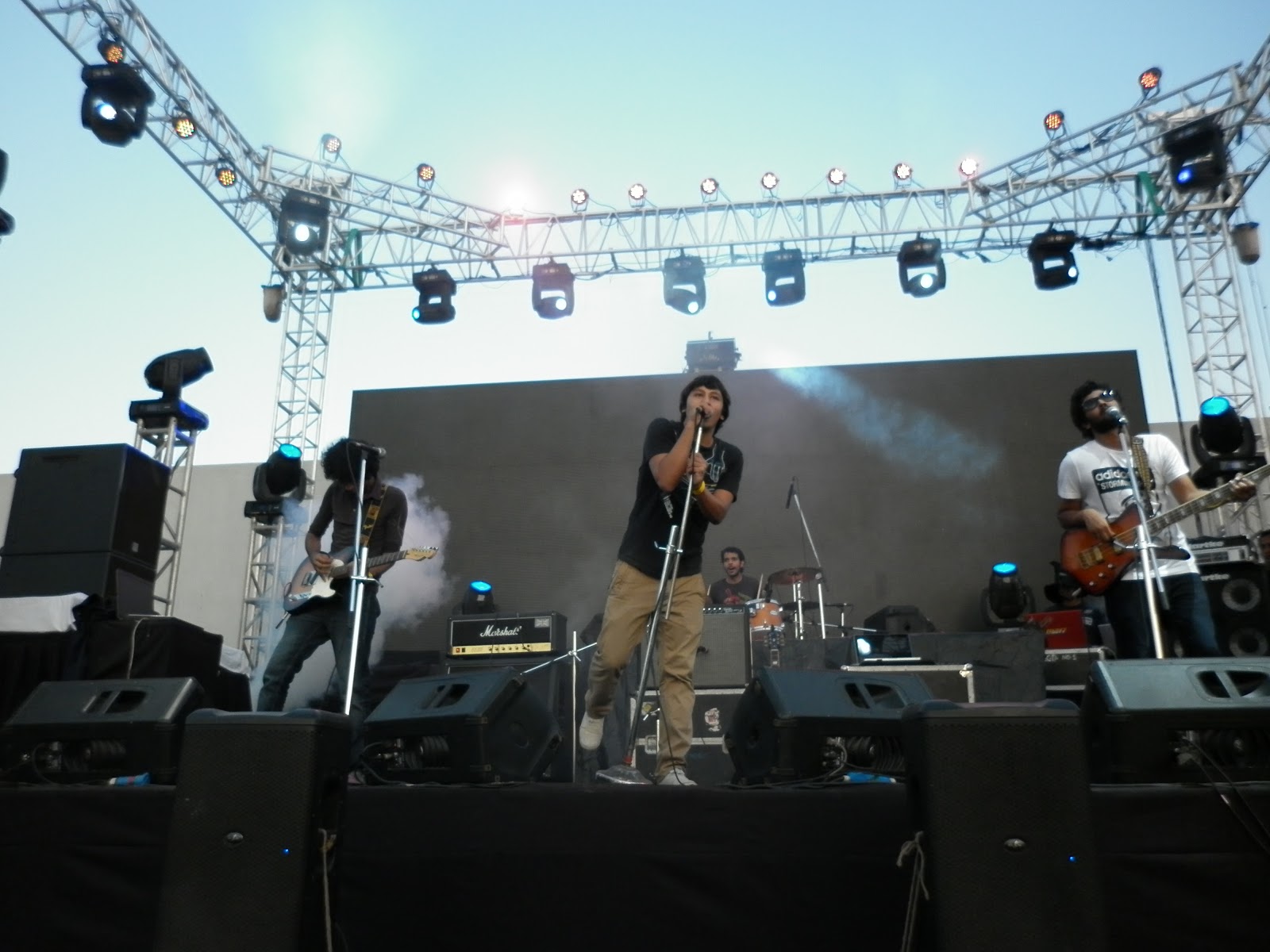
This is not an expert’s coverage of the NH7 Bacardi Weekender at Pune (from 18 to 20 Nov 11). That I am sure Arjun S Ravi would have done in NH7 and Indiecision and some of his coverage was live too. Nor are the photographs in the article even one tenth of the professional excellence, clarity and story-telling quality of Kunal Kakodkar’s. This is an ordinary music lover’s response at being amongst the music loving crowd during the music fest in Nov 11.NH7 Bacardi Weekender this year was simply great in its organisation, crowd response, and the gigs that participated. One can listen to the music and the songs on You Tube and one’s best hi-tech music system. But, there is nothing like the Live Experience. It is electric. It transports you into another world of excitement, love, ecstasy and happiness.

Papone and the East India Company at the Dewarist Stage

This year was probably the best assembly of gigs in an Indian music fest. There were five stages in all at the same Laxmi Lawns: The Dewarist, The Other Stage, Pepsi Dub Station, Eristoff Wolves Den, and Bacardi Black Rock Arena. The organisers need to be congratulated for having put up the stages, and the programme so meticulously. Arjun told me that most of it was done by his friend Dhruv and his team.

A view of the on-site admin office – Arjun and friends operated from here
Whilst the stages buzzed with music and crowd frenzy the organisers “quietly” (???) went ahead with their job

In addition to the music gigs, what makes an even like this special are organising and ensuring participation by the crowds; for example, the flea market selling anything from memorabilia to T shirts, hair dos, caps, hats, trinkets.

A happy visitor at the Flea (not free) market

Then there are food and drinks stalls and…hold your breath, a Tattoo Pavilion.

One of the many watering holes. The pictures collage at the rear wall is by Kunal Kakodkar and all the pics were lit at night

Even though the crowds were huge (when Imogen Heaps had the stage about 700 people had to be sent back due to no place available for the crowds to even stand), these were managed very well. At the parking lot, there was complete order. One of the newspapers brought out at the end of the fest that the policemen on duty had nothing to do since the crowds were so well behaved. They were in there to have a good time and they were genuine music afficiondos. Have a look at the total orderliness even at the entrance despite the ‘bouncers’ frisking everyone for drugs etc:

Entrance to the music fest

We enjoyed the music, the ambience, the young foot-tapping crowds with their lovely, colourful hair dos and head gear. To our surprise we found that Anna Hazare is the rage with the youngsters and Gandhi caps were the most preferred headgear:

An Anna Hazare Designer cap
This group of girls were always in these hats
A nice blue hair-do
Some more colours

As you entered the fest arena they gave you a Guide Book to the facilities there and a Pocket Guide. Both were very beautifully done and provided complete information about the stages, the programme, the artistes, flea markets, food stalls, watering holes etc. Here is Lyn holding one of these Guide Books:

A Gibson stall in the fest

Let me now give you a glimpse of  the Food stalls and the Tattoo shops in the Tattoo Republic

The armed forces bands play the Tattoo!
The atmosphere at the food-stalls

Before I go on to the music, the real reason for the fest, let me give you glimpses of riot of paints and colours:

Lyn trying to merge with the paintings.

As far as Music was concerned, there was so much to choose from. On the first day, Friday, the 18th Nov, there were three live stages: Eristoff Wolves Den, Pepsi Dub Station, and Eristoff Club Invasion. The gigs that played included Sky Rabbit (formerly Medusa), Midival Punditz, Ash Boy, Dualist Inquiry, Basement Jaxx, Jatin Puri, and DJ Swaggamuffin. Here is a pic of Sky Rabbit in action:

Sky Rabbit (formerly Medusa)

The second day was a delectable treat of music: On the Dewarists stage there were, amongst others Imogen Heap and Raghu Dixit. How did it go? Well, even though the crowds filled the lawns fully, they were not really on the grounds; most often than not they were airborne. Bacardi Black stage had, amongst others, Tough on Tobacco, Pentagram, and Blackstratblues. Eristoff Wolves Den stage had Reggae Rajahs.

The third day was sadly the last day. There were gigs like Scribe, King Creosote, Swarathma, Papon & the East India Company, Bhayanak Maut and Indian Ocean. In the end, another treat awaited the fans in the shape of Weekender All Stars on Bacardi Together stage.

See how neatly the organisers had worked out everything:

A Directions Map from the Guide Book


And an ‘Out of Toon’ Guide to the fest
And from these ‘before’ pictures, lets go to the pics of crowd frenzy, the vibrations, the rhythemic jumps, screams of joy and charged up atmosphere:

When the last of the gigs, Indian Ocean played there was not an inch of ground left to stand on. Well, no one was standing anyway. People were air borne most of the time. Lyn and I found a good vantage point to watch Indian Ocean live. Halfway through a girl tapped me from behind and said with becoming pleading, “Sir, you are tall you can watch from anywhere, can I come in front?” What would you have done? I did the same. She stood next to Lyn and watched and I felt like a boy scout having done my good deed for the day.

Lyn not allowing her place near the stage to be taken by anyone

There was a treat waiting for Lyn and I at the end of Indian Oceans performance. We could meet the versatile Rahul Ram of Indian Ocean and even take pics with him; all this courtesy Arjun:

Lyn and me with Rahul Ram of Indian Ocean

For Lyn and me another great and warm feeling was to be with Arjun; he lives music, breathes music. His friends say about him that other than music nothing registers in his mind.

Arjun looking satisfied with the response to NH7 Weekender and Lyn looking happy that Arjun is satisfied

The last item was the All Gigs Together and….like one often did with a long novel just before the ending, you didn’t want it to end.

The last item: Weekender All Stars – jampacked

On return, we were on the Expressway back to Mumbai and the only thought in our mind was: The real expressway (to heaven) was in Laxmi Lawns, Magarpatta City, Pune, from 18 to 20 Nov.

HINDI SONGS AND THE IMPORTANCE OF CHAND (MOON)

I am very fond of Hindi songs, especially old Hindi songs. Most of the lyricists of the era when I was small and later young wrote in Urdu. I have brought out elsewhere in this blog that Urdu – A Language of the Heart is best suited to give expression to the emotions of people in love. Indeed, I have often concluded that  poets and lyricists of yore must have been in love themselves to bring out such deep and meaningful thoughts in their poems and songs. For example, Kaifi Azmi’s “Dil ki naazuk ragein toot ti hain, yaad itna bhi koi na aaye” (why should I miss someone to that extent that heart’s tender threads should break down?) or Neeraj’s “Saara aalam hai giriftaar tere husn mein jab, mujhse hi kaise yeh barsaat sahi jayegi; aaj to tere bina neend nahin aayegi” (Complete ambience is as if captivated by your beauty; then how can it be expected that I should go through the rains without being with you? Tonight, I won’t be able to sleep without you)

One of the obsessions of the Hindi lyricist, or rather Urdu lyricist has been Chand (Moon). Some of the finest songs have been written on it.

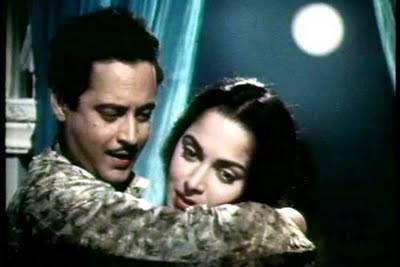
Having Chand in the lyrics has had various purposes; the commonest one being to describe the beauty of the beloved. It is difficult to pick the best in this category. However, I think my maximum votes would go to the 1960 song Chaudhvin Ka Chand (14th day moon or full moon). Shakeel Badayuni has carved out the words to perfection. I can’t imagine a woman listening to it and not being in a trance (as Waheeda Rehman was when Guru Dutt sang this for her in the movie by the same name). Ravi provided such excellent accompanying music that one cannot imagine the song without it. Finally, Hindi movies best singer ever, Mohammad Rafi sang it in such a way that the words seem to come alive. Sample just one of its three stanzas:

Chehra hai jaise jheel mein hanstaa hua kanval,
Ya zindagi ke saaz pe chhedi hui ghazal,
Jaane bahar tum kisi shayar ka khvaab ho.
Chaudhvin ka chand ho, ya aftaab ho,
Jo bhi ho tum khuda ki kasam lajwaab ho.
(Your face is like a lotus smiling in the lake,
Or you are a melody played on the instrument of life,
The Spring that you are, you are a poet’s dream come true.
Are you are a full moon, or a fairy,
Whatever you are, God knows, you are incredible.

Anand Bakshi penned some exquisite lines describing the beauty of a woman in his 1963 song, “Chand aahein bharega, phool dil thaam lenge, husn ki baat chali to sab tera naam lenge.” (Moon will mope, flowers will feel defeated; when they talk about beauty, all will only think of you). The song was sung by the most versatile singer of that era Mukesh. Another song of the same combine of singer-lyricist was the 1965 number: “Chand si mehbooba ho meri kab aisa maine socha tha; haan tum bilkul vaisi ho jaisa maine soch tha” (I used to wish that I’d have a beloved like the moon; yes, you are exactly like how I had wished)

Here is a variation from the great lyricist Hasrat Jaipuri for the 1967 movie Diwana (Crazy): “Ai sanam jisne tujhe chand si surat di hai; usi malik ne mujhe di to mohabbat di hai” (O’ my darling the one who has given you a moon-like countenance; the same almighty has given me something called Love):

Then, there is nothing like Chand as a witness of the lovers; a friend who can be asked by the lovers to do anything they want in love. There are many songs on this theme. The best is difficult to choose from amongst so many really good numbers. However, I would repeatedly listen to 1960 number sung by Lata Mangeshkar  and Mukesh for the movie Banjaarin (Bedouin). The lyricist was Pandit Madhur and music was provided by Pardesi: “Chanda re meri patiyaa le jaa saajan ko pahuncha de re; vo likh sakein jawab unhe tu mera pata bata de re” (Moon, my pal, take my epistle and deliver it to my Love; so that he should be able to write back, please tell him my address):

Talking about Chand as a friend or pal, how can anyone forget Raj Kapoor’s Aawaara (Vagabond) with this lovable number sung by Lata and Mukesh: “Dum bhar jo udhar moonh phere O’chandaaa, main unse pyaar kar loongi, baatein hazaar kar loongi” (Moon, my friend, if only you would turn your face away for a minute, I’ll love my love and talk to him a thousand things):
Raj Kapoor and Nargis in 1951 movie Aawara
Chand being directed to do things for the lovers also finds expression in this sad song from 1963 movie Dil Ek Mandir (Heart is a Temple (of love)). The combine is a very successful one of Shailendra Singh (lyricist) and Shankar, Jaikishan): “Ruk jaa raat thehar jaa re chanda beete na milan ki bela. Aaj chandni ki nagari mein armaano ka mela.” (Stand still Night, stop there Moon, let the tryst (of lovers) not pass. Tonight in the moonlit town is let loose the carnival of desires):

How about Chand building an atmosphere or trance or enchantment? Once again, there are many on this theme. Here, I don’t have to be confused about choosing the best. My favourite singer Hemant Kumar sang this for the 1952 movie Jaal (Net): “Yeh raat yeh chandni phir kahan, sun ja dil ki daastan” (This night, this moonlight will not come again; tonight listen to my heart’s tale):

Dev Anand in Jaal singing the best song ever on Moon

Talking about Hemant Kumar, there was no one like him to convey an entire ambience through his singing; he easily transported you to the world being talked about in his songs. His “Yaad aa gayin vo nasheeli nigahein” (Memories of those intoxicating eyes haunt me) remains an all time favourite with me. However, I shall talk about it when I write a post on my best Hindi songs on eyes (aankhein).

Getting back to being entranced by the Moon, here is another favourite: “Dil ki nazar se, nazron ki dil se; yeh baat kya hai, yeh raaz kya hai koi humein bata de.” You are bound to ask, where does Chand get into it? Well, here is a stanza: “Hum kho chale, chand hai ya koi jaadugar hai; ya madbhari yeh tumahaari nazar ka asar hai?” (We are being entranced, is it just Moon or a Magician; or is this the hypnotic effect of your eyes?):

https://youtu.be/t8vDu-C7u1Q

How about a combination of wet night with Chand as in: “Yeh raat bheegi bheegi, yeh mast nazaare; uthaa dheere dheere vo chaand pyaara pyaara“. The song is by Lata and Manna De for the 1956 movie ‘Chori Chori‘ with lyrics by Hasrat Jaipuri and music by the pair of Shankar, Jai Kishan. The song is one of the memorable duets between Raj Kapoor and Nargis:

https://www.youtube.com/watch?v=f1DZxkiMjRo

How about Chand being a witness to first expression of love as in “Dekho vo chand chhup ke karta hai kya ishaare; shayad vo keh raha hai, hum ho gaye tumhaar” (Look, the Moon, is beckoning us from its hiding place. Perhaps, it is saying I am yours now). The music director is Hemant, the singers are Lata and Hemant and lyrics are by SH Bihari for the 1954 movie Shart (The Bet):

One lovely Chand number was enacted by Meena Kumari and Sunil Dutt in 1962 movie ‘Main Chup Rahungi’ (I Will Keep Mum); Rajinder Krishan penned the lyrics and music was composed by Chitragupt. Mohammad Rafi and Lata Mangeshkar sang it very well indeed: “Chand jaane kahan kho gaya? Tumko chehre se parda hatana na tha.“(Where has Chand gone suddenly? You shouldn’t have lifted your veil):

Here is one from 1959 movie Anaadi (Novice) enacted by Raj Kapoor and Nutan and sung by Lata and Mukesh: “Vo chand khila, vo taare hanse, yeh raat gazab ki aayi hai. Samajhne vaale samjh gayen hain, na smajhe vo anaadi hain.” (There Moon has risen and stars are out, this night is really wonderful. Those who know can get the hint (to love) and the others? Well, they are just novices.):

https://www.youtube.com/watch?v=OvtU5FYxK-c

How about a proclamation of Love in terms of the age of celestial bodies like moon and stars? Easily the best number in this is, “Na ye chand hoga na taare rahenge, magar hum hamesha tumhaare rahenge.” (The Moon will cease to exist, the stars will fade away; but, I shall always be yours). The movie, once again, is 1954 movie Shart (The Bet) and the singers are Hemant Kumar and Geeta Dutt:
Chand, in Hindi songs, is not always supposed to bring good tidings; it is also a silent spectator when the lovers are pining. Time weighs heavily on the lovers when they are separated and they often measure the Time in phases of moon. For example, this one is an all time favourite with me from the 1957 movie ‘Paying Guest’ starring Nutan and Dev Anand; Majrooh Sultanpuri was the lyricist and music was composed by SD Burman:
Here is a 1977 number for the movie Alaap by Yesudas: “Chand akela jaaye sakhi ri, man mora ghabraye ri” (O’ friend, Moon goes alone and my heart is fearful); though it is mock pining:

A moonlit light is of no use unless your Love is with you. Even though the word ‘Chand’ or ‘Chandni’ does not occur in it, it is all about “Suhaani raat dhal chuki, na jaane tum kab aayoge?” (Moonlit night is long past its prime, I don’t know when you’ll come?) Moon is a part of the suhaani raat. This song has the Hindi movies’ best ever combination of Mohammad Rafi (singer), Shakeel Badayuni (lyricist) and Naushad (Music director):

To end let me talk about Meena Kumari’s immortal poem “Chaand tanhaa hai, aasmaan tanahaa“; the music is by Khaiyyam:

Chaand tanahaa hai, aasmaan tanahaa
Dil milaa hai kahaan kahaan tanahaa”

(The moon is lonely, the sky is lonely
My heart that I have is lonely everywhere)

Hindi songs fascination with Chand (Moon) is abiding.

I love Hindi songs; I love Chand.

MY YOUNG DAYS OF WATCHING MOVIES IN SOUTH BOMBAY

I joined the Indian Navy in 1973 and in 1975 I was a commissioned officer. I have many happy memories of the first few years of my career in the Navy that were spent in South Bombay. I was never into politics but it is my belief that internecine and dirty politics had not spoiled Bombay at that time. Bombay Police, for example, used to be compared with Scotland Yard in efficiency and reputation. In the services club, when we used to discuss such hair-raising incidents as advent of rogues and killers like Billa and Ranga in Delhi, we used to speak with great deal of satisfaction that such incidents won’t happen in Bombay due to the pro-active approach of Bombay Police.

How safe South Bombay was can be made out from the fact that it was a common sight to see young girls watch late night shows (though South Mumbai movies had to finish by 12:30 AM by local law) by themselves and then walk back home.

South Bombay prided itself in having the finest of the theatres patronised by decent crowds; the type who would be aware as well as well mannered: Regal and Strand in Colaba, Eros at Church Gate, Metro at Dhobi Talao, New Empire, Liberty and Sterling and later New Excelsior near Flora Fountain. There was Akaashvaani near LIC Building and one could watch good repertoire of movies there devoted to a theme. For example, I saw many of Raj Kapoor movies there during a fortnight devoted to his movies.

And what were the movies of those young days? In 1974, still an Acting Sub Lieutenant, I saw  The Towering Inferno in Eros. It was a done thing during those days to read the book and then see the movie. The movie ran in Eros for over a year. During the first few months it was impossible to obtain tickets in current booking. My uncle, my dad’s eldest brother, Tej Bhan Singh, had arrived from New York with his American wife, Betty aunty, and two daughters Kiran and Maninder. Kiran and Maninder had missed seeing the Inferno in New York and requested uncle if I could take them to see the movie. They hadn’t reckoned, though, that we couldn’t just walk in to see a movie in South Bombay without prior reservation. Anyway, uncle came to our rescue. He just walked to the Booking Counter where a large sign said ‘House Full’, and addressed the Booking Clerk thus, “Sir, would it be possible to get three tickets in the Dress Circle for my daughters and nephew?” There must have been something in my uncle’s personna because the Booking Clerk dished out three tickets. It was actually House Full and he put three moulded plastic chairs for us in the Dress Circle.

A scene from Towering Inferno
We were on the edge of our seats watching rescue operations

And what a movie it was; starring Steve McQueen, Paul Newman, William Holding and Faye Dunaway. We were at the edge of our seats with the excitement caused. The movie won three Oscars but left to us we would have given it many more. Hollywood was really very good at making disaster movies. Many years later when they made The Titanic and it was appreciated for its technical excellence, I was not surprised at all.

The Poseidon Adventure, a rescue from a ship that scuttled after meeting with cyclone at sea was another great experience. I saw it in Sterling. I hadn’t read the book before seeing the movie starring Gene Hackman, Ernest Borgnine, Shelley Winters, and Red Buttons. Once again the sitting on edge quality was the hallmark of the movie.

A tense scene from The Poseidon Adventure

One movie that really changed my life was One Flew Over the Cuckoo’s Nest. Jack Nicholson got the Oscar for it. Louise Fletcher played Rached and did it so well that I instantly hated her. The movie was so powerful that you didn’t walk out the same person from the hall. I saw it in Regal. The last scene where the supposedly loony Red Indian uproots the wash-basin in the hospital so as to throw it at the window and escape (and thus the name of the movie) is so intense that you had your hair standing on ends. You were silently willing him to do it. I would rank the movie amongst the best that I have seen. I read Ken Kesey’s book many years later.

By far the best movie that I ever saw: One Flew Over the Cuckoo’s Nest
She did her role to perfection and you felt like strangling her alive.

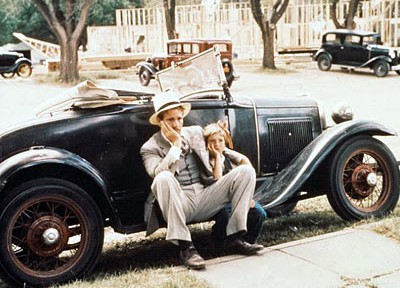
It wasn’t all disasters and hateful stuff all the while. Paper Moon was a gentle movie that I saw in New Empire. The movie was based on the novel Addie Pray and starred the father and daughter pair of Ryan O’Neal and Tatum O’Neal. Tatum, as Addie Loggins was born to a prostitute. It was rumoured that Ryan as Moze Pray was the actual father of Addie since he had had an affair with her mother. Ryan, however, was a conman and was determined to deny it. The last scene of them driving off together as father and daughter was touching.

Ryan and Tatum O’Neil in Paper Moon

Talking about conman, how can I forget The Sting that, once again, I saw in New Empire. Both Paul Newman and Robert Redford were there and the suave manner in which Sting was conducted would be probably in the same league as Count Victor Lustig who sold off the Eiffel Tower.

Superb acting by Paul Newman and Robert Redford in The Sting

Surprisingly neither Paul Newman nor Robert Redford got the Oscar for their acting in the movie.

I can go on and on since it was such great pleasure seeing movies at that time. However, let me just bring out two more before I go on to tell about some of the Hindi movies that I saw. Both these movies are important to me. Fiddler On The Roof was one of the greatest musicals that I saw, in Sterling theatre. The movie was an adaptation by Norman Jewison of a 1964 Broadway play about a Jewish family living in Tsarist Russia. The movie had an unforgettable role by Topol as head of the family with five daughters. As a poor Jewish father he had the task of finding the daughters their matches. The movie had most memorable songs such as Matchmaker, If I Were a Rich Man, Sunset Sunset, Do You Love Me?, To Life, and Far From the Home.

Topol with his wife and five daughters in Fiddler on the Roof

The other movie is really very dear to me: Chariots of Fire, story of two English track atheletes, one a devout Jew and the other a proud Christian. This was the first movie I saw with my newly wedded wife in Bombay. We had married in a mandir in 1981, prior to my parents according their permission almost two years later. As she joined me in a one room (bedroom, dining room, kitchen, and sitting room all-in-one) flat in Naval Coastal Battery Worli, I had bought a cutlery set, a few utensils, a fridge, bucket and mug, gas stove etc on instalments. Even in such indigence we went to see this movie. The movie won four Oscars.

A scene from 1981 movie Chariots of Fire

Let me now turn to some of the Hindi movies seen by me in South Bombay. South Bombay had the distinction, at that time, of not screening the run of the mill Hindi movies about rich daughter of smuggler in love with poor but upright hero; some of these financed by the smuggler Haji Mastan at that time. It would show Hindi movies with a difference. By far the most powerful of the lot was Garam Hawa (Hot Winds), a 1975 movie that I saw in Regal. The film, directed by MS Sathyu, dealt with the plight of a North Indian Muslim family in the years after partition of India in 1947. Balraj Sahni as shoemaker Salim Mirza, the head of the family, came up with a most memorable performance of his career. As one by one, Muslims left for Pakistan, Salim’s daughter found that her betrothed Farooq Sheikh (having migrated to Pakistan) couldn’t marry her since he had found someone else in Pakistan. She then turned her attention to Jalal Agha. Nothing was decided between them until they went to Fatehpur Sikri where a most poignant scene was enacted. Jalal Agha as Shamshad told her (Geeta Siddharth as Amina) about the Emperor Shahjehan entrusting the Queen Mumtaz with two pigeons whilst he’d be away for a short while. When he retured he found that she had only one pigeon in her hand. A little annoyed he asked her, “What happened?” And she says, “It flew”. He asked, “How did it fly?” and Mumtaz released the other one saying, “Like this.” However, since the story was already known to Amina, she held Shamshad’s hand half way by saying, “I won’t let the second one fly.” In the end Shamshad is arrested and she commits suicide by cutting her vein.

Balraj Sahni in the role of his lifetime in Garam Hawa

Once again in Regal Theatre I saw a great movie called Shatranj Ke Khiladi (the Chess Players). The movie directed by Satyajit Ray and based on Munshi Premchand’s short story by the same name, had a super cast of Amjad Khan as Wajid Ali Khan, Richard Attenborough as General Outram, Sanjeev Kumar as Mirza Sajjad Ali, Syed Jaffrey as Mir Roshan Ali, Shabana Azmi as Nafisa, Mirza’s wife, Farida Jalal as Mir’s wife and Farooq Shaikh as Aqueel. Mir and Mirza get so obsessed with the game of chess that they negelct their wives. There is a famous scene in the movie when Shabana starts having an affair with Farooq but Sanjeev insists, “Hum aaj kal bahut door ki sochte hain kiyunki hum shatranj khelte hain” (We look far into the future because we play chess). Because of such far-sightedness, they continue to play chess when the British marched their forces to take over Awadh.

Sanjeev Kumar and Syed Jaffrey in Sahtranj Ke Khiladi

Another movie that I saw during those days was a Vinod Khanna starrer Achanak (Suddenly) directed by Gulzar. Vinod Khanna as Manjor Ranjeet Khanna was to face gallows for having killed his wife Lily Chakravarty and her lover Kamaldeep who were having an affair when Vinod Khanna was away fighting for his country. When Vinod Khanna, running from the police, is finally caught, he is heavily wounded. Dr Chaudhary played by Om Shivpuri is entrusted with the task of reviving him so that he could face gallows in good health. An excellent movie with ironies galore.

How can I ever forget another one directed by Gulzar called Aandhi (Tempest) that I saw in Metro? The movie starred Suchitra Sen supposedly as Prime Minister Indira Gandhi and Sanjeev Kumar as a hotelier with whom Suchitra Sen had a love affair but with her engagement in politics it was not expedient to carry on. The movie had three excellent songs penned by Gulzar and music composed by RD Burman: Tere bina zindagi se koi shikva to nahin, Is mod se jaate hain, and Tum aa gaye ho noor aa gaya hai.

Suchitra Sen and Sanjeev Kumar in Aandhi

Once again, I can probably go on and on. However, let me end this by saying how an actor came on the scene like a breath of fresh air and during those days we were floord by the light heartedness of those movies. Yes, I am talking about Amol Palekar in Chotti Si Baat and Rajnigandha. During those days, heroes and heroines like Rajesh Khanna (I saw quite a few of them in Liberty, eg Ajnabee with Zeenat Aman), Dharmendra and Amitabh Bachchan (Sholay), Rekha (Umraao Jaan), Hema Malini (Sholay) were so larger than life that small timers like Amol Palekar and Vidya Sinha didn’y stand a chance in making a box-office hit. But such was Basu Chatterjee’s direction, Amol Palekar’s effortless acting, and Salil Choudhury’s lilting music of such popular songs such as Jaane man jaane man tere do nayan, Na jaane kyun hota hai yeh zindagi ke saath (title song), and Yeh din kya aaye; that the movie was a super-hit.

Amol Palkar in Chhoti Si Baat – breath of fresh air

Chhoti Si Baat was the second movie of that genre. Basu Chatterjee had earlier made Rajnigandha with the same cast and music by Salil Choudhury. It received the Critics Award in 1975, the year of my commissioning in the Navy. It too had two memorable songs: Rajnigandha phool tumhaare, and Kai baar youn hi dekha hai.

I live in Kharghar now, far from South Bombay; it is not even Bombay anymore. Every now and then I get overwhelmed with nostalgia of that era when I was young, when life was uncomplicated, when seeing a movie was such indescribable fun that it would create timeless memories. I feel like singing Gulzar’s exquisitely written lyrics for a 1975 song for the movie Mausam starring Sanjeeev Kumar and Sharmila Tagore:

“Dil Dhoondta hai phir vahi furasat ke raat din,
Baithe rahe tasavvur-e-jaanaan kiye hue”
(The heart once again yearns for those leisurely days and nights
When we could just sit back leisurely, and let our imagination wander)

RAINS AND OUR SONGS

Other day I read a beautiful quote: “Some people love to walk in rain; others only get wet.”
What makes the difference? You need to see Gene Kelly’s 1952 ‘I’m Singin’ in the Rain’ to know the difference. Listen to José Montserrate Feliciano García singing ‘Listen to Pouring Rain’ to know the difference. He was a blind Puerto Rican composer who couldn’t have seen the rain; but rain is not meant to be only seen.
Listen to the pouring rain,
Listen to the rain pour;
And with every drop of rain,
I love you more…

Let it rain whole night long,
Let my love for you go strong;
As long as we are together,
Who cares about the weather?
Listen to the pouring rain,
Listen to the rain pour.”

Rain means diffrent things to different people. To some it means an obstruction keeping them from what they want to do; they only get wet and are annoyed with the rain. Others enjoy getting drenched in the rain. It is a welcome experience.

 By and large, I believe, lovers love the rain as it brings them closer. An Urdu couplet says:

Badal tu itna na baras ke wo aa na sake;
Aur jab aayen to itna baras ke wo ja na sake”

(Translated:
“Rain cloud, hold on please so my beloved can arrive,
And when she does, pour so much that she can’t return”)

Various communities in India have different songs, in their own languages, about the rain. In the state of Uttar Pradesh (UP) since rains are brought by East winds (in Hindi “Poorba” or “Poorvaai”) they have songs about how pleasant is Poorba. In Punjab, the rains, called sawan (pronounced saunh) remind you of what all you can do during the rains, eg, eat fried sweet delicacies. So on with other states. Maybe Indians just love to love and love rains in many different ways.

Only a few decades back, when we were kids we were so eager to sing, “Rain rain go away; come again another day”. But now rains are welcome.


My favourite Hindi songs have a special place for rains (sawan).

Sawan ka maheena, pawan kare sore,
Manva re jhoome aise jaise banva naache more
(Rain month is here, the breeze touches you pleasantly,
Mind dances with joy in the manner of a peacock dancing in the forest)

In folklore, somehow, rains affect no one as much as lovers, and separated lovers at that. Taste this:


Saawan ke jhule pade hain,
Tum chale aao….
Aachal na chhode mera, pagal hui hai pavan
Ab kya karun main jatan, dhadke jiyaa jaise panchhi ude hain
(The swings for the rains are out, my love
Come be with me.
Playing with my stole, the breeze has gone crazy,
Now what should I do, my heart is beating like the flight of birds)

Or listen to the lyrics of Raja Mehdi Ali Khan in the 1967 movie Anita, with playback singer Mukesh singing these:

Saawan ke din aaye,Beeti yaaden laaye,
Kaun jhuka ker aankhen,
Mujhko paas bithaye;
Kaisa tha pyaara roop tumhaara,
Poochho mere dil se, hai
Tum bin jeevan kaise beeta, poochho mere dil se

(When the rainy days came,

They brought past memories,
Of the one who sat beside me,
With eyes looking down.
How lovely you looked, my love;
You have to ask my heart.
Without you how I lived,
You have to ask my heart)

Sawan must be a great all round friend for all of us that we get so excited by its arrival. According to me, and pardon me for getting mushy, if you haven’t ever enjoyed walking in the rain you are missing something in life. And, if the following (Mohammad Rafi and Lata Mangeshkar in Ishq Per Zor Nahin, a 1970 movie) doesn’t touch you, nothing will:


Yeh dil diwaana hai,
Dil to diwaana hai.
Saawan ke aate hi,
Baadal ke chhate hi,
Phulon ke mausam mein,
Chalte hi purvaai, milte hi tanhaai,
Uljha ke baaton mein,
Kehta hai raaton mein,
Yaadon mein kho jayun,
Jaldi se so jayun,
Kyunke saanvariya ko sapno mein aana hai
.”


Phoolon ke mausam mein
(This heart is crazy,
Crazy is this heart, because,
On the oncoming of rains,
In the shadow of the clouds,
In the season of flowers,
When the East winds blow, and when I am alone,
It gets me entangled in following talk,
In the nights:
Sleep quickly my master,
And get into the world of memories,
Because your beloved has to meet you in the dreams)

There are songs and songs on rains. Finally, my all time favourite is by the Music Director Salil Chaudhary, who composed music for this song from the 1960 movie Parakh in such a way that you not only get the pangs of separation but the pitter-patter of the rain that makes the separation unbearable:

“O sajnaa, barkha bahaara aayi,
 Ras ki phuhaar layi, ankhiyon me pyaar layi,

O sajnaa

Aisi rimjhim mein o sajan, pyaase pyaase mere nayan,
Tere hi, khvaab mein, kho gaye,

Saanvali saloni ghataa, jab jab chhayi,
Ankhiyon mein rainaa gayi, nindiyaa na aayi
O sajnaa …”

[lineate][/lineate](O Love, rainy season is here,[lineate][/lineate]That brings the spray of nectar (of love),[lineate][/lineate]And longing in the eyes.[lineate][/lineate]

A view from my house in Kharghar

[lineate][/lineate]In this pitter-patter, my love, my eyes thirst for,[lineate][/lineate]Dreams of you in which I lose me,[lineate][/lineate] Dark clouds of rain when they come,[lineate][/lineate]My eyes look for you in the nights, sleepless)[lineate][/lineate]

Saawan, folks, unfetters dreams…..

Follow

Get every new post delivered to your Inbox

Join other followers:

error

Enjoy this blog? Please spread the word :)

RSS
Follow by Email
YouTube
YouTube
Set Youtube Channel ID
LinkedIn
Share
WhatsApp
Copy link
URL has been copied successfully!