HAPPY NEW YEAR

There is absolutely nothing to suggest that God had intended any particular day or event to be more important or significant than the others. It appears that in God’s scheme of things every month, hour, minute and second is an old one dying and a new one being born.

And yet…

And yet we have special days: our birthdays and those of people close to us, our anniversary, graduation day and days of festivities.

New Year is really different. It appears that if we didn’t have something to peg our lives to there won’t be any beginning or end to anything.
HNY1

The Guru Granth Sahib talks about God being there before the Universe and that He would be there after the Universe. In the Bhagwat Gita there is a description of God saying that He is the Beginning and the End. Therefore, in order to avoid ourselves into falling into the illusion (actually reality!) of a Universe without Time, we have ourselves devised the Calendar year.

The other day I shared a discussion in latest issue of the Time magazine that until the sixteenth century there was no particular date to celebrate the Birth of Christ. According to the Bible He was born sometime in Spring. It was only then that the Pope decreed that it should be universally accepted as twenty-fifth of December. Nowadays, we have become so sacrosanct about this date that at the stroke of midnight on twenty fifth December we burst into sudden rejoicing for Christ having been born.

India too got its freedom from the British at the stroke of midnight, universally accepted as the beginning of a day.

It is really very convenient for us. Timelessness, as God had intended, would have killed us; we won’t have known what to do with it. In the olden days, we measured time by the Sun and the Moon or the changing seasons. Indeed, there are many Hindi songs about measuring time likewise; eg, “Chaand phir nikla, magar tum na aaye.” (Moon is out again, but my Love has still not returned); or “Tere bin saawan kaise beeta” (Love, do you have any idea of how I the monsoons weighed on me without you).

HNY2

There is an article in my blog titled ‘The Virtual World‘ on this issue. It may just be worth reading it to remember that the concept of Time that we have devised, just like any other virtue, makes all of us to live in a Virtual World. And yet, when a lover gets affected by Time playing tricks on him awaiting his love, we tease him for living in a world of his own.

So, there is as much New about the New Year as is about every moment.

HNY3

However, having said that, lets realise that Time is amongst the best known discoveries or inventions of Man. If it hadn’t been for it, Life would go on without any newness! Everyone would use relativity of time (which it is) than absolute terms to describe events, eg, Boss to Employee, “You are later than Sunita in coming to office but, you are earlier than Rakesh. Next time, be earlier than the most”.

Or, the train is late today but is earlier than it was last summer.

Or, Happy New Year to those in India now. In Europe, wait for another few hours.

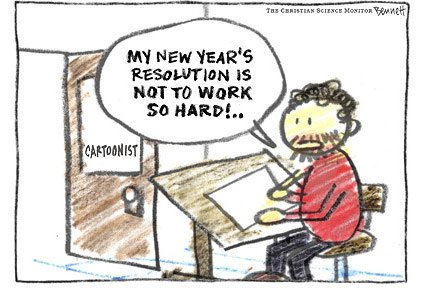
Since all this is, in any case, an illusion (maya), there is one thing that depicts it really well; it is the New Year Resolution. Since, we set the meter to beginning or start again, we are filled with great resolve to reset our Life starting….well, you guessed it…the stroke of midnight. Some of the popular resolutions are:
HNY4

  • I shall lose weight.
  • I shall give up smoking/drinking.
  • I shall stop worrying.
  • I shall be kinder to my parents.
  • I shall become leaner and fitter.
  • I shall stop lying about small things.
  • I shall become more punctual.

The illusion of these resolutions lasts for a few days and then we realise that the year has become as old as everything on earth must and we don’t have to treat it with renewed resolve. We slip back into timelessness!

So, friends, Happy New Year 2011
HNY5

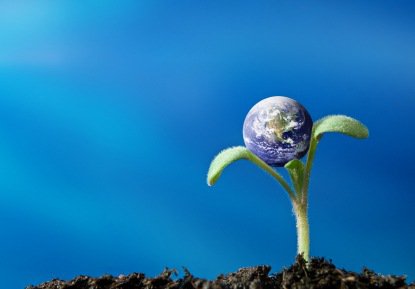
I resolve that in 2011 I shall write at least fifty percent articles about things that at least fifty percent of the people around me can understand if they find time to read them. For the others who actually rejoice in ‘Ignorance is Bliss’ (which is exactly how God intended it to be):

Aage bhi jaane na tu,
Peechhe bhi jaane na tu;
Jo bhi hai, bas yehi ik pal hai”
(Future is unknown to you,
Past is not known,
What IS, is only this moment)

Rejoice!
SOUNDS OF SILENCE

“The stars of midnight shall be so dear,
For her and she shall lean her ear,
In many a secret place;
Where rivulets dance their wayward round,
And beauty born of murmuring sound,
Shall pass into her face”.

Despite our love for silence that Wordsworth and others wrote endless verses about, the fact is that sounds and noise never leave us. We want to hear, we want to be heard.

As soon as a child is born, we want to hear him or her make a sound..any sound. For, unless you make a sound, there is no proof that you are alive.

Is life a cacophony in which the louder you are the more powerful you become? Or, is the reverse true? Despite all the shibboleths such as ‘silence is gold’, we commonly associate silence with the meloncholic, sad and poignant. Happiness and joys, on the other hand, have sounds…happy sounds.

“Hontho ko si chuke to zamane ne yeh kaha,
Yeh chup si kyun lagi hai aji kuchh to boliye”
(The moment I sewed up my lips, the world asked me:
Why does silence reign? Speak something at least.”

According to the Hindu religion silence within and without is the attainment of greatest joy. The Hindu philosophy has it that even thoughts make sound. And, if you can shut off all sounds, even those of thoughts, you are one with your God.

And yet, we never want to be silent. Honking, crackers, screeches, shouts, loud speakers and even blasts become parts of our life. We go as far away from tasting life as from the true flavour of tea by adding sugar.

There is so much to be heard in silence but we become immune to it. Here is how Wordsworth described it:

“THE world is too much with us; late and soon,
Getting and spending, we lay waste our powers:

Little we see in Nature that is ours;
We have given our hearts away, a sordid boon!”

“See it with your heart, ’tis mere joy” said he. Guru Nanak too described it as a music that can’t be heard with the worldly senses given to man.

“Chup hai dhartii, chup hain chaand sitaare,
Mere dil kii dhadakan tujhako pukaare.”
(The Earth is silent (my love)
And so are the moon and the stars,
The only sound that is there,
Is that of my heart beat calling you.”

No, silence can’t be sad or stifling or melancholic.
Silence is the beginning of the condition,
In which you hear sounds you had never heard before.

Try it.

JO BHI HAI BUS YEHI IK PAL HAI

I am so unsure of myself when I glance at forecasts, horoscopes and what the stars foretell. The reason is that I don’t know whether to believe or not. However, I often read the horoscopes to confirm that my experiences are – laugh if you want – according to some cosmic plan! Amongst all the forecasts, I found that the late Peter Vidal’s were the truest for me. Lately, I found that the Blackberry’s daily Horoscope comes close to my situation. Here is my Horoscope for today:

“You are stuck in a rut, Gemini, and the stars are urging you to dig out of it. What? You did not know you were stuck in a rut? That’s the worst kind of rut – the one that you don’t know you’re in. If you are feeling a bit stifled or if it seems you have become lost in a particular routine, you need to shake things up. It isn’t that staying this way will harm you, but going beyond your current pattern will be the first step in building a bridge that can take you to a much more attractive place. Don’t be afraid of change.”

It can well be argued that it is a very general statement and with a little variation can fit just about anyone. However, I am surprised at the confirmation of my current state of mind. Is there something to it afterall?

I don’t know whether the total people on earth can actually be divided into just twelve categories, but, I do know that shaking things up is something that a Geminian is actually good at.

Out of all people on earth, it is probably a Geminian who can be at home singing Kishore Kumar’s ‘Door Ka Rahi’ (Long Distance Traveller):

“Rehguzar mein kai manzilen bhi mili;
Dekh kar ek pal, dam liya phir chale.
Khushi do ghadi ki mile na mile.
Shama aarzoo ki jale na jale.
Har kadam par naye marhale the khade;
Ham chale dil chala, dil chala ham chale,

Khushi do ghadi ki……”

(On the way, I came across many a destination;
I saw, rested a while and moved on.
I may not get the joy of the moment,
I may not get to see my desire fulfilled.
At every step I found new stops,
I moved, heart moved,

Heart moved, I moved.

I know that when you move on, the criticism that hits you is that you don’t care; you are heartless. Here too I know for sure that a Gemini is probably the most emotional of the lot; the most caring in his/her special way. But, a Gemini is bored with trying to make music with a violin with strings deliberately loosened to make wrong or ugly music. How many times a Gemini is expected to tighten the strings to liven up the music? Why should it be his/her complete responsibility to make things work.

In the end, the more you stick, the more you want to make it work, the more it is uncharacteristic of a Gemini.

No one understands more than a Gemini that:

Jo bhi hai bus yehi ik pal hai.
(All that is there is just this moment)
and…
Dust thou art
and dust returnest
was not spoken of the soul.

INSTANTLY

If this appears deceptively similar to Cliff Richard’s famous number ‘Constantly‘, the similarity stops there. No one has the time these days to do anything constantly let alone to walk in a dream and think about one’s love. These days the world moves ‘instantly‘. No one has time to deliberately do anything or deliberate over things.

At one time we used to hear a song over the Short Wave radio and then hope to hear it again over the next few months. In order to remember the lyrics we would sit with a paper and pencil when the Geetmala would be broadcast again and, if there would be no disturbance on the shortwave, we would be able to fast write the lyrics, or, most of those. Nowadays, we download any number from the You tube and not only hear it but also see its video; and, have its lyrics before us instantly.

Take the case of photographs. Even though it is obvious, let me say it. Earlier we used to take pictures of the family during the holidays or engaged in diverse activities. We used to get them printed and stick them in the family album and then invite unsuspecting guests at home; and sort of lead them into viewing our album. They were forced to show interest whilst waiting for the dessert to be served (No one ever took the risk of showing those pictures after the dessert). But nowadays, we put them up on facebook even when the event is going on and enjoy the attention. The plus point is that we don’t get to see the yawns and the furtive glances at the watch.

Remember how we used to cringe when visiting a friend’s house and the couple insisting that we must see merit in their son Gaurav performing as Gabbar of Sholay with a dacoit’s belt loosely hanging from his shoulder. Now we go through the videos in our own time. We don’t have to match our comment, “How cute Gaurav looks!” with our own (disgusted) looks. In addition, we can instantly subject the sender to some return torture (like return gifts on birthdays) of seeing our own son Vivek doing the rendition of Michael Jackson’s moonwalk.

Television too projects pictures and news for us instantly. Gone are the days when a politician’s denial of his involvement in corruption would be read after a week. Nowadays, thanks mostly to his media-managers, his denial appears instantly whilst the scam is being aired. Do you remember when Pramod Mahajan was shot? When he was battling with life, the media used to instantly show details of his innards, knowing well that most of us are genuinely interested in the inner news.

At one time we used to deliberate over national and international issues and then form our views and much later express these. Nowadays, Twiiter has made sure that important views of such leading personalities as those who specialise in having views on everything under the sun are instantly available. It is another thing that we had never known that these worthies had any views on anything until then; but, then, a view is a view. Everyone, from Obama to O’ mama, is reduced to 140 characters.

Earlier, we would get news from the battle front days later. Nowadays, the scenes of the battle are instantly flashed before us even as the first shots are fired. Many so called war-correspondents vie with one another in reaching news to us before the bullets hit the targets.

Thankfully, in all this intantaneity there are two things that still move at leisurely pace and we are sure never going to change. One is something called a ‘File‘ in government offices. Its movement is exactly at the same pace as, say, in 1949. From noting number 1 to 478, all aspects of the case are deliberated upon at great length. Some of these notes are tagged Immediate, Most Immediate, Urgent etc but there is never any undue hurry. Five years later, the File, knowing that in the fable of the Hare and the Tortoise, it is the latter that wins, crawls even slower than the tortoise.

The second is the Indian judicial system. A fast moving case is often the one, which has advanced from being posted to its fifth hearing in about five years time.

In most other things everything is instantly done. For example, it used to take many years from love at first sight, to marriage, to children, to divorce. Nowadays, before you can switch channels on a television the divorce is through and the guy, having been instantlyfree again, is enjoying honeymoon with the second wife in Pattaya.What about instant fame? Have you forgotten Prince? He became instantly famous and rich by the sheer bad luck of falling in a 40 feet open hole; the exact opposite of golfing term, that is, one-in-hole.

Many of us, however, still miss the slow pace at which things used to move. There were no ATMs, no cell phones to instantly connect to people, ODIs and T 20s. There were no prizes for reading books fast or pressing the button in fastest finger first.

Oh, how we miss those slow moving days? “Dil dhoondta hai fursat ke chaar din...” (Heart searches for those leisurely days).
Alas, no more.

EVER THOUGHT WHY – PART I

Sometimes back, on Twitter, I started a new string called ‘Ever Thought Why’. The idea was to marvel at commonplace things and why do they happen the way you do. Here are some:

  • People who claim to be the most virtuous are often the worst?
  • Memories that you thought you had buried forever resurrect when you least expect them?
  • People who bring most happiness to you also hurt you the most?
  • Clouds make lovely shapes in the sky but these shapes vanish the moment you start to identify them?
  • It is easier to forgive others but very difficult to forgive yourself?
  • When buses and trains meet with accidents infants and small children often survive?
  • Life seems longer at times and shorter at others?
  • Thoughts that used to make you happy at one time, make you sad now?
  • You fume, fret and toil to get something but finally you get it without too much of effort?
  • A stashed away note, poem or story gives more joy on being re-found than when you originally read it?
  • Scorching sun lasts the whole day but that enchanting sunset over the sea gets over even before you start admiring it?
  • When you are closest to solving a problem it is exactly the time when the distractions are the most?
  • People have little time to listen to your problems; but, can talk for hours about their own?
  • The music of younger generation will always be annoying to the older generation?
  • Thirty years appear a long time when you look ahead but appear so short when you look back?
  • Butterflies are so beautiful but they never sit at the same place for any length of time?
  • When you have Time and Money you no longer have the Inclination?
  • Some days are longer than others that pass off so quickly?
  • Those we place on high pedestal often slip to the lowest levels?
  • Money is never enough!
  • We easily forget the things we want to remember but find hard to forget those we want to?
  • Most people prevaricate and come up with exalted theories when faced with the truth and facts?
  • Green grass rushes in more memories than the best plants and trees?
  • There is no higher feelig than Love but many a times it also makes you feel at your lowest?
  • The ‘Possibility’ of a thing occurs to us when we say “It’s not possible”?
  • When you finally come to the end you discover it is another beginning?
  • Life’s always talked about as behind us whereas it is what lies ahead; where one is going is more important than where one was.
  • It takes many things to make a person happy but it takes very little to make him sad?
  • Things never work unless we make them work?
  • It is easier to give advice than to follow it?
  • A towel should ever get dirty?
  • We resolve not to see another Bollywood movie or to see a Cricket match but we always do?
  • When one makes up one’s mind never to repeat a mistake one is not given another chance?
  • We call a person very interesting? Well, simply because he is a good listener?
  • People are bad when they cannot keep their word; but, when you break a promise it was unreasonable demand to start with?
  • Love too needs to be nurtured and cannot be left to itself to grow and become stronger?
  • Tears and rain have the same ingredient but the former is really more precious?
  • One can be totally alone amongst friends too; conversely, totally crowded by just one person around?
  • It requires courage to do things right away but cowardice to keep postponing it?
  • It always starts with a bang but ends with a whimper?
  • The words “next time” do not quite bring out the sincere intention but sound more as an excuse?

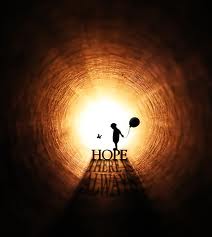
WHY HOPE?

There is the story of a doctor having told a patient that he had tried everything to save the patient and had finally come to the conclusion that nothing would work at that hopeless stage. “Is there anything that you would want to do before you die?” the doctor asked. Even though the patient was feeble and despondent, his response was prompt, “Yes, I would like to see another doctor.” Truly, life exists for us as long as hope exists. Robert Browning, the great poet of hope and optimism, in his poignant poem titled ‘Evelyn Hope’, had this to say at her death:

“So hush, I’ll give you this leaf to keep,
See, I put it in the cold white hand.
Now there is our secret that goes to sleep;
You will wake up and remember and understand!”

We may not be aware but a considerable part of our day is taken up with hopes. These are routine hopes. Small or big but they keep us going. Here are a few examples:

  • We hope that the number that we have dialed, especially if it is that of Railway or Airport Enquiry would not be engaged.
  • We hope that the milkman or the maidservant won’t be sick the next morning.
  • We hope that Indian and especially Mumbai roads would improve.
  • We hope that there won’t be a wedding party in the club next door so that children could study.
  • We hope that finally after finishing the work around the house when we step into the bathroom the water won’t play truant.
  • We hope that no one would ring the doorbell when we watch our favourite TV programme.
    We hope that the boss in office won’t think of another new and bright idea.
  • We hope that when finally we get our turn, the doctor won’t be called for “something important”.
  • We hope that sanity would somehow return to Pakistan.
  • We hope that finally we would be able to repay the house loan so that we can start calling it ‘Apna Ghar’.
  • We hope that the next Hindi movie that we watch would have a different story.
  • We hope that one day the duration of TV programmes would be more than that of the advertisements.
  • We hope that our politicians, bureaucrats, and police personnel would understand the true meaning of the term ‘public servant’.
  • We hope that the noise during the forthcoming festival season would be restricted and public places such as roads would be free for the use for which they are made.

There is no end to it. We hope and hope and hope. Sometimes, some of our hopes come true directly or indirectly and make us happy. However, always it is worth hoping for. Our son, for example, is a die-hard Indian cricket team fan. They can be 143 for 6, requiring another two hundred runs to win but he still hopes that they would win. Once he was proved right, the night when even Kaif’s parents went to see ‘Devdas’ rather than be witness to sure ignominy. Since then, it is not he but we who hope. We hope that there won’t be another ODI during the exams!

Hope is like sunshine through the clouds. It is like raindrops on parched land. Hope is a lighthouse by which we steer our ship in troubled waters. However, hopes transcend the boundaries of mere wants and desires when we do so selflessly. Supposing all people on earth would hope that poverty, hunger and violence would be wiped out forever; do you think they would stay? Supposing some of us would hope to see the smile on the face of a child who lost his parents in bomb blasts, do you think it would never come back? How wonderful the world would be if each of us would hope for something for others at least once in a month!

The other day I was reading about Mata Amritanandamayyi. Why would everyone, from famous to rich, from poor to hungry, from strong to helpless come to see her or be hugged by her? She hopes for others and provides them with a ray of hope.

Yes, it is alright to hope for promotion, for a better house, for a gift or reward, for a holiday and more pay. It is even okay to hope for “zara si lift kara de.” However, once in a while one must hope something for others.

“Lead kindly light,
Keep thou my feet.
I don’t want to see
The distant scene;
One step enough for me.”

In a small village called Ayikuddy near Tirunelvelli, my wife and I went to see a polio rehabilitation centre called ‘Amar Seva Sangam’ and discovered the very embodiment of Hope. The President and all staff of the centre are invalid. The President, Mr Ramakrishnan, is so paralytic that he requires help to even turn in bed. His condition became so when he had an accident many years ago at the time when he was about to join the Navy as a commissioned officer. Yet when we saw him he had the most beatific smile on his face. He runs a centre that provides succour to other polio stricken children. In his hopeless situation he provides hope to hundreds of young boys and girls! After that whenever our own situation is unfavourable, our faces light up when we think of him.

Hope never dies. Next only to Life, it is the second greatest gift of God to us. Why hope? Hope, so as to live better and make others live better. Some four letter words are not bad at all!

MUMBAI RAINS

Now that the monsoons are here in Mumbai again, I keep thinking that there is no other season or weather that can fill one with as deep and different emotions as the rains. There is a little something in these for everyone.

Hindi movies have always used Saawan or rains for varied purposes. The most common is the longing that the village belle feels for her lover who has gone to pardes (out station) and has not returned even when the romantic season is here. Taste this: “Saawan ke jhule pade hain, tum chale aayo (Swings are out on the trees during rains; come to me, my love”; or “Saawan ke din aaye, beeti yaadein laye..(Rainy days arrived again; bringing with them lost memories”.

As far as titillation is concerned, there is nothing like rain to wet the saree of the heroine and give alluring glimpses of her sumptuous assets. The sensuousness of a Bollywood actress is often measured against the scale of her revealing herself whilst doing the rain dance. The heroine sings that her heart is going “dhak dhak” but actually that is the effect of the song and the dance on the audience.

Drops of rainwater falling over a pond and causing small ripples are an enchanting sight. And if one is to watch these whilst listening to the crickets and the plonk plonk of the drops, one would be filled with an overwhelming desire to be out walking in the drizzle. A boat in the lake in soft drizzle is another picturesque sight.

In a city like Mumbai or for that matter any Indian city facing perpetual water shortages, rains signify the abundance of this scarce commodity. Many people just walk in the rain to have a bath they had promised themselves long back. Many leave buckets and pans in the open to fill these up as never before.

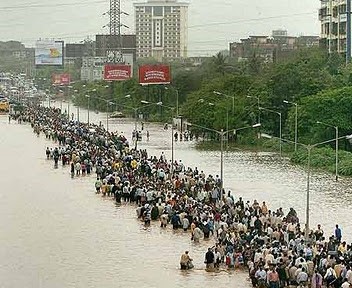
Rainy season is a favourite for unplanned holidays or breaks from work. It is because Mumbai’s transportation system comes to a halt with anything but light rains. Schools and colleges are closed and offices are forced to let off their staff either early or for the days when it rains heavily. Walking on the roads is the most dangerous exercise one can indulge in. As you gingerly find your way on the flooded roads and you only manage to find your foot in the pothole you have luck on your side; you manage to return home with minor injuries. However, if your foot finds an open manhole (such manholes are often left open by the municipality to add to the adventure of being in Mumbai) you are instantly one with God.

Rains are also a good excuse for not doing anything or for postponing things. After you have chosen your furniture at the neighbourly shop and paid the advance and you await delivery, the rains break out. You are left high and dry, nay, low and wet. “Let the rains get over”, your friendly shopkeeper informs you, “and I will make sure your sofa set is delivered promptly”.

Rains in Mumbai also result in essential cleanliness of our squalid surroundings or at least some of the muck is hidden in the waters. The perpetual dust settles down. Since we have this compelling urge to litter, rains instantly carry our wrong-doings away from us. Since a large number of Mumbaiites are used to urinating, spitting and defecating in public places, rains promptly absolve us of the guilt of our irresponsible conduct. In this way we can continue to blame the authorities for not making our areas hygienic and mosquito free whilst assuring ourselves unrestricted use of the freedom we won so dearly.

All other seasons you face on your own but there is great togetherness in the rains. Don’t believe me? Well, try being the only person who carries an umbrella when it starts pouring and see how many people will engage you in close conversation under your umbrella. You suffer together waiting for the BEST (named so that you won’t call them WORST) buses to arrive, shifting from one end of the bus stop to the other as the rain changes direction with the breeze. A kind of kinship is cemented that you had never dreamt of. In one of the Mumbai ads, a man instantly marries his son off to a girl whose father was kind enough to provide him shelter in pouring rain.

And then there is family-togetherness. Rains are the best season for the lady of the house to be making and serving maalpuras, pakodas and other fried stuff whilst the rest of the family watches TV in knee deep water. No guests are expected during this weather and you can have all the goodies to yourself. Conversely, you can avoid going to grouchy friends by the handy excuse of rains, “ All of us were ready to come and be with you for the bhajan-kirtan (hymn singing) and then it started raining”.

Rains are thanked profusely by our local milkman; in other weathers he has to depend upon the unreliable municipal water to make his fifty litres into eighty, but, during rains he does not have to do much to increase his earnings. Many Mumbai families stash the raddi (old newspapers and magazines) during other seasons and sell these during the monsoons when they absorb moisture and their weight increases.

Rains are loved by the Mumbai media ever starved to break news. During other seasons there is nothing much to report. But, during rains the media can forever indulge in such populist topics as trashing authorities for being insensitive to people’s basic needs.

Our dog Roger loves the Mumbai rains. The duration of his walks increases and he just loves to wade through pools formed on the walkway. If he could write he would write to the Mayor thanking him for having such pools everywhere. The Mumbai media would hate him for doggedly taking on their watch-dog role.

With all this, there is nothing like Mumbai rains. If you have stood under the shelter of a tree with a paper cone holding singdana (roasted peanuts) or bhutta (corn roasted on coal), you are bound to break into song, “Ai dil hai mushkil jeena yahan; Yeh hai Bombay, yeh hai Bombay meri jaan (O’ my heart, it is so difficult to live here; it is Bombay, my love)”.

Follow

Get every new post delivered to your Inbox

Join other followers:

error

Enjoy this blog? Please spread the word :)

RSS
Follow by Email
YouTube
YouTube
Set Youtube Channel ID
LinkedIn
Share
WhatsApp
Copy link
URL has been copied successfully!