THE BEST GUITAR SONGS IN THE HINDI MOVIES

These are not merely the songs on guitar. But, these are also the songs in whose scene the guitar is to be seen prominently.

The curious thing about the instrument guitar in the Hindi movies is that the guitar is a fashion statement; the hero or the heroine swings it any which way – across the shoulder, left and right like a man gone berserk with his carbine, or even to rotate it around on the floor a la Zeenat Aman style. Very rarely you come across a song in which the singer actually strums on the guitar throughout the song; most often than not the song starts with the singer strumming the guitar and then forgetting all about either strumming or the guitar itself.

One Music Director who really mastered the acoustic guitar in his songs was Sachin Dev Burman. As soon as you think of the acoustic guitar on the Indian scene, you think of Goa and that’s where Guru Dutt’s 1952 movie Jaal (the Net/Trap) was based; the second movie after Baazi in which Guru Dutt starred Dev Anand.

Dev Anand, as Tony Fernandez, is a good-for-nothing man who comes to a fishing village in Goa with a strange girl Lisa. There Tony seduces a Carlos’s (KN Singh’s) daughter Maria (played by Geeta Bali). Maria is cautioned not to fall for the no-gooder Tony but so strong is the seduction that she cannot help herself. Finally, pure Catholic love of Maria wins over the waywardness of Tony.

Sachin Dev Burman brought the seduction so well through the acoustic guitar that the song is still considered the best that Hindi movies have to offer in this genre. Sahir Ludhianvi, who often penned the lyrics of Guru Dutt movies songs (as in the classic Pyaasa) wrote the lyrics of this song. My favourite singer Hemant Kumar himself sang the song.

Please enjoy the irresistible seduction of acoustic guitar in the iconic song: Ye raat ye chandini phir kahan sun jaa dil ki dastaan……….

ye raat ye chaa.Ndanii phir kahaa.N
sun jaa dil kii daastaa.N
ye raat…

pe.Do.n kii shaakho.n pe soii soii chaa.Ndanii
tere khayaalo.n me.n khoii khoii chaa.Ndanii
aur tho.Dii der me.n thak ke lauT jaaegii
raat ye bahaar kii phir kabhii na aaegii
do ek pal aur hai ye samaa, sun jaa…

laharo.n ke ho.nTho.n pe dhiimaa dhiimaa raag hai
bhiigii havaao.n me.n Tha.nDii Tha.nDii aag hai
is hasiin aag me.n tuu bhii jalake dekhale
zi.ndagii ke giit kii dhun badal ke dekhale
khulane de ab dha.Dakano.n kii zubaa.N, sun jaa…

jaatii bahaare.n hai.n uThatii javaaniyaa.N
taaro.n ke chhaao.n me.n pahale kahaaniyaa.N
ek baar chal diye gar tujhe pukaarake
lauTakar na aae.nge qaafile bahaar ke
aajaa abhii zi.ndagii hai javaa.N, sun jaa…

https://youtube.com/watch?v=dBw_JSiNF9c%3F

Yes, this iconic song doesn’t have the singer strumming the guitar; but, then, you can hardly ever come across a better guitar song in the Hindi movies. It is guitar all the way; so much so that it is hard to imagine this song without the guitar.

This has the consistent magic of the combine of Shailendra with Shankar Jaikishen as Lyricist and Music Director. Lata Mangeshkar sang this for the 1960 movie Dil Apna Aur Preet Praayi. Shankar Jaikishen bagged the best Music Director Award for the movie.

The story of the movie takes you to my home-station Shimla where Raaj Kumar as Doctor Sushil Verma is doctor in the hospital. Meena Kumari as nurse comes to the hospital and since they are together in a difficult operation, they come close to each other.

The story takes a turn when Doctor Sushil’s mother organises a trip to Kashmir. Doctor Sushil is to marry Nadira (Kusum) in gratitude to Nadira’s father for having paid Doctor Sushil’s medical studies fees! It is on this occasion that the song is sung.

With the story, now, you will identify with the lyrics, the now happy, now sad notes and the rueful atmosphere in a boat. More than rueful, it is enigmatic.

Please enjoy: Ajeeb dastaan hai ye….

ajiib daastaa.n hai ye
kahaa.N shuruu kahaa.N khatam
ye ma.nzile.n hai kaun sii
na vo samajh sake na ham
ajiib daastaa.n…

(ye roshanii ke saath kyo.n
dhuaa.N uThaa chiraag se) -2
ye Kvaab dekhatii huu.N mai.n
ke jag pa.Dii huu.N Kvaab se
ajiib daastaa.n…

(kisiikaa pyaar leke tum
nayaa jahaa.N basaaoge) -2
ye shaam jab bhii aaegii
tum hamako yaad aaoge
ajiib daastaa.n…

(mubaarake.n tumhe.n ke tum
kisiike nuur ho gae) -2
kisiike itane paas ho
ke sabase duur ho gae
ajiib daastaa.n…

https://youtube.com/watch?v=eJLdL5_QkVo%3F

Why do I like this guitar song from the 1968 movie Kismat (Destiny) so much? Is it just because of the enchanting guitar notes brought into the song by OP Nayyar whose music direction ensured that he invariably had the maximum number of hit songs in his movies be it Kashmir Ki Kali or Phir Wohi Dil Laya Hoon. He even made songs that the comedian Johnny Walker sang (including the iconic Aye dil hai mushkil jeena yahan….ye hai Bombay meri jaan). Yes, that’s there. But, the song also has Biswajeet acting on the guitar in a club/hotel and he is not just effectively strumming the guitar but also has the right body-language throughout the song. SH Bihari, who wrote lyrics for OP Nayyar in Kashmir Ki Kali too, penned these too. The song has been sung by Mahendra Kapoor, which is not surprising at all considering that even Manna De sang guitar songs!

Please enjoy: Laakhon hain yahan dilwaale par pyaar nahin milata….

laakho.n hai yahaa.N dila vaale, aur pyaar nahii.n milataa
aa.Nkho.n me.n kisii kii vafaa kaa, iqaraar nahii.n milataa

mahafil mahafil jaa dekhaa, har dil me.n samaa kar dekhaa
har saaz pe gaa kar dekhaa
dil ko kahii.n chain naa milaa – 2
mai.n to duniyaa me.n pyaare akelaa hii rahaa
laakho.n hai yahaa.N …

is dil ko kahaa.N le jaae.n, kuchh aap agar faramaae.n
to aap ke ham ho jaae.n
kah do hame.n ha.nsake zaraa – 2
ajii jo kuchh bhii dil ne tumhaare hai kahaa
laakho.n hai yahaa.N …

https://youtube.com/watch?v=lzqA4kjBHK8%3F

Ravi, my namesake’s song too in the 1962 Shammi Kapoor and Shakeela starrer movie China Town, reached iconic proportions. So much so that when they talk about guitar songs, this one of the first songs that comes to one’s mind. Majrooh Sultanpuri was one lyricist who was far ahead of his times and penned songs that reflected the modern era during those times (his numbers in Dev Anand starrer Guru Dutt movie C.I.D., for example, shall come to your mind including the one that was banned due to its “suggestive double entendre”): Jaata kahan hai deewaane, sab kuchh yahan hai sanam. Then there are other Dev Anand starrers such as Kaala Paani, Bambai Ka Babu). His songs for Tumsa Nahin Dekha, Dil Deke Dekho, Pyaar Ka Mausam, Yaadon Ki Baraat, all reflected the modern spirit.

Sixteen years later, the story of China Town was copied in Amitabh Bachchan starrer Don. In China Town, Shammi Kapoor as Shekhar is a singer in a hotel. He is in love with Rita (Shakila); but her father wants her to marry someone of their own status, that is, rich. They relocate from Darjeeling to Calcutta and Shammi Kapoor follows them. Shakila’s father gets him arrested. It is at this time that the police realise that Shekhar’s face resembles that of China Town gangster Mike in jail with them. The police think of replacing Mike with Shekhar so as to get to China Town.

Baar baar dekho is one of the songs that Shekhar sings in the hotel in the presence of Rita. Please enjoy: Baar baar dekho, hazaar baar dekho….. 

Baar baar dekho, hazaar baar dekho
ke dekhane kii chiiz hai, hamaaraa dilarubaa, Taalii ho
Taalii ho, Taalii ho

(haa.N jii haa.N, aur bhii ho.nge diladaar yahaa.N
laakho.n dilo.n kii bahaar yahaa.N
par ye baat kahaa.N ) – 2
ye bemisaal husn, laajavaab ye aadaa, Taalii ho
Taalii ho, Taalii ho

(dil milaa, ek jaan-e-mahafil milaa
yaa chiraaG-e-ma.nzil milaa
ye na puuchho ke kahaa.N ) – 2
nayaa nayaa ye aashiqii kaa raaz hai merA, Taalii ho
Taalii ho, Taalii ho

(balle balle, uThake misTar kyo.n chale
pyaar pe mere kaho kyo.n jale
baiTh bhii jaao meharabaa.N ) – 2
duaa karo mile tumhe.n bhii aisaa dilarubaa, Taalii ho
Taalii ho, Taalii ho

https://youtube.com/watch?v=k6pYkSh2NcA%3F

Now imagine Majrooh Sultanpuri writing twenty-six years after China Town song Baar baar dekho; he was still writing for the young, the modern, the romantic. The generation had changed and Majrooh kept pace with the times. The film was the 1988 movie Qayamat Se Qayamat Taq. It was the debut film for three important people: Mansoor Khan who directed the film following in the footsteps of his father Nasir Hussain who wrote the story; Nasir Hussain’s nephew Aamir Khan who was later to emerge as the actor who set new standards in acting excellence; and finally Juhi Chawla who emerged as a bubbling and fresh star. The movie was the first grand hit for Music Director Anand, Milind and singer Udit Narayan.

This guitar song became a craze with the younger generation. Please enjoy: Papa kehte hain bada naam karega…..

Paapaa kahate hai.n ba.Daa naam karegaa
beTaa hamaaraa aisaa kaam karegaa
magar ye to, koii nA jaane
ke merii ma.nzil, hai kahaa.N

baiThe hai.n milake, sab yaar apane
sabake dilo.n me.n, aramaa.n ye hai
vo zindagii me.n, kal kyaa banegaa
har ik najar kaa, sapanaa ye hai
koii ##engineer## kaa kaam karegaa
##business## me.n koii apanaa naam karegaa, magar ye to …

meraa to sapanaa, hai ek cheharaa
dekhe jo usako, jhuume bahaar
gaalo.n me.n khilatii, kaliyo.n kaa mausam
aa.Nkho.n me.n jaaduu, hoTho.n me.n pyaar
bandaa ye khUbasUrat kaam karegaa
dil kii duniyaa me.n apanaa naam karegaa, magar ye to …

https://youtube.com/watch?v=FEvBiayarlc%3F

The 1973 Nasir Hussain movie Yaadon Ki Baraat had the oft repeated theme of siblings separated by destiny but meeting in later years through the same destiny.

Shankar (Dharmendra), Vijay (Vijay Arora), and Ratan (Tariq Khan) are three brothers. In their childhood, on their father’s birthday, their mother taught them a song titled Yaadon Ki Baaraat. One day, their father witnessed a robbery by Shakaal (Ajit Khan) and his henchmen and is hence killed by Shakaal together with his wife. The boys watch this and flee.

After they grow up, they cannot forget the nightmarish memories of their parents’ murder. Shankar is haunted by it and is now joined by his friend Usman on a crime spree around the city. Vijay was adopted by a fairly wealthy man who is the groundskeeper to the love of his life, Sunita (Zeenat Aman). Ratan was raised by the boys’ maid, who changed his name to Monto. With his new identity, Monto starts a band and does gigs at hotels for a living and is also in love with a co-singer (Neetu Singh).

The brothers meet several times, yet do not recognize each other; until their song Yaadon Ki Baraat brings them together. This too is a lovely guitar song. However, the guitar song that scores over this in my list of Best Guitar Songs in Hindi movies is certainly the one between Zeeant Aman and Vijay Arora. Now, here is one heroine who looked class with a guitar even if she only rotated it on the floor and hardly strummed it. Majrooh Sultanpuri who never disappointed with his modern era lyrics, penned the lyrics for this too. And, RD Burman’s music is simply superb. Mohammad Rafi who has sung all types and genres of songs in the movies including children’s songs, ushered in the era of pop music in Hindi movies and was totally at home singing it. Asha Bhosle, singing for Zeenat Aman was sensuous indeed.

Please enjoy: Chura liya hai tum ne jo dil ko…….

Churaa liyaa hai tum ne jo dil ko
nazar nahii.n churaanaa sanam
badal ke merii tum zi.ndagaanii
kahii.n badal na jaanaa sanam

le liyaa dil, haay meraa dil
haay dil lekar mujhako naa bahalaanaa
churaa liyaa… churaa liyaa hai …

bahaar ban ke aauu.N kabhii tumhaarii duniyaa me.n
guzar na jaae.n ye din kahii.n isii tamannaa me.n
tum mere ho, haa.N tum mere ho
aaj tum itanaa vaadaa karate jaanaa
churaa liyaa … churaa liyaa hai …

sajaauu.Ngaa luT kar bhii tere badan kii Dolii ko
lahuu jigar kaa duu.Ngaa ha.nsii.n labo.n kii laalii ko
hai vafaa kyaa, is jahaa.N ko
ek din dikhalaa duu.Ngaa mai.n diivaanaa
churaa liyaa… churaa liyaa hai …

le liyaa dil, haay meraa dil
haay dil lekar mujhako naa bahalaanaa
churaa liyaa… churaa liyaa hai …

https://youtube.com/watch?v=HvY9nHIAneg%3F

This song would have jumped several steps up and would have rubbed shoulders with the top-most guitar songs in Hindi movies, except that it was spoiled by bad picturisation by the director T Prakash Rao. Its lyrics by Anand Bakshi, music by Kalyanji Anandji and singing by Kishore Kumar are all top-notch though. It is from the 1970 movie Ghar Ghar Ki Kahani with Balraj Sahni and Nirupa Roy in title roles. They have three school going children Ravi, Roopa and Raja. The three go into a hunger strike because the parents are not able to meet their  demands, what with the father’s income being only Rupees 630 per month. It is at this time that Balraj Sahni tries to teach them budgeting by giving them reign of household expenses for the next six months. A beautiful story follows, literally ghar ghar ki kahani.

The song is played on guitar in the movie by Jalal Agha, a college student whilst Rakesh Roshan and Bharati are seen loving in the backdrop. How one wishes, the scene was built up better in the movie.

Anyway, enjoy: Samaa hai suhaana suhaana, nashe mein jahaan hai……

Samaa hai suhaanaa suhaanaa
nashe me.n jahaa.N hai
kisii ko kisii kii khabar hii kahaa.N hai
har dil me.n dekho
mohabbat javaa.N hai
##hmm##…

kah rahii hai nazar nazar se afasaane
##hmm##…
kah rahii hai nazar nazar se afasaane
ho rahaa hai asar ke jisako dil jaane
dekho ye dil kii ajab daastaa.n hai
nazar bolatii hai, dil bezubaa.n hai
##hmm##…
samaa hai suhaanaa suhaanaa…

ho rahaa hai milan dilo.n kaa mastaanaa
##hmm##…
ho rahaa hai milan dilo.n kaa mastaanaa
ho gayaa hai koii kisii kaa diivaanaa
jahaa.N dilarubaa hai, dil bhii vahaa.N hai
jise pyaar kahiye, vahii darmiyaa.N hai
##hmm##…
samaa hai suhaanaa suhaanaa…

Now that I have introduced you to a guitar song by the composers Kalyanji Anandji, I am tempted to give you another beautiful one by the same duo; this one with even better guitar notes. It is from thew 1983 movie Kalaakar starring Sridevi and Kunal Goswami. Lyrics are by Indeevar.

Please enjoy: Neele neele ambar par chand jab aaye……..

nIle nIle ambar par, chA.Nd jab aaye
pyaar barasaae, hamako tarasaaye
aisaa koii saathii ho
aisaa koii premii ho
pyaas dil kii bujhaa jaae
nIle nIle …

(ho, uu.Nche uu.Nche parvat
jab chuumate hai ambar ko
pyaasaa pyaasaa ambar
jab chuumataa hai saagar ko ) – 2
pyaar se kasane ko
baaho.n me.n basane ko
dil meraa lalachaaye
koI to aa jaaye
aisaa koI saathii ho
aisaa koI premii ho
pyaas dil kii bujhaa jaae
nIle nIle …

(ho, Tha.nDe Tha.nDe jho.nke
jab baalo.n ko sahalaae.n
tapatii tapatii kiraNe.n
jab gaalo.n ko chhU jAe.n ) – 2
saa.Nso.n kii garamii ko
haatho.n kii naramii ko
dil meraa tarasaae
koI to chhU jAye
aisaa koI saathii ho
aisaa koI premii ho
pyaas dil kii bujhaa jAe
nIle nIle …

(chham chham karataa sAvan
bU.ndo.n ke baaN chalAe
satara.ngii barasaato.n me.n jab
tan man bhIgaa jaae ) – 2
pyaar me.n nahAne ko
DUb hii jaane ko
koI to aa jAe
khvaab jagaa jAye
aisaa koI saathii ho
aisaa koI premii ho
pyaas dil kii bujhaa jae
nIle nIle …

https://youtube.com/watch?v=ZUlDWcik6dg%3F

After the success of 1952 movie Jaal’s guitar based song Ye raat ye chandini phir kahan, Sahir Ludhianvi, SD Burman and Hemant Kumar did it again, in another Dev Anand movie, the 1955 film Munimji in which Dev Anand acted with Nalini Jaywant and Pran. However, this time, singing for the heroine wasn’t Lata Mangeshkar but Geeta Dutt.

There will be some who will consider this song as a little comical because of Pran’s farcical attempts at singing. However, it is still a very beautiful guitar based song, well deserving of being included in the Best Guitar Songs compilation.

Please enjoy: Dil ki umange hain jawan, rang mein dooba hai samaa…..

he : dil kii uma.nge.n hai.n javaa.N
ra.ng me.n Duubaa hai samaa
mai.n ne tumhe.n jiit liyaa
haar ke dono.n jahaa.N

gii: aap bhii gaa_ie naa?
kyaa mushkil hai? saragam bataa_uu.N

pa ma pa dha pa ga sa pa
dil kii uma.nge.n hai.N javaa.N
gaa_ie

praa: dil kii uma.nge.n hai.n javaa.N
gii: bahut achchhe
praa: ra.ng me.n Duubaa hai samaa
gii: vaah vaah vaah

he: dil kii uma.nge.n hai.n javaa.N
aa haa haa haa haa haa haa
gii: gaa_ie gaa_ie gaa_ie
praa: o ho ho ho ho ho ho
gii: kyaa kahane

he: o~ o~ o~ o~ o~
sadiyo.n puraanii ye zamiin
hai aaj kitanii hasiin
aataa nahii.n hai yakiin
hotaa nahii.n hai bayaa.N

gii: aap bhii gaa_ie
praa: dil kii uma.nge.n hai.n javaa.N
ra.ng me.n Duubaa hai samaa
gii: jiyo jiyo
praa: mai.n ne tumhe.n jiit liyaa
he: uu.N huu.N, mai.n ne tumhe.n jiit liyaa
haar ke dono.n jahaa.N
dil kii uma.nge.n hai.n javaa.N

bhiige nazaaro.n se kaho
gaatii havaao.n se kaho o o
jaatii bahaaro.n se kaho
ruk jaaye aaj yahaa.N

dil kii uma.nge.n hai.n javaa.N

gii: gaa_ie naa
kyaa mazaa aa rahaa hai
huu.N huu.N huu.N
praa: dil kii uma.nge.n hai.n javaa.N
ra.ng me.n Duubaa hai samaa
he: mai.n ne tumhe.n jiit liyaa
haar ke dono.n jahaa.N
dil kii uma.nge.n hai.n javaa.N

he: o~ o~ o~ o~ o~
gii: huu.N huu.N huu.N
bechain tanhaa_iyaa.N
letii hai.n anga.Daa_iyaa.N
halkii sii shahanaa_iyaa.N
bajatii hai.n jaane kahaa.N

gaa_ie na ek baar aur

praa: dil kii uma.nge.n hai.n javaa.N
ra.ng me.n Duubaa hai samaa

he: mai.n_ne tumhe.n jiit liyaa
haar ke dono.n jahaa.N

gii: aa_ie na aap bhii naachiye

he, gii: dil kii uma.nge.n hai.n javaa.N
ra.ng me.n Duubaa hai samaa
he: mai.n ne tumhe.n jiit liyaa
gii: uu.N, huu.N mai.n ne tumhe.n jiit liyaa
he, gii: haar ke dono.n jahaa.N

https://www.youtube.com/watch?v=Q5rRt2jt5Aw

Lets now turn to some of the latter day movies and the guitar based songs in them. The title song of the 1990 Mahesh Bhatt movie Aashiqi. The film was a total success because of the music given by Nadeem Shravan and because of Kumar Sanu’s singing. Rahul Roy and Anu Agarwal also debuted in the movie and came in as whiffs of fresh air. In the title song, Nadeem Shravan used the electric guitar notes so well that these stay with you long after you have finished listening to the song. Lyricist is Ravi Malik and the song has been sung by Kumar Sanu and Anuradha Paudwal.

Please enjoy: Saanson ki zaroorat hai jaise zindagi ke liye……

saa.Nso.n kii zaruurat hai jaise – (2)
zi.ndagii ke liye – (2)
bas ek sanam chaahiye, aashiqii ke liye

(jaam kii zaruurat hai jaise – 2), bekhudii ke liye
haa.N ek sanam chaahiye, aashiqii ke liye
bas ek sanam chaahiye, aashiqii ke liye

vaqt ke haatho.n me.n sabakii taqadiire.n hai.n – (2)
aaInaa jhuuThaa hai sachchii tasaviire.n hai.n
jahaa.N dard hai vahii.n giit hai
jahaa.N pyaas hai vahii.n miit hai
koI naa jaane magar jiine kii yahii riit hai
(saaz kii zaruurat hai jaise -2), mausiqii ke liye
bas ek sanam chaahiye, aashiqii ke liye

ho ho ho ho ho ho ho – (2)

ma.nzile.n haasil hai.n phir bhii ek duurii hai
binaa hamaraahii ke zi.ndagii adhuurii hai
milegii kahii.n koI rahaguzar
tanhaa kaTegaa kaise ye safar
mere sapane ho jahaa.N
DhuunDhuu.N mai.n aisii nazar
(chaa.nd kii zaruurat hai jaise -2), chaa.ndanii ke liye
bas ek sanam chaahiye, aashiqii ke liye

https://youtube.com/watch?v=YCuhzjK11iA%3F

I love this song from the 1998 movie Pyaar Kiya To Darna Kyaa starring Salman Khan and Kajol. The singer Kamal Khan became an overnight success with this song. The guitar notes are really good; though, it is a shame that Salman Khan gets rid of the guitar like he does of his shirt.

The song is also a success story for the lyricist Sameer and composers Jatin Lalit.

Please enjoy: O o jaane jaana, dhoonde tujhe deewana…..

I love you all
Doston  na koi manzil hai
No koi saathi hai
Phir bhi nikal pada hoon ghar se
Shaayad wohi saathi hai wohi manzil hai
Hit it !!!

O O Jaane Jaana
Dhoondhe Tujhe Deewana
Sapnoo Mein Roz Aaye
Aa Zindagi Mein Aa Na
O O Jaane Jaana
Dhoondhe Tujhe Deewana
Sapnoo Mein Roz Aaye
Aa Zindagi Mein Aa Na Sanam

Mere Khaab Mere Khayaloon Ki Rani
Kisi Din Banegi Humari Kahani
Mere Khaab Mere Khayaloon Ki Rani
Kisi Din Banegi Humari Kahani
Aye meri Bekhudii
Ye Kasam Maine Li
Pyaar Mein Ek Din
Meri Jaan Tujhe Hai Paana

Sapnoo Mein Roz Aaye
Aa Zindagi Mein Aa Na

O O Jaane Jaana
Dhoondhe Tujhe Deewana
Sapnoo Mein Roz Aaye
Aa Zindagi Mein Aa Na Sanam

Kisi Khoobsurat Paari Jaisi Hogi
Mujhe Kya Pataa
Dilruba Kaisi Hogi
Kisi Khoobsurat Paari Jaisi Hogi
Mujhe Kya Pataa
Dilruba Kaisi Hogi
Sochta Hoon Tujhe
Chahata Hoon Tujhe
Tujhe Choom Loon Sajan
Dil Mera Keh Raha
Saare Fasley Mitaana

O O Jaane Jaana
Dhoondhe Tujhe Deewana
Sapnoo Mein Roz Aaye
Aa Zindagi Mein Aa Na

https://youtube.com/watch?v=nX_34QEVHSk%3F

If Rakesh Roshan was the second fiddle (good expression there, considering that we are talking of Guitar Songs!) in the Ghar Ghar Ki Kahani song (he didn’t act singing it; but, was somewhere in the backgrounsd), in this song too, he was the second fiddle; in that whilst he played the guitar and sang it, it was actually for the lovers Jeetendra and Neetu Singh. But, the song is so good that once again, like the Sama hai suhaana suhaana song, you will be lost in the dream world. Yogesh, Rajesh Roshan and Kishore Kumar have put this together as Lyricist, Music Director and Singer for Rakesh Roshan in the 1977 movie Priyatama.

Please enjoy: Koi rook naa deewaane ko Man machal raha kuchh gaane ko…..

ko_ii roko naa diivaane ko
man machal rahaa kuchh gaane ko -2

ye bhiigaa-bhiigaa mausam ye bhiigii-bhiigii raahe.n
chale do ham raahii baa.Nho.n me.n Daale baahe.n
to phuulo.n ne khil ke kahaa ye dil se
haa.N din suhaanaa mausam salonaa
daaman se baa.NDh lo pyaaraa samaa.N
ko_ii roko naa …

umar ke safar me.n jise jo yahaa.N bhaa_e
usii ke sapano.n me.n ye man ra.ng jaa_e
to ra.ngo.n me.n priit ke ra.nge ra.ngiilaa
gaa le taraanaa jo ye rasiilaa
alabelaa giit vo bhuule kahaa.N
ko_ii roko naa …

https://youtube.com/watch?v=7iK4trzUR7c%3F

The atmosphere of Sama hai suhaana suhaana was copied in a later day Shah Rukh Khan 1997 movie Pardes. As it happens so many times in Shah Rukh Khan movies, he is not the one wooing the heroine, in this case Mahima Chaudhary, but helping her get a good husband in Apurva Agnihotri. Her entire family would like this very much since Apurva has made himself successful in America. Now, it is up to her, Mahima, to win Apurva over and hence, Shah Rukh steps in providing the helping hand. It is only much later in the movie, when Apurva manages to show his true and evil colours that Sha Rukh and Mahima realize how much they themselves love each other. Once again, as in Sama hai suhaana suhaana song, Anand Bakshi is the lyricist. Nadeem Shravan is the composer and the song has been sung by Kumar Sanu.

Please enjoy: Do dil mil rahe hain, magar chupake chupake….

ko: gup-chup gup-chup chup-chup

ku: do dil mil rahe hai.n
do dil mil rahe hai.n magar chupake-chupake -2
sabako ho rahii hai
haa.N sabako ho rahii hai Kabar chupake-chupake
ho do dil mil rahe hai.n magar chupake-chupake

saa.Nso.n me.n ba.Dii beqaraarii, aa.Nkho.n me.n ka_ii ratajage
kabhii kahii.n lag jaye dil to, kahii.n phir dil naa lage
apanaa dil mai.n zaraa thaam luu.N
jaaduu kaa mai.n ise naam duu.N
jaaduu kar rahaa hai
jaaduu kar rahaa hai asar chupake-chupake
do dil mil rahe hai.n magar chupake-chupake

aise bhole ban kar hai.n baiThe, jaise ko_ii baat nahii.n
sab kuch nazar aa rahaa hai, din hai ye raat nahii.n
kyaa hai, kuchh bhii nahii.n hai agar
ho.nTho.n pe hai Kaamoshii magar
baate.n kar rahii.n hai
baate.n kar rahii.n hai nazar chupake-chupake
do dil mil rahe hai.n magar chupake-chupake

kahii.n aag lagane se pahale uThataa hai aisaa dhu_aa.N
jaisaa hai idhar kaa nazaaraa o vaisaa hii udhar kaa samaa.N
dil me.n kaisii kasak sii jagii
dono.n jaanib baraabar lagii
dekho to idhar se
dekho to idhar se udhar chupake-chupake
do dil mil rahe hai.n magar chupake-chupake
sabako ho rahii hai
haa.N sabako ho rahii hai Kabar chupake-chupake
ho do dil mil rahe hai.n magar chupake-chupake

ko: gup-chup gup-chup chup-chup

ku: magar chupake-chupake -2

I would be amiss if I don’t include this song in the list of Best Guitar songs in the Hindi movies. And please notice how as late as in 1995, Majrooh Sultanpuri was still going strong. The song and the guitar playing are important since Aamir Khan in the movie Akele Ham Akele Tum is teaching Manisha Koirala guitar and singing. Anu Malik’s music is refreshing indeed. The song has been sung by Udit Narayan and Alka Yagnik.

Please enjoy: Raja ko rani se pyaar ho gaya…..

raajaa ko raanii se pyaar ho gayaa pahalii nazar me.n pahalaa pyaar ho gayaa
dil jigar dono.n ghaayal hu_e tiir-e-nazar dil ke paar ho gayaa
raajaa ko raanii se …

ho raaho.n se raahe.n baaho.n se baahe.n milake bhii milatii nahii.n
ho hotaa hai aksar aramaa.n kii kaliyaa.n khil ke bhii khilatii nahii.n
o phir bhii na jaane kyuu.n nahii.n maane diivaanaa dil bekaraar ho gayaa
raajaa ko raanii se …

raanii ko dekho nazare.n milii.n to aa.Nkhe.n churaane lagii
ho karatii bhii kyaa vo sar ko jhukaa ke ka.nganaa ghumaane lagii
ho raajaa ne aisaa jaaduu chalaayaa na karate karate ikaraar ho gayaa
raajaa ko raanii se …

https://youtube.com/watch?v=Z4BhFQiX3xE%3F

I have taken you on quite a roller-coaster ride starting with the older songs and then brought you to some of the newer songs that had not just the guitar notes but, guitar was prominently there in the video of the songs.

To end, I shall give you a song representative of the older era. In this, the music directors had got sufficient hang of the guitar but, in the movie, the hero or the heroine merely carried the guitar as some sort of a fashion statement without playing it even once. It is from the 1963 movie Phir Wohi Dil Laaya Hoon. The songs of this movie penned by Majrooh Sultanpuri with remarkably bubbly music composed by OP Nayyar, are amongst the most refreshing songs in Hindi movies. Mohammad Rafi sang for Joy Mukherjee carrying his guitar as a piece of baggage.

Please enjoy the last song in this article: Laakhon hain niggah mein, zindagi ki raah mein, sanam haseen jawaan….

laakho.n hai.n nigaah me.n, zi.ndagii kii raah me.n
sanam hasiin javaa.N
hoTho.n me.n gulaab hai, aa.Nkho.n me.n sharaab hai
lekin vo baat kahaa.N

(laT hai kisii kii jaaduu kaa jaal
ra.ng Daale kisii pe kisii kaa jamaal) – 2
taubaa ye nigaahe.n, ke rokatii hai raahe.n
le leke tiir kamaan
laakho.n hai.n nigaah me.n …

(jaanuu.n naa diivaanaa mai.n dil kaa
kaun hai khayaalo.n kii malikaa) – 2
bhiigii bhiigii rut kii chhaao.n tale
man ko kahii.n vo aan mile
kaise pahachaanuu.N, ki naam nahii.n jaanuu.N
Dhuu.NDhe mere aramaan
laakho.n hai.n nigaah me.n …

(kabhii kabhii vo ek maha-jabii.n
Dolatii hai dil ke paas kahii.n) – 2
ke hai.n jo yahii baate.n
to ho.ngii mulaakaate.n
kabhii vahaa.N nahii.n to yahaa.N

haay, laakho.n hai.n nigaah me.n …

https://youtube.com/watch?v=eoiOG0a1jNw%3F

NEW YEAR EVE AND DIRTY JOKES

This incident happened half-way through my tenure on INS Himgiri, the first time I served on that ship, as an Acting Sub Lieutenant for my Watch-keeping certificate.

We had a prim n propah CO: Cdr NN Anand, also known as Baby Anand since he was way ahead of his contemporaries. What they would achieve several years hence, he had already achieved.

During those days COs gained reputation by how cool they were on the Bridge and Baby Anand was a cool one, indeed. I recall that he trained us well and gave us ample opportunity to have independent charge of the ship in harbour as well as at sea.

The Command Headquarters never plan out your sea sorties keeping such important dates in mind as New Year, Diwali, Holi and Raksha Bandhan. Indeed, it appears to me that they actually keep these dates in mind and ensure you don’t waste time and money spending such dates with your families.

So, it was with the New Year Eve of 31st Dec 1975. We were on passage from Cochin to Bombay and the New Year of 1976 was to be ushered in on our helo deck.

There was an entertainment programme by the ship’s company. We, the Sub Lieuts, presented yet another spoof on the movie Sholay, for example:

G.S.: Are’ o bison, how many tablets are there in this pistol?
S.: Government, six.
G.S.: Tablets six and men only three? Big injustice……

Frankly, it had gone a wee bit flat despite our innovation. CO had a guest on board. One Commander Awasthi who was taking passage with us to Bombay. We didn’t know about it; but, the sailors knew his reputation for ribaldry.

Soon, there were several cat calls to finish with the Sholay spoof of ours just when we had come to what we thought was the juicy item:

Veeru: Springy, in front of these dogs, don’t dance….

And, then, the sailors had Awasthi to regale them with his earthy wit and humour in the language of the streets.

Awasthi was used to calling a spade as spade and uttered with a straight face, Hindi equivalents of English four letter words.

This was much to our CO’s discomfiture. Every-time Awasthi related a juicy one, CO was seen closing his eyes in silent prayer to God to let that be the last one! However, Awasthi’s repertoire was rather large and he had us lapping up his rustic jokes for close to an hour.

Finally, at the stroke of midnight, all other nautical activities took place as in my other anecdote ‘Goddamn Happy New Year!’.

Our CO was the happiest steering Awasthi towards his cabin after that.

P.S. For those of you who entertain the hope that I would relate at least one of them here, I can only say that my blog policy doesn’t permit me to squeak even a single one. How filthy were they? Well, in comparison, Rugby jokes can be told to a bishop’s daughter!

P.P.S. I was reminded of the inimitable Khushwant Singh. He was a rare guest speaker at Defence Services Staff College, Wellington, Nilgiris (Tamilnadu) when I was undergoing the staff course in the year 1990. He recounted to us an anecdote about meeting the Haryana Chief Minister Bhajan Lal. Apparently, Bhajan Lal was used to surfeit of Hindi expletives in his conversation. When he seemed to cross his limit, Khushwant gently reminded him, “Sir, please gaali mat deejiye” (Sir, please don’t use expletives. At this, if Khushwant Singh was to be believed, Bhajan Lal countered with a straight face: “Kaun behen___ gaali deta hai?” (Who is the sister-f—-r who is using expletives?)

(Cartoon courtesy: www.aisfm.edu.in)

GODDAMN “HAPPY NEW YEAR”!

Happy New Year?

I have lost count of the number of times I have been on duty in my ship or establishment on the New Year Eve. Somehow, my friends – my ‘good friends’, that is – have talked me into paying the price of having them as ‘good friends’ in a manner not dissimilar to what Eklavya (of Mahabharta) had to pay having Guru Drona (or his statue) as his mentor in archery. Eklavaya, the low-caste, lost his thumb only once; whereas, yours truly, the bottom-most (gullible) caste, had lost my liberty and entertainment on several new year eves.

One such New Year Eve was to be on Himgiri, under the command of Captain R Patel (Jerry Patel) at Cochin. On this occasion, honestly speaking, not even lots were drawn. Most of the wardroom officers made yours truly people’s choice #1 and departed in the evening with great back-slapping etc with hefty promises such as: “Don’t you worry, old chap, you shall not miss out on the fun; as every-time we have a drink or dance, we shall think of you.”

A few stayed back on the ship and busied themselves in having drinks in the ante-room and then later join in the general revelry on the ships (blowing of ship’s siren and firing of Very pistols (signalling pistols giving out red, green or white flares) at the stroke of midnight, when the ship’s bell too is rung.

ship's bell

I finished taking my rounds of the ship and found that all was well in God’s world in general and on Himgiri in particular. And then I entered the Wardroom to have my dinner. One look at the would-be-revellers brought out that the mood was rather sombre. A direct enquiry from me brought out that they wanted to usher in the New Year with champagne and the wine steward had told them that there were only two bottles of good French champagne Moet (Brut Imperial) but these had been reserved for the Captain.

I asked for the Wine Steward and told him that the Regs Navy made me, the Officer of the Day (OOD), as Captain for the time being and that I was going to release for the thirsty souls what had been reserved for me as Captain. The Wine Steward saluted and used the wonderful naval expression that has won many a heart the world over: “Aye aye, Sir”. Anon, two of the best of the bubblies stood before me, bowing to my authority as the OOD.

It would take time to chill these and hence in the meantime, enjoying my power to bring cheer in their otherwise d and d lives, I invited the caboodle in the ante-room to Captain’s cabin. The stewards were given the surprise-test-of-professional-abilities to produce the best for the best in the world; that is, the jing-bang from the wardroom.

Ladies and gentlemen, this old chap called Albert Einstein, like many Germans, knew exactly what he was talking about when he came up with the Theory of Relativity of Time. It appeared to us that in the time it takes one to read E=mc2, several bottles of liquor flowed down the Ganges in Captain’s cabin and soon I, and not poor Albert E, was being nominated for the Nobel Prize.

Soon, when it came to ringing out the old year and ringing in the new year on the ship that I had charge of as Captain-for-the-time-being, it appeared to me that a fair amount of ringing had already been done in the Captain’s cabin itself.

After a brief ceremony on the helo-deck, wherein we witnessed sounding of siren, ringing the ship’s bell and firing of Very pistols; when the j-b returned to Captain’s cabin to further usher in the New Year, yours truly had sobered down quite a bit and wanted it to end abruptly like Dhoni’s test career. However, now that I had aroused a sleeping giant (the last such “arousing of the sleeping giant”, if you recall, was on 7th Dec 1941 with Admiral Yamamoto’s fighters wreaking havoc on Pearl Harbour with the war-cry of “Tora! Tora! Tora!”), it was well-nigh impossible to let them sleep until they had completely ransacked the Captain’s bar. It was at around 1:30 AM, when my constant endeavour to restore ‘Good Order and Naval Discipline’ had some effect and the wild lot departed, loudly singing, “Ravi’s a jolly good fellow….so say all of us”.

rocket-parachute-flare-red

It took me another one hour to get the Captain’s cabin ship-shape and that’s about the time the party from US Club landed on board led by Captain Jerry Patel. As I saw him off to his cabin, Jerry asked me to have a drink with him to ‘usher in the new year properly‘. I declined saying that it wasn’t proper for me to drink on duty!

I was quite sure, in the night, that I had removed from his cabin the last traces of a drunken soiree or mayhem. But, next day, after breakfast, frantic announcements for me to report to Captain’s cabin told me something was amiss.

I reported there breathlessly and there was our beloved CO staring at an object on his table in a manner similar to the police looking at the dead body in  James Hadley Chase novels. It turned out to be CO’s Visitors Book and there, et tu Brutus, my good friends, in their stupor had all signed one by one with melodramatic messages of “Happy New Year, Sir”, “You and your OOD are the bestest guys this side of Suez” etc.

It is the ruddy Visitors Book that did me in.

I hate New Year; Goddamn Happy New Year!

P.S. Later in (what-was-left-of) the night, I had to send the Fire and DC Party to extinguish a slow smouldering harmless fire in a sulphur dump next to our commercial berth; this fire being caused by the firing of Very pistols to – you guessed it right – usher in the New Year properly.

…..AUR KUCHH NAHIN

मेरी शाम से उसकी तन्हाईयाँ ना चुराओ
इसके पास इसके इलावा और कुछ नहीं
मैं यहाँ खुश हूँ मुझे वहां ना बुलायो
ना शौक, ना ख्वाइश, और कुछ नहींI

बेकसी की चादर ओढ़े सो रहा हूँ मैं
बुझे अरमान तले राख है, और कुछ नहीं
ये दौलत कभी कम न हो रो रहा हूँ मैं
अश्क़ों का खज़ाना है, और कुछ नहींI

मेरा हसीन आशिआना मुझे अब भी है याद
अब बर्बादी का आलम है, और कुछ नहीं
अब कौन सुनेगा मुझ गरीब की फ़रियाद
फ़टे दामन में दाग है, और कुछ नहींI

बुझा दो शमा, तोड़ डालो शीशा-ऐ-दिल
उम्मीद-ऐ-गम की दुनिया में और कुछ नहीं
इस ज़िन्दगी की शाम में कुछ तो हो हासिल
मुझे ख़ाक में मिला दो, और कुछ नहींI

हसरतों के सहारे कब तक चलेंगे हम
गर्दिश-ऐ-सफर में अब और कुछ नहीं
एक ही चिंगारी से देखना खूब जलेंगे हम
सूखी हड्डियां हैं, यादें हैं, और कुछ नहींI

Burnt Out Lamp
Meri sham se usaki tanhaayiyan na churaayo
Isske pass isske siwaye aur kuchh nahin
Main yahan khush hoon, mujhe wahan naa bulaayo
Naa shauk, naa khwaaish, aur kuchh nahin.

Bekasi ki chaadar ode so raha hoon main
Bujhe armaano tale raakh hai, aur kuchh nahin
Ye daulat kabhi kam naa ho, ro raha hoon main
Ashqon ke khazaane hain, aur kuchh nahin.

Mera hasin aashiyana mujhe ab bhi ha yaad
Ab barbaadi ka aalam hai, aur kuchh nahin
Ab kaun sunega iss gareeb ki fariyaad
Fate daaman mein daag hai, aur kuchh nahin.

Bujha do shamaa, tod daalo shisha-e-dil
Umeed-e-gam ki duniya mein aur kuchh nahin
Iss zindagi ki sham mein kuchh to ho haasil
Mujhe khaak mein mila do, aur kuchh nahin.

Hasraton ke sahaare kab tak challenge ham
Gardish-e-safar mein ab aur kuchh nahin
Ek hi chingaari se dekhana aise jalenge ham
Sookhi haddiyan hain, yaaden hain, aur kuchh nahin.

ZINDAGI AB BHI HAI LEKIN…..

ज़िन्दगी तब भी थी
ज़िन्दगी अब भी है
तब नया सूरज उगा था
तब जलते चिरागों की लौ में
अँधेरे दूर भागते थे
अब रौशनी को तरसते रात के साये
बढ़ते ही जा रहे हैं
सबेरा दूर है, बहुत दूर
ज़िन्दगी तब भी थी
ज़िन्दगी अब भी है

ज़िन्दगी तब भी थी
ज़िन्दगी अब भी है
चमन में फूलों की खुशबु से
फ़िज़ाएं मदहोश थी तब
अब मुरझाये फूल गिरते हैं मज़ार पे
सूखे पत्तों के संग
लहर आई थी चले गयी
हम साहिल पे अब भी खड़े हैं इंतेज़्ज़ार में
ज़िन्दगी तब भी थी
ज़िन्दगी अब भी है

ज़िन्दगी तब भी थी
ज़िन्दगी अब भी है
तेरे क़दमों की आहट से
बंधे थे मेरे दिल के तार
तेरी साँसों में तब था
मेरे ही प्यार का खुमार
अब खाली पैमानों की बज़्म में
हम प्यासे खड़े हैं
ज़िन्दगी तब भी थी
ज़िन्दगी अब भी है

ज़िन्दगी तब भी थी
ज़िन्दगी अब भी है
तब हम मुन्तज़िर थे
तेरे अहद-ओ-पैमान से
अब नींद से जागी हमारी आँख
मौत का नज़ारा ढूंडती है
काश उस ज़िन्दगी को रोक लेते वहीँ
जो अब हर कहीं जिन्दगी का सहारा ढूंडती है
ज़िन्दगी तब भी थी
ज़िन्दगी अब भी है

ज़िन्दगी तब भी थी
ज़िन्दगी अब भी है
फरक सिर्फ इतना है:
तब सब कुछ हमारे आगे था
अब सब कुछ हमारे पीछे है
तब हम कहते थे, “यही है ज़िन्दगी”
और अब? अब सवाल ही सवाल है:
“बस यही है ज़िन्दगी, क्या?”
ज़िन्दगी तब भी थी
ज़िन्दगी अब भी है

forest-swing-autumn-dry-leaves-tree_13108

Zindagi tab bhi thi
Zindagi ab bhi hai
Tab naya suraj uga tha
Tab jalate chiraagon ki lau mein
Andhere door bhaagte the
Ab raushni ko tarsate raat ke saaye
Badate hi ja rahe hain
Sabera door hai, bahut door
Zindagi tab bhi thi
Zindagi aaj bhi hai

Zindagi tab bhi thi
Zindagi aaj bhi hai
Chaman mein phoolon ki  khushbu se
Fizayen madhosh thi tab
Ab murjhaye phool girte hain mazaar pe
Sukhe patton ke sang
Lehar aayi thi chale gayi
Hum saahil pe ab bhi khade hain intezzaar mein
Zindagi tab bhi thi
Zindagi aaj bhi hai

Zindagi tab bhi thi
Zindagi aaj bhi hai
Tere kadmon ki aahat se
Bandhe the mere dil ke taar
Teri saanson mein tab tha
Mere hi pyaar ka khumaar
Ab khaali paimaano ki bazm mein
Ham pyaase khade hain
Zindagi tab bhi thi
Zindagi aaj bhi hai

Zindagi tab bhi thi
Zindagi ab bhi hai
Tab ham muntazir the
Tere ahad-o-paimaan se
Ab neend se jaagi hamaari aankh
Maut ka nazaara dhoondati hai
Kaash us zindagi ko roke lete wahin
Jo ab har kahin zindagi ka sahaara dhoondati hai
Zindagi tab bhi thi
Zindagi aaj bhi hai.

Zindagi tab bhi thi
Zindagi ab bhi hai
Fark sirf itana hai:
Tab sab kuchh hamaare aage tha
Ab sab kuchh hamaare peechhe hai
Tab ham kehte the, “Yehi hai zindagi”.
Aur ab? Ab sawaal hi sawaal hai:
“Bus yehi hai zindagi, kyaa?”
Zindagi tab bhi thi
Zindagi ab bhi hai.

BEAUTIFUL DEATH

Muthu was wandering along the Marina Beach quite aimlessly. He often came here on Sunday evenings when he was free from college. A few metres away there was commotion and crowd. Some fishermen had fished out a body from the sea and already the police had arrived to investigate. Muthu had moved on. He had not much interest in death. But then, he hadn’t much interest in life too.

But now, as he sat on the warm sand, away from the commotion, he thought about Death; and that too, because he remembered that his ancestors had died in as nondescript manners as the body that had been fished out on the beach. His father had gone out fishing just as a cyclone was building up in the bay and returned just before it made land fall. As he was walking back home, a coconut dislodged from the tree and hit him on the head.  The coconut survived the impact; but, his father’s head didn’t.  Then, there was his grandfather who returned from fishing, was chased by dogs and when he bent down to pick up a stone to shoo them away, one of them bit him in his left calf. He later died of rabies.

His uncle and virtually the entire family had been wiped out at sea when they went fishing and a wave swept them away. No one survived.

Recently, one cousin of his, whilst fishing off Nagapattinam, strayed into Sri Lankan waters, was picked up by the Sri Lankan Navy personnel and nothing was heard of him after that.

Mutthu closed his eyes and prayed to Lord Venkateswara that he should be given a death that should be remembered by people. May not be as famous as MGR’s on the day prior to Christmas in 1987, in which 30 people committed suicide and 29 died of violence. But, nevertheless, people should at least remember him after his death.

Other than fantasizing, Muthu hadn’t done anything to have a beautiful death. He and his family and hundreds of other fishermen families had stopped dreaming of a beautiful life; they had concluded that it wasn’t even remotely in the realm of reality. All they could pray for was beautiful death.

The same uncle, who together with his three sons had met with a watery grave, were fishing in Palk Bay one fine summer day when they were captured by Sri Lankan Navy personnel. It made big headlines in the local as well as national dailies and it was reputed that this problem would be soon licked by negotiations. However, it had continued and then his cousin too fell prey to it. No one knew whether his cousin was alive or not.

Tamilnadu (the erstwhile state of Madras) was the leading state in the country for fishing at sea. For centuries, his family had been fishing along the thousand kilometres of the coast. It was tough going but they hadn’t known another way to earn a living. They risked their lives at sea just to earn a little more than a thousand rupees a month. His parents had, therefore, thought of a bright future for Muthu by giving him education. He helped with the fishing when he could but the family wanted him to become someone big by studying.

He was 19. He had been to sea many times with his father and once entirely on his own. He liked being there, battling against elements. There was no sleep at nights too since they had to show the light in case of ships passing close to them lest they should be run over. The best catch was when ships passed close to them, scared by the propeller movement and the noise they’d get caught in the net. Else, they had to beat the cans endlessly to attract them. The cans were, however, poor substitute for propeller noise underwater that really attracted the fish.

He had got a fair hang of the fishing skills. However, his father, before he died two years back, still wanted him to become something big by studying. He hadn’t yet figured out what that something big amounted to. As he heard the footsteps of Lakshmi behind him, he knew that once again they were going to discuss this and their future. He would always come out even more confused than earlier. All his attempts to dodge the topic hadn’t succeeded in the past. However, this evening he was determined to evade it as much as he could.

[lineate][/lineate]”Lakshmi” he told her hoarsely, “I have to share a secret with you”.[lineate][/lineate]”Hold on”, she said eagerly, “First I have to share something with you.”[lineate][/lineate]

She delved into an inner crease of her half-sari and took out a red coloured arm-band with beads. As he looked at the beads, he saw their names, in short, inscribed on the square wooden beads: LakMu. She told him that she had wanted the craftsman to inscribe the complete names Lakshmi and Muthu but he had told her that five letters on five beads was the limit. She didn’t tell him that she had spent all of thirty rupees on getting two identical bands made; one for him and one for her. Hers was pink and his was red.

“So now” she urged him, “What’s the secret that you wanted to share with me?”

He told her about his dream of eventually having a beautiful death; something that he would be remembered by. She sat on the sand next to him, put her head on his shoulder and told him never again to utter such nonsense. She said he had his life ahead of him. He was good at studies and very hard-working; who knew he might just become the Prime Minister of the country!

Oh, so they were back to discussing his future, he thought; a subject he hated. He brushed aside her hare-brained idea as totally impractical. You had to be born into a family that produced prime ministers or even chief ministers. He gave the example of Nehru, Indira Gandhi and Rajiv Gandhi and also of MGR and Jayalalitha. Rajiv Gandhi, after finishing his full term as PM after the assassination of his mother was out of power now. However, he was slated to sweep the forthcoming elections in a huge manner and was addressing all rallies as if he was already re-anointed as the Prime Minister. And all because he was the son of Indira Gandhi, the second longest-serving Prime Minister. Even after MGR died, they didn’t look beyond to find his replacement. They found his wife Janaki to be the heir apparent. Jayalalitha caused a split in the party being the other woman carrying forward the legacy, if not of MGR, but, at least of the party AIDMK. Lakshmi would be really out of her mind if she thought that someone as ordinary as him, the son of a dead fisherman, could become the PM. These were all life issues. He had resigned himself to having a beautiful death. Even though she had exhorted him never to bring up the issue, he repeated it with all the emphasis at his disposal. “You must bring a huge garland at my funeral”, he told Lakshmi and she left him in a huff with the expressed threat that she would never talk to him again if he talked in this vein again.

As she walked home, she was angry with him for having ruined the evening with a crazy and horrible dream of his. He was the brightest student in their First Year Bachelor of Arts class and particularly his knowledge of Political Science was already extraordinary. It was for this reason that she had dreamt big for him to become the Prime Minister of the country. Little did she know that with all his brilliance he entertained a deplorable dream of having a beautiful death. Didn’t he ever stop to think of her? She had known him for the last dozen years or so and it was already decided by the two families that eventually they would marry. However, this defeatist idea of his had drained her enthusiasm. She looked at the pitiable contrast. Here she was giving him an arm-band with the beads having LakMu inscribed on them; and, there he was thinking of beautiful death. Life could be cruel, she concluded.

She avoided him in the college the next day, even though he tried to block her way at least twice. In the afternoon,, when she was walking in the corridor with her best friend Jayanthi, he came close to her and whispered, “I am going to study to be a prime minister”. In the evening, she finally met him and he explained that Rajiv Gandhi, the Prime Minster in the making, was going to address an election rally in Sriperumbudur just 40 kms away and he had decided to attend and see for himself at close quarter what made a man a prime ministerial material. She patted him on the right cheek and said excitedly, “Muthu, you are already my Prime Minister.”

The next day, 21st of May, was a Tuesday and both Muthu and Lakshmi knew that beginning anything on an auspicious (maṅkaḷakaramāṉa) day of Tuesday was subha muhurtham. She had already started dreaming of becoming the wife of the prime minister. As he took the bus to Sriperumbudur, she whispered to him not to ever forget LakMu even after he became the PM.

Muthu reached the rally spot in the evening. Already the crowds were milling and no one had any idea as to when Rajiv Gandhi would arrive. Hours of waiting and he was getting frustrated. There were a lot of men in Khaki and they moved around importantly as if they had everything under control. Muthu’s enthusiasm to study to be a prime minister was already waning. How can I aspire to become someone who kept people like him waiting endlessly even before becoming the PM. They would probably have to wait to see him for days if he would actually become the PM for his second tenure.

The buzz was that he was addressing various rallies in the neighbouring state of Andhra and had taken an Ambassador car from Chennai and his cavalcade had left Chennai but he was stopping all over to address rallies.

Finally, there was a flurry of activity and the cavalcade had arrived. That was the time he noticed that a girl in spectacles, yellowish orange kurta and greenish dupatta had brought a long white garland for Rajiv Gandhi. Why couldn’t he, Muthu, think of this? This was the surest way to get close to him as people jostled to get a glimpse of the would be PM in a shawl. All that Muthu could do was to stare at the jasmine flowers in her hair from behind and even get a whiff of the fragrance. She, and another girl in braids and ribbons and another in sari got close to Rajiv Gandhi and all that he could do to study becoming a PM was to look at him over the heads of these women. He was near and yet he was far.

The girl garlanded him and bent down as if to pick up something. The last conscious thought of Muthu was to hear huge explosion.

(Pic courtesy: indiatvnews.com)

It was late in the night when Lakshmi heard of this. Next day, it was on the television as well as in the newspapers. Rajiv Gandhi assassinated, the headlines said and there was a small mention of nearly 16 others killed in the blast. Muthu was amongst the nearly 16 others.

A beautiful death? Nowhere near; but, then, she thought, with pride, he must have been quite close to him, amongst hundreds who had gathered there, to have instantly died in the blast. Having been mentioned amongst nearly 16 others is the closest his love had come to be remembered after his death.

But, one thing she knew was that even as he died he would have clutched at the LakMu band that she had given him.


Disclaimer. Muthu and Lakshmi are imaginary names and persons and bear no resemblance to any person dead or alive.

COURTS MARTIAL HUMOUR – PART I

Do you recall the time when we used to study Algebra or Trignometry in school? After battling with such arcane and complex formulae, we used to wonder if we would ever require them later in our lives. I for one never had the occasion to use any of these even once.

The same, however, cannot be said of rig-changing that we used to do as cadets in the Academy. We had to appear before our seniors in one rig or the other, the complete thing taking not more than 60 seconds. This had great meaning for us in later lives when suddenly the Navy expects you to change over from one role to the other. Many times, the Navy expects you to be dual or multi-roled and you have to take them in your stride. COs of frontline ships, for example, are often multiroled as masters of ceremony and event managers.

In the year 2003, I was made the Director of Maritime Warfare Centre (MWC) in Mumbai. Since earlier, I had been Director of MWCs at Vizag and Kochi too, this made me the only officer in the Navy who was made Director of all three MWCs of the Navy.

Even before I took over, I was involved in a major one man investigation concerning illegal gratification taken by many officers in Materiel Organisation (Mumbai). As per the Navy Order itself, such major investigation should be handed over to the CBI. But, the Navy, mindful of its image, thought of Captain Ravi achieving what a team of CBI operators would have achieved. So, there I was, with scarcely any resources at my disposal, trying to unearth a gigantic scam and bring to book the culprits.

image
The Navy is sometimes right about media avoidance because media is used to scandalising everything

To give you an example of how much the Navy helps you once it gives a task to you; I must relate this anecdote. I had dozens of witnesses deposing before me everyday. Now, you can’t get the truth out of witnesses by show of authority. You have to make them feel at home. So naturally,  I would offer them tea and snacks and often lunch; all at my personal expense. When this was going on and on, I wrote to Command HQ requesting them for Rupees 2000 to defray this expense. A month later, a reply was received, signed personally by CSO (P&A): “Your request for a grant of Rupees 2000 is being processed at this headquarters. In the meantime, please forward a daily expense of number of cups of tea served and snacks”. (Read: ‘Three Things I’d Like To Change If I Were To Join The Armed Forces Again – Part I’, wherein I brought out how the command headquarters mandarins can be even more bureaucratic than the babus.)

Anyway, I kept up with the investigation. When I submitted my report within a month, the Navy decided to Court Martial six officers. In the next two years, I undertook the CM of four out of six officers. The Materiel Suprintendant (MS), one Commodore Pandit, was tried under the difficult Prevention of Corruption Act, 1982. It was in the media at that time that out of 3000 bureaucrats tried under this act, in the last two years, not a single case had resulted in conviction. However, I became some sort of lawyer by studying the intricacies of POCA. My homework and court work ensured that the MS was given 18 months of Rigorous Imprisonment. The others were thrown out of the Navy and given other lesser punishments.

image
Entrance to INS Angre which houses the Navy's Court Martial Room. This entrance was built in 1686 and is amongst the oldest structures in Mumbai

I did all these whilst commanding an operational training institute and conducted major exercises and debriefs during this period. That itself is great humour; in the Navy, we don’t ask; we just do it.

image
One of the best known court cases involving navy officer

Here are some of the CM humour. The list is long but I shall give you this in posts of manageable length:

CM Humour #1. Just retired JAG (Judge Advocate General) of the Navy, Commodore Sukhjinder Singh, was the Defence Counsel for one of the accused. His long ‘submissions’ about me were not just irrelevant but getting on my nerves. Most, if not all, were only to waste the time of court and frankly intended to prepare for appeal in a civil court at a later date. One day, after a long submission by him that took almost an hour, I intervened to respectfully ask the court to remind my learned Counsel for Defence that it was the Accused who was on trial and not the Prosecutor. This had a sobering effect on him for the rest of the day. But, he was back with a vengeance the next day trying to prove the Prosecutor guilty.

CM Humour #2. Some of the language used in the court is preposterously funny. For example, whilst referring to each other, both the Prosecutor and the Defence Counsel call each other ‘My Learned Defence Counsel/Prosecutor’. But, the body language and tone of both leave no doubt that they are referring to duffer and ass of very high order who should have been in a rehabilitation centre for retarded and mentally challenged people rather than let loose in an honourable court.

CM Humour #3. Outside the court room, especially over tea, snacks and meals, there is an atmosphere of false camaraderie, put-up joviality and artificial sincerity; the kind that you see between BJP and Shiv Sena. During such periods you crack jokes and amuse youself with pointless banter. In the course of one such break, I asked my Learned friend as to how did he decided to become a lawyer. He said he was in his college in Patiala. One day, a dear class-mate of his and he were whiling away their time in the college canteen when his friend ruminatively said, “Yaar Sukhjinder tu law kar lai” (Friend Sukhjinder, you should do law). When Sukhjinder enquired from him why, this was the innocent reply he received: “Yaar main apne gwaandi da murder karan di soch reha haan” (Friend, I am thinking of murdering my neighbour). That’s a typical Punjabi way of thinking. They brush aside serious things and consequences. A typical saying in Punjab is: “Jaada tonh jaada ki ho jaayu? Phaansi ho jaayu? Oh, aseen jhall lawange.” ( What is the worst outcome? I will be hanged? Well, I shall get over that somehow)

CM Humour #4. One day, during one of these breaks, I told Sukhjinder something. To my shocked surprise, he quoted this inside the court in the defence of the accused and in his relentless attempt to prove the Prosecutor guilty. This gave me an opening towards using him to build up my case! It was somewhat similar to the jail scene in the movie Sholay in which Viru and Jai whisper loud enough for the jailor’s spy to hear: “Jail mein pistaul aa chuka hai.” ( A pistol has been smuggled into the jail). Court Martial or for that matter any court is a mind-game finally; you have to remain ahead of the other guy.

Okay, enough for the first part. Remain tuned in for the remaining parts.

WANT TO START A FACEBOOK GROUP? HAVE A REALITY CHECK

So, you are keen to start a Facebook Group with a particular purpose, aim or theme in mind? Does the idea fascinate you because it would not only provide an outlet to your creativity; but, would also provide similar outlets to others and would be viewed as social service?

Sounds great; doesn’t it? Let me give you a reality check:

First of all, it is almost like the idea of starting a new Religion; it would be subject to so many interpretations and variations that eventually what emerges will have nothing much to do with the original concept, except perhaps the name.

And, that is because we are Indians and immediately and spontaneously resist any attempt, even mild ones, at being focussed and disciplined. How can, we silently ask, there be a group with a theme and aim when we are totally used to Chalta Hai approach in life and this CH approach has held us in good humour all these centuries? Please notice Indians in an aeroplane. Even after the announcement for fastening seat-belts, keeping seats upright and switching off cell phones; we don’t do any of these. We keep waiting for the air-hostess to come to us and personally point out. And then, we reluctantly do so, our looks indicating that she is only being a stickler to some archaic procedures. We are like that only (Read: ‘We Are Like That Only’).

We look at any attempt at regulation as being against and killing creativity. The result is that we don’t have a free society but we have a reckless one that is adept at taking short-cuts to suit its own interests and styles.

Majority of the Indians won’t have visited China. But, that doesn’t stop them from extolling the virtues of Indian “free”, “open” “liberal”, “democratic” and “fearless” society in comparison to China’s “draconian”, “closed”, and “autocratic” society wherein people live in perpetual fear. It would come as something of a shock that we, perhaps, live in greater fear than the Chinese in our everyday lives. For example, because of our chaotic, reckless and dangerous traffic conditions, when we leave our homes in the morning, we have no idea whether we shall return home alive. We never let go of our creative and free-flowing spirit (if not spirits) even on the road.

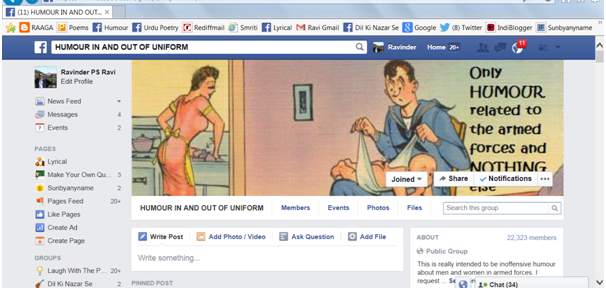
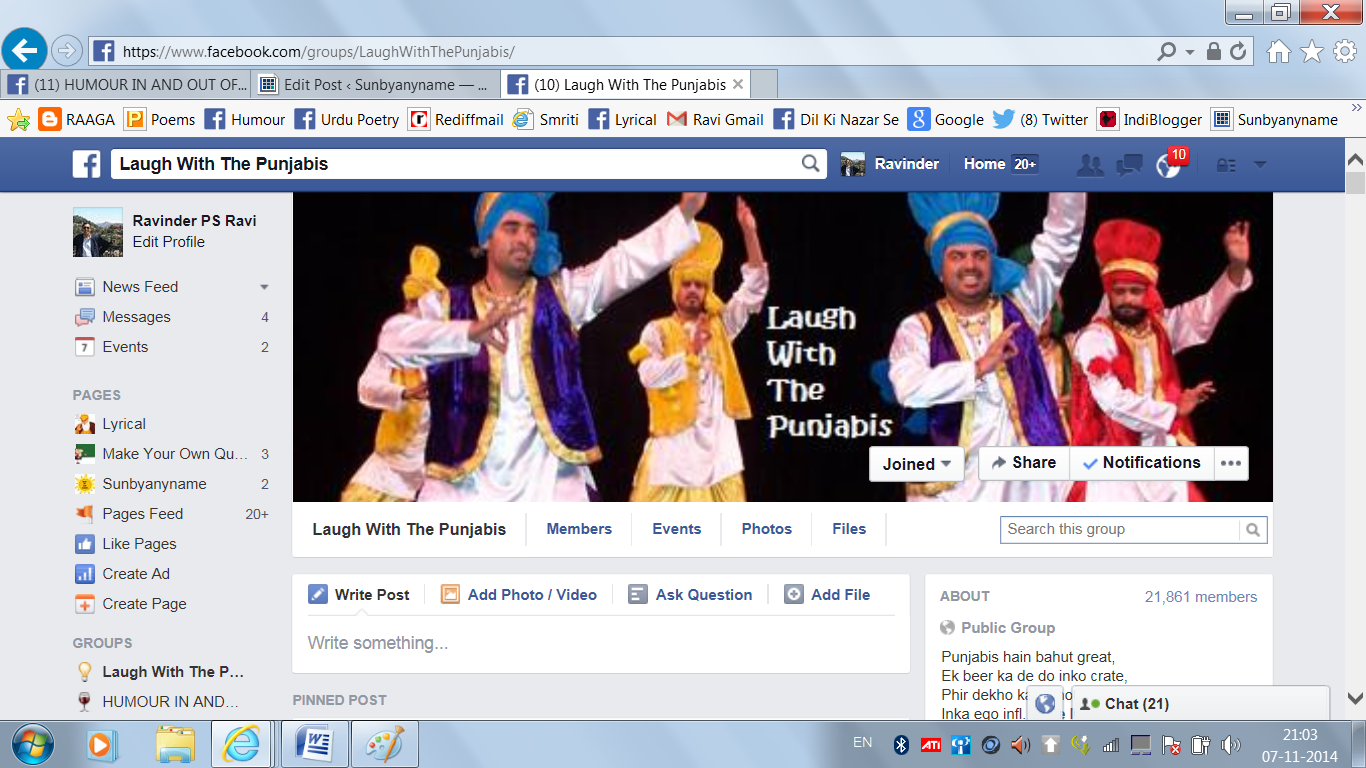
Our creativity Is also hugely appreciative of easy availability of everything on the Internet that we can copy and paste as our own. Take three of my Facebook groups, for example: ‘Humour In And Out Of Uniform’ (HIAOOU), ‘Laugh With The Punjabis’ (LWTP) and ‘Dil Ki Nazar Se’ (DKNS) to promote respectively humour about Indian armed forces,  humour about Punjabis, and love for old Urdu/ Hindi songs. The membership of the first two gradually reached 20000 each and the third one is at about 1500. In all three groups the number of people who write original posts is very small. Majority is copy-paste experts. Since the majority is like this, it appreciates copy-paste culture in others too. Hence, your original and painstakingly written post may fetch a dozen Likes,  but its copy-paste post, even if being repeated for the nth time, doesn’t fail to attract hundreds of Likes and Comments. This is real humour, the majority says; the kind that should be there instead of the “long, boring (originally written) posts”. Even though the cover picture of HIAOOU advises that the group is about ‘Humour related to Indian armed forces and nothing else’; most members feel that the group should be allowed to put up all humour and non-humour posts.

HIAOOU1

Irrespective of the name, aim and theme of the group started by you, we like to put up each and everything. Our favourite posts that find places in almost all groups are: Greetings especially Good Morning, Happy Diwali, Happy Holi etc; Motivational Quotes; Pictures and praise of religious places and symbols, god and goddesses; Pictures and praise of the armed forces (these have to be liked by everyone lest they should run the risk of being dubbed as unpatriotic); Posts that show they are modern enough to be empathic about such social issues as girl-child, women’s empowerment and child-labour (these never fail to get dozens of likes and comments since others too want to be seen in the same light), riddles (such as 2+2×3-4×2-2 is how much? Or if your brother’s aunt is married to your sister-in-law’s father, what is her relation with you?) and romantic shair-o-shairi, pictures and quotes. On my group Laugh With The Punjabis, for example, I keep enquiring from members who put up such posts, despite norms clearly spelled out in the pinned post,  whether such posts as that of gods and goddesses and girl-child are something to laugh about or at. But, that doesn’t stop the members from giving vent to such latent creativity.

LWTP1

In the end, most of the groups on Facebook just become friends’ circles wherein everything is fair game including “how are you, friends? “, “hope you have a great time”, “anyone from Shimla?” and “Add me”.

Then there are those who want to advertise free of cost. They put up ads about their products such as jewellery, shoes and even to like their pages and groups. Many of them flood your groups with dozens of such ads both as posts and comments and it would take you considerable time, sometimes hours, to get rid of these.

The new scourge on Indian Internet is pornography. Sexually oppressed and depressed Indian people have suddenly found virtual impunity in making profiles that are gay, lesbian, transgender, incestual, wife-swapping, cuckolds and open interests in such profound subjects such as Desi Gay Stories, Meri Bhabhi Ki —-, Hot Sisters and so on with explicit pictures. Whilst on the subject of profiles, my experience shows that almost half the Facebook profiles of Indians are either fake or have fake pictures; commonest being those of actors, actresses, foreigners, children, gods and goddesses, quotes, flowers and places.

On my group ‘Humour In And Out Of Uniform’, I tried to promote original writing of anecdotes since the Internet hardly had any material (including cartoons) on humour about Indian armed forces. But, I found that firstly there were very few takers and secondly even those who wrote originally decayed into writing on anything and everything and letting these pass as humorous posts. I then started a group, satirically titled Chalta Hai wherein such posts could be published. But, I should have known that the fun of putting up the forbidden stuff on a group with a specific purpose far outweighed the lure of putting it on a group wherein it is actually permitted. Hence, people kept on putting up Chalta Hai posts on HIAOOU and even tried to justify these. A senior member, for example,  is convinced that everything that happened in his tenure in the armed forces in India and abroad and in the civvie street is worthy of being chronicled in HIAOOU for the benefit of the youngsters who are looking up for leadership and guidance from the armed forces.

Chalta Hai2

With all this, your desired social-service of having a Facebook group suddenly becomes a punishment for you. You spend the whole day managing your groups, over and over again advising people to stick to norms (to the extent that they and you both start getting on each other’s nerves), removing and banning posts and members, getting into lengthy discussions with people as to why you removed a post/member without personally cautioning him and her (remember how they are used to being told by the air-hostess?), inducting and blocking members after checking their profiles, and hoping like hell there would be some time left for you to actually use your own creative spirit to write (the original purpose of starting the group). And all the while, the copy-paste artist spends all of fifteen minutes in doing his boy/girl-scout good act of posting his stuff and moving on to post the same in dozens of other groups that he/she has become members of. By the way, when I check profiles of members at induction I am surprised to see many of them being members of hundreds of groups.

Narayan Murthy in his address to students of the Jawahar Lal Nehru University at New Delhi entreated everyone to assimilate some of the attributes of Western societies wherein people invariably thought of the society before thinking of their own freedoms and liberties. But, we, in our Chalta Hai attitude, often consider ourselves as the centre of universe, and reason out how just our type of exceptions from the rules should be permitted.

Most Indians are also good at – nay experts at – giving advice (Read: ‘One Good Advice Deserves Another’). There are very few who mean well whilst rendering such advice; many of them use the medium of advice to gather as much attention for themselves as they can gather (after all, the very aim of Facebook is to seek attention, they reason out). So, whilst you need their active help to maintain your groups for the purpose for which they were created, these advisors would tell you that the simplest thing to do is to throw a person out who is putting up irrelevant and objectionable posts. They forget that you would have to spend hours reading all the posts even to decide which are the irrelevant posts. Ask them to help in this as co-admins and they would do the Mr. India act of becoming invisible.

What, then, are the solutions? You can try one of the following options:

  1. Close down your group or groups. This is easier said than done. On Facebook there is no such quick-fix option available to deactivate a group. You have to physically remove each and every member and then remove yourself and seek closure. Hence if your membership is large (in my case the total membership of my groups is close to a lakh), and you spend only 30 seconds for removing a member, you may spend as many as 50000 minutes of doing it, if you don’t take a break. This is as many as more than 800 hours or 35 days!
  2. You can restrict the membership of the group(s) to a manageable number and restrict entry by making it (these) either closed or secret groups. This defeats your original purpose of doing all-round social-service.
  3. You can change the setting of the group to ‘All posts to be approved by an Administrator’ prior to posting.
  4. You can increase the number of Administrators. This too is easier said than done since most of the advisors are actually very busy people who do not have sufficient time to do this public service. And in any case, if the norms are subject to individual interpretations (causing you chagrin in the first place), administrators’ duties then become another cause of individual interpretations.

So, finally, what are you left with? Perhaps have just one or two more trusted administrators and have the setting for posts to be approved by administrators prior to putting up. This is hard-work for the administrators but then it does away with all the heart-burn caused by removing posts, removing and blocking members, and being embarrassed by vulgar and pornographic posts being put up when you least expect them.

If you have any suggestion, please feel free to post it in the Comments below the post.

Thank you.

THIS PATAKHAWALI, THIS BOMBAWALI, HAS NOTHING IN COMMON WITH DEEPAWALI

[lineate][/lineate]Lord Rama,[lineate][/lineate]How far we have come from[lineate][/lineate]That day,[lineate][/lineate]When Hanuman heralded yours,[lineate][/lineate]Sita’s, and Laxman’s re-entry into Ayodhaya[lineate][/lineate]After fourteen years of exile?[lineate][/lineate]People were ecstatic,[lineate][/lineate]And lit lamps to signify[lineate][/lineate]Victory of Light over Darkness[lineate][/lineate]Knowledge over Ignorance[lineate][/lineate]And, Good over Evil.[lineate][/lineate]

Rama returns

[lineate][/lineate]Do you think now they remember you[lineate][/lineate]When they light bombs or crackers[lineate][/lineate]Costing thousands of rupees[lineate][/lineate]In the middle of night?[lineate][/lineate]These intended to not just wake people[lineate][/lineate]From their slumber[lineate][/lineate]But, also to proclaim their new found riches,[lineate][/lineate]Power, influence, glory and arrogance.[lineate][/lineate]And all these whilst millions of poor[lineate][/lineate]Sleep on empty stomachs.[lineate][/lineate]

(Pic courtesy: www.thtimes.co.uk)

[lineate][/lineate]Even a General Eisenhower[lineate][/lineate]Talked about every bomb and rocket[lineate][/lineate]Being a theft from those who are hungry,[lineate][/lineate]Naked and homeless.[lineate][/lineate]But, we, the Indians,[lineate][/lineate]Peace-loving as we proudly call ourselves[lineate][/lineate]Still carry on the charade[lineate][/lineate]Of Ignorance leading Knowledge Darkness replacing Light[lineate][/lineate]And help Evil conquer over Good.[lineate][/lineate]

20141024_111721

[lineate][/lineate]This noise, this unchecked noise[lineate][/lineate]Is already making us deaf[lineate][/lineate]And blind to the real challenges[lineate][/lineate]That India faces, Lord Rama’s India faces.[lineate][/lineate]This naked and shameless display of ostentation[lineate][/lineate]Has nothing to do with Humility[lineate][/lineate]Purity, Modesty and Self-sacrifice, that you embodied[lineate][/lineate]Making everyone wonder, in near and far lands,[lineate][/lineate]Whether we are really with you O Ram,[lineate][/lineate]Or are we got used to going the Raavan’s way?[lineate][/lineate]

(www.friendshipday2014.org)

BLAME IT ON GOA!

There is something about Goa that makes you feel young, romantic and reckless. And it is not just Feni or the easy availability of Goan wines. It is as if when you enter Goa, you are destined for good times; always summer, always fun on the beaches, dancing and merriment. And you don’t have to be a Herman Wouk to say: Don’t Stop The Carnival.

Merriment was, however, farthest from our minds when our ship Himgiri entered Vasco da Gama harbour. Yes, it was sunny; yes, there was this Goan appeal in the air; and yes, we felt young. However, we had entered Goa only for a few hours and were scheduled to sail as early as 7 AM the next day. Our Captain, a tall and upright submariner (he later rose to become the Chief of the Naval Staff) was the most prim and proper CO I had ever served with. He was very of all good things, ie, very knowledgeable, very intelligent, very effective and very serious. He was the kind that you read about in John Winton and CS Forrester books. He always meant business.

Lets say you were sitting in the wardroom nursing your drink and there was an announcement: “Electrical Officer requested Captain’s cabin”; it won’t be that Captain was feeling bored and wanted company. It would surely be something to do with power, generators, weapons or sensors. You could bet on it and win. As I said, he called you only on business and you’d generally rush to his cabin because he detested delays.

So, when we secured alongside at about 4 PM, the most romantic thing that occurred to anyone of us was to change into games rig and go for a walk, return on board, have early dinner and get up early next day for yet another sailing. It appeared to us that life on Himgiri revolved around sailings: you either sailed or prepared to sail.

It was merely 5 PM when we headed towards the sleepy town of Vasco da Gama in PT shorts and shoes. There were four of us: The Engineer Officer, the Electrical Officer, the Navigating Officer and the Signal Communication Officer. Someone suggested that we walk fast so as to “sweat out the extra fat that weeks of sailing without a stop had deposited on our bodies.” And that’s precisely what we did. At about 6 PM, we reached Vasco da Gama and passed in front of our favourite watering hole: Aunty’s.

One of us suggested – kind of demurely – that now that we had gotten rid of several kilos, perhaps we could just split a couple of beers between us and also Aunty’s famous Goan sausages. The objecting voices within and without were put to rest by the topper of an argument that no one, not even a child, had ever got pissed on half a bottle of beer. The Engineer Officer also added magnanimously that he had brought his wallet for exactly this kind of contingency. I do not know how they reason out things in the army and the air-force, but, the lingo of the naval officers is to be heard to be believed. Any eavesdropper would think they are planning something of great national and naval importance; whilst, all they are doing is to quickly appreciate and assess how many beers and sausages would keep them in good fettle so that four kilometres of brisk walk won’t be wasted.

Beer and peanuts have been made by God with just one purpose in mind: to try the will-power of man. As they say: ‘Will-power is to have just one peanut’. It is virtually the same with beer. After our downing of the first glass of the sparkling golden drink, we slowly bade good-bye to Will-Power and send her back to the ship. By the third glass, the Electrical Officer was offering a wager to anyone who could produce more genial and ebullient quartet anywhere in the world. Clinking of glasses, sounds of “cheers” and appreciative chuckles from all of us proved to him the correctness of his assertion. If another proof was required, the beaming and supportive smiles of our voluptuous hostess – Aunty, that is – confirmed the soundness of his hypothesis that there were no better team of four anywhere in the world.

It is at this stage that the Navigating Officer, who was very familiar with Goa (since his father was posted in Goa Shipyard) suggested that whilst no doubt we were enjoying in Vasco, the real scene was to be had in Panjim. The Engineer Officer objected that we were in shorts and would stand out like sore thumbs. At this, the NO responded with great authenticity that in Goa the only people who stood out like sore thumbs were the over-dressed variety. All misgivings, once again swiftly allayed, we soon found ourselves heading by bus towards Panjim and crossing over the Zuari river at Cortalim, by ferry, to reach the real scene.

The Navigating Officer was, of course right. The very air of Panjim was of a perpetual carnival in progress. Bars, foot-tapping music, good food and jovial company made us believe in Einstein’s Theory about Relativity of Time: whilst elsewhere the hours used to pass like snails, here the Time was galloping as if to win the annual Derby. It wasn’t long before we were happily sozzled. An old grandfather clock in the restaurant showed the time to be midnight. Once again, the Navigating Officer, with his authentic knowledge of Goa, confirmed that the clock there had always showed the time to be past midnight, from the days of Alfonso de Albuquerque.

Naturally, the mention of Albuquerque got us thinking about the famous Adega da Velha wine of Goa and we bought one at the local Wine Shop and headed towards Miramar beach to have it peacefully on the sands. It is only after the last drop of the wine had been consumed that we realised that the clock in the restaurant had indeed showed us the correct time, but, like Oliver’s father in Erich Segal’s Love Story, we had refused to see the time of the day!

A quick dash to the bus-stand was wasted since they told us there that the last bus for Panjim had already left an hour back and there would be one available as early as 6:30 in the morning. Also, the last ferry was at midnight and the next one will be available at 7:30 AM.

We had missed the last ferry (Pic courtesy: www.rnd.goa.gov.in)

Those were not the days of the mobile phones and hence there was no way of informing the ship. Finally, the last bit of money that our treasurer, the Engineer Officer had, was spent in taking an auto-rickshaw to INS Mandovi, about five kms away. It was three in the morning when the Duty Chief was woken up, who in turn woke up the Officer of the Day, a young Lieutenant. These two worthies, well versed in handling naval emergencies, needed not much convincing that a way had to be found to get us across to our ship before we sailed off at 7 AM. The naval resourcefulness, therefore, produced one rickety three-tonner, who took another one hour to get ready since he didn’t have adequate fuel to undertake such long journey (anything more than 5 kms is a long journey for any naval transport).

Anyway, to cut a long story short, as we undertook that journey by three-tonner on the longer road route (rather than by ferry at Cortalim), we realised that life finally has its ups and downs and bounces. The wise-guy who often tells us that in life, journey is more important than the destination, has never travelled by a three-tonner; I can now tell you with great authenticity.

When we reached the ship, Special Sea Dutymen for leaving harbour had been piped. In ten minutes, after having bath and changed, we too were closed up, trying to look as prim and proper as our Captain.

If we had thought that our absence from the ship for more than 13 hours had gone unnoticed by the CO, we were soon proved wrong. As soon as we left harbour, he remarked, “I say, I didn’t know you guys too are such fitness freaks (he himself was). Imagine going for a jog early morning even when we were to sail as early as at seven.”

Ignorance is bliss. If only the CO would have known that it was yesterday’s walk that had ended today.

One has to be very careful of and in Goa. It is always the Goan air that gets you.


WALK OR GYM? I LIKE IT IN THE OPEN

I have been walking for the last several years. I like walking. At one time, when I was younger, I used to jog, especially long distances. But then, the doctor told me that jogging on metalled roads harms the knee-joints. So, I walk without any fear of undue wear and tear of knees.

Running or walking on the tread-mill in a gym never fascinated me. I am an outdoor person and I hate being cooped up in an office the whole day. Whatever little time I have to keep me fit cannot be spent inside a gym looking at cold machines and weights and other gadgets or to look at myself in large mirrors. I am not talking about the physical benefits of being in a gym. All I am saying is that mentally and temperamentally I don’t relish being in a cage.

I walk very fast; almost close to running. However, I still have time to breathe in air and perceive its changes in seasons, times of day and night, and in the proximity.  There are these crepuscular birds flying silently in jagged arrowheads. Sometimes I see them against the sun, changing shades of red until they mingle with blackness of the approaching night.

I walk very fast and yet have time to look at crepuscular birds

Walking in the rains is an art by itself. One has to wait until the rain stops to a slow drizzle and then you go out like Gene Kelly Dancing in  the Rain. There are times when the fog engulfs you and you are surprised to see people coming out of thick fog as if by magic. Then you observe them dexterously moving around with their umbrellas.

IMG02902-20111021-0651
In Kharghar, Navi Mumbai, where I have a house in the Jal Vayu Defence Enclave, just across from the Kharghar Golf Course, you see the twin Pandavakada Falls with a beeline of people going towards the falls to see them from close distance and get sprayed by its raging waters.

Pandavakada Falls in Kharghar as seen during my walks

Walks enable you to observe people’s behaviour closely. For example, I notice that I have hardly come across a two wheeler driver looking straight ahead. He or she is either busy talking to the person on the pilion seat by tilting head backwards or observing the scenery. I also notice that vehicles in Mumbai, especially two wheelers, go straight to the point of destination from where they are and don’t worry too much about being on the wrong side of median.

I also observe people taking their pet dogs for walk. I see that there are very few who take the pets; in majority of the cases, it is the pets that take them for walk. Sometimes, I feel envious of the pets.

Sometimes when you go for walks early mornings, you find that the moon hasn’t set yet and sun hasn’t risen and you get the illusion of having moon looking like sun.

By the way, that brings me to the point that you never walk alone; the sun, the moon, the stars, they all walk with you.

IMG00750-20101123-0710
(Sun or moon? Well, who cares?)

Then, once in a while, during the rains, you come across a rainbow and you marvel at the fact that not only God made colours but He presented them in the most alluring manner to all of us. Your heart wants to swing on the rainbow.

IMG00755-20101124-0703

Then, early mornings, you also see devotees walking by singing hymns. The Sikhs have a Gurudwara on the other end of the Central Park and they go, together with women and children, one week in a year, on what is called Prabhat Pheri (Early Morning Walk-around). We also have an ISKCON temple (under construction) close-by. It is such a tranquil sight to see a small group going past singing hymns of Lord Krishna.

IMG02934-20111030-0643

And, it is not just the people and the birds that I come across. I come across dogs either playfully sprinting in a pack or pups feeding on their mother. In all cases, like children, there is so much of excitement about them.

IMG01390-20110210-2119

And then, there is walking in the evenings. The sun sets over the hill. An occasional flight goes past since on the other side of the hill is the Santa Cruz airport. There is a lot of noise but slowly colours and noise fades, the lights come on slowly and everything starts becoming serene like the waters of this small lake in the Central Park.

IMG03471-20120108-1810Gradually, yellow becomes crimson and crimson becomes black and night engulfs you and takes you in your arms with promise of another day, another part of your journey on earth.

IMG03474-20120109-0628

Come the morning, you again want to be out, walking, walking, walking. You look at the sun and you see it reflected in the lake and you learn about life itself. There is no such teaching in a gym: you sweat, you add muscles and off you go.

IMG03679-20120308-0707

And then the hustle and bustle of the new day starts again. The milk-man going on his bicycle with two milk drums perched on either side of his bicycle rear carrier, and some skaters skating on the roads for want of a skating rink anywhere close by.

IMG01631-20110331-0707

I walk very fast; a little less than seven minutes a kilometre. However, I always have time to see, observe and click pictures; including this of mine at the end of the walk, breathless but full of joy and satisfaction:

IMG01709-20110417-1851

Yellow flowers are my favourite. These were clicked by me during a walk on the road side:

IMG00620-20101017-0951

As you were reading this article and looking at the pictures, it must have occurred to you that I am blessed and living in exquisite surroundings; the hills, the falls, the lake etc. I would like you to consider that such beauty would be anywhere. This is not in the hills; this is in Mumbai itself. Such beauty lies close to where you too live. All that you have to remember is to see as you walk past. And also remember what Rabindranath Tagore had said:

“Eyes can see only dust and earth,
But feel it with your heart, it is pure joy.
The flowers of delight blossom on all sides, in every form,
But where is your heart’s thread to weave them in a garland?”

IMG00621-20101017-0953

I can never walk in a gym. I have to be in the open where the water-falls, the grass, the sky, the birds, the people, the sun and the moon beckon me.

I walk with them.
IMG00208-20100617-0621

I hope, with this, I have encouraged you enough to walk in the open rather than in a gymnasium. In the latter you seek physical fitness only. Walking in the open is for your total well-being.

WORLDS APART

There was a time
Not much time ago
When our two worlds met
Like day meets night, or
Sky meets the sea
Or the river seeks the banks.
Our two worlds formed
Not one but another two worlds:
One in which we existed, and
Another in which we lived.
The latter had life, laughter
Song and music and
The beating of our heartbeats as one.
I believe that we liked
Loved and adored
Our second world more.

And now that the physical distances
Are closer than
The miles between our hearts,
Can we just look back and see
How our worlds moved apart?

Shouldn’t we have sensed
The fading smiles
The elongated silences
The songs that went sad
The shadows that lengthened
The sunsets that lasted
Many times more than the sunrises
The wetting of the eyes
The drying of the hearts?

We are the predators
Who killed our world
Where we lived beyond the world.
Egoes and anxieties
Suspicions and rigidities
Competed to win
And we both lost.

Worlds apart
I can barely see you
Can you see me?
Worlds apart
Death didn’t do it to us
Life did.
We could have known
We should have known.

image
(Pic courtesy: www.doubledeclic.com)

GOD’S CHILD

He hated waiting for the bus at the stop below his office. At this time of the evening, several lakh salaried employees like him left the office. All were always in a hurry to get back home after a hard day’s work.

One’s position in life could be anything he had mused; but, in the evenings, what mattered was your position in the queue for the bus. In case one managed to stand with the first few in the queue for the bus, one could not only be assured of catching the bus but may also get a seat.

At one time, from Mantralaya to Bandra, he used to catch the local train but he had to walk great distances on either end from the local stations. Also, trains at this time of the evenings would be crowded. The only people who’d get seats at Churchgate would be the ones who’d travel backwards from Grant Road and Charni Road to Churchgate and then wait for the train to restart for Borivali.

It had taken him years to become a Head Clerk in his office in the Education Department; and now, instead of being a mere Godbole, he had become Godbole saab. He liked the ring of the title saab. It gave him an authoritative stature in the office. Minister madam trusted him so much that she had given instructions that all outgoing mail put up to her for signatures should be whetted by Godbole saab and should bear his initials just below the signature block.

He had met Anjali twenty years back and they were married for thirteen years now. She had given him everything that he could have asked for except for one thing that she had not been able to bear his child.

He had taken her for checks by gynaecologist several times. The gynaec had not been able to find anything wrong except to tell them that their anxiety was probably the cause. It may or may not have been; but, as time went by, it actually became the cause. The more time passed, the more was their anxiety at not having to have a child.

In their holidays, they had been to several holy places to pray for Anjali to become a mother and for him, Vikas Godbole to become a proud father. They had also been to Sri Sai Baba at Shirdi. But, they hadn’t been fortunate.

Just at the time they had almost given up, they found that their loneliness and anxiety had actually reunited them in more matured love. They longed to be with each other. She was at home during the daytime. She tailored clothes for the children and actually earned more with this hobby of hers than he did as a head-clerk. However, from the time he returned from office late in the evenings until next day after breakfast, they were virtually inseparable. They played Scrabble, went for walks on the sea-shore after dinner, and they watched television together. Once in a week they went to see either Marathi or Hindi movies.

Finally, God decided to be kind to them and she was expecting. Indeed, it was due anytime now. And that accounted for his rush home in the evenings as if his life depended upon it. Nowadays, thanks to Anjali’s condition, he was always the first or at least amongst the first few in the queue.

Standing in the queue everyday, he used to see an urchin approaching the queue for alms. He was a boy of about eight, unkempt, his nose dripping mucous, dressed in his tattered shorts and invariably in the same yellow shirt that obviously had seen better days. His feet were bare. He went from one person to the other, touching them on their trousers or sarees and suits, lifting his hand from their clothes, bringing it repeatedly to his forehead and saying, “Saab/memsaab gareeb ko kuchh de do. Subah se kuchh nahin khaya. Aap ka bhala hoga“. (Sir/Madam, please five something to this poor boy. Haven’t eaten anything since the morning. God will bless you.)

Most people turned their faces away from the boy and ignored him or just shooed him away. Some even began animated conversations about how beggary was the curse of India and how one had to be careful about such ruffians: “Before you can say Jai Ganesh, such guys would flick your bags and run away. You can’t trust these thugs.”

Vikas too had busied himself looking here and there in the first few days. However, once when the boy had tugged at his trousers hard, he looked down and looked straight into those pleading eyes; these were intense and bore into him. He could never look away after that. He was hooked. He would take out some coins and give the boy and now they had become friends; a degree of intimacy had set in as if they knew each other from ages.

He liked looking into those deep eyes searching his face for recognition. The looks changed from pity to joy when the boy sighted him. A smile would form on the corners of those young supple lips as if thanking him for what he was going to receive: a coin, a currency note, a toffee, a biscuit; invariably, Vikas Godbole got into the habit of carrying something for the boy.

Those eyes, those deep and eager eyes haunted Vikas. He was trying his best to read them, to figure out what story they carried for him. But, every time, he thought he came close to it, the bus arrived and he rushed home to be with the love of his life Anjali.

One day, immediately after his pay-day, he bought the boy a new shirt and a pocket comb. And today, the boy had changed his looks somewhat: hair were combed and he almost looked clean. As he approached Vikas in the queue, his heartbeat quickened. If it hadn’t been for the others in the queue who continued to sneer not just at the boy but also at the reckless habit of Vikas Godbole to show affection towards a street urchin, he would have wanted to hug him and pick him up in his arms. Vikas knew instinctively that he would be buying the young boy many more clothes and things in the future.

He reached out in his pocket, took out a few coins, and handed over to the boy. One of them slipped from his hand and rolled over to the road. Impulsively, the boy ran after it. He couldn’t have let go of a coin on a day when he needed it most to buy an ice-stick to add to the joy of wearing his new shirt for the first time in his life.

A speeding car had just overtaken a scooter and busy as it was in overtaking, it failed to react to the young urchin running after the coin. There was a screeching noise of the brakes, a fearful howl, the sound of metal meeting flesh, a scream, several shouts, blood and a body lying under the car, that of the urchin, honks, more shouts…….and then the sound of a siren.

Vikas broke from the queue and ran towards the car. Everything happened in a flash even after that. The car reversed a little, a cop appeared on the scene, an ambulance appeared, took the boy away and a police van took the car driver away. The police man parked the car involved in the accident on the side to make way for the traffic.

Vikas tried to get into the ambulance with the boy but he was pushed out. Later, when he had missed his bus and just sat on the kerb, he was trying to come to grips with what had happened. It was certainly his charity that had killed the child. He would never forgive himself for it. Should he have gone with the ambulance or with the police van? But, that would have required telling them what the child meant to him. In what way was he related to the child? Did he really mean that much? Was it simply because of those deep and keen eyes?

Vikas had no idea of how long he sat at the kerb and how much he cried. One hour, two hours, or even more; he had lost count of time.

Finally, it was dark and he resignedly caught a bus home. All throughout the journey he kept thinking of what could he have done before and after the accident. Could it have worked out any other way?

He reached home and found the door locked. It was unlike Anjali to have left home in this condition and that too without informing him. He reached into his pocket for his phone and then saw that there were as many as seven missed calls from her in a span of three hours. He got panicky and knocked at the door of his neighbour to enquire from them where Anjali was since she often informed them before leaving home. They informed him that she had gone into labour and had to be rushed to the maternity hospital.

He went running there. He was in a trance. He prayed to all the gods known to him whilst running.

The nurse told him that it was a difficult delivery but the good news was that his wife had given birth to a healthy male child. Could he see them? He was told that it was late and Anjali had been totally exhausted. He could go home he could come in the morning to see them.

He didn’t go home at all. He sat on the bench in the corridor and reminisced about his life with Anjali. He couldn’t believe it; he was a father after all those years of hopelessness. He prayed for her, prayed for his new-born son. But, every now and then his thoughts returned to the urchin in his new shirt, combed hair, his reaching into the pocket, taking out the coins, one of the coins rolling on to the road and the boy rushing after it for the last time in his life.

He hardly slept except for a few times when he dozed off due to sheer fatigue.

In the morning, he was taken to her bed. Both she and the child were awake. He hugged her and cried and then with tearful eyes he looked at his son.

Those deep and keen eyes looked back at him…..as if…..as if…..they hadn’t ever stopped looking at him.

CAPTAIN (I.N.), IS IT A RANK?

Captain (I.N.) (Captain (Indian Navy)

There is, of course, no such rank. However, just like all morals, ethics and virtues are acceptable societal attributes if the majority thinks so, in the armed forces too, the majority service in manpower, Army that is, decides on what is an acceptable rank of the other service (in this case Navy) when they too have a rank spelled and pronounced exactly the same way (the Navy Captain is equivalent to a full Colonel in the Army).

The situation is compounded further when you realise that in the Navy, Captain is a rank as well as an appointment. A CO of a ship or a submarine is referred to as Captain irrespective of his rank. If you are a Sub-Lieutenant to a Commodore, you are in command as a Captain.

But, Captain (I.N.) has some unwanted connotations. I was undergoing the Higher Command Course with the Army at (that time) the College of Combat (no pretences at this being the Army College of Combat; but being the ‘majority‘ service, it had ascribed to itself the prefix ‘the’ and touted its training institution as the College of Combat. It was here that my rank was changed/modified to Captain ‘Within brackets IN’.

In my dreams (Whenever I am in difficult and unfamiliar situations I dream and transport myself to elsewhere. This hobby of mine continued from my school days when during Algebra classes, I transported myself to Switzerland and such other exotic locales) I reached the Pearly Gates. One glance at Saint Peter and his Assistant convinced me that, as in everything in India, the Army had been asked to control ‘the situation’; namely, to check and monitor the heavy influx into the Kingdom of Heaven (KOH). Saint Peter’s Assistant (SPA) was an army man, mustachioed, booted and looking important. After the usual questions regarding name, date of birth, father’s name etc, he asked me: “Rank?”

“Captain” I said.
“Captain In” said SPA.
“Thank you” I said and started walking in.
“Thum” SPA growled, “I asked you if you are a Captain I.N. or a normal Captain.

I cringed at the distinction. Before arriving at the Army’s premier training institution, I had considered myself perfectly normal.

“I too am a perfectly normal Captain” I replied with great dignity.

He re-checked my age and decided otherwise.

“Ah”, it suddenly dawned on him, “You must be a Group Captain”.
“But Sir”, I remonstrated, “I am totally by myself”.
“Stop being funny” he said, “One of the reasons why you are here is because you always tend to be funny whether in class, mess or even during tours and wargames.”

I made a quick mental note not to ask any “funny” questions, even if given another chance to undergo the Army Higher Command Course (AHCC), in my next life.

At this Saint Peter himself intervened, “Let’s hear why you consider yourself qualified to enter the KOH.”

wargame
(Pic courtesy: tehelka.com)

“Well Sir”, I began hopefully, “I was a Col GS/Adm of an important Division in the wargame Zorawar.”
“We know”, said SP and SPA together, “No action whatsoever took place in your Div Sector”.
“By the way”, said SPA with a view to deflate my new acquired Army-styled-ego, “Even if you had done anything better than trying to ‘figure-out’, you would still not be qualified. You know even the Corps and Div Commanders of that exercise haven’t qualified. Only Blue Air Force officers can be permitted into the KOH, on the strength of their ‘pro-active stance’ and ‘pre-emptive strikes’, even though these were outside the wargame rooms.”

“But Sir”, I insisted, “Surely you won’t have failed to notice that I was in the Control (Room) in the last wargame Yudh Abhyas. Won’t that be a ‘positive’ achievement?”

“No, not enough” said SPA with finality.

What a cruel world, I thought. When one is not in ‘Control’, it appears as if those who are there have directly descended from Heaven; but, now that I was there, SPA found it “not enough”.

I decided to speak-up against the prejudices, but in the interest of Jointmanship (incidentally, the Army wants the word itself to be changed to Jointmantank and the Air Force to Jointmanplane), I decided against it. Clutching at the last straw, I blurted excitedly, “I facilitated several AHCC course-mates and even DSs to purchase ship’s canteen items during our visit to Mumbai.”

There was an immediate response as if I had touched a raw nerve. SP turned to SPA and barked, “Tell the cheeky Navy fellow to go to HELL.”

Captain IN became Captain OUT.

JOIN THE NAVY, SEE THE WORLD; JOIN THE NAVY, MEET THE GIRLS

“Join The Navy See The World”
“Join The Navy Meet The Girls”

The above two slogans were very prevalent (in the US Navy at least and by imitation in our Navy too) during our impressionable days and helped some of us to quickly make up our minds as to which service to join.

(Pic courtesy: www.funnyjunk.com)

And then, we got on to sailing, bunks, holy-stoning the decks and looking at miles and miles of water around the ships we sailed in. The ‘world’ that we had to see was Bridge, Wheel House, Ops Room, Engine Room and Paint Store.

Once, in a while, some of us who were (un) lucky, were sent up on the Crow’s Nest (a place on the foremast. In the days of yore, a sailor used to be put up there to sight the land). From the Crow’s Nest we could see more. That is more of ‘miles and miles of waters around us’.

So, who were the people for whom these slogans were applicable? I was of the rank of Commander serving in Naval Headquarters and I discovered that there was hardly an Electrical Officer, serving ashore, who had not been sent abroad on some course or the other. Curiously, many of these officers, after completing their courses, never again served on the equipment on which they underwent foreign training.

There was one exception to this. He was Cdr L (Commander of the Electrical Department on a ship) of just commissioned Godavari and retired as the COM (Chief of Material). When the commissioning crew was excitedly talking about the forthcoming dream foreign cruise, he, correctly and resignedly, predicted that as long as he was Cdr L of the ship, the ship won’t go abroad. He said in his 20 years naval career, he had never been abroad.

He was a rare Electrical Officer.

Until I left the Navy in 2010, I was in awe of these officers who had ‘seen the world’, so as to say, in their fair reward of having joined the Navy.

One of them was introduced to me in NHQ with: “He is presently on temporary duty to our country India in his permanent appointment abroad for the last two decades”.

After retirement, and thanks to HIAOOU (My Facebook group called ‘Humour In And Out of Uniform’, I discovered that there is another branch worth joining to give credence to ‘Join The Navy See The World’. It is the Naval Constructor’s branch. These guys go abroad to enable them to come up with indigenous designs.

Slogans are always true. They may not be applicable to the poor executive officers (the business end of the Navy) in the two pictures below:

(Pic courtesy: www.funniestmemes.com)


(Pic courtesy: www.cheezburger.com)


Follow

Get every new post delivered to your Inbox

Join other followers:

error

Enjoy this blog? Please spread the word :)

RSS
Follow by Email
YouTube
YouTube
Set Youtube Channel ID
LinkedIn
Share
WhatsApp
Copy link
URL has been copied successfully!