THE BEST OF OLD HINDI SONGS – RAFI, SHAKEEL, NAUSHAD AND DILIP KUMAR TOGETHER

How proud I am that I lived in an era when Mohammed Rafi sang the songs whose lyrics were written by Shakeel Badayuni, music composed by Naushad and Dilip Kumar enacted those songs? There are other great lyricists such as Hasrat Jaipuri, Sahir Ludhianvi and Majrooh Sultanpuri. Similarly, there are other great music composers such as Ravi, Hemant Kumar, Salil Choudhury, Shanker-Jai Kishen, and Laxmikant Pyarelal. However, this article is only about the greatest ever quartet of Rafi, Shakeel, Naushad and Dilip Kumar being together.

The best musical trio ever: Naushad, Rafi, Shakeel – I would give anything to meet them

Sadly, out of the four, the first three are no more except Dilip Kumar who celebrated his 89th birthday on the 11th of Dec. Mohammed Rafi died three and half decades ago (31 Jul 1980) at the age of 56. If he were alive, he would have celebrated his 87th birthday on 24th of Dec.Similarly, Naushad who died on 5th May 2006 would have been 92 on 25th of Dec. Can you imagine that the three of them had their birthdays this month? Shakeel didn’t even reach the age of 54: born on 3rd Aug 1916, he died on 20 Apr 1970

As far as songs not including the complete quartet are concerned, by far the number one song in Hindi movies has been the 1963 movie Mere Mehboob’s title song. Its lyrics are the finest written by Shakeel and Naushad has given the most heart-touching music. Rafi’d rendition is the best ever. But I am not putting it here because instead of Dilip, the film had Rajendra Kumar.

Once again you are bound to ask me: what about ‘Suhani raat dhal chuki’ from 1949 Dulari. Once again it has Shakeel-Naushad and Rafi but not Dilip Kumar. I think by this time you get the point hat this article is all about.

Let me begin with the oldest of the four: Shakeel of the village Badayun in UP. Initially he started as a shayar (poet) but moved in 1944 to Bombay to find a career in films. He met Naushad. During those days shayars were full of songs about upliftment of society. But Shakeel chose to write about love and Naushad liked his romantic poetry immediately and signed for AR Kardar’s 1947 movie Dard. The songs were a hit especially Afsana likh rahi hoon. Shakeel had arrived in the Hindi film industry with a bang. Shakeel wrote for Ravi, Burman, Hemant Kumar, C Ramachandra etc too but his favourite always was his first: Naushad. Unlike shayars of that era, Shakeel didn’t drink. However, he died young at 53 years of age in diabetes related problems.

The greatest lyricist of Hindi movies. He wrote Mere Mehboob

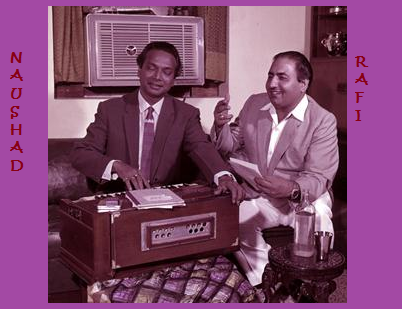
Naushad was the next younger, having been born three and a half years after Shakeel. However, he was in Hindi film industry as an independent music director for close to seven years before he paired with Shakeel. He too was from UP; the city of Lucknow famous for its old Urdu etiquette and refinement. Naushad was the most versatile music director the industry ever saw. His genre was to base his music on classical raagas. His career spanned more than six decades. He was awarded the Dadasaheb Phalke award in 1981 and Padam Bhushan in 1992.
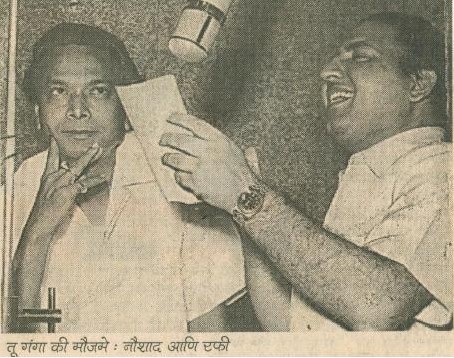
The Greatest with the Greatest – Naushad with Mohammad Rafi

Next is Dilip Kumar who is still alive having been born as Muhammad Yusuf Khan in Peshawar (now in Pakistan) on 11 Dec 1922. Satyajit Ray called him the ultimate method actor. He too began his career in the same year as Shakeel did. He was the first actor to win Filmfare Best Actor Award; ultimately he won the highest number, ie, eight, an honour that he shares with Shah Rukh Khan. He was awarded the Padam Bhushan in 1991, Filmfare Lifetime Achievement Award in 1993 and Dadasaheb Phalke Award in 1994. He remained a good friend of Shakeel and Naushad.

Dilip Kumar – there hasn’t been a better actor than him in Hindi films

The youngest was Rafi, born on 24 Dec 1924 in village Kotla Sultan Singh near Amritsar in Punjab. He has sung nearly 8000 songs including 112 in non Hindi and 328 non filmy private songs. He too started his career in Hindi movies in 1944 and became a contemporary of the other three. However, his career lasted nearly half of Naushad’s. He, however, had started singing at the age of 13. He sang 149 songs for Naushad. Other than Hindi and Urdu (the languages of the Hindi songs), he has sung songs in Konkani, Bhojpuri, Orya, Punjabi, Bengali, Marathi, Sindhi, Gujarati, Kannada, Tamil, Maghi, Maithili, Assamese, English, Persian, Spanish, and Dutch. His genre too was Hindustani and he was reputed to have moulded his voice to suit the character of the actor. I do not consider myself qualified to describe his talent. He is simply God of Hindi songs and there would never be a time when I shall not want to hear a song sung by Rafi.

The gretest Hindi films singer ever – Rafi was also the most humble

The first of the movies in which the quartet was together was the 1948 Mela. Its title song ‘Yeh zindagi ke mele duniya mein kam na honge afsos hum na honge‘ is still the standard in Urdu poetry. Taste this:
Duniyaa hai mauj-e-dariyaa, qatare ki zindagi kyaa
Paani mein mil ke paani, a.njaam ye ke paani
Dam bhar ko saans le le, ye zindagi …

The next movie of the quartet was 1951 movie Deedar. The song that I love the most is a duet between Rafi and Lata:
Dekh liya maine kismet ka tamaasha dekh liya.
Milakar bhi rahaa main mushkil mein
Milane ka natijaa dekh liyaa
1952 Aan became a super-hit movie of that time. It was produced and directed by the legendary Mehboob Khan. Amongst all the song that best describes the theme of the movie, ie, a poor villager Dilip Kumar overcoming the pride (Aan) of the princess Nadira is Maan mera ehsaan arey nadaan ke maine tujhse kiya hai pyaar. Enjoy:

Two years later the great Mehboob Khan got the quartet toegther again for the movie Amar. The song close to my heart is the bhajan ‘Insaaf ka mandir hai ye bhagwan ka ghar hai‘. Just imagine all four Muslims getting together and making a mandir (Hindu temple) song. This was the essential greatness of the society, the movies and songs of that era: people of all communities participated in hymns of all religions. Two years earlier, for Baiju Bawra, Shakeel-Naushad-Rafi had combined to make one of the best Hindu bhajans: ‘Man tadpat Hari darshan ko aaj’.

The next movie of the quartet was the 1955 movie Uran Khatola that was produced by Naushad. The story-line was about a plane that crashed near an isolated town that is ruled by women. I have a problem now. There are so many good songs in this movie that I don’t know which one to select. There are, eg, Na toofan se khelo, na sahil se khelo’, ‘Hue ham jinake liye barbaad’ and ‘O door ke musaafir’. My choice is ‘Mohabbat ki raahon mein chalna sambhal ke‘. It is about the hopelessness of love. There are these immortal lines in the song:

Hamen dhoondhati hain, bahaaron ki duniyaa
Kahaan aa gaye ham, chaman se nikal ke.

And if you can see better acting than Dilip Kumar, do let me know.

Then there was a five year period in which no movie of the quartet together were released though there were others for them to accept movies separately. It was worth the wait. The 1960 Mughal-e-Azam, written by Kamal Amrohi (amongst others. Kamal went on to make his own classic Pakeezah a few years later) and directed by K Asif. It was the biggest box office hit ever (Rupees 133 Crores after adjusting for inflation) until Sholay broke its record. The movie was about the love affair between Prince Salim (who went on to become Emperor Jehangir) and Anarkali. The movie belonged to Lata Mangeshkar who bagged the best and most popular songs like ‘Mohe panghat pe Nandlal’, ‘Mohabbat ki jhooti kahani pe roye’, and ‘Jab pyaar kiya to darna kya’. Rafi had only one important song but it became very famous: ‘Zindabaad, zindabaad; ai mohabbat zindabaad’. Enjoy:

The year 1960 also saw the light-hearted Kohinoor; a movie with Dilip Kumar and Meena Kumari. Dilip Kumar had, by this time, earned the reputation of a Tragedy King with movies like Devdas and had actually gone into depression with the intensity of his roles. This movie was, therefore, to break the monotony of tragic roles. He won the Filmfare Best Actor award for this too. The movie had two very beautiful duets: ‘Chalenge teer jab dil par’, and ‘Do sitaaron ka zameen per hai milan’ and Rafi’s ‘Koi pyaar ki dekhe jadugari’ and ‘Zara man ki kewadiyaa khol’. My choice is: ‘Madhuban mein Radhika naach re‘, one of the best songs sung by Rafi:

Just a year later, in 1961, was released Dilip Kumar’s musical romance with Vyjantimala in the shape of Ganga Jamuna. Asha Bhonsle sang ‘Tora man bada paapi’, and Lata sang ‘Na maanu, na maanu na maanu re dagabaaj tori‘ and the all time hit song ‘Dhundo dhundo re saajna mere kaan ka baala’. However, Rafi’s ‘Nain lad jainhe to manavaa mein kasak hoibe kari‘ showed the rustic dancing by Dilip at its best. Here it is then:

We had to wait for another three years until 1964 to find the quartet again in Leader starring Vyjantimala once again opposite Dilip Kumar. The duet ‘Ek Shahenshah ne banwa ke hasin Taj Mahal’ was famous. But the movie belonged to Rafi with songs such as ‘Apni aazaadi ko hum’, ‘Hamin se mohabbat hamin se ladaayi’ and ‘Tere husn ki kya taareef karun’. I am, however, putting up ‘Mujhe duniya waalo shraabi na samjho’ if only to see Dilip in a drunken stage and Rafi matching the drunken voice in his singing:

One year later, the quartet was back again with the movie ‘Dil Diya Dard Liya‘ based on Emile Bronte’s ‘Wuthering Heights; this time with some of the best songs that Mohammad Rafi has sung. Dilip acted opposite Waheeda Rehman. Rafi’s songs that became famous and are still famous are: ‘Koi saagar dil ko behlaata nahin’, ‘Dilruba maine tere pyaar mein’, and a duet with Asha Bhosle, ‘Sawan aaye na aaye’. My choice is an all time favourite of mine: ‘Guzre hain aaj ishq mein‘. I adore these lines:

O bewafaa teraa bhi youn hi toot jaae dil
Tu bhi tadap-tadap ke pukaare haay dil
Tera bhi saamnaa ho kabhi gam ki shaam se

Two years later, the quartet were back in the super-hit movie Ram Aur Shyam. The theme of twins separated at birth and united later in life made its debut and continue unabated for many years. The movie had a soul-stirring song by Rafi: ‘Aaj ki raat mere dil ki salaami le le‘. Enjoy:

We could see the quartet for the last time in 1968 movie Sunghursh. The movie about thugee (conning) in Varanasi was based on a story by Jnanpith Award winner Mahasweta Devi; and starred Dilip Kumar and Vyjantimala. Rafi sang: ‘Jab dil se dil’ and ‘Ishq Diwana’; but, Dilip’s rustic dancing was once again to be seen in ‘Mere pairon mein ghungroo‘:

Well folks that is all from me for the quartet of Shakeel Badayuni as lyricist, Naushad Ali as Music Director, Mohammad Rafi as singer and Dilip Kumar as an actor with all four being together. How I wish that era had never ended. But, like Shakeel wrote in Mela: ‘Ye zindagi ke mele duniya mein kam na honge, afsos hum na honge’.
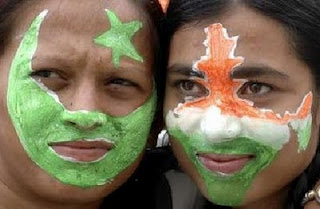
INDIA AND PAKISTAN – CAN WE LIVE WITHOUT BEING ENEMIES?

India and Pakistan are like two separated brothers, for example, in a Manmohan Desai movie. A time will come when we will pull the sleeves of our shirts back and reveal the common tattoos that our parents had got etched for us before we parted company or were separated by a tumultuous cyclone or earthquake; and Manmohan will exult, “Bhaiyya or Bhaaji” to Zardari and the latter will, in euphoric denouement scream, “Bhaii jaan”.But, until then, we hurl rockets, bombs, artillery shells, accusations, abuses, brickbats at each other with a regularity that would put rising and setting of the sun to shame. The following anecdote describes it aptly:

A Pakistani and an Indian were travelling together from Dubai to London and by quirk of fate (just like the quirk of our Geography) had seats next to each other; the Indian had the isle seat and the Pakistani had the middle seat. After take off when the aircraft had settled at the cruising altitude the Pakistani was about to press the overhead button for calling the hostess when the Indian turned to him and said, “Now what are you doing that for? I am just going to the washroom; on the way back I will fetch you what you want.” The Pakistani told him that he wanted a coke. This being a long flight the Indian had taken off his jutties (slip on ethnic shoes) and he tip-toed to the washroom and the pantry and brought the Paki a can of coke. In his absence, the Paki had picked up the left jutti and had deposited a big blob of his spittle into it.

Pic Courtesy: CHUP! – Changing Up Pakistan

After some time the Paki had the desire to spit in the right jutti too. So he proceeded to press the overhead call button hoping that the Indian would fall for the ploy; and sure enough the Indian did and went to get another coke for the Pakistani.

It came to be time to land at Heathrow and in preparation for the landing, the Indian started putting on his juttis. As he slipped his feet in the Indian realised straightway as to what the Pakistani had done. So he turned to the Pakistani and said, “India and Pakistan are two great nations and civilisations. We have common heritage and can be great friends. Hence, it is not understood, why we keep spitting in each other’s juttis and cokes.”

Pakistanis are busy teaching ‘Hate India and Indians’ in their madrassas (Islamic schools) so much so that even their once great friends (but now not so great friends) Americans have taken notice of that. The think-tanks, media, movie-makers etc on both sides of the divide are busy churning out stories about how the other party has gone rogue and how “our love and consideration” can bring them back to good sense and decent friendly behaviour.

Pic Courtesy: The Internationalist

After the break-up of the USSR, Henry Kissinger wrote in an essay in Time magazine that having an enemy in the USSR (the Iron Curtain etc) provided focus to the NATO; both for the industry and the defence forces. Without USSR, such a focus would be missing. Arguably, a similar focus seems to exist between India and Pakistan. You only have to witness a cricket or hockey match between the two nations to see the intensity or extent of this focus. Our governments would really have to concentrate on good governance without the comic relief of accusations and counter accusations between the two nations. That people die and considerable blood and money is spilled whilst retaining this enmity only adds to the focus. There is a race, a competition in everything, which assumes ludicrous proportions. If they shower hospitality over us we have to somehow outdo them and vice versa.

Pic Courtesy: Viewstonews

There is a great opportunity that has come our way post second of May when, just as we in India guessed, ranted, expected and proclaimed, Osama Bin Laden was found living in luxury in Pakistan itself in Abbottabad with the Pakistan Army almost guarding his house and pretending to be unaware of his presence there. As expected, the US has tried to be tough with Pakistan and, as expected, the chasm between Pakistan and the US is increasing since then. Our opportunity is that the two countries can now get back to sorting out matters between ourselves without intervention and mediation that we were averse to but which Pakistan wanted. Hopefully Pakistan would have probably learnt its lesson that those who mediate or intervene don’t do so out of love or consideration for us but out of – what they call – their strategic interests; one of which is, though not expressed in such blunt words, that conflicts are the stuff that armed industries love – their motivation and indeed their raison d’être.

Pic Courtesy: Anil Kalhan

The other opportunity that has come our way is the current tussle that is going on betwen the army and the civil government in Pakistan post memogate scandal. Curiously, the tussel is not to take over the reins of the country but to give to the other party the first choice in ruling the country; knowing very well that the rule (whether of the civil government or the army) is bound to fail under the uncertain environment that Pakistan faces post disinterest/dienchantment by the US.

I can explain this with this game we used to play when we were in our primary school. Two contenders would keep a kerchief on the ground between them and the contenders would circle around, getting into a position to grab the kerchief and run without being tagged by the other. Often, when they were hesitant, a third party would grab the kerchief leaving both the ontenders high and dry.

Pic Courtesy: Ring Time Pro Wrestling

Now, what if India were to think strategic (for a change) and give the kerchief to the civilian government and make arrangements that it is not tagged by the army? It would be easy to assure the Pakistan government that we would together not allow the kerchief to be taken by a third party.

Else, I can visualise the frightening scenario a number of years later when Pakistan breaks up and instead of one adversary we have to contend with a few of them.

SEASON’S GREETINGS – 2011

Dear Friends,

Christmas is here again,
And so is New Year,

I go down memory lane,
And share our news here.

After retirement we made home,
In Kharghar, Navi Mumbai.
It’s neither Paris, nor Rome
Nor even London or Shanghai.


But it is our home and hence,
We are always in love with it,
It would give us joy immense,

When you honour us with a visit.


We have with us, my mother,
And it’s great blessing indeed.

To have at the table none other,
Than who gave me my first feed.


Arjun, our elder lives on his own,
He has emerged as a critic,
No, folks, don’t grunt or groan,
It’s only of Western & Pop music.


Arun, the younger is in Hyderabad,
As an animator in Rhythem & Hues,
Yes, mohawk is still his hair fad,
And he often blows our fuse.


Lyn, God bless, is as sweet,
As when we were newly wed,
To taste her cooking is still a treat,
She keeps us happy and well fed.


We miss our Roger dear,
The youngest of our boys,
He is not with us this year,
To share our smiles and joys.
(But, he will always be with us)


So that is about all of us,
We hope to hear from you, dear,
We wish you a very Merry Christmas
And a Happy New Year.

With lots of love, regards and best wishes,
Mom, Lyn, Arjun, Arun, Roger and Me

SULAGTE AANSU

वो लौटा रहें हैं मेरा सामान,
और जला रहे हैं सब कुछ,
मेरी आरज़ू है सितमगर
मेरे अश्क भी जला दें

ताके दिल के समुन्दर में
वो तूफ़ान फिर ना उभरे;
जो मरहले खड़े थे
उन्हें ठोकर से मिटा दें

काश हम ना होते वो ना होते,
और ये आरज़ू ना होती
तेरी आँखों में जो सरूर था
वो सरूर भी हटा दें

मैं भूल गया हूँ सब कुछ,
तेरे प्यार की नज़र में
मेरी कौन सी है मंजिल
मुझे कुछ तो अब पता दें

अब दिल न हो, प्यार ना हो,
और ना रहे उनकी यादें,
कोई उनसे जाके कह दे,
मेरी हस्ती ही मिटा दें

Vo lauta rahe hain mera saamaan,
Aur jala rahen hain sab kuchh,
Meri araz hai sitamgar
Mere ashq bhi jala dein.

Taa ke dil ke samunder mein
Vo toofan phir na ubhre.
Jo marhale khade the
Unhein thokar se mita dein.

Kaash hum na hote vo na hote,
Aur ye aarzoo na hoti,
Teri aankhon mein jo saroor tha,
Vo saroor bhi hata dein.
 Main bhool gaya hoon sab kuchh,
Tere pyaar ki nazar mein.
Meri kaun si hai manzil,
Mujhe kuchh to ab pata dein.
Ab dil na ho, pyaar na ho,
Aur naa rahein unki yaadein,
Koi unse jaake keh de,
Meri hasti hi mita dein.

NH7 BACARDI WEEKENDER – ROAD TO HEAVEN

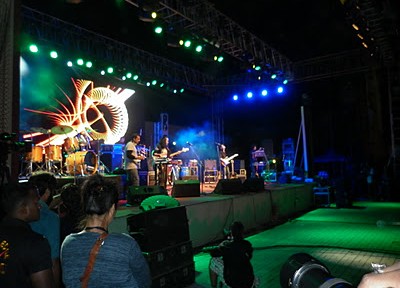
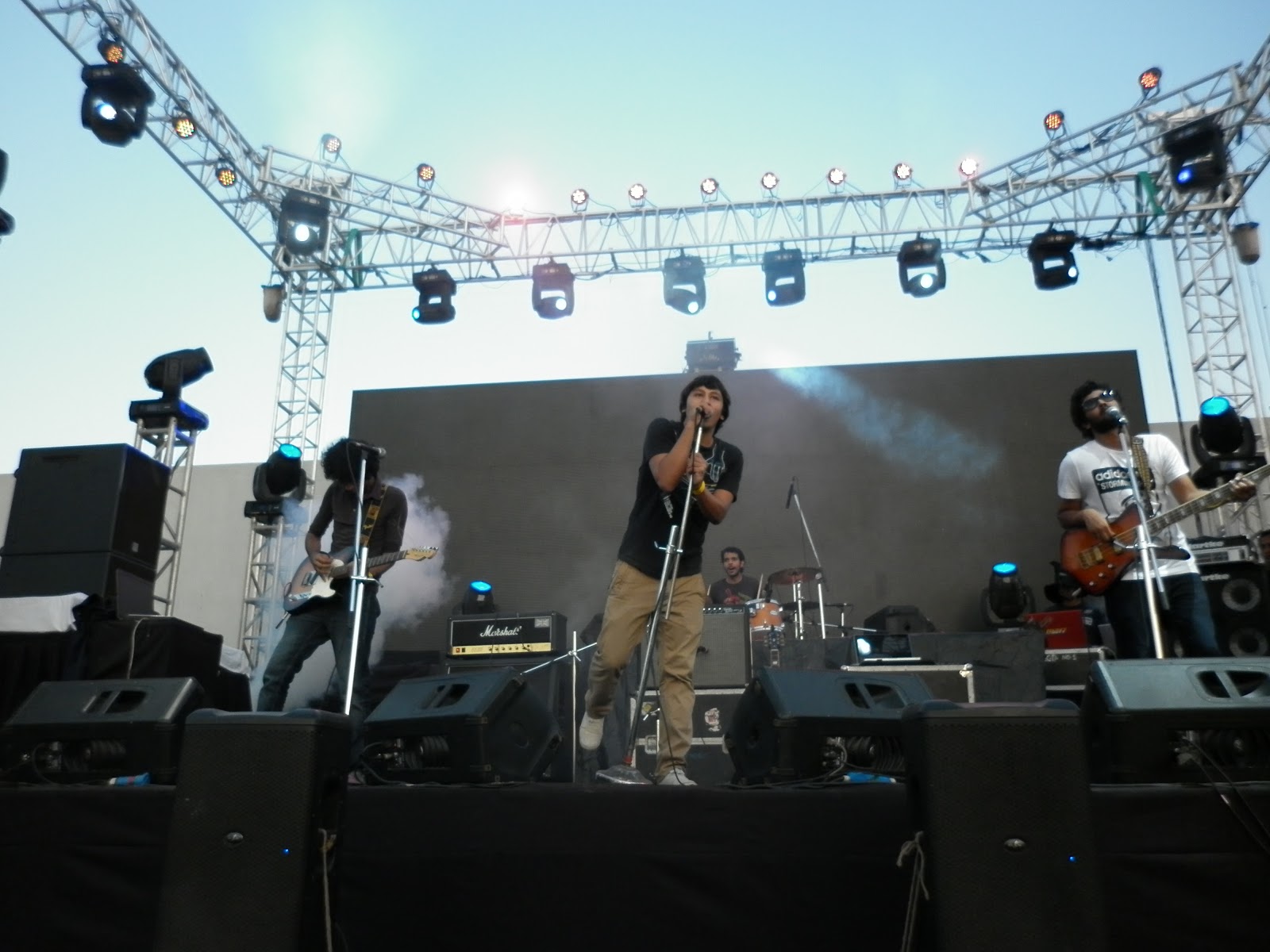
This is not an expert’s coverage of the NH7 Bacardi Weekender at Pune (from 18 to 20 Nov 11). That I am sure Arjun S Ravi would have done in NH7 and Indiecision and some of his coverage was live too. Nor are the photographs in the article even one tenth of the professional excellence, clarity and story-telling quality of Kunal Kakodkar’s. This is an ordinary music lover’s response at being amongst the music loving crowd during the music fest in Nov 11.NH7 Bacardi Weekender this year was simply great in its organisation, crowd response, and the gigs that participated. One can listen to the music and the songs on You Tube and one’s best hi-tech music system. But, there is nothing like the Live Experience. It is electric. It transports you into another world of excitement, love, ecstasy and happiness.

Papone and the East India Company at the Dewarist Stage

This year was probably the best assembly of gigs in an Indian music fest. There were five stages in all at the same Laxmi Lawns: The Dewarist, The Other Stage, Pepsi Dub Station, Eristoff Wolves Den, and Bacardi Black Rock Arena. The organisers need to be congratulated for having put up the stages, and the programme so meticulously. Arjun told me that most of it was done by his friend Dhruv and his team.

A view of the on-site admin office – Arjun and friends operated from here
Whilst the stages buzzed with music and crowd frenzy the organisers “quietly” (???) went ahead with their job

In addition to the music gigs, what makes an even like this special are organising and ensuring participation by the crowds; for example, the flea market selling anything from memorabilia to T shirts, hair dos, caps, hats, trinkets.

A happy visitor at the Flea (not free) market

Then there are food and drinks stalls and…hold your breath, a Tattoo Pavilion.

One of the many watering holes. The pictures collage at the rear wall is by Kunal Kakodkar and all the pics were lit at night

Even though the crowds were huge (when Imogen Heaps had the stage about 700 people had to be sent back due to no place available for the crowds to even stand), these were managed very well. At the parking lot, there was complete order. One of the newspapers brought out at the end of the fest that the policemen on duty had nothing to do since the crowds were so well behaved. They were in there to have a good time and they were genuine music afficiondos. Have a look at the total orderliness even at the entrance despite the ‘bouncers’ frisking everyone for drugs etc:

Entrance to the music fest

We enjoyed the music, the ambience, the young foot-tapping crowds with their lovely, colourful hair dos and head gear. To our surprise we found that Anna Hazare is the rage with the youngsters and Gandhi caps were the most preferred headgear:

An Anna Hazare Designer cap
This group of girls were always in these hats
A nice blue hair-do
Some more colours

As you entered the fest arena they gave you a Guide Book to the facilities there and a Pocket Guide. Both were very beautifully done and provided complete information about the stages, the programme, the artistes, flea markets, food stalls, watering holes etc. Here is Lyn holding one of these Guide Books:

A Gibson stall in the fest

Let me now give you a glimpse of  the Food stalls and the Tattoo shops in the Tattoo Republic

The armed forces bands play the Tattoo!
The atmosphere at the food-stalls

Before I go on to the music, the real reason for the fest, let me give you glimpses of riot of paints and colours:

Lyn trying to merge with the paintings.

As far as Music was concerned, there was so much to choose from. On the first day, Friday, the 18th Nov, there were three live stages: Eristoff Wolves Den, Pepsi Dub Station, and Eristoff Club Invasion. The gigs that played included Sky Rabbit (formerly Medusa), Midival Punditz, Ash Boy, Dualist Inquiry, Basement Jaxx, Jatin Puri, and DJ Swaggamuffin. Here is a pic of Sky Rabbit in action:

Sky Rabbit (formerly Medusa)

The second day was a delectable treat of music: On the Dewarists stage there were, amongst others Imogen Heap and Raghu Dixit. How did it go? Well, even though the crowds filled the lawns fully, they were not really on the grounds; most often than not they were airborne. Bacardi Black stage had, amongst others, Tough on Tobacco, Pentagram, and Blackstratblues. Eristoff Wolves Den stage had Reggae Rajahs.

The third day was sadly the last day. There were gigs like Scribe, King Creosote, Swarathma, Papon & the East India Company, Bhayanak Maut and Indian Ocean. In the end, another treat awaited the fans in the shape of Weekender All Stars on Bacardi Together stage.

See how neatly the organisers had worked out everything:

A Directions Map from the Guide Book


And an ‘Out of Toon’ Guide to the fest
And from these ‘before’ pictures, lets go to the pics of crowd frenzy, the vibrations, the rhythemic jumps, screams of joy and charged up atmosphere:

When the last of the gigs, Indian Ocean played there was not an inch of ground left to stand on. Well, no one was standing anyway. People were air borne most of the time. Lyn and I found a good vantage point to watch Indian Ocean live. Halfway through a girl tapped me from behind and said with becoming pleading, “Sir, you are tall you can watch from anywhere, can I come in front?” What would you have done? I did the same. She stood next to Lyn and watched and I felt like a boy scout having done my good deed for the day.

Lyn not allowing her place near the stage to be taken by anyone

There was a treat waiting for Lyn and I at the end of Indian Oceans performance. We could meet the versatile Rahul Ram of Indian Ocean and even take pics with him; all this courtesy Arjun:

Lyn and me with Rahul Ram of Indian Ocean

For Lyn and me another great and warm feeling was to be with Arjun; he lives music, breathes music. His friends say about him that other than music nothing registers in his mind.

Arjun looking satisfied with the response to NH7 Weekender and Lyn looking happy that Arjun is satisfied

The last item was the All Gigs Together and….like one often did with a long novel just before the ending, you didn’t want it to end.

The last item: Weekender All Stars – jampacked

On return, we were on the Expressway back to Mumbai and the only thought in our mind was: The real expressway (to heaven) was in Laxmi Lawns, Magarpatta City, Pune, from 18 to 20 Nov.

MOBILE ESHTYLE

Cellphones have become part of our life; so much so that an ad campaign shows the mobile phone craving for a man’s attention – through urgent ringtone – even when he, with his would be wife, are taking rounds of the nuptial fire (agni), or attending a funeral, or a class in a college or even in the library. Together with the cellphone have come various styles of attending to the calls or talking on the phone. I am listing out some that I have observed. You can add to it in the comments below.The queerest of them all is what I call the Jain wayof talking. This person has the hand in front of his mouth, covering his trap, half his face and extending it to the cellphone at his ear. He or she is convinced that if they don’t direct the sound energy from the mouth to the ear, the phone and hence the recipient won’t be able to catch it.

Then there is the man who feels every phone conversation is a public address. He walks up and down with his phone at the ear and is loudly discussing transactions with the third party. He is totally oblivious of the crowds around him; however, they can’t be so oblivious of him thanks to his irritable pacing and taking for granted that people around him would be totally interested how much he gets out of a truck full of old gunny bags.

I just love this style: the phone rings and the man or the woman looks around as if betrayed by the ring. He or she then picks up the phone furtively and goes to the corner of the room like a scared puppy and talks into it like a prompter in a play.

Pic courtesy: zyozy.org

Then there is the one more used to the olden day (early twentieth century) phones that had an earphone stuck to the ear and a microphone attached to a wire in front of the mouth. So, in memory of this style (at that time a necessity) he or she alternates the cellphone to the ear and the mouth. For example, he puts the phone directly in front of his mouth, mutters something, and then quickly takes it to his ear to catch what the other party has to say.

black-man-yelling-into-cell-phone

I am rather amused by this inimitable (for me) style: in this the person speaking on the phone sticks it between his shoulder, neck and ear and then goes about doing other important things such as skinning a radish or shelling peanuts with both his hands. Most often than not he has a lit beedi in his mouth that he puffs at without the use of his hands. And just when he is comfortable with doing all the three things, the other phone in his trouser pocket rings. I keep imagining this guy working in a circus or playing a number of instruments together like Vinod Khanna in the Hindi movie Amar, Akbar, Antony.

stock-photo-smiling-young-woman-cutting-vegetables-and-talking-on-cellphone-181403234

Then there is the one who can only be called ‘lambi race kaa ghoda’ (Long race horse). He knows that his conversation is not a matter of minutes but hours. He not only keeps putting the phone to alternate ears, but, even in the same ear he keeps shifting the angle to match with whether he wants to hear or talk or even to emphasize a point.

You have seen and heard of the person with ears plugged and a wire going to the trouser pocket or speaking through a bluetooth device. However, none of these are for the eternal lover. He walks past you as if talking to himself whilst in his pocket is the cellphone on speaker. He describes everything to his girlfriend including rain, guy almost falling off a bus and the lovely puppy eating the ice cream cone thrown away by the rich-kid. He is also in a perpetual trance and, if it is not for the kind hearted old woman, he’d walk straight into the open man-hole.

This man is rich, very rich. He is a Telugu from the rich East Godavari district. He has any number of latest models of cellphones. He has one on his left ear, another on his right and one in the hand on which he is playing Angry Bird. Next to him his three daughters, two sons, his wife etc all are doing the same on their phones. You don’t find it funny? Well, niether does the air hostess who had made a fervent announcement to switch off the cellphones before the take off.

pic courtesy: textually.org

Then we have this girl. The cover of her phone resembles a cassette or a pencil box or a giant eraser. You are amused that she can talk to such objects but she is carrying on a conversation as if it is perfectly normal for people to talk to an eraser.

We have the group cellphone. On this phone first the man talks and then throws it to a woman at the other end of the railway compartment and shouting to her, “Mata ji kaa hai, tumhaare baare mein poochh rahin hain.” (It is from your mother enquiring after you). Just when you pity the couple for not getting a seat together on the 6:30 PM fast from Churchgate to Viraar; she throws it to their son tring to edge himself closer to a man about to get down, with, “Vikaas, beta, mata ji ko pranaam kar le” (Vikaas my son, pay your respect to your grandmother). Before, Vikas can throw it to the rest of the family, you get down at Borivali after having endured long-distance telephony.

We also have this guy who takes his phone everywhere whilst talking, even to the toilet. It appears that next they will have a cellphone that dispenses toilet paper.

Pic courtesy: best-choice-tech.com

Then there is the man who feels it is totally the fault of the cellphone that life is treating him bad. Hence, he directs all his anger on the phone, screams, shouts, waves it angrily as if to throw it. For him the biggest crib in his life is the phone – his biggest enemy. People around him pity the makers of the cellphones. He could be used in the cellphone companies for carrying out endurance test of the phones.

I end with this guy who could have been a director in a movie. He builds the scene on his phone and includes you as the other actors (extras) in the movie. He gives you directions like “Shhh” and even asks you, “Sala samajhta kya hai apne aap ko?” (What does he think of himself?)

CRAZY SPECK SONNET

Ah, is it just a speck?
An insignificant fleck?
But, could it be so grotesque?
So as to be in a story Kafkaesque?
Or may be in theatre burlesque?
Lets just do a check:
Is it a mere stain on deck?
Or perhaps a smart Aleck?
A veritable pain-in-the-neck,
Who is not worth a peck?
What the heck, it could be a wreck,
Found whilst out on a trek.
So, from afar, when you see a speck,
Please just go closer and check.

MAN IN THE MIRROR

The court was assembled
Splendid and majestic
People looked down
Awaiting the arrival of the King
A bugle…hushed silence…pronouncement
And then he walked in
With the edge of his robe
Held by minions behind
He took his seat
At the throne.
This is what he said:
“Last week when
I went hunting
I came across a pond
In a recess in the forest
With clear and placid waters
I looked down
And saw it all
Truth, Beauty and Perfection.”

He looked down at them
Mere mortals
In the presence of the Monarch.
He laughed derisively
Enjoying his power over them
No one could deny
His having found
Truth, Beauty and Perfection.
As he laughed
He looked horrible
Uglier than the Evil.
A far cry from
Truth, Beauty and Perfection.
But the King won’t know this;
There wasn’t a pond in the palace
And the king won’t go hunting
Until next season
When the pond wouldn’t be placid
And the water would be muddy.

NO, NOT PALOMA BLANCA

I heard a flutter,
And there it was
On my window sill.
It looked small and frail
But with restless energy
And eyes alert and moving
Smelling danger and
Chance to peck.
What lovely combination
Of colours and shades, I thought
And freedom to move
With abandon.
You can keep people out
And even dogs and cats
But you can’t
Keep birds like that out.

I wanted to hold it,
Caress and
Feel the warmth of its belly
And be protective.
But, as I extended
My hand to do so
It flew and
Landed on the other window
I quickly moved there
And it flew
To the tree
And stared at me
Out of reach.
I envied the freedom it had
To fly the skies
And reach places I can’t.

I can’t, and it can
I was jealous of its colours,
Flight, independence
Anywhere, anytime
Even on the water
Over electric cables
Roof tops and ledges.
I, wanted nothing
But to be like it…
“Just a bird in the sky”.
“Rather be a sparrow than a snail.”
And then….. a gunshot
A violent and helpless flutter
And it fell like a ripe fruit from the tree.
Bruised and bleeding.
My fancy fluttered and died.

Why would anyone
Shoot down a bird
That brings as much joy
As a butterfly fleeting amongst flowers?
Will we ever
Make Darwinian Theory
Stand on its head?
Don’t caresses and whispers
Stand a chance
Against shouts and screams
And barks and roars?
Is Life an unequal race?
Can Beauty protect itself?
Does anyone know?
A Bird is what we want to be;
But, a bird is what we shoot…
Because….we can.

The radio played:
“I am a Paloma Blanca
I am just a bird in the sky
No one can take
My freedom away”
We pretend
But, we detest freedom
Of birds, animals, people
No one can fly
No one can soar
We have enough means
To shoot, kill, bring down
“Get in line,
Do this, do that
Follow…
Or else.”

JOURNEY OF A RAIN DROP

It arose from the sea,
As vapour,
Still not fully formed as a drop.
There was unbound excitement
At being born, created
A separate entity
Proud to be by itself
Rather than mixed in the salt of the sea.
As it took shape,
Amongst millions others,
It was conscious,
As do all of us
That it would be carried
By forces beyond its control
To far places and people
To lose its identity again when it’d fall.

“Where would fate take me?”
It mused as winds carried it landwards,
“Will I fall on a tree and hang
On to the leaves for dear life?”
“Or will I fall in a pot hole on the road
To be cursed by drivers and walkers alike?”
“Or worse, on a heap of rubbish,
Carrying stench in the air?”

“If I am lucky,
I may fall on the Ganesha idol
In a procession
But then, I shall be quickly
Back into where I was born and arose:
The vastness of the sea.
My friends and I may also fall in the milkman’s pot
And he’d rejoice for increased sale.”

“I have no choice
But, I don’t want to be part of a gutter.
God, I am small and feeble,
Be kind to me,
Let me be valued,
By myself and not
As part of the gang
Together called ‘rain’.”

The cloud that carried him,
Deposited him
On the cheek of a small child,
Naked and hungry,
On a street in Mumbai;
Where it mingled with a single tear
That shot from her eye
On the death of her mother in a bomb attack.

“God”, it said,
Let a hundred drops fall
To wash the sin of
What man has done to man.
But, they should never
Forget that single tear from her eye.
I don’t want to be born again
And again, and again, and again.”

INDIANS – BARTERING CHARACTER FOR PROSPERITY

Dr Abdul Kalam, the former President of India, when asked by a small girl if he had a solution for rampant corruption in the country, replied, “Start with yourself, go on to the family and extend it to the community.” A very pragmatic advice.I saw hope in this.

Afterall, even when we were a poorer country we had values that the world admired. By and large the Indian society was peaceful, honest, modest, godfaring, more spiritual than materialistic, and regarded pursuit of knowledge higher than making money by hook or by crook. Yes, they were aberrations too; but their number was small and the majority looked down upon these and took such people to task both in the media and in moral debates. No one ever identified with them.

When did the dumbing down of the Indian society start? Surprisingly, or actually not so surprisingly, the decline of our values commenced when we started coming out of what was derisively called ‘Hindu rate of Growth’. It is around the same time that I read an essay in India Today titled ‘Evil Fascinates’. It was about the growing fascination of Indians towards things which were the opposite of ‘Good’. At around the same time, if you care to recall, Khalnayak (Villain) became an object of aspiration. Nayak (Hero), with all his ‘Goodness’ became dull, uninteresting, banal.

The result? Our collective acceptance of things which once would have shocked us or would have, at least, annoyed us. The list ranges from the small things to bigger scams etc. Are these the effects of rapid industrialisation or were we always like this? Most Indian towns are now unliveable. Why? Are the authorities, politicians, bureuacrats, etc, to be blamed all the while for degeneration of our values? Ain’t we always fond of short-cuts, blaming the authorities for the eventual mess? Yes, the authorities have coined this convenient phrase “the sentiments of the people have to be respected” to overlook rampant lawlessness and indiscipline whilst pandering to “vote bank politics”. But, a large amount of blame has to stick to us too.

Let me give a few examples. We recently finished with what used to be called Deepavali and which should now be called ‘Bombavali‘. What fun could it have been for the kids in our colony (and everywhere else) to burst crackers (the sounds that would bring afresh the horror of Hiroshima and Nagasaki) at odd hours of night and day? At one time, I was about to shout at them from my tenth floor window with, “Don’t your parents teach you anything?” But then, I heard the excited voices of the parents’ asking them to light a “big one”.

Next day, I sighted a kid of 8 years with his mother in the elevator. Just out of curiosity I asked him how much he had spent on his crackers. He replied Five Thousand Rupees; and I was shocked to see that the mother didn’t have a resigned look on her face but one of pride as if anything less would be unacceptable for their status.

Now, I am not the die-hard socialist trying to make a point that this kind of money should have been spent on the poor etc (I have, indeed, nil comments for a 30 ml peg of Remy Martin Louis XIII Black Pearl costing all of Rupees 1.25 Lakhs at The Leela Palace at Chanakyapuri; you can go ahead have all the fun in the world and flaunt your money without blowing smoke in someone’s face). Far from it. All I am saying is that whilst such consumption may not be evil but it certainly is hedonistic with scant regard for other people’s right for a noiseless colony at late hours in the night; and that unlike what is prescribed by Dr Abdul Kalam, the parents don’t teach values to the children. Hence, the dumbing down of even the next generation is assured.

You go for a drive anywhere in India and people are trying to kill you. Sounds like an over-statement? Think again. Yesterday, I went to Nagothane. On the way I noticed that whenever my driver got a few feet out to the right to see if it was safe to overtake the next vehicle, our position on the road was immediately taken by the vehicle behind us. Now, if we had to find (which actually happened) that it was not safe to overtake, we had no place to return to, making it dangerous and life threatening for us. Most of the drivers doing such dangerous things on the road were the younger generation, even girls and women. Surely, somewhere along, the upbringing and education of such people has been lacking in something. The utter selfishness and scant regard for others are traits that have got ingrained in the majority of our people. Traffic sense is just one manifestation of it.

Littering wantonly is another manifestation of this trait. Let the authorities clean up; afterall we pay them to do so. I have seen parents shouting at their kids for holding on to the wrapper, skin of fruit, other trash in their hands and slanging them for not immediately getting rid of these by chucking these outside the windows.

We have had great fun in the Ramlila Ground in New delhi recently and on the city streets singing paeans for Anna Hazare and his team. I suspect that majority of the people don’t want anything to change. And, hence, they are very relieved when something, however little, is found against Team Anna so that they can heave a sigh of relief that all Indians are alike and no one has any holier-than-thou right to think differently. This is similar to some of the members of my team visiting a spic n span foreign country returning to India and exclaiming, “Thank God we are back; the kind of restrictions there (not to litter etc) were stifling. Home sweet home.”

Mayawati is a Dalit Chief Minister. Her emotional bonding with her people is due to respect for meekness and poverty. What did she do after the elections? Huge elephants put up all over the state. I enjoyed the first ever F1 Grand Prix in India. But I hated Mayawati handing over the winning cup to Sebastian Vettel. What was wrong with that? Only this that she should not hoodwink people about Dalits and Socialism and eradication of poverty etc.

Talking about F1, yes it was a great circuit. But, however hard we try we can’t get rid of perpetual dust and smog in our cities. It is black dust, noise, confusion, weird smells; and yet, we somehow make believe that we are progressing and that India is a power to reckon with. When countries abroad hold F1 and other such jamborees their civic life matches with the culture of the event. In our country, F1 Grand Prix would only be representative of the growing chasm between the haves and have-nots.

India and its people, I feel, have lost character whilst seeking prosperity. We are somehow convinced that the abundance of material goods has made our lives better: cell phones, cars, electronic gadgets, money. However, arguably, our lives are worse than what these used to be earlier. What are the litmus tests of these? Well, let me hear recent tales (since I have not experienced these myself) of people respecting goodness, honesty, other people’s privacy; rights of minority to have peace and silence during festivals; respecting people who observe traffic rules; respecting those who don’t pay bribes or don’t take short-cuts as matters of principle. In short ‘Live and Let Live’.

At the present juncture, I am sorry to say, we are doomed to be what we bemoaned at one time: ‘a rich country inhabited by the poor’; except that now, poor is defined as ‘poor in character‘.

Everyone of us has to bring in (and do so proudly) discipline in our individual and collective lives.

HAPPY DIWALI

She, a girl of five,
In tattered clothes,
And shattered hopes,
Tugged at her mother’s torn sari nervously.
Diwali; it was their big day..
For begging along Marine Drive.
Rich people who came here
To burst crackers, huge bombs and rockets
That burst and filled the sky
With myriad colours
Were always in good mood
To let the beggars have
A miniscule part of the money
That went up in flames and sounds.
Each bomb, rocket, cracker, flower-pot
Cost several times Montek’s Thirty Two Rupees,
That separated them from becoming rich.
Pic Courtesy: reuters
They had already collected
Seventy three rupees and fifty paise
And three empty whisky bottles
And two un-burst bombs
And two empty boxes of sweets
Empty for the rich but..
With remnants of sweets still sticking on edges
Enough for the girl and mother
To have a Happy Diwali feast.
Tonight was the night when
They could collect enough
For the next few days
Even after paying half to the beat-cop on duty.
In the din of crackers
And daze of sparklers
The little child and mother
Couldn’t help thanking
Lord Ram for having returned to Ayodhaya
Several centuries ago
And given them reason
To rejoice;
And sleep, after days
With stomachs nearly full
“Shubh Deepawali, maa” the child whispered.
“Shubh Deepawali, Lakshmi”, the mother responded,
“Let’s await Christmas, to have more….fun ”.

ART AND SCIENCE OF MOOD-SETTING

This is not an article; it is an advertisement for a new organisation that I am setting up. The organisation is called AIMS (Association of International Mood Setters). There is golden opportunity in it for any man or woman who likes the idea and joins the organisation and has the necessary potential and skills to become a Mood Setter (MS). The idea though is Copyright protectedand hence you are cautioned not to try it out on your own.Let me explain the concept of Mood Setting. Lets say one has an assignment. One plunges into the assignment without one’s mood being set appropriate to the assignment. One can otherwise be very well qualified for the assignment; however, the attitude makes a lot of difference. Attitude has got two components: a fixed component based on years of conditioning that a person goes through and a variable component depending upon the mood that a person is in. The pie chart below shows the share of mood (variable component) in the overall attitude of a person.

Copyright: AIMS


The following graph brings out the importance of the variable component, ie, the mood, towards the success of an assignment.

Copyright: AIMS

It can thus be made out that mood plays an important role in success of assignments. And yet, for reasons beyond comprehension, not enough studies have been done to promote Mood Setting. AIMS intends to fill up the gap.

To easily understand the concept, take the case of an assignment of modeling. Lets say a model has to do a shoot for an ad depicting a headache or toothache or a near relative having died so as to bring out the need for an analgesic or right toothpaste or an insurance policy. In 30 seconds of the advertisement the model has to go through emotions ranging from extreme pain or sorrow to sudden joy or relief. You will say that the entire thing depends upon the acting prowess of the model. Right? Wrong. Acting prowess is the fixed skill of an individual (refer to graphs above). If one is not in the right mood, the entire shoot can be a failure.

To explain it further, lets say the model’s boy friend has, that morning, accepted her persistent suggestion that she be taken out for dinner. She is on top of the world with feet hardly touching the ground. At this stage if she was to be asked to do an ad for air ballooning, she would perhaps be in the right mood. However, death of a relative or headache are far away from her buoyant mood. That’s where a qualified Mood Setter comes in handy. He or she has enormous experience at Mood Setting and proceeds, as an example, as per following flow diagram (in this case the depiction is to set the mood from buoyant to pained):

Copyright: AIMS

Lets take another scenario. And here I don’t mind telling you big bucks are there for the asking for the Mood Setter: A politician has to suddenly visit a flood affected area. This would involve looking sad at the plight of hundreds of countrymen who would have lost their houses, near and dear ones, livelihood, livestock etc. The politician would have never remotely come across this situation. So, even if he tries his best acting skills – which most of them do from the time of campaigning for elections onwards – he/she is unlikely to be in the appropriate mood for empathising with the victims of the flood. In today’s age of media ubiquitousness, such politicians are often caught on the camera smiling to the crowds that is seen by the victims as not being in sync with the gloomy mood of the situation. That’s where our Mood Setter comes in. Just ten minutes with the minister, in his plane, whilst on the way to flood-affected area, are sufficient to get the minister into the right mood. He is thus able to avoid the kind of faux pas that George Bush made when he said, “What the f__k is that?” not knowing that the microphone was on; or, of the Indian External Affairs Minister happily reading the wrong speech in the UN.

The business of Mood Setting has unlimited opportunities, at the higher levels, at the middle levels and day to day or routine levels. Let me give an example each of each level. At the higher level: lets say the Maharashtra government is toying with the idea of a new airport near Panvel (indeed they have been planning this for the last 20 years). Various surveys have been done, reports prepared, technical panels have discussed ad infinitum the feasibility, budgetary estimates made etc. So, why are we not going further than putting a board saying: Site for Airport? Once again, it would be a big mistake to think that there are such issues as environmental clearance that are keeping the coconut to be broken over launching the project. The actual reason is that the concerned people and authorities are not in the right frame of mind. In other words: not in the right mood. That is where my organisation can help. Our highly qualified mood setters, at nominal cost, can change the mood, say, within a week.

Take the middle level. Indian Cricket Team won the ODI World Cup and we were the best team in the world for Test Cricket. This means that we had the requisite skills to be the world champs. And yet, the hammering that we got in the recent tour to England made us look like nincompoops; playing cricket for the first time. What went wrong? Analysis done at AIMS shows that they were not in the right mood (they were, for example, in the IPL Mood whereas it requires a different mood altogether to play international cricket abroad). Mood Setting is really a specialised business. Our SMEs (Subject Matter Experts) have proven abilities to change the mood of any cricketing team. Team India could have very well won in England if they had consulted us.

Lastly, here is an example of a routine day-to-day level. You and family, lets say, have to visit another family whose son has topped the university in BA exam whereas your own son has failed miserably. They are celebrating and expect you to share their bubbly and happiness. Our MS will sit with you for precisely 15 mins and you would be in the right mood to visit your friend. What’s more is that since you won’t be moping or sulking, he is likely to stay your friend even after your visit.

Let me give one last example: your boss, for apparently no fault of yours, gave you a dressing down because of a fire or other botch-up in the premises. You feel it was uncalled for. In the evening he calls you home for dinner for the ring ceremony of his only daughter. If you continue being in the morning mood, eventually you can say goodbye to your job. Our trained Mood Setters, after they have finished with you, make it look like to you as if it is your daughter who has the ring ceremony. You don’t have a daughter? Well, don’t mind, you have no idea of the powers of professional mood setting.

Still not convinced to join my organisation? Well, do you know that you have come to the end of this article because I, a qualified Mood Setter, actually willed you to change your mood from murders, scams, arrests, corruption, Anna, Raja, Kalmadi, Amar Singh, Pakistan, Afghanistan etc. And I did it without charging any fees. Think of how your mood would change if you were to hire me or any of my qualified Mood Setters.

Please write your EOI (Expression Of Interest) in my organisation in the Comments below and I shall get back to you.

Mood Setting is the road to success, these days; the next best thing after Facebook and Twitter. Those who want to seek the help of AIMS in solving their inappropriate mood problems, please book on line on the AIMS portal. I shall send you a Mood Setter after we have completed the current assignments of Indian politicians, Bollywood actors, cricketers and jailed leaders.

EMERGING ORGANISATIONS, TRENDS AND ACRONYMS

When I was small, knowing the full forms/expansions of abbreviations and acronyms used to be one of the important things in GK, ie, General Knowledge. Many of us nearly failed when confronted with RSVP, UNESCO, FIFA, IOA, YMCA, WHO and the like.Over a period of time the expansions of some of these acronyms and abbreviations have changed. New meanings have emerged.

Also, over a period of time, a number of more such organisations and their acronyms are emerging. Some of these may appear to be deceptively similar to the existing ones but look again and you will see why these are different and urgently required.

  • TSJLT        –  Traffic School for Jumping Lanes Tactics.
  • IDYTO       –   Institute for Doing Your Thing in the Open.
  • YMTA        –   Young Men Terror Association.
  • YWTA        –   Young Women Terror Association.
  • CII              –   Centre for Idling with Impunity.
  • MP             –   Moneyed Person.
  • MLA          –   My Livelihood Assured.
  • NETA         –   Never Easy To Arrest.
  • IACS          –   Indian Association of Compulsive Spitters.
  • HHU          –   Horny Honkers Union.
  • PTBE         –   Passing The Buck Experts.
  • BCCI         –   Bored Cricket Cribbers of India.
  • AIPRV       –   Association for Identification of Potential Rape Victims (New Delhi Based)
  • SFTPE       –   School for Foreign Travel at Public Expense.
  • ORBS        –   Organisation for Receiving Bribes Safely.
  • ADARSH  –   Army Doesn’t Avert Re-appropriating Surplus Housing.
  • CMNPG    –   Centre for Making Noise to Please Gods.
  • SSSMS      –   Strikes Strikes Strikes and More Strikes.
  • EWT          –   Encroachment Without Tears.
  • USWETs    –   Useful Stripping With Eyes Techniques.
  • EJF            –   Elite Jail Friends.
  • ECM          –   Elite Cell Mates.
  • MICA        –   Member of Indian Cribbers Association.
  • POOR        –   People sans Office Or Residence.
  • PM            –    Paralysed Man. (If totally paralysed and requiring a chair then: Chairman).

These are typically Indian acronyms. However, should you want to adapt some of these to your own national conditions you have the author’s permission to do so.

INDIA – TOO MANY PEOPLE

Of course India is a young nation with average age of Indians being just 29 years. Paeans have been written and sung about how the young work-force is an asset for the nation. However, anywhere you go, you can’t get over the fact that there are too many of us.The other day an English friend of mine who is working in Dubai remarked about the driving habits of Indians there. He said whilst driving they come so close to one another in a lane that it is stifling. I explained to him that this habit comes from the fear that if they leave sufficient space between the vehicles, another car would come and fill the gap and they would lose the position. This frequently happens in Mumbai traffic. Vehicles jockey for every inch of space. You can frequently find yourself dangerously placed with huge trucks and buses all around you. Let alone driving space, there is scarce breathing space.

It is the same with forming queues of people. In an intense anxiety not to lose our position we, Indians, don’t leave any gaps between people. We touch, shove, kick, push, pull. Lets say someone has to cross the queue; no one is willing to move back to let the person cross, fearful that if one does one would find oneself pushed behind at best or out at worst.

A usually ‘quiet’ street scene in India (Pic courtesy: My Blog Maze)

There is no privacy anywhere even momentarily. If ever you go on the beach or picnic in the woods, try finding an isolated place. By the time you finish spreading the mat and open your hamper there are people all around you with their kids kicking the football or the sand right into your face.

There is a 1950 song sung by Talat Mahmood with lyrics by Majrooh Sultanpuri: “Ai dil mujhe aisi jagah le chal jahan koi na ho” (O’ heart, take me to such a place where there is no one). Well, it might have been possible in India of 1950. It is not possible now six decades later. Indians, the rich ones at least, are buying islands abroad to escape the ubiquitous flow of humanity that we have here.

Jobs are scarce; parking space is well nigh impossible; getting a berth in a train is an ordeal; driving is a nightmare; we make more filth and noise than any country in the world. It makes you think whether in some way or the other having a large population is of some use to us. I have put on my thinking cap and come up with the following advantages:

  • We cannot be ignored. We are one sixth of humanity. Soon we shall move up. A time will come when we shall be one fourth, one third, and finally half the humanity.
  • Foreign firms are keen to introduce their products in India assured of large patronage.
  • Our points of view matter for the sheer force of numbers behind these; eg, we now dictate terms to ICC.
  • In case there is a tug of war between populations of nations we will certainly win.
  • Rent-a-crowd for political rallies is never a problem. This keeps the morale of the politicians high.
  • We are able to send large contingents to UN, foreign visits, olympics etc. These win us large amounts of respect especially when and if we win a medal.
  • Potentially we have large work force to repair and build roads, become teachers in our schools, join armed forces to defend the nation and devote their lives to infrastructural projects. It may not be happening now, but, perhaps a time will come when people would actually take such initiatives.
  • In case of any adverse fallouts of global economy we are protected as most of our products and services are meant for domestic consumption.
  • Someone someday is bound to generate energy from the litter, noise, defecation, spitting and urinating that we adorn our public places with.
  • Nothing that we make is ever a failure since we are assured of people buying it, seeing it, visiting it or hiring it. This gives impetus to any enterpreneur initiative.
  • Gods are happy with so many people worshipping them. Hence, not just Kerala,we can call the whole nation as Gods Own Country.
  • No one in our country need to ever feel lonely.
  • The census guys are always kept busy; no sooner have they finished counting us when we add another few crores to the number. India discovered Zero because we were soon to add many of these zeroes to our population.
  • Our movies and music are instantly more popular than any other movies and music in the world.

Well, as a first list, I think it would suffice. I have asked my hundred cousins, fifty brothers and sisters and a thousand larger family members to help me prepare the second list. Perhaps, even the readers can help.

Follow

Get every new post delivered to your Inbox

Join other followers:

error

Enjoy this blog? Please spread the word :)

RSS
Follow by Email
YouTube
YouTube
Set Youtube Channel ID
LinkedIn
Share
WhatsApp
Copy link
URL has been copied successfully!