Punjab, particularly the area around Ludhiana, has given us unforgettable Hindi films personalities like Mohammad Rafi, Sahir Ludhianvi, Jaidev, Sunil Dutt, Khaiyyam, Vicky Kaushal, Ajay Devgn, Akshay Kumar, Rajesh Khanna, Ayushmann Khurrana, Diljit Dosanjh, Johars and Chopras. Among all these, Dharmendra arguably commanded more popularity than anyone. For example, among his 300 films or so, he had more hit and superhit movies than any other. With all this, he was never the recipient of a Filmfare Award for acting. He was like my hero, Mohammad Rafi, in this respect who never coveted awards and honours. In 1997 he finally became the recipient of Filmfare Lifetime Achievement Award, at the age of 61 years (He was born on 08 Dec 1935 in Nasrali village in Ludhiana). In the year 2012, he was conferred with the third highest civilian award, the Padma Bhushan, by the government of India.
There is a popular anecdote about him that whilst seeing one of Meena Kumari movies in a cinema in Phagwara, Punjab, he boasted to his friends that one day he would act opposite her. It wasn’t easy. He had to struggle when he reached Bombay and at one time, he actually gave up, not getting any break. Co-star Manoj Kumar motivated him to continue his struggle. In 1960, at the age of 24 years, he finally made his debut in Arjun Hingorani’s Dil Bhi Tera Hum Bhi Tere opposite Kumkum. The movie was a flop. In 1961, he tasted success with Shola Aur Shabnam opposite Tarla Mehta. I sang two songs of his from this movie.
Song #1
Jaane kya dhoondati rehti hain yeh aankhen mujh mein
In his later day interviews, Dharmendra talked about this song from Ramesh Saigal’s Shola Aur Shabnam as his #1 favourite song of Mohammad Rafi.
Kaifi Azmi’s lyrics are powerful. Khaiyyam composed it in his favourite Raag Pahadi.
One associates Dharmendra with his bubbly, carefree and cavalier image. However, his serious acting and reserved should won him many accolades.
Song #2
Jeet hi lenge baazi hum tum
Dharemendra paid rich tribute to Mohammad Rafi and said in an interview that Rafi sahib helped him become popular.
This duet of Mohammad Rafi singing for Dharmendra and Lata Mangeshkar singing for Tarla Mehta (she joins in the second stanza after she realises that the person singing this song must be her childhood sweetheart) was also penned by Kaifi Azmi. It was composed by Khaiyyam in Raag Bhairavi:
His Boast About Meena Kumari
She was two years older. In 1965, he finally got an opportunity to act with her in Ram Maheshwari’s Kaajal. She won her last Filmfare Award with this role that was opposite Raaj Kumar (she had won the inaugural Filmfare Best Actress Award in 1954 for Baiju Bawra). However, the best of her songs in the movie (Tora man darpan kehlaye and Chhu lene do naazuk hontho ko) were not with him (He was married to Padmini in the movie.
His dream of acting opposite Meena Kumari came true in 1966 superhit movie (the top movie of that year) Phool Aur Patthar. There was no song to remember them by.
Song #3
Tumhen dekha hai maine gulsitan mein
His boast about Meena Kumari, as seen by me in a song, came true in 1967 movie Chandan Ka Palna. The song was created for him by Anand Bakshi, RD Burman, and Mohammad Rafi. Their histrionics are worth seeing on a honeymoon night:
J Om Prakash’s Aaye Din Bhara Ke was a major success for Dharmendra opposite Asha Parekh. Its best and most popular song for him by Rafi saheb was Mere dushman tu meri dosti ko tarse, which Dharmendra sings for Asha Parekh in a party after a misunderstanding. I don’t sing such negative songs for Lyn.
Song #4
Aya sawan jhoom ke
The kind of songs that I sing for Lyn are, for example, this from 1969 J Om Prakash movie Aya Sawan Jhoom Ke, also starring Dharmendra and Asha Parekh. The song was put together by Anand Bakshi, Laxmikant Pyarelal, Mohammad Rafi, and Lata Mangeshkar:
Song #5
Majhi chal, O majhi chal
Indeed, I sang a second song from the same movie since it is a positive, motivational song. I also liked the picturisation of it:
Dharmendra and Sharmila Tagore movies
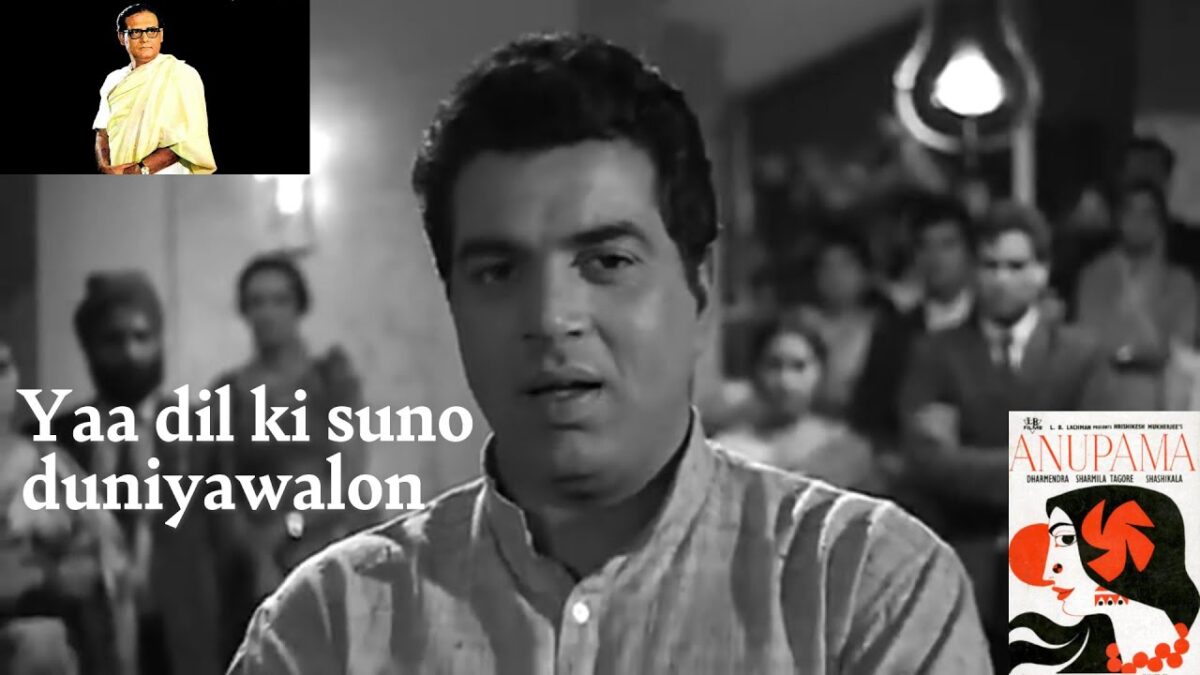
She is nine years younger to Dharmendra. The first movie that they did together was the 1966 Hrishikesh Mukherjee movie Anupama, the recipient of National Film Award for Best Feature Film in 1966. Both of them played their roles with great sensitivity. Sharmila Tagore played the title role of a girl whose mother was lost during her birth and hence her father dislikes her. She grows into a recluse. Later, she falls in love with Dharmendra, a writer and teacher.
Song #6
Yaa dil ki suno duniyawalon
The father, Tarun Bose hates everything associated with his daughter Sharmila and hence dislikes Dharmendra, too.
This song, sung by Hemant Kumar on the lyrics of Kaifi Azmi and composition of Hemant Kumar in Raag Pilu brought out the kind of restrained and serious acting that Dharmendra was capable of.
Indeed, in later years, Hrishikesh Mukherjee claimed that the pairing of Dharmendra with Sharmila Kumar was the best in Hindi movies. They did 10 movies together. The best was their 1969 movie Satyakaam, the winner of National Award for Best Feature Film that year. It also had the most accomplished performance by Dharmendra.
Song #7
Naa jaa kahin ab naa jaa
Dharmendra and Sharmila Tagore’s 1968 movie Mere Hamdam Mere Dost became a superhit movie and had superhit songs penned by Majrooh Sultanpuri and composed by Laxmikant Pyarelal.
I sang two of these sung by Mohammad Rafi for Dharmendra.
Here is the first one in very high pitch:
Song #8
Hui shaam unka khyaal aa gaya
This is the second song from the 1968 Dharmendra and Sharmila Tagore movie Mere Hamdam Mere Dost that I sang. Because of a misunderstanding between them, the two fall apart in the story of the movie and he goes to Mumbai to be as far away from her as possible. However, he soon realises that he cannot get her out of his mind and after getting himself drunk he sings this. Manohri’s saxophone is the highlight of this song:
Song #9
Gar tum bhula na doge
Yes, Sharmila Tagore is nine years younger to Dharmendra. They have the same birth date, ie, 08 December; as if even God had wanted them to be together.
The movies that they did together are Anupama (1966), Devar (1966), Mere Hamdam Mere Dost (1968), Satyakam (1969), Yakeen (1969), Chupke Chupke (1975), Ek Mahal Ho Sapno Ka (1975), Sunny (1984), Chaitali, and Devdas (Gulzar’s).
This song from their 1969 movie Yakeen shows him, yet again, sure of himself. If he had set his eyes on her (with the title song of the movie: Yakeen karlo mujhe mohabbat hai tumse tumse), he must have her for life.
It is a Hasrat Jaipuri, Shankar Jaikishan, Mohammad Rafi song:
Dharmendra’s Madan Mohan Songs
Side by side as his bubbly image was also his sensitive portrayal of roles. Naturally, the composer of choice for songs of such movies was Madan Mohan. The first of such movies for Dharmendra was the 1962 movie Anpadh. This movie didn’t have a song lip-synced by Dharmendra, but the songs featuring Mala Sinha were counted among the best of Madan Mohan, eg, Aapki nazaron ne samajha, and Hai isi mein pyaar ki aabru. Chetan Anand 1964 movie, Haqeeqat, made on the 1962 Indo China War was, hence, the first movie in which Dharmendra gained popularity through Madan Mohan’s songs. The song that really made Dharmendra famous was Kar chale hum fida jaan o tan saathiyo.
Song #10
Main nigahen tere chehre se hatayun kaise?
In the same year, 1964, Dharmendra lip-synced two of the best songs of Rafi saheb for the Mohan Kumar movie Aap Ki Parchhaiyan starring the doe-eyed Supriya Pathak. The first one is a favourite of mine with the above title. The lyrics were penned by Raja Mehdi Ali Khan. Madan Mohan composed it in Raag Darbari Kanada. Indeed, he composed a similar Lata Mangeshkar song, too, of the same movie in the same raag: Agar mujhse muhabbat hai mujhe sab apne gham de do.
Here, then is Main nigaahen…
Song #11
Yahi hai tamanna tere ghar ke saamne
The second song of the same movie that I sang was the song in which Dharmendra was wooing Supriya in his signature style:
Song #12
Aakhri geet mohabbat ka suna loon to chalun
The 1965 movie Neela Aakash had, once again, his heroine of Anpadh acting opposite him. Raja Mehdi Ali Khan and Madan Mohan created for Rafi saheb singing for Dharmendra an unforgettable song that saw Dharmendra coming up with remarkably serious acting.
Have a look at the song:
Song #13
Ik haseen shaam ko dil mera kho gaya
Four years ago, this was the first Dharmendra song that I sang. It is from the 1967 DD Kashyap movie Dulhan Ek Raat Ki. Nutan was his heroine.
This, too, was penned by Raja Mehdi Ali Khan and composed by Madan Mohan:
Dharmendra’s Only Movie with Sadhana
The 1970 Ramesh Saigal movie Ishq Par Zor Nahin was the only movie that Dharmendra did with Sadhana. He was the only hero of olden days who could withstand the onslaught of the superstar Rajesh Khanna who, too, joined the movies after an All India Talent Competition in which he won the first position. Earlier, Dharmendra had won the second position in a similar contest (the first one was Suresh Puri who hardly made it big).
Song #14
Mehbooba teri tasveer kis tarah main banayun?
Anyway, this movie with Sadhana was a flop. However, everyone loved this song that Dharmendra lip-synced. It was penned by Anand Bakshi and composed by SD Burman:
Handsome and He-Man Image
Dharmendra was widely regarded as the handsomest man in the Hindi films. Indeed, whilst giving him the Filmfare Lifetime Achievement Award in the year 2012, Dilip Kumar rued that stars like him were jealous that Dharmendra was so handsome. He didn’t have to woo his heroines by falling head over heels. They were the ones who would do it.
Song #15
Aaj mausam bada beimaan hai
Have a look at this song from the 1973 A Bhim Singh superhit movie Loafer. The movie was a superhit primarily because of the carefree, he-man acting of Dharam paaji. Mumtaz was sent by the villains to get him to a secluded spot so that they could then kill him. Dharmendra was unruffled, at his coolest and handsomest. In the song when he sings that the mausam is beimaan (rogue), she playfully points that not the mausam (weather), but he was beimaan!
The song was put together for him by Anand Bakshi, Kaxmikant Pyarelal, and Mohammad Rafi. It is one of my favourites. You can watch it by clicking on ‘Watch on YouTube’:
Song #16
Kaliyon ne ghunghat khole
The 1966 CL Rawal movie Dil Ne Phir Yaad Kiya had a love triangle between Dharmendra, Nutan, and Rehman (a handsome man in his own right). There is this famous song that all three sing in a boat rowed by Dharmendra: Rafi saheb singing for him, Lata Mangeshkar singing for Nutan, and Mukesh singing for Rehman; the title song of the movie.
However, the song that I love is a honeymoon song between the handsome Dharmendra and a little shy Nutan. You can make out as to why she would be in love with him.
The song was penned by GL Rawal, composed by Sonik-Omi and sung for Dharmendra by Rafi saheb:
Wooing Actresses from the South
Wooing actresses from the South was and is a typical Punjabi fascination. Take Raj Kapoor, for example. He was a hard-core Punjabi born in Peshawar (now in Pakistan). He was romantically involved with Padmini and did movies with Vyjayanthimala (who finally married another Punjabi, Dr Bali) and Hema Malini. In his own production, Sangam, he chose Vyjaynthimala.
Dharmendra enacted Kaajal with Padmini, wooed Vyjayanthimala in movies, and finally acted with and married Hema Malini even though he was already married to Prakash Kaur at the age of 19 years. It is rumoured that he, on paper at least, converted to Islam so as to marry Hema Malini whilst still married to Prakash Kaur.
Indeed, from the time he acted with Hema Malini in their first movie together, the 1970 movie Tum Haseen Main Jawan, he was drawn to her despite being a married man. They finally married on 02 May 1980 after ten years of love affair. They acted in 33 movies together until their last one in 2011 Tell Me O Khuda, which was directed by Hema Malini.
Their most popular song together is: Main jat yamla pagla deewana, an Anand Bakshi, Laxmikant Pyarelal song from their 1975 movie Pratiggya. Sadly, I haven’t sung any of his songs for her.
Song #17
Main kabhi kavi na ban jayun tere pyaar main
However, I have sung two of his songs for another South Indian actress Vyjayanthimala. The first one is a favourite of mine.
It is from the 1968 movie Pyaar Hi Pyaar. It was penned by Hasrat Jaipuri and composed by Shankar Jaikishan and sung by Mohammad Rafi:
Song #18
Dekha hai teri aankhon mein pyaar hi pyaar
This is the title song of the 1968 movie Pyaar Hi Pyaar and also penned by Hasrat Jaipuri, composed by Shankar Jaikishan, and sung by Mohammad Rafi.
Proud Poor Man/Middle Class Image
Dharmendra did many such movies wherein he represented an honest, poor or middle class man. He won many a heart through this portrayal especially when he exposed the wrong-doings of the rich or the super rich.
For example, in the 1968 T Prakash Rao movie Izzat (Dharmendra had a dual role in this wherein he wooed both Jayalalitha and Tanuja together. The song in the movie in which he made fun of the rich was: Kya miliye aise logon se jinki firat chhupi rahe, nakli chehra saamne aaye asli surat chhupi rahe.
Song #19
Mujhe dard-e-dil ka pata na tha
A similar situation is there in the 1965 Phani Majumdar movie Akashdeep. He works as an ordinary labourer in the mill run by Ashok Kumar whose sister Nanda falls in love with him because of his ideals. However, the same ideals keep him from accepting her love when he learns of her reality.
This song was put together by Majrooh Sultanpuri, Chitragupt, and Mohammad Rafi wherein he bemoans that he ever fell in love with a rich man’s sister:
Dharmendra’s End
Like a typical Punjabi, Dharmendra was passionate about everything that he did. Sadly, this included hitting the bottle hard. One of the rumours said that he could drink up to 12 bottles in a day.
From the turn of the century, all this had a telling effect on his health. In the year 2001 he developed serious back problems and went through prolonged hospitalisation. His loneliness resulted into his writing poetry. Probably, the inspiration to fine tune his poetry came from Meena Kumari who, too, heavily drank and wrote poetry.
In the year 2010, having become aware of the fact that drinking would eventually kill him, he left drinking altogether. However, he continued his poetry. Rather than writing, he used to video record his poetry and share it with his friends.
Here is a poignant example:
Recently, on 31 Oct 25 he was hospitalised in Breach Candy Hospital due to respiratory problems. However, he was discharged within a few hours.
Within ten days, he was again admitted with respiratory problems. The very next day, many of the news channels and media declared him dead so as to be among the first to give out the authentic news. Knowing him, he would have probably told death, “Kutte, main tera khoon pi jayunga.” It appeared to us that death had run away scared.
However, the end finally came on Monday, 24 Nov 25.
It was very sad to see him go. His acting and life represented two ends of the spectrum: a comic, lively, bubbly, disdainful romantic at one end, and serious, intense, sensitive actor on the other end.
Most actors had buckled under when Rajesh Khanna swept the audiences away. However, Dharmendra kept coming up with one superhit movie or the other even at the height of Rajesh Khanna era.
Song #20
Yeh dosti hum nahin
One of his most successful movies was the 1975 Ramesh Sippy blockbuster Sholay. His acting was almost totally comic even in the face of danger and death.
This song of the movie describes his essence as a loyal friend, a typical Punjabi trait.
I used this song to pay homage to another friend Jaswant Lagwal as passionate in everything and very heavy drinker.
The song was penned by Anand Bakshi, composed by RD Burman, and sung by Kishore Kumar for Dharmendra and Manna Dey for Amitabh Bachchan:
Dharmendra ruled our hearts for decades since 1960 movie Dil Bhi Tera Hum Bhi Tera until the 2024 movie Teri Baaton Mein Aisa Uljha Jiya wherein he did a small role as Jai Singh Agnihotri.
His last recorded song is reported to be from his own 1999 production Dillagi starring his son Sunny and Urmila Mantodkar and of course, Dharmendra.
However, the song that aptly describes the way he lived is from the 1972 movie Lalkar, put together by Indeevar, Kalyanji Anandji, and Mohammad Rafi: